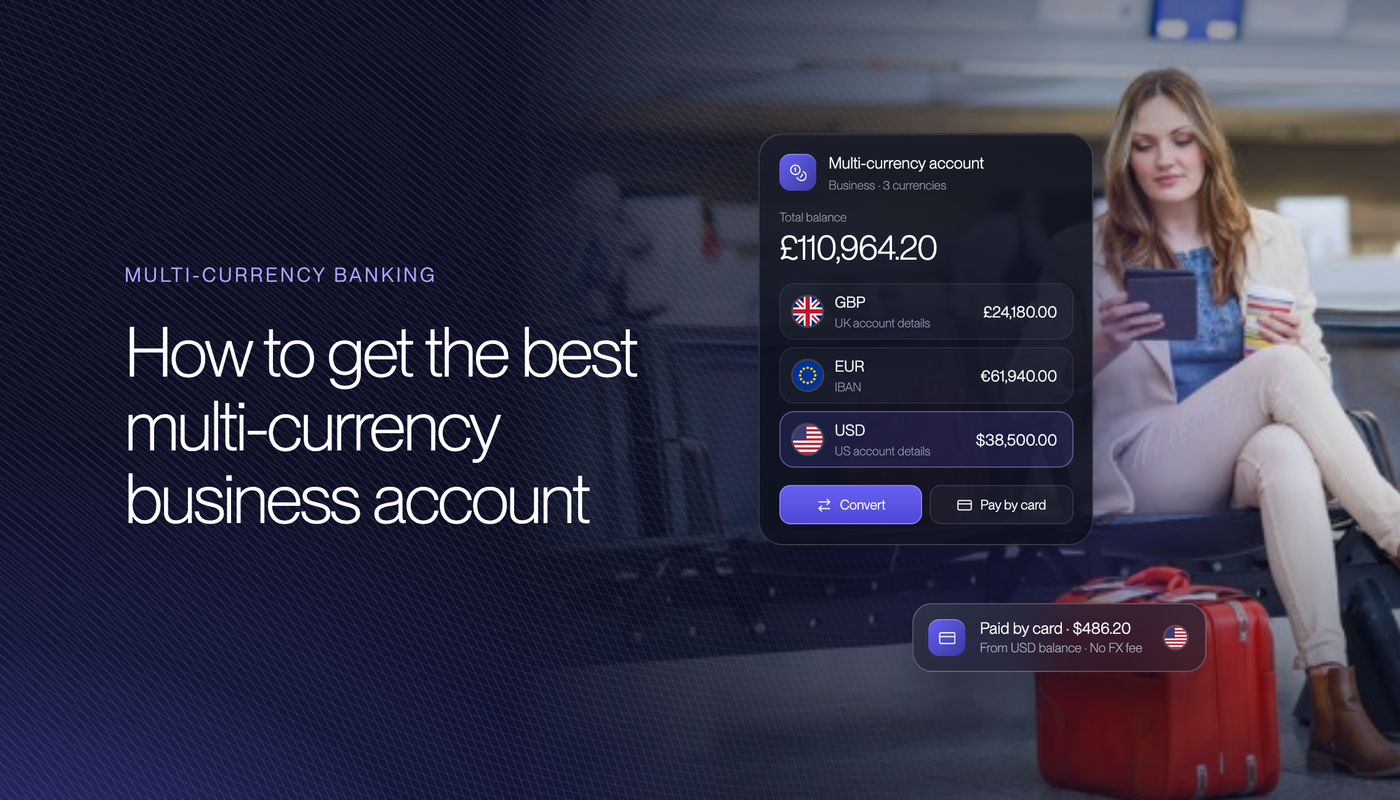
A multi-currency business account lets your company hold euros, pounds, US dollars and other currencies in one place. Clients abroad pay you in their own currency, you pay suppliers in theirs, and you convert only when the rate suits you.
The hard part is the bank route. High street banks sell currency accounts as add-ons: one account per currency, each with its own fee, and only after you hold their main account, which often means local tax residency. Conversion margins reach 2% to 2.6% on everyday amounts.
This is where we come in. Our regulated partners hold several currencies in one account and open it in days to about a week, remotely, with no minimum balance. We handle the slow part for you: the KYC file, the company documents, the source of funds and every question in review. You tell us how you get paid, and we get it done.
Our top-rated, licensed banking providers open multi-currency accounts for companies in days to about a week, fully online, with no branch visit and no minimum balance.

Moneygate
Business Banking
Monthly fee
€30
Onboarding fee
€500
Time to onboard
2-3 days
Features
Dedicated IBAN, SEPA, FX and more

Trumia
Business account
Monthly fees
€50
Onboarding fees
€500
Time to onboard
1 week
Accepts
Gambling, Betting, Casino, Crypto, and more
What Is a Multi-Currency Business Account
A multi-currency business account is one account that holds several currencies side by side. You receive, keep and pay out euros, pounds, US dollars and more without turning each payment into your home currency first. You convert only when you choose, at a rate you see before you confirm.
How Balances Work in Each Currency
Each currency sits in its own balance inside the same account. A payment in US dollars lands in the dollar balance and stays in dollars. A supplier invoice in euros is paid from the euro balance. Nothing is converted unless you ask for it. Money earned in a currency can be spent in that currency, so the same funds are not converted twice. A company that sells in dollars and buys in dollars can run that side of the business with no currency cost at all.
Account Details for a Multi-Currency Account for Business
A multi-currency account for business gives you account details your clients can pay into, usually an IBAN for euro payments and SWIFT details for other currencies. Some accounts also give local details in more than one country, so a client can pay you as if you were a local business. If you need a separate IBAN for each client or each country, read our guide to virtual IBAN accounts for businesses. Since 9 October 2025, euro area payment providers must check the payee's name against the IBAN before a euro payment goes out, so the account name must match your company name exactly.
Open a Multi-Currency Business Account
You can open a multi-currency business account for your company without a branch visit or a local address. This is what we do for you.
- One account, several currencies: EUR, GBP and USD at one partner, 17 or more at the other.
- KYC file built with you: We tell you what is needed and prepare it before review.
- Dedicated IBAN: An IBAN in your company's own name for euro payments.
- Opened in days: 2 to 3 business days at one partner, about a week at the other.
- No minimum balance: Nothing locked up on published plans.
- Payment rails included: SEPA, SEPA Instant and SWIFT from the first day.
Converting Between Currencies
When you do convert, the provider uses its own exchange rate, and the gap between that rate and the market rate is its margin. With several currencies in one account, you can hold the money and wait, convert part of it, or convert in one larger payment rather than ten small ones. That choice is where most of the savings come from. A bank account in one currency converts every foreign payment the moment it arrives, at the rate on that day, with no choice.
Read more: what an EMI account is and business bank account vs EMI account.
Multi-Currency Business Account Features That Matter
The multi-currency business account features that matter most are the currencies you can hold and pay out, the account details you get, the FX margin, the payment fees and how your money is protected. The monthly fee matters far less. A cheap account with a 2% margin costs more than a paid plan with a low one.
Currencies You Can Hold and Pay Out
Check two lists: the currencies you can hold and the currencies you can pay out. They are often different. AIB's guide to its currency accounts lists US dollars, sterling, Canadian dollars and Australian dollars as readily available, with others on request. Barclays offers currency accounts in more than 20 currencies traded in London. One of our partners holds and converts 17 or more currencies and pays out in more than 40. The other offers EUR, GBP and USD accounts under a dedicated IBAN. If your suppliers sit in Asia or the Gulf, make sure their currencies are on the payout list before you open.
Local Account Details vs One IBAN
One IBAN is enough for most companies that trade in euros. Under Article 9 of the SEPA Regulation, a payer or payee in the EU may not refuse your account because the IBAN comes from another member state. Local details in other countries help when your clients pay by domestic transfer, for example in the UK. Ask which details come with the account, not only how many currencies it holds. Our guide to an EU multi-currency business account covers the euro side in more depth.
FX Margin on Every Conversion
The FX margin is the largest cost on most accounts, and banks rarely show it on the statement. Lloyds Bank publishes a standard margin of 2.60% on international payments up to £25,000. Barclays' international tariff, correct as at March 2026, caps its conversion charge at 2% for business customers. Bank of Ireland's Global Markets tariff allows a spread of up to 4% on sterling and dollar transactions up to €10,000, with up to 2.5% on each side. Chase's own business fee schedule warns that its foreign exchange rates will be less favorable than rates quoted online or in publications. Our partners show the rate and the margin before you confirm. One of them publishes a conversion margin of 0.8% to 1% over the interbank rate.
Payment Rails and Fees
A good account sends money on the cheapest rail for each currency: SEPA for euros, local transfers for sterling and SWIFT for the rest. The fee gap is large. At Barclays, a SEPA payment made online costs £0.35 and a SWIFT payment costs £15. HSBC UK charges 24p for SEPA and £17 for an international payment by internet banking. Incoming payments are often charged too: £6 at HSBC UK and Barclays and £7 at Lloyds and NatWest on payments over £100. At one of our partners, SEPA costs 0.20% each way, or €1 plus 0.10% on the other plan, and international payments cost €25 plus 0.10% to 0.15% in or out. That is more than a bank charges for one small SWIFT payment, so check your payment pattern as well as your conversions.
Safeguarding vs Deposit Protection
Banks are covered by deposit protection. In the UK, the FSCS limit rose to £120,000 per eligible person, per bank, on 1 December 2025. In the EU it is €100,000 per depositor per bank, and in the US the FDIC covers $250,000. Our partners are electronic money institutions licensed in the EU, one authorised by the Central Bank of Cyprus and the other by the Malta Financial Services Authority. They are not banks. They do not lend your money out. They must safeguard it by law, which means keeping client funds segregated from the firm's own money or covering them with insurance or a comparable guarantee. One of our partners holds client money in segregated accounts at European banks. Safeguarded money is not covered by a deposit guarantee scheme, and e-money issuers may not pay interest on balances. Read more about deposit guarantee schemes for business accounts.
Read more: what a safeguarding account is.
Multi-Currency Business Bank Accounts at High Street Banks
Banks do offer a multi-currency business bank account of sorts, but it is usually a set of separate currency accounts. Each one carries its own fee and its own transaction charges, and you open it only after the bank has accepted you for its main account. The table shows what each bank publishes in its own tariff.
Bank | What it offers | Who it takes | Fees |
|---|---|---|---|
HSBC UK | Current and savings accounts in US dollars, euros and most freely tradable currencies, one account per currency | UK tax-resident businesses banking with HSBC UK | £96 to £180 a year per currency account; £17 per international payment online |
Barclays | Currency Current Account in more than 20 currencies | Businesses that already hold a Barclays sterling current account and show a genuine business need | 45p to 64p per item; £15 per international payment online, £25 in branch |
Lloyds Bank | Foreign Currency Account, plus a separate Euro Current Account | Lloyds sterling business customers with turnover up to £25 million | £60 a year per currency account, £24 for the euro account; £15 per payment online |
NatWest | Business Currency Current Account in a range of currencies | Opened alongside a NatWest sterling current account | Product fees may apply; £15 per international payment online, £30 in branch outside the euro |
Bank of Ireland | Currency Current Account in most major currencies through Global Markets | Business customers only | €0.95 per transaction; 1% of value, €17.75 to €50, on most non-euro payments |
AIB | Currency Current Account in USD, GBP, CAD and AUD, others on request | Business customers only | €0.80 per transaction; €15 per electronic international payment |
Chase (US) | Business checking in US dollars; foreign currency is converted when you send a wire | Businesses with a US tax ID (SSN, TIN or EIN) | $15 a month unless waived; $40 per international wire online |
Every bank in the table runs currency accounts as an extra to its main account. None of them is built for a company owned from abroad that wants one account for every currency. For a company that holds three currencies, the account fees alone add up before a single payment is made, and the FX margin and SWIFT charges come on top.
One Account per Currency, Each With a Fee
HSBC UK's Business Price List of 15 December 2025 charges an annual maintenance fee of £96 per international account for Small Business Banking customers, £120 for Business Banking and £180 for Corporate Banking. Lloyds charges £60 a year for each Foreign Currency Account. A company holding euros, dollars and one more currency at HSBC UK on Business Banking pays £360 a year in account fees alone. With our partners, every currency sits under one plan fee.
Wide FX Margins at Banks
Bank margins of 2% to 2.6% apply on smaller payments, which is where most small companies sit. Lloyds' 2.60% only starts to fall above £25,000 per payment. Card spending in another currency costs 2.75% of the converted amount at HSBC UK and NatWest. On £200,000 of conversions a year, a 2% margin costs £4,000.
SWIFT Charges on Both Sides
A bank charges you to send and often charges you to receive. Barclays adds a £33 US dollar cover charge when you send dollars to an account outside the US, and lets you prepay overseas bank charges of £4, £6 or £12. Lloyds lists correspondent bank fees of £12 and £20. Bank of Ireland charges €5 to €12.50 on incoming payments over €65, other than euro payments from the UK and the EEA.
Built for Existing Resident Customers
The currency account is never the first step at a bank. Barclays requires a sterling current account and asks you to show a genuine business need. Lloyds requires a sterling business account. HSBC UK's Business Banking Account is for businesses that hold UK tax residency. For a company with owners abroad, the main account is often where the application stops. Our guide on why banks reject business account applications explains the usual reasons.
Read more: best business bank accounts in the UK and how to open an HSBC business account in the UK.
Moneygate
Business Banking
Monthly fee
€30
Onboarding fee
€500
Time to onboard
2-3 days
Features
Dedicated IBAN, SEPA, FX and more
A Faster and Cheaper Way to Open a Multi-Currency Business Account
There is a better route than stacking bank currency accounts. Our partners are electronic money institutions licensed in the EU, one authorised by the Central Bank of Cyprus and the other by the Malta Financial Services Authority. They open one multi-currency business account that holds several currencies, with no minimum balance on published plans and no branch visit. The account is live 2 to 3 business days after the file is complete at one partner, and in about a week at the other.
It is cheaper where most of the money goes. One partner converts at 0.8% to 1% over the interbank rate, against 2% to 2.6% at the banks above, and every currency sits under one plan of about €30 to €50 a month instead of a fee per currency account. There are no idle minimum balances. It is not cheaper on everything: opening carries a one-off onboarding fee from €500, and an international payment costs €25 plus 0.10% to 0.15%, more than the £15 or €15 a bank charges for a small SWIFT payment.
We prepare the file before the partner sees it: the company documents, the owners' identity documents, what the business does, who pays you and in which currencies, and a written source of funds. Because the usual questions are answered upfront, the review happens once.
Feature | Bank currency accounts | Our partners |
|---|---|---|
Time to open | Added after the main account is open; no published timeline | 2 to 3 business days at one partner, about a week at the other |
Account structure | A separate account per currency, added to a main account at Barclays, Lloyds and NatWest | One account holding several currencies |
Who they accept | Mostly resident or existing customers | Companies with owners abroad; gambling, betting, casino and crypto at one partner |
Currencies | One account per currency; 4 readily available at AIB, more than 20 at Barclays | EUR, GBP and USD at one partner; 17 or more held and over 40 paid out at the other |
Account fee | £24 to £180 a year per currency account | About €30 to €50 a month on published plans, plus a one-off onboarding fee from €500 |
Minimum balance | None at most banks; Chase waives its fee at a $2,000 balance | None on published plans |
International payments | £15 to £17 online in the UK; €15 at AIB; $40 at Chase | €25 plus 0.10% to 0.15% in or out at one partner |
FX margin | Up to 2% at Barclays, 2.60% at Lloyds up to £25,000 | 0.8% to 1% over the interbank rate at one partner |
Lending and cash | Overdrafts and cash services at some banks | No lending and no cash deposits |
Protection of your money | FSCS up to £120,000 or €100,000 in the EU per bank | Safeguarded; one partner holds client money in segregated accounts at European banks |
Our partners win on conversion, on holding several currencies in one account and on speed, and they take companies the banks turn away. To be fair to the banks, they cost less to open and less per small SWIFT payment. A company that only needs euros now and then and already banks with Lloyds may pay less with a £24 a year Euro Current Account. If you send many small international payments, ask us for a custom quote before you choose.
Multi-Currency Business Account Alternatives to Banks
The real multi-currency business account alternatives to bank currency accounts are licensed e-money and payment institutions. They hold several currencies in one account and charge one plan fee. One of our partners issues Mastercard debit cards and supports bulk payments and user roles. The other issues Visa business cards and offers batch payments, maker-checker approvals and multi-bank virtual IBANs, and both connect by API. One partner also accepts gambling, betting, casino and crypto businesses. That is the route we use. It suits exporters, online sellers, agencies, holding companies and any business with clients or suppliers in other currencies. See our guides to banking for import and export companies and banking for online businesses.
What Our Partners Do Not Do
Our partners do not lend, so there is no overdraft or business loan. They do not take cash deposits. Balances are safeguarded rather than covered by a deposit guarantee scheme, and they do not pay interest. Many companies keep a local bank for cash, lending and a reserve balance, and run payments and currencies through the partner account. Read our guide to cash management for how to split the two.
Moneygate
Business Banking
Monthly fee
€30
Onboarding fee
€500
Time to onboard
2-3 days
Features
Dedicated IBAN, SEPA, FX and more
Trumia
Business account
Monthly fees
€50
Onboarding fees
€500
Time to onboard
1 week
Accepts
Gambling, Betting, Casino, Crypto, and more
How to Open a Multi-Currency Business Account Online
To open a multi-currency business account online, you send the company documents, the identity documents of each director and owner, and a short description of the business and its payments. The directors verify their identity on a phone, and the review starts. With a complete file, our partners open the account in days to about a week.
Documents for the Company
You need the certificate of incorporation, the articles of association, a recent extract from the company registry, the register of shareholders and directors, and the beneficial ownership details. If another company owns yours, show every layer up to the real people at the top. A clear ownership chart saves a full round of questions. Our full list of documents needed to open a business bank account applies here too.
Documents for Owners and Directors
Each director, signatory and beneficial owner gives a valid passport and a proof of home address, usually from the last three months. Identity is checked remotely with a live selfie, so nobody has to travel. Read how to open a business bank account remotely for how the checks work.
Details About Your Payments
This is the part most applicants leave thin, and it matters most for a multi-currency account for business. The partner wants to know:
- Who pays you, in which countries and in which currencies
- Who you pay, and in which currencies
- Expected monthly volumes in and out, per currency
- Your website, contracts or invoices that show real trade
- Where the first deposit comes from, with evidence
Read more: business bank account requirements and business bank account for non-residents.
Prepare Your Multi-Currency Business Account File
A multi-currency business account opens fastest when the file explains every currency you plan to use. We prepare it with you.
- Company pack complete: Registry extract, articles and ownership chart in one set.
- Owners checked first: Passports and address proofs for every owner and signatory.
- Currency flows mapped: Who pays you and whom you pay, by currency and volume.
- Source of funds written: Clear, evidenced and in the format reviewers expect.
- Fit confirmed early: We check your sector and countries before you apply.
Multi-Currency Business Account Costs
Multi-currency business account costs come from four places: account fees, payment fees, the FX margin and charges on incoming money. At a bank, each currency adds its own account fee and every conversion carries a margin of up to 2% or more. The table sets typical bank charges against our partners' published plans.
Charge | Typical range at a bank | With our partners |
|---|---|---|
Account opening | Free, after the main account is open | One-off onboarding fee from €500 |
Currency account fee | £24 to £180 a year per currency at Lloyds and HSBC UK | Included in the plan |
Monthly plan fee | None on most UK currency accounts; $15 a month at Chase unless waived | About €30 to €50 on published plans |
Minimum balance | None at most banks; $2,000 to waive the Chase fee | None on published plans |
Transactions on the account | 45p to 64p per item at Barclays; €0.80 to €0.95 at AIB and Bank of Ireland | Confirmed in your quote |
SEPA payments out | 24p to 35p online at HSBC UK and Barclays | 0.20% each way, or €1 plus 0.10%, at one partner |
International payments out | £15 to £17 online, £25 to £30 in branch; $40 at Chase | €25 plus 0.10% to 0.15% at one partner |
International payments in | £6 to £7 over £100 in the UK; €5 to €12.50 at Bank of Ireland | €25 plus 0.10% to 0.15% at one partner |
US dollar cover charge | £33 at Barclays for dollars sent outside the US | Confirmed in your quote |
Correspondent bank fees | £12 to £20 at Lloyds | Confirmed in your quote |
FX margin | Up to 2% at Barclays; 2.60% at Lloyds up to £25,000; up to 2.5% each way at Bank of Ireland | 0.8% to 1% over the interbank rate at one partner |
Card spending in another currency | 2.75% at HSBC UK and NatWest | Quoted with your setup |
Recalls and traces | £20 at Barclays | Confirmed in your quote |
Deposit protection | FSCS up to £120,000 per bank | Safeguarding, not deposit insurance |
The account fee is the smallest line for most companies. The money goes on the margin, because it is charged on every conversion. Our partners cost more to open and more per international payment than a bank, but one of them converts at less than half the bank margin, and every currency sits under one plan. The more you convert, the more the partner route saves. If you mostly send small SWIFT payments and rarely convert, a bank can be cheaper, and we will tell you so.
A Worked Example With Assumed Numbers
This is an illustration with assumed numbers, not a quote. Take a company that converts €30,000 of US dollar sales into euros every month, in four payments of €7,500, and sends 8 SWIFT payments a month of about €3,000 each. It holds a dollar and a sterling balance.
At a bank, assume a 2% margin, the cap in Barclays' tariff and below Lloyds' 2.60%, €15 per SWIFT payment as at AIB, and €140 a year for each of two currency accounts, close to HSBC UK's £120. The conversions cost €7,200 a year, 96 payments cost €1,440 and the accounts €280. Opening is free. The total is €8,920 a year.
With a partner, use the published figures: a 0.8% to 1% margin, €25 plus 0.10% to 0.15% per payment, a plan of €30 to €50 a month and a €500 onboarding fee. The conversions cost €2,880 to €3,600, the payments €2,688 to €2,832, the plan €360 to €600 and onboarding €500. The first year costs €6,428 to €7,532, about €1,400 to €2,500 less than the bank, and from the second year the onboarding fee falls away. The payments cost more with the partner. The saving comes from the margin, so it grows with what you convert and shrinks if you mostly send small payments.
To be fair to the banks, they charge nothing to open and less for each small SWIFT payment. A company that holds one foreign currency, converts rarely and already banks with Lloyds may pay less with a £60 a year Foreign Currency Account. If you send many small international payments, ask us for a custom quote. All figures are planning ranges taken from published tariffs, and we confirm your final price in writing before you apply.
Read more: business bank account fees and how to get a free business bank account.
Moneygate
Business Banking
Monthly fee
€30
Onboarding fee
€500
Time to onboard
2-3 days
Features
Dedicated IBAN, SEPA, FX and more
Trumia
Business account
Monthly fees
€50
Onboarding fees
€500
Time to onboard
1 week
Accepts
Gambling, Betting, Casino, Crypto, and more
How Long a Multi-Currency Business Account Takes
A multi-currency business account with our partners opens 2 to 3 business days after the file is complete at one partner, and in about a week at the other. At a bank, the currency account comes only after the main account is open, and banks do not publish a timeline for it. For a company owned from abroad, the main account is the slow part.
Stage | Bank | Our partners |
|---|---|---|
Company registration | Needed first | Needed first |
Currency account application | By phone, branch form or relationship manager | Online, with identity checked remotely |
Decision | No published timeline | 2 to 3 business days at one partner, about a week at the other |
First payment | Once each currency account is set up | As soon as the account is live, in each currency it holds |
With a bank, the main account and each currency account are separate steps. With our partners, you apply once for one account that holds several currencies.
What Slows It Down
Delays come from gaps in the file: an ownership chain that stops at a company, a source of funds with no evidence, currency flows that do not match the business, or a sector the provider has to review. Each question adds days, and a late answer puts the file back in the queue.
How to Speed It Up
Register the company first, collect every document in one round and write down your currency flows before you apply. Answer questions the same day. Apply once, to a provider that takes your sector and your owners' countries. Our guide to opening a business bank account online has the full checklist.
Trumia
Business account
Monthly fees
€50
Onboarding fees
€500
Time to onboard
1 week
Accepts
Gambling, Betting, Casino, Crypto, and more
What Happens After the Account Is Open
After the multi-currency business account opens, you fund it, add your users and share your account details with clients and suppliers. Then keep the file current, because every provider reviews its customers.
Fund the Account and Share Your Details
Send the first deposit from the source you named in the application. Give each client the details for the currency they pay in, and update your invoice templates. Ask suppliers abroad to confirm the new details in writing before you send the first payment.
Hold Currencies Until You Need Them
Keep money in the currency you will spend it in. Convert in fewer, larger payments rather than many small ones, and check the rate before you confirm. This is how the account pays for itself. Our guide to international business bank accounts covers banking for groups that trade in many markets.
Reviews and Changes You Must Report
Tell the provider before you add a new owner, change the activity, start trading with a new country or move much larger amounts. Unexplained changes trigger reviews and can freeze payments while the provider asks questions. Do not leave an account idle either: one of our partners charges a dormancy fee of €99 plus 0.5% of the balance after six months without activity.
Read more: multi-currency business bank accounts in the UAE and multi-currency business accounts in Jersey.
Why the Company Comes Before the Account
No bank and no partner opens a business account for a company that does not exist yet. Every provider asks for the registration number, the registry extract and the ownership records, so the order is always company first and account second. If you are still choosing where to register, our guide to setting up a company as a non-resident explains the options. We form the company and build the account file at the same time, so you can apply as soon as the company is registered. See company formation with a bank account.
Moneygate
Business Banking
Monthly fee
€30
Onboarding fee
€500
Time to onboard
2-3 days
Features
Dedicated IBAN, SEPA, FX and more
Common Multi-Currency Business Account Mistakes
Most of the money lost on currencies comes from a few avoidable choices. These are the mistakes we see most.
Opening One Bank Account per Currency
Many companies add a bank currency account each time a new client pays in a new currency. Three currency accounts at HSBC UK on Business Banking cost £360 a year before any payment, and each one has its own payment charges. The fix is one multi-currency business account that holds every currency under a single plan. Each new currency is a balance in the same account, not a new account with its own fee.
Converting Every Payment on Arrival
A single-currency account converts every foreign payment the day it lands, at the bank's rate. At a 2% margin, £200,000 of foreign sales a year costs £4,000 in conversion alone, and you pay again if the money later goes out in the same currency. Hold the currency, pay suppliers from it and convert only the surplus, in larger amounts.
Ignoring Fees on Incoming Payments
Founders compare the fee to send and forget the fee to receive. HSBC UK and Barclays charge £6 and Lloyds and NatWest £7 on most incoming international payments over £100. Twenty client payments a month at £7 is £1,680 a year. Check the receiving fee for each currency you invoice in before you choose an account.
Treating Safeguarded Money as Insured
A partner account is safeguarded, not covered by the FSCS or an EU deposit guarantee scheme. That is a sound model for payments and working balances, but it is not a deposit. Keep long-term reserves above your payment needs in a bank, up to the £120,000 FSCS limit or the €100,000 EU limit per bank, and run day-to-day currency through the partner account.
Get Help With a Multi-Currency Business Account
Setting up a multi-currency business account is simple when the file and the provider fit your business. Send us your details and we get back to you.
- Sector checked first: We confirm a partner takes your sector and countries.
- Owners abroad welcome: Directors and owners do not need local residency.
- Refused before: We review what went wrong and fix the file.
- Harder sectors accepted: Gambling, betting, casino and crypto at one partner.
- Honest advice: We tell you when a bank currency account is cheaper.
- One point of contact: From the first document to the first payment.
Bottom Line
A multi-currency business account saves money once your company is paid or pays in more than one currency. Banks offer currency accounts, but as separate add-ons with their own fees, a main account to win first and conversion margins of 2% to 2.6% on everyday amounts. For a resident company that rarely converts, a bank account can still be the cheaper choice.
For a company owned from abroad, or any business that converts every month, the best multi-currency business account is one account that holds several currencies, converts at 0.8% to 1% rather than 2% or more, and shows the fees before you pay. It costs €500 to open and more per small SWIFT payment than a bank, so the saving comes from conversion. Our partners open it in days to about a week, remotely, with no minimum balance on published plans, and we prepare the file so the review runs once.
What is a multi-currency business account?
What is the best multi-currency business account?
What is the best multi-currency business bank account for a company owned from abroad?
Which is the best multi-currency account for small business owners?
How do I open a multi-currency business account online?
How much does a multi-currency business account cost?
How long does it take to open a multi-currency business account?
Is a business bank account multi-currency by default?
Does a multi-currency account for business come with its own IBAN?
Is money in a multi-currency business account protected?
What are the best multi-currency business account alternatives to banks?
Which multi-currency business account features matter most?
Can a business multi-currency account replace my local bank account?
Sources
- HSBC UK, Business Price List, 15 December 2025
- HSBC UK, Business Banking Account eligibility
- Barclays, Business Banking International Tariff, March 2026
- Barclays, Business Banking Currency Account and additional conditions
- Lloyds Bank, Business Foreign Currency Account
- Lloyds Bank, International Services Rates and Charges
- Lloyds Bank, Foreign Exchange Margins
- NatWest, Our business account charges, 28 November 2022
- Bank of Ireland Global Markets, Currency Accounts fees and charges, effective 7 April 2025
- AIB, A Guide to Currency Accounts
- AIB, International Transaction Charges
- JPMorgan Chase, Additional Banking Services and Fees for Business Accounts, effective 14 June 2026
- FSCS, Deposit protection limit
- FCA, Safeguarding requirements for payment and e-money institutions
- Regulation (EU) No 260/2012 (SEPA Regulation), EUR-Lex