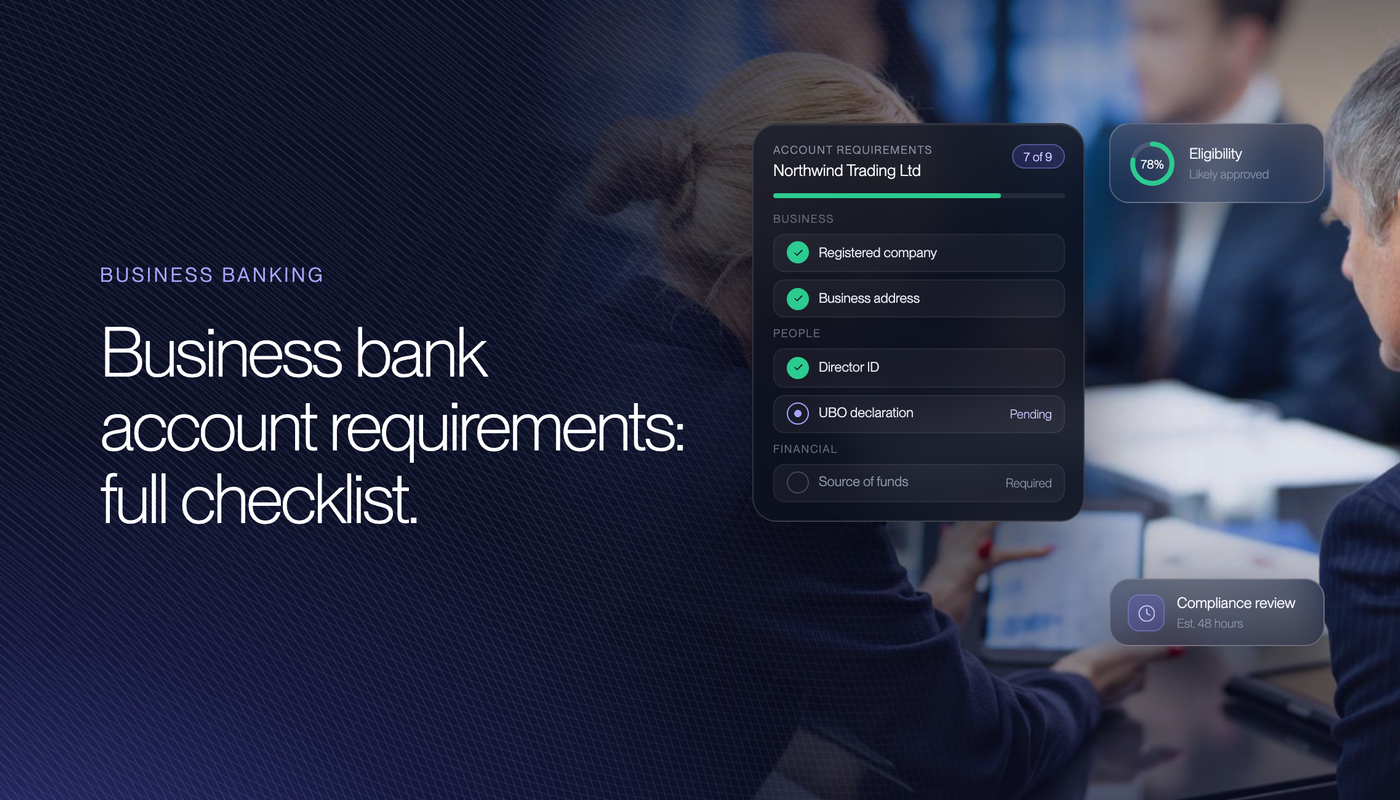
The business bank account requirements are set by anti-money laundering law, not by the provider, which is why the list barely changes between banks and why arguing with it does not work.
What does change is how much evidence each provider wants for the same requirement, and how quickly it gives up when the evidence is late. That is the whole difference between an account open in two days and an application still sitting unanswered after a month.
This is the full checklist: the four things every provider has to establish, the law behind each one, what changes by company type, the eligibility rules that decide yes or no before any document is read, and the mistakes that fail an otherwise good application.
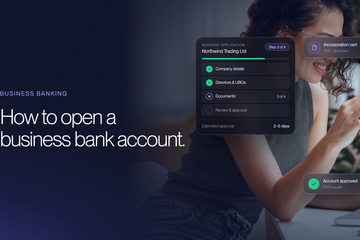
If you want the process in order rather than the requirements list, how to open a business bank account runs through the five steps end to end.

Equals Money
Business Bank Account
Time to onboard
2 Days
Account opening fee
Free
Monthly fee
€30

Trumia
Business account
Monthly fees
€50
Onboarding fees
€500
Time to onboard
1 week
Accepts
Gambling, Betting, Casino, Crypto, and more
Meet Every Business Bank Account Requirement First Time
The requirements are knowable in advance, so the file is built before the application opens rather than assembled one emailed question at a time.
- A file providers accept: ownership traced to individuals, funding evidenced, activity described clearly.
- Business banking: the account opened as part of the setup, not left to you afterwards.
- Built for non-residents: no visa, no residence, no flights, no local partner.
- Onboarding from 2 days: with providers that publish a turnaround and hold to it.
- Flat fee quoted upfront: nothing taken before the scope is agreed.
Business Bank Account Requirements in 2026
The business bank account requirements come down to four things every provider must establish: that the company legally exists, who owns and controls it, where its money comes from, and what it actually does. Every document on every checklist exists to satisfy one of those four. Nothing else is a requirement, however it is presented.
The Four Things Every Provider Has to Establish
- Legal existence: the company is registered, still active, and is the entity named on the application.
- Ownership and control: the chain runs from the company to named individuals, with every layer in between documented.
- Source of funds and wealth: the money going in is evidenced, and so is how the owners accumulated it.
- Purpose and activity: what the business sells, to whom, in which countries, and at what expected volume.
Read any provider's document list against those four and it stops looking arbitrary. A registry extract proves existence. A share register proves ownership. A sale agreement proves source of funds. A business description proves purpose. When a provider asks for something unexpected, it is almost always because one of the four is not yet satisfied.
Requirements Set by Law Against Requirements Set by the Provider
The legal requirements are fixed and identical across providers in the same jurisdiction. The provider requirements sit on top and vary a great deal: a minimum opening deposit, a minimum monthly balance, a restriction on certain activities, a preference for a director in a particular country.
This distinction is worth holding on to when an application is refused. A legal requirement you cannot meet closes every door. A provider requirement you cannot meet closes one door, and the next provider may not have it at all. Most founders treat the second as though it were the first and stop looking.
What Changes Between a Bank and an EMI
Very little on the legal side, quite a lot on the practical side. Both are supervised under the same anti-money laundering framework and both have to satisfy the same four points. The bank tends to want more of it certified, wants a local connection, and takes longer. The electronic money institution runs the same checks digitally and accepts foreign ownership as routine.
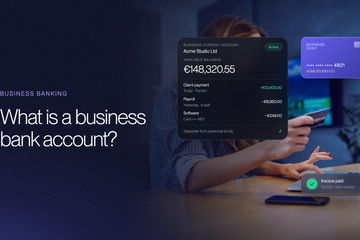
The licence difference behind that is covered in what a business bank account is, including what deposit protection and safeguarding each one gives you.
Requirement | What satisfies it | Bank | EMI |
|---|---|---|---|
Legal existence | Certificate plus registry extract under three months old | Often certified or apostilled | Usually a clear scan |
Directors and officers | Registry filing, ID and proof of address for each | Certified copies common | Video or document check |
Beneficial ownership | Share register and the chain through every entity | Same | Same |
Source of funds | Accounts, sale agreement, payslips or a loan agreement | Same | Same |
Business activity | A written description with countries and volumes | Same | Same |
Local connection | A resident director, a local address or a meeting | Frequently required | Rarely required |
Opening deposit | A first transfer from the company or a shareholder | EUR 0 to EUR 10,000 | Usually EUR 0 |
Time to satisfy all of it | A complete file | 3 to 12 weeks | 2 days to 2 weeks |
The rows that differ are the last three, and none of them is a legal requirement. That is the practical reason a foreign-owned company with a clean file opens faster with an EMI: not lighter rules, fewer provider conditions layered on top of them.
Prove Your Ownership and Source of Funds
These two are where most applications stall, and both are evidence problems rather than eligibility problems.
- A file providers accept: the ownership chart and funding evidence prepared before you apply.
- Built for non-residents: certification and translation handled as part of the work.
- Two applications in parallel: one slow answer does not cost you another month.
- Business banking: arranged alongside the company rather than left with you.
- Expert advice: holding structures and multi-country groups handled in house.
The Law Behind the Business Bank Account Requirements
The checklist comes from customer due diligence obligations. A provider must identify the customer and verify it from independent sources, identify the beneficial owners and take reasonable measures to verify them, understand the purpose of the relationship, and then monitor it. Those four duties generate the whole document list.
Customer Due Diligence on a Company
In the United Kingdom, Regulation 28 of the Money Laundering Regulations 2017 is explicit about a body corporate. The provider must obtain and verify its name, its company or other registration number, and the address of its registered office and, if different, its principal place of business. It must also take reasonable measures to determine and verify the law to which the company is subject, its constitution, and the full names of the board.
EU member states run the same requirements through their national transpositions of the anti-money laundering directives, and from 10 July 2027 through the directly applicable Anti-Money Laundering Regulation instead. The wording differs, the obligations do not.
Beneficial Ownership at 25 Percent or More
Regulation 28(4) requires the provider to identify any beneficial owner and take reasonable measures to verify their identity, and where the beneficial owner is itself a legal entity, to understand its ownership and control structure. A company listed on a regulated market is the exception under Regulation 28(5). Almost nothing else is.
The threshold is moving. Under the EU's Anti-Money Laundering Regulation the test changes from more than 25 percent to 25 percent or more, set out in Articles 62 and 63, applying from 10 July 2027. A shareholder on exactly a quarter was outside the definition and is now inside it. The Commission can also lower the threshold to 15 percent or below for higher-risk sectors, which it has not yet done.
If the structure runs through more than one entity, how indirect ownership is calculated is the part worth reading before you fill anything in, because two incompatible methods are in use and they give different answers.
When Enhanced Due Diligence Applies
Enhanced measures are mandatory rather than discretionary in defined situations: a beneficial owner resident in a high-risk third country, a politically exposed person, an unusually complex or opaque structure, or a transaction pattern with no apparent economic purpose. In those cases the provider must go further on source of wealth and apply closer ongoing scrutiny.
None of these is a refusal. Each is a longer review with a higher evidence bar. Declaring the trigger yourself, with the supporting documents attached, is the difference between extra weeks and a decline.
The Requirements Do Not Stop at Opening
Ongoing monitoring is part of the same obligation, which is why a provider asks for updated documents a year later, queries a payment that does not match your stated activity, or reviews the account when your turnover jumps. Keeping the registry record, the ownership chart and the business description current is a maintenance task, not a one-off.
Our guide to know your business verification sets out how providers run and re-run these checks from their own side of the desk.
Business Bank Account Requirements by Company Type
The four requirements never change. What changes is how many documents it takes to satisfy the ownership one, and that scales directly with how many entities and people sit between the account and a human being.
A Single-Owner Limited Company
The simplest case and the fastest. Certificate, articles, a current registry extract, and one person's passport and proof of address. Source of funds is that person's, so a payslip history, accounts from a previous business or a sale agreement covers it. Most providers clear this in days.
A Company With Two or More Individual Shareholders
Same documents, multiplied. Every director and every shareholder at or above the beneficial ownership threshold needs identity, address and source of wealth. The delay here is coordination rather than complexity: one shareholder slow to complete a video check holds the whole application, and providers rarely proceed on a partial set.
A Company With a Corporate Shareholder
Add a full set for the parent: its registry extract, its constitution, its share register, and the identity documents for whoever ultimately owns it. If there are two layers, that is two sets. An ownership chart supplied upfront turns this from a month of back and forth into a single review.
An LLC, an LLP or a Partnership
The partnership or operating agreement replaces the articles as the governing document, and the provider reads it to work out who can bind the entity and who benefits. A US LLC also needs its EIN confirmation letter rather than the number alone. Members holding at or above the threshold are treated as beneficial owners in the same way as shareholders.
A Trust, Foundation or Nominee Arrangement
The heaviest case. The deed or charter, plus identity and source of wealth for the settlor, the trustees, the protector where one exists, and the beneficiaries or the class of beneficiaries. Nominee shareholders have to be disclosed with the declaration of trust behind them, because an undisclosed nominee reads as concealment rather than administration.
Company type | Extra documents beyond the basic set | Realistic timeline |
|---|---|---|
Single-owner limited company | None | 2 days to 2 weeks |
Several individual shareholders | ID, address and source of wealth for each | 1 to 3 weeks |
Corporate shareholder, one layer | Full set for the parent, plus an ownership chart | 2 to 6 weeks |
Corporate shareholder, two or more layers | A full set per layer | 4 to 10 weeks |
LLC or partnership | Operating or partnership agreement, EIN letter for a US LLC | 1 to 4 weeks |
Trust or foundation | Deed, settlor, trustees, protector, beneficiaries | 6 to 12 weeks |
Nominee shareholding | Declaration of trust and the beneficial owner behind it | Add 2 to 4 weeks |
The pattern is simple: each additional layer adds a full document set and a few weeks. That is worth knowing before you design the structure, because a holding company added for a reason nobody can articulate later costs real time at every account you ever open.
Business Bank Account Requirements for Your Company Type
A holding company, a trust or shareholders in three countries changes the evidence needed, not the answer. The file is built to match the structure.
- Expert advice: holding structures and multi-country groups handled in house.
- A file providers accept: every layer documented before the first question is asked.
- Business banking: the account matched to a provider that underwrites your structure.
- Built for non-residents: foreign ownership is the normal case here, not the exception.
- Flat fee quoted upfront: the whole scope priced before anything is taken.
Business Bank Account Eligibility: What Decides Yes or No
Before a single document is read, four facts about the company decide whether the application is viable at all: the registered activity, where the directors live, where the money moves, and whether the sector is one the provider underwrites. Get these wrong and the paperwork never gets looked at.
The Registered Activity Has to Match What You Actually Do
The provider reads the registry record before your application form and compares the two. A broad catch-all activity code chosen to keep options open is one of the most expensive shortcuts available, because a description the underwriter cannot categorise defaults to the cautious category. Changing it later means filing an amendment and restarting the review.
The reverse is just as bad. An activity code that mentions a regulated or restricted business you do not actually carry on, left in because a template had it, gets the application routed to a team that will ask for a licence you do not have.
Where the Directors Live
No jurisdiction on this page requires a resident director to open an account as a matter of law. Plenty of individual providers require one as a matter of policy, and in some markets so many do that the effect is the same. This is the single most common reason a foreign-owned company finds itself registered and unbanked.
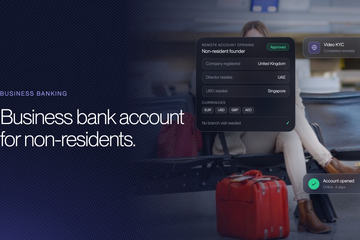
It is worth testing before you register rather than after. Business bank accounts for non-residents covers which routes stay open when nobody in the structure lives locally.
Where the Money Comes From and Goes To
Expected counterparty countries are part of the purpose requirement, and a provider will check them against its own restricted list. Regular flows to or from a jurisdiction on the EU high-risk list or the FATF grey list trigger enhanced due diligence automatically, and some providers decline rather than run it.
Answer honestly and early. A country disclosed at application is a condition. The same country discovered in the first month of statements is an account freeze and a review.
Sectors Providers Will Not Underwrite
Every provider publishes or maintains a restricted list, and the common entries are consistent: gambling, adult, unlicensed financial services, cash-intensive dealing, arms, and in many cases crypto. Being on it is not a judgement on the business, it is a decision about the compliance cost of supervising that category.
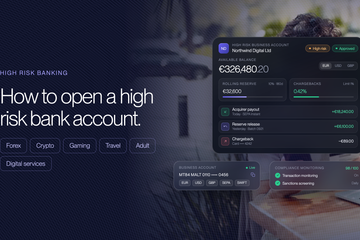
If your activity sits there, the requirements change shape rather than disappear. Opening a high risk bank account covers what a specialist provider asks for instead and how the sequencing differs.
Business Bank Account Providers and the Conditions They Add
The four legal requirements are the same at all four providers below. What differs is the conditions each one layers on top: cost, minimum activity, and how much human attention comes with the review.
Equals Money, No Balance or Fee Conditions
Equals Money runs a business account with no monthly fee, no account opening fee and onboarding published at two days. There is no minimum balance to maintain and no volume you have to reach, so the only requirements to satisfy are the legal ones.
That makes it the sensible baseline for a company that has just registered and cannot yet predict its volumes. Check the conversion spread against your own numbers before you settle on it, because a zero-fee product earns elsewhere.
Equals Money
Business Bank Account
Time to onboard
2 Days
Account opening fee
Free
Monthly fee
€30
Trumia, When the Evidence Needs Explaining
Trumia Limited is an authorised payment services provider and electronic money institution licensed by the Malta Financial Services Authority. Onboarding is one week and the account costs EUR 50 a month.
The requirement it removes is not on any checklist. A structure with a corporate shareholder, a trust, or an activity that needs a paragraph rather than a checkbox is the case where a named contact who can take the explanation once and carry it internally is worth more than the fee. A single-owner company with one currency does not need it.
Trumia
Business account
Monthly fees
€50
Onboarding fees
€500
Time to onboard
1 week
Accepts
Gambling, Betting, Casino, Crypto, and more
3S Money, a Volume Requirement of Its Own
3S Money is a cross-border payments account with free opening, four-day onboarding and pricing from EUR 100 a month. The legal requirements are identical, but the commercial one is real: below roughly EUR 50,000 a month in cross-border flow the fee is hard to justify.
Above that level it is the opposite calculation, because the fee is small against the spread and the failed-payment cost it removes on high-volume international activity.

3S Money
Cross-border payments
Time to onboard
4 Days
Account opening fee
Free
Monthly fee
Starting from € 100
Moneybase, Multi-Currency Without a Volume Condition
Moneybase offers a multi-currency business account with free opening, four-day onboarding and pricing from EUR 9.99 a month. No volume requirement and no minimum balance, with real multi-currency support for a small predictable cost.
Read the four together and the conditions sort themselves. No recurring cost points at Equals, a structure that needs explaining points at Trumia, several currencies at moderate volume point at Moneybase, and heavy cross-border flow points at 3S Money. Three of the four charge no account opening fee, and Trumia does not publish one either way.

Moneybase
Multi Currency Business Account
Time to onboard
4 Days
Account opening fee
Free
Monthly fee
Starting from € 9.99
Choose a Provider That Accepts Your Company
The legal requirements are fixed. The provider conditions are not, and matching the company to a provider that already accepts its shape is most of the work.
- Business banking: the account matched to your structure, currencies and volumes.
- Two applications in parallel: so a slow answer does not cost you another month.
- Built for non-residents: providers chosen because foreign ownership is their normal case.
- Onboarding from 2 days: with the ones that publish a turnaround and hold to it.
- Expert advice: advisors who place foreign-owned companies weekly and know who is saying yes.
The Full Business Bank Account Requirements Checklist
Work down this list before you open an application. Everything on it is knowable in advance, and a file that satisfies all four groups usually clears in days rather than weeks. Everything a business bank account application asks for maps onto one of the four groups below.
Company Requirements
- Certificate of incorporation or registration.
- Memorandum and articles of association, or the equivalent constitution.
- Registry extract dated within three months, showing directors, shareholders and the registered office.
- Proof of the trading address where it differs from the registered office.
- Tax identification number, and the VAT number where registered. A US LLC needs its EIN confirmation letter.
- Board resolution authorising the account and naming the signatories.
People Requirements
- Passport for every director and every beneficial owner at or above the threshold.
- Proof of address under three months old for each, in the country where they actually live.
- Share register or shareholder certificates showing percentages.
- An ownership chart wherever the structure runs through more than one entity.
- Registry extracts for each intermediate holding company in the chain.
- Trust deed with settlor, trustees, protector and beneficiaries where a trust sits in the structure.
Money Requirements
- Source of funds for the money going into the account, documented rather than described.
- Source of wealth for each beneficial owner: accounts, a sale agreement, payslips, a loan agreement or investment statements.
- Expected monthly turnover and average transaction size.
- Expected counterparty countries, incoming and outgoing.
- A first deposit from an account in the company's or a shareholder's name, never a third party.
Activity Requirements
- A written business description covering what you sell, to whom, where, and through which channels.
- A registered activity code that matches that description.
- Main suppliers and main customers named where the business is already trading.
- Any licence the activity requires, current and in the company's name.
- A stated reason for the company being registered where it is, if the owners live elsewhere.
Reading how KYB onboarding actually runs alongside this list is the fastest way to see which of these a provider checks first and which it only asks about when something else does not add up.
Common Mistakes on Business Bank Account Requirements
Four errors account for most rejected applications, and none of them is about failing a requirement the company could never have met.
Treating the Provider's List as the Full Requirement
The published document list is the starting point, not the finish. It satisfies existence and identity, and then the questions begin on ownership, funding and activity. Founders who send exactly what the list asked for and nothing else are surprised by a second round that was always coming, and each round trip costs days.
Supplying an Expired or Wrongly Certified Document
A registry extract older than three months, a proof of address from last year, a copy certified by someone the provider does not accept, or a translation that is not certified. Each of these returns the file to you unread. Check the validity window and the certification standard before you gather anything, because gathering twice is the actual cost.
Describing Source of Funds Instead of Evidencing It
The most common single failure. Source of funds is a documentary requirement, so a paragraph explaining that the founder saved the money over ten years does not satisfy it, however true it is. The provider is required to verify, and a claim is not verification. Produce the accounts, the agreement or the statements.
Leaving Out an Intermediate Entity
Supplying the operating company's papers and stopping there, because the holding company above it felt like background. The requirement is that ownership is traced to individuals, so an undocumented layer means the requirement is unmet, and the application reads as incomplete rather than complex. Produce the chart first.
Which Business Bank Account Requirements Apply to You?
Three questions narrow the list from everything above to the part you actually have to assemble. How many entities sit above the company, where do the people live, and is the activity one providers restrict?
One Company, One or Two Owners, an Ordinary Activity
The basic set only. Company documents, one or two passports with proof of address, source of funds for the founding money, and a specific business description. Two days to two weeks with an EMI, and no reason to expect a decline.
Owners Abroad, No Local Director
Same requirements, higher evidence standard, because nothing can be checked informally. Certified copies, translations where the document is not in the provider's language, and a stated reason for the company being registered where it is. Choose a provider that underwrites foreign ownership rather than one that tolerates it.
A Holding Company, a Trust or a Regulated Activity
Expect a full document set per layer, source of wealth for everyone in the chain, and enhanced due diligence if a high-risk country or a politically exposed person is involved. Build the file completely before applying, and budget six to twelve weeks rather than two.
Where to Start
If the company already exists, work the checklist above and then read how to open a business bank account for the order to do it in. If it does not, how to set up a company covers the registration decisions that determine half of these requirements before you ever apply.
The country guides show what providers locally ask for on top: Cyprus, Malta and the UK for non-resident owners.
Open Your Company and Bank Account Together
The requirements are the same whoever files them. Having them assembled before the application opens is what turns weeks into days.
- Business banking: the account opened as part of the setup, not left to you afterwards.
- A file providers accept: every requirement evidenced before the first question is asked.
- Built for non-residents: no visa, no residence, no flights, no local partner.
- Flat fee from EUR 350: quoted in full upfront, nothing taken before the scope is agreed.
- Expert advice: licensing, holding structures and multi-country groups handled in house.