Registering the company takes days. Opening the business bank account takes weeks, and it is the step that decides when you can actually invoice a customer and get paid.
Most guides on how to open a business bank account stop at a document checklist. That is the easy half. The hard half is that a bank or an electronic money institution is underwriting you, not processing you, and it can say no without telling you why. The Financial Conduct Authority's own review of de-risking found that small businesses are more likely to be de-risked than larger firms in the same sectors, and that refusals in fintech are often delivered by letter with no explanation and no remedial action offered.
So the useful question about how to open a business bank account is not what documents to gather. It is what the provider is trying to establish, what evidence satisfies it, and which route gets there fastest for a company like yours. This guide covers the business bank account requirements that come from law, the documents needed to open a business bank account in practice, the difference between a bank and an EMI, and the specific reasons applications stall.
If you have not chosen a jurisdiction yet, the easiest country to set up a company in Europe covers that decision first, because where the company sits changes who will bank it.
Open Your Company and Bank Account Together
The account application is built while the company is being registered, not after the certificate arrives, which is what removes most of the waiting.
- Application file prepared for you: ownership traced to the individuals, source of funds evidenced, business description written the way underwriters read it.
- Applications run in parallel: so a single decline does not cost you another month.
- Onboarding from 2 days: with the providers that publish a turnaround, rather than an open-ended wait.
- Fixed price quoted before anything starts: no hourly billing and no payment upfront.
How to Open a Business Bank Account: The Five Steps
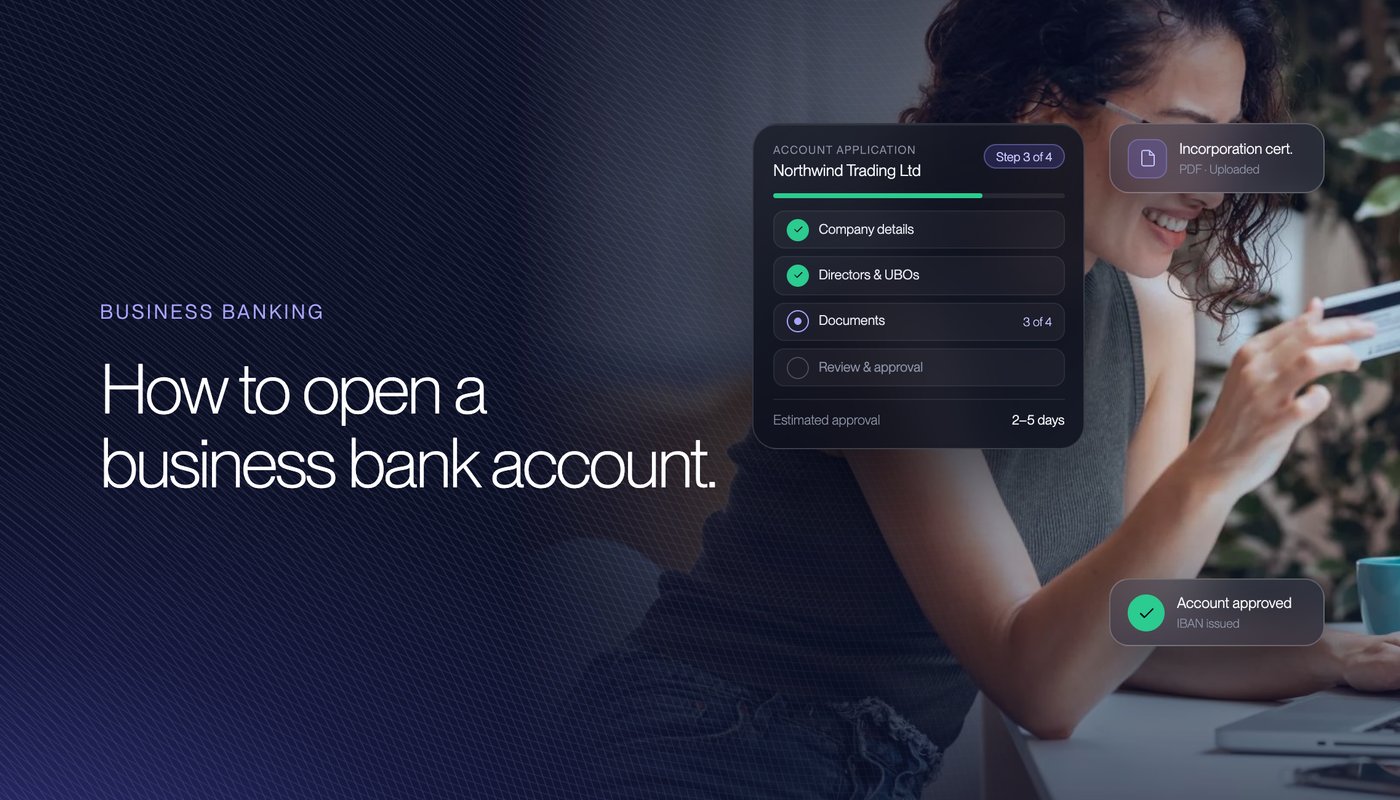
You open a business bank account by registering the company, assembling an underwriting file that traces ownership and money to real people, choosing a provider that accepts your activity and country, submitting and answering the follow-up questions, then funding the account to activate it. Two to twelve weeks end to end, depending on the route.
Step 1: Register the Company First
No provider opens a business bank account for a company that does not exist. The application needs a registration number and a certificate, because the first thing the onboarding team does is look the entity up on the register and compare what it finds against what you wrote.
This is also where the first avoidable delay happens. A company registered with a generic activity code and a mail-forwarding address is harder to bank than the same company registered with a specific activity and a real office, and changing it later means filing an amendment and restarting the review.
Step 2: Build the Underwriting File
The file is what the decision is actually made on. It traces ownership from the company up to named individuals, evidences where the founding money came from, and describes the business in a way an underwriter can categorise. Most of the delay in opening a business bank account is this file being assembled reactively, one emailed question at a time.
Step 3: Choose a Bank or an EMI
These are different products with different approval odds. A traditional bank gives you deposit protection, cash handling and credit. An electronic money institution gives you an IBAN, multi-currency accounts and cards, usually in days rather than weeks, and safeguards client funds rather than insuring them. The comparison is further down.
Step 4: Apply and Answer the Follow-Ups
Every application generates questions. Expect to be asked who your first customers are, which countries money will move to and from, expected monthly volume, and how the shareholders funded the company. Answer with evidence rather than assertion. A vague answer does not get a decline, it gets another question, and each round trip costs days.
Step 5: Fund and Activate the Account
Approval is not activation. Most providers require an initial deposit and a first incoming transfer from an account in the company's or a shareholder's name before the account is fully usable. A first deposit routed from an unrelated third party is one of the fastest ways to have a freshly approved account frozen for review.
Running Spend Through a New Account With Brex
Once the account is funded, the next problem is running money through it without losing visibility. Brex is a financial technology company that pairs corporate charge cards with expense management, bill pay, and travel on one platform, so a newly opened account has an operating layer on top of it from day one rather than months later.
Brex corporate cards work as charge cards paid in full each cycle and require no personal guarantee, which matters for founders who just traced their ownership to individuals for underwriting and would rather not attach themselves to company debt. Dynamic limits adjust with cash flow, virtual cards issue instantly, and policies enforce at the point of spend rather than at reconciliation. Receipts match automatically and transactions sync to the ERP through native integrations with NetSuite, QuickBooks, and Sage.
The practical effect is that finance sees spend before it happens rather than reconstructing it afterwards, which is the difference between an account that holds money and a finance function that runs on it.
Read more: how KYB onboarding actually runs covers the same process from the compliance side of the desk, which is useful for anticipating the questions.
Business Bank Account Requirements in 2026
The business bank account requirements are set by anti-money laundering law, not by the provider's preference. The provider must identify the company, verify it from independent sources, identify the people who ultimately own or control it, and understand what the relationship is for. Everything on the document list exists to satisfy one of those four.
What the Law Requires the Provider to Check
In the United Kingdom, Regulation 28 of the Money Laundering Regulations 2017 is explicit about a body corporate. The provider must obtain and verify the name of the body corporate, its company number or other registration number, and the address of its registered office and, if different, its principal place of business. It must also take reasonable measures to determine and verify the law to which the company is subject, its constitution, and the full names of the board of directors.
Regulation 28(4) then goes to ownership. Where someone else beneficially owns the customer, the provider must identify that beneficial owner and take reasonable measures to verify their identity, and where the beneficial owner is itself a legal entity, take reasonable measures to understand its ownership and control structure. A company listed on a regulated market is the exception under Regulation 28(5). Almost nothing else is.
What is checked | What satisfies it | Where founders lose time |
|---|---|---|
Legal existence | Certificate of incorporation and a current registry extract | Extract older than three months |
Registered office and trading address | Registry record plus a utility bill or lease | A mail-forwarding address with nothing behind it |
Directors and officers | Registry filing, plus ID and proof of address for each | One director unreachable for verification |
Beneficial ownership | Share register, and the chain traced through every holding company | An intermediate entity nobody documented |
Purpose of the relationship | A written business description, customers, countries, volumes | A description too generic to categorise |
Source of funds | Bank statements, sale agreement, payslips, loan agreement | Asserting savings with no paper trail |
The pattern in the right-hand column is the same every time. Nothing on the list is hard to produce. It is hard to produce quickly, in response to a question, once the clock has already started.
The Beneficial Ownership Threshold Is Changing
Under the European Union's new anti-money laundering package, the beneficial ownership threshold moves from more than 25 percent to 25 percent or more, set out in Articles 62 and 63 of the Anti-Money Laundering Regulation. A shareholder holding exactly a quarter was previously outside the definition and is now inside it. The Commission also has the power to lower the threshold to 15 percent or below for higher-risk sectors, which it has not yet used.
The Regulation applies from 10 July 2027 and is directly applicable, so there is no national transposition to wait for and no room for a member state to soften it. The Anti-Money Laundering Authority has been operational in Frankfurt since 1 July 2025 and is already shaping how supervisors expect this to be evidenced. If your cap table has a shareholder on exactly 25 percent, treat them as a beneficial owner now. Our guide to what an ultimate beneficial owner is works through how indirect holdings are calculated.
Identity Verification Tightened in November 2025
Identity verification became mandatory at Companies House on 18 November 2025 under the Economic Crime and Corporate Transparency Act. Every director and person with significant control now has to verify their identity, and the registry data a bank pulls is consequently better than it was. That cuts both ways: it is a one-off check that speeds later applications, and it is a step that catches non-resident founders who assumed the United Kingdom asked for nothing.
Get a Business Bank Account Application That Passes
Not whether your documents are complete. Whether the money, the ownership and the stated activity are consistent with each other, and whether the file explains anything that looks unusual before they have to ask.
- Consistency across documents: the activity on the registry, in the business description and in the expected transactions should be one story.
- Ownership traced to people: every intermediate entity documented, not just the top shareholder.
- Money with a paper trail: evidence of where the funding came from, not a statement that it exists.
- The awkward facts explained upfront: a non-resident director or a high-risk country is a question, not a decline, unless you leave it for them to find.
Documents Needed to Open a Business Bank Account
Every provider asks for four groups: the company itself, the people who own and control it, evidence of where the money comes from, and a description of what the business does. What varies is how much evidence each one wants, not which groups it asks for.
Company Documents
- Certificate of incorporation or registration.
- Memorandum and articles of association, or the equivalent constitution.
- A current extract from the register showing directors, shareholders and the registered office, usually dated within three months.
- Proof of the trading address where it differs from the registered office.
- Tax identification number, and the VAT number where the company is registered.
- Board resolution authorising the account opening and naming the signatories.
Ownership and Control Documents
This is where applications stall. The provider needs to get from the company to named individuals, and every layer in between has to be documented. A two-tier structure with a holding company means producing the holding company's registry extract and share register too, not just the operating company's.
- Share register or shareholder certificates showing percentages.
- An ownership chart where the structure runs through more than one entity.
- Passport and proof of address for every director and every beneficial owner.
- Registry extracts for each intermediate holding company in the chain.
- Trust deed and details of the settlor, trustees, protector and beneficiaries where a trust sits in the structure.
If the chain is genuinely complex, produce the chart before anyone asks for it. Our guide to know your business verification sets out how the provider maps the same structure from their side.
Source of Funds and Source of Wealth
These are two different questions and providers ask both. Source of funds is where the specific money going into this account came from. Source of wealth is how the beneficial owner accumulated their money overall. Answering one does not answer the other.
Acceptable evidence is documentary: audited accounts, a signed sale agreement for a previous business, payslips or an employment contract, a loan agreement with the lender identified, investment statements, or a grant letter. What does not work is a paragraph explaining that the founder has savings. The provider is required to verify, and a claim is not verification.
The Business Description That Gets Approved
The single most underrated document. Write what the company sells, to whom, in which countries, through which channels, at what expected monthly volume and average transaction size, and who the main suppliers are. Two hundred specific words beat two pages of positioning.
An underwriter's job is to place your business in a risk category. A description they cannot categorise defaults to the cautious category, which means more questions, a longer review, and sometimes a decline for a business that was never actually risky.
Best Bank to Open a Business Account: Bank or EMI?
For most newly formed companies the best bank to open a business account with is not a bank at all in the first year. An electronic money institution opens faster, accepts non-resident ownership more readily and gives you multi-currency accounts and cards. A traditional bank gives you deposit protection, cash handling and credit, and takes longer.
What a Traditional Bank Gives You
Deposit protection up to the statutory limit, the ability to pay in and withdraw cash, access to lending and overdrafts, and a name on your invoices that some counterparties still prefer. If you need any of those, the wait is the price.
The cost is time and selectivity. Traditional banks in most jurisdictions want a local connection, a local director or an in-person meeting, and they run the longest reviews. For a company owned entirely from outside the country, this is where the business bank account for non residents question usually meets its first refusal.
What an EMI Gives You
A dedicated IBAN, multiple currency balances, payment cards, and onboarding in days rather than weeks. EMIs are licensed and supervised, and they safeguard client funds by holding them at a credit institution rather than lending them out, which is a different protection from deposit insurance rather than a weaker version of the same thing.
The genuine limits are worth knowing before you rely on one. Most do not take cash, most do not lend, and safeguarding is not a deposit guarantee scheme. For a trading company that invoices and gets paid electronically, none of those matter.
| Traditional bank | Electronic money institution |
|---|---|---|
Time to open | 3 to 12 weeks | 2 days to 2 weeks |
Non-resident owners | Often refused without a local link | Routinely accepted |
Multi-currency | Usually a separate product per currency | Standard, several currencies in one account |
Cash handling | Yes | Almost never |
Lending and overdrafts | Yes | Rarely |
Protection of funds | Deposit guarantee scheme | Safeguarded at a credit institution |
Typical monthly cost | Free to moderate, often with conditions | EUR 0 to EUR 100 |
Best for | Cash businesses, borrowers, local operations | New companies, cross-border trade, non-resident owners |
Read the first two rows together. The reason so many newly formed companies open with an EMI is not that the product is better in the abstract, it is that a company with no trading history and owners abroad is a marginal application at a bank and a normal one at an EMI.
Which One to Open First
Open the EMI account first and the bank account second. The EMI gets you trading within days, and six months of clean transaction history through it is the single most useful thing you can present to a traditional bank later. Applying to the bank first, waiting eight weeks and then being declined leaves you with neither.
Choose the Right Business Bank Account
A trading company invoicing in two currencies does not need a EUR 30 call to work this out, and we will say so. Where the structure has a holding company, a trust or an unusual sector, the call is worth it.
- 30-minute call with an advisor: matched to your sector and the jurisdiction the company sits in.
- EUR 30 one-off: credited in full if you proceed with a setup within 30 days.
- Written summary afterwards: the recommended provider, the document list and the realistic timeline.
- No retainer and no subscription: one call, one answer.
How to Open a Business Bank Account Online
You open a business bank account online by completing an application on the provider's portal, uploading the company and ownership documents, verifying each director and beneficial owner by video or document scan, then answering the compliance questions that follow. Straightforward companies clear in two to five business days, which is why most founders now open a business bank account online rather than in a branch.
What Online Onboarding Actually Checks
Automated onboarding is not a lighter check, it is the same check run faster. The system pulls the company from the registry, matches the officers you declared against the officers on file, screens every individual against sanctions, politically exposed person and adverse media lists, and scores the result. Anything that does not reconcile goes to a human.
When Online Applications Get Escalated
The common triggers are worth knowing because most of them are avoidable. A director resident in a country the provider treats as higher risk. An ownership chain the system cannot resolve. A declared activity that does not match the registered activity code. A name that produces a screening hit needing manual clearance. A company incorporated in the last few weeks with no operating history.
None of those is a decline on its own. Each adds days, and several together turn a two-day onboarding into a three-week one.
Opening a Business Bank Account for Non-Residents
A business bank account for non residents is standard business for EMIs and an exception for most traditional banks. The workable route is an EU or United Kingdom company with a genuine registered office, an EMI account opened remotely, and a traditional bank approached later once there is history to show.
Read more: the best UK business bank accounts for non-residents, opening a business bank account in Malta as a non-resident and opening a business bank account in Cyprus as a non-resident cover the three routes founders ask about most.
Best Providers to Open a Business Account With
The providers below are the ones Binderr onboards through, with the turnaround and pricing each one publishes. They are all electronic money institutions rather than traditional banks, which is why the timelines are days rather than months.
Equals
A business current account aimed at companies that want the account open quickly and want the monthly cost to be nothing. Onboarding is quoted at two days, which is the fastest published turnaround of the set, and there is no account opening fee and no monthly fee.
It suits a newly formed trading company that needs to invoice and get paid without a long review, and that does not need cash handling or credit on day one. Where it is the wrong fit is a business with heavy multi-currency treasury needs or large cross-border flows, where a provider built around those is the better call.

Equals Money
Business Bank Account
Time to onboard
2 Days
Account opening fee
Free
Monthly fee
€30
Trumia
Trumia Limited is an authorised payment services provider and electronic money institution licensed by the Malta Financial Services Authority under company number C96757. It offers single-currency and multi-currency business accounts, foreign currency exchange, invoice and partner payments, and a dedicated account manager rather than a support queue. Onboarding is one week and the account costs EUR 50 a month.
The account manager is what that fee buys, and for a company with a structure that needs explaining it is worth more than a lower headline price. Most onboarding friction is a question asked by email and answered three days later, and a named contact collapses that loop. It is the middle option here on both cost and speed, and the one to pick when the application is likely to generate questions.

Trumia
Business account
Monthly fees
€50
Onboarding fees
€500
Time to onboard
1 week
Accepts
Gambling, Betting, Casino, Crypto, and more
3S Money
Built for cross-border payments, which is a different problem from holding a balance. Onboarding is four days, there is no account opening fee, and the monthly fee starts at EUR 100, which is the highest of the set and reflects what it is for.
It earns that fee on companies moving money between several countries and currencies at volume, where the alternative is paying an FX spread on every transfer through a cheaper account. For a company invoicing domestically in one currency it is the wrong product.

3S Money
Cross-border payments
Time to onboard
4 Days
Account opening fee
Free
Monthly fee
Starting from € 100
Moneybase
A multi-currency business account with a four-day onboarding, no account opening fee and a monthly fee starting at EUR 9.99. It sits between the other two: more currency capability than a straightforward current account, at a fraction of the cost of a dedicated cross-border provider.
This is the default for most newly formed companies that invoice in more than one currency but are not yet moving money at the volume that justifies a specialist. Read all four together and the choice falls out cleanly: speed and zero cost point at Equals, a structure that needs a human explaining it points at Trumia, several currencies at moderate volume point at Moneybase, and heavy cross-border flow points at 3S Money.

Moneybase
Multi Currency Business Account
Time to onboard
4 Days
Account opening fee
Free
Monthly fee
Starting from € 9.99
Reapply After a Business Bank Account Decline
A decline is not a verdict on the business. It usually means one provider's risk policy excluded something about the file, and often nobody will tell you which part.
- The file is reviewed, not resubmitted: the same pack sent to a second provider gets the same answer.
- Applications prepared in parallel: so the second route is already moving when the first one closes.
- Providers matched to the actual obstacle: a non-resident director, a holding company or a sector exclusion each point somewhere different.
- Free to open with most of them: so a second application does not add a cost.
Why Business Bank Account Applications Get Declined
Applications are declined for risk policy reasons far more often than for missing paperwork. The provider is deciding whether the revenue from your account justifies the cost of monitoring it, and for a small company in a sector they find awkward, the answer is frequently no.
De-Risking Is a Business Decision, Not a Judgement on You
The Financial Conduct Authority's review of de-risking found that small and medium businesses are more likely to be de-risked than larger firms in the same sectors, with defence and fintech among those seeing services denied or withdrawn. It also found that banks were using size as a proxy for compliance effectiveness, and that refusals in fintech often arrived by letter with no explanation and no remedial action offered.
Read that last part carefully, because it changes what to do next. If no reason is given, there is nothing to fix and resubmitting the same file to the same provider is wasted time. The move is a different provider whose policy does not exclude whatever excluded you.
The Specific Reasons Behind Most Refusals
- A sector on the provider's exclusion list, decided before anyone read your file.
- Ownership or directors resident in a jurisdiction the provider will not underwrite.
- An ownership chain that could not be resolved to individuals.
- Source of funds asserted rather than evidenced.
- A company with no trading history and no local presence of any kind.
- A declared activity that does not match the registered activity code.
- A screening hit on a director or beneficial owner that was never cleared.
What to Do After a Decline
Ask for the reason in writing, since some providers will give it even when the initial letter does not. Fix anything factual, such as a stale registry extract or an undocumented intermediate company. Then apply to a provider chosen for the specific obstacle rather than the next one on a list. Where the business is genuinely in a higher-risk category, our guide on opening a high risk bank account covers the providers that underwrite it and what they charge for doing so.
Common Business Bank Account Mistakes
Four errors account for most of the delay founders hit when working out how to open a business bank account, and all four are decided before the application is submitted.
Applying Before the File Is Ready
The most expensive one. Founders submit as soon as the certificate arrives, then answer questions as they come, one at a time. Each round trip is two to four days, and a moderately complex structure generates five or six of them. That is three weeks added to an application that could have taken four days, and worse, an application that keeps producing new questions reads as disorganised to the person reviewing it. Assemble the ownership chart, the source of funds evidence and the business description before you start, and the same file clears in one pass.
Treating Source of Wealth as the Same Question as Source of Funds
Founders answer where the money in the account came from and consider the question closed. The provider then asks how the beneficial owner accumulated their wealth in the first place, and the applicant reads it as the same question repeated and answers it the same way. Two more rounds go by before anyone realises they are talking past each other. Source of funds is this money. Source of wealth is the person's overall financial history. Prepare both, with documents for each, and say which is which.
Choosing the Provider by Monthly Fee
A EUR 9.99 account and a EUR 100 account look like a EUR 1,080 difference over a year, so founders take the cheaper one. If the business moves money across borders, the FX spread on the cheaper account will exceed that difference in a single quarter, because the margin is taken on every conversion rather than billed monthly. Work out the annual cost as the monthly fee plus the expected FX volume multiplied by the spread. For a domestic single-currency business the cheap account genuinely is cheaper, and for a cross-border one it usually is not.
Funding the Account From the Wrong Place
An approved account is not yet a trusted account. The first incoming transfer is watched, and a first deposit from a third party with no documented relationship to the company is one of the most reliable ways to get a new account frozen pending review. That review takes longer than the onboarding did, and it starts the relationship with a file note. Fund from the company's own account elsewhere or from a shareholder in the register, and keep the evidence of what that transfer was.
Which Business Account Should You Open?
How to open a business bank account well comes down to matching the provider to the company. Three profiles cover most, and the answer changes with each.
A New Company Invoicing in One Currency
An electronic money institution, opened remotely, with the account live in days. Add a traditional bank later if you need cash handling or credit. The easiest business bank account to open is almost always the one that does not require a local director.
A Company Trading Across Several Countries
A multi-currency account from the start, chosen on the FX spread rather than the monthly fee. Opening a single-currency account and converting through it is the most common avoidable cost in the first year of cross-border trading.
A Holding Company, Trust or Regulated Business
Expect a longer review and prepare for it. The structure has to be documented to the individuals, the purpose of each entity explained, and the regulatory permissions evidenced where the business is licensed. This is the case where advice before applying genuinely saves time.
Related reading: opening a UK business bank account as a foreigner, opening a business bank account in Ireland as a non-resident, opening a business bank account in Jersey and opening a business bank account in the UAE.
Open a Business Bank Account This Month
One engagement covering the provider choice, the application file and the follow-up questions, priced before anything is submitted.
- Onboarding from 2 days: with providers that publish a turnaround, up to one week for the rest.
- Free to open: three of the four providers above charge no account opening fee.
- Document pack built for you: ownership, source of funds and business description in the form underwriters accept.
- Company formation handled alongside: so the account application starts before the certificate arrives, not after.