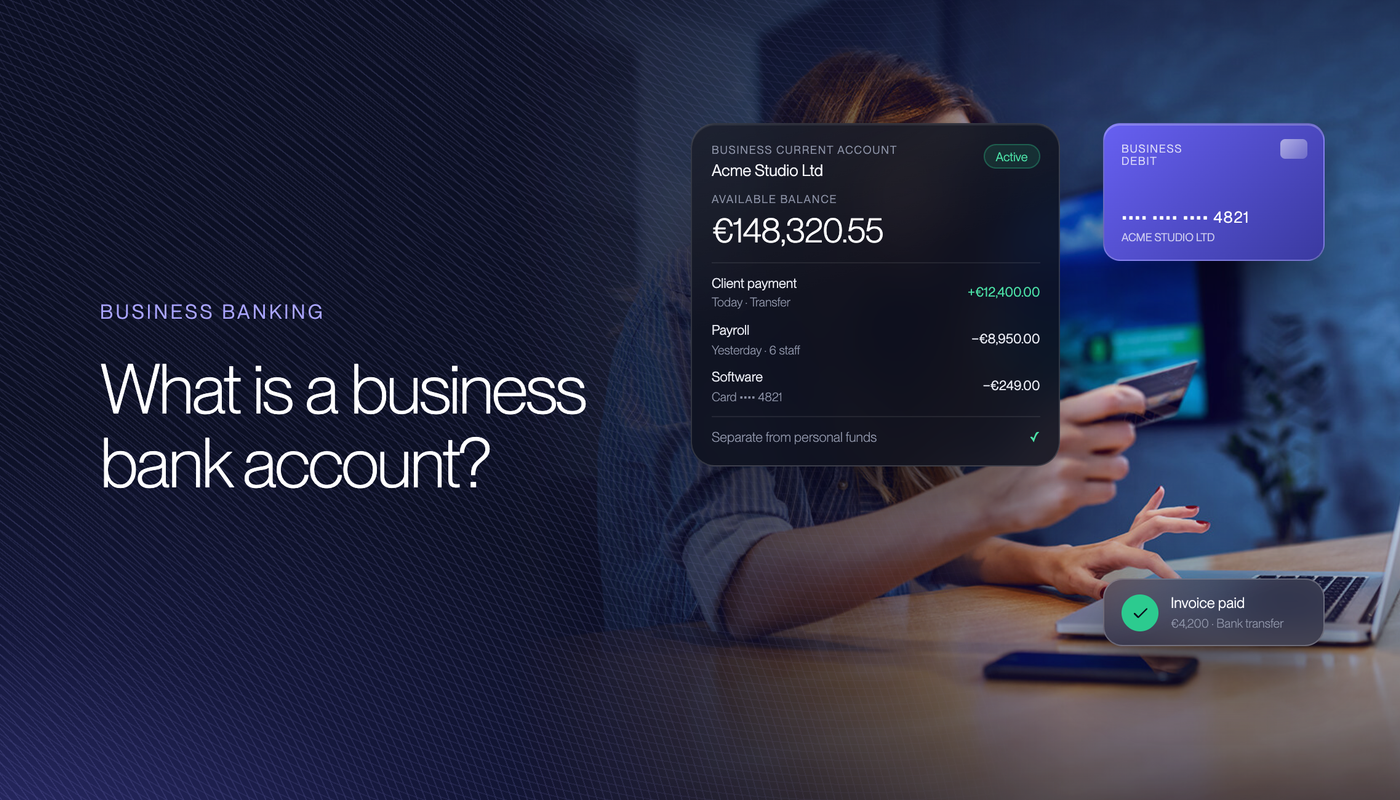
A business bank account is an account held in the company's name rather than yours, and that single fact is what makes it a legal requirement rather than an administrative preference.
Most answers to what is a business bank account stop at "it keeps business and personal money separate". True, and not much use. The separation is a consequence. The cause is that once you incorporate, the company is a person in law, it owns its own money, and that money cannot sit in an account belonging to a different person, which is you.
Everything else follows from there: why a bank underwrites the company rather than processing a form, why an electronic money institution can hold company funds without being a bank, why the protection on your balance works differently in each case, and why the monthly fee is almost never the number that decides the cost. This guide covers what a business bank account actually is, what sits inside one, who is required to hold one, and what separates the products you can choose between in 2026.
If you have already chosen and want the process rather than the definition, how to open a business bank account walks through the five steps and the underwriting file.

Equals Money
Business Bank Account
Time to onboard
2 Days
Account opening fee
Free
Monthly fee
€30

Trumia
Business account
Monthly fees
€50
Onboarding fees
€500
Time to onboard
1 week
Accepts
Gambling, Betting, Casino, Crypto, and more
Open Your Company and Bank Account Together
The account is arranged alongside the incorporation, so the company does not sit registered and unusable while an application queue moves.
- Business banking: the account opened as part of the setup, not left to you afterwards.
- Built for non-residents: no visa, no residence, no flights, no local partner.
- Jurisdiction selection: the country picked around your customers and where you can bank.
- Onboarding from 2 days: with the providers that publish a turnaround and hold to it.
- Flat fee quoted upfront: nothing taken before the scope is agreed.
What Is a Business Bank Account?
A business bank account is a payment account opened in the name of a registered business and used only for that business's money. It is legally distinct from the owner's personal account, it is underwritten against the company rather than the individual, and it carries the company's own IBAN or account number, which is what lets customers pay the business directly.
The Company Owns the Account, Not You
When you incorporate, the company becomes a separate legal person. It can own property, sign contracts, sue and be sued, and hold money. Your shares give you a claim on the company, not on its bank balance. A business bank account is simply the account that belongs to that second person.
This is why the application asks about the company and then about you. The customer is the company. You appear as a director, a signatory and a beneficial owner, and the provider verifies you in those roles rather than as the account holder. It is also why the account survives you selling your shares, and why taking money out of it is a transaction, a salary, a dividend or a loan, rather than a transfer between two of your own pockets.
What Is Inside a Business Bank Account
Stripped to its parts, a business bank account is four things bundled together, and providers differ mostly in how good each part is.
- A set of account identifiers: an IBAN, or a sort code and account number, in the company's name, which is what an invoice quotes and a customer pays into.
- Access to payment rails: SEPA and SEPA Instant in the euro area, Faster Payments in the UK, SWIFT for everything international, and card scheme acquiring if you sell online.
- A balance the provider holds for you: either as a deposit or as safeguarded e-money, which is the distinction that decides what happens if the provider fails.
- Controls and reporting: signatories, approval limits, cards, and a statement feed your accountant can reconcile against.
Notice what is not on that list. Lending, overdrafts, cash deposits and cheque handling are bank products layered on top of an account, not part of the definition. A company that never handles cash and never borrows can run entirely on the four items above, which is exactly why the non-bank options became viable.
Who Is Legally Required to Have One
A limited company, an LLC, a partnership with legal personality and any other incorporated entity needs its own account, because its money is not yours to hold. No statute anywhere says "thou shalt open a business bank account", but company law, accounting standards and tax law between them make trading through a personal account a breach in several directions at once.
A sole trader is the genuine exception, covered below.
Everyone else should treat the account as part of the incorporation rather than a follow-on task. If you are still choosing where to register, the easiest country to set up a company in Europe ranks jurisdictions partly on whether a bank will actually open for the company afterwards, which is the step that strands most new entities.
Business Bank Account vs Personal Account
The difference is ownership, not branding. A personal account holds your money and a business bank account holds the company's money, and because those are two different legal persons, running one through the other undoes the protection you incorporated to get and creates work at every year end.
Why Mixing the Two Breaks Limited Liability
Limited liability rests on the company being genuinely separate from its owner. Where a director habitually pays company suppliers from a personal account and takes company income into it, that separation stops being real, and a liquidator or a court asked to look at the company's affairs has a documented pattern to point at. The technical term varies by jurisdiction, piercing the corporate veil in common law systems, but the evidence is always the same: commingled money.
This is not a theoretical risk that only matters in insolvency. It also shows up when a buyer runs due diligence on the company, when a lender asks for two years of statements, and when a tax authority reconstructs turnover from bank data rather than from your books.
What It Costs You at Year End
The accounting cost is immediate and boring. Every transaction in a mixed account has to be classified by hand, because no rule can tell the software whether a EUR 400 payment was a supplier invoice or a personal purchase. Bookkeepers price that reconstruction work at several times the cost of a clean feed, and it is the most common reason a small company's year-end fee comes back higher than quoted.
The tax cost is worse. A deduction you cannot evidence from a company account is a deduction an auditor can disallow, and money moved out of the company without being characterised as salary, dividend or loan tends to be characterised for you, usually in the way that collects the most tax.
Sole Traders: The One Case Where It Is Optional
A sole trader is not a separate legal person, so there is no second owner and no legal requirement for a second account. Most banks' personal terms still prohibit business use, so the practical answer is usually a second account anyway, but it can be a personal one in your own name rather than a business bank account.
The moment you incorporate, that option closes. This is worth knowing before you register, because founders who traded happily for a year as a sole trader are the ones most likely to keep using the old account after incorporation without realising anything changed.
| Personal account | Business bank account |
|---|---|---|
Whose money it holds | Yours | The company's |
Who is underwritten | You | The company, with you as director and owner |
Required after incorporation | Not permitted for company money | Yes |
Name on invoices and payments | Your name | The company's registered name |
Accounting treatment | Reconstructed by hand | Direct feed, rules applied once |
Typical monthly cost | Free | EUR 0 to EUR 100 depending on the product |
Multi-currency | Rare | Standard on most business products |
Effect on limited liability | Erodes it where company money passes through | Preserves it |
The line that matters in that table is the second one. A personal account is opened against your identity in minutes. A business bank account is opened against the company's ownership, activity and source of funds, which is why it takes days or weeks and why it can be refused.
Get a Business Bank Account That Actually Opens
Most refusals come from the file rather than the company. The ownership chain, the source of funds and the business description are prepared before anything is submitted.
- A file providers accept: ownership traced to individuals, funding evidenced, activity described clearly.
- Two applications in parallel: one slow answer does not cost you another month.
- Business banking: handled as part of the setup rather than left with you.
- Built for non-residents: foreign ownership is the normal case here, not the exception.
- Expert advice: advisors who place foreign-owned companies weekly and know who is saying yes.
Business Bank Account or EMI Account: What the Licence Changes
Both hold company money and both give you an IBAN. A bank holds your balance as a deposit and lends against it, protected by a state-backed guarantee scheme. An electronic money institution holds it as e-money, cannot lend it, and must safeguard it in a separate account at a credit institution. Different protection, not weaker paperwork.
Deposit Protection: GBP 120,000 and EUR 100,000
If a UK bank fails, the Financial Services Compensation Scheme covers eligible deposits up to GBP 120,000 per depositor per authorised institution. That limit rose from GBP 85,000 on 1 December 2025, the first increase since 2017, and the temporary high balance limit rose with it from GBP 1 million to GBP 1.4 million. In the EU, the Deposit Guarantee Schemes Directive sets the equivalent at EUR 100,000 per depositor per bank.
Two practical points get missed. The limit is per institution, not per account, so three accounts at the same bank share one ceiling. And it is a compensation scheme that pays out after a failure, not a guarantee that your payments keep running through it, which for a trading company is often the more painful part.
Safeguarding: What an EMI Does With Your Money Instead
An electronic money institution is not allowed to lend your balance out, which is precisely why it is not covered by a deposit scheme. Instead it must safeguard client funds, either by segregating them in a designated account at a credit institution or by covering them with an insurance policy or comparable guarantee. If the institution fails, safeguarded funds sit outside the insolvency estate and are returned to clients ahead of general creditors.
The regime got materially stricter in 2026. New FCA safeguarding rules took effect on 7 May 2026, adding daily reconciliation across internal and external records, a resolution pack so funds can be returned quickly if the firm fails, monthly reporting on form REP027, and an audit within six months of the rules applying and every four months after that. The EU is heading the same way: the PSD3 package agreed provisionally on 27 November 2025 requires safeguarded funds above a threshold to be spread across at least two credit institutions and formalises daily reconciliation.
The honest summary for a company balance: a deposit scheme pays a capped amount quickly, safeguarding returns the full amount but through an administration process that takes time. Neither is a reason to leave a year of working capital with any single provider.
PSD3 Merges the Two Licences From 2027
The distinction is also about to get simpler. PSD3 and the accompanying Payment Services Regulation merge the payment institution and electronic money institution regimes into a single licence. Existing EMIs are grandfathered rather than reauthorised from scratch, but they update their permissions and reporting to the new structure. Publication is expected during 2026 with a transition period of roughly 21 months, so the rules bite in 2027.
The change that matters commercially is access. Payment institutions get clearer rights to reach payment systems directly, including instant payment schemes, rather than settling through a sponsoring bank. Less dependence on a sponsor means fewer of the sudden service interruptions that have hit fintech account holders when a sponsoring relationship ended.
| Bank | Electronic money institution |
|---|---|---|
What it holds | A deposit it may lend against | E-money it must safeguard |
Failure protection | GBP 120,000 UK, EUR 100,000 EU, per institution | Full balance returned from safeguarded funds, via administration |
Time to open | 3 to 12 weeks | 2 days to 2 weeks |
Non-resident ownership | Often refused without a local link | Routinely accepted |
Cash and cheques | Yes | Almost never |
Lending and overdrafts | Yes | No |
Multi-currency | Usually a separate product per currency | Several currencies in one account |
Typical monthly cost | EUR 5 to EUR 40 | EUR 0 to EUR 100 |
Read that table by what your company actually does rather than by which column looks safer. A company that invoices electronically, gets paid electronically and holds a working balance is served by either. A company that takes cash over a counter or needs an overdraft has only one option, and should plan for the longer timeline from the start.
What an Online Business Bank Account Actually Does
An online business bank account is the same product without a branch: the company is verified by document upload and video check rather than in person, and everything after that runs through a portal and an app. The features that matter are the currencies it holds, the rails it reaches, and how much control you get over who can move money.
Multi-Currency Balances and Local Account Details
Holding a balance in a currency is not the same as being able to receive that currency locally. A euro balance with a euro IBAN means a French customer pays you by ordinary SEPA transfer. A euro balance without one means they send an international payment, which costs them more, arrives later and sometimes gets returned by their own bank's checks.
So the question to ask an online business bank account provider is not "how many currencies" but "which of them come with local details". Thirty currencies you can hold and two you can be paid into locally is a common shape, and it is much less useful than the headline suggests.
Judge an online business bank account on the three things that actually bite: which currencies carry local details, which payment rails are included, and what the conversion margin is. Everything else on a pricing page is decoration.
The Payment Rails, and Why They Decide Your Timing
Four rails cover almost everything a company does. SEPA credit transfers settle across the euro area in one business day. SEPA Instant settles in under ten seconds, at any hour, and is now mandatory for euro area providers to receive and to send under the Instant Payments Regulation. Faster Payments does the same job in sterling. SWIFT carries everything else, at one to five days and with correspondent bank fees deducted along the way.
If your suppliers invoice in euro and your customers pay in euro, an account without SEPA Instant costs you a day of float on every payment in both directions. If you are paying contractors outside Europe, the SWIFT fee structure and the FX spread matter far more than the monthly fee.
Verification of Payee Changed Supplier Payments in October 2025
Since 9 October 2025, every payment service provider in the euro area has had to offer Verification of Payee under Article 5c of the Instant Payments Regulation. Before you confirm a transfer, the provider checks the payee name you typed against the name on the IBAN and returns a match, a close match or no match. It is free, it covers ordinary credit transfers as well as instant ones, and non-euro area providers follow by 9 July 2027.
The commercial consequence is the part to plan for. You can still send a payment after a mismatch warning, but doing so shifts liability towards you if the money goes to the wrong party. That makes supplier data hygiene a finance control rather than an admin chore: the legal name on the account has to match the name in your ledger, or every payment run generates warnings your team learns to click through.
Cards, Approvals and the Accounting Feed
The controls are what separate a business bank account from a personal one in daily use. Named cards for each person spending, per-card limits, an approval step above a threshold, and a receipt capture flow that attaches evidence at the moment of spend rather than three weeks later.
Check how the statement reaches your accounting software before you commit. A live feed with categorisation rules is a different product from a monthly CSV export, and the difference is measured in hours of bookkeeping every month.
Get a Multi-Currency Business Account
Currency and rails decide how quickly you actually get paid. The account is matched to where your customers are before it is opened, not after the first cross-border invoice.
- Business banking: the account arranged around your currencies and your customers.
- Local details where it counts: so European customers pay you by ordinary transfer.
- Onboarding from 2 days: with providers that publish a turnaround and hold to it.
- Built for non-residents: foreign ownership handled as routine, not as an exception.
- Flat fee quoted upfront: nothing taken before the scope is agreed.
What a Business Bank Account Costs in 2026
The monthly fee is the number every provider advertises and the smallest one on most companies' bills. The real cost is the sum of the monthly fee, the per-payment charges, the FX spread on every conversion, and whatever the provider holds back or requires you to keep on deposit.
The Monthly Fee Is the Smallest Number on the Bill
Business accounts run from EUR 0 to around EUR 100 a month, and the free ones are usually not the cheapest. A free account that charges per transfer and takes a wide margin on currency conversion costs a company sending forty supplier payments a month considerably more than a EUR 50 account with unlimited transfers and a tighter spread.
Work it out on your own volumes before choosing. Take last quarter's payment count, split it by currency, and price each candidate against that. It takes twenty minutes and it regularly reverses the ranking that the headline fees suggest.
FX Spread, the Cost Nobody Quotes
The spread is the gap between the rate a provider gives you and the interbank rate at the same moment. It is quoted as a percentage where it is quoted at all, and it is frequently not quoted at all, which is why comparing it means converting a live amount on two platforms at the same time rather than reading the pricing page.
At 0.5 percent, a company converting EUR 40,000 a month pays EUR 200 for the privilege, which dwarfs any plausible monthly fee. This is the single line where switching provider pays for itself fastest, and it is the line most founders never check.
Deposits, Reserves and Minimum Balances
Some providers require an opening deposit before the account activates, some require a minimum balance to keep the pricing tier, and payment-heavy businesses may face a rolling reserve where a percentage of receipts is held for a set period. None of these are fees, they are cash you cannot use, and for an early-stage company that distinction matters more than the fee itself.
Cost line | Typical range | When it bites |
|---|---|---|
Account opening fee | EUR 0 to EUR 250 | Once, at onboarding |
Monthly account fee | EUR 0 to EUR 100 | Every month, regardless of use |
Outgoing SEPA transfer | EUR 0 to EUR 1.50 | Per payment, so it scales with supplier count |
Outgoing SWIFT transfer | EUR 15 to EUR 45 | Per international payment, plus correspondent fees |
FX spread | 0.2% to 1.5% above interbank | Every conversion, the largest line for most companies |
Card issuance | EUR 0 to EUR 20 per card | Per person spending |
Minimum balance | EUR 0 to EUR 10,000 | Locked capital, not a fee |
Account closure or dormancy | EUR 0 to EUR 100 | On exit, easy to forget when comparing |
Add the first five lines against your own volumes and the ranking usually changes. A company making forty euro payments a month and converting nothing is best served by the cheapest monthly fee. A company converting EUR 50,000 a month should ignore the monthly fee entirely and choose on spread.
Best Bank to Open a Business Account With in 2026
For most newly formed companies the best bank to open a business account with is an electronic money institution rather than a bank, because the approval odds and the timeline are better and the missing features are ones a young trading company does not use. Four business account products cover the realistic range, and they differ on cost model rather than on quality.
Equals Money, the Zero-Cost Baseline
Equals Money runs a business account with no monthly fee, no account opening fee and onboarding published at two days. For a company that wants an IBAN, cards and euro payments without a recurring cost, it is the baseline every other option has to beat on something specific.
The trade-off is that a zero-fee product prices elsewhere, so check the conversion spread against your own volumes. If you convert very little, this is the cheapest way to be operational; if you convert heavily, a paid account with a tighter spread wins on the second month.
Equals Money
Business Bank Account
Time to onboard
2 Days
Account opening fee
Free
Monthly fee
€30
Trumia, When You Want a Person on the Account
Trumia Limited is an authorised payment services provider and electronic money institution licensed by the Malta Financial Services Authority. Onboarding is one week and the account costs EUR 50 a month.
What that fee buys is attention. A structure with a holding company above it, several shareholders, or an activity that needs explaining rather than ticking is the case where a named contact who can take the explanation and carry it internally is worth more than a saved fee. A simple single-owner company invoicing in one currency does not need it.
Trumia
Business account
Monthly fees
€50
Onboarding fees
€500
Time to onboard
1 week
Accepts
Gambling, Betting, Casino, Crypto, and more
3S Money, Built for Heavy Cross-Border Flow
3S Money is a cross-border payments account with free opening, onboarding in four days and pricing from EUR 100 a month. That is the most expensive entry on this page and it is aimed at a specific company: one moving significant volume across several countries and currencies, where the service model and the payment limits matter more than the fee.
Below roughly EUR 50,000 a month in cross-border flow it is hard to justify. Above it, the fee is small against the spread and the failed-payment cost it removes.

3S Money
Cross-border payments
Time to onboard
4 Days
Account opening fee
Free
Monthly fee
Starting from € 100
Moneybase, the Multi-Currency Middle Ground
Moneybase offers a multi-currency business account with free opening, four-day onboarding and pricing from EUR 9.99 a month. It sits between the zero-fee baseline and the cross-border product: several currencies in one account, a real monthly cost that stays small, and no requirement to be moving large volume to make it sensible.
Read the four together and the choice falls out cleanly. No recurring cost points at Equals, a structure that needs a human explaining it points at Trumia, several currencies at moderate volume point at Moneybase, and heavy cross-border flow points at 3S Money. Three of the four charge no account opening fee, and Trumia does not publish one either way.

Moneybase
Multi Currency Business Account
Time to onboard
4 Days
Account opening fee
Free
Monthly fee
Starting from € 9.99
Choose the Right Business Bank Account
Which of these fits depends on your currencies, your payment count and your ownership structure, not on the headline fee.
- Business banking: the account matched to your volumes and opened alongside the company.
- Two applications in parallel: so a slow answer does not cost you another month.
- Built for non-residents: no visa, no residence, no local partner required.
- Onboarding from 2 days: with providers that publish a turnaround and hold to it.
- Expert advice: holding structures and multi-country groups handled in house.
Common Business Bank Account Mistakes
The same four errors account for most of the delay and most of the avoidable cost. None of them are about choosing the wrong provider.
Treating the Account as a Task for After Incorporation
The certificate arrives, the company exists, and only then does anyone start the account application. That sequencing adds the entire onboarding time to the point at which the business can invoice, which is anywhere from a fortnight to three months. The file that a provider asks for is knowable in advance, so it can be assembled while the registry is still processing the incorporation. Companies that do this are trading in days rather than weeks.
Our guide on how to open a business bank account sets out that file in the order providers ask for it, so it can be built before the company is even registered.
Registering a Generic Activity Code
Registering the company under a broad, catch-all activity because it seemed to keep options open is one of the most expensive shortcuts available. The provider reads the registry record first, and a description it cannot categorise defaults to the cautious category, which means more questions, a longer review and sometimes a decline for a business that was never risky. Changing it afterwards means filing an amendment and restarting the review. Banks and EMIs read that field the same way, so no provider lets you skip it.
Choosing on the Monthly Fee Alone
Covered in the cost section, and worth repeating because it is the most common one. The monthly fee is between zero and about EUR 100. The FX spread on a company converting EUR 40,000 a month is EUR 80 to EUR 600 over the same period. Ranking providers by the advertised fee optimises the smaller number and ignores the larger one.
Funding the New Account From the Wrong Place
Approval is not activation. Most providers want the first incoming transfer to come from an account in the company's name or a shareholder's name, and a first deposit routed from an unrelated third party, a friend, a customer or another company, triggers a source of funds review on an account that was already approved. It is the fastest way to freeze a working account in its first week.
Which Business Bank Account Should You Open?
Once you know what is a business bank account and what separates the products, the choice comes down to three questions. Does the company need cash, cheques or lending? Where are your customers, and in what currency do they pay? And is the ownership structure simple enough to explain in a paragraph?
A New Company Invoicing in One Currency
An EMI business account, opened alongside the incorporation. You get an IBAN, cards and euro payments in days rather than weeks, at no monthly cost if you pick the zero-fee product. Revisit the decision when cross-border volume appears, not before.
A Company Trading Across Several Countries
Choose on currency coverage and spread rather than on fee. Confirm which currencies come with local account details, because holding a balance and being paid into it locally are different things, and the second is what stops your customers paying international transfer charges to reach you.
A Holding Company, a Trust or a Regulated Business
Expect a longer review and prepare for it. The ownership chart, registry extracts for every intermediate entity and, where a trust sits in the structure, the deed and the details of settlor, trustees, protector and beneficiaries, all assembled before you apply. Regulated activity adds the licence and the compliance framework behind it.
If the activity is one providers treat as high risk, gambling, adult, crypto or high value dealing, the field narrows further and the sequencing changes. opening a high risk bank account covers what changes and which routes stay open.
Where the Company Is Registered Still Decides Who Will Bank It
Jurisdiction and banking are one decision, not two. The country guides go into what actually happens locally: a business bank account in Malta, one in Cyprus, one in Ireland, and UK business bank accounts for non-residents, each written for an owner who does not live there.
If the company does not exist yet, how to set up a company covers the registration side, and how KYB onboarding runs shows the same verification from the provider's side of the desk, which is the best way to anticipate the questions.
Open Your Company and Bank Account Together in One Go
The account is the step that decides when you can invoice. It is prepared alongside the incorporation rather than started after it.
- Business banking: opened as part of the setup, not left to you afterwards.
- Jurisdiction selection: the country picked around where you can actually bank.
- Built for non-residents: no visa, no residence, no flights, no local partner.
- Flat fee quoted upfront: the whole scope priced before anything is taken.
- Expert advice: licensing, holding structures and multi-country groups handled in house.
-360x240.jpg?w=3840&q=75)