You can open a business bank account online in two to five business days with an electronic money institution, without a branch visit and without posting a single document. The application, the identity check and the signing all happen in a browser.
What people mean by online varies, though, and the difference matters. Some providers let you start online and then require a video call, a certified document by post or a visit before anything opens. Others run the whole thing digitally, from the registry lookup to the first funding transfer.
This guide covers the fully digital route: the five steps of the flow, exactly how the identity check works and why it fails, what still forces a human into the loop, and how the timelines compare with a branch.
If you want the requirements rather than the process, the business bank account requirements cover what a provider must establish, and the documents needed to open a business bank account list what you will be uploading.

Equals Money
Business Bank Account
Time to onboard
2 Days
Account opening fee
Free
Monthly fee
€30

Trumia
Business account
Monthly fees
€50
Onboarding fees
€500
Time to onboard
1 week
Accepts
Gambling, Betting, Casino, Crypto, and more
Open a Business Bank Account Online
The application is prepared and submitted for you, to a provider that runs the whole onboarding digitally rather than one that starts online and finishes in a branch.
- Business banking: the account opened as part of the setup, not left to you afterwards.
- Onboarding from 2 days: with providers that publish a turnaround and hold to it.
- Built for non-residents: no visa, no residence, no flights, no local partner.
- A file providers accept: uploaded complete, so the portal does not send it back.
- Flat fee quoted upfront: nothing taken before the scope is agreed.
Can I Open a Business Bank Account Online?
Yes, with an electronic money institution, and increasingly with some banks. Identity is verified by a document scan and a liveness check, the company by a registry lookup and uploaded documents, and the account agreement by electronic signature. Nothing in the law requires a face-to-face meeting.
Fully Online With an EMI, Partly Online With a Bank
An electronic money institution is built around a digital flow, so the whole process from application to a funded account runs through a portal. Two to five business days is normal for a straightforward company, and the providers we work with publish turnarounds from two days to one week.
A traditional bank varies by country and by bank. Some run genuine digital onboarding, some let you apply online and then require a video call with a relationship manager, and some still want a director in a branch with original documents. The application form being online does not mean the account opening is.
What Still Forces a Person Into the Loop
- An in-person requirement in the provider's own policy: common at retail banks, particularly in the United States and parts of continental Europe.
- A structure the automated checks cannot resolve: a corporate shareholder abroad, a trust, or a nominee arrangement.
- A person the identity check keeps failing: usually a document or lighting problem, sometimes an unsupported document type.
- An activity on the restricted list: these route to a human underwriter regardless of how clean the file is.
- Wet-ink documents in a few jurisdictions: mostly a board resolution, and mostly outside Western Europe.
None of these makes an online account impossible. They change which providers can serve you, which is why matching the company to the right one before applying saves more time than any speed-up inside the flow.
The Law Permits It, the Provider Decides
Anti-money laundering rules require identification and verification from a reliable, independent source. They do not require a physical meeting, and remote verification has been explicitly accepted across the EU and the UK for years. Where a provider insists on a branch, that is a commercial and risk decision rather than a legal obligation.
Which matters practically, because the next provider may not have it. Business bank accounts for non-residents covers how much this varies once nobody in the structure lives locally.
How to Open a Business Bank Account Online: The Five Steps
The online flow is a pre-check, a document upload, an identity verification, a business questionnaire and then signing plus funding. Most of the elapsed time is the provider's review between steps three and four, not the parts you complete.
Step 1: The Registry Pre-Check
Before you upload anything, the provider looks the company up on the public register and pulls its status, directors, shareholders and registered office. This takes seconds and it is where the first rejections happen: a company not yet fully registered, an overdue filing, or a registered activity the provider does not accept.
Check your own registry record first. If what it says does not match what you are about to type into the application, fix the record before starting rather than explaining the difference afterwards.
Step 2: Upload the Company File
Certificate of incorporation, constitution, a registry extract under three months old, proof of trading address and the share register. Upload clear colour scans of complete documents, every page, no cropping and no phone photos taken at an angle.
Portals reject files silently more often than they explain, so check each upload actually appears in the list with the right label. A document uploaded into the wrong slot is a missing document as far as the review queue is concerned.
Step 3: The Identity Check for Each Person
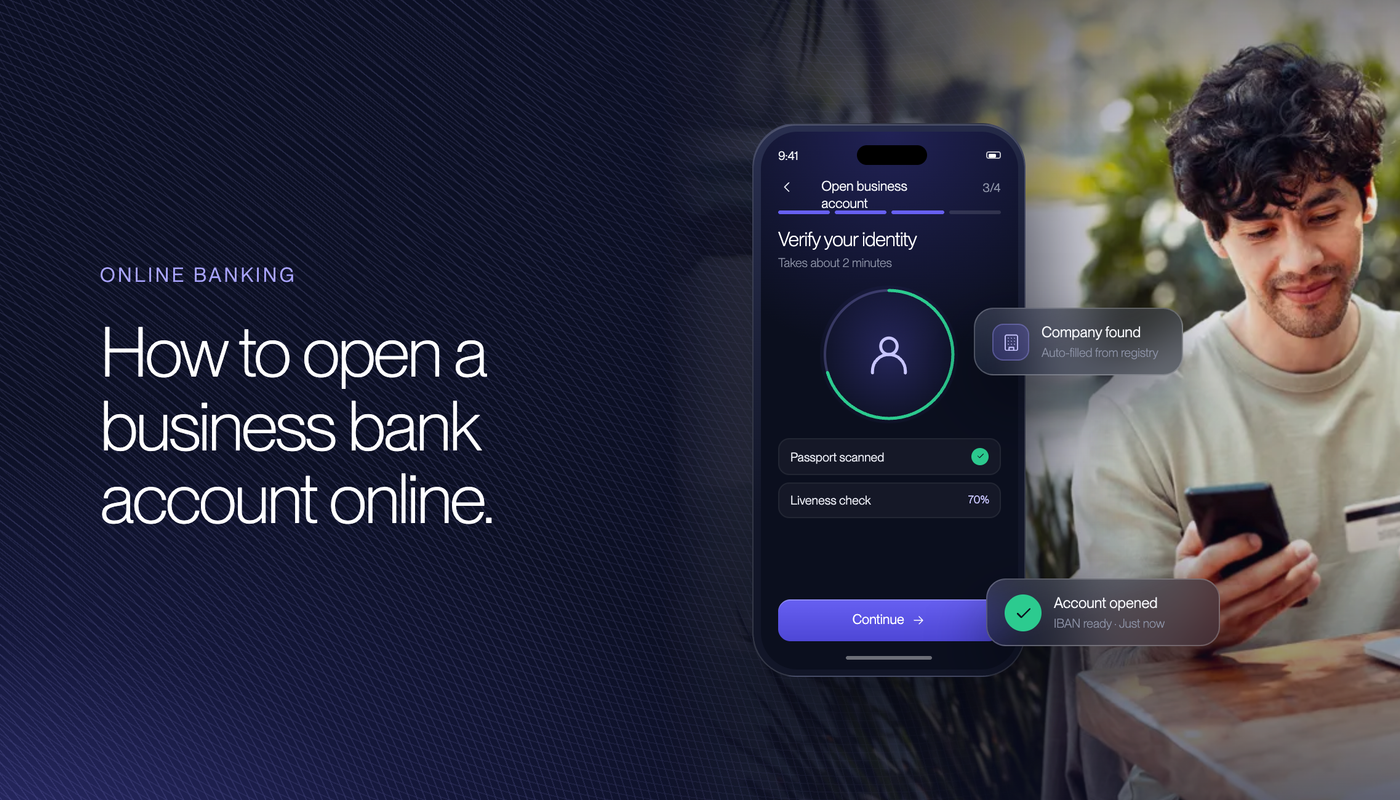
Every director and beneficial owner gets a link, and each completes their own check on a phone: photograph the identity document, then a short liveness capture. Where the document has an NFC chip, the app reads it directly, which is both faster and much harder to fail.
This is the step that stalls applications, because it depends on people in different time zones acting promptly. Send the links the same day, and tell everyone the check takes three minutes, since most delays come from people assuming it is longer.
Step 4: The Business Questionnaire
What the company sells, to whom, in which countries, expected monthly turnover, average transaction size, main suppliers and main customers, and the source of the funding. This is the same information a bank would ask across a desk, entered once instead.
Write it out before you open the form. The questionnaire usually times out, answers are hard to revise afterwards, and vague answers here are the single biggest cause of the follow-up questions that turn a two-day onboarding into a two-week one.
Step 5: Sign and Fund
The account agreement is signed electronically, which is legally equivalent to a wet signature across the EU and the UK, then the account activates on a first incoming transfer. Most providers require that first payment to come from an account in the company's or a shareholder's name.
A first deposit from an unrelated third party triggers a source of funds review on an account that was already approved. How to open a business bank account covers the underwriting file behind all of this, which is what the review actually reads.
Get Through the Online Application First Time
Most of the delay in a digital application is a document uploaded wrong or a person who has not done their identity check yet.
- A file providers accept: documents current, complete and uploaded in the right slots.
- Two applications in parallel: one slow answer does not cost you another month.
- Business banking: arranged alongside the company rather than left with you.
- Built for non-residents: remote identity checks handled for owners in any time zone.
- Expert advice: holding structures and trusts explained before the portal asks.
How the Online Identity Check Actually Works
Three things happen in about three minutes: the document is captured and validated, a liveness check confirms a real person is present, and the face on the document is matched to the face in the capture. Everything else is the provider comparing the result against what the registry and your application say.
The Document Capture, and Why the Chip Matters
The app photographs both sides of a passport or identity card and reads the machine-readable zone, then checks the security features and the internal consistency of the data. Where the document contains an NFC chip, which most passports issued in the last decade do, holding it against the phone reads the signed data directly from the chip.
Use the chip route where it is offered. It removes almost every failure mode in the photographic path and it is the difference between a check that passes first time and one that asks for a fourth attempt.
Liveness and the Face Match
The liveness step confirms a live human is in front of the camera rather than a photograph, a screen or a mask, usually by asking you to turn your head or by analysing depth and micro-movement passively. The face is then compared with the portrait on the document.
Deepfake-resistant liveness is now standard at serious providers, which is why the checks have got stricter about screens and reflections. Nothing about that is aimed at you, it is aimed at the injection attacks that made simple selfie checks unreliable.
Why Checks Fail, and What Actually Fixes It
- Glare on the document: the most common single failure. Move away from overhead lights and windows, and never photograph through a plastic sleeve.
- A cropped edge: the whole document has to be in frame, including the border.
- A worn or damaged document: the machine-readable zone is the fragile part, so use the chip if it has one.
- A poor camera or an old phone: borrow a newer one rather than retrying six times.
- An unsupported document type: a driving licence or a residence permit where the provider only accepts passports and national identity cards.
After three or four failures most systems lock the check and route it to manual review, which adds days. Get the conditions right before the first attempt rather than after the third.
The EU Digital Identity Wallet Changes This From 2026
Under Regulation (EU) 2024/1183, which entered into force on 20 May 2024, every member state has to make a European Digital Identity Wallet available to its citizens and residents, with rollout landing through 2026. Banks and other regulated sectors are among the relying parties that must accept it during the 2026 to 2027 window.
For an EU-resident founder that eventually replaces the document scan with a verified credential the provider can check instantly. It does not remove the company-side checks, and it does nothing for owners outside the EU, so treat it as a coming improvement to one step rather than to the whole process.
What Breaks in an Online Business Bank Account Application
Four things account for most stalled online applications, and all four are visible before you start.
One Person Who Has Not Done Their Check
Providers rarely proceed on a partial set, so a single director who has not opened the link holds everything. With owners in three time zones this alone routinely costs a week. Send every link on the same day and chase the same day.
A Structure the Automated Checks Cannot Follow
Registry lookups resolve a company to its shareholders. They do not resolve a shareholder that is itself a company in another country, and they never resolve a trust. At that point the file leaves the automated path and joins a manual queue, which is exactly the delay an ownership chart uploaded at step two prevents.
A Business Description That Cannot Be Categorised
The questionnaire feeds a risk model. A description that could describe six different businesses gets the cautious classification, and cautious means questions. Naming your actual customers, countries and volumes is what keeps an application in the fast lane.
Funding the Account From the Wrong Place
Approval is not activation. A first transfer from a friend, a customer or an unrelated company puts a freshly approved account straight into review. Fund it from the company or from a named shareholder, and only after the account is confirmed open.
Open the Company and the Account Online Together
Half the delay in an online application is waiting for documents the incorporation already produced. Doing both together removes that gap.
- Business banking: the account opened as part of the setup, not left to you afterwards.
- Built for non-residents: the whole process handled remotely, wherever the owners live.
- Onboarding from 2 days: with providers that run the full flow digitally.
- Jurisdiction selection: the country picked around where you can actually bank.
- Flat fee from EUR 350: quoted in full upfront, nothing taken before the scope is agreed.
Best Providers to Open a Business Account Online
All four run a digital onboarding flow with no branch visit. They differ on speed, cost and how much human help sits behind the portal when something needs explaining.
Equals Money, the Fastest Digital Flow
Equals Money runs a business account with no monthly fee, no account opening fee and onboarding published at two days. Everything is done through the portal, and for a single-owner company with documents ready it is the shortest route on this page from application to a working IBAN.
Check the conversion spread against your own volumes before settling, because a zero-fee product earns elsewhere.
Equals Money
Business Bank Account
Time to onboard
2 Days
Account opening fee
Free
Monthly fee
€30
Trumia, a Human Behind the Portal
Trumia Limited is an authorised payment services provider and electronic money institution licensed by the Malta Financial Services Authority. Onboarding is one week and the account costs EUR 50 a month.
A digital flow is fast until something needs explaining, and then it is only as fast as the next queue. A named contact is worth the fee where the structure has a corporate shareholder, a trust, or an activity that will not fit the questionnaire's categories.
Trumia
Business account
Monthly fees
€50
Onboarding fees
€500
Time to onboard
1 week
Accepts
Gambling, Betting, Casino, Crypto, and more
3S Money, Online Onboarding at Volume
3S Money is a cross-border payments account with free opening, four-day onboarding and pricing from EUR 100 a month. The flow is digital and the service model is built for companies moving significant volume across several countries.
Below roughly EUR 50,000 a month in cross-border flow the fee is hard to justify. Above it, the fee is small against the spread and the failed payments it prevents.

3S Money
Cross-border payments
Time to onboard
4 Days
Account opening fee
Free
Monthly fee
Starting from € 100
Moneybase, Multi-Currency and Fully Digital
Moneybase offers a multi-currency business account with free opening, four-day onboarding and pricing from EUR 9.99 a month. Digital onboarding, several currencies in one account, and no volume you have to reach first.
Read the four together and the online choice sorts quickly. Speed with no recurring cost points at Equals, a structure that needs explaining points at Trumia, several currencies at moderate volume point at Moneybase, and heavy cross-border flow points at 3S Money. Three of the four charge no account opening fee, and Trumia does not publish one either way.

Moneybase
Multi Currency Business Account
Time to onboard
4 Days
Account opening fee
Free
Monthly fee
Starting from € 9.99
Online Business Bank Account Against a Branch Account
An online business bank account wins clearly on speed and on accepting foreign ownership. The branch route wins on cash, credit and the small number of situations where a person can resolve something a form cannot.
| Online with an EMI | Branch with a bank |
|---|---|---|
Time to open | 2 days to 2 weeks | 3 to 12 weeks |
Travel required | None | Often, for at least one director |
Identity verification | Document scan and liveness check | In person, with originals |
Documents | Clear scans, uploaded | Often certified or apostilled |
Non-resident owners | Routinely accepted | Often refused without a local link |
Cash and cheques | Almost never | Yes |
Lending and overdrafts | No | Yes |
Complex structures | Routed to manual review | Handled by a person from the start |
Typical monthly cost | EUR 0 to EUR 100 | EUR 5 to EUR 40 |
The honest read: for a trading company that invoices and gets paid electronically, the branch offers nothing it needs and costs weeks. For a company handling cash or seeking credit in its first year, the wait buys something real.
The licence difference underneath that comparison, including how your balance is protected in each case, is covered in what a business bank account actually is.
Choose a Provider That Opens Fully Online
The difference between an online application and an online account is whether the flow ends in a portal or in a branch. That is checked before you apply.
- Business banking: matched to providers that complete the whole process digitally.
- Onboarding from 2 days: with the ones that publish a turnaround and hold to it.
- Two applications in parallel: so a slow answer does not cost you another month.
- Built for non-residents: foreign ownership is their normal case, not an exception.
- Expert advice: structures that will not fit a questionnaire handled in house.
Common Mistakes When Opening a Business Account Online
Four mistakes turn a two-day onboarding into a two-week one, and none of them is about the company being unsuitable.
Starting the Application Before the File Is Ready
Portals time out, save partially, and in some cases lock the application once submitted. Assemble every document and write the business description before you open the form, then complete it in one sitting. Half-finished applications are also read as abandoned by some review queues.
Photographing Documents Instead of Scanning Them
A phone photo at an angle, with a shadow across the page or an edge missing, is the most common upload rejection. Use a scanner app that flattens and crops properly, capture every page including blank ones where the document is numbered, and check the result is readable before uploading.
Leaving the Identity Links Until Someone Has Time
The identity check takes three minutes and it is the step that most often adds a week, purely because links sit unopened. Send them all at once, say how long it takes, and get everyone to use the chip route on a recent phone in even lighting.
Treating the Questionnaire as a Formality
It is the only part of the application a human definitely reads, and it decides your risk classification. Generic answers produce cautious classifications, cautious classifications produce questions, and each question costs days.
Reading how KYB onboarding runs from the compliance side is the fastest way to see which parts of the digital flow are automated and which reach a person, and what each of them is checking.
Which Route to Open a Business Bank Account Online Fits You?
Three questions decide how you open a business bank account online: how simple the ownership is, where the owners live, and whether the business needs anything only a bank provides.
A New Company, One or Two Owners, No Cash
An online business bank account with an EMI, opened alongside the incorporation. Two to five business days, no certification, no travel, and no monthly cost if you choose the zero-fee product. There is no advantage in waiting for a branch appointment.
Owners Living Outside the Country of Registration
Also fully online, and in practice the only reliable route, because the branch requirement is what stops most foreign-owned companies. Expect a slightly higher evidence standard on proof of address and source of funds, and pick a provider that underwrites foreign ownership as routine.
A Holding Company, a Trust or a Regulated Activity
Start online, but expect the file to leave the automated path. Upload the ownership chart and every intermediate entity's documents at step two, and choose a provider where a named person can take the explanation. Budget weeks rather than days.
Where to Go Next
With the route chosen, the documents needed to open a business bank account is what you will be uploading, and the requirements checklist is what the provider is testing them against.
Local practice still varies, so the country guides are worth a look before you apply: Cyprus, Malta and the UK for non-resident owners.
Open Your Business Bank Account Online This Week
A prepared file and the right provider is the difference between an account open in days and an application still in a queue next month.
- Business banking: the account opened as part of the setup, not left to you afterwards.
- Onboarding from 2 days: with providers that complete the whole process online.
- Built for non-residents: no visa, no residence, no flights, no local partner.
- A file providers accept: complete and correctly uploaded before the review starts.
- Expert advice: licensing, holding structures and multi-country groups handled in house.