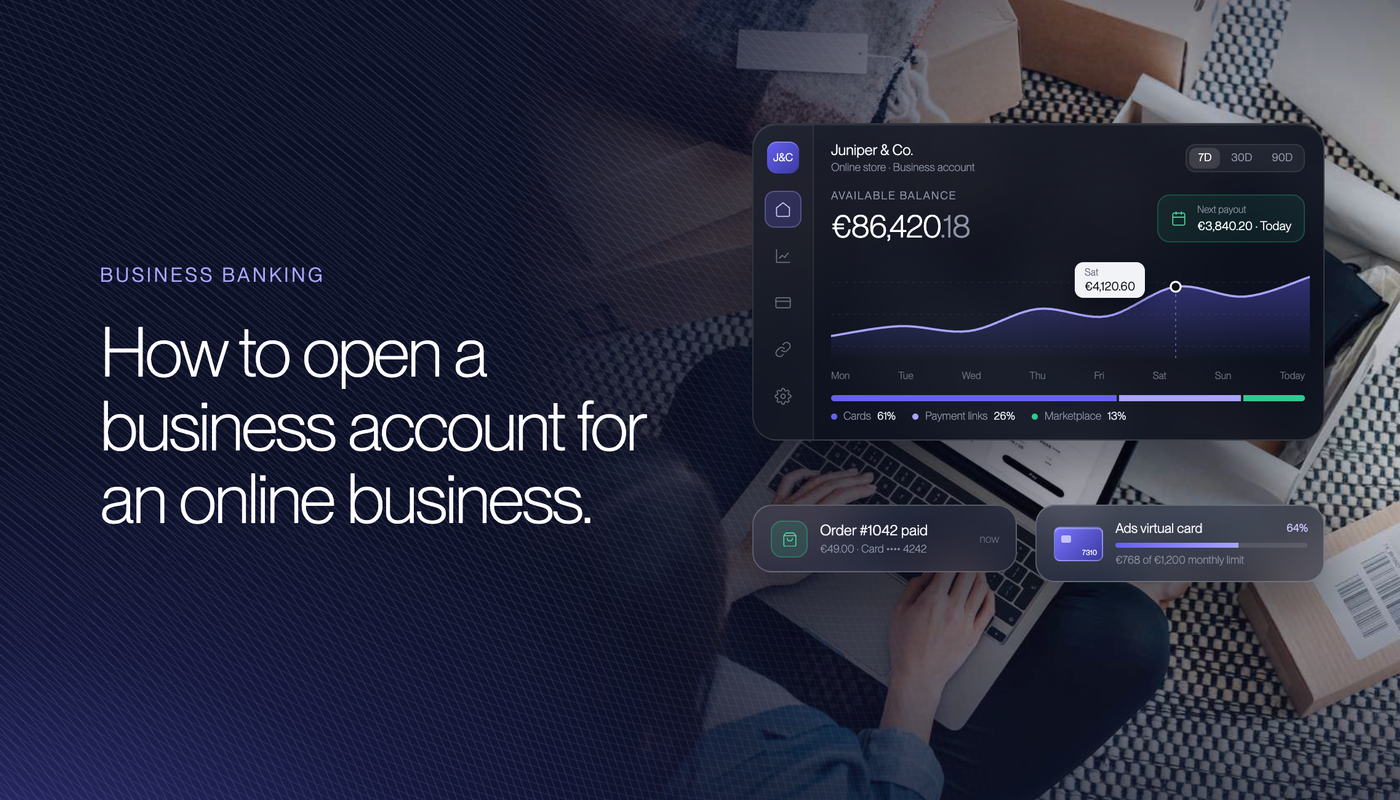
A business account for online business is where your store's money lives. Payouts from Stripe, Shopify Payments, PayPal and Amazon arrive, suppliers and advertising get paid, and your sales stay apart from your personal money, which makes tax returns and VAT much easier. With accounts in more than one currency, you can keep euros and dollars from foreign buyers instead of losing a cut on every conversion.
The hard part is the bank. High street banks want a UK-resident applicant, and many digital banks only take companies with a local presence. Money arrives in lumps from platforms and from buyers the bank does not know, some products are excluded outright, and in the FCA's 2023 review, some UK firms declined up to 11.4% of business account applications.
This is where we come in. We prepare your file, from the live store and supplier invoices to your expected volumes, and open the account with our regulated partners. They work with online sellers and open multi-currency accounts in days.
Our top-rated, licensed banking providers for online sellers open multi-currency business accounts in days, with dedicated IBANs, cards and no branch visit.

MoneyGate
Business Banking
Monthly fee
€30
Onboarding fee
€500
Time to onboard
2-3 days
Features
Dedicated IBAN, SEPA, FX and more

Trumia
Business account
Monthly fees
€50
Onboarding fees
€500
Time to onboard
1 week
Accepts
Gambling, Betting, Casino, Crypto, and more
Why a Business Account for Online Business Is Hard to Open
A business account for online business is hard to open because an online store does not look like the businesses banks are built for. There is often no shop and no local office, the owners may live abroad, and the money comes from payment platforms and buyers in many countries. Each of those points adds a question for the bank, and the bank can say no without explaining why.
Banks Want Local Owners
UK high street banks set residency rules before they look at the business. Barclays needs at least one UK resident on the application. Lloyds wants a UK resident with a UK mobile number, trading from a UK address. HSBC UK's small business account is for UK tax-resident businesses. Starling goes further: every person with significant control, and every director with access to the account, must live in the UK. Revolut Business takes companies that can prove a physical presence in the UK or the EEA. A founder selling from Dubai or Lagos through a UK company falls outside most of these rules on day one.
Money Comes From Platforms and Strangers
UK money laundering rules list "payments will be received from unknown or unassociated third parties" as a higher-risk factor, and that describes almost every store. Platforms also hold money back. PayPal holds a new seller's first payments for up to 21 days, and Shopify Payments can keep a reserve, for example 10% of each transaction for 120 days, to cover disputes and refunds. The bank sees uneven payouts from processors, refunds going out and card disputes, and it has to understand all of it before it says yes.
Open a Business Bank Account for an Online Business
Opening the account is very achievable when the store and its money flows are explained before the bank asks. This is what we do for you.
- Partners for online sellers: Licensed providers that work with ecommerce businesses.
- No branch visit: Everything is done online, with no need to travel.
- Accounts in days: Not the weeks or months owners abroad can face at a high street bank.
- Several currencies: EUR, GBP, USD and more, with dedicated IBANs.
- Suppliers and ads paid: SEPA, SWIFT and business cards for your spending.
- Clear pricing, no surprises: One quote before we start.
Some Products Are Excluded Outright
Most banks and payment accounts publish a list of businesses they will not serve, and online sellers hit those lists more than most. Starling excludes adult entertainment, unlicensed drugs including CBD, and the sale of used vehicles. Revolut Business adds fake or counterfeit goods. Wise's acceptable use policy covers the unauthorised sale of designer or brand products, nutraceuticals that make unreasonable health claims, online pharmacies and multi-level marketing. Stripe prohibits counterfeit goods and restricts CBD and tobacco. Dropshipping itself is not on the lists of Starling, Revolut, Wise, Tide or Monzo, so the product matters more than the model.
Why Online Business Accounts Get Refused
Refusals are common. In the FCA's review of UK payment accounts, firms in the central range declined between 0.2% and 11.4% of business account applications, and concerns about financial crime were among the most common reasons. Online fraud keeps banks careful. Remote purchase card fraud in the UK reached £423.5 million in 2025, and since October 2024 a UK payment firm that receives the money from an authorised push payment scam pays half of the victim's refund. A new account with no trading history and money from strangers is the kind of account banks review hardest. Banks rarely explain a refusal, so the file has to be right the first time.
Read more: Why banks reject business account applications and how to open a high risk bank account.
Banks That Open Accounts for Online Businesses
Most banks will open a business account for online business if the owners fit their rules. Which one is the best business bank account for online business depends on where the owners live and where the buyers are. The table shows who each bank takes and what it costs.
Bank | Who it takes | Who it turns away | Monthly fee or minimum |
|---|---|---|---|
Barclays | UK businesses with at least one UK-resident applicant | Applications with no UK resident | £8.50 a month after 12 months free |
HSBC UK | UK tax-resident businesses with turnover up to £6.5 million and fewer than 50 staff | Businesses that are not UK tax resident | No monthly fee on its small business account |
Lloyds | UK residents trading from a UK address, with turnover up to £3 million | Applicants without UK residence or a UK mobile number | £10 a month after 12 months free |
NatWest | Businesses with a UK-resident applicant, registered for UK tax | Applicants who are bankrupt or have a County Court Judgement | No minimum monthly charge, 35p per automated payment |
Starling | UK companies whose owners and directors live in the UK | Holding companies, corporate owners, CBD, adult and used vehicle sellers | No monthly fee |
Revolut Business | Companies with a physical presence in the UK or the EEA | Counterfeit goods, adult content, cannabinoids and gambling | From €10 a month in Ireland |
Mercury (US fintech) | Companies formed in the US, with founders from many countries | Companies formed outside the US, cannabis, adult and internet gambling | No required monthly fee |
For a UK-resident seller who sells in pounds, a high street account is a fair start. For everyone else, the list gets short fast. Owners abroad, a company registered outside the UK, sales in several currencies or a product on an excluded list each rule out part of the table. Payment accounts such as Wise, Airwallex and Payoneer run their own reviews too, so they are not a way around the same questions.
High Fees on Every Cross-Border Payment
Online sellers pay suppliers, freelancers and ad platforms abroad, and every payment costs money at a high street bank. An international payment costs £15 to £17 online at Barclays, HSBC UK, Lloyds and NatWest, and £20 to £30 in a branch. Add an agent fee of £12 at NatWest, or £12 to £20 at Lloyds, when you pay the overseas bank's charges. Receiving a payment from abroad costs £6 to £7 for amounts over £100 at the same four banks.
Currency Margins Take a Cut
The bigger cost is the exchange rate. Barclays says its conversion charge for business customers is no more than 2%, Lloyds charges 2.60% on conversions up to £25,000, and Barclays, HSBC UK and NatWest charge 2.75% when you spend abroad on a business debit card. The platforms charge too. Stripe adds 2% when it has to convert a payment, and PayPal UK charges 3% above its base rate. A seller with buyers in Europe and the US can lose 2% to 3% of foreign sales before a single bill is paid.
Platforms Have Their Own Payout Rules
The account also has to suit the platforms. Stripe wants a current account whose name matches your bank statement, in a currency that matches your payout settings. PayPal UK wants a bank in the same country as your PayPal account, in the local currency, and warns that most online-only or prepaid accounts may not work. Shopify Payments in the UK pays into a GBP account located in the UK, and does not support savings accounts or money transfer services that mimic bank accounts. eBay wants an account in your country of residence or establishment. Inside the EU, the SEPA Regulation stops a payer from insisting that your euro account sits in a particular EU country, as long as it can be reached by SEPA.
Slow Reviews When the Owners Live Abroad
Where a bank will take an overseas-owned business at all, it takes time. UK government guidance says opening an account for an overseas-owned business can take 4 weeks to 3 months. That can mean up to a quarter of platform payouts and supplier bills with nowhere to put them.
Read more: Business bank account for non-residents and best UK business bank accounts for non-residents.
MoneyGate
Business Banking
Monthly fee
€30
Onboarding fee
€500
Time to onboard
2-3 days
Features
Dedicated IBAN, SEPA, FX and more
A Faster Way to Open a Business Account for an Online Business
There is a better alternative to the bank queue. Our partners, MoneyGate and Trumia, are electronic money institutions licensed in the EU. MoneyGate is authorised by the Central Bank of Cyprus and built for high-volume international businesses, and it named ecommerce merchants among its target clients when it was licensed. Trumia is licensed by the Malta Financial Services Authority and names ecommerce and global merchants among the businesses it is built for.
MoneyGate gives each company a dedicated IBAN in its own name, with accounts in EUR, GBP and USD, payments over SEPA, SEPA Instant and SWIFT, Mastercard debit cards that work with Apple Pay and Google Pay, bulk payments by CSV upload and user roles to view, start and approve payments. Trumia says it holds and converts 17+ currencies and pays out in 40+, with multi-bank virtual IBANs, Visa business cards, batch payments and maker-checker approvals. Payments between Trumia account holders settle instantly, 24 hours a day. Both connect by API, so supplier payments and refunds can run from your own systems.
We prepare the file before either partner sees it: the company documents, the owners' identity, a link to the live store, supplier invoices and your expected monthly volumes. As EMIs, both must safeguard client money by law, usually by keeping it separate from their own funds, and Trumia holds it in segregated accounts at European banks. Be clear about what the account does: it receives, holds, converts and pays money. It does not offer loans or overdrafts, pay interest or come under a deposit guarantee scheme.
Feature | High street banks | Our partners |
|---|---|---|
Time to open | 24 hours for some UK residents, 4 weeks to 3 months for overseas-owned businesses | 2 to 3 business days at one partner, about a week at the other |
Who they accept | At least one UK-resident applicant, at most banks | Reviewed case by case; one partner takes companies from the EU or another reputable jurisdiction |
Minimum balance | None at most banks | None on published plans |
Monthly cost | £0 to £10 | €25 to €50 on published plans |
Currencies | GBP, with separate currency accounts at extra cost | EUR, GBP and USD at one partner, 17+ at the other |
International payments | £15 to £30 each, plus agent fees | €25 plus 0.10% to 0.15% at one partner |
Currency conversion | Up to 2% to 2.6% on smaller amounts | 0.8% to 1% over the interbank rate at one partner |
Lending and overdrafts | Available at banks | Not offered, funds safeguarded instead |
For a seller with buyers and suppliers in several countries, the best business bank account for online business opens fast and converts currency for less than a high street bank. Our partners open in days, and one converts at 0.8% to 1%. A UK-resident seller who sells only in pounds may still want a high street account, and the two work side by side.
Which Online Businesses Our Partners Accept
Our partners name ecommerce merchants among the businesses they serve, and we put forward online stores, brands that sell direct to buyers and marketplace sellers. We check the fit before anyone applies. Trumia's terms prohibit payments for drugs, weapons and other unlawful goods, and money from prohibited or unacceptable countries can be rejected. Neither partner will take a business that cannot show who owns it or where its money comes from. Counterfeit goods and unlicensed brand resale are refused across the market, and products such as CBD or supplements with health claims need a conversation before the application, not after.
Opening the Account Without a Branch Visit
To open a business bank account for an online business with our partners, the application runs online in four steps. We build the file with you, the directors and owners verify their identity online and sign, the partner's compliance team reviews the business and asks any questions through us, and the account goes live with its IBANs and cards. No one has to visit a branch, and you can add team members with their own permissions.
Trumia
Business account
Monthly fees
€50
Onboarding fees
€500
Time to onboard
1 week
Accepts
Gambling, Betting, Casino, Crypto, and more
Documents for a Bank Account for an Online Business
The documents for a bank account for an online business cover the company, its owners and proof that the store is real and trading. We gather them with you and write the parts reviewers care about most.
Company and Owner Documents
Provide the certificate of incorporation, the articles, the register of directors and shareholders and, where another company owns part of the business, an ownership chart up to the individuals. Every director and every owner of more than 25% sends a passport and proof of address. Wise, for example, asks for a document showing who owns or controls the company.
A Live Store With Clear Policies
Reviewers open your website. Stripe expects the business name, a description of what you sell, customer service contact details, a return policy for physical goods, a refund and dispute policy and the terms of any promotions. Revolut accepts an Amazon or eBay seller profile as proof of an online presence, but it must clearly show your business name as the seller, and a website must be fully completed. Payoneer warns against sending a site that is offline or under construction.
Proof That You Trade
A new store has little history, so show what you have. Revolut accepts a signed supplier agreement dated within the last 12 months, supplier invoices from the last 6 months, a signed customer contract, or an invoice with a matching bank statement. Payout statements from Stripe, Shopify, PayPal or Amazon show real sales. A store that has not launched yet should add a short business plan, which Airwallex asks new businesses for.
Expected Volumes and Countries
Banks ask how much money will move and where. Payoneer's questionnaire asks for average monthly volume in and out, and UK Finance's account opening guide says banks ask which countries your customers and suppliers are in and roughly what share of turnover each one is. Give real numbers: monthly sales, the currencies they arrive in, the main suppliers and the platforms you sell on.
Tax Registrations
Add your VAT number and any One Stop Shop or Import One Stop Shop registration. In the UK, a business registers for VAT once taxable turnover passes £90,000 in 12 months, but a seller based outside the UK must register whatever its turnover, unless all its UK sales go through marketplaces that account for the VAT. In the EU, a €10,000 threshold for cross-border sales to consumers decides when you charge VAT in the buyer's country. Platforms also report sellers to tax authorities under DAC7, including the seller's bank account details, so the account should match the business on file.
Read more: Documents needed to open a business bank account and business bank account requirements.
Prepare the Bank Account File for Your Online Store
An online business account opens fastest when the store, the owners and the money flows fit on a few pages. We prepare it with you.
- Company pack: Incorporation, articles, directors and an ownership chart.
- Store checked: Live site, policies and seller profiles reviewed before submission.
- Trading evidence: Supplier invoices, contracts and payout statements.
- Volumes and countries: Monthly sales, currencies and main suppliers set out.
- Tax details: VAT, OSS and IOSS registrations ready.
Ecommerce Business Bank Account Costs
An ecommerce business bank account costs more than its monthly fee. The fee is the small number. The money goes on currency conversion, international payments and receiving charges, and online sellers pay all three every month. The table sets typical ranges at UK banks against our partners' published plans. Payment and conversion fees are from one partner's plans.
Charge | Typical range at a bank | With our partners |
|---|---|---|
Account opening | Free at UK high street banks, for eligible applicants | €500 to €1,000 one-off on published plans |
Monthly fee | £0 to £10, often free for the first 12 months | €25 to €50 on published plans |
Minimum balance | None at most high street banks | None on published plans |
Extra users | Varies by bank | Free on published plans |
Currency accounts | Separate currency accounts, often with extra fees, such as £2 a month for a Starling euro account | Several currencies in one account, extra IBANs free on published plans |
Euro payments (SEPA) | Free to 35p to send, free to receive from the EEA | 0.20% each way, or €1 plus 0.10% on the other plan |
International payment out | £15 to £40, plus agent fees of £4 to £20 | €25 plus 0.10% to 0.15% |
International payment in | Free to £7 per payment | €25 plus 0.10% to 0.15% |
Payment made in a branch or by phone | £20 to £30, or £40 by post at HSBC UK | Online, app or API at the standard rate |
Transfers to another client of the same provider | Free | Free to 0.20%, settled instantly |
Currency conversion | Up to 2% to 2.6% on smaller amounts | 0.8% to 1% over the interbank rate at one partner |
Card spending abroad | 2.75% of the amount | Confirmed in your quote |
For most online sellers, currency is the biggest cost of a business account for online business. Take a store that sells €40,000 a month to European buyers and converts each payout to pounds. At a 2% margin that costs €9,600 a year. At 0.8% over the interbank rate it costs €3,840, a saving of up to €5,760 before account and payment fees. Letting the platform convert costs as much or more, at 2% with Stripe or 3% above the base rate with PayPal. That is why the best business bank account for online business is rarely the one with the lowest monthly fee.
Per-payment fees are a different story. A UK bank charges up to £7 to receive a payment from abroad, while one partner's published plans charge €25 plus 0.10% to 0.15% on cross-border payments, so a store that receives many small SWIFT payments should ask for a custom quote. A UK-resident seller who sells only in pounds to UK buyers will often pay less at a high street bank, and it is fair to say so. All figures are planning ranges drawn from published tariffs, and we confirm your final price in writing before you apply.
MoneyGate
Business Banking
Monthly fee
€30
Onboarding fee
€500
Time to onboard
2-3 days
Features
Dedicated IBAN, SEPA, FX and more
How Long It Takes to Open a Business Account for an Online Business
A business account for online business takes from a day to three months at a bank, depending mostly on where the owners live. HSBC UK says 65% of its small business accounts opened within 24 hours in March to May 2026, but UK government guidance gives 4 weeks to 3 months for overseas-owned businesses. With our partners, accounts usually open in 2 to 3 business days at one and about a week at the other.
Stage | Bank | Our partners |
|---|---|---|
Preparing the file | 1 to 2 weeks to gather store, trading and owner documents | A few days, built with us |
Review and follow-up questions | 24 hours for simple UK applications, weeks for overseas owners | Preliminary approval in about 1 day |
Account open and ready | 4 weeks to 3 months for overseas-owned businesses | 2 to 3 business days at one partner, about a week at the other |
What Slows It Down
The usual delays on an ecommerce business bank account are a store that is not live yet, missing refund or return policies, a seller name on a marketplace that does not match the company name, an owner who is slow to verify their identity, and a sensitive product that the file does not explain. Every missing item restarts part of the review.
Payouts Start After the Account
Opening the account is one step, and getting paid is another. Stripe usually schedules a new account's first payout within 7 to 14 days, depending on industry, country and risk. In the UK and the EU countries it lists, the first payout comes after 7 calendar days, then on a 3 business day schedule. PayPal can hold a new seller's payments for up to 21 days, while eBay usually makes proceeds available within one to two business days. Plan the cash for stock and ads around those dates.
How to Speed It Up
Before you open a business bank account for an online business, launch the store and publish its policies. Make the seller name on every platform match the company name, collect every owner's documents in one round and write down your expected monthly volumes by currency. Apply once, to a provider that takes your kind of online business, rather than to several banks at the same time.
Trumia
Business account
Monthly fees
€50
Onboarding fees
€500
Time to onboard
1 week
Accepts
Gambling, Betting, Casino, Crypto, and more
What Happens After the Account Is Open
Connect your new business account for online business to your platforms first. Add it to Stripe, Shopify, PayPal, Amazon and eBay, check that the name matches each seller account exactly, and set the payout currency. Stripe's multi-currency settlement, available to businesses in the UK, the EU and several other countries, pays out in up to 18 currencies, but it needs a separate supported bank account for each currency. Check that each platform accepts the account details before you switch payouts, because Shopify warns that some virtual accounts see more payout failures.
Then watch your dispute rate. Visa's Acquirer Monitoring Program counts fraud reports and disputes against settled transactions, and since 1 April 2026 a merchant in Europe, the US, Canada or Asia Pacific is rated excessive at 1.5% with at least 1,500 such transactions in a month. The Merchant Risk Council says merchants in the program pay $8 for each fraudulent or disputed transaction, and the fee can differ by region. Mastercard's excessive chargeback level starts at 100 chargebacks in a month and a 1.5% ratio.
Duties are changing too, and they come out of this account. The EU charges a €3 customs duty on each item category in low-value parcels from 1 July 2026, the UK will remove its £135 low-value import relief by October 2028 at the latest, and the US suspended duty-free de minimis treatment for all countries from 29 August 2025.
Keep the file for your ecommerce business bank account current. Tell the provider when you add a product line, a new market, a new owner or a big jump in volume. Keep the account in use as well, because one of our partners charges a dormancy fee of €99 plus 0.5% of the balance after six months without activity.
Why the Company Comes Before the Account
A provider can only review a company that exists and is set up for how you sell. Where the company is registered decides which banks will look at you, which tax registrations you need and which platforms you can use. The table shows common choices for online sellers.
Company | Suits | Banking point | Tax point |
|---|---|---|---|
UK limited company | Selling to UK buyers on Amazon UK, eBay and Shopify | High street banks want a UK-resident applicant | VAT registration once taxable turnover passes £90,000 |
EU company | Selling across the EU from one base | Euro accounts reachable by SEPA, though some platforms want one in the same country | One Stop Shop for cross-border sales to consumers above €10,000 a year |
US LLC or corporation | Selling on Amazon US and to US buyers | US providers such as Mercury take US-formed companies with founders abroad | No duty-free de minimis on imports since 29 August 2025 |
Company outside the EU selling into it | Shipping low-value parcels to EU buyers | Needs an account that pays EU VAT and duties in euros | IOSS for parcels up to €150, plus €3 duty per item category from 1 July 2026 |
Many founders register the company and open the account in one go. Our guides on how to register a company online and how to set up a company as a non-resident walk through the steps. Set up the company first, then open a business bank account for an online business with a complete file.
Common Mistakes With a Business Account for Online Business
Most problems with a business account for online business come from how the store and its money are presented, not from the business itself. These are the mistakes we see most.
Running the Store Through a Personal Account
Stripe, PayPal, eBay and Etsy all want the name on the bank account to match the seller account. Mixing personal and business money also makes the records harder to keep, and a bank reads it as a sign the business is not run separately.
Letting Every Payout Be Converted
Without an account in each sale currency, Stripe converts everything into your default currency and charges 2% for it. Hold the currencies you sell in and convert when you choose.
Applying Before the Store Is Live
An empty site or a page under construction gives the reviewer nothing to check. Publish the products, prices and policies first.
Not Mentioning a Sensitive Product
CBD, supplements with health claims and branded goods bought for resale are on many restricted lists. Saying so up front, with licences and supplier invoices, is far better than an account closed after the first payout.
Ignoring Disputes and Refunds
A dispute rate creeping toward 1.5% puts card processing at risk and makes every provider look harder at the account. Fix delivery and customer service problems before they show up as chargebacks.
Get Help With Banking for Your Online Business
Banking an online business is very manageable when the store and its money flows are planned with the provider in mind. Talk to us before you apply.
- Fit checked first: We confirm your products and markets suit our partners.
- Every currency planned: Payouts, suppliers and ad spend in each currency.
- Refused before: We review the file and fix the gaps.
- Honest advice: We tell you when a high street account should sit alongside.
- One point of contact: From the first call to the first payout.
Bottom Line
A business account for online business is harder to open than most sellers expect. High street banks want a UK-resident applicant, platforms add their own payout rules, money arrives from strangers in several currencies and some products are excluded outright. Every international payment and every conversion costs money on top.
For sellers with buyers and suppliers in several countries, the faster route is a regulated partner that works with online businesses. With a live store, clear policies, trading evidence and expected volumes, a business account for online business opens in days, with IBANs, cards and several currencies, and no branch visit.
Do I need a business account for online business?
What is the best business bank account for online business?
How do I open a business bank account for an online business?
Can a non-resident open a business account for online business?
What documents do I need for a bank account for online business?
How long does it take to open a business account for online business?
Can Stripe and Shopify pay into a multi-currency account?
Why do payment platforms hold my money?
Can a dropshipping business open a business account?
How much does an ecommerce business bank account cost?
What is the VAMP ratio and why does it matter?
Is money in an EMI account protected?
Do I need a bank account in every country I sell to?
Sources
- Stripe: Add a bank account for payouts
- Stripe: Multi-currency settlement
- Shopify Help Center: Bank account requirements
- Shopify Help Center: Reserves
- PayPal UK: Why can't I link a bank account?
- Visa Acquirer Monitoring Program fact sheet
- FCA: UK payment accounts, access and closures
- UK Finance: Annual Fraud Report 2026
- Payment Systems Regulator: APP scams reimbursement policy statement
- The Money Laundering Regulations 2017, regulation 33
- Starling Bank: Business account eligibility
- GOV.UK: When to register for VAT
- European Commission: VAT One Stop Shop
- Council of the EU: New customs duty rules for small parcels
- Moneygate: Services
- Trumia: Business terms and conditions