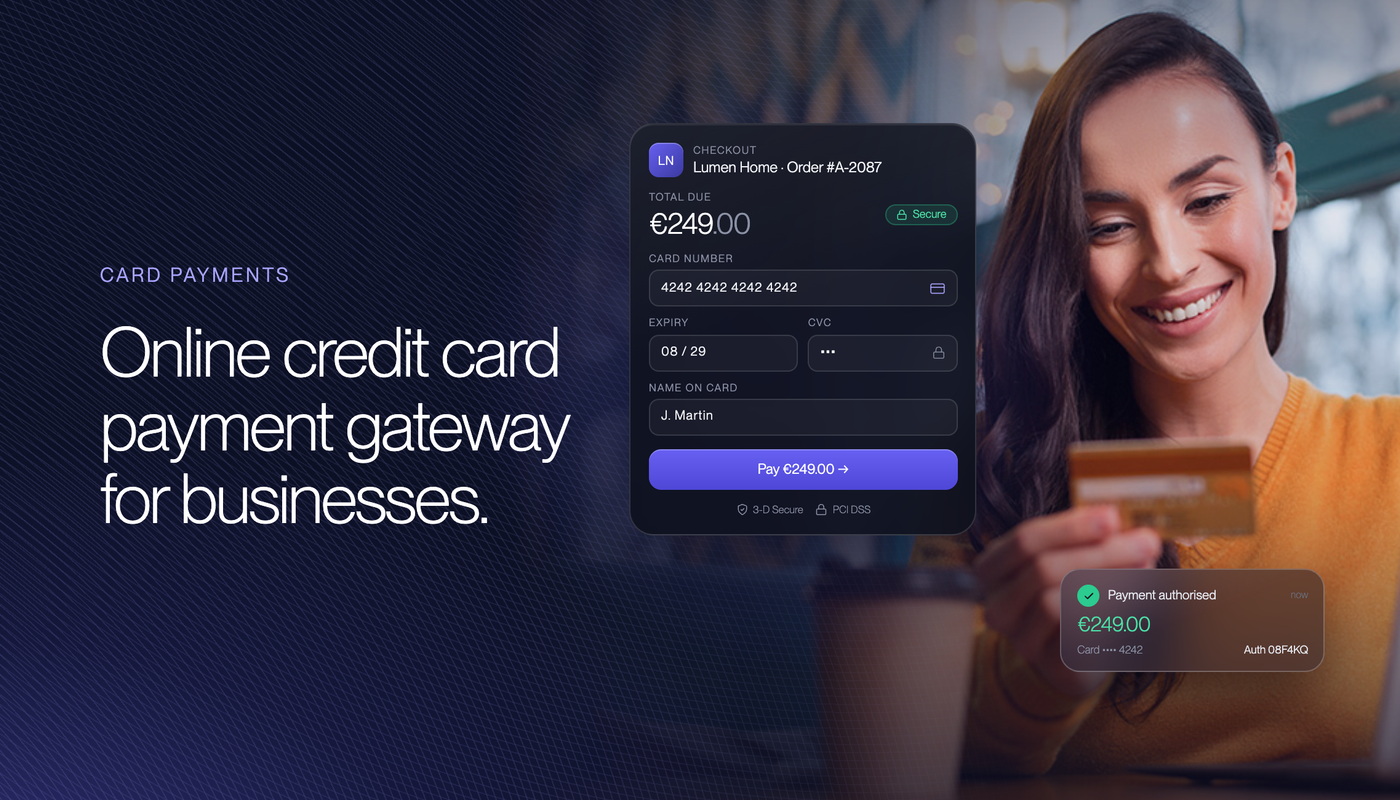
Cards still sit behind a large share of online payments, including Apple Pay and Google Pay, which pay with a card stored in the wallet. Each of those payments passes through a credit card payment gateway in a second or two. The card is checked, the bank says yes or no, and the money is held for you.
The parts that decide your real cost sit behind that checkout. Interchange changes with the card type and the country, security rules change by market, and a gateway that declines good customers or handles disputes badly costs more than its headline rate. Most pricing pages show one number and leave out the rest.
You do not have to work through that alone. Binderr Chooses is one short intake form: we look at your business, place you with a regulated card partner that fits it, and prepare the file and the application with you. Most businesses are taking card payments within 5 to 7 business days.

What Is a Credit Card Payment Gateway?
It is the software that carries card details from your checkout to the banks that approve the payment, and carries the answer back. It encrypts the card data, sends an authorisation request through your acquirer and the card network to the bank that issued the card, and returns an approval or a decline code, usually before the customer's page has finished loading. It then tells your acquirer which approved payments to collect, so the money reaches your account.
Who Is Involved in a Card Payment
Every card payment involves the same parties, even when one company plays several of these roles.
Party | What it does |
|---|---|
Cardholder | Pays with a card, or with a wallet that holds a card |
Merchant | Sells the goods or services and starts the payment |
Payment gateway | Encrypts the card data and routes the request and the answer |
Processor | Runs the technical connection to the card networks |
Acquirer | The bank that holds your merchant account and pays you |
Card network | Visa, Mastercard and others, which set the rules and carry the messages |
Issuer | The customer's bank, which approves or declines and bills the customer |
Visa and Mastercard do not issue cards or sign up merchants themselves. Banks and licensed payment firms do that. American Express often does both, which is why it approves and prices merchants on its own terms.
Card Payment Gateway vs Merchant Account vs Processor
The terms get mixed up because many providers sell all three together. The card payment gateway is the connection. The processor moves the data between banks and networks. The merchant account is the account at the acquirer where approved card payments land before they are paid out to your business bank account. You can buy a gateway on its own and connect it to a merchant account from a different acquirer, or take both from one provider. Our guide to payment gateway vs merchant account vs payment processor explains the split, and our guide to what a payment gateway is covers the basics.
Online Card Payment Gateway vs Card Terminals
An online card payment gateway handles card-not-present payments, where the card is typed in, stored or taken from a wallet on a website or app. A terminal handles card-present payments, where the chip or contactless reader proves the card is really there. That difference changes the price. On Visa's April 2026 US schedule, a Traditional Rewards credit card costs 1.65% plus USD 0.10 in interchange in a store and 2.04% plus USD 0.10 online. It also changes who pays for fraud. Online, you carry the loss on most fraud disputes unless the payment was authenticated.
Get an Online Card Payment Gateway Without the Legwork
Card payments on a regulated partner, with the account, the gateway and the paperwork handled for you.
- Binderr Chooses: one intake form, and we place you with the right card partner.
- Visa and Mastercard: plus wallets such as Apple Pay and Google Pay.
- Fast approval: a preliminary answer in about 1 business day.
- Hosted or embedded checkout: card data kept off your servers from day one.
- Major currencies: settle in USD, EUR, GBP and more.
- KYC pack prepared: documents collected and checked before submission.
How Payment Gateway Credit Card Processing Works
Payment gateway credit card processing runs in two stages. Authorisation happens in real time while the customer waits. Clearing and settlement happen afterwards, in batches, and decide when the money reaches you.
Step | What happens | Typical timing |
|---|---|---|
Checkout | Customer enters a card or picks a wallet, and the gateway encrypts or tokenises the details | Instant |
Authorisation | The request goes from gateway to acquirer, network and issuer, which checks funds, card status and fraud signals | A second or two |
Response | An approval with an authorisation code, or a decline code | Returned at once |
Capture | You confirm the final amount to collect | At checkout, or when goods ship |
Clearing | The acquirer sends captured payments to the card network | Usually once a day |
Settlement | The issuer pays the network, the network pays the acquirer, and the acquirer pays you after fees | Typically 1 to 3 business days |
Authorisation
The issuer checks that the card is open and not reported lost or stolen, that there is enough credit or balance, and how risky the payment looks. The gateway passes along the security results that help it decide: the card security code check, the address check where it is supported, and any 3D Secure result. An approval places a hold on the customer's funds. It is not yet a payment.
Holds do not last forever. Under Visa's rules, a customer-initiated online payment must be processed within 10 calendar days of the authorisation, or 30 days with an extended authorisation indicator. A merchant-initiated payment, such as a subscription renewal, must be processed within 5 days. Capture after the window and the issuer can dispute the charge as late presentment.
Capture and Shipping
For physical goods, Visa's rules set the transaction date on or after the date the goods ship. In practice you authorise when the order is placed and capture when it leaves the warehouse, capturing part of the amount for each parcel if the order ships in pieces. Release any hold you will not use, because customers see pending amounts in their banking app and call their bank about them. Digital goods and services are usually captured at checkout.
Clearing and Settlement
At the end of the day, the gateway or acquirer sends all captured payments for clearing. The card networks work out what each bank owes, the issuers pay, and your acquirer pays you after deducting fees, typically within 1 to 3 business days. New accounts often start on a longer payout schedule or with a rolling reserve, where a share of each day's sales is held for a set period. Ask for both in writing before you sign. If you sell in several currencies, check which ones you can settle in without conversion, which our guide to international payment gateways covers.
Voids, Refunds and Chargebacks
A void cancels an authorisation before it is captured, so the customer never sees a charge. A refund returns money after capture, and many providers keep the processing fee from the original payment. A chargeback is different. The customer disputes the payment through their bank, the money is taken back from your account, and you pay a dispute fee whether or not you win. For fraud claims on online Visa payments, the customer's bank has 120 calendar days from the processing date to raise one.
Security Every Credit Card Payment Gateway Needs
Card security rules exist to keep card numbers out of the wrong hands and to decide who pays when fraud gets through. A good gateway takes most of the work off you, but only if you integrate it the right way.
PCI DSS and Your Self-Assessment
Every business that accepts cards must comply with the Payment Card Industry Data Security Standard, now at version 4.0.1. How much work that takes depends on how much card data you touch. If card details are entered on a page or in fields hosted by your provider, through a redirect or an embedded iframe, you usually complete the shortest questionnaire, SAQ A. If your own page collects the card data and sends it to the provider, you move to SAQ A-EP. If card data passes through or is stored on your systems, you face SAQ D, which runs to hundreds of requirements.
Since January 2025, SAQ A no longer includes the two newer script-monitoring requirements for payment pages, but you must confirm your site is not open to script attacks that could affect the payment page. Separately, the card security code must never be stored after authorisation. The largest merchants, those with more than 6 million Visa transactions a year, need an annual on-site assessment by a qualified security assessor.
3D Secure and Strong Customer Authentication
3D Secure is the step where the issuer confirms the customer's identity, often silently in the background and sometimes with a code or a prompt in the banking app. In the EEA and the UK, strong customer authentication is required for most online card payments the customer starts, when both the issuer and the acquirer are in the region. When a payment is authenticated, liability for most fraud disputes moves from you to the issuer.
Exemptions keep friction down. Payments under EUR 30 can skip authentication until the card reaches 5 payments in a row or EUR 100 in total without it. A provider with a low fraud rate can skip it on payments up to EUR 100, EUR 250 or EUR 500, depending on how low that rate is. Merchant-initiated payments such as renewals sit outside the rule, as our guide to how subscription payment gateways work explains. In the US, 3D Secure is optional, but it cuts fraud losses on risky orders.
Tokenisation and Network Tokens
Tokenisation replaces the card number with a stand-in value that is useless if stolen. Gateway tokens work only with that provider. Network tokens are issued by Visa and Mastercard themselves, stay valid when the bank reissues the card, and carry a one-time code for each payment. Visa rewards them in the US. Its April 2026 schedule takes 0.05% off online interchange on consumer credit cards for token payments, 0.10% for payments under its Digital Commerce Authentication Program and 0.15% for both. Our guide to payment gateway security features covers the rest.
Address, Security Code and Fraud Checks
The card security code check confirms the customer has the card in hand. The address verification service compares the billing address with the issuer's records in the US, the UK and Canada. From 25 July 2026, Visa requires the details sent in these checks to be accurate and true, with no dummy data. On top of that, most gateways score each payment on device, location, spending speed and purchase history, and let you block or review risky orders. Our guide to payment gateway fraud detection goes further.
Payment Gateway Credit Card Processing With Clear Rates
Card processing with every fee agreed before you sign, from the rate to reserves and payout timing.
- Rates in writing: processing rate, fixed fee and extras agreed up front.
- Payout schedule agreed: when funds arrive, set before your first sale.
- 3D Secure handled: authentication and exemptions set up for Europe.
- Stored cards handled: tokens instead of card numbers on your systems.
- Regulated partners only: licensed acquirers and payment institutions.
What Credit Card Payment Gateway Providers Charge
Every card fee has three layers. Interchange goes to the issuing bank and is set by the card networks. Scheme fees go to Visa, Mastercard and the other networks. The markup is what the acquirer and the gateway keep. Credit card payment gateway providers package these layers in different ways, so the same card can cost very different amounts depending on the pricing model.
Interchange Is the Biggest Cost
Interchange depends on the card type, whether the card was present, and where the issuer and the acquirer are. These are published examples for online payments.
Card and market | Online interchange |
|---|---|
US debit from a large bank (regulated) | 0.05% + USD 0.21, plus USD 0.01 for fraud prevention |
US debit from a smaller bank | 1.65% + USD 0.15 |
US Visa Traditional Rewards credit | 2.04% + USD 0.10 |
US Visa Signature Preferred credit | 2.50% + USD 0.10 |
US Visa business credit | 2.65% to 3.00% + USD 0.10 |
EEA consumer debit, issuer and acquirer in the EEA | Capped at 0.2% |
EEA consumer credit, issuer and acquirer in the EEA | Capped at 0.3% |
Between the UK and the EEA | 1.15% on debit, 1.5% on credit |
The US figures are from Visa's schedule effective 18 April 2026. The US debit cap under Regulation II was struck down by a North Dakota court in 2025, but that ruling is on hold while the Federal Reserve appeals, so the cap still applies. The EU caps do not cover business cards or cards issued outside the EEA. Fees on payments between the UK and the EEA rose about fivefold after Brexit. The UK Payment Systems Regulator plans to cap them and won a High Court challenge in January 2026, but the level and the date are still to be set.
Flat Rate, Interchange Plus and Gateway Only
Flat-rate pricing charges one blended rate on every card. Stripe lists 2.9% plus USD 0.30 for US cards, with 1.5% more for international cards and 1% more when currency conversion is needed. Square charges 3.3% plus USD 0.30 online on its free plan and 2.9% plus USD 0.30 on its paid plans. PayPal lists 2.99% plus USD 0.49 for standard card payments and 2.89% plus the fixed fee for its advanced card integration.
Interchange plus pricing passes the real interchange and scheme fees through and adds a fixed markup. Adyen, for example, lists USD 0.13 per transaction plus interchange, scheme fees and 0.60% for Visa and Mastercard, with a minimum monthly invoice that depends on the industry. Gateway-only plans suit businesses that already have a merchant account. Authorize.net charges USD 25 a month, USD 0.10 per transaction and a USD 0.10 daily batch fee.
What the Same Payment Costs Under Each Model
Take a USD 80 online order. On a US Visa Traditional Rewards credit card, interchange is about USD 1.73. A 2.9% plus USD 0.30 flat rate costs USD 2.62, so the provider keeps about USD 0.89 before scheme fees. On a regulated US debit card, interchange is about USD 0.26, but the flat rate is still USD 2.62. If most of your customers pay by debit, or you sell mostly inside the EEA, interchange plus pricing usually costs less once your volume is steady. On small volumes, a flat rate is simpler and the gap is small.
Typical Market Ranges
For a standard online business, these are typical ranges on the lower side of the market. They are the numbers to hold against any quote for payment gateway credit card processing.
Cost item | Typical range |
|---|---|
Setup fee | Usually none |
Monthly fee | Often none, around USD 25 on gateway-only plans |
Processing rate | 1.5% to 3.5% of each payment, lower on EEA consumer cards |
Fee per transaction | USD 0.05 to USD 0.30 |
International cards | Around 1% to 1.5% extra |
Currency conversion | Around 1% to 2% when conversion is needed |
Chargeback fee | USD 15 to USD 25 per dispute |
Surcharges and the 2026 US Settlement
In the US, you can add a surcharge to credit card payments but never to debit or prepaid cards. Visa caps it at 3% and Mastercard at 4%. You must show it at the entry to your store or site and at checkout, and Mastercard requires 30 days' notice to it and to your acquirer. Some states limit surcharges further. In the EU and the UK, surcharges on consumer cards are banned. On US credit cards, Visa also lets you set a minimum purchase of up to USD 10.
A US class action settlement with Visa and Mastercard received preliminary court approval on 9 June 2026. It cuts interchange by 10 basis points for five years, caps standard consumer credit cards at 1.25% for eight years, and lets merchants decline premium and commercial credit cards and surcharge them. Final approval is still pending, so check the status before you change your checkout.
What Makes the Best Credit Card Payment Gateway
The best credit card payment gateway for your business is the one that approves you, approves your customers and pays you on time, at a cost that fits your card mix. The headline rate is the last thing to look at, not the first.
Approval Rate Matters More Than Price
On USD 1 million a year in card sales, a 1% higher approval rate is USD 10,000 more revenue. A 0.2% lower processing rate saves USD 2,000. That is why the best credit card payment gateway on paper is often not the one that earns you the most. Ask for approval rates on businesses like yours, and check how the gateway handles retries, 3D Secure exemptions and network tokens, because those drive the number. Our guide to improving payment gateway success rates covers the detail.
Best Payment Gateway for Credit Cards by Business
There is no single best payment gateway for credit cards. The best card payment gateway for a small shop is rarely the right one for a marketplace, so start from how you sell.
Business | What matters most |
|---|---|
Small online shop | Flat rate, hosted checkout, SAQ A and no monthly fee |
Growing ecommerce brand | Interchange plus pricing, network tokens and fast payouts |
Subscriptions and SaaS | Stored credentials, card updater services and smart retries |
International seller | Local acquiring and settlement in several currencies |
Marketplace or platform | Split payments and onboarding for sub-merchants |
High risk sector | A specialist acquirer that accepts your category |
Our guides to ecommerce payment gateways, SaaS payment gateways and how high risk payment processing works go deeper on each case. For marketplaces, Visa's rules generally require the acquirer to sign directly with any sub-merchant that passes USD 1 million a year in transactions.
Questions to Ask Credit Card Payment Gateway Providers
Before you sign, get clear answers on these points: which acquirer holds the merchant account and in which country; the full fee list, including international cards, currency conversion, disputes and monthly minimums; any reserve, and when it is released; the payout schedule; support for network tokens, card updater services and 3D Secure exemptions; the contract length and any exit fee; and whether you can take your stored card data with you if you leave. Our guide to how to choose a payment gateway provider walks through each one, and our roundup of the best payment gateways covers the main names.
Get the Best Card Payment Gateway for Your Model
We place you with a partner that fits your sector, markets and card mix, and run the application with you.
- Chosen for your sector: a partner that accepts what you sell.
- Built for your markets: acquiring where your customers are.
- Honest answer first: what is realistic for your business, before you apply.
- Reserves agreed up front: no surprise holds after launch.
- One point of contact: one team from application to first payout.
Why Card Payments Get Declined
A decline is not always the customer's fault or yours. Issuers decline for fraud rules, card status, limits and data problems, and many declines are avoidable.
Common Decline Codes and What to Do
Code | Meaning | Can you retry? |
|---|---|---|
05 | Do not honour, a general decline | Yes, within Visa limits, but ask for another card first |
51 | Insufficient funds | Yes, later, within Visa limits |
54 | Expired card | Update the card details first |
14 | Invalid card number | No, ask for the correct details |
41 or 43 | Lost or stolen card | Never |
57 | Transaction not permitted to the cardholder | Never on the same card |
Visa sorts decline codes into four categories. Codes in the first, where the issuer will never approve, must not be retried. The other three can be retried up to 20 times in 30 days, and a retry must not change the original data, such as the merchant category or country, to get a different answer.
How to Raise Approval Rates
Most gains come from sending cleaner data. Use the correct merchant category code, a billing descriptor customers recognise, and full address and security code data. Use network tokens for stored cards. In Europe, let your provider apply exemptions so low-risk payments skip authentication, and use 3D Secure where the issuer expects it. Issuers approve domestic payments more readily than cross-border ones, so selling heavily in one region is a reason to use an acquirer in that region. Our guide to how smart routing and payment orchestration work covers sending each payment to the acquirer most likely to approve it.
Chargebacks on Card Payments
Every chargeback costs you the sale, the goods and a fee, usually USD 15 to USD 25. Too many can cost you the account.
Card Scheme Monitoring Programmes
Visa's acquirer monitoring programme flags an online merchant once fraud and disputes reach 1.5% of transactions, with at least 1,500 cases a month, in the US, Canada, Europe and Asia Pacific, with fees of about USD 8 per case. Mastercard's excessive chargeback programme starts at 100 chargebacks and a 1.5% ratio, with fines that rise from USD 1,000 in the second month to USD 50,000 a month by month 12. Providers usually act well before those lines, and a closed account can put the business on the MATCH list for 5 years. Businesses that run high dispute ratios usually end up on high risk terms, as our guide to what a high risk merchant account is explains.
Compelling Evidence 3.0
Many fraud chargebacks are really customers who forgot or regret a purchase. For online Visa fraud disputes, you can defeat the claim by showing 2 earlier payments on the same card that were not reported as fraud, processed between 120 and 365 days before the dispute, where the IP address or device matches the disputed payment along with one more detail, such as the customer login or the delivery address. From 24 October 2026, those earlier payments can come from other merchants too. Your gateway has to capture that data for this to work.
How to Keep Disputes Down
Use a descriptor customers recognise, show a clear refund policy before checkout, send receipts and tracking, answer customer emails fast and refund when a claim is fair. Dispute alerts from the card networks warn you before a chargeback is filed, so you can refund instead. Authenticate risky orders with 3D Secure to move fraud liability to the issuer. Our guide to chargeback management for high risk merchants covers the tools in detail.
Card Processing Built to Keep Approvals High
A setup that approves more good customers and keeps disputes under the scheme limits.
- Clean transaction data: correct category, descriptor, address and security code.
- 3D Secure where it helps: exemptions used, authentication where it shifts liability.
- Dispute alerts: refund before a chargeback counts against you.
- Your own merchant account: a dedicated account in your company name.
- Support after launch: we stay with you after your first payout.
Setting Up an Online Credit Card Payment Gateway
Setting up an online credit card payment gateway has three parts: the company and bank account, the application, and the integration. Most delays come from the first two, not from the code.
Company, Bank Account and Documents
Every acquirer onboards a registered company with a business bank account for payouts. Expect to provide company documents, proof of ownership down to the people behind it, ID for directors and owners, a description of what you sell, and recent processing statements if you have them. Acquirers run the same business verification checks payment firms are required to run. Our guides to how to set up a company, how to open a business bank account and business bank account vs EMI account cover the groundwork.
What Your Website Must Show
Underwriters check the live site. Under Visa's rules, it must show customer service contact details, and the country where your business is based on the checkout screen or within the checkout pages. A link to a separate page does not count. If you restrict returns or cancellations, the policy must be clear before the customer pays. Add clear terms, a privacy policy, delivery terms and prices in the currency you charge. Our guide to payment gateway requirements lists the full set.
Integration Options
An online card payment gateway with a hosted payment page or embedded card fields keeps card data off your servers and qualifies for SAQ A, and most businesses should start there. A direct API gives full control over the checkout but brings a heavier PCI burden. Ecommerce platforms offer plugins, and some charge extra for outside gateways. Shopify adds 2%, 1%, 0.6% or 0.2% per order, depending on the plan, when you do not use Shopify Payments. Our guides to how to set up an online payment gateway and hosted vs third-party payment gateways cover the choices.
How Long Setup Takes
With a complete file, most businesses are live within 5 to 7 business days with our partners. This is the timeline they work to.
Stage | Typical time |
|---|---|
Quick assessment | 5 minutes |
Preliminary approval | 1 day |
Complete onboarding requirements | 15 minutes |
Provision of services | 3 days |
Total | 5 to 7 business days |
Common Card Payment Mistakes
These are the mistakes that cost card-accepting businesses the most, and each one is easy to avoid.
Choosing on Headline Rate Alone
A low rate means little if approvals are poor, payouts are slow or the reserve is large.
Touching Card Data You Do Not Need
Collecting card numbers on your own servers turns a short PCI questionnaire into a full audit.
Capturing Too Early or Too Late
Capturing before you ship breaks Visa's rules for physical goods. Capturing after the authorisation window invites late presentment disputes.
Ignoring Your Debit and Business Card Mix
Flat pricing overcharges on debit, and business cards cost far more than consumer cards. Price your real mix before you sign.
Retrying Hard Declines
Retrying a lost, stolen or closed card breaks Visa's rules and wastes attempts on cards you could still save.
Apply Once for an Online Credit Card Payment Gateway
Apply once, and we choose the partner, prepare the file and run the application for you.
- One intake form: Binderr Chooses reads your business and picks the partner.
- No provider shopping: one file, one application, one point of contact.
- Documents handled: KYC pack, policies and website checks prepared for you.
- Descriptor and policies checked: set up before your first sale, not after a dispute.
- Live in days: most businesses take payments within 5 to 7 business days.
Bottom Line
The gateway does its real work in the second after the customer clicks pay, and in the days after, when the money settles and disputes arrive. The best credit card payment gateway for you approves a high share of good payments, costs the least for your real card mix, pays out on clear terms and gives you the data to fight disputes. Integrate it so card data stays off your servers, and keep your website and descriptor clean.
We set it up through one intake form with a regulated partner that fits your business, and most businesses are live within 5 to 7 business days. If you want to accept crypto alongside cards, our guide to how crypto payment gateways work covers that side.