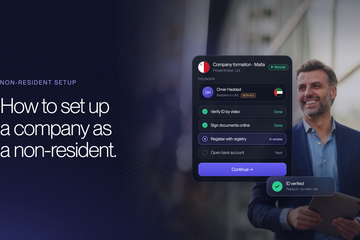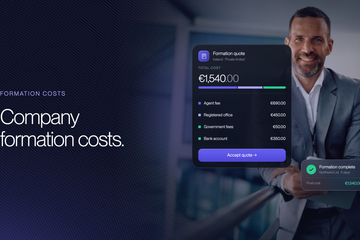
Knowing how to set up a company in 2026 puts a real business behind your work. A company limits your personal risk, signs contracts in its own name and lets you choose your tax system. A UK company can be registered within a day, and EU rules give registries 5 to 10 working days to form a company online.
The hard part is the order of the steps. Many founders file first and find a bank later, then wait weeks while a traditional bank reviews a company with no history. Identity checks are now a legal step at most registries, and each country adds its own rules on local directors, secretaries and tax.
Setting it up with us is simple. We form the company ourselves and plan the account before anything is filed: the country and structure, your KYC file, the documents, the filing and the business account through our partners. You get one team, one price from €350 and a company within about a week.
For most first companies we recommend a UK private limited company, from €350 with us and the Companies House fee already in the price.
.svg.webp?w=96&q=75)
UK Company Incorporation
Binderr
Corporate tax
19% (small profits) / 25% (main rate)
Time to Incorporate
1 Week
Cost
€350 (no pre-payment)
Why Set Up a Company in 2026
You set up a company to separate the business from yourself. The company owns its contracts, its debts and its profits, and it can hire, raise money and be sold. Company formation is also faster and more open to foreign owners than ever, so the real work is planning.
Limited Liability for Your Personal Assets
A private limited company is a separate legal person. If it cannot pay its debts, creditors claim against the company and not your home or savings, unless you signed a personal guarantee. That protection is the first of the advantages of incorporating a company, and it is why most founders set up a company before the first large contract.
A Tax Rate You Choose
Corporate tax rates differ widely. The UK charges 19% on profits up to £50,000 and 25% above £250,000. Ireland taxes trading income at 12.5%. The UAE charges 0% on taxable income up to AED 375,000 and 9% above it. A company pays tax where it is really managed, so plan that at company setup, not later.
Set Up a Company in About a Week
Company formation is simple when one team runs every step. Here is what we take off your plate.
- Formed by our team: We draft the documents, file them and deal with the registry.
- Account planned early: The bank file is built alongside the company file.
- KYC pack built: We tell you what to send and check it before filing.
- Signed online: Directors verify and sign without travelling in most cases.
- One team throughout: The same people handle your company and your account.
- Ready in about 7 days: Most complete files become a company within a week.
Credibility With Clients and Payment Providers
Large clients often sign contracts only with companies, which is a common reason to start a company early. Payment providers, marketplaces and landlords ask for a company number. A company also builds its own trading record, which helps later with credit, a local bank account and investors.
Ownership You Can Share or Sell
Shares make ownership easy to divide. You can bring in a co-founder or an investor, give shares to staff or sell the business without changing the company itself.
How to Set Up a Company
Every registry asks for the same basic things, so the steps to set up a company barely change from one country to the next. The order decides how fast the company can trade. We plan the bank account before anything is filed, choose the country and structure around it, and file once the file is complete. These are the eight steps we follow.
Decide What the Company Will Do
Write down the activity, where your customers are and where you live. These three facts decide the country, the company type and whether you need a licence.
Plan the Business Bank Account First
Banks and payment providers decide which companies they take on. Their view of your activity, your country and your owners should shape the setup, not follow it. We treat company formation with a bank account as one job, so the account file is ready the day the company exists.
Choose the Country and Company Type
Pick the jurisdiction that fits your customers, your residence and your bank, then the company type. For most first companies that is a private limited company. Tax comes after these, because a low rate in the wrong place is not worth having.
Appoint Directors, Shareholders and an Office
Every company needs at least one director, at least one shareholder and a registered office in its country. Some countries add a company secretary or a local director rule.
Verify Identities and Prepare the Documents
Registries now check directors and record the real owners at incorporation. Collect passports, proof of address and certified copies early. Our list of the documents you need to set up a company shows the full set.
File the Company With the Registry
The filing is the fast part of setting up a company. Our guide on how to incorporate a company walks through the filing itself, and how long it takes to set up a company compares registry times by country. We file and answer the registry's questions for you.
Open the Account and Register for Tax
Once the certificate is issued, the account application goes in and the company registers for tax. A UK company is usually set up for Corporation Tax when it registers with Companies House. A UAE company must register for corporate tax within 3 months of incorporation.
Put the First-Year Filings in a Calendar
Three filings repeat every year in every country: a registry return, the accounts and a tax return. The first UK accounts fall due 21 months after incorporation, and Ireland's first annual return is made up to 6 months after it. Diary each date the day the company is formed.
Read more: the company formation checklist and whether you can set up a company yourself.
Ireland Company Incorporation
Binderr
Corporate tax
12.5% trading / 25% non-trading income
Time to Incorporate
1 Week
Cost
€1,899
Structure and Country for Your Company Setup
For a first company the answer is usually a private limited company in the country where you sell or can bank most easily. Choose the country with the same care, because it sets your tax, your running costs and how banks see you.
Private Limited Company for Most Founders
A private limited company has shareholders whose risk stops at the value of their shares and directors who run it. It is the standard company in the UK and Ireland, and the free zone limited liability company is the closest UAE form. Our guide to limited company formation covers it in detail.
Sole Trader vs Limited Company
A sole trader is you, trading under your own name. There is no separate legal person, so business debts are personal debts and profits are taxed as your income. A company costs more to run, but it protects you and can keep profits inside the business. Our guide to sole trader vs limited company sets out when to switch.
Branch or Subsidiary for an Existing Business
If you already own a company and want to trade in a new country, you can register a branch of it or form a subsidiary. A subsidiary is a separate company, so its debts stay with it. A branch is the parent itself trading abroad. Our guide to a branch office vs subsidiary explains when each one fits.
Set Up Your Company in the Right Country
The structure and the country are the two choices that are hardest to change later. We make them with you before anything is filed.
- Country fit checked: Customers, residence, tax and banking weighed together.
- Structure explained: Ltd, holding company or branch, and which one fits you.
- Tax position planned: Where the company is managed decided early.
- Licence needs flagged: Regulated activities spotted before the filing.
- Groups handled in house: Holding and multi-country structures planned with you.
Directors, Shareholders and Office for Company Incorporation
Every company incorporation needs people and an address. At least one director runs the company, at least one shareholder owns it and a registered office receives official post. Founders abroad can read our guide to setting up a company as a non-resident.
Who Can Be a Director
A UK private company needs at least one director who is a person, and that director can live anywhere. Ireland needs one director resident in the European Economic Area, or a €25,000 bond that runs for at least two years under section 137 of the Companies Act 2014, as our page on non-resident director rules for Irish companies explains. The UAE has no resident director rule in company law, but some free zones and many local banks look for a manager or signatory with a UAE residence visa.
You can usually be a director while you hold a job. Our guide to setting up a company while employed covers what to check in your contract first.
Shareholders and Share Capital
Shareholders can be people or companies of any nationality. The UK and Ireland set no minimum share capital for a private company, and many founders start with 100 shares of £1 or €1. Where a company holds the shares, the registry wants the people at the end of the chain: anyone above 25% in the UK and Ireland, and from 25% in the UAE.
Company Secretary and Registered Office
Ireland requires a company secretary for every company, and section 129 of the Companies Act 2014 stops a sole director from holding both jobs. A UK private company can skip the role. Both countries want a real address as the registered office: since 4 March 2024 the UK registered office rules rule out a PO box and require an address where post reaches a person. We provide the office and, in Ireland, the secretary at formation.

UAE Company Incorporation
Binderr
Corporate tax
0% up to AED 375,000
Freezone Tax
0%
Time to Incorporate
1 Week
Cost
Starting from €1,899
Identity Checks and Registries for Company Incorporation
Company incorporation now starts with proof of who you are. Registries in the UK, the EU and the UAE check directors and record the real owners behind every company. A clean file is the fastest route to a certificate.
Companies House Personal Codes
In the UK, each director now proves who they are before the company can be registered. The rule became law on 18 November 2025. A director checks their ID once through GOV.UK One Login, or through an authorised agent, and Companies House issues a personal code. The application quotes every director's code, so we collect them before filing day.
Ireland's In-Person Witness Rule
Every Irish director gives a PPS number or, without one, files Form VIF to get an identity number. Since 30 April 2026 the CRO no longer accepts VIF forms witnessed online, so the director and the witness must be in the same room when it is signed. It is the one step of an Irish setup that cannot happen on a video call.
EU Rules on Online Company Formation
Inside the EU, online formation is a legal right. Directive (EU) 2019/1151 obliges member states to offer it for limited companies, with a limit of 5 working days when individuals use the state's standard template and 10 working days otherwise (Article 13g). A visit in person can be required only in single cases of suspected identity fraud. Ireland's CRO, for example, aims for 5 working days on its pre-approved Fé Phráinn route.
Beneficial Owner Registers
Every country we cover keeps a record of who owns and controls a company. A UK company names its people with significant control when it registers. An Irish company files with the Register of Beneficial Ownership within 5 months of incorporation. A UAE company sets up its beneficial owner register within 60 days and records any change within 15 days.
Read more: how to register a company online and how to set up a company remotely.
Form a Company With a Clean KYC File
A complete file is what lets the registry and the bank say yes quickly. We build it with you before anything is filed.
- Director checks guided: Each director walked through the registry's identity step.
- Copies certified correctly: Notary and apostille needs confirmed before you send.
- Ownership chart drawn: Every owner above the threshold recorded once.
- One pack, two uses: The same file serves the registry and the bank.
- Registry queries handled: We answer the registry until the certificate is issued.
Business Banking When Setting Up a Company
The bank account is what turns a registered company into a working one. Plan it while setting up a company, not after, and choose a route built for new companies. Prepared properly, a new company can have a working account within days of its certificate.
Why Traditional Banks Move Slowly
Traditional banks price risk, and a brand new company gives them little to go on: no accounts, no revenue and no track record. Each gap means more questions, more documents and more waiting, so a corporate account often takes several weeks to open. Many banks also want a branch visit or a local director, and a refusal rarely comes with a reason. Our guide to why banks reject business account applications lists the usual causes.
Opening the Account With Our Partners
Our banking partners hold payment and e-money licences and are built for new companies. They review a complete file in days, entirely online, and a company with no history is normal business for them. We send one pack, covering the certificate, registers, ownership chart and proof of source of funds, then make the introduction and follow the application through.
For the first year, an EMI account does the jobs that matter: client receipts, supplier payments and currency transfers. Our guide on how to open a business bank account shows the full process.

Equals Money
Business Bank Account
Time to onboard
2 Days
Account opening fee
Free
Monthly fee
€30

3S Money
Cross-border payments
Time to onboard
4 Days
Account opening fee
Free
Monthly fee
Starting from € 100
What Our Partner Accounts Cost
Plans run from about €30 to €100 a month, and accounts open in 2 to 4 days once the file is complete. A traditional bank can take weeks and often adds maintenance fees and a minimum balance. We open the partner account first so the company can invoice straight away, and a local bank can follow once the company has a year of accounts.
Read more: documents needed to open a business bank account.
Open a Business Account for Your New Company
Your account can open in the same week as your company. We build the file while we form it.
- Open in 2 to 4 days: A complete file means a working account within the week.
- Remote onboarding: Every step done online, with no branch visit.
- Partner-ready file: Certificate, registers and ownership chart sent as one pack.
- Clear monthly price: Plans from about €30 to €100 a month.
- Multi-currency payments: Get paid and pay suppliers across borders.
- Room to grow: A local bank account added once you have a trading record.
Tax and First-Year Filings After Company Formation
After company formation the company registers for tax and starts a filing calendar. Plan three things: corporate tax registration, VAT once you pass a threshold, and the yearly returns and accounts.
Corporate Tax Registration
A UK company is usually set up for Corporation Tax when it registers with Companies House. An Irish company registers with Revenue through ROS or Form TR2 once it has its CRO number. A UAE company must register for corporate tax within 3 months of incorporation under FTA Decision No. 3 of 2024, and late registration costs AED 10,000.
VAT Registration Thresholds
VAT starts at different points. The UK threshold is £90,000 of taxable turnover over 12 months. Ireland's is €42,500 for services and €85,000 for goods. The UAE requires registration above AED 375,000. A business not established in the UK or Ireland that makes taxable supplies there registers whatever its turnover.
Yearly Returns and Accounts
Filing | UK | Ireland | UAE |
|---|---|---|---|
Registry return | Confirmation statement every 12 months, £50 | Annual return Form B1, €20, the first made up to 6 months after incorporation | Licence renewal every year |
Accounts | First accounts due 21 months after incorporation | Attached to the annual return from the second one | Audited above AED 50 million revenue or to keep the free zone 0% rate |
Tax return | Within 12 months of the period end | CT1 by the 23rd day of the 9th month after the period ends | Within 9 months of the period end |
Example penalty | £150 to £1,500 for late accounts, £200 for a late tax return | €120 on day one, then €3 a day up to €1,200 | AED 10,000 for late tax registration |
The UK and Ireland split the work between a registry and a tax office, with different deadlines and separate penalties. The UAE puts more weight on tax registration and the yearly licence. In all three, one missed date costs more than a year of reminders.
UK Company Incorporation
Binderr
Corporate tax
19% (small profits) / 25% (main rate)
Time to Incorporate
1 Week
Cost
€350 (no pre-payment)
A Realistic First-Year Budget for Company Setup
Company setup costs more than the registry fee, and less than many founders fear. With us, formation starts from €350 in the UK and from €1,899 in Ireland and the UAE, with the UK and Irish registry fees inside the price. Trusts, foundations and regulated companies are quoted separately. The yearly lines decide the real total.
Cost item | UK | Ireland | UAE, free zone with one visa |
|---|---|---|---|
Company incorporation with us | From €350, £100 registry fee included | From €1,899, €50 CRO fee included | From €1,899 |
Licence or annual filing | £50 confirmation statement | €20 annual return | From AED 12,500 free zone licence at Meydan, paid yearly |
Accounts and tax return | About £1,000 to £2,500 | About €1,200 to €3,000 | Custom (book a call) |
Local roles | Registered office about £22 to £85 a year if you have no UK address | Secretary included in year one, bond about €1,500 to €1,970 if no director lives in the EEA | About AED 5,350 to AED 8,850 per visa |
Business account with our partners | About €30 to €100 a month | About €30 to €100 a month | About €30 to €100 a month |
Realistic first-year total | About €2,000 to €5,000 | About €3,500 to €7,500 | About €5,000 to €9,000 before the audit |
Read across the bottom row. The registry fee is a small part of every first year, and the accountant and the bank plan are the lines that repeat. The UK gives the lowest real total, Ireland adds a secretary and sometimes a bond, and the UAE licence and visa renew every year. Our guide to company formation costs breaks every line down, and our guide to choosing a company formation agent shows what a fair quote includes.
Company Formation From €350 With Every Cost Shown
A first-year budget is easy to plan when every line is on paper. Share your plans and we price each line.
- Registry fee inside: The UK and Irish filing fees are part of our price.
- Year two priced too: Renewals and filings quoted before you pay.
- Accounting through partners: Bookkeeping, accounts and tax returns handled for you.
- Deadlines tracked: Returns, accounts and tax dates kept on one calendar.
- Pay after scope: You pay once the scope is agreed in writing.
UK, Ireland and UAE Company Formation Compared
For a first company we recommend one of three countries: the UK for the lowest cost and fastest start, Ireland for an English-speaking EU base at 12.5%, and the UAE for low tax and a Gulf presence. We form companies in all three within about a week. Our rankings of the best countries to set up a company and the cheapest countries to set up a company cover the wider field.
Factor | UK | Ireland | UAE |
|---|---|---|---|
Corporate tax | 19% to 25% | 12.5% trading, 25% non-trading | 0% up to AED 375,000, then 9%, and 0% on qualifying free zone income |
Our price | From €350 | From €1,899 | From €1,899 |
Time to incorporate | About 1 week | About 1 week | About 1 week |
Director or residency rule | One director, who can live anywhere | One EEA-resident director or a €25,000 bond | No resident director rule in company law |
Audit | Exempt for small companies | Exempt for small companies | Required for the free zone 0% rate or above AED 50 million revenue |
EU member | No | Yes | No |
Banking | Partners in days, local banks slow | Partners in days, local banks slow | Partners in days, local banks often want a resident signatory |
The UK wins on cost and speed. Ireland is the only EU member of the three and gives a 12.5% trading rate inside the single market. The UAE is the low-tax choice for modest profits. The catch is different in each: UK profits above £250,000 pay 25%, Ireland needs an EEA director or a bond, and the UAE's free zone 0% rate needs audited accounts and real activity in the zone.
Set Up a Company in the UK
Best for a first trading or service company that sells across borders and wants the lowest running cost. We form it from €350, Companies House fee included, and the registry usually issues the certificate within 24 hours of filing. Small companies skip the audit, and no company secretary is needed. The trade-off is that the UK sits outside the EU single market, and profits above £250,000 pay the 25% main rate. Read our UK company registration guide.
UK Company Incorporation
Binderr
Corporate tax
19% (small profits) / 25% (main rate)
Time to Incorporate
1 Week
Cost
€350 (no pre-payment)
Set Up a Company in Ireland
Best for founders who sell into the EU and want an English-speaking, common law base with the euro. Trading profits pay 12.5%, and we form an Irish company from €1,899 with the €50 CRO fee included, in about a week. Small companies are exempt from audit. The trade-off is the director rule: without a director resident in the EEA, the company needs a €25,000 bond for at least two years, and the VIF form is witnessed in person. See how to set up a company in Ireland.
Ireland Company Incorporation
Binderr
Corporate tax
12.5% trading / 25% non-trading income
Time to Incorporate
1 Week
Cost
€1,899
Set Up a Company in the UAE
Best for founders who are moving to Dubai or building a customer base across the Gulf. Corporate tax is 0% on the first AED 375,000 of taxable income and 9% after that, and Federal Decree-Law No. 26 of 2020 lets foreign owners hold 100%. Our UAE incorporation starts from €1,899 and takes about a week. The trade-off is the yearly cycle: the licence and visas renew every year, the free zone 0% rate needs audited accounts, and local banks often want a resident signatory. Read our guide to company formation in the UAE.
UAE Company Incorporation
Binderr
Corporate tax
0% up to AED 375,000
Freezone Tax
0%
Time to Incorporate
1 Week
Cost
Starting from €1,899
Our Recommendation for a First Company
Start from where your customers and your life are. If the answer is several countries and no need for the EU, form in the UK, the cheapest to run and the quickest to register. If your customers are mainly in the EU and you need EU VAT and an EU address, form in Ireland and settle the director rule first. If you live in the Gulf or will run the company from there, form in the UAE. If two answers fit, a short call settles it.
Common Mistakes When Setting Up a Company
Most expensive mistakes when setting up a company happen before the certificate arrives. Each one has a real cost, and each is easy to avoid.
Filing Before Planning the Bank Account
A founder forms the cheapest company available, then learns that the bank they wanted does not take that country, that activity or owners who live abroad. The company is live, its filings have started and it still has no way to receive money. Changing country means a second formation and a second set of yearly costs. Ask the account question first: which provider takes this activity, this structure and these owners? We answer it before we file, and our partners then open the account in 2 to 4 days on plans from about €30 to €100 a month.
Choosing a Country Only for the Tax Rate
A founder picks a country for its headline rate, such as 0% on the first AED 375,000 of UAE taxable income, but keeps living and working somewhere else. A low rate only holds where the company is really run, so the founder's home country can claim the profits instead. The saving disappears, and the company now has two tax offices asking questions. A rate also says nothing about running costs: the free zone 0% rate needs audited accounts every year. Choose the country where the company will operate and bank, and check the rate after that, before setting up your company.
Treating Local Roles as an Afterthought
Founders often budget for the company and forget the people and the address it needs. In Ireland a sole director cannot also be the secretary, and a board with no EEA-resident director needs a €25,000 bond that costs about €1,500 to €1,970 for two years on published broker prices. In the UK a PO box no longer works as a registered office. In the UAE, local banks often want a signatory with a residence visa. Each gap delays the filing or the account by days or weeks. List every local role and its yearly cost before you choose the country, and we fill them at formation.
Missing the First Filing Deadlines
The first deadlines arrive before most owners expect them. A UK company's first accounts are due 21 months after incorporation, and Companies House charges from £150 to £1,500 depending on how late they are, double for a second late year. HMRC adds £200 for a tax return filed a day late. Ireland charges €120 on the first late day of an annual return plus €3 a day, up to €1,200, and a second late return within 5 years costs the audit exemption for 2 years. Diary every date on day one, or hand the filings to our partners.
Read more: company formation mistakes to avoid.
Talk to Us Before You Form Your Company
A short call now can save a second formation later. Bring your plan, and we check it against tax, banking and local rules.
- Plan in writing: Country, structure and first-year cost set out after the call.
- Bank route confirmed: The account option for your activity agreed up front.
- Complex cases welcome: Holding companies, licensed activities and groups.
- Call fee credited: €30, taken off your setup if you go ahead within 30 days.
- Your decision: Nothing starts until you approve the plan.
Bottom Line
Setting up a company in 2026 is very doable. The steps to set up a company are the same almost everywhere: plan the bank account first, choose the country and structure around it, verify identities early and keep the first-year filings on a calendar. Done in that order, company formation takes about a week and the company can trade within days.
Our pick for most first companies is the UK, from €350 and registered within about a day of filing. Ireland is the answer when your customers are in the EU, and the UAE when your life and business are in the Gulf. In each case one team forms the company, opens the account with our partners and runs the filing calendar with you.
What are the steps to set up a company?
What is the first step in setting up a company?
How much does it cost to set up a company?
How quickly can a new company start trading?
Which company structure is best for a first company?
Can a foreigner own 100% of a company?
Do I need a local director to set up a company?
Should I open a bank account before company incorporation?
What identity checks apply to company formation in 2026?
What taxes does a new company pay?
What happens after company incorporation?
Which country should I choose for my first company?
What happens if a new company misses a filing deadline?
Sources
- GOV.UK, Register your company and Companies House fees
- GOV.UK, Identity verification from 18 November 2025, 5 August 2025
- Companies House blog, Changes to UK company law, 22 January 2024
- GOV.UK, late filing penalties for accounts and tax returns
- GOV.UK, deadlines for annual accounts and Company Tax Returns
- GOV.UK, Audit exemptions and when to register for VAT
- CRO Ireland, company fees, registration methods and audit exemption
- CRO Ireland, EEA resident director, Leaflet 17 and VIF form update, 30 April 2026
- Companies Act 2014, section 129, and the Register of Beneficial Ownership FAQs
- Revenue Ireland, corporation tax, registering for tax and VAT thresholds
- EUR-Lex, Directive (EU) 2019/1151
- UAE Government, Full foreign ownership of commercial companies
- Federal Tax Authority, corporate tax registration timeframes and VAT registration; PwC, FTA Decision No. 3 of 2024
- UAE Ministry of Finance, Small Business Relief to 2029, 7 August 2026, and Ministerial Decision No. 84 of 2025
- SAIF Zone Authority, beneficial owner rules, Cabinet Decision No. 109 of 2023
- Meydan Free Zone, setup cost breakdown, 30 June 2026
- PwC Tax Summaries, UK, 23 July 2026, and UAE tax rates and tax administration, 9 September 2026