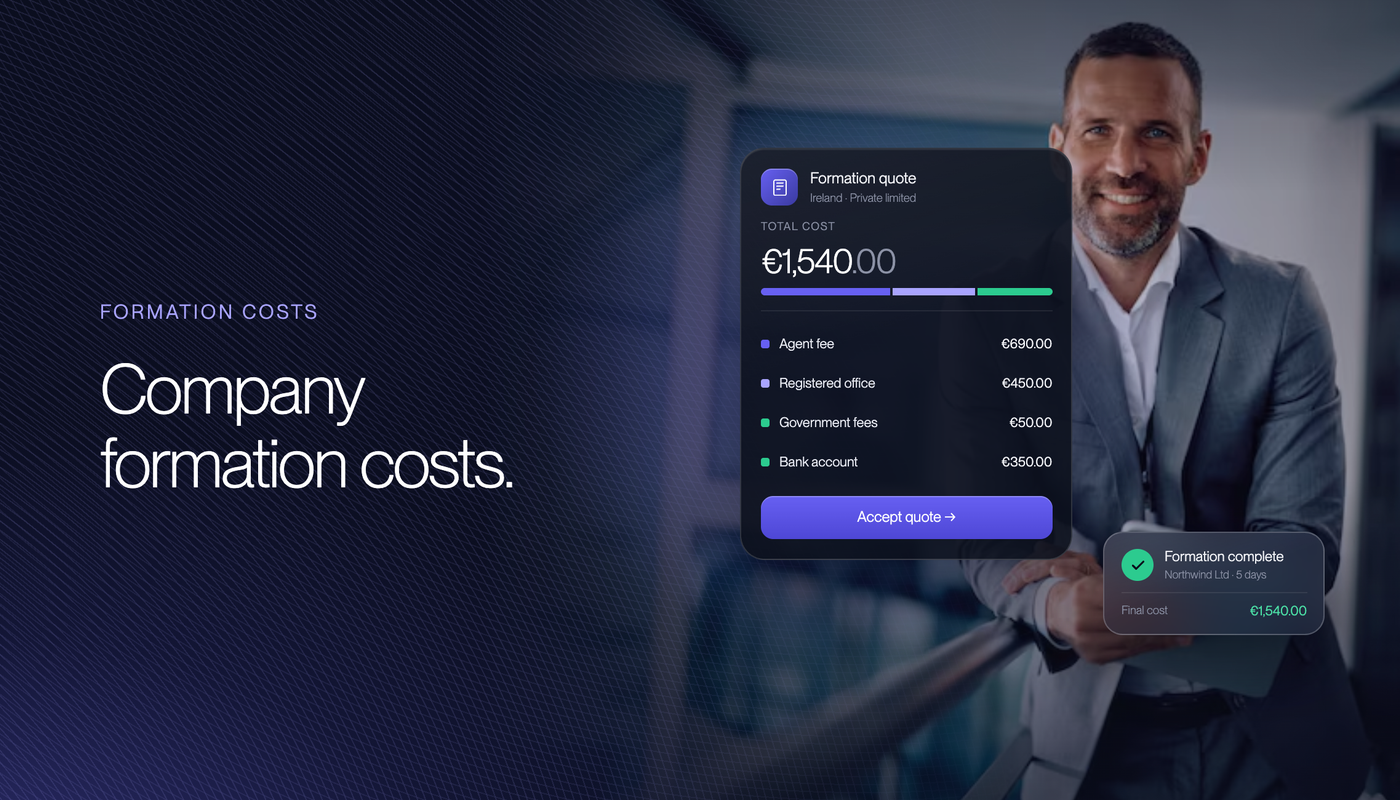
Company formation costs are lower than most founders expect. Companies House charges £100 to register a UK company, the Cyprus Registrar €175 with name approval, and the Malta Business Registry from €100. A complete file becomes a company within a week, ready to invoice, hire and open an account.
The hard part is the rest of the bill. The registry fee is often under 5% of the first year. The registered office, company secretary, accountant, audit, licence and bank account make up everything else, and most price lists leave them out or add them at renewal, when changing is hardest.
This is where we come in. We form the company ourselves at one clear price, with the registry fee already inside it. Before you commit, we set out the yearly costs too: the filings, the accounts, the audit or review and the account with our banking partners. One team, one quote, and no surprises at renewal.
We form companies in the UK, Cyprus and Malta from one clear starting price, with the registry fee included.
.svg.webp?w=96&q=75)
UK Company Incorporation
Binderr
Corporate tax
19% (small profits) / 25% (main rate)
Time to Incorporate
1 Week
Cost
€350 (no pre-payment)

Cyprus Company Incorporation
Binderr
Corporate tax
15% flat
Time to Incorporate
1 Week
Cost
€1,200 one-off
Malta Company Incorporation
GCS Malta
Effective tax
~5% for non-resident
Time to Incorporate
1 Week
Cost
Starting from €1,299
How Much Company Formation Costs in 2026
Company formation with us costs from €350 in the UK, €1,200 in Cyprus, €1,299 in Malta and €1,899 in the UAE. A realistic first year, with the yearly costs added, runs from about €2,000 in the UK to €10,500 plus VAT in Malta. In most countries the registry fee is the smallest part of that total.
Company Formation Fees at the Registry
Government company formation fees are low and published. Companies House has charged £100 for a digital incorporation since 1 February 2026, up from £50, according to its fee list on GOV.UK. In Cyprus, the Registrar of Companies charges €10 to approve a name and €165 to register a company with share capital, so €175 in total, or €295 on the express routes. The Malta Business Registry charges €100 where authorised share capital is €1,500 or less, on a scale that tops out at €1,900. Ireland's Companies Registration Office charges €50, and all four registries take filings online, as our guide to registering a company online explains.
Registry Fee vs First-Year Cost
The number that decides your budget is the first-year cost, not the formation fee at the registry. When we priced company setup in eight countries for our global guide to setting up a company, the government fee came to between 2% and 20% of the first-year total. The table shows the same pattern in the four countries where we form the most companies.
Country | Registry fee | Realistic first-year cost | Registry fee share |
|---|---|---|---|
UK | £100 (about €118) | About €2,000 to €5,000 | About 2% to 6% |
Cyprus | €175 | About €4,000 to €7,000 | About 2% to 4% |
Malta | From €100 | About €6,800 to €10,500 plus VAT | About 1% to 1.5% |
UAE, Meydan free zone with one visa | AED 12,500 licence (about €3,050) | About €6,600 to €8,300 before the audit | About 37% to 46% |
In the UK, Cyprus and Malta the registry fee is close to a rounding error. What moves company formation costs is the accountant, the audit or review, the registered office and the bank account, and all of them repeat every year. The UAE works the other way: the free zone licence is the biggest single line and renews every year, so the zone you choose matters more than any filing fee. Sterling and dirham figures use the European Central Bank rates of 7 October 2026.
Know Your Company Formation Costs Upfront
Company formation is simple when the whole cost is clear from day one. This is what we handle.
- Registry fee included: UK, Cyprus and Malta filing fees sit inside our price.
- First-year budget: Filings, accounts and audit costed before you commit.
- Formed within a week: A complete file becomes a registered company in about 7 days.
- KYC pack prepared: We tell you what each owner sends and build the file.
- No residence needed: UK, Cyprus and Malta directors can live anywhere.
- One point of contact: One team from the first question to the open account.
One-Off Costs and Yearly Costs
Formation costs fall into two groups. One-off incorporation costs are paid once, before or at filing: the registry fee, the formation work, the documents, any licence application and the first share capital payment. Yearly costs start on the day the company exists: the registered office, the company secretary where the law needs one, the accounts and tax return, an audit or review where required, the annual return and the bank plan.
A first-year budget needs both, plus the renewals due at the first anniversary. That is why we quote a realistic first-year cost next to our starting price, and why a cheap-looking package can cost more over two years.
Read more: how much it costs to set up a limited company.
UK Company Incorporation
Binderr
Corporate tax
19% (small profits) / 25% (main rate)
Time to Incorporate
1 Week
Cost
€350 (no pre-payment)
One-Off Company Incorporation Costs
The one-off company incorporation cost is the registry fee plus the work to prepare and file the company. With us it is one price, from €350 in the UK to €1,899 in the UAE, and in the UK, Cyprus and Malta the registry fee is inside it. Licences and express filing cost extra where they apply.
The Formation Fee and What It Covers
A company formation fee pays for the work around the filing. Someone checks the name, drafts the memorandum and articles, collects identity documents for every owner and director, and files with the registry. In Cyprus the incorporation form must be sworn by the lawyer handling the case, so legal work is part of every Cyprus formation.
We form the company ourselves, so you do not pay one firm for the filing and another for the documents. Our price covers the structure advice, the KYC pack, the memorandum and articles, the registry fee, the filing and the first beneficial ownership record, confirmed in writing before you pay. Trusts, foundations, cell companies and regulated structures are quoted separately. Our guide on how to incorporate a company covers the steps.
Name Checks, Express Filing and Share Capital
Most registries sell speed. Companies House charges £156 for a same-day incorporation through software, against £100 for the standard digital route. Cyprus adds €20 for an express name check and €100 for express registration. A clean file usually makes these unnecessary.
Share capital is not a fee, but it is cash you need on day one. A Malta private company needs at least €1,165 of share capital with 20% paid up, and the Malta registration fee rises with authorised capital. In Cyprus, constitutional documents in another language need a certified translation. Our list of the documents you need to set up a company shows what to prepare.
Company Incorporation Cost in One Clear Price
A fixed price is easy to plan around. Ours starts from €350 and covers everything the registry needs.
- From €350 in the UK: The £100 Companies House fee included, never billed apart.
- EU companies from €1,200: Cyprus from €1,200 and Malta from €1,299.
- Documents drafted: Memorandum, articles and registry forms prepared by us.
- Nothing paid upfront: You pay once the scope is confirmed in writing.
- Complex work quoted apart: Trusts, foundations and regulated structures priced on scope.
Licence or Free Zone Package
In the UAE, every free zone company needs a trade licence from its zone. Meydan Free Zone in Dubai publishes company setup from AED 12,500 (about €3,050) with no visa and a flexi desk included, on its cost page updated 30 June 2026. Each residence visa adds an allocation fee of AED 1,850 and about AED 3,500 to AED 7,000 for the visa, medical test, Emirates ID and stamping.
Regulated businesses, such as payments, gaming, crypto and funds, also pay for a licence, capital and compliance staff, so their incorporation costs are priced on scope. For the zone side, read our guide to free zone company formation in the UAE.
Resident Director or Bond Where Required
Ireland adds a cost because of who runs the company. It requires at least one director resident in the European Economic Area, or a €25,000 bond under section 137 of the Companies Act 2014, which costs about €1,500 to €2,000 for two years on published broker prices. Our page on non-resident director rules for Irish companies explains the options.
UK, Cyprus and Malta company law sets no residence rule for directors. Where a company needs local management for tax or substance, a professional director is a yearly cost: in Malta our partners charge from €2,000 plus VAT a year for an individual director and from €1,500 plus VAT for a corporate one. Our guide to setting up a company as a non-resident covers when this matters.

UAE Company Incorporation
Binderr
Corporate tax
0% up to AED 375,000
Freezone Tax
0%
Time to Incorporate
1 Week
Cost
Starting from €1,899
Yearly Costs After Company Formation
Yearly costs are what make one country cheap and another expensive. They start on the day the company is formed and repeat every year: the address, the officers, the accounts, an audit or review where required, the annual return and the bank plan. Price them before you choose the country.
Registered Office and Company Secretary
Our UK cost guide found published prices of about £22 to £85 a year for an address-only registered office, and a director with a UK address can use their own. A UK private company needs no company secretary, but Cyprus and Malta companies must have one. In Malta our partners charge from €900 plus VAT a year for the registered address and the same for the secretary. These services are often included in year one and billed from the first anniversary, so check the year-two price. Our guide to UK registered office address rules lists what the address must do.
Accounting and Tax Returns
Accounting is the largest yearly line for most small companies. Our UK cost guide uses a planning range of about £1,000 to £2,500 a year for the annual accounts and the company tax return. In Malta, our partners' accounting retainer starts from €1,500 plus VAT a year for up to 20 transactions, with the tax return from €500 plus VAT. For a small Cyprus company, plan on about €1,000 to €2,000 a year. Volume drives this cost, so a quiet holding company pays far less than a busy trading company.
Audit or Review
Audit rules move company setup costs more than any other line. A UK private company is exempt if it meets two of three tests: turnover up to £15 million, assets up to £7.5 million and 50 employees or fewer, for financial years starting on or after 6 April 2025. Every Cyprus company is audited, but in January 2026 the House of Representatives approved a review by the auditor instead for small companies with turnover under €300,000. Malta's Legal Notice 139 of 2025 lets a very small company file a review report, and in some cases neither. In the UAE, a free zone company that wants the 0% rate must keep audited accounts under Ministerial Decision No. 84 of 2025. A review is lighter, but still paid work.
Annual Return and Licence Renewal
The annual filing is cheap when it is on time. Companies House charges £50 for the online confirmation statement, up from £34 before 1 February 2026. Cyprus charges €20 for the annual return and Malta €85 online for a company with authorised capital up to €1,500. Ireland charges €20, but a late return costs €120 plus €3 a day, up to €1,200, according to the CRO's fee list. In the UAE the yearly cost is the licence itself, which renews at the zone's tariff.
Cost layer | One-off or yearly | Typical amount | Where it applies |
|---|---|---|---|
Registry incorporation fee | One-off | £100 UK, €175 Cyprus, from €100 Malta, €50 Ireland | Every country |
Company formation with us | One-off | From €350 to €1,899 | Registry fee included in the UK, Cyprus and Malta |
Free zone licence and visas | Yearly | From AED 12,500, plus about AED 5,350 to AED 8,850 per visa | UAE |
Registered office | Yearly | About £22 to £85 UK, from €900 plus VAT Malta | Every country |
Company secretary | Yearly | From €900 plus VAT in Malta | Cyprus and Malta |
Director bond | Every 2 years | About €1,500 to €2,000 | Ireland, with no EEA-resident director |
Accounting and tax return | Yearly | About £1,000 to £2,500 UK, from €1,500 plus VAT Malta | Every country |
Audit or review | Yearly | Custom (book a call) | Cyprus, Malta, UAE free zones, larger UK companies |
Annual return | Yearly | £50 UK, €20 Cyprus, €85 Malta, €20 Ireland | Every country |
Business account with our partners | Monthly | About €30 to €100 a month | Every country |
Read down the second column and the pattern is clear. Only two rows are one-off formation costs, and both are small next to the yearly lines. A company that costs €350 to form can still cost €2,000 or more a year to keep, so the lowest cost to form a company is not always the lowest cost to run one.
Plan Your Yearly Company Running Costs
Yearly costs are where budgets slip. Tell us about your company and we set out the full first year.
- Renewals priced early: Office and secretary renewals quoted at the start.
- Accounts on one calendar: Annual returns, accounts and tax returns tracked for you.
- Audit or review checked: We tell you which one your company needs.
- Late fees avoided: Filings made on time, so no penalty charges.
- Partner services ready: Accounting, secretary and director services through our partners.
Business Bank Account Costs
A business account costs from about €30 a month with our banking partners. Local banks charge more and take longer: application fees, monthly maintenance, low-activity charges and currency commission add up, and many want a branch visit before they open an account.
Local Bank Fees and Charges
Bank of Cyprus publishes its tariff. Its June 2026 price list for international business customers charges a company incorporated outside the European Economic Area a €300 application fee, or €500 where enhanced due diligence applies. Monthly maintenance is €50 for an active company from the EEA and €75 for one from elsewhere, with €20 a month more when there are four or fewer transactions. Currency conversion costs 0.40%, and closing the account costs €200.
These accounts also need a personal visit to an International Business Unit, so add travel to the cost. Our guide to business bank account fees explains the charges banks use.
Open a Business Account With Your Company
The account is the easy part when the file is right. We prepare it while the company is being formed.
- Account in days: Our partners usually open in 2 to 4 days, fully online.
- Clear monthly plans: Plans from about €30 to €100 a month.
- No branch visit: The whole application runs remotely.
- Multi-currency payments: Pay suppliers and get paid in the main currencies.
- File built once: The same KYC pack serves the registry and the account.
Partner Accounts From About €30 a Month
Our banking partners are licensed payment and e-money institutions built for international companies. They open business accounts remotely in days, with no branch visit, on plans from about €30 to €100 a month. Read what an EMI account is to see how it differs from a bank account.
We prepare the account file while we form the company, so the certificate, registers and ownership chart reach the partner as one pack. That is the idea behind company formation with a bank account.
Read more: Cyprus company formation with a bank account.

Equals Money
Business Bank Account
Time to onboard
2 Days
Account opening fee
Free
Monthly fee
€30

3S Money
Cross-border payments
Time to onboard
4 Days
Account opening fee
Free
Monthly fee
Starting from € 100
Company Formation Fee Changes in 2025 and 2026
Several company formation fees changed in 2025 and 2026, and many price guides have not caught up. The UK raised its fees, Cyprus removed stamp duty and eased its audit rule, and Malta added audit relief for very small companies. Ireland's CRO still charges €50 to incorporate and €20 for the annual return.
UK Companies House Fees Rose in February 2026
Companies House raised its fees on 1 February 2026. Digital incorporation went from £50 to £100 and the online confirmation statement from £34 to £50. Identity verification for directors and people with significant control became a legal requirement on 18 November 2025, with a 12-month transition, and the small company audit thresholds rose for financial years starting on or after 6 April 2025. Our UK price stays from €350 with the £100 fee included.
Cyprus Ended Stamp Duty in January 2026
Law 239(I)/2025 repealed the Cyprus stamp duty laws, so documents filed with the Registrar need no stamp duty from 1 January 2026. From the same date, corporate tax rose from 12.5% to 15%. The €350 annual levy has not been charged since 2024, but arrears for 2012 to 2023 still count: in a notice of 30 September 2026, the Registrar said it will start striking off companies that owe them from December. Our page on the Cyprus annual levy has the detail.
Malta Added Audit Relief for Small Companies
Legal Notice 139 of 2025 lets a Malta company that stays within two of three limits for two years running file a review report instead of a full audit: a balance sheet of €46,600, turnover of €93,000 and 2 employees. A company within all three needs neither. The rules apply to accounting periods starting on or after 1 January 2025. Malta also added an optional 15% final tax from the 2025 year of assessment, next to its refund system.
Read more: Malta company registration fees.
Low Cost Company Formation and the Real Total
Low cost company formation is real, but judge it by the first-year cost, not the headline. The UK gives the lowest real total we offer: from €350 to form and about €2,000 to €5,000 for the first year, with no audit for a small company.
Cheapest Headline vs Cheapest First Year
Headline prices are built to win the first order. A package can leave out the registered office, the secretary, the first annual return or the bank file, then bill them at renewal. The test is simple: ask for the full cost of company formation and the second year before you pay. Our guide to the cheapest countries to set up a company ranks countries on that basis, and our guide to the cheapest country to form a company in Europe does the same inside the EU.
When Paying More Costs Less
A higher formation cost is often the cheaper choice. If you sell into the EU and need EU VAT, a licence you can passport or EU directive relief on dividends, a UK company cannot give you that at any price, so Cyprus or Malta is the low cost route that works. If you hold shares or intellectual property, the Cyprus or Malta tax rules can save more in a year than the extra running cost. And a company that banks easily costs less than one that waits months for an account.
Low Cost Company Formation From €350
For a trading company with no need to be in the EU, the UK gives the lowest real total. We form it for you.
- Lowest running costs: No audit for small companies and a £50 yearly statement.
- Fast registration: Companies House usually registers a clean digital filing within 24 hours.
- Identity checks guided: Every director taken through the Companies House check.
- Bank file ready: Prepared alongside the company, so the account follows fast.
- No hidden renewals: The address and yearly filings quoted before you pay.
Company Formation Costs by Country
Four countries answer most questions on company formation costs: the UK for the lowest total, Cyprus and Malta for an EU company, and the UAE for low tax outside the EU. The table sets our starting price next to the facts that drive the yearly cost.
Factor | UK | Cyprus | Malta | UAE |
|---|---|---|---|---|
Corporate tax | 19% to 25% | 15% from 2026 | 35%, about 5% after the 6/7ths refund | 0% to AED 375,000, then 9%; 0% on qualifying free zone income |
Registry fee | £100 | €175 | From €100 | Licence from AED 12,500 at Meydan |
Our price | From €350 | From €1,200 | From €1,299 | From €1,899 |
Time to incorporate | 1 week | 1 week | 1 week | 1 week |
Local director or sponsor | Not required | Not required | Not required | No local sponsor in a free zone |
Audit | Not for small companies | Yes, review below €300,000 turnover | Yes, review or none for very small companies | Yes, to keep the 0% rate |
Banking with our partners | From about €30 a month | From about €30 a month | From about €30 a month | From about €30 a month |
Realistic first-year cost | About €2,000 to €5,000 | About €4,000 to €7,000 | About €6,800 to €10,500 plus VAT | About €5,000 to €9,000 before the audit |
The UK wins on total cost, with no audit for small companies, no secretary rule and the lowest filing fees. Cyprus has the lowest EU starting price. Malta costs the most to run because of its officers and audit, and earns that back through the refund system for profitable companies. In the UAE, the zone and the number of visas move the total more than anything we charge. We also publish full cost guides for the Isle of Man, Jersey and the BVI, plus offshore company formation costs and holding company setup costs.
UK Company Formation Cost
Best for founders who need a credible company at the lowest real cost outside the EU. The UK company formation cost with us is from €350 with the £100 Companies House fee included, in about a week. Plan about €2,000 to €5,000 for the first year, mostly the accountant and the bank plan. The catch is that the UK is outside the EU, so it gives no EU passport and no EU directive relief on dividends. Full breakdown: the cost of setting up a UK company.
UK Company Incorporation
Binderr
Corporate tax
19% (small profits) / 25% (main rate)
Time to Incorporate
1 Week
Cost
€350 (no pre-payment)
Cyprus Company Formation Cost
Best for an EU trading or holding company at the lowest EU starting price. We form a Cyprus company from €1,200, in about a week. Plan about €4,000 to €7,000 for the first year, mostly the accountant and the audit or review. The catch is that corporate tax is now 15%, and a lawyer must swear the filing, which we arrange. Full breakdown: Cyprus company costs.
Cyprus Company Incorporation
Binderr
Corporate tax
15% flat
Time to Incorporate
1 Week
Cost
€1,200 one-off
Malta Company Formation Cost
Best for profitable EU trading and holding companies that will use the tax refund system. We form a Malta company from €1,299, in about a week. Plan about €6,800 to €10,500 plus VAT for the first year, because Malta requires a company secretary and an audit or review, and most owners abroad buy in the registered address. The catch is that the 35% tax is paid first and refunded to shareholders later, so cash flow needs planning. Full breakdown: how much a Malta company costs.
Malta Company Incorporation
GCS Malta
Effective tax
~5% for non-resident
Time to Incorporate
1 Week
Cost
Starting from €1,299
UAE Company Formation Cost
Best for founders who want 0% tax on qualifying income and a base in the Gulf. We form a UAE free zone company from €1,899, with zone, office and visa fees passed through at cost and listed in the quote. Plan about €5,000 to €9,000 for the first year with one visa, before the audit. The catch is that the licence and visas renew every year, and keeping the 0% rate needs audited accounts. Full breakdown: the cost of business setup in the UAE.
UAE Company Incorporation
Binderr
Corporate tax
0% up to AED 375,000
Freezone Tax
0%
Time to Incorporate
1 Week
Cost
Starting from €1,899
Which Country Gives the Lowest Real Cost
For most founders who need a company to trade, the UK is the answer: the lowest formation cost and the lowest yearly cost. Inside the EU, choose Cyprus for the lower running cost and Malta when the refund system is worth more than its extra cost. Choose the UAE when 0% tax on qualifying income and a Gulf base justify a yearly licence. If two countries fit, book a call and we price both on your numbers.
Common Mistakes When Budgeting Company Formation Costs
Most budget problems with company formation costs come from three avoidable mistakes. Each one adds hundreds or thousands of euros to the first year, and each has a simple fix that takes a few minutes before you file.
Budgeting Only the Registry Fee
A founder sees €175 for Cyprus and budgets €175. The first year then brings the formation work, a company secretary, an accountant, the audit or review and a bank plan, and the real figure is about €4,000 to €7,000, more than 20 times the plan. A company that runs short of money in its first months still owes its filings and its audit or review. Budget from a first-year cost in writing, not a filing fee, and keep the yearly lines in your business plan from the start.
Ignoring the Second-Year Price
Some packages include the registered office, the secretary or the first filing for year one only. At renewal they are billed one by one, and moving a company to a new provider costs money too. A Malta registered address alone runs from €900 plus VAT a year with our partners. Ask for the year-two price before you pay for year one. Our guide to choosing a company formation agent lists what a fair quote shows, and our guide to the best company formation services covers what good service looks like.
Missing a Filing Deadline
Late fees are small per day and large in total. A late Irish annual return costs €120 plus €3 a day, up to €1,200, against €20 on time. A late Cyprus annual return costs up to €500, and a Cyprus company that still owes levy arrears for 2012 to 2023 now faces strike-off proceedings from December 2026. Owners abroad miss these dates most, because no local accountant reminds them and no post reaches them. Put every date on one calendar on the day the company is formed, and give one person the job of filing.
Read more: company formation mistakes to avoid.
Book a Call About Your Formation Costs
If two countries fit, a short call settles it. We price both on your real numbers.
- Country choice made clear: The right place for your customers, tax and banking.
- Written cost summary: Formation, yearly costs and first-year total in one note.
- Complex structures covered: Holding companies, licensed businesses and groups.
- Tax residence planned: Where the company is managed, decided before you file.
- Clear next steps: What to send, who signs and when the company is formed.
Bottom Line
Company formation costs are low at the registry and higher across the first year. The fee to register is £100 in the UK, €175 in Cyprus and from €100 in Malta, often under 5% of the first-year total. The yearly lines decide the real cost.
With us, formation starts from €350 in the UK, €1,200 in Cyprus, €1,299 in Malta and €1,899 in the UAE, with the registry fee included in the UK, Cyprus and Malta. The UK gives the lowest real total, Cyprus the lowest EU starting price and Malta the strongest refund system, while the UAE suits 0% tax on qualifying income. You get the first-year figure in writing before you pay.
How much does company formation cost in 2026?
How much does incorporation of a company cost?
What is the cost of incorporating a company in the UK?
How much does it cost to form a company in Cyprus?
What is the company formation cost in Malta?
How much does a UAE free zone company cost in its first year?
What is included in a company formation fee?
What yearly costs come after company incorporation?
Is low cost company formation worth it?
Did company formation fees change in 2026?
Does a small company need an audit?
Do non-residents pay more for company formation?
Does the company formation cost include a business bank account?
Sources
Companies House fees, GOV.UK, updated 25 September 2026.
Companies House fees are changing from 1 February 2026, GOV.UK news, 30 October 2025.
Verify your identity for Companies House, GOV.UK.
Audit exemption for private limited companies, GOV.UK.
Company incorporation forms and fees, Registrar of Companies, Cyprus.
Choosing a company name, Registrar of Companies, Cyprus.
Annual return filing fee, Registrar of Companies, Cyprus.
Repeal of the Stamp Duties Laws of 1963 to 2025, Law No. 239(I)/2025, Registrar of Companies, Cyprus, 19 January 2026.
Strike-off of companies for non-payment of the annual fee, Registrar of Companies, Cyprus, 30 September 2026.
Registration and fee structure, Malta Business Registry.
Annual filings, Malta Business Registry.
Audit Exemption Rules, Legal Notice 139 of 2025, guidelines, Malta Tax and Customs Administration.
Company fees, Companies Registration Office, Ireland.
Ministerial Decision No. 84 of 2025 on Audited Financial Statements, UAE Ministry of Finance.
Meydan Free Zone company setup cost breakdown, Meydan Free Zone, updated 30 June 2026.
Commissions and charges for International Business Units customers, Bank of Cyprus, June 2026.
Euro foreign exchange reference rates, European Central Bank, 7 October 2026.


-360x240.jpg?w=3840&q=75)