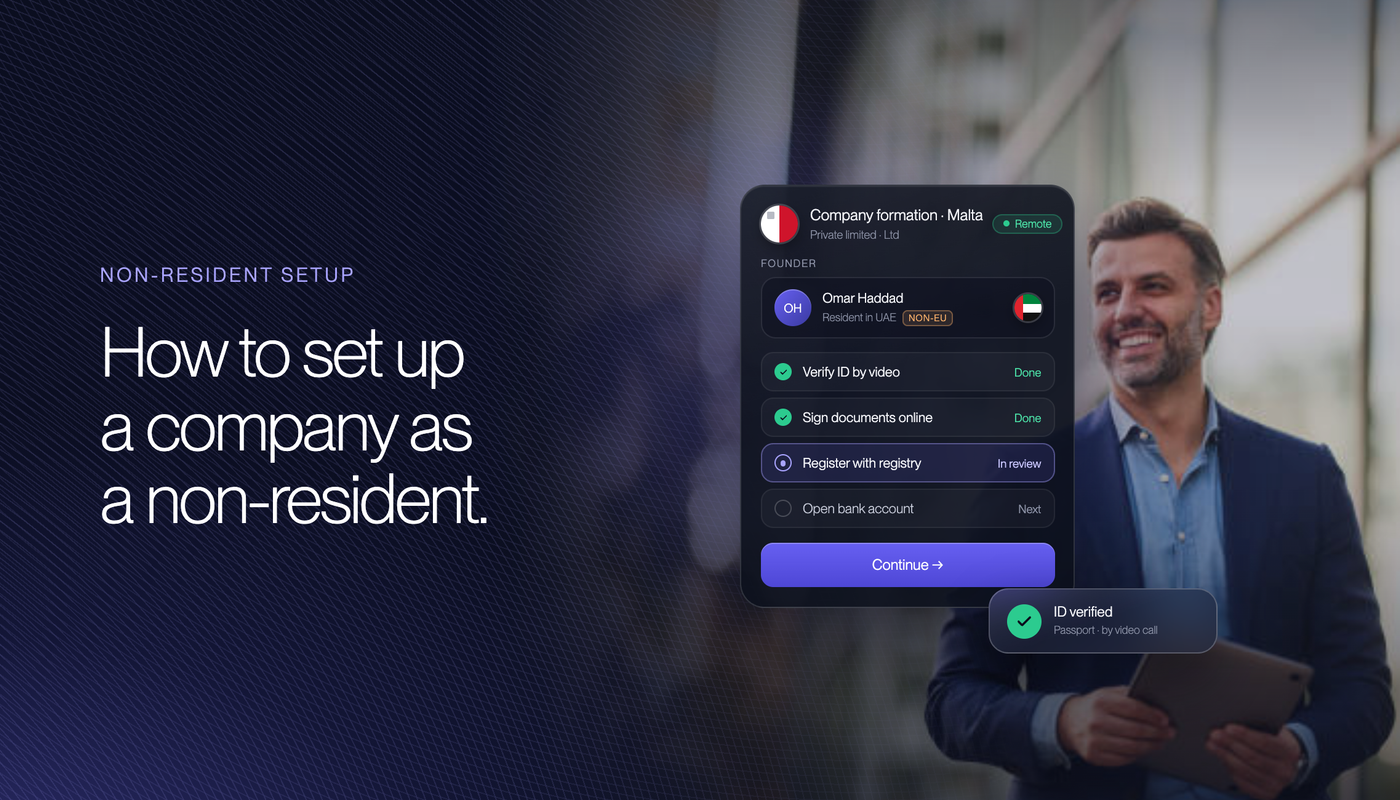
Knowing how to set up a company as a non-resident gives you real choice. In the UK, the UAE, Cyprus and Malta a foreign founder can own 100% of the shares without living there or holding a local visa. You pick the market you sell into, the tax system that fits and a company that banks and clients take seriously.
The extra work sits around the filing. Some countries want a local director or secretary. Registries now check every director's identity, and banks look closely at a company whose owner lives abroad. Tax needs a plan too, because a company run from your home country can be taxed there as well.
This is where we come in. We form the company ourselves and run every step from abroad: the right jurisdiction, your KYC file, the local secretary and office, the filing and the bank account through our partners. One team, one clear price from €350, and a company formed within about a week.
For most founders abroad the quickest start is a UK company, which we form from €350 with the Companies House fee included.
.svg.webp?w=96&q=75)
UK Company Incorporation
Binderr
Corporate tax
19% (small profits) / 25% (main rate)
Time to Incorporate
1 Week
Cost
€350 (no pre-payment)
Why Set Up a Company as a Non-Resident
You can set up a company as a non-resident in most countries that matter for international business, and own all of it. The main gains are access to the market you sell into, a stronger position with banks and clients, limited liability and a tax system you choose on purpose.
Full Foreign Ownership in Most Countries
Ownership is rarely the obstacle. The UK, Cyprus, Malta and Hong Kong let a foreign founder hold 100% of a private company with no local partner. The UAE joined them when Federal Decree-Law No. 26 of 2020 removed the old rule that a UAE national had to own most of a mainland company, apart from a short list of restricted sectors such as banking, insurance and defence. The company is yours from day one, with no nominee shareholder to pay.
No Visa or Residence Needed
Company law in these countries does not ask where the owner lives. A UK company needs one director who is a natural person, and that director can live anywhere. Most registries now let you register a company online, and Directive (EU) 2019/1151 requires every EU member state to offer online company formation. Where a country does have a local requirement, it is a role someone fills for you, not a reason to move.
Set Up a Company as a Non-Resident
Setting up a company as a non-resident is very doable, and we do the work. This is what you get.
- Right country picked: Chosen around your customers, your residence and your bank.
- Fully remote setup: No visa, no flights and no local partner needed.
- KYC pack prepared: We tell you what to send and build the file.
- Local roles covered: Secretary and registered office arranged where required.
- Bank account planned: The account is part of the setup, not an afterthought.
- One clear price: From €350 in the UK, confirmed before you pay.
A Company Where Your Customers Are
A local company makes selling easier. An EU company in Cyprus or Malta trades across the single market and registers for EU VAT like any EU business. A UK company reassures UK clients, and a UAE company puts you inside the Gulf market with a licence local partners recognise.
Tax Planned on Purpose
Corporate tax varies widely. The UK charges 25% on profits above £250,000 and 19% below £50,000. The UAE taxes profits at 0% up to AED 375,000 and 9% above it. Cyprus moved to 15% on 1 January 2026, and Malta's 35% headline rate falls to about 5% for most trading profits after the shareholder refund.
The rate only holds if the company is really run from that country, so plan it before you file.
Limited Liability and Credibility
When you incorporate a company, it separates your personal assets from the debts of the business. It signs contracts in its own name and builds its own trading history, which helps later with credit, payment gateways and local banks.
How to Set Up a Company as a Non-Resident
The steps to set up a company as a non-resident are the same in almost every country. Choose the jurisdiction, check the residency rules, verify your identity, file, open the bank account, settle tax residency and keep up the annual filings. The order matters, because the bank account and the tax position decide whether the company is useful.
Choose the Jurisdiction
Start from your customers, your own residence and where the company can bank. Tax comes after those three, and the best jurisdictions for non-resident company owners score well on all four. A non-resident founder selling to EU clients needs an EU company.
Check the Residency Rules
Look for three things before you commit: a resident director rule, a local company secretary and a local registered office. Each one has a yearly cost, so price it in at the start.
Verify Your Identity
Every director and owner now goes through an identity check. In the UK it has been a legal requirement since 18 November 2025. Elsewhere it is part of the KYC file. Certified documents prepared early save days.
File the Company
The filing itself is fast, and how long it takes to set up a company depends more on your documents than on the registry. Companies House usually registers a UK company within 24 hours, and EU law sets a limit of 5 to 10 working days for online formation. We file the company and deal with the registry for you.
Open the Business Bank Account
This is the step to plan from day one, because a company you cannot bank cannot invoice. We run company formation with a bank account as one process, so the account application goes in as soon as the certificate is issued.
Settle Tax Residency and Substance
Decide where the board meets and who makes the decisions. That decides where the company is taxed, and whether your own country can tax its profits.
Keep Up the Annual Filings
Every company files a yearly return, accounts and a tax return. Put the dates in a calendar on the day the company is formed.
Read more: how to set up a company and whether you can set up a company yourself.
UAE Company Incorporation
Binderr
Corporate tax
0% up to AED 375,000
Freezone Tax
0%
Time to Incorporate
1 Week
Cost
Starting from €1,899
Residency Rules for a Non-Resident Company Owner
Most countries let a non-resident company owner hold every share and every board seat. The rules that do apply are local appointments: a resident director in a few countries, a company secretary in others and a local registered office everywhere, and each one is a role filled for you.
Resident Director Requirements
Singapore requires at least one director who is ordinarily resident there (ACRA, updated 29 January 2026). A foreign founder setting up a company in Singapore therefore appoints a nominee director.
Ireland's non-resident director rules require at least one director resident in the European Economic Area under section 137 of the Companies Act 2014. A company without one lodges a €25,000 bond that runs for at least two years, or proves a real and continuous link with economic activity in Ireland and gets a certificate from the CRO. The UK, Cyprus, Malta, the UAE and Hong Kong have no resident director rule in company law.
Local Company Secretary
A UK private company does not need a company secretary at all. Cyprus and Malta require one for every company. Hong Kong is stricter: the secretary must ordinarily live in Hong Kong or be a company with an office there, which is the main extra step when setting up a company in Hong Kong as a foreigner. Our partners provide one where the law asks.
Registered Office Address
Every company needs an official address in its country of registration. In the UK the registered office rules changed on 4 March 2024: the address must be one where post reaches someone, so a PO box no longer qualifies, and every company must also give Companies House a registered email address.
Meet Local Requirements From Abroad
Most residency rules are met with the right local appointments. Our partners provide them, and we set them up with your company.
- Registered office: A compliant local address from day one.
- Company secretary: Provided where Cyprus or Malta require one.
- Local director options: Arranged in Cyprus or Malta when your tax plan needs one.
- Ownership filings: Beneficial owners reported on time.
- Renewals quoted upfront: Yearly fees agreed before the company is formed.
Register a Company as a Non-Resident Remotely
You can register a company as a non-resident without travelling in the UK and across the EU. Identity checks have moved online, and EU law now requires online formation in every member state. What changes from country to country is who files the documents and how your identity is proved.
UK Identity Checks Since November 2025
Identity verification became a legal requirement at Companies House on 18 November 2025. New directors must verify before they can incorporate a company or be appointed to one. Existing directors confirm it with their next confirmation statement during a 12 month transition, and existing people with significant control have 12 months to verify (Companies House, 5 August 2025).
You verify for free through GOV.UK One Login, or through an Authorised Corporate Service Provider, and get a personal code. The government expects 6 to 7 million people to verify by mid-November 2026, so get your code early.
Online Company Formation in the EU
Directive (EU) 2019/1151 requires every EU member state to let founders form a limited company fully online. Article 13g sets the deadline: five working days where the founders are individuals using the state's template, and ten working days in other cases. A registry can ask you to attend in person only case by case, where it suspects identity fraud.
In practice a local professional still files. In Cyprus an advocate signs the incorporation documents, and Malta's registry works through a qualified digital signature. We handle both, and you sign online.
Documents a Foreign Founder Needs
Copies usually need certifying by a lawyer or notary, and papers from another country may need an apostille under the Hague Apostille Convention.
- Passport: A clear, valid copy for every director and owner.
- Proof of address: A recent utility bill or bank statement.
- Short CV: Your experience in the business you are starting.
- Source of funds: Statements or contracts showing where the capital comes from.
- Business description: What the company does, where its clients are and expected turnover.
- Corporate owner papers: Certificate and registers for any company that holds shares.
When You Still Need to Travel
A UAE residence visa needs a medical test and biometrics in the country, and some local banks want to meet directors. Our partners open business accounts fully online, so the account never needs a trip.
Read more: how to set up a company remotely and what documents you need to set up a company.
Form a Company From Abroad
You can form a company from abroad without a single trip. We run the identity checks and the filing with you.
- Identity checks guided: GOV.UK One Login and EU online checks, step by step.
- Documents checked first: Certified copies and apostilles right the first time.
- Filing handled: We submit to the registry and answer its questions.
- Formed within a week: Most companies are ready in about seven days.
- Digital certificate: Your company documents sent to you online.
- One point of contact: A single team across every time zone.
Business Banking for Non-Resident Founders
The bank account decides how fast non-resident founders can trade. Banks are slower and stricter with foreign-owned companies, so plan the account with the company, not after it. With the right file and the right partner, an account in days is the normal outcome.
Why Banks Look Harder at Foreign Owners
A new company has no trading history and no revenue, and its owner lives in another country. Each of those is a risk point for a bank's compliance team. So a traditional bank asks more questions, and a corporate account can take several weeks to open. For a company that cannot invoice yet, every week of waiting is lost revenue.
Local Banks for a Company Abroad
Local banks are expensive, slow and quick to refuse a foreign-owned company with no history. Many want to meet the directors, some ask for a local director, and UAE retail banks often expect a signatory who holds a UAE residence visa. Fees, minimum balances and exchange rate margins add up, and a refusal rarely comes with a reason.
A Faster Route Through Our Partners
This is the route most non-resident founders should take first. We work with regulated payment partners built for international companies. They let you open a business bank account remotely in 2 to 4 days, and they treat a foreign-owned company as normal business.
We build the file the partner asks for, with the ownership chart, source of funds and business description, and we make the introduction. These partners are licensed payment institutions rather than banks, which is why they move faster, and an EMI account covers what a new company needs: receiving client payments, paying suppliers and moving money across borders.

3S Money
Cross-border payments
Time to onboard
4 Days
Account opening fee
Free
Monthly fee
Starting from € 100

Equals Money
Business Bank Account
Time to onboard
2 Days
Account opening fee
Free
Monthly fee
€30
Local Banks vs Our Partners
Factor | Local bank | Our partners |
|---|---|---|
Time to open | Often several weeks | 2 to 4 days |
How you apply | Meetings, forms and follow-up questions | Online, with a file we prepare |
Opening fee | Varies by bank | Fees set out upfront in each plan |
New foreign-owned company | Reviewed case by case | Standard business |
Best for | Companies with trading history | New companies and founders abroad |
The partner account gets the company trading in days, which is why we open it first. A local bank can follow once there is a year of accounts behind the application.
Read more: business bank accounts for non-residents and why banks reject business account applications.
Open a Business Account as a Non-Resident Founder
The account is the easy part when the file is right. We prepare it and open the account with you.
- Account in days: Our partners open in 2 to 4 days, fully online.
- No branch visit: Every step is done remotely.
- Bank-ready file: Ownership chart, source of funds and business plan prepared.
- Free account opening: Fees set out upfront in each plan.
- Fewer rejections: Gaps closed before the application goes in.
- Local bank later: Added once the company has trading history.
Tax Residency When Setting Up a Company Abroad
A company pays tax where it is tax resident, and that is not always where it was registered. When setting up a company abroad, the place where the board makes its decisions matters as much as the address on the certificate. Plan it before you file, and the tax rate you chose is the one you pay.
Where the Company Is Managed
Most countries use two tests: where the company is incorporated and where its central management and control sits. The UK and Malta apply both. Cyprus uses management and control, and since 2023 it also presumes a Cyprus company is resident unless it is resident somewhere else. The UAE treats any company formed under UAE law as resident, plus foreign companies effectively managed in the UAE.
So a Cyprus company whose only director decides everything in Germany may be resident in Germany too. When two countries both claim a company, their tax treaty decides. Under Article 4(3) of the OECD Model Tax Convention the tax authorities settle it by mutual agreement, looking at the place of effective management, where the company was incorporated and other factors.
Permanent Establishment in Plain Words
A permanent establishment is a taxable presence in a country where the company is not resident. It usually means a fixed place of business or a person who regularly signs contracts for the company there. Run a UK company from your flat in Spain, and Spain may tax the profits linked to that flat.
The OECD's 2025 update to its Model Tax Convention, approved on 18 November 2025, gives founders who work from home a clearer test. A home office is generally not a permanent establishment when the person works there less than 50% of their working time over 12 months. Above that, it depends on whether the company has a real commercial reason for the work to be done there.
Controlled Foreign Company Rules at Home
Your own country may tax the company's profits even if they stay in the company. Articles 7 and 8 of the EU Anti-Tax Avoidance Directive (EU) 2016/1164 require every member state to have controlled foreign company rules. Where an EU company holds more than 50% of a foreign company that pays less than half the tax it would pay at home, some of those profits can be taxed at home. Many countries apply similar rules to individual owners.
Substance That Holds Up
Substance means real management where the company is registered. Hold board meetings there, keep minutes and, where your plan relies on local tax residence, make key decisions with a director who lives there. That costs far less than a tax dispute in two countries.
Read more: whether a UK company is tax resident and the Cyprus tax residency rules.
Plan Tax Residency Before You File
Where the company is run decides where it pays tax. We plan that with you before the company exists.
- Management planned: Board meetings and decisions set up in the right country.
- Home rules flagged: Residence and CFC questions raised early.
- Substance sized: Only the local presence your activity really needs.
- Group structures: Holding and multi-country setups planned in house.
- Written next steps: A short summary of what to do after the call.
Annual Filings for Foreign Founders
Every company files three things each year: a return to the registry, its accounts and a tax return. For foreign founders the risk is simple, because letters go to a registered office they never see. Set the deadlines up on the day the company is formed.
Filing | UK | Cyprus | Malta | UAE |
|---|---|---|---|---|
Registry return | Confirmation statement every year, £50 | Annual return to the Registrar every year | Annual return to the Malta Business Registry every year | Trade licence renewal every year |
Accounts | Filed within 9 months of year end, no audit if small | Audit, or a review below €300,000 turnover | Audit, or a review report for small companies | Audited above AED 50 million revenue or for free zone 0% |
Tax return | Within 12 months, tax paid 9 months and 1 day after year end | By 31 January of the second year after the tax year | 9 months after year end or 31 March, whichever is later | Within 9 months of year end, tax paid in the same window |
The UK is the lightest to run. Cyprus and Malta add an audit or a review each year, which is a real yearly cost to plan for. In the UAE the audit rule decides whether a free zone company keeps its 0% rate.
A small UK company is exempt from audit when it meets two of three tests: turnover up to £15 million, a balance sheet up to £7.5 million and no more than 50 employees, for years starting on or after 6 April 2025.

Cyprus Company Incorporation
Binderr
Corporate tax
15% flat
Time to Incorporate
1 Week
Cost
€1,200 one-off
Company Formation for Non-Residents by Country
Four countries cover most company formation for non-residents: the UK, the UAE, Cyprus and Malta. All four allow 100% foreign ownership, remote setup and no resident director, and we form companies in each within about a week. They differ on tax, cost, audit and how local banks see them.
Factor | UK | UAE | Cyprus | Malta |
|---|---|---|---|---|
Corporate tax | 19% to 25% | 0% up to AED 375,000, then 9% | 15% | 35%, about 5% effective after refunds |
Our price | From €350 | From €1,899 | From €1,200 | From €1,299 |
Time to incorporate | About 1 week | About 1 week | About 1 week | About 1 week |
Director or residency rule | No residency rule, one director must be a person | No local partner needed for most activities | Secretary required, manage from Cyprus for tax residence | Secretary required, no resident director rule |
Audit | Exempt for small companies | Above AED 50 million revenue or for free zone 0% | Review below €300,000 turnover, audit above | Audit, review report for small companies |
Banking | Partners in days, local banks slower | Partners in days, local banks often want a resident | Partners in days, local banks selective | Partners in days, local banks slow |
The UK is the cheapest to form and the simplest to run. The UAE wins on tax while profits stay modest, as long as the company is really run from the UAE. Cyprus and Malta are the EU options, and the yearly audit or review is the price of being inside the single market.
UK Company Formation
The UK suits consultants, online businesses and service companies with clients in several countries. It has no residency rule, no minimum capital and no company secretary. We form it from €350 with the £100 Companies House fee included, and it is usually registered within 24 hours of filing. The catch is the rate: profits above £250,000 pay 25%. See our guide to UK company formation for non-residents.
UK Company Incorporation
Binderr
Corporate tax
19% (small profits) / 25% (main rate)
Time to Incorporate
1 Week
Cost
€350 (no pre-payment)
UAE Company Formation
The UAE suits founders who live in the Gulf or trade with the Middle East. Profits up to AED 375,000 pay 0% and the rest 9%, and qualifying free zone income stays at 0%. Our UAE incorporation starts from €1,899. The catch is substance and banking: tax residence follows real management, and local banks usually want a resident signatory. Read about business setup in the UAE for foreigners.
UAE Company Incorporation
Binderr
Corporate tax
0% up to AED 375,000
Freezone Tax
0%
Time to Incorporate
1 Week
Cost
Starting from €1,899
Cyprus Company Formation
Cyprus suits holding companies, IP owners and EU trading businesses that want a legal system based on English common law. Corporate tax is 15% from 1 January 2026, and companies under €300,000 turnover can use a review instead of a full audit. We form a Cyprus company from €1,200. The catch is management: run it entirely from abroad and another country can claim it, so plan board meetings in Cyprus. See how to start a business in Cyprus as a foreigner.
Cyprus Company Incorporation
Binderr
Corporate tax
15% flat
Time to Incorporate
1 Week
Cost
€1,200 one-off
Malta Company Formation
Malta suits gaming, fintech and trading companies that want an EU licence or an EU base. The headline rate is 35%, but shareholders can claim back six sevenths of the tax on most trading profits, which brings the effective rate to about 5%. Our Malta incorporation starts from €1,299. The catch is cash flow and audit: the full tax is paid first and refunded after the dividend, and accounts are audited unless the company qualifies as small. See how to start a business in Malta as a foreigner.

Malta Company Incorporation
GCS Malta
Effective tax
~5% for non-resident
Time to Incorporate
1 Week
Cost
Starting from €1,299
Which Country to Choose as a Foreign Founder
For most founders abroad with clients in several countries, the UK is the best first company: from €350, no residency rule, registered in about a day and simple to run. Choose Cyprus or Malta when you need to be inside the EU, Cyprus for holding and IP structures and Malta for gaming and fintech. Choose the UAE when you live in the Gulf or can run the company from there.
A founder who only needs a holding vehicle can open an offshore company as a non-resident instead.
Read more: the best country to register a company in Europe.
Common Mistakes When Setting Up a Company Abroad
Most problems when setting up a company abroad come from the order of the steps, not from the law. These are the ones that cost real money, and each is easy to avoid.
Leaving the Bank Account to Last
Founders form the company, then start looking for an account. With traditional banks often taking several weeks to onboard a new business, that is weeks of a company that cannot invoice while the registered office and secretary fees are already running. A refusal restarts the clock. Some founders also run business payments through a personal account in the meantime, which mixes funds and makes the later bank review harder. Prepare the bank file with the company file, and apply to our partners as soon as the certificate arrives.
Missing a Resident Director Rule
A founder picks Ireland for its 12.5% trading rate and finds out after filing that the company needs an EEA-resident director. The fix is a €25,000 bond that must run for at least two years, bought from an insurer or a bank, or a local director paid every year. The bond has to be renewed when it ends, and the CRO must be told if it lapses, so it is a running cost rather than a one-off. Check the director, secretary and office rules before you choose the country, not after.
Managing the Company From Your Home Country
A founder in France forms a company abroad and makes every decision from home. France can then argue the company is managed in France, or that it has a permanent establishment there, and tax the profits. The result can be tax in two countries, plus interest and penalties. A tax authority can look at emails, travel records and where contracts were signed to decide where the company is managed. Hold board meetings where the company is registered, keep minutes and, where your plan depends on local tax residence, appoint a local director.
Missing the Annual Accounts Deadline
A UK private company that files its accounts late pays £150 when they are up to one month late, rising to £1,500 after six months, and the penalty doubles if the accounts are late two years in a row. Cyprus, Malta and the UAE also fine late filings, and a company that stays late can be struck off. In the UK the assets of a struck-off company, including money left in its account, pass to the Crown. Put every deadline in a calendar on the day the company is formed, or let our partners file for you.
Choose Where to Set Up Your Company Abroad
A short call costs far less than picking the wrong country. We look at your customers, your residence and your bank.
- A clear recommendation: The country, the company type and the first-year cost.
- Banking checked first: Only countries where you can open an account.
- Complex cases covered: Holding, fintech, gaming and multi-country groups.
- €30 advisory call: Credited against your setup within 30 days.
- No obligation: You decide after you see the plan.
Bottom Line
Setting up a company as a non-resident is very doable in 2026. Ownership is open and registries work online. What decides success is the bank account, the residency rules and where the company is really managed.
For most founders abroad, a UK company from €350 is the simplest start. Cyprus and Malta fit when you need the EU, and the UAE fits when you live in the Gulf or can run the company there. Whichever you choose, we form the company, prepare the bank file with our partners and keep the yearly filings on track. You deal with one team from the first call to the open account.
Can a non-resident set up a company?
How do you set up a company as a non-resident?
Do I need a resident director to register a company as a non-resident?
Can a non-resident company owner open a business bank account?
How much does it cost to set up a company abroad?
How long does it take to set up a company abroad?
Do I need to travel to form a company from abroad?
Where does my company pay tax if I live in another country?
What is a permanent establishment for a non-resident founder?
Which country should a non-resident founder choose?
What documents does a foreign founder need?
Can a non-resident be the only director and shareholder?
What does a non-resident company owner file each year?
Sources
- Companies House, identity verification from 18 November 2025, GOV.UK, 5 August 2025
- Companies House fees, GOV.UK, updated 25 September 2026
- GOV.UK, Register your company
- GOV.UK, Prepare and file annual accounts for a limited company
- GOV.UK, Late filing penalties
- GOV.UK, Audit exemptions for private limited companies
- Companies House blog, Get ready for changes to UK company law, 22 January 2024
- EUR-Lex, Directive (EU) 2019/1151 on digital tools in company law
- EUR-Lex, Anti-Tax Avoidance Directive (EU) 2016/1164
- OECD, The 2025 Update to the OECD Model Tax Convention, November 2025
- ACRA Singapore, Appointing directors and a company secretary, updated 29 January 2026
- Companies Registry Hong Kong, Directors and company secretary FAQ
- CRO Ireland, EEA resident director, Information Leaflet 17
- UAE Government, Full foreign ownership of commercial companies, updated 6 April 2026
- PwC Tax Summaries, corporate tax in the UK, Cyprus, Malta and the UAE, reviewed 2026
- PwC Tax Summaries, corporate residence in the UK, Cyprus, Malta and the UAE, reviewed 2026
- PwC Tax Summaries, tax administration in Cyprus, Malta and the UAE, reviewed 2026
- UAE Ministerial Decision No. 84 of 2025 on audited accounts, KPMG summary
-360x240.jpg?w=3840&q=75)