The best country in Europe to set up a company gives you the whole EU market from one base. An EU company sells across 27 member states, registers for EU VAT and can move dividends between EU group companies without withholding tax. Cyprus, Malta and Ireland add the euro, company law that works in English and tax systems built for international business.
The hard part is that each one wins for a different company. Cyprus raised corporate tax to 15% in January 2026. Malta's low rate arrives as a refund after 35% is paid. Ireland wants a director resident in the EEA or a €25,000 bond, and its identity form now needs an in-person witness.
This is where we come in. We tell you which country fits and form the company ourselves: the structure, your KYC file, the documents, the filing and the local office. Our partners open the bank account. One team, one price from €1,200, and your EU company ready in about a week.
We form EU companies in Cyprus from €1,200 and in Malta from €1,299, with the registry fee included in the price.
Cyprus Company Incorporation
Binderr
Corporate tax
15% flat
Time to Incorporate
1 Week
Cost
€1,200 one-off
Malta Company Incorporation
GCS Malta
Effective tax
~5% for non-resident
Time to Incorporate
1 Week
Cost
Starting from €1,299
Best Country in Europe to Set Up a Company
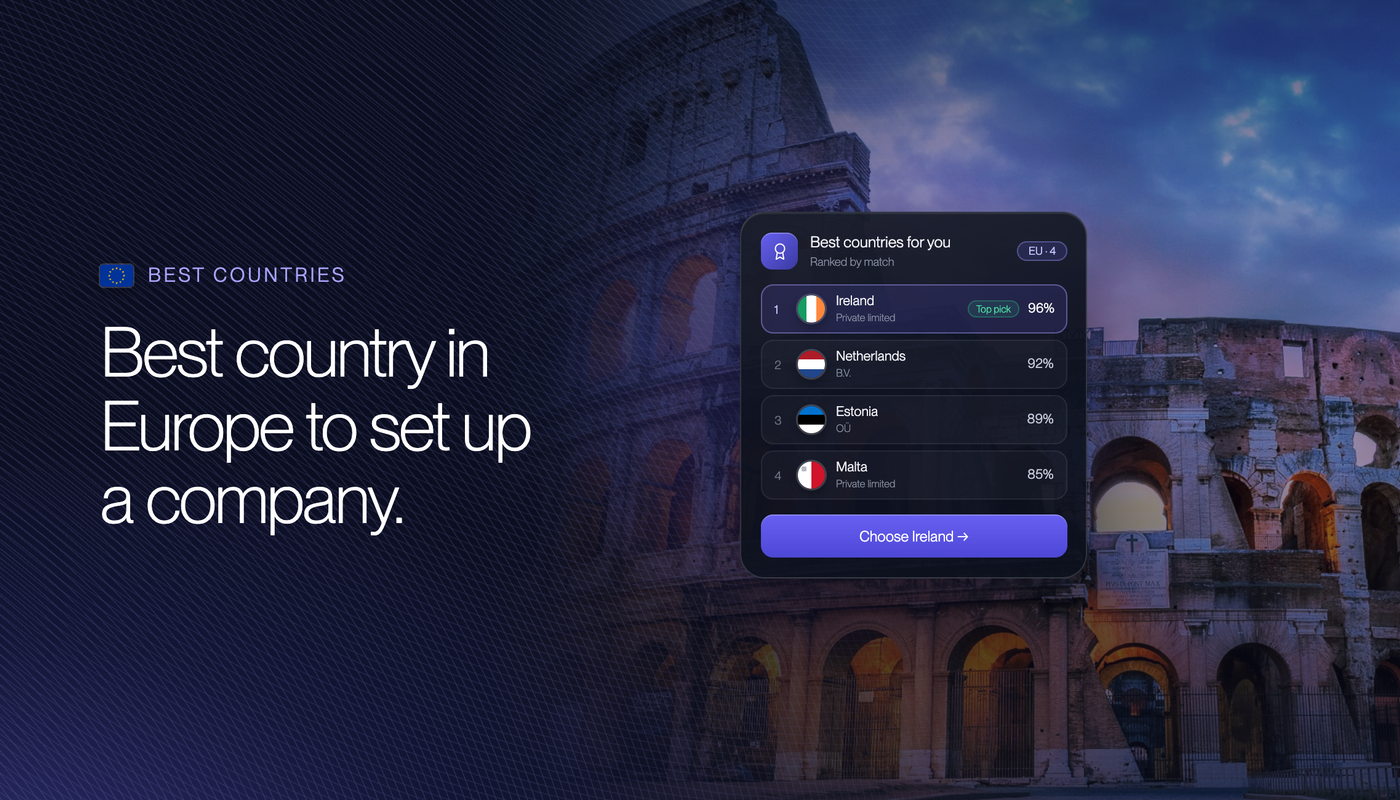
The best country in Europe to set up a company depends on what the company will do. For most founders who live outside the EU it is Cyprus. Malta is the best fit for gaming, fintech and profitable companies that pay dividends abroad. Ireland is the best fit for trading and SaaS companies selling into the EU.
What an EU Company Gives You
An EU company sells across all 27 member states on the same terms as a local business. Since 1 July 2021 the VAT One Stop Shop has let it declare cross-border sales to consumers in a single return, instead of registering in each country.
Group income moves freely too. The Parent-Subsidiary Directive removes withholding tax on dividends paid between EU companies where the parent holds at least 10%, and the Interest and Royalties Directive does the same for interest and royalties. Payment and electronic money licences can be passported to the other member states. Our European company formation guide explains each benefit.
The Top Pick for Most Founders
For founders who live outside the EU, the best EU country to set up a company is Cyprus. It has no residence rule for directors, the lowest EU starting price we offer at €1,200 and a realistic first year of about €4,000 to €7,000. Corporate tax is 15%, dividends paid to non-resident shareholders are free of withholding tax in most cases, and the IP box cuts tax on qualifying IP profit to about 3%.
Malta and Ireland win when the business fits them. Malta suits gaming, fintech and profitable companies that pay their profits out to shareholders abroad. Ireland suits trading and software companies that want a 12.5% rate and can meet its director rule.
Form Your Company in Cyprus, Malta or Ireland
Setting up an EU company is very doable, and we do the work for you. This is what you get.
- Country chosen for you: Picked around your customers, your residence and your bank.
- Company formed by us: Structure, documents and registry filing in one process.
- Local office covered: Registered office arranged at formation in every country.
- Clean KYC file: We tell you what to send and build the pack once.
- One starting price: From €1,200 in Cyprus, €1,299 in Malta and €1,899 in Ireland.
- Ready in about a week: Once your documents are complete.
Why Cyprus, Malta and Ireland Lead
Three things put these countries ahead. Business works in English: it is an official language in Malta and Ireland, and Cyprus company law is modelled on English company law. All three use the euro. Each has a tax system built for companies that trade or hold assets across borders, and Ireland alone has signed double tax agreements with 78 countries.
They are also the three EU countries where we form companies ourselves. In this guide Europe means the EU, because EU membership is what gives the company its value. If you are also weighing countries outside Europe, read our guide to the best countries to set up a company.
New Rules in 2025 and 2026
Several rules changed recently. Cyprus raised corporate tax from 12.5% to 15% on 1 January 2026, removed stamp duty on documents filed with the Registrar and now treats a company incorporated there as tax resident unless a treaty says otherwise. Malta added an option to pay a flat 15% as final tax from the 2025 year of assessment, locked in for at least five years.
Ireland's Companies Registration Office stopped accepting identity forms witnessed online on 30 April 2026, so a director without an Irish PPS number now signs in front of a witness in the same room. Our page on the Cyprus corporate tax rate has the detail. We form Irish companies from €1,899 and handle the witness step with you.
Ireland Company Incorporation
Binderr
Corporate tax
12.5% trading / 25% non-trading income
Time to Incorporate
1 Week
Cost
€1,899
Choosing the Best EU Country for Company Formation
To find the best EU country to set up a company, check seven things: tax on your type of income, the yearly running cost, banking, substance, director rules, language and law, and any licence you need. Tax gets the attention, but the other six decide whether you keep the rate.
Corporate Tax and the Rate You Pay
Headline rates mislead. Ireland charges 12.5% on trading income but 25% on non-trading income such as interest and rent, according to Revenue. Cyprus charges 15% on all company profit from 1 January 2026. Malta charges 35%, then refunds six sevenths of that tax to shareholders when trading profits are paid out as dividends, which leaves about 5%.
Reliefs move the number further. Cyprus treats 80% of qualifying IP profit as a deductible expense, so its IP box taxes that profit at about 3%. Ireland's Knowledge Development Box gives 10%, and its R&D tax credit is 35%. The 15% global minimum tax only applies to groups with revenue of €750 million or more.
Yearly Running Costs of an EU Company
The formation fee is a small part of the bill. Plan a realistic first year of about €4,000 to €7,000 in Cyprus, about €6,800 to €10,500 plus VAT in Malta, and about €3,500 to €7,500 in Ireland before any audit, bond or licence. Malta costs most because it requires a company secretary and an audit or review. Cyprus audits every company too, but a reform approved in January 2026 lets companies with turnover under €300,000 use a review instead. A small Irish company is exempt from audit. Our European company formation cost comparison breaks every line down.
Banking Access for a New Company
A company is only useful once it can be paid. Local banks in all three countries review a new company with owners abroad slowly. Our partners open accounts for new EU companies in days to about a week, as the banking section below explains.
Substance and Where the Company Is Managed
An EU company is taxed where it is really run. Cyprus, Malta and Ireland all treat a company incorporated under their law as tax resident, but another country can claim it too if the board makes its decisions there. Real board meetings, a local director where the plan needs one and records kept in the country keep the tax where you planned it. Our guide to setting up a company as a non-resident shows how.
Find the Best Place in the EU to Incorporate
We look at your customers, your income and where you live, then tell you which country fits. You get the answer in writing.
- Tax planned on purpose: The rate checked against the income you will earn.
- First-year cost upfront: A full figure before you commit to a country.
- Substance set up right: Board, director and records placed where the tax holds.
- Licence route mapped: Gaming, payments and crypto needs flagged early.
- Home tax considered: Your own country's rules looked at before you file.
Director and Residency Rules
Cyprus and Malta set no residence rule for directors, and one person can own and run the company. Ireland requires at least one director resident in the EEA under section 137 of the Companies Act 2014, or a €25,000 bond that runs for at least two years. Published broker prices put the bond at about €1,500 to €1,970. Our page on Irish company formation requirements and director rules covers the options.
Language and Legal System
English works in all three. Malta and Ireland have English as an official language, and Ireland uses common law. Cyprus company law is modelled on English company law, so the memorandum, the articles and the board's duties will look familiar.
Sector Licences and the EU Passport
Payment and electronic money licences can be passported across the EU, and so can a crypto-asset licence under MiCA, as our guide to EU crypto company formation under MiCA explains. Gambling is different: there is no EU law for it, and each member state sets its own rules. Malta built its online gaming regime around the Malta Gaming Authority, and it is the usual EU base for gaming companies. We form Malta companies from €1,299.
Malta Company Incorporation
GCS Malta
Effective tax
~5% for non-resident
Time to Incorporate
1 Week
Cost
Starting from €1,299
Best Place to Set Up a Company in Europe
The best place to set up a company in Europe changes with the business. Ireland wins for trading and SaaS, Cyprus for holding, IP and founders abroad, and Malta for gaming, fintech and profitable traders.
Best for a Trading Company
For a trading company, the best country in Europe to set up a company is Ireland, at 12.5% on trading income, inside the euro and the single market. It suits a business with EU customers that can meet the EEA director rule. Where no director lives in the EEA, Cyprus is often simpler: 15% tax, no residence rule and a starting price of €1,200 against €1,899.
Best for a Holding Company
Cyprus is our preferred base for a holding company. Foreign dividends are exempt from Cyprus corporate tax in most cases, and Cyprus does not withhold tax on dividends it pays to non-resident shareholders in most cases. Malta is a strong second, with a participation exemption and no withholding tax on dividends, but it costs more to run. European holding company formation covers the structures.
Best for IP and Royalty Income
Cyprus leads for IP. Its IP box treats 80% of qualifying profit from qualifying IP as a deductible expense, so the tax on that profit is about 3% at the 15% rate. How much qualifies depends on how much of the R&D the company does itself. Ireland's Knowledge Development Box is the alternative at 10%. See the best EU jurisdiction for IP holding.
Best for Gaming and Fintech Licences
Malta is the usual choice for online gaming, through the Malta Gaming Authority, and it also licenses payment, electronic money and crypto firms through the Malta Financial Services Authority. Cyprus is strong for investment firms supervised by CySEC, and Ireland's Central Bank also authorises payment and e-money firms. See how to get a Malta gaming licence and fintech company formation in Cyprus.
Best for SaaS Selling Into the EU
Ireland is the best fit for a software company selling into the EU. It charges 12.5% on trading profit, offers a 35% R&D tax credit and hosts more than 1,800 multinational operations, according to IDA Ireland's 2025 annual report. A founder with no EEA director can get a similar setup in Cyprus, where software can count as qualifying IP for the IP box. See EU tech startup company formation.
Best for a Non-Resident Founder
Cyprus is the best place to register a company in Europe for a founder who lives outside the EU. There is no director residence rule, a licensed Cyprus lawyer prepares and signs the documents, which we arrange, and no trip is needed. Malta has no residence rule either, but its online registry needs a Maltese e-ID or an EU eIDAS login, so a licensed Malta firm files for founders from outside the EU. Our page on EU company formation for non-residents has the full route.
Business type | Top choice | Runner-up | Why it wins |
|---|---|---|---|
Trading company with EU customers | Ireland | Cyprus | 12.5% on trading profit, euro and single market |
Holding company | Cyprus | Malta | Dividend exemptions and no withholding tax in most cases |
IP and royalty income | Cyprus | Ireland | IP box at about 3% against Ireland's 10% |
Gaming and fintech | Malta | Cyprus | Malta Gaming Authority and MFSA licences |
SaaS selling into the EU | Ireland | Cyprus | 12.5% rate and a 35% R&D tax credit |
Founder living outside the EU | Cyprus | Malta | No director residence rule, from €1,200 |
Cyprus appears in every row as the top choice or the runner-up, so when you are unsure it is the safest default. Ireland wins where the company earns active trading income and has an EEA director. Malta wins where a licence, or a profitable company paying dividends abroad, makes its higher running cost worth paying.
Read more: cheapest country to form a company in Europe and easiest country to set up a company in Europe.
Set Up a Holding or Licensed EU Company
Holding groups, IP companies and licensed businesses need more than a standard filing. We plan the structure with you and handle it end to end.
- Holding structures planned: Parent and subsidiaries set up across EU countries.
- IP company ready: Ownership and R&D records set up for the IP box from day one.
- Licence files prepared: Gaming, payments and crypto applications built with licensed advisers.
- Expert advice in house: Group, treaty and licence questions answered by one team.
- Quoted on scope: Regulated and complex structures priced in writing first.
Business Banking for Your EU Company
Your EU company needs an account before it can invoice, and this is the easy part when the file is right. Local banks in Cyprus, Malta and Ireland can take weeks for a company with owners abroad. Our partners open accounts for new EU companies in days to about a week.
How Local Banks Treat New EU Companies
Local banks are careful with new companies owned from abroad. Bank of Cyprus, in its June 2026 tariff for international business customers, charges a company from outside the EEA a €300 application fee, or €500 with enhanced due diligence, plus €75 a month to maintain an active account. Our guide to the best banks for Cyprus companies lists the main options.
Irish high street banks usually look for an Irish-resident director and local activity, and AIB's business tariff of 1 July 2026 charges 1.75% on card purchases in other currencies. In Malta, a corporate account for a company with no local history can take several weeks at a traditional bank.
A Faster Route Through Our Partners
Our banking partners are built for international companies and open business accounts for new EU companies in days to about a week. One focuses on cross-border payments for trading companies. The other is set up for more complex structures such as holding companies, trusts and SPVs, with accounts in EUR, USD, GBP and many other currencies. We prepare the file from the same KYC pack used for your company and make the introduction.

3S Money
Cross-border payments
Time to onboard
4 Days
Account opening fee
Free
Monthly fee
Starting from € 100

Interpolitan Money
Business account
Time to onboard
1 Week
Currency
EUR, USD, GBP, AED, and 50+
Monthly fee
Custom
What Our Partners Need From You
Both partners ask for the file a bank would want, so we build it once: passports and proof of address for each director and owner, the company documents, an ownership chart down to every person with more than 25%, source of funds and a plain description of the business. Pricing starts from €100 a month or is quoted on your structure.
Read more: business bank account in Europe and business bank accounts in Ireland for new companies.
Open a Business Account for Your EU Company
A business account for your EU company is part of the setup, not a separate job afterwards.
- Account opened with you: We prepare the file and make the introduction.
- Built for international owners: Partners that work with companies owned from abroad.
- Days, not months: Opening in days to about a week with a complete file.
- One KYC pack: The same documents serve the company and the account.
- Clear monthly cost: From €100 a month or priced on your structure.
- Complex structures accepted: Holding companies, trusts and SPVs banked too.
Best European Country for Company Formation
Cyprus, Malta and Ireland are the top EU jurisdictions for company formation, and each is the best European country for company formation for a different business. The table sets the facts side by side. Our prices are starting prices for a standard limited company, with the registry fee included.
Factor | Cyprus | Malta | Ireland |
|---|---|---|---|
Corporate tax | 15% from 1 January 2026 | 35%, about 5% after the 6/7ths refund | 12.5% trading, 25% non-trading |
Main relief | IP box at about 3% on qualifying IP profit | Participation exemption, 15% final tax option | Knowledge Development Box at 10%, 35% R&D credit |
Our price | From €1,200 | From €1,299 | From €1,899 |
Time with us | About 1 week | About 1 week | About 1 week |
Director rule | No residence rule | No residence rule | One EEA-resident director or a €25,000 bond |
Company secretary | Required | Required | Required |
Audit | Yes, review under €300,000 turnover | Yes, review or none for very small companies | Exempt for small companies |
VAT rate | 19% | 18% | 23% |
Realistic first year | About €4,000 to €7,000 | About €6,800 to €10,500 plus VAT | About €3,500 to €7,500 before audit, bond or licence |
Best for | Holding, IP and founders abroad | Gaming, fintech and profitable traders | Trading and SaaS companies |
Read the table by your income, not by the tax row. Ireland has the lowest headline rate and can be the cheapest to run, but the 12.5% covers trading income only and the company needs an EEA director or the bond. Cyprus costs less to run than Malta and needs no local director. Malta costs the most, and earns it back when a profitable company pays dividends to shareholders abroad. Our guide to Cyprus vs Malta company formation goes deeper on that pair.
Cyprus for Holding, IP and Founders Abroad
Cyprus is the best European country to set up a company for holding, IP and founders who live outside the EU. We form a Cyprus company from €1,200 in about a week, with a lawyer licensed by the Cyprus Bar Association signing the incorporation documents, as the law requires. Plan about €4,000 to €7,000 for the first year. The catch is that corporate tax is now 15%, so a plain trading company pays more than it would in Ireland. Read our guide to holding company formation in Cyprus.
Cyprus Company Incorporation
Binderr
Corporate tax
15% flat
Time to Incorporate
1 Week
Cost
€1,200 one-off
Malta for Gaming, Fintech and Profitable Traders
Malta is the best country in Europe for company formation in gaming and fintech, and for profitable companies that pay dividends to shareholders abroad. We form a Malta company from €1,299 in about a week, filed through the registry's online system with a qualified electronic signature. Plan about €6,800 to €10,500 plus VAT for the first year, because a company secretary and an audit or review are required, and the share capital must be at least €1,165 with 20% paid up. The catch is cash flow: the 35% is paid first and the refund follows the dividend. See Malta company formation and fintech company formation in Malta.
Malta Company Incorporation
GCS Malta
Effective tax
~5% for non-resident
Time to Incorporate
1 Week
Cost
Starting from €1,299
Ireland for EU Trading and SaaS Companies
Ireland is the best country to set up a company in Europe for trading and software businesses that sell into the EU. We form an Irish company from €1,899 in about a week, with the €50 CRO fee included, and the CRO aims to register Fé Phráinn online filings within 5 working days. Plan about €3,500 to €7,500 for the first year before any audit, bond or licence. The catch is the EEA director rule: without one, the €25,000 bond costs about €1,500 to €1,970 for two years. See the Ireland company formation guide and the cost of starting a company in Ireland.
Ireland Company Incorporation
Binderr
Corporate tax
12.5% trading / 25% non-trading income
Time to Incorporate
1 Week
Cost
€1,899
Our Recommendation by Founder Type
If you live outside the EU and want one answer, choose Cyprus. It has the lowest EU starting price we offer, no director rule and a tax system that suits holding and IP income, which makes it the best place in the EU to incorporate for most founders abroad.
If you trade into the EU and can appoint an EEA director, choose Ireland for its 12.5% rate. If you need a gaming or fintech licence, or run a profitable company that will pay dividends abroad, choose Malta. If two countries fit, we price both on your numbers before you decide.
Read more: setting up a company in Europe, country by country.
Form Your EU Company in About a Week
Once the country is clear, the setup is quick and we run every step.
- Registry fee included: Cyprus, Malta and Irish filing fees sit inside our price.
- Lawyer and e-signature arranged: The Cyprus lawyer and the Malta signature covered.
- Irish bond handled: Arranged for you when no director lives in the EEA.
- Deadlines diarised: Annual returns, accounts and ownership filings tracked from day one.
- One point of contact: A single team from filing to your first invoice.
The UK as a Non-EU Alternative
The UK is not in the EU, but it is the cheapest and quickest company we form, from €350 with the £100 Companies House fee included. It suits a founder who does not need EU access, such as a consultancy with clients outside the EU.
Being outside the EU has a cost. A UK company has no single market access, no EU directive relief on withholding tax and no licence it can passport into the EU. For EU VAT it is a non-EU business: goods sent to EU customers are imports, and the import One Stop Shop for parcels up to €150 needs an EU intermediary. If you need any of these, the best country in Europe for a company like yours is one of the EU three.
Factor | UK | Cyprus | Malta | Ireland |
|---|---|---|---|---|
EU member | No | Yes | Yes | Yes |
Corporate tax | 19% to 25% | 15% | 35%, about 5% after refund | 12.5% trading |
Our price | From €350 | From €1,200 | From €1,299 | From €1,899 |
Director rule | No residence rule | No residence rule | No residence rule | EEA director or €25,000 bond |
Audit | Not for small companies | Yes, or a review | Yes, or a review | Not for small companies |
The UK wins on price and speed. Companies House usually registers a company within 24 hours, and every director has had to verify their identity since 18 November 2025. See UK company formation for non-residents.
.svg.webp?w=96&q=75)
UK Company Incorporation
Binderr
Corporate tax
19% (small profits) / 25% (main rate)
Time to Incorporate
1 Week
Cost
€350 (no pre-payment)
Common Mistakes When Choosing an EU Country
Most mistakes come from judging the best EU country to register a company on one number. Each of these costs real money, and each is easy to avoid before you file.
Choosing on the Headline Tax Rate
Founders pick Ireland for 12.5% and then hold investments or earn interest, which Ireland taxes at 25%. Others reject Malta for its 35% rate without seeing that a trading company paying dividends abroad ends up at about 5%. On €100,000 of non-trading income, the gap between 12.5% and 25% is €12,500 a year. Work out the type of income first, then compare the rate.
Running the Company From Your Home Country
An EU company whose decisions are all made where the founder lives can be taxed there as well. The home country can treat it as resident or apply controlled foreign company rules, and the EU rate is lost, plus the cost of advisers to unwind it. Hold real board meetings in the company's country, appoint a local director where the plan needs one and keep the records there.
Missing the Irish Director Rule
Founders outside the EEA form an Irish company and then learn it needs an EEA-resident director or a €25,000 bond. The bond costs about €1,500 to €1,970 for two years and has to be in place before the filing, and a director without a PPS number now signs the identity form in person. Decide on the director or the bond at the start, or choose Cyprus, which has no such rule.
Expecting the Malta Refund Without Planning It
Malta's 5% comes as a refund to shareholders after a dividend, not as a lower rate. The company pays 35% first, and the refund depends on the income: six sevenths for trading profits, less for some other income. A company that never pays a dividend keeps paying 35%. Plan the shareholding, the dividend timing and the cash flow first, or look at the 15% final tax option. How much a Malta company costs sets out the yearly bill.
Leaving the Bank Account Until Last
The company is formed in a week, but the account decides when you can invoice. Founders who go to a local bank only after the certificate arrives can wait weeks and pay application fees, such as the €300 Bank of Cyprus charges companies from outside the EEA. Start the account at the same time as the company, with the file prepared once.
Get Expert Advice on Your EU Country
Not sure which country fits? A short call settles it before you commit.
- Call with an expert: 30 minutes on your income, customers and residence.
- Written answer: The country, the company type and the first-year cost.
- €30, fully credited: Deducted from your setup if you go ahead within 30 days.
- Complex cases welcome: Groups, licences and shareholders in several countries.
- Both options priced: Two countries costed side by side when both fit.
Bottom Line on the Best Country in Europe
The best country in Europe to set up a company is the one that fits your income and where you live. For most founders outside the EU that is Cyprus, from €1,200 with no director rule. Ireland is best for EU trading and SaaS companies with an EEA director. Malta is best for gaming, fintech and profitable companies paying dividends abroad.
The UK is the low-cost choice only when you do not need the EU. Pick the country first, plan the bank account with it, and the rest takes about a week with us.
What is the best country in Europe to set up a company?
What is the best place to set up a company in Europe as a non-resident?
Is Ireland or Cyprus better for a trading company?
Is Cyprus or Malta better for a holding company?
Which is the best EU country to set up a company for gaming or fintech?
What is the best country to register a company in Europe for SaaS?
How much does it cost to set up a company in Cyprus, Malta or Ireland?
How long does it take to set up an EU company?
Do I need a local director for an EU company?
How does the Malta tax refund work?
Where does an EU company pay tax if I live abroad?
How do I open a bank account for a new EU company?
Is a UK company a good alternative to an EU company?
Sources
Official and published sources behind the figures, checked in October 2026.
- Revenue, Ireland, Corporation tax basis of charge
- Revenue, Ireland, Double taxation treaties
- Government of Ireland, Budget 2027 tax policy changes, 6 October 2026
- Revenue, Ireland, Pillar Two scope, Part 4A manual
- Companies Registration Office, Company fees and Registration methods
- Companies Registration Office, EEA resident director, Information Leaflet 17
- Companies Registration Office, VIF form update, 30 April 2026
- Companies Registration Office, Audit exemption
- Irish Statute Book, Companies Act 2014, section 137
- IDA Ireland, Annual report 2025
- Registrar of Companies, Cyprus, Company incorporation forms and fees and Applying to incorporate a company
- Registrar of Companies, Cyprus, Repeal of the Stamp Duties Laws, Law 239(I)/2025, 19 January 2026
- EY Global Tax News, Cyprus enacts major tax reform legislation, 7 January 2026
- PwC Worldwide Tax Summaries, Cyprus taxes on corporate income, IP box and withholding taxes, reviewed 4 August 2026
- Bank of Cyprus, Commissions and charges for International Business Units customers, June 2026
- Malta Business Registry, Registration and fee structure and BAROS user guide, November 2025
- Malta Enterprise, Incorporation
- Legislation Malta, Legal Notice 139 of 2025, Audit Exemption Rules
- PwC Worldwide Tax Summaries, Malta taxes on corporate income, income determination and refunds and withholding taxes, reviewed 30 September 2026
- AIB, Business fees and charges, effective 1 July 2026
- European Commission, VAT One Stop Shop
- European Commission, Gambling services in the EU
- EUR-Lex, Parent-Subsidiary Directive 2011/96/EU and Interest and Royalties Directive 2003/49/EC
- EUR-Lex, Markets in Crypto-Assets Regulation (EU) 2023/1114, Directive (EU) 2019/1151 and Anti-Tax Avoidance Directive (EU) 2016/1164
- GOV.UK, Companies House fees and Verify your identity for Companies House