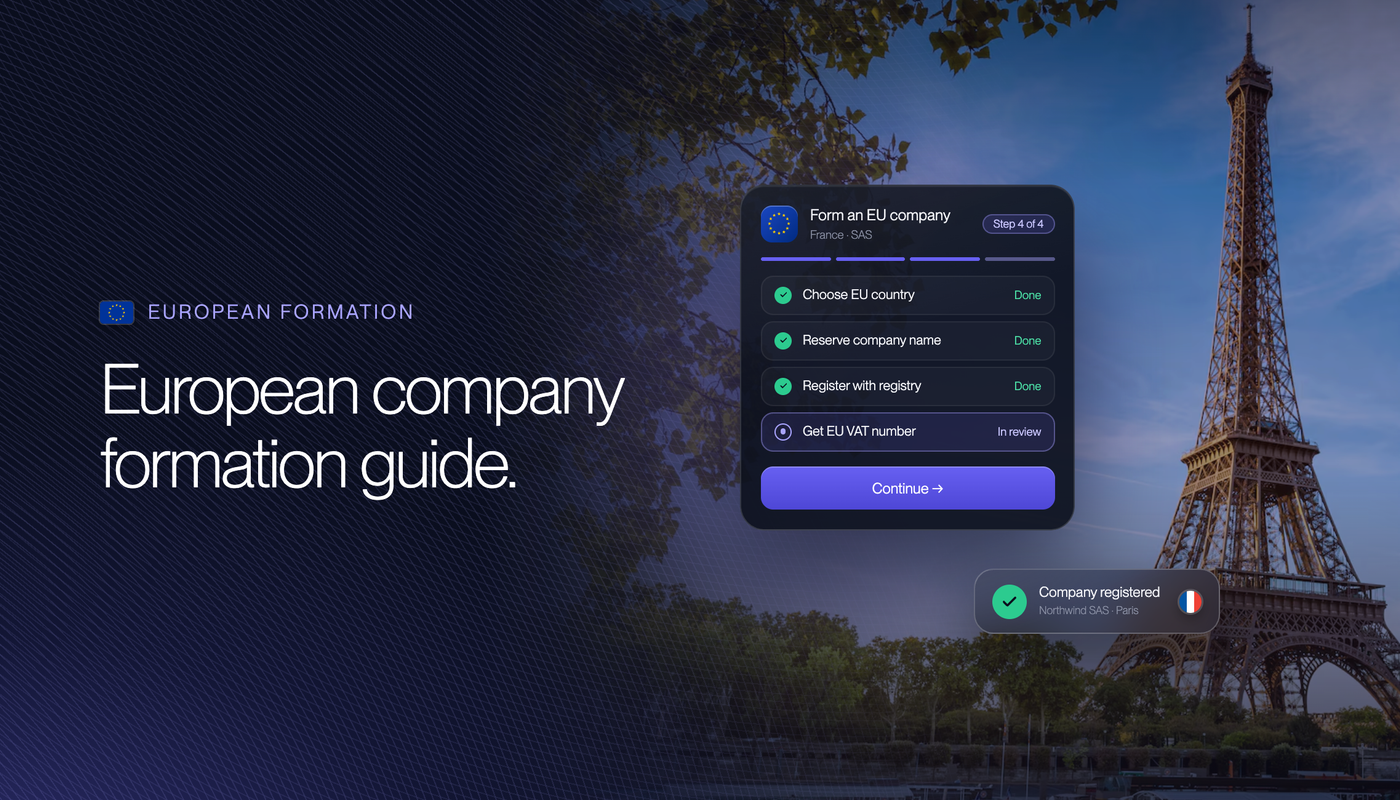
European company formation puts your business inside the EU single market: 27 countries and about 452 million people. You sell across borders without customs, declare EU VAT on cross-border consumer sales in one return and can passport a financial licence. Cyprus, Malta and Ireland add company law in English and low tax.
The work sits in the local rules. In Cyprus, only a lawyer licensed by the Cyprus Bar can prepare and sign the incorporation documents. Malta filings need a qualified electronic signature. Ireland wants a director who lives in the EEA or a €25,000 bond. Banks then review the owners and the money before they open an account.
We make it easy. Our team forms the company and handles what slows founders down: the country choice, your KYC pack, the Cyprus lawyer, the Malta signature or the Irish director rule, the filing and the bank introduction. One team, one price from €1,200, and your EU company in about a week.
Our lowest EU starting price is Cyprus, where we form a private company from €1,200 with the Registrar fees included.
Cyprus Company Incorporation
Binderr
Corporate tax
15% flat
Time to Incorporate
1 Week
Cost
€1,200 one-off
Why Form a Company in the EU
Company formation in Europe gives you one market of 27 countries on equal terms. When you form a company in the EU, it files one VAT return for cross-border consumer sales, can passport a financial licence and pays no withholding tax on many payments inside its group.
Access to the EU Single Market
The single market lets goods, services, capital and people move freely between member states. An EU company ships stock across borders with no customs checks or import duty. Eurostat put the EU population at 452.0 million on 1 January 2026.
One VAT Return Through the EU OSS
Selling to consumers in other EU countries usually means charging the buyer's VAT. The One Stop Shop, in place since 1 July 2021, lets an EU-established company declare all of it in one quarterly return at home, with no VAT registration in each country. Below a €10,000 EU-wide threshold, small cross-border sales can stay under home-country VAT.
Start Your European Company Formation
European company formation is very doable when one team runs it. This is what we handle for you.
- Country chosen for you: Cyprus, Malta or Ireland, based on what your company does.
- Local signatures arranged: The Cyprus lawyer, the Malta e-signature and the Irish forms.
- KYC pack built once: One set of documents for the registry and the bank.
- Banking planned early: The business account is part of the setup from the start.
- Filing handled end to end: We submit the filing and deal with any registry queries.
- Formed in about a week: Once the file is complete and signed.
Licence Passporting Across the EU
A financial licence from one EU regulator can be used across the EU. A payment institution, an e-money institution, an investment firm or, under MiCA, a crypto-asset service provider notifies its home regulator and then serves other member states without a second licence. Our guide to the EMI licence in Europe covers the steps.
No Withholding Tax Between EU Group Companies
Two EU directives remove withholding tax inside a group. The Parent-Subsidiary Directive (2011/96/EU) covers dividends paid to an EU parent that holds at least 10% of the subsidiary. The Interest and Royalties Directive (2003/49/EC) covers interest and royalties between associated EU companies, at 25% or more. Outside the EU, a company relies on tax treaties that often leave some tax withheld, which is why groups put their European holding company inside the EU.
EU Company Rules That Apply in Every Country
Every company formation in Europe follows a shared base of EU law, whichever member state you pick. Online formation, beneficial ownership registers, anti-avoidance rules and tax residence shape how you form and run the company, in all three countries.
Online Formation Under Directive 2019/1151
Directive (EU) 2019/1151 obliges every member state to offer fully online formation of limited companies. Under Article 13g(7), the registry has 5 working days when only individuals form the company on the state's template, and 10 in all other cases, counted from the complete file and paid fees. Physical presence can be asked for only when the registry suspects identity fraud. Each country still adds its own gate, and our guide on how to register a company online shows where online filing stops.
Beneficial Ownership Registers
Every EU company records the people who own or control it in a national register, usually anyone with more than 25% of the shares or votes. Cyprus wants the details within 90 days of incorporation. Ireland wants them within 5 months, and Malta asks for a yearly confirmation with the annual return. Since an EU Court of Justice ruling of 22 November 2022, the general public can no longer search these registers, but banks and authorities can. The Anti-Money Laundering Regulation (EU) 2024/1624 brings one rulebook from 10 July 2027.
Anti-Tax Avoidance Rules Since 2019
The Anti-Tax Avoidance Directive (EU) 2016/1164 applies in every member state. It limits net interest costs to 30% of EBITDA, usually with a €3 million safe amount, and adds controlled foreign company rules, an exit tax and a general anti-abuse rule. In short, an EU company needs a real business purpose and real decisions where it says it is run.
Pillar Two Only Above €750 Million
The EU's 15% minimum tax, Directive (EU) 2022/2523, applies only to groups with revenue of €750 million or more in two of the last four years. Ireland's Department of Finance says over 99% of companies in Ireland are outside it, so the low rates in Cyprus, Malta and Ireland still apply to you.
Tax Residence and Substance
Where the company pays tax depends on where it is run. From 2026, Cyprus treats a company incorporated there as tax resident unless a tax treaty says otherwise, and Ireland treats an Irish-incorporated company as resident by default. Your home country can still claim the company if you make every decision from there. Hold board meetings in the company's country and keep the minutes. Our guide to EU company formation for non-residents covers this.
Read more: How to set up a company as a non-resident.
Malta Company Incorporation
GCS Malta
Effective tax
~5% for non-resident
Time to Incorporate
1 Week
Cost
Starting from €1,299
Steps for Setting Up a Company in Europe
Setting up a company in Europe takes eight steps, and we run each one with you: choose the country, reserve the name, build the KYC file, prepare the constitution, file with the registry, register for tax, file the beneficial owners and open the account. With a complete file, it takes about a week.
Choose the Country and Company Type
Most founders setting up a European company choose a private company limited by shares: the Cyprus Ltd, the Malta Ltd or the Irish LTD. Pick the country by what the company does, where your customers are and where you can bank. An existing company abroad can open a branch instead, and our guide to the EU branch vs subsidiary choice explains when that fits.
Reserve the Company Name
We check and reserve the name with the registry first. Cyprus charges €10 to approve a name, or €30 on the express route, and the approved name holds for 6 months. Malta's BAROS portal reserves a name for €10. Ireland's CRO reserves one for €25 for 28 days, and takes the €25 off the incorporation fee if you incorporate in that time.
Build the KYC File
Every registry and every bank asks for the same core documents: certified copies of every director's and owner's passport and proof of address, a short business description and evidence of where the money comes from. We collect them once for both. Our checklist of the documents you need to set up a company lists every item.
Prepare the Constitution and Officers
We draft the memorandum and articles, or Ireland's single-document constitution, and set the share capital. We appoint the directors and the company secretary and arrange the registered office. In Malta, the paid-up capital goes into a company account first, and the deposit slip goes in with the application.
Set Up an EU Company With One Team
You can set up an EU company without learning three registries. We run the whole process with you.
- Single contact: One team from the name check to the certificate.
- Constitution drafted for you: Articles and share capital set for your plan.
- Officers in place: Secretary and registered office arranged at formation.
- Registry questions answered: We deal with the registry for you.
- Clear price upfront: From €1,200 in Cyprus, €1,299 in Malta and €1,899 in Ireland.
File With the Registry
We file with the Registrar of Companies in Cyprus, the Malta Business Registry or the Companies Registration Office (CRO) in Ireland, and the registry fee comes out of our price. Fees and timings are in the table below.
Register for Tax and VAT
Once the company number is issued, it registers for corporate tax and, where needed, VAT. The VAT threshold is €15,600 a year in Cyprus, and €42,500 for services or €85,000 for goods in Ireland. A business not established in Ireland that makes taxable supplies there must register from the first euro.
File the Owners and Open the Account
We make the first beneficial ownership filing as part of the formation. We then prepare the bank file from the same KYC pack and introduce the company to our banking partners once the certificate is issued.
Read more: How to incorporate a company.
Ireland Company Incorporation
Binderr
Corporate tax
12.5% trading / 25% non-trading income
Time to Incorporate
1 Week
Cost
€1,899
Company Incorporation in Europe by Country
Company incorporation in Europe follows the same EU base, but each country sets its own officers, capital and signing rules. Cyprus needs a lawyer to sign, Malta needs a qualified electronic signature and paid-up capital, and Ireland needs a director in the EEA or a bond.
Requirement | Cyprus | Malta | Ireland |
|---|---|---|---|
Minimum directors | 1, any residence | 1, any residence | 1, with one director in the EEA or a €25,000 bond |
Company secretary | Required | Required, a natural person | Required, not the sole director |
Share capital | No legal minimum | €1,164.69 minimum, 20% paid up | No minimum for an LTD |
Registered office | Address in Cyprus | Address in Malta | Physical address in Ireland |
Who signs the filing | A Cyprus Bar lawyer | Qualified e-signature on BAROS | Directors, plus an in-person VIF without a PPS number |
Registry fee | €10 name and €165 registration | From €100 to €1,900 | €50 online |
Registry time | A few days | 2 to 14 days | 5 or 10 working days (CRO target) |
For European company incorporation, the real differences are who signs and what you pay in. Cyprus puts a lawyer in the middle of every formation, Malta wants about €233 of capital paid into the company, and Ireland adds a €25,000 bond when no director lives in the EEA.
Cyprus Company Requirements
A Cyprus private company needs at least one director, one shareholder, a company secretary and a registered office in Cyprus. The HE1 declaration, the memorandum and the articles must be prepared and signed by a lawyer licensed by the Cyprus Bar Association, who swears the HE1 before the court. Since 1 January 2026, Registrar filings need no stamp duty. Our page on Cyprus company formation requirements goes deeper.
Malta Company Requirements
Malta requires at least one director and a company secretary, who must be a natural person. Issued share capital must be at least €1,164.69, with 20% paid up at formation. Filings go through the Malta Business Registry's BAROS portal and need a qualified electronic signature that meets the EU's eIDAS standard, which the registry itself can issue after a video identity interview. Our Malta company registration fees guide lists the full scale.
Ireland Company Requirements
An Irish LTD needs at least one director and a company secretary, and one person cannot hold both roles when there is only one director. One of the directors has to live in the EEA, or the company buys a €25,000 bond under section 137 of the Companies Act 2014. A director with no PPS number files a VIF form, and since 30 April 2026 the CRO only accepts one signed with the witness in the same room. Our page on Irish company formation requirements covers each step.
European Company Incorporation From Abroad
European company incorporation is simple when someone handles the local roles. We arrange each one.
- Cyprus lawyer arranged: A Cyprus Bar lawyer prepares, signs and files your documents.
- Malta e-signature handled: The BAROS filing signed the way the registry needs.
- EEA director or bond: Ireland's section 137 rule settled before filing.
- Secretary and office: A local secretary and registered address from day one.
- Capital deposit guided: Malta's paid-up capital and deposit slip done with you.
Business Banking for an EU Company
Company formation in Europe is only half the job, because an EU company cannot trade until it has a business account. A traditional bank in Cyprus, Malta or Ireland often needs several weeks for a new company owned from abroad. Our partners open accounts in about 2 days to a week, and we prepare the file with you.
Local Banks in Cyprus, Malta and Ireland
Local banks are a good long-term home, but slow and costly for a new company. The Bank of Cyprus June 2026 tariff for international business customers charges €50 a month for an active company account, €20 more in any month with four or fewer transactions and 0.40% on currency conversion. AIB in Ireland charges €4.50 a quarter under its fee schedule of 1 July 2026, but Irish banks usually want an Irish-resident director and local activity. Malta's banks run the same full review.
Refusals are common for a company with no trading history. Our guides to the best banks for Cyprus companies, opening a Malta business bank account and business bank accounts in Ireland for new companies cover each market.
A Faster Route Through Our Partners
Our partners are the faster and easier route. They are regulated e-money and payment firms that specialise in companies trading across borders, and they open accounts in about 2 days to a week. Pricing starts from about €30 a month, with custom pricing for complex structures such as holding companies and SPVs.
We prepare the file from your formation KYC pack and make the introduction once the certificate is issued. The account does not need to sit in the company's own country: under the SEPA Regulation, (EU) 260/2012, a payer cannot refuse an IBAN from another SEPA country.
Our top-rated, regulated banking partners work with new EU companies owned from abroad.

Interpolitan Money
Business account
Time to onboard
1 Week
Currency
EUR, USD, GBP, AED, and 50+
Monthly fee
Custom

Equals Money
Business Bank Account
Time to onboard
2 Days
Account opening fee
Free
Monthly fee
€30
Local Banks vs Our Partners
Factor | Traditional bank | Our partners |
|---|---|---|
Time to open | Several weeks for a new company owned from abroad | About 2 days to a week |
Monthly cost | €50 a month at Bank of Cyprus for an active company | From about €30 a month, custom for complex structures |
Currency conversion | 0.40% at Bank of Cyprus | Quoted with your setup |
The application file | Built by you in each bank's format | Prepared by us from your KYC pack |
Best for | An established company with local trade | A new EU company that needs to trade now |
For a new company, the partner route wins on time and usually on monthly cost. A local bank is worth adding once you have local staff, suppliers or a lender.
Read more: Business bank account in Europe.
Open a Business Account for Your EU Company
Your EU company's account opens fast with a complete file, and we put that file together with you.
- Fast opening: Accounts ready in 2 days to a week through our partners.
- One file, two uses: Your formation KYC pack becomes the bank file.
- Introduction made for you: We present the company to the partner that fits it.
- Fewer refusals: Gaps closed before submission, not after a decline.
- Clear monthly cost: From about €30 a month, custom for complex structures.
Tax and First-Year Filings for an EU Company
An EU company pays corporate tax where it is resident and files a short list of returns in year one. Ireland charges 12.5% on trading profits, Cyprus 15% from 2026, and Malta 35% with a refund that brings distributed profits to about 5%.
Corporate Tax in Cyprus, Malta and Ireland
Cyprus raised its rate from 12.5% to 15% on 1 January 2026, and its IP box leaves about 3% tax on qualifying IP profit, as our page on the Cyprus corporate tax rate explains. Malta charges 35%, refunds 6/7ths to shareholders on distributed profits, and since 2025 also offers an optional flat 15% final tax. Ireland taxes trading income at 12.5% and passive income like rent and interest at 25%.
First-Year Filing Calendar
Filing | Cyprus | Malta | Ireland |
|---|---|---|---|
Beneficial owners | Within 90 days, then yearly from 1 October to 31 December | Yearly confirmation with the annual return | Within 5 months of incorporation |
Annual return | Yearly, €20 fee | €85 online, within 42 days of each anniversary | €20 online, first one made up to month 6 |
Financial statements | Audited, or reviewed if small | Approved within 10 months of year end, filed 42 days later | Filed with the annual return from year two |
Corporate tax return | 31 January of the second year after the tax year | Later of 9 months after year end or 31 March | 23rd day of the ninth month after year end |
Tax payments | Provisional tax on 31 July and 31 December | Provisional tax in 3 instalments | Preliminary tax before the return |
In Ireland, a late annual return costs €120 straight away and €3 for each extra day, capped at €1,200. Two late returns in five years also cost the company its audit exemption for two years.
Audit or Review in the First Year
Most small Irish companies are exempt from audit. Cyprus requires one, but a company with turnover up to €300,000 and gross assets up to €500,000 for two years running can file a review instead, for financial years from 6 February 2026. In Malta, Legal Notice 139 of 2025 gives very small companies a review report, or in some cases neither.
Read more: European company formation cost comparison and company formation costs by country.
First-Year Compliance for Your European Company
Your first year is easy when the dates are set from day one. We plan it with you.
- Tax plan before filing: Residence, VAT and the refund route decided upfront.
- Calendar from day one: Every return and deadline listed at formation.
- Accounts through our partners: Bookkeeping, statements and returns arranged.
- Audit route checked: Review or exemption confirmed where the rules allow.
- Beneficial owners filed: The first register filing made with the formation.
Cyprus, Malta or Ireland for EU Company Formation
When setting up a European company, Ireland suits most trading and software companies, Cyprus suits holding and IP structures and the lowest-cost start, and Malta suits profitable companies that pay dividends. All three form in about a week with us, from €1,200.
Factor | Cyprus | Malta | Ireland |
|---|---|---|---|
Corporate tax | 15% from 1 January 2026 | 35%, about 5% effective after the refund | 12.5% trading, 25% non-trading |
Our price | From €1,200 | From €1,299 | From €1,899 |
Time with us | About 1 week | About 1 week | About 1 week |
Director rule | 1 director, any residence | 1 director, any residence | 1 director in the EEA or a €25,000 bond |
Audit | Audit, or review below €300,000 turnover | Audit, with relief for very small companies | Exempt for small companies |
VAT rate | 19% | 18% | 23% |
Account with our partners | About 2 days to a week | About 2 days to a week | About 2 days to a week |
Strongest for | Holding, IP and treaty structures | Distributed profits and licensed sectors | Trading and software companies |
For European company formation, read the tax row with the cost rows. Ireland's 12.5% is the simplest low rate, but it needs a director in the EEA or a bond. Cyprus is the cheapest EU start. Malta has the highest headline rate and the lowest effective one, which pays off only when profits are paid out.
Cyprus Company Formation
Cyprus is the pick for holding companies, IP owners and founders who want the cheapest way into the EU. Our Cyprus formation starts from €1,200 and takes about a week. The catch is the new 15% rate and a yearly audit or review, so Cyprus wins on structure rather than on headline tax. Read our full guide to Cyprus company formation.
Cyprus Company Incorporation
Binderr
Corporate tax
15% flat
Time to Incorporate
1 Week
Cost
€1,200 one-off
Malta Company Formation
Malta suits profitable trading and holding companies that pay out dividends, and businesses in licensed sectors such as gaming and fintech. Our Malta formation starts from €1,299 and takes about a week. The catch is cash flow, because the 35% is paid before the 6/7ths refund arrives, and Malta needs a secretary and paid-up capital. See our guide to Malta company formation.
Malta Company Incorporation
GCS Malta
Effective tax
~5% for non-resident
Time to Incorporate
1 Week
Cost
Starting from €1,299
Ireland Company Formation
Ireland suits trading, software and service companies that want a simple 12.5% rate, English common law and the euro. Formation with us starts from €1,899 and takes about a week. The catch is the EEA director rule: with no director in the EEA you need the €25,000 bond, which we arrange at extra cost. Our Ireland company formation guide has the full process.
Ireland Company Incorporation
Binderr
Corporate tax
12.5% trading / 25% non-trading income
Time to Incorporate
1 Week
Cost
€1,899
Which EU Jurisdiction Should You Choose?
Choose Ireland if your company trades or sells software and you can meet the EEA director rule. Choose Cyprus for a holding or IP structure, or when you want the lowest-cost EU company with no residence rule for directors. Choose Malta when profits will be paid out as dividends from the first years, because the refund then beats both.
If you are still unsure, start with Cyprus. It is the simplest EU company for us to form from abroad, at the lowest price. Our ranking of the best country in Europe to set up a company and our country-by-country comparison go further.
UK Company Formation Outside the EU
A UK company is the cheapest company we form. It costs from €350 with us, the £100 Companies House fee included, and takes about a week. It suits founders who sell mainly to the UK or outside Europe. Corporation tax is 19% on profits up to £50,000 and 25% above £250,000.
The UK is not in the EU, so it is not an option for EU company formation. It left on 31 January 2020, and since the transition ended on 31 December 2020 a UK company has no place in the single market. Goods sold into the EU face customs and import VAT. You cannot use the EU VAT One Stop Shop as an EU-established business. EU directives do not remove withholding tax on payments from EU companies, and a UK licence cannot be passported into the EU. Our UK company registration guide covers the UK route.
Factor | UK | Cyprus | Malta | Ireland |
|---|---|---|---|---|
EU member | No | Yes | Yes | Yes |
Our price | From €350 | From €1,200 | From €1,299 | From €1,899 |
Corporate tax | 19% to 25% | 15% | About 5% effective | 12.5% trading |
EU VAT OSS as an EU business | No | Yes | Yes | Yes |
EU licence passport | No | Yes | Yes | Yes |
Choose the UK only when the EU market is not the point. If you sell into the EU, need EU VAT treatment or plan a licence, one of the EU three costs more upfront and saves more later.
.svg.webp?w=96&q=75)
UK Company Incorporation
Binderr
Corporate tax
19% (small profits) / 25% (main rate)
Time to Incorporate
1 Week
Cost
€350 (no pre-payment)
Common European Company Formation Mistakes
In Europe, company formation mistakes come from planning the filing and not the years after it. These four cost founders the most, and each has a simple fix if you plan it before you file.
Choosing Ireland for a Passive Holding Company
Founders see 12.5% and put a holding company in Ireland. But Ireland taxes non-trading income such as interest and rent at 25%, and a close company pays a 20% surcharge on undistributed investment income. A holding company earning €100,000 of interest pays €25,000, not the €12,500 the founder planned. Ireland does exempt qualifying foreign dividends from 2025, but only where the holding is at least 5% and held for 12 months. Check what income the company will earn before you pick the country. A holding company built for dividends and IP usually sits better in Cyprus.
Forming in Malta Without Planning the Refund
Malta's 5% effective rate is real, but it arrives as a refund after the dividend. A company with €200,000 of profit pays €70,000 of tax first, and the shareholder claims €60,000 back only after the dividend is paid and the claim is filed. Passive interest and royalties get only 5/7ths back, an effective 10%, so a company earning interest pays twice the rate it planned. Plan the dividend timing and the refund claim before you form, or look at the optional 15% final tax where it fits, since that choice binds you for at least five years.
Planning on the Old Cyprus Tax Rate
Many guides still quote Cyprus at 12.5%, and founders build their numbers on it. The rate has been 15% since 1 January 2026. On €200,000 of profit that is €30,000 of tax, not €25,000, so the plan falls €5,000 short every year. The IP box moved too: it now leaves about 3% on qualifying IP profit, not the 2.5% that older guides still show. Build the plan on 15% from day one, use the IP box where your income qualifies, or form in Ireland at 12.5% if the company simply trades.
Leaving the Bank Account Until After Formation
Many founders form the company first and think about the bank later. The company then has a certificate and no way to get paid, while a traditional bank reviews it for weeks. A company that waits six weeks for a bank also waits six weeks to invoice its first client. Build the bank file with the formation file, from the same documents, and apply the day the certificate arrives. With our partners, the account then follows in about 2 days to a week, so you can invoice within the month.
Choose the Right Country for Your EU Company
Not sure which of the three fits? A short call settles it.
- Advice in writing: Which country, which company type and what year one costs.
- Fitted to your plan: Where you sell, where you live and where you bank.
- Complex cases covered: Holding groups, IP and licensed sectors.
- €30 advisory call: Credited in full against a setup within 30 days.
- Same team after the call: The people who advise you also form the company.
Bottom Line
European company formation gives you the single market, EU VAT treatment, licence passporting and directive relief, which no company outside the EU can buy. The rules on online formation, beneficial owners and tax avoidance are shared. For company formation, Europe then comes down to tax, officers and cost.
If you are setting up a company in Europe to trade or sell software and can meet the EEA director rule, choose Ireland at 12.5%. For a holding or IP structure, or the lowest-cost EU start, choose Cyprus from €1,200. For profits paid out as dividends, choose Malta and its refund. Choose the UK only when the EU market is not the point.
Plan the account alongside the company rather than after it. We form your EU company in about a week and open the account through our partners in days.
What is European company formation?
How much does company formation in Europe cost?
How long does EU company formation take?
Can a foreigner form a company in the EU?
Can you register a company in Europe online?
Do you need a local director for a European company?
Which is better for tax, Cyprus, Malta or Ireland?
Is Cyprus corporate tax still 12.5%?
How does the Malta tax refund work?
Where should an EU company open its bank account?
Does an EU company need an audit?
Is a UK company an EU company?
Is a European company the same as a Societas Europaea?
Sources
- EUR-Lex, Directive (EU) 2019/1151
- European Commission, VAT One Stop Shop
- EUR-Lex, Directive 2011/96/EU, Directive 2003/49/EC, ATAD (EU) 2016/1164 and Pillar Two (EU) 2022/2523
- EUR-Lex, AMLR (EU) 2024/1624, SEPA Regulation (EU) 260/2012 and Regulation (EC) No 2157/2001
- Court of Justice of the EU, Joined Cases C-37/20 and C-601/20, 22 November 2022
- Eurostat, Population and demography, 10 July 2026
- Cyprus Registrar of Companies, Applying to incorporate, Choosing a name, Beneficial owners and Stamp duty repeal, 19 January 2026
- Invest Cyprus, Starting a business in Cyprus
- PwC Worldwide Tax Summaries, Cyprus corporate tax, residence, IP box, administration and VAT, reviewed 4 August 2026
- Mondaq, Cyprus statutory audit requirements, 25 March 2026
- Malta Business Registry, Fee structure, Annual filings and BAROS guide, November 2025
- Malta Enterprise, Incorporation; Companies Act, Cap. 386; Legal Notice 139 of 2025, 15 July 2025
- PwC Worldwide Tax Summaries, Malta corporate tax, administration and VAT, reviewed 30 September 2026; KPMG Malta, Malta's tax system, April 2024
- Companies Registration Office, Fees, Registration methods, EEA resident director, Audit exemption and VIF update, 30 April 2026; RBO FAQs
- Revenue, Corporation tax, Filing, Close companies, Foreign dividends, VAT thresholds and Pillar Two
- Bank of Cyprus, International business charges, June 2026; AIB, Business fees, 1 July 2026
- GOV.UK, Companies House fees and Corporation Tax rates

-360x240.jpg?w=3840&q=75)