Banks reject business account applications for a small set of reasons, and almost all of them can be seen before you apply. Get the file right and an account that looked out of reach opens in days: clients can pay you, suppliers get paid, and the company can trade from the first week.
The hard part is that banks rarely say why. In the UK, the middle half of banks decline up to 11.4% of business applications, a wider range than for personal accounts, and owners abroad, layered structures and higher-risk sectors are refused far more often. There is no legal duty to give a reason, and each refusal makes the next bank more careful.
You do not need to work through any of that alone. We check your file against what reviewers look for, fix the gaps, and place it with our regulated banking partners, who open multi-currency accounts in days. One team handles it, and we get it done.
Our top-rated, licensed banking providers open accounts for companies that high street banks turn away, fully online and in days.

Equals Money
Business Bank Account
Time to onboard
2 Days
Account opening fee
Free
Monthly fee
€30

3S Money
Cross-border payments
Time to onboard
4 Days
Account opening fee
Free
Monthly fee
Starting from € 100
Why Banks Reject Business Account Applications
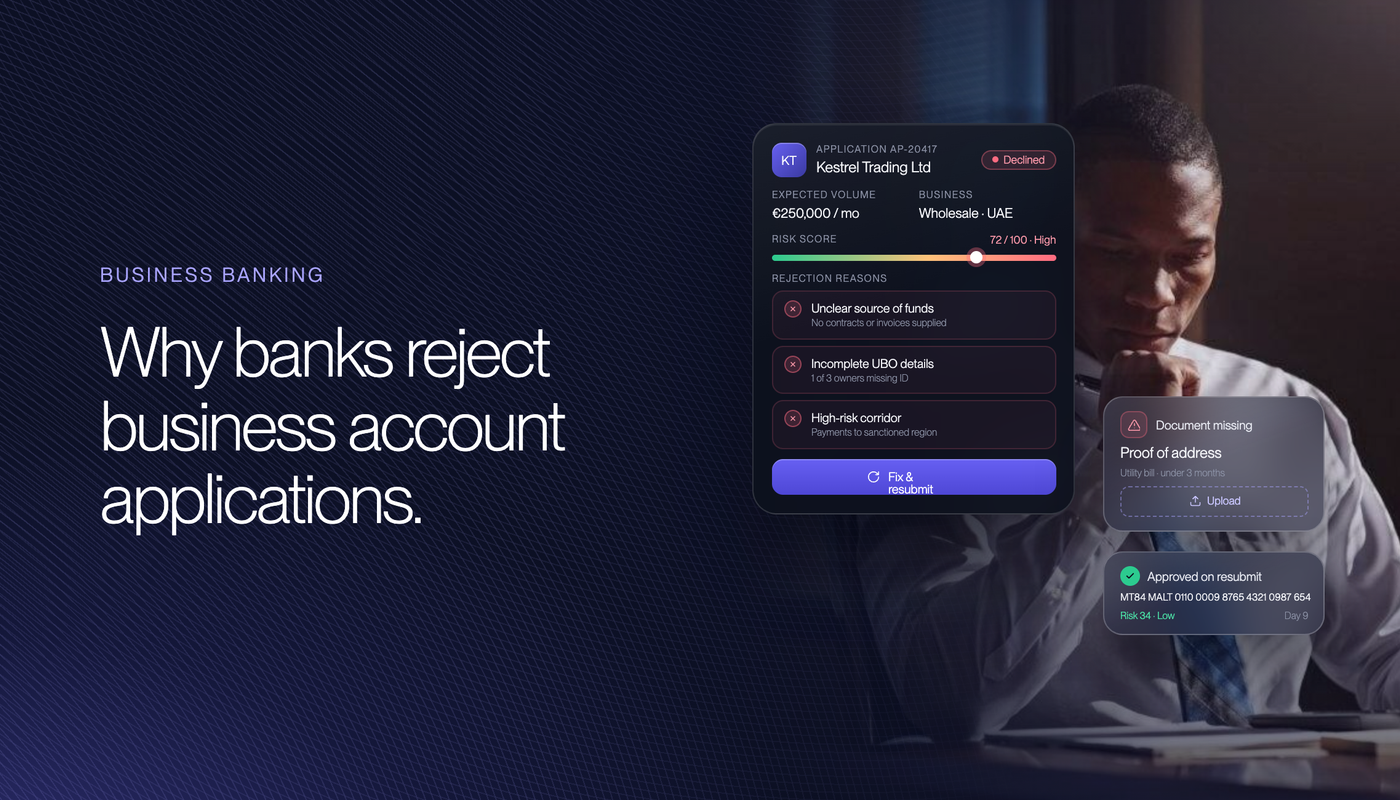
Banks reject business account applications for three kinds of reason. The rules stop them, because they cannot complete the checks the law requires. The risk puts them off, because the customer falls outside what they are willing to hold. Or the revenue does not justify the work. The FCA put it plainly in 2023: there is "no legal obligation for a firm to offer their services to businesses". These are the reasons that come up most.
The Bank Cannot Complete Its Checks
Under the UK Money Laundering Regulations, a bank that cannot complete customer due diligence must not open the account, and must consider whether to report the customer. EU law says the same. Due diligence means knowing who the company is, who owns and controls it, and what the relationship is for. A missing document, an owner who cannot be verified or a structure the bank cannot follow ends the application, whatever else is right about the business.
The Owners Live Outside the Bank's Country
High street banks build their accounts for local owners, and they say so. HSBC UK asks for a business that holds UK tax residency. NatWest needs at least one person on the application to be a UK resident. Barclays asks applicants to be UK residents. Santander's classic account allows a maximum of two directors or owners, all living in the UK. Starling needs every person of significant control and every director with account access to live in the UK. A company owned from abroad fails these tests before anyone reads the file.
Get a Business Account When Banks Say No
Most refused applications can be turned into approved ones when the file is rebuilt. This is what we do for you.
- Owners abroad welcome: Directors and owners can live in most countries.
- Structures explained: Holding companies and layered ownership mapped clearly.
- Banks slow to onboard: An account in days, not weeks of back and forth.
- Refused before: We find the gap and fix it before you reapply.
- Multi-currency from day one: EUR, GBP, USD and more in one account.
- Clear pricing, no surprises: One quote before we start.
The Structure Is Hard to Follow
UK law names nominee shareholders, bearer shares, personal asset holding vehicles and structures that are "unusual or excessively complex given the nature of the company's business" as risk factors. Some providers exclude whole categories: Starling does not take holding companies, and Revolut Business lists special purpose vehicles and trusts among the businesses it does not support. In the Netherlands, financial holding companies were the sector with the most anti-money laundering exits at the four largest banks in 2021.
The Sector Is on the Bank's Restricted List
Every bank keeps a list of industries it will not serve or will serve only with extra checks. Crypto, gambling, adult content, weapons, cannabis and CBD, and money services businesses appear on most of them, including the published lists at Revolut, Starling and Wise. A company in one of these sectors that applies to a general business account is almost always refused, however clean its file.
The Country Is on a Watch List
After the June 2026 plenary, the FATF's call for action list named North Korea, Iran and Myanmar, and 22 jurisdictions were under increased monitoring, including Bulgaria, Monaco, Kenya, Vietnam and the British Virgin Islands. The EU's own high-risk list had 26 jurisdictions after its January 2026 update. Links to any of these, through owners, customers or suppliers, bring enhanced checks at best and a refusal at worst.
The Money Cannot Be Traced
For higher-risk customers, and for any politically exposed person, the bank must establish the source of funds and the source of wealth, with senior management approval. A founder who cannot show where the first deposit came from, or how they built their wealth, gives the bank no way to say yes. "Savings" or "business income" with no evidence is one of the most common reasons banks reject business account applications from new companies.
A Politically Exposed Person Is Involved
When an owner, director or close family member holds or has held a prominent public role, the bank must get senior management approval, establish the source of wealth and source of funds, and monitor the account more closely for as long as the relationship lasts. Some banks simply do not take that work on. Since January 2024, UK rules start from the view that a domestic politically exposed person is lower risk than a foreign one, but the extra checks still apply.
The Documents Do Not Match
Names spelled differently on the passport and the register, an old address on the proof of address, an expired identity document or an ownership chart that disagrees with the public record all stop a review. Each one looks small, but together they tell the reviewer the file cannot be relied on, and that alone is why banks reject business account applications that look fine on paper.
The Business Model Is Unclear
The law requires the bank to understand the purpose and intended nature of the relationship. A company with no website, no contracts and a one-line description leaves the reviewer guessing, and European banks have told regulators that a lack of expertise in a customer's business model is itself a reason they turn customers away.
The Account Is Not Worth It to the Bank
Some refusals are simply commercial. The FCA lists commercial factors and the cost of meeting financial crime rules among the reasons for business account decisions. The US Treasury found that "profitability is the predominant consideration" in de-risking. A small company that needs costly checks and brings little revenue is an easy no.
Read more: How to open a business bank account and business bank account requirements.
How Often Banks Reject Business Account Applications
Banks reject business account applications more often than most founders expect, and they close existing accounts at a steady rate too. The figures below come from regulators, Parliament and the ombudsman.
Source | What it found |
|---|---|
FCA, July 2022 to June 2023 | The middle half of firms declined 0.2% to 11.4% of business applications, against 0.1% to 6.7% for personal ones |
FCA, same period | The middle half of firms closed 1% to 6.9% of business accounts |
UK Treasury Committee | More than 140,000 small business accounts, 2.7% of the total, were closed by major banks in 2023 |
UK Treasury minister, June 2025 | About 64% of business account closures were for suspicious activity, financial crime, due diligence or fraud |
Financial Ombudsman Service | Business account closure cases rose from 367 to 666 in one year, an 81% rise, and 36% of closure complaints were upheld in 2023/24 |
Dutch central bank | The four largest Dutch banks turned away about 7,000 applicants at onboarding and exited 7,700 customers for money laundering reasons in 2021 |
The same pattern shows everywhere: business files are refused more often than personal ones, and financial crime rules drive most of it. Non-resident owners and offshore structures sit at the top of the risk scale, so their refusal rates are higher than these averages suggest.
Business Files Are Refused More Than Personal Ones
The FCA's own data shows a wider decline range for business accounts than for personal ones. A business file carries more people, more documents and more risk factors, and each one is a chance for the bank to stop.
Banks Rarely Say Why
No UK or EU rule makes a bank explain why it refused to open a business account, and tipping-off law can stop it from saying anything if it has concerns about financial crime. New UK rules in force since 28 April 2026 require 90 days' notice and specific reasons when a bank closes an account, but they cover closures of new contracts, not refusals. In the EU, banks must document refusals and tell applicants they can contact the regulator or an ombudsman.
A Refusal Can Follow You
If a bank considers you a fraud or money laundering risk, a record can sit on the Cifas National Fraud Database for up to six years, and other providers may refuse you because of it. Since January 2024, UK firms can also share information about economic crime concerns with each other without breaching confidentiality. No published rule says a simple refusal is shared between banks, but it still changes how you answer the next application.
The EU Is Tightening Too
The EU's new Anti-Money Laundering Authority took up operations in Frankfurt on 1 July 2025, and the single EU anti-money laundering regulation applies from 10 July 2027. It sets beneficial ownership at 25% or more, allows lower thresholds down to 15% for higher-risk entities, and requires higher-risk customers to be reviewed at least once a year. EU banks reject business account applications with gaps today, and they will do it faster once it applies.
High Street Banks Are Built for Local Customers
Even without any risk concern, high street accounts are designed for residents with simple companies. Their online forms often need a local address and a local phone number: Lloyds and Tide both ask for a UK mobile number. A foreign-owned company can be refused by the form alone.
Read more: What is de-risking and why banks close business accounts and business bank account for non-residents.
Equals Money
Business Bank Account
Time to onboard
2 Days
Account opening fee
Free
Monthly fee
€30
A Faster Way to Open a Business Account When Banks Say No
There is a better alternative to applying bank after bank. Our regulated banking partners are licensed e-money institutions built for international companies. They accept owners and directors from most countries, one of them welcomes directors and shareholders from over 190, and one accepts complex structures on its higher plans. They open a business account in days, fully online, with no branch visit.
We prepare the file before the partner sees it: the company documents, the ownership chart, the owners' identity documents, a clear description of the business and a written source of funds. Because the usual reasons for refusal are dealt with upfront, the review happens once. Client money is kept in safeguarding accounts at major banks, separate from the partner's own funds.
Feature | High street banks | Our partners |
|---|---|---|
Time to open | Days for local owners, weeks or never for others | Days |
Owners and directors abroad | Often refused | Accepted from most countries |
Holding companies and layered ownership | Often excluded | Accepted case by case, complex structures on higher plans |
How you apply | Local address, phone and documents | Fully online, from anywhere |
Monthly cost | Free to £50 or more | €30 to €100 on standard plans |
Currencies | Mostly local, others at extra cost | EUR, GBP, USD and many more |
International payments | About £12 to £80 or more each | €15 or less on published plans |
Lending and cash | Available | Not offered |
For companies with owners abroad, cross-border payments or a structure that high street banks will not read, our partners are faster and cheaper. A local bank can still suit a resident-owned company that needs lending, cash deposits or a branch.
Which Businesses Our Partners Accept
Our partners' standard plans are built for companies incorporated in the UK, the EU or the UAE, and they review companies from other jurisdictions case by case, with a higher opening fee. Owners can live in most countries. What they will not take is a shell company, hidden owners, money with no clear source, or a prohibited industry such as gambling, crypto, adult content or weapons. We check the fit before you apply, so you do not add a second refusal to the first.
How to Apply Online Through Us
The directors verify their identity with a passport and a live selfie and sign electronically, which takes about half an hour. We upload the documents, answer the partner's questions and tell you when the account is live.
Equals Money
Business Bank Account
Time to onboard
2 Days
Account opening fee
Free
Monthly fee
€30
3S Money
Cross-border payments
Time to onboard
4 Days
Account opening fee
Free
Monthly fee
Starting from € 100
Documents That Stop a Rejection
Most of the reasons banks reject business account applications disappear when the file is complete and consistent. We build it with you in this order.
Company Documents
Provide the certificate of incorporation, articles, register of directors, register of members and a recent registry extract. Check that the owners you declare match the public register exactly, because UK banks must report any material difference to Companies House.
Owners, Directors and Signatories
Each owner with more than 25%, each director and each signatory provides a certified passport and a recent proof of address. Many banks look at 10% and above. Where a company or trust owns the shares, show every layer up to the people at the top.
Proof of the Business
Describe what the company does, who its customers and suppliers are, where they are, and the payments you expect in and out each month. Add contracts, invoices, a website or a business plan. A new company with no history should explain who is behind it and why the business will work.
The Money Trail
Write the source of funds for the first deposit and the source of wealth of the main owners, with evidence such as payslips, a sale agreement, dividend statements or tax returns. Add the tax self-certification, because banks must collect it when the account is opened.
Read more: Documents needed to open a business bank account and source of funds and source of wealth for business accounts.
Prepare a File Banks Approve
A business account opens fastest when the reviewer has nothing left to ask. We prepare the file with you.
- Ownership chart signed: Every layer up to the people at the top.
- Source of funds written: Clear, evidenced and in the format reviewers use.
- Business proof: Contracts, invoices and a plain description.
- Registers matched: What you declare matches the public record.
- Certified and translated: Every document in the form reviewers accept.
What a Refused or High-Risk Business Account Costs
A refusal costs time, and a bank that says yes to a file it rates as higher risk often costs money. The table sets typical ranges at banks that take harder files against our partners' published plans.
Charge | Typical range at a bank | With our partners |
|---|---|---|
Account opening or onboarding | Free for local owners, £250 to £500 for structures | Free to €500, higher on complex structures |
Monthly fee | Free to £50 | €30 to €100 a month on standard plans |
Surcharge for owners abroad | €110 to €270 a month at some EU banks | None published |
Due diligence fee for foreign companies | €20 to €24 a month at some EU banks | None published |
Yearly high-risk charge | £2,500 or more at some offshore banks | None published |
Yearly charge where a PEP is involved | £4,500 to £5,000 or more | None published |
Enhanced due diligence fee | Up to £10,000 a year per entity | None published |
Minimum balance | $2,000 to $5,000 or more to avoid fees | None, or up to three months of plan fees |
International payments out | £12 to £80 or more each | €15 or less on published plans |
International payments in | £6 to £15 | Free to €5 |
Currency conversion | Bank rate with a wide margin | Low margin, shown before you confirm |
Closing early | $15 to $50 at some banks | Unpaid plan fees for the first six months on some plans |
Time lost to each refusal | Weeks, then a fresh application | Days, with the file checked first |
The surcharges are the part most founders miss. One large Dutch bank charges €270 a month per company for owners outside the EEA, more than most partner plans cost in total. Offshore banks add £2,500 a year for a higher-risk rating before a payment moves, and the currency margin adds more: 2% on €500,000 of payments a year costs €10,000. A local bank can still be cheaper for a resident-owned company that pays and gets paid in one currency. All figures are planning ranges drawn from published tariffs, and we confirm your final price in writing before you apply.
Equals Money
Business Bank Account
Time to onboard
2 Days
Account opening fee
Free
Monthly fee
€30
3S Money
Cross-border payments
Time to onboard
4 Days
Account opening fee
Free
Monthly fee
Starting from € 100
How Long It Takes to Get an Account After a Rejection
After a rejection, a second bank application usually takes weeks, because the new bank asks about the first refusal and reviews the file from scratch. High street banks can open accounts for local owners in about a day, but that speed does not apply to files with owners abroad. With our partners, the account opens in days once the documents are complete.
Stage | Reapplying to a bank | Our partners |
|---|---|---|
Finding out what went wrong | Often impossible, the bank gives no reason | We review the file with you |
Fixing the file | 1 to 3 weeks | A few days, built with us |
Review and follow-up questions | Several weeks | A few days |
Account open and ready | Weeks, if approved | Days after the file is complete |
What Slows It Down
The usual delays are documents that do not match the public register, an ownership chart that stops short, a source of funds with no evidence and a business description that raises more questions than it answers.
How to Speed It Up
Fix the gap before you reapply, collect every document in one round, and answer questions the same day. Apply once, to a provider that accepts your kind of company.
3S Money
Cross-border payments
Time to onboard
4 Days
Account opening fee
Free
Monthly fee
Starting from € 100
What to Do After a Rejection
A rejection is not the end of the road, but what you do next decides whether the second application succeeds.
Ask What You Can
Ask the bank whether the refusal was about eligibility, such as residency or sector, or about missing information. Some banks will tell you when it is a simple eligibility rule. If the concern is financial crime, the bank may not be allowed to say.
Complain Where the Rules Allow It
In the UK, a potential customer can take a complaint to the Financial Ombudsman Service. Micro-enterprises with fewer than 10 staff and turnover or a balance sheet up to €2 million qualify, and so do small businesses with turnover under £6.5 million. The ombudsman can award up to £455,000 for recent cases. In the EU, the bank should tell you which regulator or ombudsman you can contact.
Fix the File Before You Reapply
Most refusals trace back to one gap: residency, structure, sector, country or money trail. Find it and fix it, or choose a provider whose rules fit your company, before you try again.
Do Not Apply Everywhere at Once
Several applications at the same time multiply the chances of a refusal and give each bank another question to ask. One complete application to the right provider works better.
Read more: Business account rejected, how to appeal and reapply.
What Happens After the Account Is Open
After the account opens, fund it, add your users and share the account details with clients and suppliers. Some partner plans ask for a first deposit within 30 days, and we confirm the amount before you sign.
Keep the file current, because banks and partners review every customer regularly, and higher-risk customers most often. Tell your provider about new owners, directors, activities or countries before the payments change. If the tax self-certification was not collected at opening, provide it quickly: UK rules give the provider 90 days to obtain it, and the account is treated as reportable until then. In the UK, accounts opened since 28 April 2026 come with 90 days' notice and specific reasons in most cases if the bank ever decides to close them.
Common Mistakes That Get Business Accounts Rejected
Many of the reasons banks reject business account applications are self-inflicted. These are the mistakes we see most.
Applying to a Bank Built for Residents
A company owned from abroad that applies to a high street account meant for local owners is refused by the eligibility rules, not by the reviewer.
Declaring Owners That Do Not Match the Register
An ownership chart that disagrees with the public register stops the review and can trigger a report to the registry.
Describing the Money in One Line
"Savings" is not a source of funds. Show where the money came from, with documents.
Hiding the Sector
A company that describes a crypto, gambling or payments business in vague terms is found out at the first review, and the refusal that follows is harder to explain later.
Leaving Out a Layer
A holding company, trust or nominee in the chain that is not declared is one of the fastest routes to a refusal.
Get Help With a Refused Business Account
A refusal is usually a file problem, and file problems can be fixed. Talk to us before you apply again.
- Refusal reviewed: We find the most likely reason.
- Right provider chosen: We match your company to a partner that fits.
- Owners abroad: Foreign directors and owners are fine.
- Honest advice: We tell you when a local bank is still worth trying.
- One point of contact: From the first call to the first payment.
Bottom Line
Banks reject business account applications because they cannot complete their checks, because the company falls outside their risk appetite, or because it is not worth the cost. Owners abroad, complex structures, restricted sectors, listed countries and untraced money cause most refusals, and banks rarely explain which one applied.
The answer is a complete file and the right provider. Our regulated partners accept owners from most countries and more complex structures, and with a file that answers the usual questions upfront, the account opens in days.