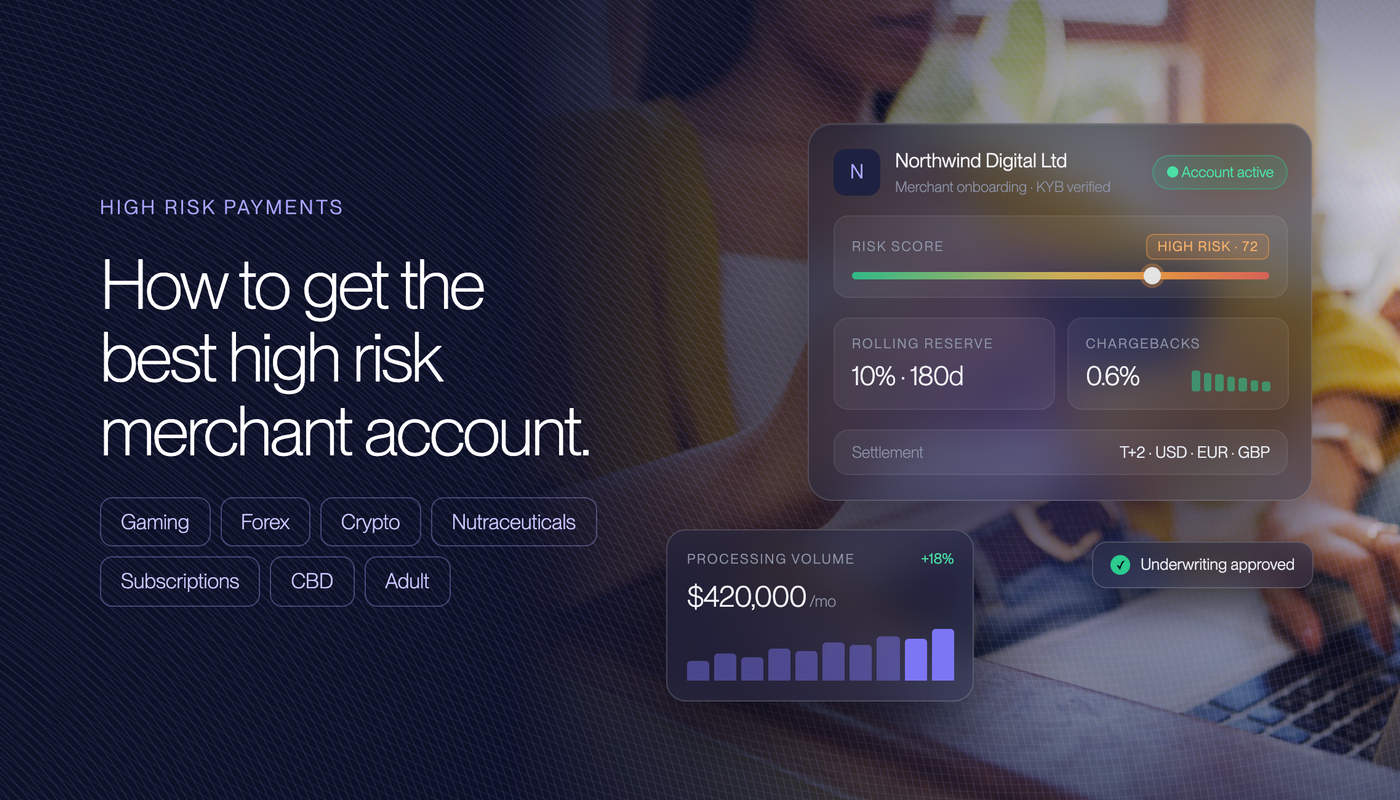
A high risk merchant account lets you take Visa and Mastercard payments in the industries mainstream processors avoid, such as gaming, supplements, CBD, adult, travel and subscription sales. It settles your card sales to your bank in USD, EUR, GBP, CAD and other major currencies, and it gives you a stable home for your payments.
The hard part is getting approved. Stripe and PayPal often let a high risk business sign up, then hold the balance or close the account after the first review. Traditional banks ask for months of history and decline many files. A termination can also follow you to the next application.
We make this simple. You fill in one short form, and Binderr places you with a regulated partner that already approves your industry. We prepare your KYC pack, handle the introduction and stay with you until your first payout. Most merchants are live in 5 to 7 business days.
Open a High Risk Merchant Account in Days
One short application, and we place you with a regulated partner that already approves your industry.
- Approved in days: a preliminary decision in about 1 business day.
- Your sector accepted: gaming, adult, CBD, nutra, travel, peptides and more.
- Binderr Chooses: we pick the right partner for you, no shopping around.
- Fully remote: apply and onboard from anywhere, no branch visit.
- Regulated acquirers: licensed partners only, no grey-market processors.
- Major currencies: settle in USD, EUR, GBP, CAD and more.
Do You Need a High Risk Merchant Account?
High risk merchant accounts exist for businesses that standard processors turn away. You need a high risk merchant account when a standard processor will not take your business, or will take it and then freeze your funds. The trigger is usually your industry, your chargeback level, your billing model or where your customers are. If any of these apply, you need a high risk merchant account, and applying to a high risk specialist first saves you months.
What Makes a Business High Risk
Card acquirers score risk before they approve an account, and high risk merchant accounts are priced on that score. They look at your industry, how often customers dispute payments, how long it takes you to deliver, whether you bill on a subscription, how big your average sale is, and how much of your volume comes from abroad. A business that scores badly on one or two of these is treated as high risk, even if it is fully legal and well run.
Future delivery is a common trigger that people miss. A travel agency that takes payment months before a trip, or a supplements brand that sells a 12-month subscription, carries risk for the acquirer until the service is delivered. The acquirer is liable if the business fails and customers ask for their money back, so it prices that risk in. That is why a merchant account for a high risk business carries a reserve that a standard account does not. Our guide on what a high risk merchant account is goes deeper on how the scoring works.
Industries That Need High Risk Merchant Accounts
Some industries are high risk by default, and almost every business in them needs one of the high risk merchant accounts built for its sector. Visa's Integrity Risk Program, in force since 1 May 2023, puts dating (MCC 7273), betting and gambling (7995), inbound telemarketing (5967), drugs (5122) and online pharmacies (5912) in its highest tier. Crypto and quasi-cash (6051), digital content (5816), cyberlockers (4816), subscription billing (5968) and tobacco sold online (5993) also need extra checks.
Most merchant accounts for high risk businesses serve the same group of sectors: online gaming and betting, adult content, CBD and hemp, nutraceuticals and supplements, peptides, vape and tobacco, firearms, travel, dating, tech support, forex and crypto. Casino and betting operators should also read our guide on how casino payment gateways work, and supplement brands our guide to payment gateways for supplements and nutraceuticals. The full breakdown with codes is in our list of high risk merchant industries and MCC codes.
When a Standard Account Is Not Enough
A business can also become high risk after it opens. If your chargebacks go above about 1% of your transactions, most acquirers reclassify you. Stripe treats dispute activity above 0.75% as excessive. Visa's monitoring threshold for merchants dropped from 2.2% to 1.5% on 1 April 2026 in the US, Canada, Europe and Asia Pacific. At that point a standard account is no longer a safe place for your volume, and you need a high risk merchant account that is built for it.
For a merchant account, high risk status is not a penalty. When you open a merchant account, high risk business owners often expect a punishment, but it is simply a different product. The terms are different: a higher rate, a rolling reserve and closer monitoring. In return, the acquirer has already accepted your sector, so it does not close the account the moment a dispute arrives.

High Risk Payment Gateway and Merchant Account
Binderr Chooses
Time to onboard
5 to 7 days
Currencies
USD, EUR, GBP and more
Industries
Gambling, Adult, CBD, Crypto, Travel, Forex and more
Why Stripe and PayPal Decline High Risk Businesses
Stripe and PayPal are built for low risk merchants who pay one flat price. Their terms exclude many high risk sectors, and their automated reviews close accounts that drift into risk. That is why so many founders only start looking at high risk merchant accounts after a frozen payout rather than before.
Restricted Business Lists
Stripe's restricted businesses list, updated in May 2026, prohibits adult content, gambling, weapons, nutraceuticals, marijuana, debt relief and some travel services, among others. PayPal's acceptable use policy requires pre-approval for gambling, crypto, prescription drugs, telemedicine, adult content, dating, tobacco and multi-level marketing. If your business is on either list, a standard account is not a real option, and high risk merchant accounts are the only stable route. Our guide on whether Stripe and PayPal allow high risk merchants covers each list in detail.
Frozen Funds and Sudden Terminations
The bigger problem is what happens after sign-up. PayPal says it can hold funds for up to 21 days, and its reserve example is 10% of sales held for 90 days. Stripe can apply a fixed or rolling reserve at any point. When these reviews happen after a sales spike, the business loses access to its own cash right when it needs it most.
Fees add up too. Stripe charges $15 per dispute in the US, plus a further $15 if you contest it, which is refunded only if you win. PayPal charges a $20 chargeback fee. A high risk business with regular disputes pays these on every case, on an account that can still be closed.
The MATCH List After a Termination
If an acquirer closes your account for cause, it can add you to Mastercard's MATCH list. A listing lasts 5 years, and merchants are often not told. One common reason code covers chargebacks above 1% with at least USD 5,000 in disputes in a single month. Most acquirers decline a listed applicant outright, so avoiding a termination is worth far more than a lower rate. It is also why you should open a high risk merchant account before trouble starts, not after. Read more about the Mastercard MATCH list.
Get a High Risk Merchant Account Without Rejection
Most declines come from applying to the wrong processor. Your file only goes where your sector is already approved.
- No blind applications: your file goes only where it will be accepted.
- Declines avoided: no more rejections from mainstream processors.
- Clean record kept: fewer declines, nothing counting against you later.
- Pre-screened fit: your model is checked before anything is submitted.
- Second route ready: a backup partner if the first asks for more.
How to Open a High Risk Merchant Account
The question we hear most is simple: how can I get a high risk merchant account without being declined? To open a high risk merchant account, you need a registered company, a business bank account, a compliant website and a complete document pack. You then apply to an acquirer that accepts your industry, pass underwriting and connect a payment gateway. With the right partner the whole process takes days, not months, and it is the same whether you apply for a high risk merchant account as a startup or as an established seller.
Get Your Company and Bank Account Ready
Acquirers approve companies, not individuals, and high risk merchant accounts are no exception. You need a registered entity, its incorporation documents and a business bank account in the company's name to receive payouts. If you do not have the company yet, set it up first, and choose a jurisdiction your acquirer supports. Founders selling mostly to American customers should read our guide on high risk merchant accounts in the USA, and those selling into Europe our guide on high risk merchant accounts in the UK and Europe. A merchant account for a high risk business is much easier to open when the company, the bank account and the website all tell the same story. A high risk business merchant account is approved on consistency.
Apply for a High Risk Merchant Account
This is where most founders lose time with high risk merchant accounts. They apply to three or four processors at once, each with its own form, and collect declines that stay on record. With Binderr you apply once, and you get a high risk merchant account through one matched introduction. Our intake form, Binderr Chooses, asks about your business model, your volume and your markets, and we match you with the regulated partner that already accepts your industry. You do not need to research providers or compare offers.
If you have been declined before, say so on the form. A past decline is not the end of the road, but it changes where the file should go. Our guide on high risk merchant account brokers explains why a matched application beats a scattered one.
Your High Risk Merchant Account Application
Your high risk merchant account application covers the company, its owners, its products and its payment history. Expect questions on your expected monthly volume, average sale value, refund policy, delivery times and the countries you sell to. The more precise the answers, the faster the review. A clear high risk merchant account application is the fastest way to open a high risk merchant account. We prepare the file with you, so nothing goes in half complete.
Underwriting and Approval
Underwriting is the acquirer's review of your file. It checks the owners, the business model, the website and any past processing. Our partners give a preliminary decision in about 1 business day. The approval letter sets your rate, your rolling reserve, your monthly limit and your payout schedule. Read it before you sign, because it sets the terms of your high risk processing merchant account for the next 12 months at least. Our guide on how to get approved for a high risk merchant account explains what underwriters look for.
Connect a Gateway and Take Your First Payment
Once approved, your high risk merchant processing account is connected to a payment gateway that sends card payments to the acquirer. You can use a hosted payment page, an API integration or a plugin for your store. If you are new to the terms, our explainer on payment gateways vs merchant accounts vs processors sets out who does what. After a test transaction, you go live. Our guide on how to set up a high risk payment gateway covers the integration options.
Get Fast Approval for a High Risk Merchant Account
Underwriting moves fast when the file is complete on day one. That part is on us.
- Quick assessment: a 5 minute intake form tells us where you fit.
- Preliminary approval: a first answer from our partner in about 1 day.
- Complete file first time: no back-and-forth that stalls the review.
- Live in 5 to 7 days: services provisioned in about 3 days after approval.
- One point of contact: one person from application to first payout.
- Chased for you: we follow up with the underwriter, not you.
What You Need Before You Apply
Across all merchant accounts, high risk files need more evidence than standard ones. Every acquirer asks for the same core set: company documents, owner documents, recent statements and a website that meets card scheme rules. Having all of it ready before you apply is the single biggest factor in how fast you are approved.
Company and Owner Documents
Expect to provide the certificate of incorporation, the articles, a recent registry extract, proof of the business address and a business bank letter or voided cheque. US companies add their EIN. For each owner with 25% or more, and each director, you need a passport or ID and proof of address. Regulated sectors such as gambling, forex or pharmacy also need the licence itself. A high risk business merchant account is rarely approved without it.
Processing History and Statements
Most acquirers want 3 to 6 months of bank statements and, if you already take cards, 3 to 6 months of processing statements. These show your volume, your refund rate and your chargeback ratio. A new business without history can still apply. It usually starts with a lower monthly limit and a higher reserve that eases as the account builds a record. See our guide to merchant accounts with no credit check or history.
A Website That Passes Review
Visa's rules require your website to show a customer service email or phone number, your company's country, and your refund policy before checkout, with a box the customer ticks to accept it. Acquirers also check for clear terms, a privacy policy, shipping and cancellation terms, prices in the right currency and card logos. Most first-time declines we see come from website gaps that take an hour to fix, so check the site before you apply for a high risk merchant account.
Read more: red flags in a high risk payment processor and high risk ecommerce merchant accounts.
High Risk Payment Gateway and Merchant Account
Binderr Chooses
Time to onboard
5 to 7 days
Currencies
USD, EUR, GBP and more
Industries
Gambling, Adult, CBD, Crypto, Travel, Forex and more
How a High Risk Merchant Processing Account Works
A high risk merchant processing account is the account an acquirer opens for you to receive card payments. When a customer pays, the money moves from their bank to the acquirer, into your merchant account, and then to your business bank account on a set schedule.
Acquirer, Gateway and Processor
Three parties do the work. The payment gateway captures the card details and sends the transaction. The processor routes it through the card networks. The acquirer is the regulated bank or institution that holds the merchant relationship and carries the risk. Our guide on high risk acquiring banks and acquirers explains their role. For high risk merchants, payment processing accounts only work when all three accept the sector. On most merchant accounts, high risk approval depends on the acquirer, not the gateway. Our guide on how high risk payment processing works walks through each step.
Settlement and Payouts
Settlement is when your card sales are paid out to your bank. High risk merchant accounts often settle daily or every few days, after the reserve is taken. Our partners settle in USD, EUR, GBP, CAD and other major currencies, so you can keep revenue in the currency you sell in and avoid a conversion on every payout.
How a Rolling Reserve Works
A rolling reserve is a share of each day's sales that the acquirer holds back for a set time. A common term is 5% to 10% held for 90 to 180 days. On USD 50,000 of monthly sales, a 10% reserve holds USD 5,000 each month, and after 180 days the oldest amounts start coming back. Reserves are usually reviewed every 60 to 90 days and often reduced after 6 to 12 months of clean processing.
Read more: high risk merchant services and solutions and high risk vs low risk payment processing.
Get Your High Risk Merchant Account Application Ready
Underwriters want a specific set of documents. We build it with you before anything is submitted.
- KYC pack prepared: company, owner and UBO documents in the right format.
- Statements packaged: volume, refunds and chargebacks presented clearly.
- Website checked: refund policy, terms and contact details fixed first.
- Licence covered: regulated sectors submitted with the right permissions.
- Nothing missing: no delays from an incomplete file.
What a High Risk Merchant Account Costs
High risk merchant accounts cost more than standard ones because the acquirer carries more risk. Low risk businesses usually pay 1.5% to 2.9% per sale. High risk businesses pay a higher rate, a few fixed fees and a rolling reserve. The ranges below are typical market figures on the lower side, taken from published industry guides in 2026.
Cost item | Typical range |
|---|---|
Setup or application fee | $0 to $500, one-off |
Monthly account fee | $10 to $50 |
Processing rate | 2.5% to 5% of each sale |
Fee per transaction | $0.10 to $0.35 |
Payment gateway | $10 to $30 a month, plus $0.05 to $0.15 per transaction |
Chargeback fee | $15 to $35 per dispute |
Rolling reserve | 5% to 10% of sales, held 90 to 180 days |
PCI compliance | $99 to $200 a year |
Early termination fee | $250 to $500, where the contract has one |
The rate is the number everyone compares, but it is rarely the biggest cost. On USD 50,000 a month, the difference between 3% and 4% is USD 500. A 10% reserve holds USD 5,000 of your cash every month. Chargeback fees on 20 disputes can add another USD 300 to USD 700. Look at the full package, not the headline rate. Merchant accounts for high risk businesses are priced as a bundle, so compare the bundle.
Your final price depends on your industry, volume, chargeback history and the markets you sell to. It is confirmed in writing before you sign. Our guide on high risk merchant account fees and rates breaks down each line.
High Risk Payment Gateway and Merchant Account
Binderr Chooses
Time to onboard
5 to 7 days
Currencies
USD, EUR, GBP and more
Industries
Gambling, Adult, CBD, Crypto, Travel, Forex and more
Timeline to Get a High Risk Merchant Account
With a complete file and the right partner, you can get a high risk merchant account in 5 to 7 business days. Traditional banks often take several weeks, sometimes months, and many decline without a reason. Our partners work to a clear timeline.
Stage | Typical time |
|---|---|
Quick assessment | 5 minutes |
Preliminary approval | 1 day |
Complete onboarding requirements | 15 minutes |
Provision of services | 3 days |
Total | 5 to 7 business days |
Most delays come from missing documents or a website that fails review. The fastest way to get a high risk merchant account is to send a complete file on day one. A file that arrives complete moves straight through. If speed is your main concern, read our guide to instant approval high risk merchant accounts, which explains what fast approval really means.
Get a High Risk Business Merchant Account That Lasts
A merchant account built for high risk does not get shut the day a chargeback lands.
- Built for high risk: your partner underwrote your sector, so no surprise shutdowns.
- Reserve agreed upfront: terms set before you sign, not imposed later.
- Multi-currency settlement: USD, EUR, GBP, CAD and more.
- Cards and wallets: Visa, Mastercard and alternative payment methods.
- Clear pricing: every fee shown before you sign.
How to Keep Your High Risk Merchant Account Open
Getting approved is half the job. High risk merchant accounts are monitored more closely than standard ones, and that never stops. Keeping the account means staying inside card scheme limits, keeping disputes low and giving the acquirer no reason to review you. Most terminations are avoidable.
Keep Chargebacks Under 1%
Treat 1% as your ceiling and aim well below it. Use a clear billing descriptor so customers recognise the charge. Send receipts and renewal reminders. Refund quickly when a customer complains, because a refund costs less than a chargeback. Chargeback alerts let you refund before a dispute is filed. Our guide on fraud prevention for high risk merchants covers the screening side. Our guide on chargeback management for high risk merchants covers the tools.
Visa VAMP and Mastercard ECM Limits
Visa's Acquirer Monitoring Program, VAMP, launched on 1 April 2025 and replaced Visa's older dispute and fraud programs. It adds fraud reports and disputes together and divides them by settled transactions. Since 1 April 2026, a merchant with a ratio of 1.5% or more and at least 1,500 fraud reports and disputes in a month is flagged as excessive in the US, Canada, Europe and Asia Pacific, with fees reported at about USD 8 per case.
Mastercard's Excessive Chargeback Program flags merchants at 1.5% and 100 chargebacks in a month. Fines start at USD 1,000 in the second month, rise to USD 25,000 a month from month 7 and reach USD 100,000 a month from month 19. The account exits the program after 3 months in a row below the threshold. See Visa and Mastercard high risk merchant registration for the rules that apply before you even start.
Getting Your Rolling Reserve Released
Reserves are not permanent. After 6 months of low chargebacks and steady volume, ask your acquirer for a review. Bring your numbers: monthly volume, refund rate and chargeback ratio for each month. A clean record is the strongest case for a lower reserve, a shorter holding period or a higher limit.
High Risk Payment Gateway and Merchant Account
Binderr Chooses
Time to onboard
5 to 7 days
Currencies
USD, EUR, GBP and more
Industries
Gambling, Adult, CBD, Crypto, Travel, Forex and more
Business Bank Account for a High Risk Business
Your merchant account pays out to a business bank account, and that account must accept your industry too. Many local banks decline high risk sectors or close the account once card payouts start arriving, even when the business already has merchant accounts for high risk businesses approved. That leaves a merchant with approved processing and nowhere to receive the money.
We open the settlement account alongside the merchant account, with regulated banking partners that accept high risk sectors. You get real IBANs, multi-currency balances and no minimum balance. Read our guide on how to open a high risk bank account.
Open a High Risk Business Bank Account
Your payouts need somewhere to land. We open the settlement account alongside your merchant account.
- Settlement account opened: payouts land in an account that accepts your sector.
- Real IBANs: EUR and multi-currency accounts from day one.
- Opened fast: your account ready in about a week.
- No minimum balance: no idle cash locked up.
- Same team: one contact for payments and banking.
Common High Risk Merchant Account Mistakes
Most failed applications and closed high risk merchant accounts come from a short list of avoidable mistakes. When you run a merchant account, high risk business owners make the same few errors again and again. Each one costs time, money or a place on the MATCH list.
Starting With Stripe or PayPal
Many founders open a standard account because it takes 10 minutes, then lose access to their balance after the first review. The cost is not only the frozen funds. A termination for cause can put you on the MATCH list for 5 years, which closes the door to many acquirers. If your industry is on a restricted list, start with a high risk specialist.
A Website That Does Not Match Your Business
Underwriters compare what you say on the form with what your website sells. If the site shows products the form did not mention, or hides the refund policy in the footer, the file is declined or delayed. Before you apply, check that every product, price and policy on the site matches your application.
Hiding Your Chargeback History
Some merchants leave out a past account or a bad month, hoping the underwriter will not notice. Acquirers check. A hidden problem that is found later is treated far more harshly than one explained upfront. Share your statements, explain any spike, and show what you changed.
Applying Everywhere at Once
Sending the same file to five processors feels efficient, especially for high risk merchant accounts, but each decline is recorded and each one makes the next harder. It also wastes weeks on forms. One matched application to a partner that accepts your sector is faster and keeps your record clean.
Choosing on Rate Alone
A low headline rate often comes with a higher reserve, a long contract, a large early termination fee or a partner that is not comfortable with your sector. A slightly higher rate on an account that stays open is worth far more than a cheap one that closes in 3 months. Compare the full terms, not just the percentage.
Read more: offshore high risk merchant accounts and credit card processing for high risk merchants.
Apply Once for a High Risk Merchant Account
Skip every mistake above. One intake form, and we handle the partner, the file and the introduction.
- One intake form: a single application instead of five.
- We choose for you: the partner picked on your sector, volume and markets.
- Handled end to end: from application to your first payout.
- Honest answer upfront: told what is realistic before you apply.
- Ongoing support: help when your volume or model changes.
Bottom Line
Knowing how to open a high risk merchant account is mostly about sequence. A high risk merchant account is the right home for your card payments when your industry, your billing model or your dispute levels put you outside what Stripe and PayPal accept. It costs more than a standard account, but it gives you an acquirer that has already said yes to your sector.
The fastest route is simple: get the company, bank account and website ready, apply once to a partner that approves your industry, and keep your chargebacks under 1% once you are live. We handle the matching, the KYC pack and the introduction, and most merchants are processing in 5 to 7 business days.