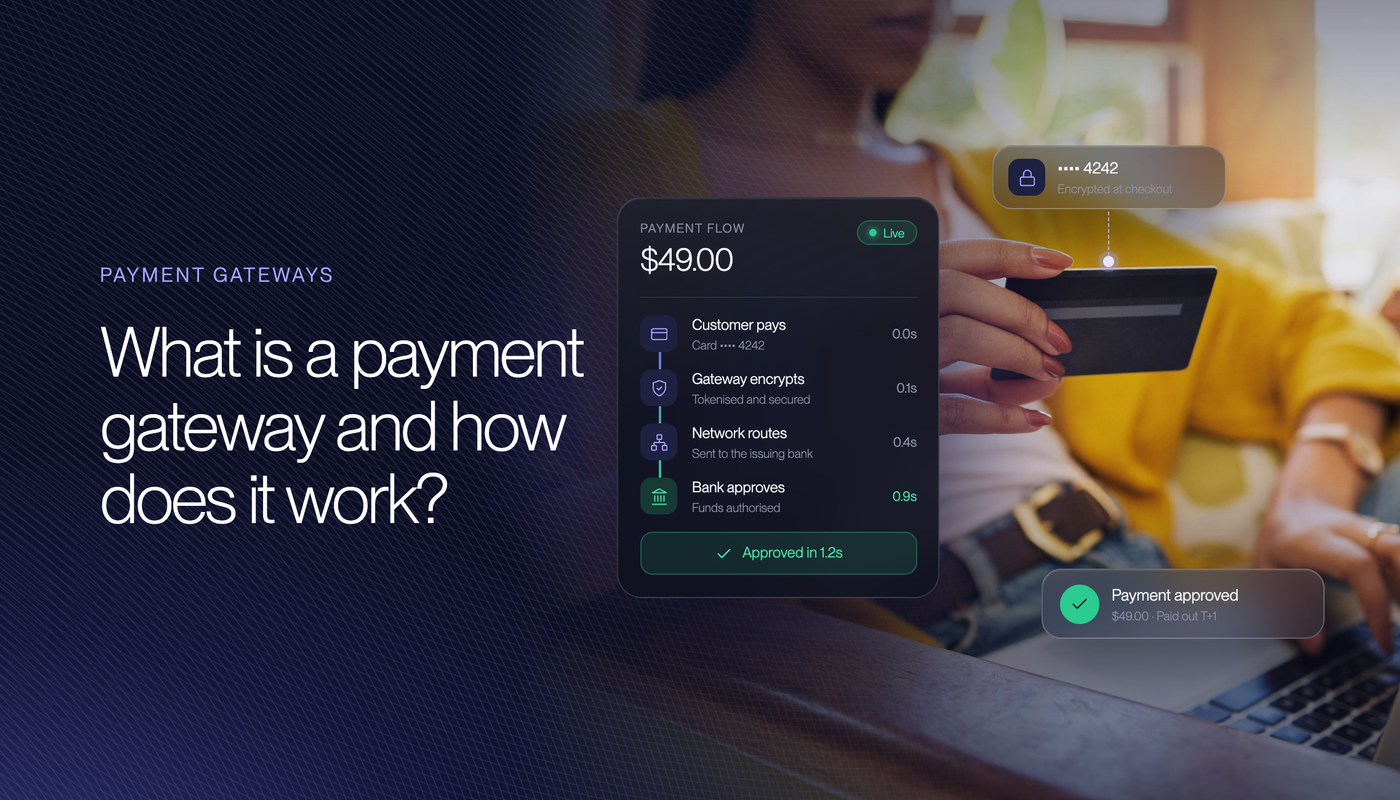
A payment gateway lets your business take card, wallet and local payments online and have the money paid into your business account. Customers pay in their own currency, you settle in USD, EUR, GBP, CAD or another major currency, and every sale, refund and dispute runs through one connection to your checkout.
The gateway is the easy part. The hard part is what sits around it: getting approved by the acquirer behind it, understanding a fee stack of interchange, scheme fees and markup, and waiting days for your money to arrive. Shared accounts also sign you up in minutes, then review you later and sometimes hold your funds.
We take that work off your hands. Through one intake form, Binderr Chooses, we match your business with a regulated payment partner that fits your sector and markets, set up the gateway and merchant account, and handle the application. Most businesses are taking payments within 5 to 7 business days.
Get a Payment Gateway Set Up in Days
A payment gateway set up with a regulated partner that fits your business, with the application handled for you.
- Binderr Chooses: one intake form, and we match you with the right partner.
- Gateway and merchant account: both set up together, not left for you to join.
- Fast approval: a preliminary answer in about 1 business day.
- Cards, wallets and local methods: the ways your customers actually pay.
- Major currencies: settle in USD, EUR, GBP, CAD and more.
- KYC pack prepared: documents collected and checked before submission.
What Is a Payment Gateway?
A payment gateway is the software that takes card details at your checkout, protects them and sends the payment to be approved. It returns an approval or a decline in about a second. It does not hold your money and it does not decide whether you are allowed to trade. Those jobs belong to the acquirer and the merchant account behind it.
What a Payment Gateway Does
The gateway's job is narrow and important. It takes the card number and replaces it with a token, so the real number never touches your servers. It applies the fraud rules you have switched on. It sends the payment on to be approved and passes the answer back to your checkout. Afterwards it handles refunds, partial captures, retries on failed subscription payments and the reports you match against your bank statement.
What a Payment Gateway Does Not Do
A payment gateway does not approve you as a merchant, hold your funds or carry the licence that lets money move. The acquirer does those things. In practice you rarely buy a gateway on its own. You get it bundled with a merchant account from a payment provider, and the gateway is the part you can see. Our guide to payment gateways, merchant accounts and payment processors covers the three roles in detail.
Who Does What in a Card Payment
Six parties touch every card payment. Knowing which one charges you for what is what makes a payment statement readable.
Party | What it does | Where it shows on your bill |
|---|---|---|
Payment gateway | Captures and protects card data, applies fraud rules, routes the payment | A per-transaction fee, sometimes a monthly fee |
Payment processor | Moves the payment data between the parties | Inside your processing rate |
Acquirer | Holds the merchant account, approves you, carries the settlement risk | The largest part of your rate |
Merchant account | Holds your takings before payout to your bank | Settlement timing, holds and reserves |
Card scheme | Sets the rules, interchange and scheme fees | Interchange and scheme fees inside your rate |
Issuing bank | Your customer's bank, approves or declines and handles disputes | Declines and chargebacks |
Your provider controls only its own markup. Interchange and scheme fees are set by Visa and Mastercard and passed through to every provider. So when two quotes differ a lot, the difference is usually the markup, or how much of the underlying cost the quote hides.

How Does a Payment Gateway Work?
A payment gateway turns a card entry at your checkout into an approval request, carries it to your customer's bank through the card network and brings back a yes or no. The round trip takes about a second. The money itself arrives days later, and those are two separate events.
Capture at Checkout
The customer enters their card or picks a wallet. The gateway swaps the card number for a token, so your systems never store it. In the EEA and the UK, strong customer authentication through 3D Secure may add a step where the customer confirms the payment with their bank. It has applied to card ecommerce in the EEA since 31 December 2020 and in the UK since 14 March 2022.
Authorisation
The gateway sends the payment to the acquirer, which routes it through Visa or Mastercard to the bank that issued the card. The bank checks the balance, its fraud signals and its own rules, then approves or declines. An approval reserves the money on the customer's card. It does not move it yet.
Capture and Clearing
You confirm the sale, often at dispatch. Online shops selling digital goods usually capture straight away, while shops shipping physical goods often wait until the order leaves. At the end of the day your approved sales are batched and sent to the card networks, which pass each one to the right bank. This is when interchange and scheme fees are worked out.
Settlement to Your Account
The customer's bank pays the network, the network pays the acquirer and the acquirer pays you, minus fees. Stripe says settlement typically takes one to three business days, and it pays US accounts on a two business day schedule by default. New businesses and higher risk sectors often wait longer, because settlement speed is a risk decision rather than a technical limit.
Two things can slow your money down further. A rolling reserve holds back a share of your takings for a set period as cover against disputes, and a longer payout cycle keeps everything for more days. Both are usually negotiable once you have a few months of clean history. Read more: how credit card payment gateways work and hosted vs third-party payment gateways.
Payment Gateway Payouts You Can Plan Around
Know your payout schedule, fees and limits before your first sale, because we agree them with the partner upfront.
- Payout schedule agreed: settlement timing in writing before you sign.
- Your own merchant account: a dedicated merchant account, not a shared one.
- Website checked: refund, contact and pricing pages fixed before review.
- Clear pricing: every fee line in writing, not just a headline rate.
- One point of contact: no back-and-forth emails with several providers.
Internet, Digital and Electronic Payment Gateways
Internet, digital and electronic payment gateways are the same product. The three names come from different eras of marketing, not from different technology. Whichever name a provider uses, the gateway still captures the payment, sends it for approval and returns the answer.
Internet Payment Gateway
Internet payment gateway is the oldest of the three terms. It still appears in older enterprise documents, bank tenders and some government procurement. It means a gateway that takes payments over the internet, which today is every gateway. Internet payment gateways got the name when taking a card online was still new.
Digital Payment Gateway
Digital payment gateway tends to appear where wallets, buy now pay later and local payment methods are part of the offer. If a provider sells a digital payment gateway as a new category, ask what it does differently. The honest answer is usually about which payment methods it supports, because digital payment gateways differ mainly in the wallets and local methods they offer. Our guide to buy now pay later and e-wallet payment gateways covers those methods.
Electronic Payment Gateway
Electronic payment gateway is the phrase legal and procurement teams often use, especially in contracts and regulatory filings. An electronic payment gateway covers the same capture, approval and routing job. For businesses that also want bank transfers and eChecks, our guide on eCheck and open banking payment gateways explains the other payment rails.
What Does a Payment Gateway Cost?
A payment gateway usually costs a percentage of each sale plus a small fixed fee, with most of the range driven by where your customers' cards were issued. On top of that can sit monthly fees, chargeback fees and currency conversion. These are typical market ranges on the lower side, taken from published industry guides in 2026.
Cost item | Typical range |
|---|---|
Setup fee | Usually none |
Monthly fee | Often none |
Processing rate | 1.5% to 3.5% of each sale, lower on domestic EEA consumer cards |
Fee per transaction | $0.05 to $0.30 |
Chargeback fee | $15 to $25 per dispute |
Currency conversion | Around 2% when you sell in a currency you do not settle in |
Rolling reserve | Usually none for standard-risk businesses |
Your final price depends on your sector, volume, card mix and markets, and it is confirmed in writing before you sign.
Why Card Origin Moves Your Rate
Interchange is the part of every sale that goes to the customer's bank, and it explains most of the difference between two otherwise identical sales. Under Regulation (EU) 2015/751, consumer interchange in the EEA is capped at 0.2% for debit cards and 0.3% for credit cards. Cards issued outside the EEA can carry 1.15% for debit and 1.50% for credit on online sales, under caps Visa and Mastercard agreed with the European Commission in 2019. Commercial cards were never capped. That is why a foreign card can cost several times more than a domestic one, and it is not your provider being greedy.
The same pattern shows up in the US. Visa's interchange schedule effective 18 April 2026 sets 0.80% plus $0.15 for an exempt debit card used in a store, and 1.65% plus $0.15 for the same kind of card used online. Online payments cost more because the card is not present and fraud is higher.
Flat Pricing and Interchange-Plus
Providers price in one of two ways. Flat pricing charges one rate, sometimes split by card type, and hides the underlying costs inside it. It is easy to budget and usually suits smaller businesses. Interchange-plus passes the real interchange and scheme fees through and adds a fixed markup. It shows every cost line and usually works out cheaper at higher volume, once any monthly fee is covered. Our guide to ecommerce payment gateways shows how your card mix sets the blended rate.
The Costs That Are Easy to Miss
None of these appear in a headline rate, and all of them are real money. Chargeback fees are charged whether you win the dispute or lose it. A reserve is not a fee, but it is revenue you cannot spend for months. Currency conversion is often the largest hidden cost for anyone selling across borders, and Stripe, for example, adds 2% when it converts. And a fixed monthly fee is expensive at low volume, however good the rate looks.
How Long Payment Gateway Setup Takes
With a complete file, most businesses are live within 5 to 7 business days with our partners. This is the timeline they work to.
Stage | Typical time |
|---|---|
Quick assessment | 5 minutes |
Preliminary approval | 1 day |
Complete onboarding requirements | 15 minutes |
Provision of services | 3 days |
Total | 5 to 7 business days |
It can run a little longer when your website needs changes or your sector needs extra checks, but a week is the usual maximum. Connecting the gateway to your checkout comes on top, and a plugin or hosted payment page can be live the day the credentials arrive. Our guide on how to add a payment gateway to your website covers that part.
Payment Gateway Pricing in Writing
Get your payment gateway pricing confirmed in writing before you sign, with every fee line shown.
- Rate on your real card mix: priced on where your customers' cards come from.
- No hidden fee lines: monthly, dispute and conversion fees listed upfront.
- Preliminary approval: usually within 1 business day of a complete file.
- Multi-currency settlement: get paid in the currencies you spend in.
- Regulated partners: licensed payment providers only.
- Terms reviewed as you grow: clean months used to review your rate.
How to Get Approved for a Payment Gateway
Taking on a merchant is a credit decision. The acquirer guarantees your customers' refunds and chargebacks, sometimes for months after you have been paid, so it checks you the way a lender would. That is why the application asks about ownership and history, not just your website.
The Documents to Have Ready
Have your incorporation documents, articles and register of directors ready, along with details of anyone who owns 25% or more and the structure above any company shareholders. You will need a passport and proof of address for each director and owner, 3 to 6 months of bank statements and, if you already take cards, 3 to 6 months of processing statements. The website itself is checked too: terms, refund policy, contact details, prices and a working checkout. Having all of this in one folder is the difference between three days and three weeks. Our guide to payment gateway requirements lists every item.
Why Applications Get Declined
Most declines come from a short list. Ownership that cannot be traced to real people, because providers run the same business verification checks payment firms are required to run. A sector the provider does not serve. A mismatch between the application and the website, such as consultancy on the form and supplements on the site. No trading history combined with a high average order value. And links to sanctioned countries or people, which trigger the AML obligations every payment provider carries.
If Your Business Is High Risk
Gambling, adult content, forex, some supplements, CBD, travel and free-trial subscriptions are usually classed as high risk because of their dispute rates or regulation. These businesses can still get a payment gateway, but from a smaller set of acquirers, at a higher rate and often with a reserve. Our guides on what a high risk merchant account is and how to set up a high risk payment gateway cover that route.
Chargebacks and What They Cost
A chargeback is a forced refund started by your customer's bank. You lose the sale, often the goods, and a fee of about $15 to $25 whether you win or lose. Past a certain ratio you can also lose the account, which is the part that ends businesses rather than denting them.
The Real Cost of One Chargeback
Take a USD 120 order. You refund USD 120, you have already shipped stock worth perhaps USD 45, you pay a dispute fee of about USD 20, and you spend staff time gathering evidence. The direct loss is close to USD 190 on a sale that earned you maybe USD 40. That is why your provider watches your chargeback rate, not just the count. Three disputes on 3,000 sales is background noise. Three on 100 is a conversation about your account.
The Ratios Card Schemes Watch
Since 1 April 2026, Visa's Acquirer Monitoring Program flags card-not-present merchants in Europe, the US, Canada and Asia Pacific at a fraud and dispute ratio of 1.5% with at least 1,500 cases a month. Mastercard flags merchants at 1.5% and 100 chargebacks a month, with fines from USD 1,000 in the second month. An account closed for excessive chargebacks can end up on the Mastercard MATCH list for 5 years.
The fix is operational: clear billing descriptors, quick support, delivery tracking and honest subscription terms. Read more: payment gateway fraud detection and payment gateway security features.
Keep Your Payment Gateway Account Healthy
A payment gateway account is only useful if it stays open, so we set yours up with the tools that keep disputes low.
- Chargeback alerts: refund before a dispute counts against your ratio.
- 3D Secure ready: liability shift on authenticated card payments.
- Clear billing descriptor: customers recognise the charge on their statement.
- Ratio monitoring: early warning before Visa or Mastercard limits.
- Support after launch: we stay with you after your first payout.
What Decides the Right Payment Gateway Setup
Three things decide the right setup for your business: where your customers' cards are issued, how much you process each month, and what sector you trade in. Card origin sets your cost floor, volume decides the pricing model, and sector decides which acquirers will take you at all. Features come last, because most gateways offer the same ones.
Where Your Customers' Cards Are Issued
This is the variable most businesses ignore, and it moves cost more than anything else. Pull last quarter's sales and split them by card origin. If most are domestic consumer cards, the headline rate is close to what you pay. If a large share is international, your blended cost is far higher than the headline, and local acquiring in your main markets will save more than a better domestic rate. Our guide to international payment gateways explains local acquiring.
Your Monthly Volume
At lower volume, fixed costs matter most and flat pricing usually wins. At higher volume, the saving per sale on interchange-plus pricing starts to outweigh any monthly fee. Volume also changes what you can negotiate. Markup, reserve and payout timing can usually be reviewed once you have six months of clean processing. Our guide to payment gateways for small businesses covers the early stage.
Your Sector
Sector decides whether you have a choice at all. A software company, an online shop and a game studio each need a different setup, and each has its own guide: SaaS payment gateways, payment gateways for video games and online gaming and crypto payment gateways. We match you with a partner that already accepts your sector, so the application starts in the right place.
Common Payment Gateway Mistakes
Most of these cost money quietly for months before anyone notices, which is why they are so common.
Comparing Headline Rates
A flat rate and an interchange-plus markup are not comparable numbers. One includes interchange and the other does not. Compare the total cost on your own card mix, including fixed fees and currency conversion.
Forgetting Currency Conversion
A 2% conversion charge on a third of your revenue costs more than any rate negotiation will win back. Settle in the currencies you spend in wherever you can. Our guide on how multi-currency payment gateways work explains the setup.
Describing the Business Loosely
Underwriters compare your application with your website. A gap between the two reads as hiding something and ends applications. Describe what you sell in plain words, and make sure the website says the same.
Treating Approval as the End
Providers keep watching after onboarding. A sudden change in volume or average order value triggers a review, and unexplained changes can lead to held funds. Tell your provider before a big launch or a new product line, not after.
Apply Once for a Payment Gateway
Apply once for a payment gateway, and we choose the partner and prepare the file before anything is sent.
- One intake form: Binderr Chooses reads your business and picks the partner.
- Honest answer upfront: told what is realistic for your sector first.
- No provider shopping: no comparing rates across a dozen sites.
- Documents handled: KYC pack, statements and policies prepared for you.
- Live in days: most businesses take payments within 5 to 7 business days.
- Banking alongside: a business account ready for your payouts.
Bottom Line
A payment gateway is the easy part of taking payments online. It captures the payment, sends it for approval and returns the answer in a second. The decisions that matter are around it: which acquirer will approve you, what your card mix really costs and how long your money takes to arrive.
Get those right and the rest is setup work. We match you with a regulated partner that fits your sector, set up the gateway and merchant account, and handle the application, with most businesses live within 5 to 7 business days. If you have no company or business account yet, start with setting up the company and how to open a business bank account.