
Payment providers and electronic money institutions enable fast, borderless transactions that drive modern commerce. Their digital scale and global reach also expose them to money laundering, fraud, and sanctions risks, making strong aml payment providers frameworks and aml payments compliance essential to protect financial systems and maintain trust.
A strong risk-based AML framework helps payment service providers manage these threats effectively. It combines customer verification, merchant due diligence, sanctions screening, transaction monitoring, suspicious activity reporting, and continuous risk management. According to the United Nations Office on Drugs and Crime, up to 5 percent of global GDP is laundered each year, highlighting the scale of financial crime risk that payment institutions must address through robust aml emi compliance and aml payments compliance strategies.
This guide explains AML compliance for payment providers and EMIs, covering key risks, controls, red flags, and practical implementation steps, while noting that requirements vary by jurisdiction and that aml payment providers must adapt their controls accordingly.
Binderr AML Compliance Software for Payment Providers and EMIs
Binderr Compliance Platform offers a complete, unified solution designed to simplify AML compliance:
- KYC (Identity Verification) with AI-powered document checks, biometric face matching, and liveness detection
- AML Screening across sanctions lists, watchlists, PEPs, and adverse media
- Dynamic Risk Assessment with automated scoring
- UBO Identification & Ownership Mapping for complex structures
- Streamlined CDD and EDD workflows
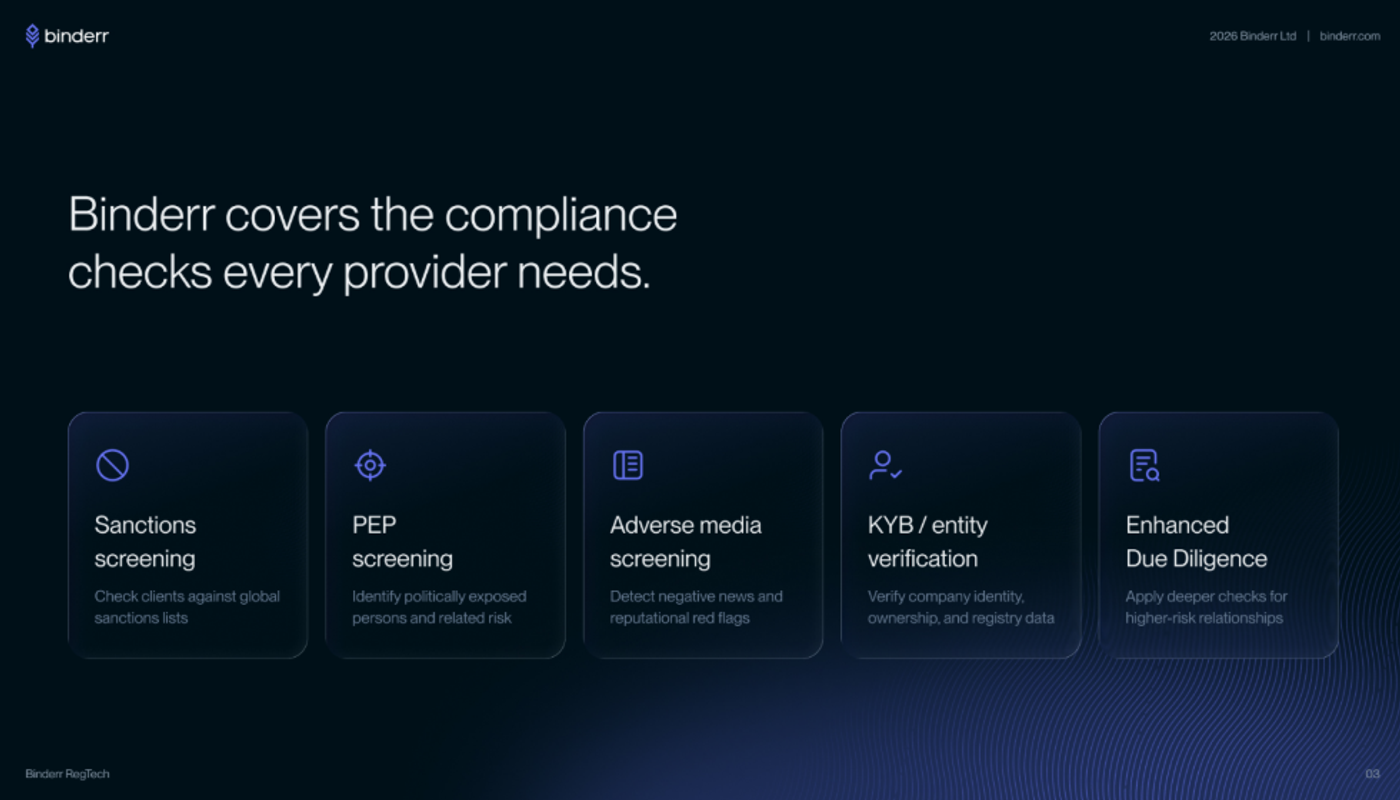
Payment providers often need separate systems for customer screening, merchant verification, adverse media checks, and enhanced due diligence. Binderr brings these controls together, helping compliance teams maintain a consistent risk view across individual customers, businesses, directors, and beneficial owners.
What Is AML Compliance for Payment Providers and EMIs?
AML compliance for payment providers and EMIs is a continuous, risk-based framework of policies, procedures, and technologies used to prevent, detect, and report financial crime across digital payment services, combining controls such as KYC and KYB verification, sanctions screening, transaction monitoring, and governance to address risks like money laundering, terrorist and proliferation financing, sanctions evasion, fraud, and mule activity throughout the entire customer lifecycle, from onboarding to ongoing monitoring, reporting, and offboarding, forming the foundation of aml payments compliance.
Make AML Screening Easier with Binderr
What Is a Payment Service Provider?
A Payment Service Provider (PSP) is a regulated entity that facilitates the transfer of funds between individuals, businesses, and financial institutions by enabling services such as payment initiation, money transfers, card processing, merchant acquiring, and digital wallet transactions, and because PSPs manage high volumes of fast-moving payments, they are required to implement robust AML controls including customer verification, transaction monitoring, and sanctions screening in line with the regulatory requirements of the jurisdictions in which they operate, forming a core part of aml payment providers obligations.
What Is an Electronic Money Institution?
An Electronic Money Institution (EMI) is a regulated financial entity authorised to issue electronically stored monetary value that customers can use for payments, transfers, and purchases, often through products like digital wallets, prepaid cards, and multi-currency accounts; because EMIs hold customer funds and facilitate fast, often cross-border transactions, they are exposed to elevated AML risks and must apply robust controls including customer due diligence, beneficial ownership checks, sanctions screening, and continuous monitoring as part of aml emi compliance.
Why Payment Providers and EMIs Face High AML Risk
Payment providers and EMIs operate in fast-moving, high-volume environments that make them attractive targets for money laundering and financial crime, reinforcing the importance of aml payments compliance.
Understanding AML risks in digital payments, transaction monitoring, KYC, KYB, and cross-border payment flows is essential for building effective compliance controls for aml payment providers.
Remote and Non-Face-to-Face Onboarding - Remote onboarding increases risks like stolen identities, forged documents, and deepfakes. Firms must rely on digital KYC, biometrics, and fraud tools to confirm customers are genuine. This highlights the importance of AML compliance for payment providers using remote onboarding and digital identity verification.
Cross-Border Payment Activity - Cross-border payments involve multiple jurisdictions and currencies, making it harder to trace funds. They also increase exposure to sanctions risks and high-risk regions. Effective AML compliance for EMIs requires strong monitoring of cross-border payments and sanctions screening.
Complex Merchant and Business Relationships - Merchants may have complex ownership or unclear business models. This can hide beneficial owners, making strong KYB and UBO checks essential. Robust KYB verification and UBO identification are critical for AML compliance in payment institutions.
Agents, Distributors, and Third Parties - Third parties can weaken AML controls if not properly managed. Poor oversight or inconsistent checks can create gaps criminals exploit. Payment providers must enforce AML compliance controls across agents, distributors, and third-party relationships.
Mule Accounts and Transaction Laundering - Mule accounts move illicit funds quickly through layered transfers. Transaction laundering occurs when merchants process payments for hidden or prohibited businesses. Detecting mule accounts and transaction laundering is essential for effective AML monitoring in digital payments.
New Products and Delivery Channels - New tools like virtual cards and mobile wallets increase speed and complexity. These require updated monitoring and risk controls. Emerging payment technologies demand adaptive AML compliance strategies for fintech and payment service providers.
See How Binderr Streamlines AML Processes
Binderr simplifies AML compliance workflows by:
- Running KYC, KYB, and AML checks in one platform
- Automating risk scoring using dynamic data inputs
- Triggering EDD workflows for high-risk users
- Providing real-time monitoring and alerts
- Centralising compliance data for faster investigations
AML Regulations Affecting Payment Providers and EMIs
Navigating AML regulations is essential for payment providers and EMIs operating in a fast-moving financial landscape and maintaining aml emi compliance.
Understanding global AML frameworks, compliance requirements, and regulatory expectations helps firms manage risk and maintain trust while strengthening aml payment providers controls.
FATF Standards
The Financial Action Task Force (FATF) sets global AML and counter-terrorist financing standards. It promotes a risk-based approach, requiring firms to assess risk, perform customer due diligence, identify beneficial owners, and keep records. FATF also emphasises suspicious transaction reporting and sanctions screening. While not legally binding, its standards shape national regulations and influence aml payments compliance globally.
UK AML Framework
In the UK, payment providers and EMIs must follow laws such as the Money Laundering Regulations 2017, Proceeds of Crime Act 2002, and Terrorism Act 2000. They must also meet requirements under the Payment Services Regulations 2017 and Electronic Money Regulations 2011. The FCA expects firms to apply risk-based controls and maintain clear oversight to detect suspicious activity, reinforcing aml emi compliance expectations.
EU AML Framework
The EU AML framework sets common rules across member states. It focuses on customer due diligence, beneficial ownership, and transaction traceability. Firms must report to national FIUs and comply with sanctions rules. The EU is also moving toward a single AML rulebook and central supervision under AMLA. Verify timelines before publication, especially for aml payment providers operating across borders.
Other Jurisdictions
Firms operating globally must follow local AML rules in regions like the US, Singapore, Hong Kong, and Australia. Each has its own licensing, reporting, and sanctions requirements. Payment providers should adapt their controls to each market while maintaining a consistent risk-based approach to aml payments compliance.
Core AML Requirements for Payment Providers and EMIs
Powering secure payments starts with strong AML foundations that keep financial crime out of every transaction and support aml payment providers.
From KYC and KYB to transaction monitoring and risk-based controls, these core AML requirements help payment providers and EMIs stay compliant and resilient while strengthening aml emi compliance.
Business-Wide Risk Assessment
A business-wide risk assessment underpins AML compliance for payment providers and EMIs, requiring firms to evaluate exposure across customers, products, geographies, transactions, channels, agents, and emerging risks. By analysing these factors, firms can identify vulnerabilities such as high-risk jurisdictions, complex ownership, or unusual activity. The findings should guide AML policies, monitoring rules, staffing, and control intensity to ensure a risk-based approach aligned with key risks and aml payments compliance.
AML Policies, Governance, and Senior Management Oversight
Effective AML governance requires clear policies, a defined risk appetite, and strong senior management oversight. Payment providers should appoint an MLRO or nominated officer, supported by clear escalation channels and sufficient resources. Independent testing and regular reporting help ensure controls remain effective and continuously improve aml payment providers frameworks.
Customer Identification and KYC Verification
Customer identification and KYC verification are essential onboarding steps that confirm a customer’s identity using details like name, date of birth, address, and government-issued ID. Advanced methods such as biometric matching, liveness checks, and device intelligence help prevent fraud and account takeover. Failed or inconsistent checks should trigger manual review and enhanced due diligence rather than automatic approval, supporting aml emi compliance.
Binderr’s dynamic onboarding forms adapt to the entity type, jurisdiction, and answers provided. Information is captured once and transferred into the risk assessment workflow, reducing duplicate data entry and disconnected compliance records.

KYB and Merchant Due Diligence
KYB and merchant due diligence ensure payment providers verify both the legal existence and operational legitimacy of business customers. This includes checking the company’s name, registration details, directors, shareholders, and beneficial owners, as well as assessing its business model, products, licences, and expected transaction activity. Effective KYB goes beyond documents to confirm the business operates as claimed, helping detect shell companies, transaction laundering, and high-risk activity within aml payments compliance frameworks.
UBO Identification and Verification
UBO identification and verification require EMIs and payment providers to identify the individuals who ultimately own or control a business. This includes mapping ownership structures, determining controlling interests, and verifying each beneficial owner. All identified individuals should be screened against sanctions, PEP lists, and adverse media, with additional scrutiny applied to nominee arrangements or opaque structures that may conceal illicit activity, strengthening aml payment providers controls.
Find the People Behind the Business
Customer Risk Assessment
Customer risk assessment assigns a risk rating based on factors such as customer type, geographic exposure, ownership complexity, product usage, delivery channel, and expected transaction behaviour. It also considers PEP status, sanctions exposure, adverse media, source of funds, and links to high-risk industries. These scores should be documented, explainable, and regularly updated to reflect changes in risk, supporting aml emi compliance.
Sanctions, PEP, and Adverse Media Screening
Sanctions, PEP, and adverse media screening are key AML controls applied at onboarding and throughout the customer lifecycle. Screening should cover customers, beneficial owners, directors, merchants, payees, counterparties, and agents. Advanced systems use fuzzy matching, transliteration, and alias detection to identify potential matches while reducing false positives, ensuring effective aml payments compliance.
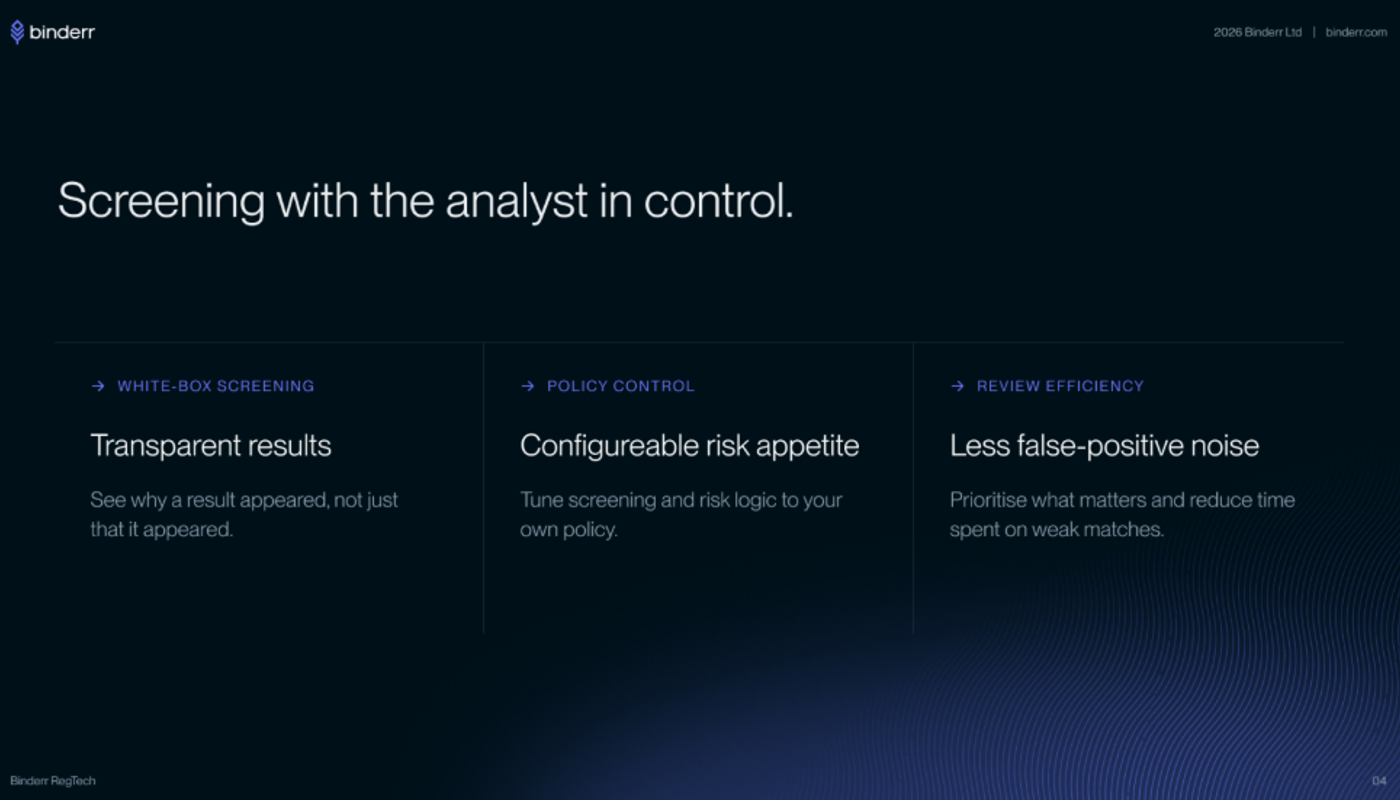
Binderr keeps compliance analysts in control of screening decisions. Transparent results show why a match appeared, while configurable risk settings allow payment providers and EMIs to align screening logic with their internal policies. This helps teams focus on meaningful risks instead of spending excessive time on weak matches.
Enhanced Due Diligence
Enhanced due diligence (EDD) is required for higher-risk relationships, such as PEPs, customers in high-risk jurisdictions, complex ownership structures, or unusual transaction patterns. It may also be triggered by adverse media, sanctions exposure, or unclear sources of funds. EDD involves collecting additional documentation, verifying source of funds and wealth, obtaining senior management approval, and applying enhanced monitoring to manage elevated AML risks within aml payment providers frameworks.
Ongoing Customer and Merchant Monitoring
Ongoing monitoring keeps customer and merchant information accurate after onboarding, supporting continuous AML compliance. It includes periodic reviews based on risk and trigger-based checks for events like ownership changes, new directors, licence updates, sanctions matches, or major shifts in transaction behaviour, ensuring ongoing aml emi compliance.
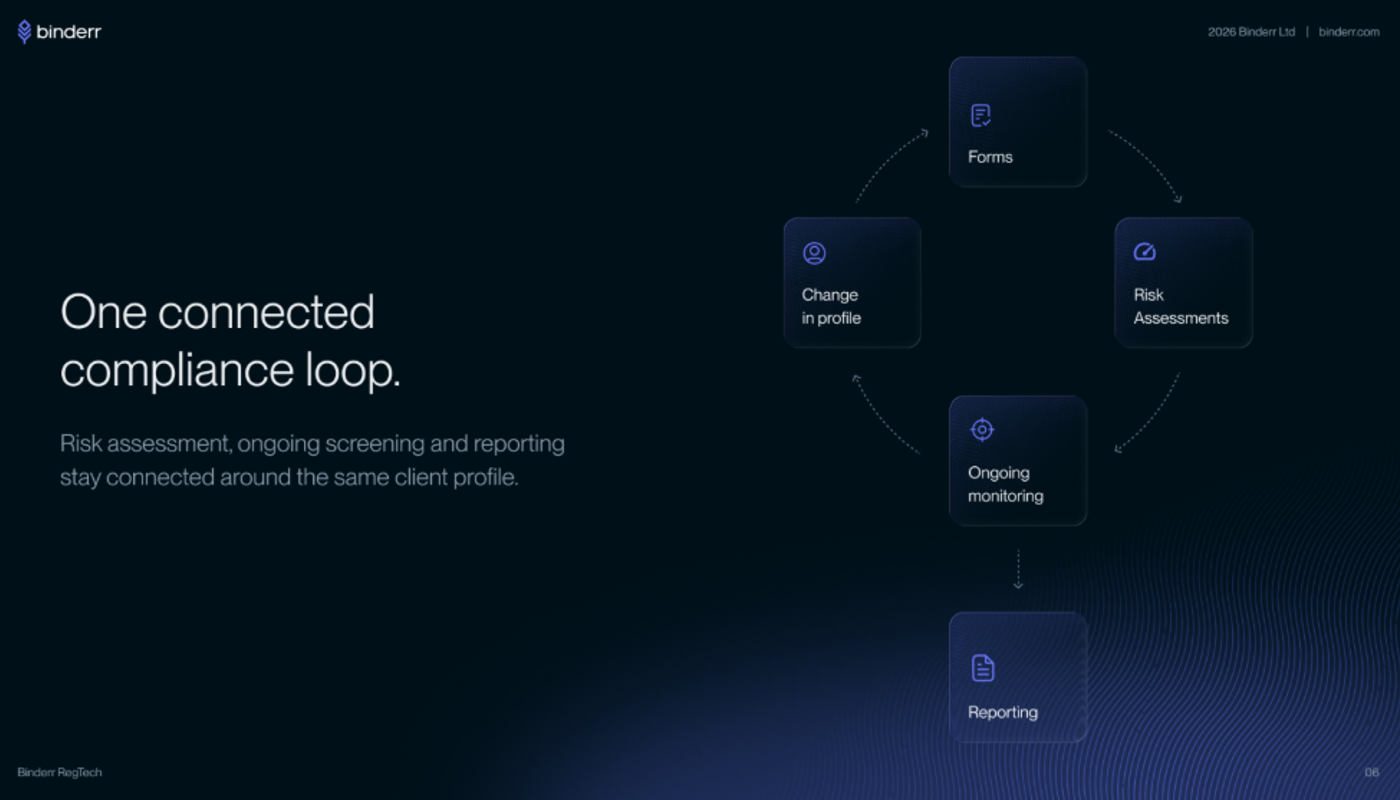
Binderr creates a connected compliance loop around the same customer or merchant profile. Changes to company information, risk assessments, screening results, and ongoing monitoring can feed into follow-up reviews and reporting without forcing analysts to reconstruct the relationship across separate systems.
Get Advanced AML Features for Payment Providers with Binderr
Binderr enhances AML compliance with advanced capabilities:
- AI-powered identity verification and fraud detection
- Global KYB registry access and ownership mapping
- Real-time sanctions, PEP, and adverse media screening
- Dynamic risk scoring for automated decision-making
- Support for complex entities like trusts and partnerships
How to Build an Effective AML Programme
Build a resilient AML programme that keeps pace with evolving financial crime risks and regulatory expectations for aml payment providers.
Discover how risk-based controls, KYC, transaction monitoring, and compliance workflows come together to strengthen AML compliance for payment providers and EMIs, support aml payments compliance, and reinforce aml emi compliance across onboarding and ongoing monitoring.
Step 1: Map the Regulatory Perimeter
Start by identifying the full regulatory landscape that applies to your payment services or EMI operations. This includes every licence held, legal entity structure, product offering, and the jurisdictions in which you operate or provide services. Mapping the regulatory perimeter ensures that AML compliance obligations are aligned with local laws, cross-border requirements, and supervisory expectations, which is essential for aml payment providers and aml emi compliance.
You should also document all relevant regulators, financial intelligence units (FIUs), sanctions regimes, and reporting authorities. This step is critical for understanding AML reporting requirements, sanctions screening obligations, and compliance responsibilities across different markets, forming the foundation of effective aml payments compliance.
Step 2: Assess Business-Wide Risk
Conduct a comprehensive business-wide risk assessment to evaluate exposure to money laundering, terrorist financing, and financial crime risks. This involves analysing customer types, merchant categories, payment products, transaction volumes, and geographic exposure, including high-risk jurisdictions and cross-border payment corridors relevant to aml payment providers.
You should also assess risks linked to agents, distributors, third-party providers, and emerging technologies such as digital wallets or embedded finance. The outcome of this assessment should inform your AML policies, transaction monitoring rules, customer risk scoring, and enhanced due diligence (EDD) requirements, strengthening aml payments compliance and aml emi compliance.
Step 3: Define the Firm’s Risk Appetite
Define a clear AML risk appetite that outlines which customers, sectors, jurisdictions, and transaction behaviours are acceptable or prohibited. This includes identifying high-risk industries, sanctioned countries, politically exposed persons (PEPs), and complex ownership structures that may require enhanced scrutiny or exclusion.
Your risk appetite should be approved by senior management and embedded into onboarding, monitoring, and escalation processes. It should guide decision-making across compliance teams, ensuring consistency in customer acceptance, transaction monitoring, and suspicious activity reporting. A defined risk appetite helps balance regulatory compliance with business growth while supporting aml payment providers and aml emi compliance.
Step 4: Design Risk-Based Onboarding
Develop a risk-based onboarding framework that applies appropriate KYC (Know Your Customer), KYB (Know Your Business), and UBO (Ultimate Beneficial Owner) verification controls. This includes identity verification, document checks, biometric authentication, sanctions screening, PEP screening, and adverse media checks tailored to the customer’s risk profile.
Higher-risk customers should be subject to enhanced due diligence (EDD), including source of funds verification, ownership analysis, and senior management approval. By aligning onboarding controls with risk levels, payment providers and EMIs can improve compliance efficiency, reduce onboarding friction, and strengthen aml payments compliance and aml emi compliance from the first interaction.
Detect Compliance Risk Faster with Binderr
Step 5: Configure Transaction Monitoring
Configure transaction monitoring systems to reflect the specific risk profile of your payment services, customer base, and transaction flows. This includes setting rules based on transaction amount, frequency, velocity, geography, and counterparties. Payment providers and EMIs should align monitoring scenarios with known money laundering typologies such as structuring, mule account activity, and cross-border layering, which are critical considerations for aml payment providers.
In addition to rules-based monitoring, incorporate behavioural analytics to detect deviations from expected customer activity. Combining real-time monitoring with post-transaction analysis helps identify suspicious patterns early while maintaining a comprehensive audit trail. Regularly review and calibrate monitoring thresholds to reduce false positives and improve aml payments compliance effectiveness.
Step 6: Establish Investigation and Reporting Workflows
Develop clear investigation workflows to ensure that alerts generated by transaction monitoring are reviewed consistently and efficiently. Assign ownership of alerts to trained analysts, define escalation thresholds, and establish timelines for investigation. Each case should include documented findings, supporting evidence, and a clear rationale for decisions.
Ensure that suspicious activity is escalated to the MLRO or designated compliance officer for review. Where required, submit Suspicious Activity Reports (SARs) or Suspicious Transaction Reports (STRs) to the relevant Financial Intelligence Unit (FIU). Maintain strict confidentiality and comply with anti-tipping-off regulations throughout the reporting process, supporting robust aml emi compliance and aml payments compliance.
Step 7: Train Employees and Third Parties
Provide role-specific AML training to employees and third parties involved in payment operations. Training should cover KYC and KYB procedures, transaction monitoring, red flag identification, sanctions screening, and reporting obligations. Staff in customer support, onboarding, compliance, and product teams should understand how their roles contribute to aml payment providers and overall aml payments compliance.
Extend training to agents, distributors, and outsourced partners to ensure consistent application of AML controls across the business. Regular refresher sessions and updates on emerging financial crime risks help maintain awareness and strengthen the overall compliance culture, particularly for aml emi compliance.
Step 8: Test and Improve the Framework
Continuously test the AML framework to ensure it remains effective and aligned with regulatory expectations. Conduct quality assurance reviews, independent audits, and alert sampling to evaluate the performance of transaction monitoring systems and investigation processes. Identify gaps, inefficiencies, and areas for improvement.
Incorporate feedback from regulators, internal audits, and compliance reviews to refine policies and controls. Model validation and periodic recalibration of risk scoring and monitoring rules are essential to adapt to evolving money laundering threats and maintain robust aml payments compliance for aml payment providers and aml emi compliance.
Common AML Compliance Weaknesses in Payment Firms
Even the most advanced payment firms can overlook critical gaps in their AML frameworks.
Understanding these weaknesses is key to strengthening compliance, reducing risk, and staying ahead of financial crime threats in aml payment providers environments.
Generic Risk Assessments - Generic risk assessments often rely on static templates that miss key risks specific to a payment provider or EMI. This can create blind spots and weaken controls. Firms should use real data and update assessments regularly to reflect actual business activity and evolving threats, improving aml payments compliance.
Overreliance on Onboarding Checks - Relying only on onboarding checks can miss changes in customer risk over time. Without ongoing monitoring, new risks may go undetected. Firms should combine onboarding with continuous screening and regular reviews to maintain aml emi compliance.
Poorly Calibrated Transaction Rules - Poorly set rules can create too many alerts or miss real risks. This reduces efficiency and effectiveness. Firms should regularly test and adjust rules using real data and risk-based segmentation to strengthen aml payment providers systems.
Weak Agent and Distributor Oversight - Third parties can introduce risk if controls are inconsistent. Weak oversight may lead to poor due diligence. Firms should apply strong onboarding, monitoring, training, and audit processes for all partners to maintain aml payments compliance.
Fragmented Compliance Data - Disconnected systems make it hard to assess customer risk and investigate alerts. This slows decisions and weakens controls. Firms should centralise data for a clear, unified risk view, improving aml emi compliance.
Inadequate Documentation - Poor documentation makes it difficult to justify decisions during audits. This increases regulatory risk. Firms should ensure all actions are clearly recorded with supporting evidence and audit trails, supporting aml payment providers compliance.
Binderr: Complete AML Compliance Solution
Binderr provides an end-to-end AML compliance platform:
- Unified KYC, KYB, AML screening, and monitoring
- Automated CDD and EDD workflows
- UBO identification and ownership mapping
- Real-time risk scoring and alerts
- Centralised audit trails and reporting
- Scalable compliance infrastructure for global operations
Bottom Line
AML compliance for payment providers and EMIs is an ongoing, connected process. From onboarding and KYC to KYB, UBO checks, screening, and transaction monitoring, each step should work together to build a clear risk view, strengthening aml payments compliance.
A risk-based, technology-driven approach helps firms scale while keeping compliance strong. Automation, real-time monitoring, and risk scoring can reduce financial crime risk without disrupting legitimate payments, supporting aml emi compliance.
Binderr Compliance brings KYC, KYB, UBO verification, AML screening, risk scoring, and ongoing monitoring together to help payment providers and EMIs build faster, more consistent compliance workflows.