
PEP and sanctions screening sit at the core of AML screening and sanctions compliance, and effective pep and sanctions screening is essential for modern compliance frameworks. Businesses must identify who they onboard, verify beneficial ownership, and assess whether any individual or entity carries politically exposed person risk or appears on sanctions lists.
PEP screening and sanctions screening serve different purposes but work together in AML frameworks. A PEP match signals higher corruption risk and may require enhanced due diligence, while a sanctions match can trigger legal restrictions such as asset freezes or blocked transactions. According to the United Nations, over 14,000 individuals and entities are currently subject to sanctions measures, highlighting the scale of global compliance risk and the importance of consistent pep and sanction list screening.
This guide explains how PEP and sanctions screening works in practice, including how to conduct a reliable pep sanctions check. It covers politically exposed person identification, sanctions list screening, data matching techniques, alert investigation, ongoing monitoring, and the role of automated screening tools in strengthening AML compliance.
Binderr PEP and Sanctions Screening Software
Binderr stands out as a leading AML screening platform designed to simplify and automate compliance processes:
- Screen individuals and businesses against global sanctions lists, PEP databases, and watchlists
- AI-powered adverse media screening across thousands of global sources
- Smart matching algorithms to reduce false positives
- Dynamic risk scoring for CDD and EDD workflows
- Support for complex entities, including UBOs, trusts, and layered ownership structures
What Is PEP and Sanctions Screening?
PEP and sanctions screening is a key part of AML screening and includes processes such as pep sanction screening and pep and sanction list screening. It involves checking individuals and entities against global risk databases to identify politically exposed persons (PEPs) and sanctioned parties. This helps businesses detect exposure to corruption, financial crime, or legal restrictions. By comparing customer data with sanctions lists and PEP databases, organisations can assess potential risks and compliance obligations.
Screening applies to individuals, businesses, UBOs, directors, shareholders, authorised signatories, trustees, and payment counterparties. It can also include vendors and partners to ensure broader risk coverage. PEP and sanctions screening is not a one-time task. It involves ongoing checks, identity verification, name matching, alert reviews, and proper documentation to support compliance and ensure an effective pep sanctions check process.
An effective screening process must examine more than a customer’s name. Binderr Compliance brings sanctions, PEP, adverse media, business verification, and enhanced due diligence checks into one connected environment, helping teams assess risk across individuals, companies, and related parties.
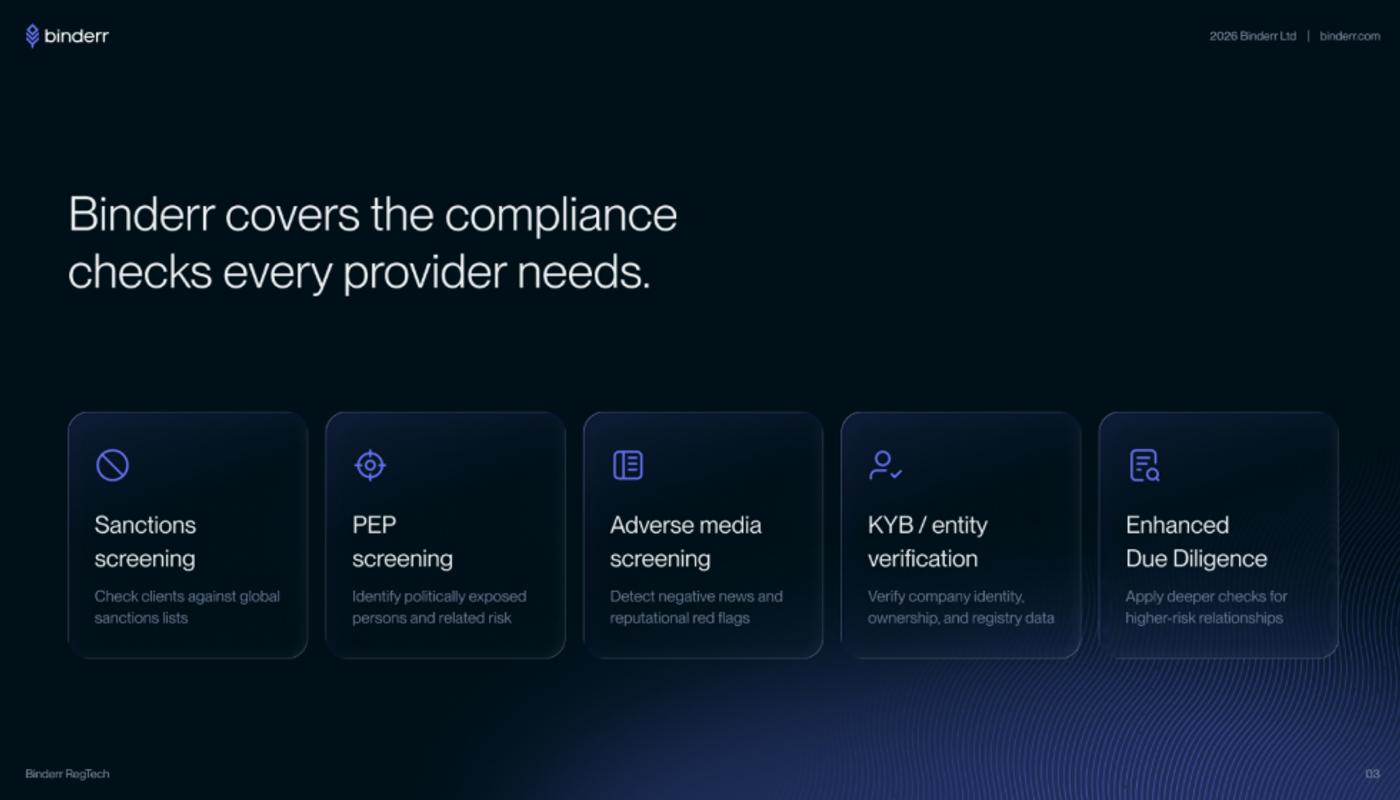
(Binderr Compliance combines PEP, sanctions, adverse media, KYB, and enhanced due diligence checks.)
Check Sanctions and PEPs for FREE
PEP Screening vs Sanctions Screening
Understanding the difference between PEP screening and sanctions screening is essential for building a strong AML compliance framework and implementing effective pep and sanctions screening strategies.
While both processes help identify risk, they serve distinct purposes in detecting politically exposed persons and enforcing sanctions compliance.
Screening area | PEP screening | Sanctions screening |
Primary purpose | Identify elevated corruption and bribery exposure | Identify legally restricted parties or activities |
Does a match prohibit onboarding? | Not automatically | It may, depending on the applicable sanctions |
Typical response | Risk assessment and enhanced due diligence | Stop, freeze, reject, block, escalate, or report as legally required |
Related parties | Family members and close associates | Owned, controlled, or connected entities |
Key checks | Public role, jurisdiction, influence, source of wealth | Identity, aliases, ownership, control, regime, and restriction type |
Monitoring requirement | Review exposure and changes over time | Rescreen when lists, ownership, or transactions change |
Decision basis | Risk-based AML controls | Applicable sanctions law and licence conditions |
Why PEP and Sanctions Screening Matters in AML
Stay ahead of financial crime risks by understanding how PEP and sanctions screening and pep sanction screening strengthen AML compliance and protect your business from hidden threats.
From identifying politically exposed persons to detecting sanctioned entities, effective AML screening is essential for managing risk, ensuring regulatory compliance, and maintaining trust through consistent pep sanctions check procedures.
Detecting Corruption and Bribery Exposure - PEP screening helps identify individuals with political influence who may present a higher risk of corruption or bribery, especially in sectors like public procurement and state-owned enterprises. It also helps uncover hidden ownership structures that could conceal illicit activity, reinforcing the importance of pep and sanction list screening.
Preventing Dealings With Sanctioned Parties - Sanctions screening helps businesses avoid engaging with restricted individuals or entities by checking customers and counterparties against sanctions lists. It also helps detect indirect exposure through intermediaries or controlled entities, making pep sanctions check processes critical.
Protecting the Business From Regulatory Exposure - Effective PEP and sanctions screening reduces the risk of regulatory breaches that can lead to enforcement action, financial penalties, and costly remediation efforts. Non-compliance can also disrupt operations and damage a company’s reputation, making robust AML controls and pep sanction screening essential for maintaining trust and regulatory standing.
Supporting Risk-Based Customer Due Diligence - Screening results play a key role in shaping a risk-based approach to customer due diligence. Identifying PEPs or sanctions exposure allows businesses to assign appropriate risk scores, apply enhanced due diligence where needed, and determine approval levels, supported by accurate pep and sanctions screening.
Make AML Screening Easier with Binderr
When Should PEP and Sanctions Screening Be Performed?
Timing is everything in AML compliance, knowing exactly when to run PEP and sanctions screening or a pep sanctions check can make the difference between proactive risk management and costly oversight.
From onboarding to ongoing monitoring, effective AML screening ensures businesses stay aligned with evolving sanctions lists, PEP risk exposure, and regulatory expectations through continuous pep and sanction list screening.
Before Customer Onboarding - PEP and sanctions screening should be completed before onboarding any customer to ensure compliance with AML regulations. This includes screening individuals, businesses, UBOs, and associated parties to identify potential risks early and prevent onboarding prohibited or high-risk entities using proper pep sanction screening.
Before Processing Relevant Transactions - Sanctions screening is critical before processing transactions, especially for cross-border payments, trade finance, and high-risk jurisdictions. Screening payment originators and beneficiaries helps detect restricted parties and ensures compliance with sanctions regulations and pep sanctions check requirements.
When Customer Information Changes - Rescreening should be triggered when key customer details change, such as ownership structure, UBOs, directors, or geographic location. These updates may introduce new PEP or sanctions risks that require reassessment through updated pep and sanctions screening.
During Ongoing Monitoring - Ongoing monitoring involves both periodic and event-driven screening to detect changes in customer risk profiles. Screening frequency should align with the customer’s risk level, transaction activity, and updates to sanctions or PEP lists, ensuring continuous pep sanction screening.
When Sanctions Lists Change - When sanctions lists are updated, businesses should promptly rescreen their customer base to identify newly designated individuals or entities. Continuous monitoring ensures that existing relationships remain compliant with evolving sanctions requirements and pep sanctions check obligations.
Monitor Sanctions and PEP Updates
How the PEP and Sanctions Screening Process Works
Understand how PEP and sanctions screening in AML, including pep sanction screening and pep and sanction list screening, transforms raw customer data into actionable risk insights.
From identity verification to ongoing monitoring, each step strengthens compliance, reduces exposure, and supports effective AML screening decisions.
Step 1: Collect Accurate Customer Information
Collecting accurate customer information is the foundation of effective PEP and sanctions screening in AML. Businesses must gather complete and reliable data during KYC or KYB processes to ensure screening results are meaningful and reduce false positives or false negatives. Poor-quality data can lead to missed risks or unnecessary alerts, weakening overall AML screening effectiveness and pep sanctions check accuracy.
Include key identifiers such as full legal name, aliases, date of birth, nationality, identification numbers, and company registration details. It is also essential to capture ownership and control information, including UBOs, as well as any public position or institutional affiliation to support politically exposed person screening and sanctions compliance.
Step 2: Verify the Customer’s Identity
Verifying the customer’s identity ensures that the information collected is accurate and trustworthy before conducting PEP screening or sanctions screening. AML screening outcomes depend heavily on verified data, as incorrect or incomplete identity details can result in unreliable matches and compliance gaps in pep sanction screening.
Through KYC or KYB verification, businesses confirm identity documents, validate company records, and establish beneficial ownership. This step strengthens sanctions compliance by ensuring that screening checks are performed against genuine individuals and entities, improving the accuracy of AML screening processes.
Accurate screening starts with complete, verified customer data. Binderr uses dynamic onboarding forms to collect information according to the entity type, jurisdiction, and answers provided. The captured information can then feed directly into the customer’s risk assessment.
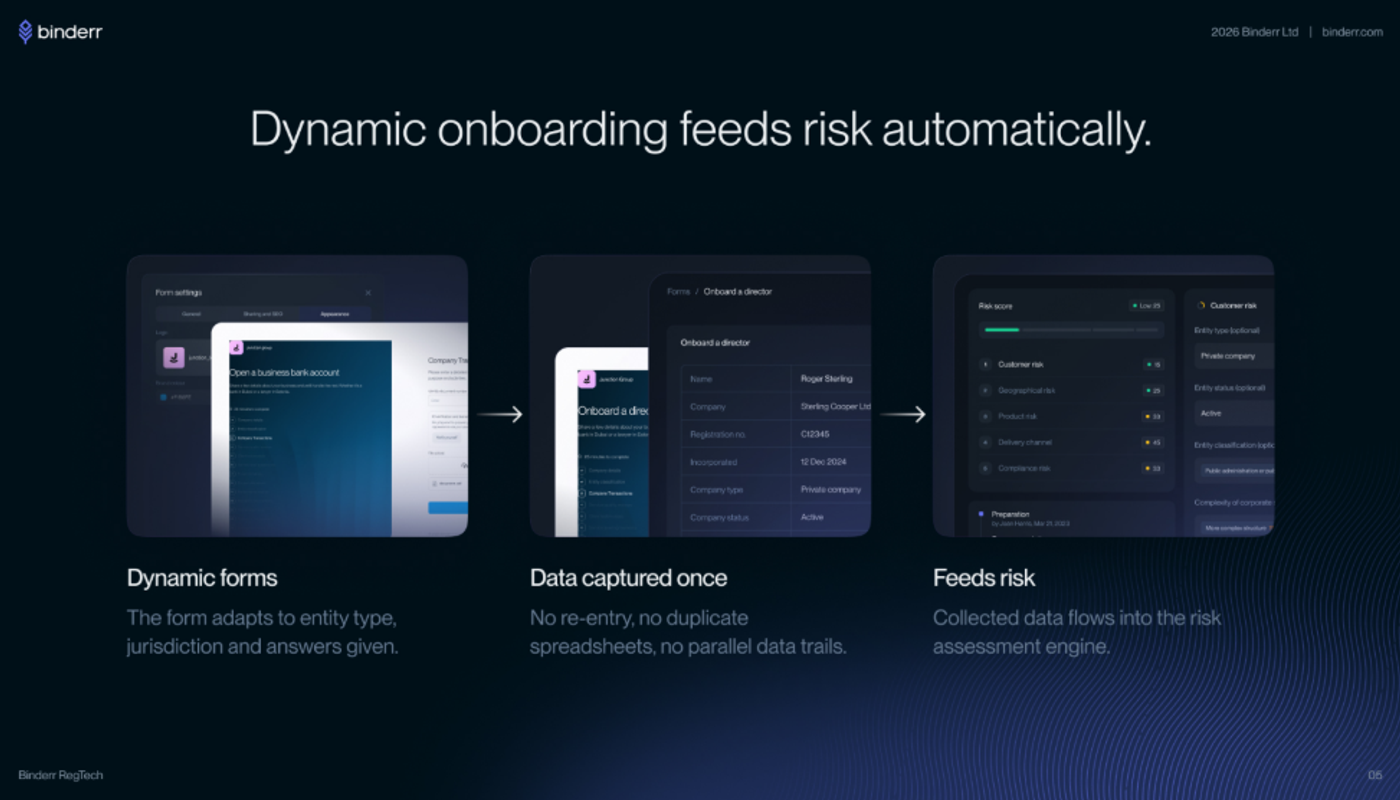
(Binderr dynamic onboarding forms feeding verified customer data into AML risk assessment.)
Step 3: Screen Relevant Parties and Entities
Screening must extend beyond the primary customer to include all relevant parties connected to the relationship. This includes individuals, businesses, UBOs, directors, shareholders, and authorised representatives, as well as any associated entities that may pose sanctions or PEP risk.
By conducting comprehensive AML screening across all connected parties, businesses can identify indirect exposure to politically exposed persons or sanctioned entities. This approach supports effective sanctions screening and helps detect risks linked to ownership, control, or close associations through pep and sanction list screening.
Step 4: Apply Data-Matching Rules
Applying data-matching rules is critical to identifying potential matches during PEP and sanctions screening. Screening systems use a combination of exact matching, fuzzy matching, alias detection, phonetic matching, and transliteration to capture variations in names and identifiers across global datasets, supporting accurate pep sanctions check outcomes.
Additional filters such as date-of-birth comparison, geographic indicators, nationality, and entity identifiers improve match accuracy and reduce false positives. Effective AML screening relies on well-calibrated matching logic to balance sensitivity and precision.
Screening technology should help analysts understand why an alert appeared. Binderr provides transparent screening results and configurable risk logic, enabling compliance teams to adjust screening according to internal policies while prioritising stronger matches.
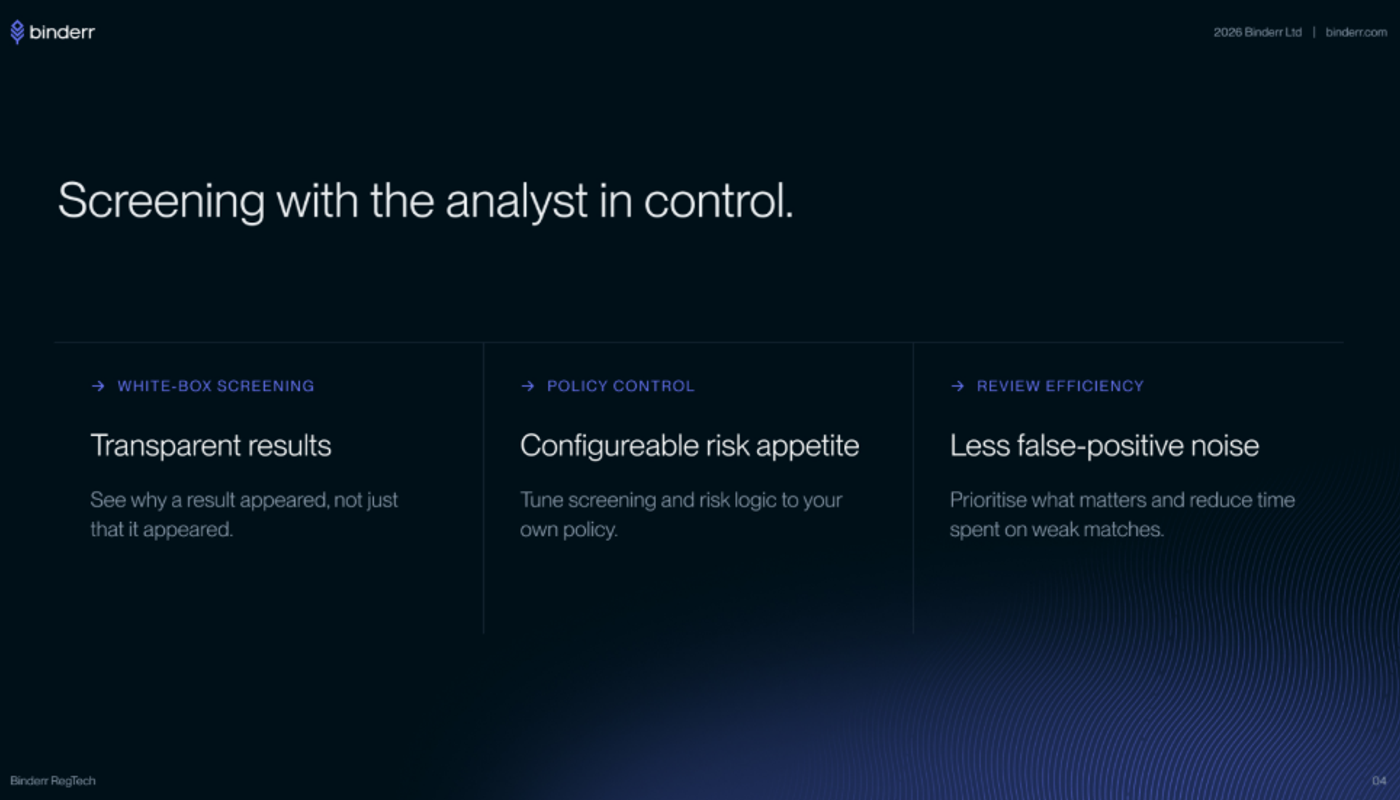
(Binderr gives analysts transparent results, configurable risk controls, and more focused alert queues.)
Step 5: Investigate Potential Matches
Investigate potential matches by comparing key identifiers such as full name, date of birth, nationality, address, and known aliases against PEP and sanctions screening data. This process helps determine whether an alert is a true match, false positive, or inconclusive result within AML screening workflows and pep sanction screening processes.
Effective investigation reduces compliance risk by ensuring accurate identification of politically exposed persons and sanctioned entities.
Step 6: Assess Risk and Escalate
Assess the level of risk associated with each confirmed or potential match by applying a risk-based approach. PEP screening results may require enhanced due diligence (EDD), including source of wealth checks and senior management approval before proceeding with the business relationship.
Sanctions screening alerts must be escalated immediately in line with legal obligations and internal AML procedures. This ensures timely action and compliance with pep sanctions check requirements.
Detect Compliance Risk Faster
Step 7: Record the Decision
Record all screening outcomes in detail, including the data reviewed, matching criteria, supporting evidence, reviewer identity, and final decision. Maintaining a clear audit trail is essential for AML compliance and regulatory inspections.
Proper documentation supports transparency and accountability in PEP and sanctions screening processes. It also ensures that decisions can be reviewed, justified, and consistently applied across future compliance checks.
Step 8: Monitor for Future Changes
Implement ongoing monitoring to detect changes in customer risk profiles, including new sanctions designations, updates to PEP status, or changes in ownership and control structures. Continuous AML screening ensures that emerging risks are identified promptly.
Regular rescreening and real-time alerts help businesses stay compliant with evolving sanctions lists and regulatory expectations. Ongoing monitoring strengthens risk management and supports proactive sanctions compliance and PEP risk assessment.
Customer risk does not remain static after onboarding. Binderr connects customer information, risk assessments, ongoing screening, reporting, and profile changes around the same client record. When relevant data changes, compliance teams can reassess risk without relying on disconnected spreadsheets or separate customer files.
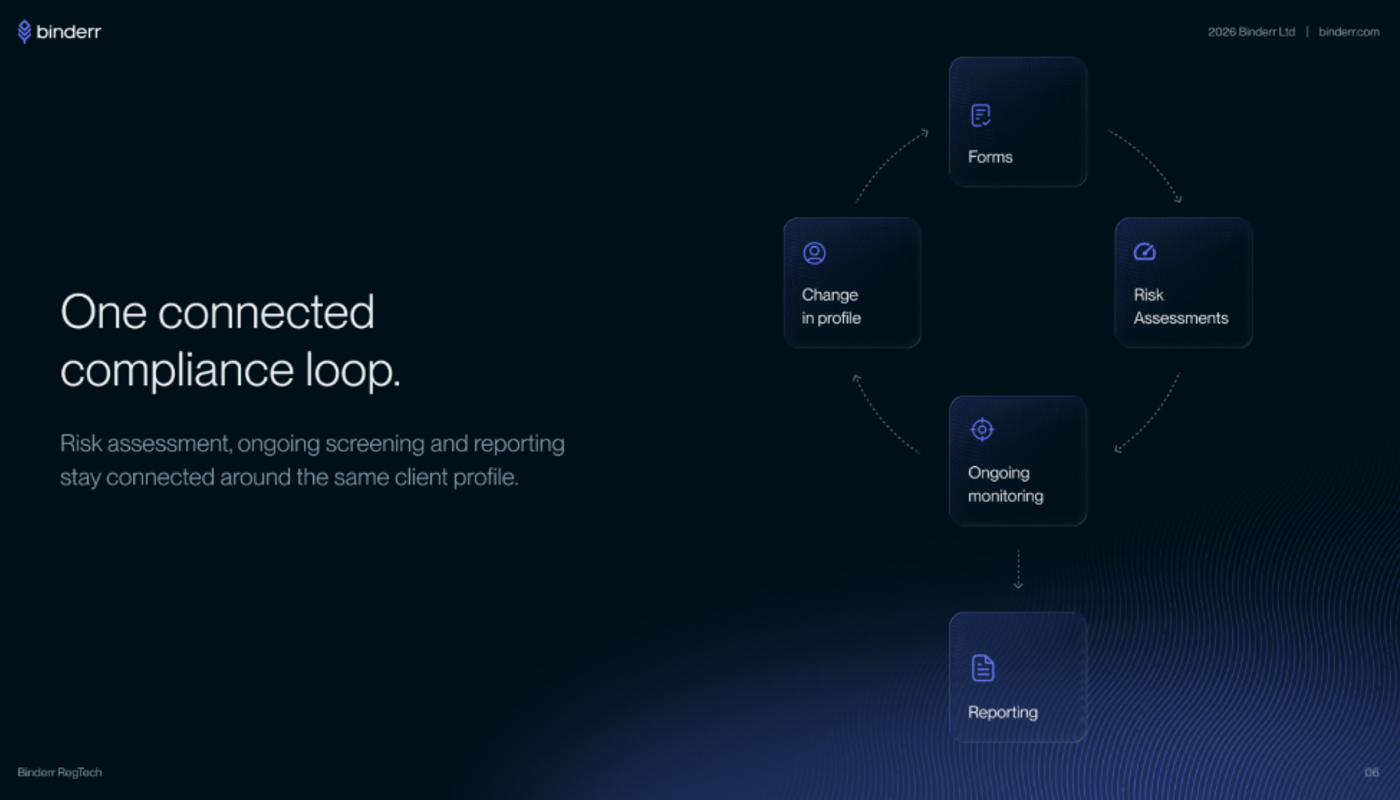
(Binderr connects customer data, risk assessments, ongoing monitoring, and reporting in one compliance loop.)
See How Binderr Simplifies the Screening Process
Binderr streamlines the entire screening workflow:
- Run KYC, KYB, and AML checks in one platform
- Automatically screen individuals, businesses, and UBOs
- Apply dynamic risk scoring based on real-time data
- Trigger EDD workflows for high-risk customers
- Maintain full audit trails for compliance reporting
- Enable continuous monitoring with instant alerts
EP and Sanctions Screening Requirements Across Major Jurisdictions
Stay ahead of global compliance by understanding how PEP and sanctions screening and pep sanctions check rules differ across regions.
Explore key AML screening requirements, sanctions compliance standards, and PEP obligations across major jurisdictions.
FATF Standards
FATF standards set the global baseline for PEP and sanctions screening in AML, particularly through Recommendations 6 and 12. Recommendation 6 focuses on targeted financial sanctions related to terrorism and proliferation, requiring businesses to identify and freeze assets of designated individuals and entities without delay. Recommendation 12 addresses politically exposed persons, requiring risk-based PEP screening, enhanced due diligence, and ongoing monitoring for higher-risk relationships, including family members and close associates.
United States
In the United States, sanctions screening is primarily governed by the Office of Foreign Assets Control (OFAC), which administers and enforces economic and trade sanctions. Businesses must implement risk-based compliance programs that include sanctions list screening, ownership and control checks, and robust record keeping. Failure to comply can result in significant enforcement exposure, including civil penalties and reputational damage, making accurate AML screening and monitoring essential.
United Kingdom
The United Kingdom enforces sanctions through the UK Sanctions List and guidance issued by the Office of Financial Sanctions Implementation (OFSI). Businesses must assess ownership and control, apply financial restrictions, and meet reporting and licensing requirements where applicable. As of 28 January 2026, the UK adopted a single-list model for sanctions designations, making the UK Sanctions List the sole authoritative source. Newly designated parties are assigned a Unique ID instead of an OFSI Group ID.
European Union
The European Union applies restrictive measures through its consolidated financial sanctions list and requires enhanced due diligence for PEP-related risks under AML directives. Businesses must align sanctions screening with EU regulations while preparing for the transition to the new AML framework. Regulation (EU) 2024/1624 is expected to apply from 10 July 2027, so firms should distinguish between current 2026 obligations and upcoming changes.
Best Practices for PEP and Sanctions Screening in 2026
Stay ahead of evolving AML risks with smarter pep and sanctions screening strategies. Discover how effective AML screening, sanctions compliance, and politically exposed person checks can strengthen your risk-based approach through robust pep sanction screening and pep and sanction list screening processes.
Screen individuals, entities, UBOs, and controlling parties - Effective pep and sanctions screening should cover not only the primary customer but also all related parties, including ultimate beneficial owners (UBOs), directors, and individuals with control or influence. This ensures that hidden ownership structures or indirect connections to sanctioned or politically exposed persons are identified during AML screening and pep sanctions check procedures.
Keep PEP and sanctions response workflows separate - PEP screening and sanctions screening serve different purposes and require distinct response processes. A PEP match typically triggers enhanced due diligence (EDD) and risk assessment, while a sanctions match may require immediate escalation, transaction blocking, or reporting under sanctions compliance obligations within a structured pep sanction screening framework.
Use configurable matching thresholds based on risk - AML screening systems should allow adjustable matching thresholds to balance detection accuracy and operational efficiency. Higher-risk customers may require stricter matching criteria, while lower-risk profiles can use more refined thresholds to reduce false positives without increasing false negatives in pep and sanction list screening.
Include aliases, transliterations, and alternative spellings - Names can vary significantly across languages and regions, making it essential to include aliases, transliterations, and alternative spellings in sanctions and PEP screening. This improves match accuracy and helps identify individuals who may appear differently across watchlists and official records during pep sanctions check processes.
Apply EDD proportionately to PEP relationships - Not all PEP relationships carry the same level of risk, so enhanced due diligence should be applied proportionately. Factors such as the individual’s role, jurisdiction, and source of wealth should guide the depth of investigation and ongoing monitoring requirements within pep and sanctions screening programs.
Rescreen customers after list and profile changes - Ongoing monitoring is critical in AML compliance, as sanctions lists and customer profiles can change over time. Businesses should rescreen customers when there are updates to sanctions lists, changes in ownership, or new risk indicators to ensure continued compliance through consistent pep sanction screening.
Try Advanced AML Screening Features with Binderr
Binderr enhances screening accuracy with advanced capabilities:
- AI-powered identity verification and document checks
- Biometric face matching and liveness detection
- Ownership structure mapping and UBO identification
- Integrated adverse media screening
- Smart matching algorithms to reduce false positives
- Global registry access for KYB verification
Common Mistakes to Avoid in PEP and Sanctions Screening
Uncover the most common challenges in AML screening, including issues affecting pep sanction screening and pep and sanction list screening.
Incomplete or Poor-Quality Customer Data
Problem: Poor or incomplete customer data weakens AML screening and increases false positives and false negatives, making accurate PEP and sanctions matching difficult.
Solution: Improve KYC and KYB data collection by gathering key identifiers such as full names, dates of birth, and ownership details to enhance screening accuracy and risk assessment.
High False-Positive Volumes
Problem: Too many false positives can overwhelm compliance teams, delay onboarding, and raise costs. Broad matching rules, like loose fuzzy matching or name-only checks, often cause unnecessary alerts.
Solution: Use risk-based matching thresholds and stronger identifiers such as date of birth and nationality to reduce false positives. Apply tested suppression rules and regularly refine screening systems to maintain accuracy and compliance.
Different Sanctions Regimes
Problem: Businesses operating across multiple jurisdictions must manage different sanctions regimes, such as OFAC, UK, and EU lists. A one-size-fits-all approach can create compliance gaps or unnecessary restrictions.
Solution: Map legal exposure based on jurisdiction, customers, and transactions. Tailor screening to relevant regimes to improve accuracy and reduce regulatory risk.
Complex Ownership Structures
Problem: Complex ownership structures can hide the true beneficial owners, making it harder to detect sanctions or PEP risks.
Solution: Map ownership thoroughly and screen all levels of the structure to identify UBOs and uncover hidden risks.
Transliteration and Name Variations
Problem: Transliteration differences and name variations across languages can lead to missed matches or excessive false positives in sanctions screening and PEP screening. Variations in spelling, phonetics, and script conversion complicate accurate AML screening.
Solution: Using multilingual screening tools that support aliases, phonetic matching, and script conversion improves detection accuracy. Incorporating advanced fuzzy matching techniques ensures that AML screening systems can identify relevant matches despite linguistic differences.
Outdated Screening Results
Problem: Outdated screening results can expose businesses to compliance risks if customers become sanctioned or politically exposed after onboarding.
Solution: Use event-driven rescreening and automated list monitoring to keep customer profiles updated and detect new risks quickly.
Inconsistent Alert Decisions
Problem: Inconsistent alert decisions in AML screening can lead to uneven risk management and potential compliance failures. Without clear guidelines, different reviewers may interpret PEP and sanctions screening alerts differently, increasing the risk of errors.
Solution: Establishing documented investigation standards, providing reviewer training, and implementing quality assurance processes ensure consistent decision-making. Clear escalation rules and audit trails improve the reliability of AML screening and support stronger sanctions compliance.
Binderr: Complete Compliance Solution
Binderr provides a full end-to-end compliance platform:
- KYC identity verification with AI-powered checks
- KYB business verification with global registry access
- AML screening across sanctions, PEPs, and watchlists
- Dynamic risk assessment and scoring
- UBO identification and ownership mapping
- Automated CDD and EDD workflows
Bottom Line
Effective PEP and sanctions screening and pep sanction screening go beyond simple name checks. It relies on accurate customer data, clear ownership visibility, and risk-based matching to identify potential exposure to politically exposed persons and sanctioned entities.
Ongoing monitoring remains essential as political roles, sanctions lists, and ownership structures change. Continuous screening and timely updates help businesses maintain accurate risk profiles and avoid regulatory exposure through consistent pep sanctions check processes.
Binderr Compliance brings PEP screening, sanctions screening, adverse media checks, KYC, KYB, and ongoing monitoring into one unified platform, helping teams streamline workflows and make consistent, well-documented compliance decisions.