
Digital customer onboarding for financial services has shifted from branch counters and paper forms to mobile-first, remote experiences. Customers now expect to open accounts, complete digital onboarding KYC, verify identity, and submit documents from their devices without visiting a physical location, making digital onboarding a key part of customer onboarding financial services and retention.
Financial institutions face a clear challenge. They must deliver fast and seamless financial customer onboarding while preventing identity fraud and meeting strict KYC, AML, sanctions screening, data protection, and onboarding compliance requirements. According to the Federal Trade Commission, consumers reported losing over $10 billion to fraud in 2023, highlighting the growing risk environment that makes secure digital onboarding solutions essential.
This guide explains how digital customer onboarding works in financial services, covering identity verification, workflows, onboarding compliance, fraud risks, and best practices.
Binderr Digital Customer Onboarding Software
- KYC (Identity Verification) with AI-powered document checks, biometric face matching, and liveness detection
- KYB (Business Verification) with global registry access and ownership mapping
- AML Screening across sanctions, PEPs, watchlists, and adverse media
- Dynamic Risk Assessment with automated scoring
- UBO Identification and ownership structure visualisation
- Full audit trails and compliance reporting
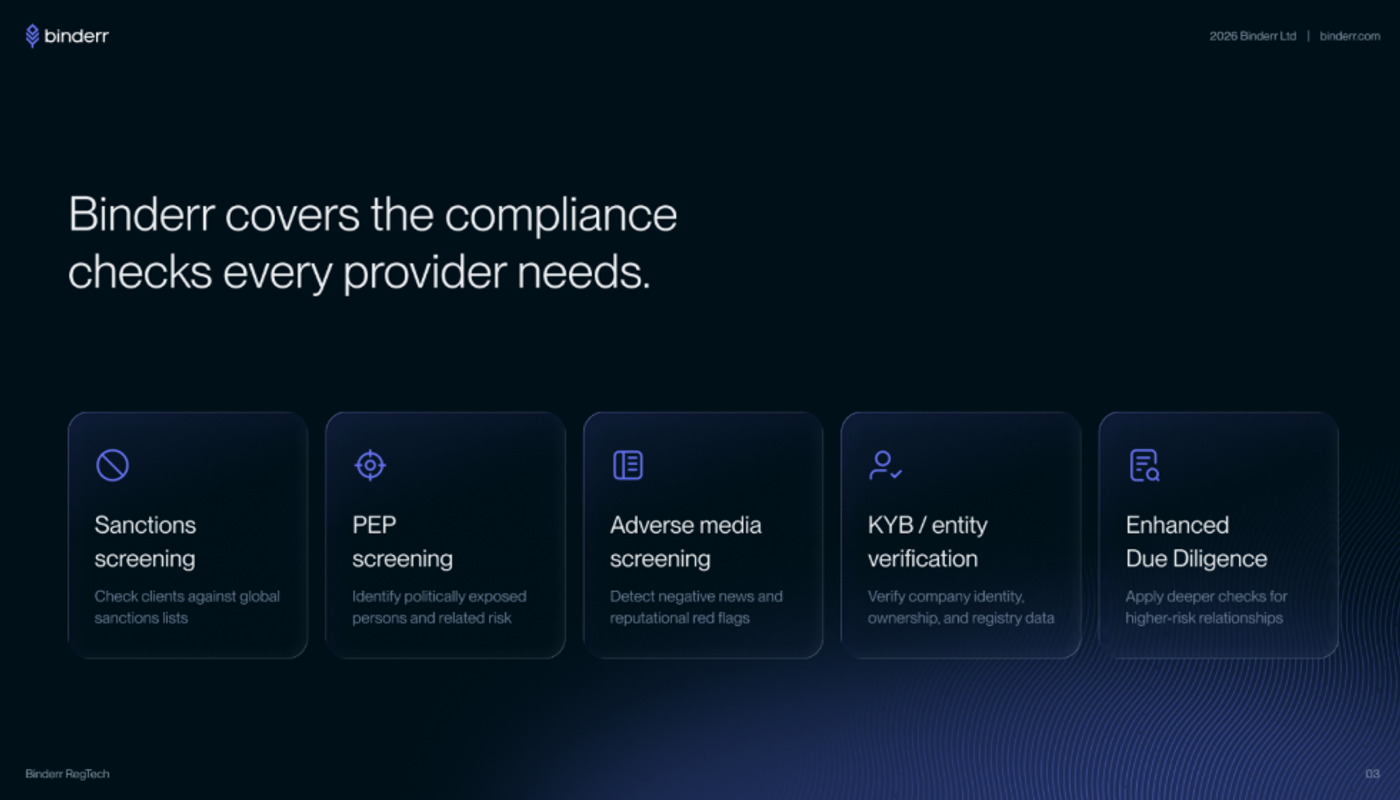
Digital onboarding should not require compliance teams to move between separate systems for identity checks, sanctions screening, adverse media, and enhanced due diligence. Binderr brings these checks into one connected onboarding workflow, allowing institutions to assess customers and related entities from a central platform.
What Is Digital Customer Onboarding?
Digital customer onboarding is the process financial institutions use to register, verify, assess, and activate customers online as part of customer onboarding financial services. It replaces in-branch onboarding with a faster digital workflow.
It includes collecting personal data, verifying identity documents, performing biometric checks, and running digital onboarding KYC and AML screening. Fraud detection, device checks, and risk scoring are also applied.
The process supports document collection, electronic consent, and account approval. It may be automated for low-risk users or reviewed manually for higher-risk cases to maintain onboarding compliance.
Simplify Customer Onboarding with Binderr
Why Digital Onboarding Matters for Financial Services
Digital onboarding is reshaping how financial institutions attract, verify, and retain customers in an increasingly remote-first world.
From faster account opening to stronger fraud prevention and seamless onboarding compliance, it plays a critical role in modern customer onboarding financial services operations.
Faster customer acquisition - Digital customer onboarding accelerates customer acquisition by automating key steps such as data extraction, identity verification, AML screening, and decision-making. Instead of relying on email exchanges and manual document reviews, financial institutions can process applications in near real time, reducing delays and enabling faster account opening for both banks and fintech platforms.
Higher application completion rates - Mobile-friendly onboarding forms, clear progress indicators, and pre-filled information help reduce friction and improve application completion rates. By minimising unnecessary questions and guiding users through each step, digital onboarding solutions can lower abandonment while still applying risk-based checks that reflect the customer profile and financial product.
Lower operational costs - Automated customer onboarding reduces operational costs by eliminating repetitive manual tasks such as copying data between systems, reviewing standard identity documents, and running separate sanctions checks. It also streamlines onboarding compliance processes by automatically requesting missing information, generating audit records, and routing routine cases without requiring constant analyst involvement.
Stronger fraud prevention - Digital onboarding strengthens fraud prevention by combining multiple verification layers, including document authenticity checks, biometric matching, liveness detection, and device intelligence. These tools help detect identity fraud, synthetic identities, and suspicious behaviour early in the onboarding process, supported by database verification and behavioural analysis.
More consistent compliance decisions - Standardised workflows and predefined rules ensure that compliance decisions are applied consistently across teams, locations, and business units. Automated onboarding systems reduce reliance on individual judgement, helping financial institutions maintain uniform digital onboarding KYC and AML processes while improving onboarding compliance.
Better auditability- Digital onboarding platforms improve auditability by capturing timestamped records, verification evidence, screening results, and decision histories in a centralised system. This creates a clear audit trail that includes reviewer actions, risk-score changes, and approval logs, supporting regulatory reporting and internal onboarding compliance reviews.
Easier international expansion - Configurable digital onboarding workflows enable financial institutions to expand into new markets by adapting to different document requirements, languages, and regulatory frameworks. With flexible risk rules and broad country coverage, organisations can onboard customers across multiple jurisdictions while maintaining consistent onboarding compliance standards.
Verify Customers in Minutes
How the Digital Customer Onboarding Process Works
A seamless digital customer onboarding process transforms identity verification, digital onboarding KYC checks, and account setup into a fast, secure journey.
Explore how automated onboarding workflows, digital identity verification, and AML screening come together to streamline customer onboarding financial services.
Step 1: Customer registration and application
The digital customer onboarding process begins with customer registration, where financial institutions collect essential personal and account-related information. This stage forms the foundation of digital onboarding KYC and customer due diligence, helping organisations understand who the customer is and why they are opening an account. Typical data collected includes full legal name, date of birth, nationality, residential address, contact details, occupation or employment, intended account use, expected transaction activity, tax residency, and product selection.
To improve customer experience and reduce onboarding abandonment, institutions should adopt progressive data collection. Instead of presenting a long, complex form upfront, information can be gathered in stages based on risk and context. This approach supports automated customer onboarding while maintaining onboarding compliance and enabling smoother digital account opening journeys.
Step 2: Identity document capture
Once basic information is collected, the next step in digital onboarding in financial services is identity document capture. Customers are asked to upload or photograph an accepted identity document, such as a passport, national identity card, residence permit, or driving licence. This step is critical for customer identity verification and forms a core part of digital onboarding KYC.
Advanced digital onboarding solutions analyse the submitted document to verify authenticity and integrity. Checks may include validating the document type and issuing country, confirming the expiry date, assessing security features, reading the machine-readable zone, extracting barcode or chip data, detecting signs of tampering, evaluating image quality, and ensuring data consistency. These controls help prevent identity fraud and support compliant digital onboarding processes.
Step 3: Data extraction and validation
After capturing the identity document, optical character recognition (OCR) technology is used to extract key data such as names, dates of birth, document numbers, and addresses. This automation reduces manual data entry, improves accuracy, and accelerates the digital customer onboarding process.
Extracted data must then be validated against multiple sources to ensure reliability. This includes comparing it with customer-entered information, verifying consistency across document fields, checking against government or trusted databases, reviewing internal records, and cross-referencing supporting documents. Financial institutions should also account for challenges such as low-quality images, non-Latin scripts, damaged documents, and transliteration differences, which may require additional verification controls or manual review to maintain onboarding compliance.
Step 4: Biometric and liveness verification
Biometric verification plays a key role in remote customer onboarding by confirming that the applicant is the legitimate owner of the identity document. Facial matching compares the customer’s live image or selfie with the photograph on the submitted document, helping to detect impersonation attempts.
Liveness detection ensures that the individual is physically present during the verification process, rather than using a static image, video replay, mask, or manipulated media. Deepfake detection adds another layer of protection by identifying synthetic or AI-generated faces, videos, audio, or documents. Regulatory bodies such as FinCEN and FINRA have highlighted the growing risk of deepfake-enabled fraud in digital onboarding, making these controls essential for secure and compliant customer onboarding financial services.
Step 5: Address and contact verification
Address and contact verification helps confirm that the customer can be reliably reached and that their provided details are consistent with known data sources. Common methods include proof-of-address document checks, address database matching, postal validation, email verification, one-time passcodes, telephone number intelligence, and device or IP location consistency checks.
While these methods strengthen the digital onboarding process, it is important to note that verifying a contact channel does not, on its own, prove identity. Instead, it should be used alongside identity verification, AML screening, and risk assessment as part of a layered approach to customer onboarding financial services.
Step 6: KYC and customer due diligence
Know Your Customer (KYC) and customer due diligence (CDD) are central to digital customer onboarding in financial services. Financial institutions must establish a clear understanding of who the customer is, why they are opening an account, and whether their expected activity aligns with the product being requested. This risk-based approach helps ensure onboarding compliance with AML regulations while reducing exposure to financial crime.
CDD typically involves collecting and verifying key customer information, including identity verification, purpose of the relationship, expected transaction patterns, employment or business activity, source of funds, tax residency, geographic exposure, and product or delivery-channel risk. These elements allow institutions to build a comprehensive customer profile and determine whether the relationship presents a low, medium, or high level of risk.
Start KYC Verification for Free
Step 7: AML, sanctions, PEP, and adverse media screening
As part of AML compliance, financial institutions must screen customers against multiple risk databases to identify potential exposure to financial crime. This includes sanctions lists, politically exposed person (PEP) databases, relatives and close associates (RCAs), regulatory and enforcement watchlists, adverse media sources, and internal blocklists. These checks are essential for detecting individuals or entities linked to corruption, terrorism financing, or other illicit activities.
It is important to note that screening results often generate potential matches rather than confirmed risks. Institutions must apply additional identifiers such as date of birth, nationality, or address to accurately resolve matches. Effective AML screening processes reduce false positives while ensuring that genuine risks are escalated for further investigation, supporting onboarding compliance.
Screening workload is not determined only by the customer’s risk classification. Sanctions and PEP matches may be easier to assess when structured identifiers are available, while adverse-media reviews often require analysts to read multiple articles, confirm whether they refer to the correct person, and evaluate the relevance of each allegation.
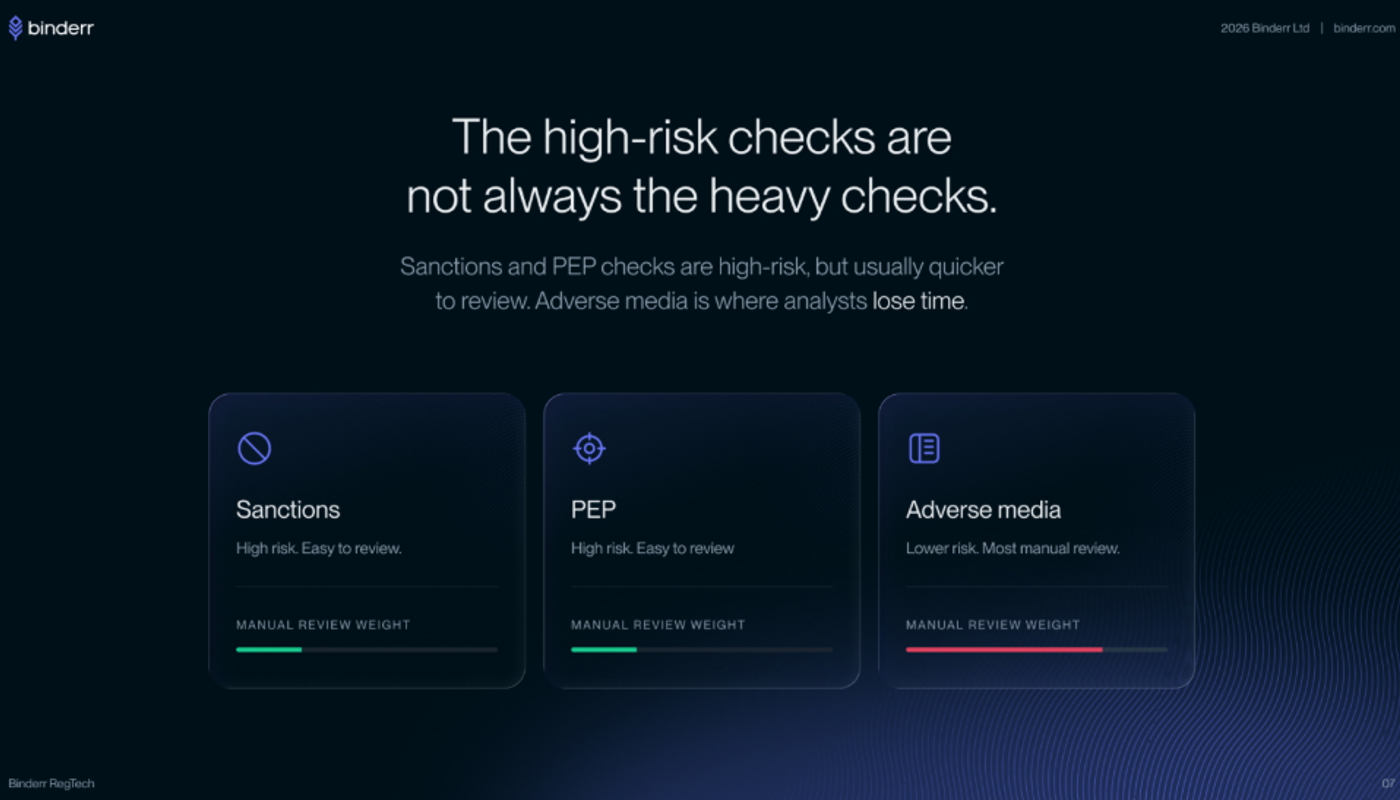
(Binderr helps analysts prioritise different types of AML screening alerts according to their relevance and review requirements.)
Step 8: Fraud and device-risk assessment
Fraud and device-risk assessment plays a critical role in identifying suspicious behaviour during digital onboarding. Financial institutions analyse a range of technical and behavioural signals, including IP address, VPN or proxy usage, device fingerprinting, emulator detection, repeated device use, unusual application velocity, location mismatches, behavioural anomalies, duplicate identities, and reused photographs or documents.
These signals help detect identity fraud, synthetic identities, and coordinated account creation attempts. However, no single signal should determine the outcome. Instead, institutions should combine these indicators within a broader fraud detection framework to support accurate and context-aware risk decisions.
Step 9: Customer risk scoring
Customer risk scoring brings together insights from digital onboarding KYC, AML screening, fraud detection, product risk, geographic exposure, and behavioural data to classify each applicant. This automated or semi-automated process enables financial institutions to apply consistent and scalable decision-making across large volumes of onboarding applications.
Based on the calculated risk score, outcomes may include low-risk automatic approval, medium-risk cases requiring additional verification, high-risk customers subject to enhanced due diligence (EDD), manual review by compliance teams, rejection of the application, or escalation for further investigation. Risk scoring ensures that onboarding workflows remain efficient while maintaining onboarding compliance.
An effective digital onboarding process should not collect customer information and assess risk in separate systems. With Binderr, dynamic forms can adapt according to the customer type, jurisdiction, and previous answers. The information collected is then transferred directly into the customer risk assessment, reducing duplicate data entry and disconnected spreadsheets.
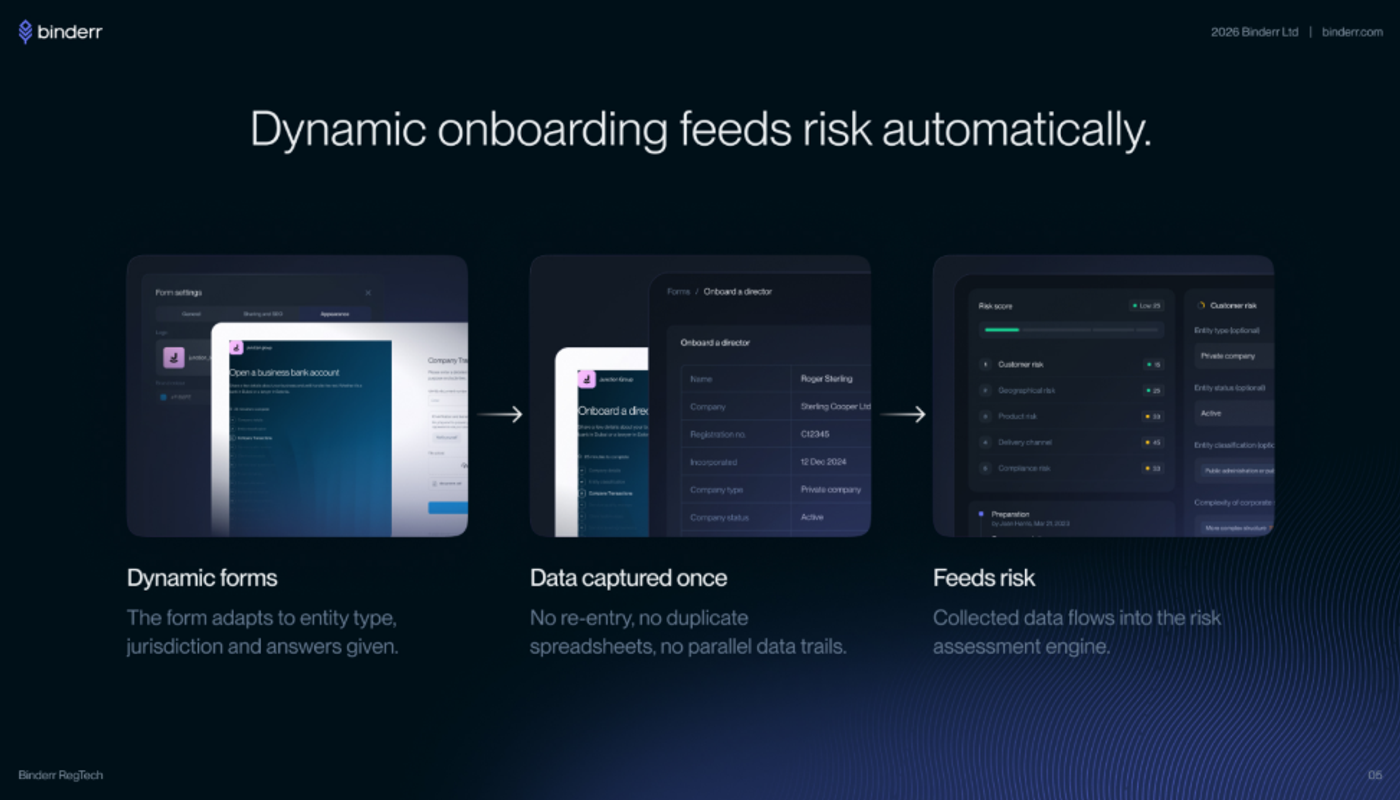
(Binderr connects dynamic onboarding forms with automated customer risk assessment.)
Detect Compliance Risk Faster with Binderr
Step 10: Enhanced due diligence where required
Enhanced due diligence (EDD) is applied to higher-risk customers identified during the onboarding process. These may include politically exposed persons, customers from high-risk jurisdictions, or individuals with complex ownership structures or unclear sources of wealth. EDD requires a deeper level of scrutiny to mitigate potential financial crime risks.
Additional requirements may include providing extra identity documents, detailed source-of-funds evidence, source-of-wealth information, employment or business records, bank statements, tax documents, explanations of anticipated transactions, and supporting information about related parties. This ensures that financial institutions have sufficient evidence to justify onboarding higher-risk customers while maintaining onboarding compliance.
Step 11: Decision, electronic consent, and account activation
Once all verification, screening, and risk assessment steps are complete, the institution proceeds to the final decision stage. This may involve automated approval rules for low-risk customers or manual approval for more complex cases. Clear decision logic helps maintain consistency and auditability across the onboarding process.
Following approval, customers are required to provide electronic consent by accepting terms and conditions, privacy notices, and marketing preferences. The account is then configured with appropriate settings, including initial transaction limits and access permissions. Finally, customer notifications confirm successful onboarding, completing the digital account opening journey within customer onboarding financial services.
Simplify the Digital Onboarding Process with Binderr
Binderr streamlines every step of onboarding into a single workflow:
- Run KYC, KYB, and AML checks in one platform
- Automatically assign risk scores using dynamic risk assessment
- Trigger EDD workflows for high-risk customers
- Collect documents and data dynamically
- Maintain full audit trails for compliance
Digital Customer Onboarding Risks and Controls
Explore the key risks in digital customer onboarding for financial services and how effective controls can strengthen onboarding compliance and fraud prevention.
Understand how identity verification, AML screening, and risk-based onboarding strategies help protect institutions while maintaining a smooth customer experience.
Onboarding risk | Example | Recommended controls |
Stolen identity | Criminal uses genuine personal information belonging to another person | Document verification, biometric matching, database checks and device intelligence |
Synthetic identity | Real and fabricated information is combined to create a new identity | Cross-source validation, duplicate detection, behavioural analysis and ongoing monitoring |
Deepfake attack | AI-generated face or video is used during verification | Liveness detection, injection-attack controls, deepfake detection and manual escalation |
Forged document | Identity document is edited or fabricated | Document authenticity analysis, security-feature checks and trusted database verification |
Account farming | Multiple accounts are opened using coordinated identities or devices | Device fingerprinting, velocity rules, network analysis and duplicate detection |
Sanctions exposure | Applicant matches a sanctioned person or entity | Sanctions screening, match resolution and continuous monitoring |
Application abandonment | Customer exits because the process is too long or confusing | Progressive forms, clear instructions, mobile optimisation and save-and-resume functionality |
False rejection | Legitimate customer fails automated checks | Alternative verification routes, accessible support and trained manual review |
Data breach | Identity documents or biometric data are exposed | Encryption, access controls, minimised retention, monitoring and incident response |
Inconsistent decisions | Similar applicants receive different outcomes | Standardised policies, automated workflows, quality assurance and documented exceptions |
Automation should help analysts make faster decisions without hiding why a screening result appeared. Binderr uses a white-box screening approach that gives reviewers visibility into the information behind each match rather than presenting an unexplained alert.
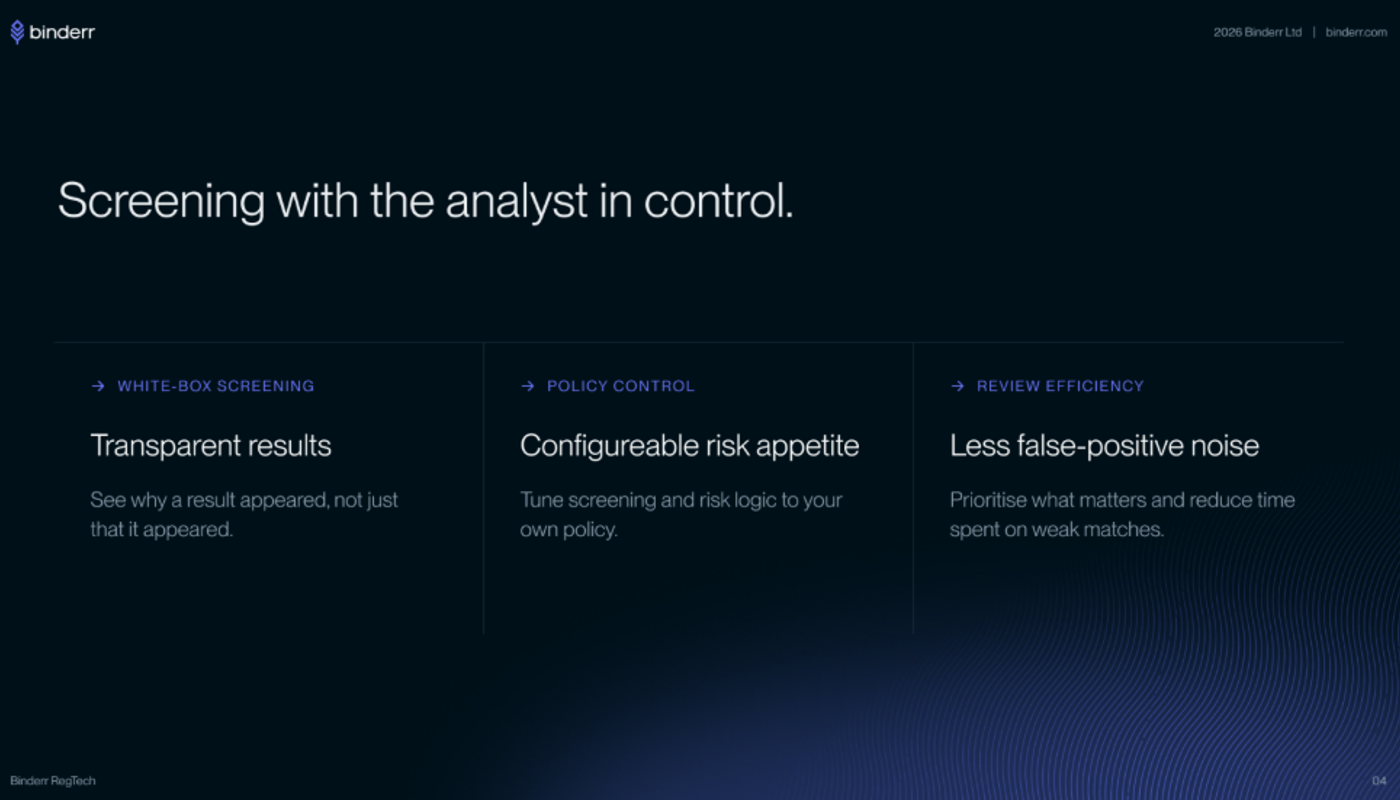
(Binderr gives compliance analysts transparent screening results, configurable risk controls, and clearer review priorities.)
How to Build a Digital Onboarding Strategy
Design a seamless digital onboarding strategy that balances speed, security, and onboarding compliance in customer onboarding financial services.
Learn how to structure an effective digital customer onboarding process using digital onboarding KYC, AML screening, identity verification, and risk-based workflows.
Define the customer and product scope
Defining the customer and product scope is a key step in building an effective digital onboarding strategy. Financial institutions should identify target customer types, such as retail customers, business owners, investors, or high-net-worth individuals, and the products they will use, including accounts, loans, or payment services. They should also consider jurisdictions, regulations, and onboarding channels like mobile or web. Aligning customer profiles with product complexity and compliance needs helps create onboarding workflows that balance user experience, risk, and onboarding compliance requirements.
Map regulatory requirements
Mapping regulatory requirements involves creating a compliance framework to ensure digital onboarding meets legal and supervisory obligations. Financial institutions should build a requirements matrix covering identity checks, address verification, AML screening, risk assessment, due diligence triggers, consent, record retention, and ongoing monitoring. It should also reflect local rules such as data protection and KYC laws. Aligning workflows with these requirements helps reduce risk, improve audit readiness, and maintain consistent onboarding compliance controls.
Map the customer journey
Mapping the customer journey helps create a smoother digital onboarding experience while maintaining onboarding compliance. Financial institutions should outline each step, from application to account activation, and identify issues like repeated data requests, delays, or unclear instructions. By analysing user behaviour, organisations can simplify workflows, improve usability, and reduce drop-offs, leading to better customer experience and higher conversion rates.
Segment customers by risk
Segmenting customers by risk is essential for a risk-based onboarding approach, allowing financial institutions to apply appropriate due diligence based on customer profiles, product use, and geography. Instead of a single process, organisations should create different onboarding paths for standard cases, additional checks, enhanced due diligence, manual review, and restricted applicants. This helps low-risk customers onboard quickly while ensuring higher-risk individuals undergo stricter verification. It also supports AML and digital onboarding KYC compliance, improves fraud detection, and uses compliance resources more efficiently.
Select verification and screening controls
Selecting the right verification and screening controls is essential for a secure and compliant digital onboarding process. Financial institutions should base their choices on actual risk, using tools like identity document checks, biometrics, liveness detection, AML screening, and device intelligence. Instead of adding multiple tools without purpose, organisations should adopt a layered approach aligned with risk and regulations. Integrating these controls into one workflow helps improve fraud prevention, decision accuracy, and overall customer experience.
Try FREE AI-powered AML screening with Binderr
Design exception and fallback journeys
Designing exception and fallback journeys is essential for resilient digital onboarding, ensuring legitimate users are not excluded. Financial institutions should offer alternative verification methods such as manual review, assisted onboarding, or database checks for customers without supported documents or who fail biometric checks. Accessibility features and low-bandwidth options can support users with limited connectivity. For uncertain AML matches or non-standard addresses, workflows should trigger enhanced due diligence or analyst review to maintain onboarding compliance while keeping the process smooth.
Integrate systems and data flows
Integrating systems and data flows helps prevent fragmented customer records and ensures a unified view across onboarding, KYC, AML, fraud detection, and core banking. API integrations and centralised data enable consistent verification, real-time risk scoring, and accurate profiles, reducing duplication. A connected system improves decision-making, audit trails, and compliance by giving all teams access to the same up-to-date information.
Customer screening should connect with the institution’s wider technology stack rather than operate as an isolated compliance task. Binderr supports API-based integrations and connections through Zapier, allowing onboarding and compliance information to flow between CRM platforms, document systems, spreadsheets, operational tools, and reporting workflows.
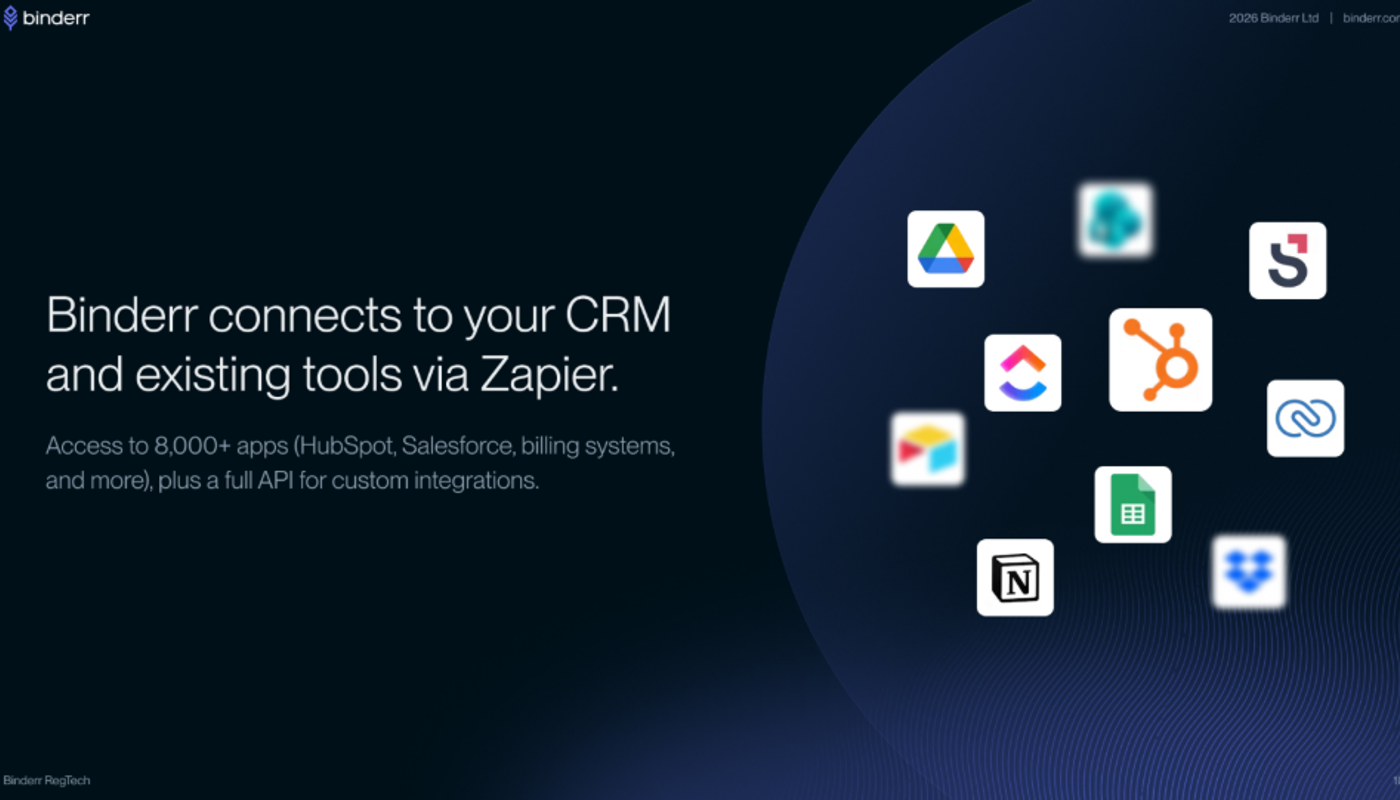
(Binderr can connect digital onboarding and compliance workflows with existing CRM and operational systems.)
Test before launch
Comprehensive testing before launch ensures digital onboarding systems work reliably. Institutions should test across different documents, regions, devices, and network conditions, while including fraud scenarios like synthetic identities and deepfakes. They should also check false positives, manual reviews, system resilience, and data handling to maintain compliance and a smooth customer experience.
Establish governance and ownership
Establishing clear governance and ownership is essential for accountability and compliance in digital onboarding. Responsibilities should be defined across key teams, including compliance, fraud, operations, and security. A structured framework helps ensure consistent policies, effective risk management, and alignment with regulatory requirements.
Monitor and improve the workflow
Continuous monitoring and improvement of the onboarding workflow help institutions adapt to changing fraud risks, regulations, and customer expectations. By analysing customer behaviour, verification outcomes, fraud data, and feedback, organisations can identify gaps and improve efficiency. Using performance metrics and audit insights supports ongoing optimisation while maintaining compliance and effective risk management.
Advanced KYC & AML Features for Fraud Prevention with Binderr
Binderr provides powerful tools to strengthen onboarding security:
- AI-powered identity verification across 230+ countries
- Biometric face matching and liveness detection
- Deepfake detection and fraud signal analysis
- AML screening across sanctions, PEPs, and adverse media
- Support for complex entities and ownership structures
Common Digital Onboarding Mistakes
Even the most advanced digital customer onboarding processes can fail without the right balance of compliance, user experience, and fraud prevention.
Understanding common digital onboarding mistakes helps financial institutions improve KYC workflows, reduce onboarding friction, and strengthen AML compliance.
Digitising an inefficient manual process
Problem: Simply transferring paper-based workflows into digital customer onboarding systems often results in the same inefficiencies, including long forms, repeated data entry, and slow approvals. This approach fails to improve the customer experience and can increase onboarding abandonment rates.
Solution: Redesign the digital onboarding process using automation, data reuse, and risk-based workflows. Streamline forms, eliminate redundant steps, and use intelligent onboarding software to create a faster, more efficient financial services customer onboarding journey.
Treating every customer as equally risky
Problem: Applying the same level of KYC checks and verification steps to all customers can create unnecessary friction for low-risk users while failing to adequately assess high-risk individuals. This reduces onboarding conversion rates and weakens risk management.
Solution: Implement risk-based digital onboarding by segmenting customers according to risk profiles. Use dynamic workflows that adjust KYC verification, AML screening, and enhanced due diligence requirements based on customer risk levels.
Focusing only on identity documents
Problem: Relying solely on identity document verification in digital onboarding does not confirm that the applicant is the legitimate owner of the identity or that the account will be used appropriately. This increases exposure to identity fraud and synthetic identities.
Solution: Strengthen digital KYC onboarding by combining document verification with biometric authentication, liveness detection, database checks, behavioural analysis, device intelligence, and AML screening to create a layered fraud prevention strategy.
Automating without effective escalation
Problem: Fully automated customer onboarding systems can generate uncertain outcomes, false positives, or unresolved AML screening alerts without proper escalation paths. This can lead to compliance gaps or incorrect decisions.
Solution: Build automated onboarding workflows with clear manual review and compliance escalation processes. Ensure that high-risk or ambiguous cases are routed to trained analysts for further investigation and decision-making.
Ignoring deepfake and injection attacks
Problem: Basic facial recognition and selfie verification methods in digital onboarding may be vulnerable to deepfake attacks, replay attacks, or injected media, increasing the risk of fraudulent account opening.
Solution: Enhance fraud detection by integrating advanced liveness detection, deepfake detection, and injection attack prevention technologies. Combine these with device intelligence and behavioural signals to strengthen identity verification.
Poor third-party oversight
Problem: Financial institutions may depend on digital onboarding providers without fully assessing their accuracy, compliance capabilities, data security, or geographic coverage. This can introduce regulatory and operational risks.
Solution: Conduct thorough vendor due diligence when selecting digital onboarding solutions. Evaluate identity verification accuracy, AML screening capabilities, data protection standards, and service reliability, and maintain ongoing monitoring and contractual oversight.
Failing to monitor after approval
Problem: Treating digital customer onboarding as a one-time process ignores the fact that customer risk profiles can change over time. Fraudulent or synthetic identities may remain dormant before engaging in suspicious activity.
Solution: Integrate onboarding data with ongoing monitoring systems, including continuous AML screening, transaction monitoring, and behavioural analysis. This ensures that financial institutions maintain compliance and detect emerging risks throughout the customer lifecycle.
Binderr: Complete Compliance Solution for Digital Onboarding
Binderr offers a unified compliance platform covering:
- KYC (identity verification) process
- KYB (business verification) checks
- AML screening and monitoring tools
- Dynamic risk assessment models
- CDD and EDD workflows automation
- UBO identification and ownership mapping
Bottom Line
Digital customer onboarding is essential for balancing customer experience, fraud prevention, and regulatory compliance. By using risk-based workflows, financial institutions can automate low-risk applications while applying stronger checks where needed, supporting both efficiency and control.
Binderr Compliance helps financial institutions create connected onboarding workflows for identity verification, AML screening, customer risk assessment, due diligence, and ongoing monitoring.