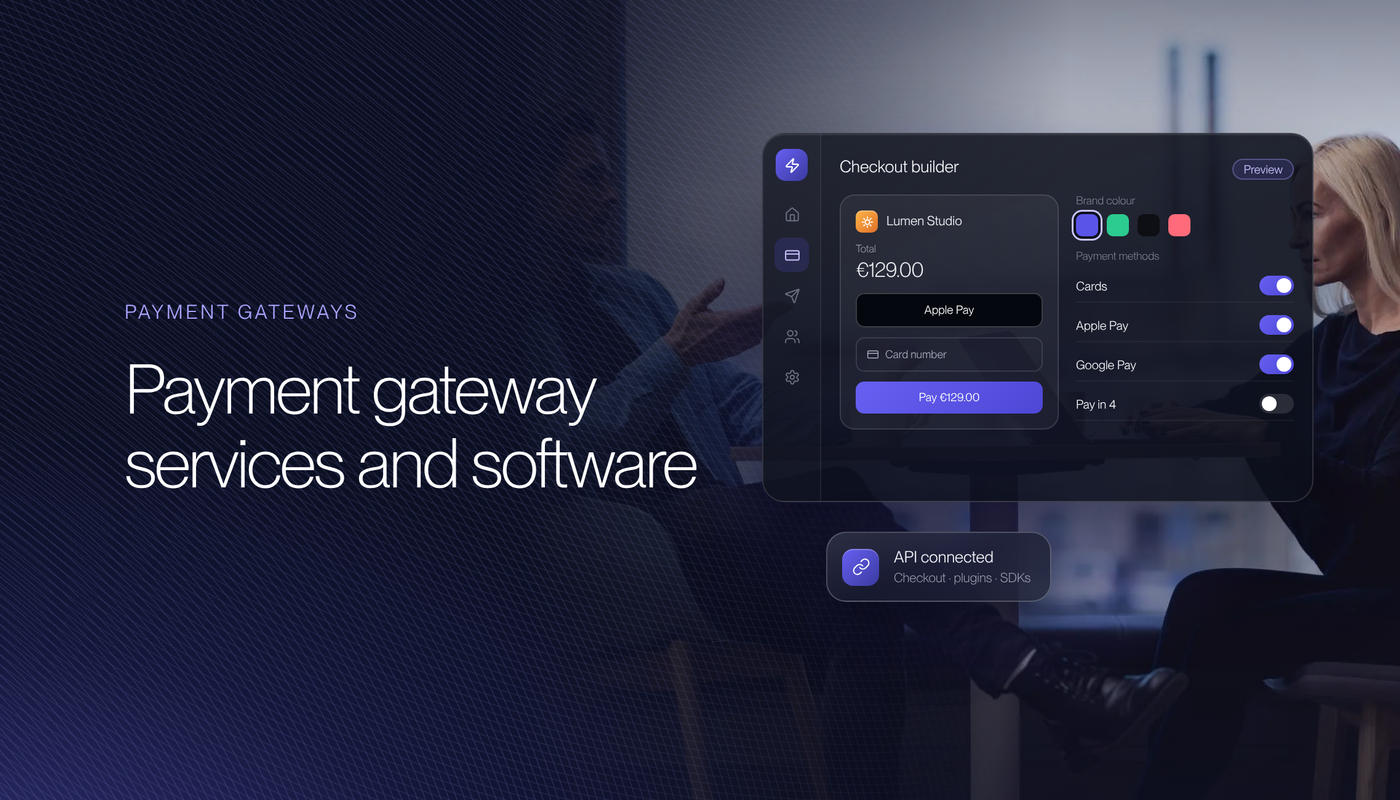
Good payment gateway services let your business take cards, wallets and bank payments online, in several currencies, from customers anywhere. The right payment gateway software checks each payment, blocks fraud before it costs you, pays the money out to your account and plugs into Shopify, WooCommerce or your own code.
The hard part is the paperwork and the pricing. Every provider runs its own underwriting, asks for its own documents and can decline a new company without saying why. Published rates rarely match what you pay once fixed fees, currency conversion, disputes and monthly charges reach the statement.
This is where we come in. We work with regulated payment partners and do the setup with you: the application, the KYC pack, the website checks card schemes look for and the integration plan. You get one team, clear pricing and an answer in about a day. Tell us how you sell, and we get your payments live.

What Is Payment Gateway Software
Payment gateway software is the technology that collects a customer's card or wallet details at checkout, protects them, sends them for approval and returns the answer to your site while the customer waits. Payment gateway services are the same technology run for you by a provider, usually together with the account that receives the money.
Payment Gateway Software vs Payment Gateway Services
Payment gateway software is the code itself. A payment company can license it, host it and run a gateway for other merchants. That route needs developers, a full security assessment and, in the EU, usually a payment licence. It suits founders who want to become a provider, such as the team behind a payment processing company.
Payment gateway services are what almost every online seller buys. The provider runs the software, keeps it certified, adds payment methods and pays out your sales. You connect through a plugin or an API and pay per transaction. For a shop, a SaaS product or a marketplace, that is faster, cheaper and safer than running gateway software yourself.
What a Payment Gateway Platform Does in Each Payment
The gateway captures the card details on a secure form and replaces the card number with a token. It runs fraud checks and, in Europe and the UK, the 3D Secure step that strong customer authentication requires. It sends the request to the acquiring bank, which passes it through Visa or Mastercard to the issuing bank. The answer comes back in seconds, and approved payments are settled to your account on your payout schedule. Our guide to how a payment gateway works follows each step.
Where the Gateway Ends and the Merchant Account Begins
The gateway is the technology layer, the merchant account receives card funds for you, and the processor moves the data between the parties. Many modern payment gateway solutions sell all three as one product, with one contract and one dashboard. For the full breakdown, read our guide to the gateway, the merchant account and the processor.
Set Up Payment Gateway Services for Your Business
Getting payment gateway services live is quick when the file is right. We match you with a regulated partner and handle the setup with you.
- Fast approval: Preliminary approval in about one day after a five minute assessment.
- KYC pack prepared: We tell you what is needed and build the file with you.
- Website checked first: We review your checkout against card scheme rules before you apply.
- No fixed costs: No setup, monthly or minimum fees on standard accounts.
- One contact: The same team from the application to your first live payment.
Types of Payment Gateway Solutions
There are four types of payment gateway solutions: hosted payment pages, embedded checkout fields, direct API integration and self-hosted software. They differ in who touches the card data, how much PCI DSS work falls on you and how much control you get over the checkout. Most online sellers need one of the first two.
Hosted Payment Pages
A hosted page sends the customer to a checkout page run by the provider, then back to your site. Card data never touches your systems, so you normally complete SAQ A, the shortest PCI DSS self assessment. Setup often takes hours through a plugin. The trade off is design control, and the redirect adds one more step for the customer.
Embedded Checkout Fields
Embedded fields keep the customer on your page. The card fields load from the provider inside an iframe, so the card number still goes straight to the provider. This gives you a branded checkout with a light compliance load. Since the PCI Security Standards Council revised SAQ A in January 2025, you must also confirm that your site is not open to attacks from scripts, so control which scripts run on your checkout page.
Checkout design has a real cost. Baymard Institute puts average cart abandonment at 70.22%, and 19% of shoppers who left for a reason did not trust the site with their card. A clean embedded checkout helps.
Direct API Integration
With a direct API, your own form or scripts collect the card details. You control every step, but compliance grows: when your scripts build the payment form you move to SAQ A-EP, and when card data passes through your servers you fall under SAQ D, the full standard. Large platforms with security teams choose this route. Most businesses get enough flexibility from embedded fields.
Self-Hosted and White-Label Payment Gateway Software
Self-hosted payment gateway software is for companies that sell payments to other merchants. You license or build it, run it on your own infrastructure and connect to acquirers. You need a full PCI DSS assessment as a service provider and, in the EU, usually authorisation as a payment institution. Our guides to a Malta payment gateway company and a Cyprus payment institution licence set out that route.
Type | Who handles card data | Usual PCI questionnaire | Setup effort | Best for |
|---|---|---|---|---|
Hosted payment page | The provider, on its own page | SAQ A | Hours, often a plugin | New shops and simple catalogues |
Embedded fields | The provider, inside your page | SAQ A, if your site is protected from script attacks | Days | Brands that want checkout on their own site |
Direct API with your own form | Your scripts or servers | SAQ A-EP or SAQ D | Weeks of development | Large platforms with security teams |
Self-hosted software | You | Full assessment as a service provider | Months, plus licensing | Payment companies building a gateway |
Most businesses choose between the first two rows: a hosted page to go live this week, embedded fields when checkout design starts to cost you sales. Our guide to hosted and third-party gateways compares the first two.
Payment Gateway Platform Features That Matter
The features that change your revenue on a payment gateway platform are tokenisation, smart use of 3D Secure, the right local payment methods, fraud tools and clean payout reporting. Each one raises approvals, cuts fraud or saves admin time. A long feature list matters less than how well these five work.
Tokenisation and Network Tokens
A token replaces the card number in your systems, so a breach exposes nothing usable. Network tokens, issued by Visa or Mastercard, also update when the customer's card is replaced. Visa reports a 4.6% lift in card-not-present approval rates globally for network tokens compared with plain card numbers, and 30% less online fraud. Ask whether network tokens and automatic card updates are included. They matter most for subscription payment gateways.
3D Secure and SCA Exemptions
In the EEA and the UK, strong customer authentication applies to most online card payments. Delegated Regulation (EU) 2018/389 sets exemptions. Payments up to €30 can skip the check until five in a row, or €100 in total, have passed since the last one. Transaction risk analysis lets a provider skip it up to €100, €250 or €500 if its fraud rate stays under 0.13%, 0.06% or 0.01%. Good software applies these for you, but with an exemption the fraud risk usually stays with you, so solid fraud tools must sit behind it.
Local Payment Methods and Wallets
Worldpay's Global Payments Report 2026 found that digital wallets made up 56% of global ecommerce value in 2025. Markets differ: cards were 46% of UK online spending and buy now pay later held 18% of German ecommerce. If you sell abroad, check that your provider covers the methods your buyers use. Our guide to multi-currency payment gateways covers currencies and local methods together.
Fraud Tools and Chargeback Data
Basic fraud tools check the address, the security code and the 3D Secure result. Stronger ones score each payment on device data and past behaviour, and let you set your own rules. You also need clear dispute data, because the card schemes judge you on your ratios. Our guide to payment gateway fraud detection explains the rule types.
Reporting, Payouts and Reconciliation
Check how often the provider pays out, in which currencies, and whether fees are shown per transaction. Settling euros, pounds and dollars into a multi-currency business account avoids paying for conversion twice, and predictable payouts make cash flow management for ecommerce far easier. Our guide to banking for ecommerce businesses shows how the gateway and the account work together.
Get a Payment Gateway Solution That Fits Your Checkout
The right payment gateway solution depends on how you sell. We look at your store, your markets and your products, then set up the partner that fits.
- Matched to your model: A regulated partner that accepts your products and markets.
- Integration plan: We map your store or app and the cleanest way to connect it.
- Fewer review rounds: We close gaps in the file before the partner sees it.
- Clear card pricing: 1.29% + €0.10 on EEA consumer cards, nothing per month.
- Support as you grow: The same contact when you add markets or methods.
Payment Gateway Services Pricing in 2026
Payment gateway services are priced in two main ways: a flat rate per transaction, or Interchange++, where you pay the card's interchange and scheme fees at cost plus a markup. Flat rates are simpler and suit smaller businesses. Plan fees, currency conversion, disputes and platform surcharges come on top of either model.
Flat Rate Pricing
A flat rate charges one percentage plus one fixed fee per payment. Stripe's published Ireland pricing is 1.5% + €0.25 for standard EEA cards, 2.8% + €0.25 for premium EEA cards and 3.15% + €0.25 for international cards, plus 2% when currency conversion is needed. In the UK, Stripe charges 1.5% + 20p for standard UK cards. PayPal's UK rate for standard commercial payments is 2.9% + £0.30, with 1.29% added for EEA buyers and 1.99% for buyers elsewhere.
Our gateway partner's published rates are 1.29% + €0.10 on EEA consumer cards and 2.69% + €0.10 on other cards, with no setup, monthly or minimum fees. The lower fixed fee matters more than it looks, as the second table shows.
Interchange++ Pricing
Interchange++ splits the price into three parts. Interchange goes to the card issuer and is capped in the EU at 0.2% for consumer debit and 0.3% for consumer credit cards under Regulation (EU) 2015/751. Scheme fees go to Visa or Mastercard, and the markup is the provider's margin. Adyen publishes its Visa and Mastercard price as interchange plus 0.60% plus a US$0.13 processing fee, with no setup or monthly fees, but it sets a minimum invoice by industry.
The model rewards scale. On consumer EEA cards Interchange++ usually beats a flat rate once card volume passes about GBP 70,000 a month, a flip point we work through in our guide to the best payment gateways. Below that, minimum invoices and complex statements cancel out the saving.
Monthly, Platform and Hidden Fees
Shopify's UK plans cost £25 to £344 a month on monthly billing, and Shopify adds its own fee when you use a third-party gateway: 2% on Basic, 1% on Grow, 0.6% on Advanced and 0.2% on Plus. Dispute fees add up too: €20 per dispute at Stripe and £14 per card chargeback at PayPal UK, whose conversion spread is 3% above its base rate.
Provider | Pricing model | Published card rate | Other published fees |
|---|---|---|---|
Stripe (Ireland) | Flat rate | 1.5% + €0.25 standard EEA cards, 3.15% + €0.25 international | 2% currency conversion, €20 per dispute, no monthly fee |
Stripe (UK) | Flat rate | 1.5% + 20p standard UK cards, 2.5% + 20p EEA cards | 2% currency conversion, £20 per dispute, no monthly fee |
Adyen | Interchange++ | Interchange + 0.60% + US$0.13 for Visa and Mastercard | No setup or monthly fee, minimum invoice by industry |
PayPal (UK) | Flat rate | 2.9% + £0.30 standard commercial payments | 1.29% EEA or 1.99% other surcharge, 3% conversion spread |
Shopify Payments (UK) | Flat rate inside a plan | 2% + 25p on Basic to 1.3% + 25p on Plus | Plan fee £25 to £344 a month, 0.2% to 2% fee on third-party gateways |
These are market comparators, not a ranking. Currency conversion, dispute fees and platform surcharges often add more than the gap between two headline rates, so compare the full cost for your own sales mix.
Average sale | 1.5% + €0.25 | 1.29% + €0.10 | Saving on 1,000 sales |
|---|---|---|---|
€10 | 4.00% effective | 2.29% effective | €171 |
€25 | 2.50% effective | 1.69% effective | €202.50 |
€50 | 2.00% effective | 1.49% effective | €255 |
€100 | 1.75% effective | 1.39% effective | €360 |
€250 | 1.60% effective | 1.33% effective | €675 |
The fixed fee drives the real rate on small sales. At a €10 average sale, a €0.25 fixed fee adds 2.5 points, taking a 1.5% headline rate to 4%. Work out your effective rate before you sign anything.
Read more: how credit card payment gateways work.
Best Payment Gateway Software by Business Type
The best payment gateway software is the one built for how you sell, not the one with the lowest headline rate. A small shop needs a hosted page and no monthly fee, a subscription business needs tokens and retries, a marketplace needs split payouts and an international seller needs local methods.
Startups and Small Online Shops
For a new shop, the best payment gateway solution has no monthly fee, no minimum volume and a plugin for your store platform. Watch the fixed fee if your average sale is under €25. Our guide to payment gateways for small businesses goes deeper on store setups.
Subscription and SaaS Businesses
You need network tokens, automatic card updates, smart retries and correct SCA handling: the customer authenticates the first payment, and renewals run as merchant-initiated payments. The best payment gateway platform for this model also handles trials and dunning emails. Our SaaS payment gateway guide covers billing logic.
Marketplaces and Platforms
A marketplace takes money from buyers and pays many sellers, so it needs split payments, seller verification and delayed payouts. Ask who carries the seller KYC and how refunds flow back. Our guide to choosing a marketplace payment gateway sets out the models.
International Sellers
Selling abroad adds cross-border card rates, currency conversion and lower approval rates. Stripe's international rate of 3.15% + €0.25, plus 2% for conversion, shows the gap against 1.5% for standard EEA cards. Local acquiring and local methods close most of it. Our international payment gateways guide explains local acquiring.
High Risk Industries
Our standard gateway partner does not take cannabis, crypto, adult, arms or chemicals, and most mainstream platforms decline them too. These sectors need a partner that underwrites them, with reserves and different pricing. We arrange that through a separate route, set out in our guide to setting up a high risk payment gateway.
Business type | What to look for | Pricing model that usually fits |
|---|---|---|
New online shop | Plugin, hosted or embedded checkout, no monthly fee | Flat rate with a low fixed fee |
Subscription or SaaS | Network tokens, card updater, smart retries | Flat rate, then Interchange++ at scale |
Marketplace | Split payments, seller KYC, delayed payouts | Flat rate or custom, priced on scope |
International seller | Local acquiring, local methods, multi-currency payouts | Interchange++ once volume allows |
High risk sector | A partner that accepts the sector | Custom pricing with reserves |
Most businesses fit one row today and another in two years. The best payment gateway solutions let you add currencies or move to Interchange++ without a new integration, because switching later costs developer time and can break saved card tokens.
Read more: getting a payment gateway in the UAE and getting a payment gateway in Cyprus.
Get the Best Payment Gateway Services for Your Model
The best payment gateway services are the ones that accept your business and fit your checkout. We set that up with you from the first form.
- Built around your sales: One-off sales, subscriptions or seller payouts.
- Category checked first: We confirm your products are accepted before you apply.
- Right route for high risk: Restricted sectors go to a partner that accepts them.
- Low cost per sale: 2.69% + €0.10 on non-EEA cards, 1.29% + €0.10 on EEA consumer cards.
- Start small: No minimum volume, so a new company can apply.
How Top Payment Gateway Platforms in 2026 Approve Merchants
Top payment gateway platforms in 2026 approve a merchant after checking the company, its owners, its website and what it sells. A complete file with a compliant website is approved in days. Most declines come from gaps you can fix before you apply, such as a missing policy or documents that do not match.
What Underwriting Checks
Underwriters ask for company documents, ID and proof of address for directors and beneficial owners, a business bank account in the company's name, your website, expected volume and average sale, and any past processing statements. New companies are accepted every day, but the website and the business model then carry more weight. Our online payment gateway setup guide lists the full file.
Website Rules Card Schemes Enforce
Card schemes expect certain items on every website that takes cards. Show your legal or trading name on every page, and the statement descriptor customers will see. Publish your refund policy in full and link it at checkout. Give a business address and a phone number or email. Show price and currency next to the add to cart button, display card logos and run the site over TLS. Subscription sellers must show the price and billing cycle above the pay button and offer an easy way to cancel.
Chargeback Ratios After Go-Live
Visa's Acquirer Monitoring Program counts fraud reports and disputes against settled card-not-present transactions. From 1 April 2026, a merchant in the US, Canada, the EU or Asia Pacific is flagged as excessive at a ratio of 1.5% or more, with at least 1,500 fraud reports and disputes a month. Above that, fees and remedial plans follow, and a terminated account can land on Mastercard's MATCH list.
Why New Companies Get Declined
The common reasons are simple: an unfinished website or no refund policy, a vague product description, a bank account in a director's name, a volume forecast far above what a new business can show, or a restricted product. Every one can be fixed before submission, which is why we check the file first.
Read more: opening a business bank account as a non-resident.
How to Integrate Payment Gateway Software
You integrate payment gateway software through a plugin, a hosted page link or an API. A plugin on a standard store is usually live the same day once the account is ready. A custom API build takes longer and depends on your developers. Every route should be tested in the provider's sandbox before the first live payment.
Ecommerce Plugins and Shopify
Most store platforms connect through a ready plugin: install it, paste your keys and switch on the methods you want. On Shopify, include Shopify's third-party fee in the cost. Our guide on how to add a payment gateway to your website covers each platform step by step.
API Integration and Testing
With an API, your developers create payments from your server, receive results through webhooks and handle 3D Secure in the browser or app. Test approved and declined cards, 3D Secure flows, refunds and duplicate requests before launch, and log every webhook so orders and payments always match.
Go-Live Timeline
Stage | Typical time | What happens |
|---|---|---|
Assessment | About 5 minutes | You tell us how you sell, where and roughly how much |
Preliminary approval | About 1 day | The partner reviews the business, the owners and the website |
Documents and KYC | Same week | We build the KYC pack and close any gaps |
Account provisioning | About 3 days | Live credentials and dashboard access are issued |
Integration | Hours for a plugin, longer for custom API work | You connect, test in the sandbox and switch to live |
For a standard store with a complete file, the whole process fits inside a week. Prepare plugin or developer access while the application is in review.
Set Up Your Payment Gateway Platform in Days
Your payment gateway platform can be live within a week when the file and the website are ready. We keep each stage moving.
- Five minute start: A short assessment tells us your model and markets.
- Approval in about a day: Preliminary approval follows the assessment.
- Live in about three days: Provisioning follows approval on a complete file.
- Application ready: Documents, website and policies checked before submission.
- Apply once: One application through us instead of rounds of forms.
Common Payment Gateway Software Mistakes
The costly mistakes with payment gateway software are choosing on headline rate, paying platform fees twice, taking card data onto your own servers and ignoring chargeback ratios. Each one has a clear fix that costs little when you plan for it at setup.
Choosing on the Headline Rate Only
Many sellers compare the percentage and ignore the fixed fee. On a €10 average sale, 1.5% + €0.25 is really 4% of each payment, while 1.29% + €0.10 is 2.29%. On 1,000 sales a month that gap is €171, or more than €2,000 a year. Work out your effective rate and compare the totals. The cheapest headline rate is often not the cheapest deal.
Paying Twice on Shopify
A Shopify store on the Basic plan that uses a third-party gateway pays Shopify's 2% fee on top of the gateway's own rate. On €20,000 of monthly sales, that is €400 a month, or €4,800 a year, for nothing extra. Compare the total with Shopify Payments on your plan before you connect another provider. On Advanced the surcharge falls to 0.6%, and on Plus to 0.2%.
Taking Card Data Onto Your Own Servers
Some businesses build their own card form for the design. Once card data passes through your servers, you move from SAQ A to SAQ D, the full PCI DSS standard. That brings security testing, policies and assessments that cost far more than the design gain. Embedded fields give you a branded checkout while the card number goes straight to the provider.
Ignoring Chargeback Ratios Until a Warning
Disputes cost money before they cost the account. At €20 per dispute received, 100 disputes cost €2,000 in fees alone, plus the goods and the refunded sale. Track your ratio weekly against Visa's 1.5% threshold, use a clear statement descriptor, answer customer emails fast and refund before a dispute is filed.
Get Payment Gateway Solutions Set Up for You
Whatever you sell, there is a payment gateway solution that fits. Send us your details and we come back with the route and the next step.
- Regulated partners: Licensed payment partners that settle to your business account.
- Standard and high risk: Each sector goes to a partner that accepts it.
- Transparent costs: Published per-sale rates, no setup or monthly fees on standard accounts.
- Company first if needed: We can form the company before the payment setup.
- We handle the paperwork: KYC pack, policies and website checks done with you.
Bottom Line
Most businesses do not need to run payment gateway software. They need payment gateway services that accept their sector, keep PCI work light and cost little per sale. Compare the full cost for your average sale, not the headline rate. A hosted or embedded checkout on a flat rate suits most new sellers, and Interchange++ makes sense once volume is high. With a complete file, you can be live in about a week.
Your situation | What to do | Why |
|---|---|---|
New online shop | Start with a hosted or embedded payment gateway solution on a flat rate | No monthly fee, light PCI work, live in days |
Average sale under €25 | Choose the lowest fixed fee per sale | The fixed fee adds 1 to 2.5 points at that size |
Subscription or SaaS | Pick software with network tokens and card updates | Fewer failed renewals and less fraud |
Card volume above about GBP 70,000 a month | Ask for an Interchange++ quote | The markup becomes the main cost you can negotiate |
Cannabis, crypto, adult, arms or chemicals | Use the high risk route | Standard gateway partners decline these sectors |
No company yet | Form the company first | Every gateway contracts with a legal entity |
Pick the row that matches you today and plan for the next one. If two rows apply, the stricter one decides, so a high risk product needs the high risk route even at small volume.
What is payment gateway software?
What is the difference between payment gateway software and payment gateway services?
How much do payment gateway services cost in 2026?
What are the top payment gateway platforms in 2026?
Is flat rate or Interchange++ pricing better?
What are the best payment gateway solutions for a new online store?
Can I build my own payment gateway software?
What features should the best payment gateway platform have?
How long does it take to get approved for payment gateway services?
Do I need a company before I can get a payment gateway?
Can a non-resident company use payment gateway services in Europe?
What PCI DSS level do I need with a hosted payment gateway solution?
What happens if my chargeback ratio gets too high?
Sources
- Stripe, pricing for Ireland (standard EEA, premium and international card rates)
- Stripe, pricing for the United Kingdom
- Adyen, pricing (Interchange++ card pricing and processing fee)
- PayPal UK, merchant fees
- Shopify UK, plans, Shopify Payments rates and third-party transaction fees
- Regulation (EU) 2015/751 on interchange fees for card-based payment transactions
- Commission Delegated Regulation (EU) 2018/389, strong customer authentication RTS
- PCI Security Standards Council, guidance on e-commerce requirements effective after 31 March 2025
- Visa, tokenization (authorisation lift and fraud reduction)
- Visa, Visa Acquirer Monitoring Program fact sheet 2025
- Payment Expert, Worldpay Global Payments Report 2026 on digital wallets
- Baymard Institute, cart abandonment rate statistics