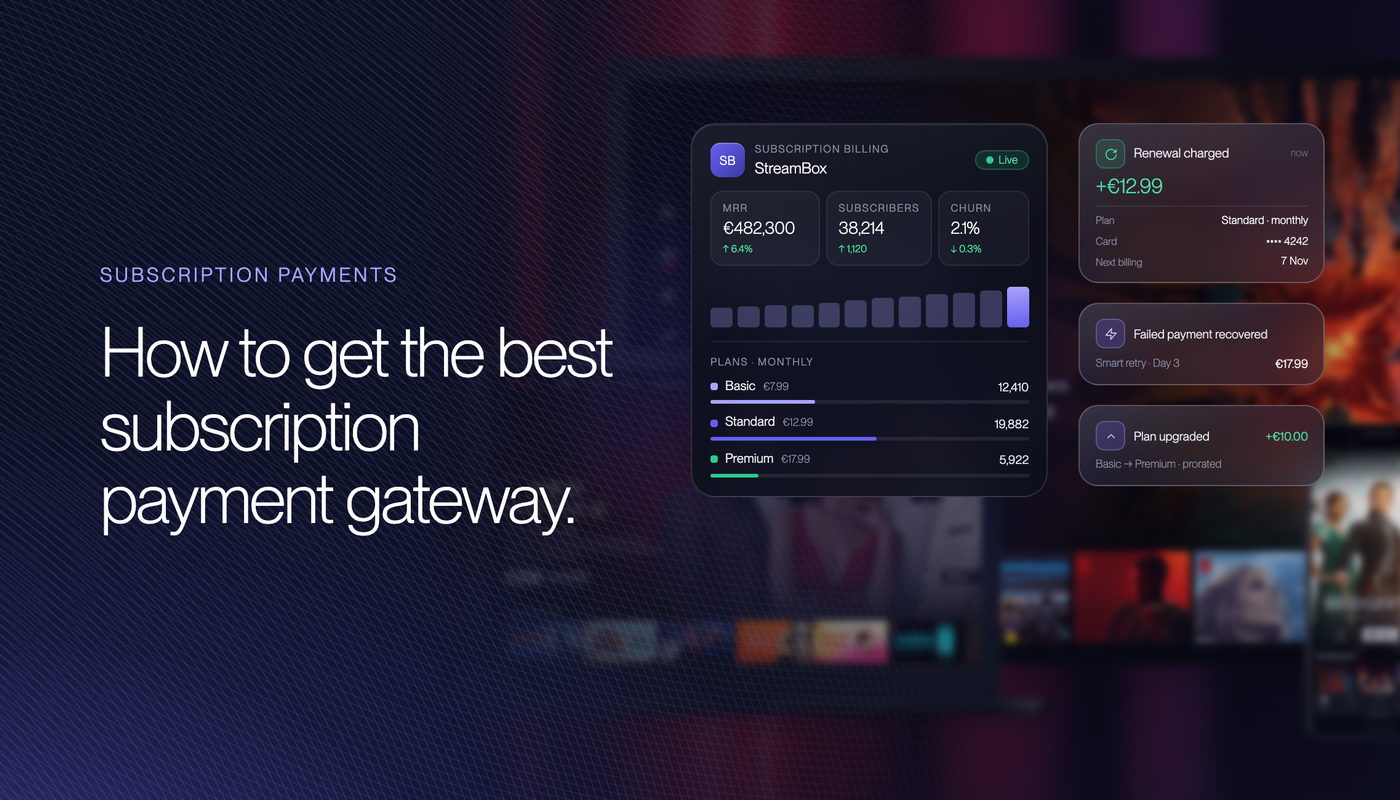
If you sell subscriptions, the hard part is rarely winning customers. It is keeping their payments working. Cards expire, banks decline renewals, and a customer who meant to stay quietly drops off because one charge failed. A good subscription payment gateway catches most of that before you ever notice it.
The trouble is that the rules sit in three places. Visa and Mastercard set rules on trials, reminders and retries. Consumer law in the US, the UK and the EU sets rules on how customers cancel. And your gateway decides how well stored cards, retries and card updates actually work, which most pricing pages never mention.
That is where we come in. Through one intake form, Binderr Chooses, we place you with a regulated partner that handles recurring billing properly, set up the merchant account and gateway, and run the application for you. Most businesses are taking payments within 5 to 7 business days.

What Is a Subscription Payment Gateway?
A subscription payment gateway is the payment setup that charges a customer on a schedule without them re-entering their card each time. It stores the card securely at sign-up, charges it on each renewal date, retries payments that fail, refreshes cards that expire, and tells your billing system what happened so access can be kept or paused.
What a Recurring Payment Gateway Does
A recurring payment gateway does five jobs a one-off checkout never has to. It captures the customer's consent to future charges at sign-up. It stores the card as a token rather than the card number. It charges each renewal without the customer present. It handles failed renewals with retries and card updates. And it records every charge against the original agreement, which is what you need when a customer disputes one.
Stored Credentials and Merchant-Initiated Payments
Card schemes split subscription payments into two types. The first payment, made while the customer is at your checkout, is customer-initiated and in Europe usually needs strong customer authentication. The renewals that follow are merchant-initiated, because you start them. Merchant-initiated payments sit outside strong customer authentication in the EEA and the UK, as long as the first payment was authenticated and flagged correctly as setting up a stored credential.
Getting that flag wrong is a common and expensive mistake. A renewal that is not marked as merchant-initiated can be sent for authentication the customer never sees, and it fails. Our guide to what a payment gateway is covers the basic payment flow underneath.
Payment Gateway for Subscriptions vs One-Off Checkout
A payment gateway for subscriptions is judged on different numbers from a normal checkout, and the provider underneath matters as much as the gateway itself, as our guide to payment gateway vs merchant account vs payment processor explains. Conversion at sign-up still matters, but the figure that decides revenue is how many renewals succeed month after month. A gateway that looks cheap on the first charge and loses a few percent of renewals to avoidable declines is the expensive one.
Get a Subscription Payment Gateway Set Up Properly
Recurring billing on a regulated partner that handles stored cards, retries and card updates the way the schemes require.
- Binderr Chooses: one intake form, and we place you with the right partner.
- Stored credentials flagged right: first payment and renewals set up correctly.
- Fast approval: a preliminary answer in about 1 business day.
- Card updater included: expired cards refreshed before renewals fail.
- Major currencies: settle in USD, EUR, GBP, CAD and more.
- KYC pack prepared: documents collected and checked before submission.
How Payment Gateway Recurring Billing Works
Payment gateway recurring billing follows the same cycle for every subscription, from sign-up to cancellation, whatever the plan or price. Each stage has a scheme rule or a legal requirement attached.
Stage | What happens | What the rules require |
|---|---|---|
Sign-up | Customer enters a card and agrees to future charges | Clear terms, express consent, authentication in Europe |
Trial or first charge | A zero amount check or the first payment | Trial length and later price shown at checkout |
Renewal | Merchant-initiated charge on the agreed date | Charge matches the agreed amount and interval |
Failed renewal | Retry, card update or customer reminder | Retry limits set by the card schemes |
Change or cancellation | Plan change, pause or cancel | Simple cancellation, online if signed up online |
Trials and Introductory Offers
Visa's rules require a merchant running recurring payments to show the length of any trial or introductory offer, the amount due today, and the amount and date or interval of each later charge before the customer pays. At least 7 days before a trial or introductory offer turns into a paid charge, the customer must be told by email or another agreed method, with the amount and a simple way to cancel.
In Europe, the same notice is required when more than 6 months have passed since the previous charge, or when the terms change, including the amount or the date. Build these reminders into the billing system rather than a marketing tool, so they cannot be switched off by accident.
Upgrades, Downgrades and Proration
Plan changes are where recurring charges most often stop matching what the customer agreed to. Upgrades mid-cycle usually charge the prorated difference immediately, and downgrades usually take effect at the next renewal. Show the new amount and date before the customer confirms, send a receipt straight after, and treat a price rise as a change of terms that needs notice. A charge that does not match the agreement is the easiest dispute a customer will ever win.
Subscription Models and Their Payment Needs
Not every subscription behaves the same way, and the right setup depends on how and when you charge. These are the common models and what each one needs from a payment gateway for subscriptions.
Fixed Monthly Plans
A monthly subscription payment gateway handles the most renewals per customer, twelve a year, so renewal success rate and card updates matter more than anything else. Keep the renewal date stable, send receipts every month and make the plan price obvious on the statement descriptor. Low monthly prices also make the fixed fee per charge a bigger share of revenue, which the cost section below works through.
Annual and Prepaid Plans
Annual plans renew once, so each failure is expensive and the customer has had a year to forget. Send a reminder before the renewal even where the rules do not require it, and expect more refund requests in the first days after the charge. Offer bank transfer or direct debit for business customers who prefer to pay by invoice.
Usage-Based and Metered Billing
Usage-based plans charge a different amount each period, so the customer's consent has to cover variable amounts and your receipts have to explain the charge. Card issuers are more likely to question an unusually large charge, so set clear limits and warn customers when usage spikes. Our guide to payment gateways for digital products covers low-value digital billing.
Subscription Boxes and Physical Goods
Box subscriptions add shipping, stock and delivery disputes to recurring billing. Charge on a fixed date, ship promptly and keep tracking data, because item-not-received disputes are the main risk. Our guide to ecommerce payment gateways covers the store side of the setup.
Memberships, Content and Games
Content memberships, communities and in-game passes sell access rather than goods, so disputes usually come from customers who forgot they were subscribed. Clear descriptors and reminders do most of the work. Our guide to payment gateways for video games and online gaming covers passes and in-game subscriptions.
Failed Payments and Involuntary Churn
Involuntary churn is the customer who wanted to stay but whose payment failed. It is the most fixable loss in any subscription business, and it is where subscription payment gateways differ most. Payment gateway recurring billing tools that combine retries, updates and prompts recover a large share of failed renewals automatically.
Why Renewals Fail
Renewals fail for a short list of reasons: expired cards, replaced cards after a loss or fraud alert, insufficient funds on the renewal date, issuer fraud rules that dislike a charge with no customer present, and technical errors. The first two are solved by card updates. The rest are solved by retrying at the right time, the right number of times.
Visa Retry Limits
Visa sorts decline codes into categories, and each has a retry limit. Codes that mean the issuer will never approve, such as a lost or stolen card, a closed account or a transaction the cardholder is not permitted to make, must never be retried on the same card. Codes that mean the issuer cannot approve right now, such as insufficient funds, can be retried up to 20 times in 30 days. Retries must not change the original data, such as the merchant category or country, to get a different answer.
Smart retry logic in your payment gateway recurring billing setup reads the code, waits for a sensible moment such as a likely payday, and stops when the code says stop. A recurring payment gateway with smart retries built in saves you writing this logic yourself. Do not resend a declined renewal through a different acquirer, merchant category or country to get a different answer: Visa treats that as manipulating the transaction. Routing each first attempt to the acquirer most likely to approve it is a separate and permitted technique, covered in our guide to how smart routing and payment orchestration work. Blind retries every few hours waste attempts, annoy issuers and can breach the scheme limits. Read more: how to improve payment gateway success rates.
Card Updaters and Network Tokens
Card updater services, Visa Account Updater and Mastercard Automatic Billing Updater, send your provider new card details when a bank reissues a card. Network tokens go further: the card network keeps the token current even when the card number changes, so the renewal simply works. Tokens also keep real card numbers off your systems, which our guide to payment gateway security features explains. A recurring billing payment gateway that supports both recovers renewals that would otherwise fail on the first attempt.
Dunning Emails and In-App Prompts
When a renewal still fails after retries and updates, ask the customer. Send a short email with a direct link to update the card, show a banner in the product, and keep access for a few days while they fix it. Most customers who fail a payment did not mean to leave, and a clear prompt brings many of them back. On a monthly subscription payment gateway, finish the retries and reminders well before the next renewal date, so two unpaid charges never stack up on the same card.
A Recurring Billing Payment Gateway That Recovers Renewals
Fewer failed renewals through retries, card updates and network tokens set up by default.
- Smart retries: decline codes read, scheme limits respected.
- Card updater and tokens: new card details applied before the renewal date.
- Renewal success reporting: failure reasons by card type and country.
- Chargeback alerts: refund before a dispute counts against you.
- Regulated partners only: licensed acquirers and payment institutions.
Cancellation Rules in the US, UK and EU
Consumer law decides how customers leave, and it is tightening. No online subscription payment gateway makes you compliant on its own, but yours has to support the cancellation and notice flows the law now expects.
United States
The Restore Online Shoppers' Confidence Act requires online sellers to disclose all material terms before taking billing details, get the customer's express consent, and provide a simple way to stop recurring charges. The Federal Trade Commission's broader click-to-cancel rule was vacated by the Eighth Circuit in 2025, and the agency restarted the rulemaking in March 2026. Enforcement has not paused: Amazon agreed to pay USD 2.5 billion in 2025 to settle claims over its Prime sign-up and cancellation flows. Several states add their own automatic renewal laws on top.
United Kingdom
The Digital Markets, Competition and Consumers Act 2024 brings in a dedicated subscription regime, now expected in spring 2027 after two delays. It requires renewal reminder notices in writing on a durable medium such as email, a 14 day cooling-off period on renewal including after free trials, and cancellation through the same channel the customer used to sign up, such as a clearly labelled button or account page.
European Union
Since 19 June 2026, traders who sell online in the EU must offer a withdrawal function, a clearly labelled button that lets consumers use their 14 day right to withdraw from a distance contract as easily as they entered it. It sits alongside the card scheme rules on trials and notices, so your sign-up, reminder and cancellation flows need to meet both.
What a Subscription Payment Gateway Costs
Subscription payment gateways charge the same kind of fees as any card setup, plus a few lines specific to recurring billing. These are typical market ranges on the lower side for standard online businesses.
Cost item | Typical range |
|---|---|
Setup fee | Usually none |
Monthly fee | Often none |
Processing rate | 1.5% to 3.5% of each charge, lower on domestic EEA consumer cards |
Fee per transaction | USD 0.05 to USD 0.30 |
Card updater | Often included, sometimes a few cents per update |
Currency conversion | Around 1% to 2% when conversion is needed |
Chargeback fee | USD 15 to USD 25 per dispute |
Two things move a subscription business's real cost more than the rate. Business cards cost more than consumer cards in most markets and are not covered by the EU interchange caps, so a software company selling to other companies pays more interchange than one selling to consumers. And the fixed fee matters on low-priced plans: USD 0.30 on a USD 5 monthly plan is 6% of the charge before the percentage is added. On a monthly subscription payment gateway charging a common US online rate of 2.9% plus USD 0.30, a USD 20 plan pays USD 0.88 per renewal, an effective 4.4%, while a USD 100 plan pays USD 3.20, or 3.2%. Price your own plan mix before you compare offers.
Payment Gateway Subscription Tools vs Billing Platforms
Most providers include basic payment gateway subscription tools: plans, schedules, trials and simple invoices. They are enough for a single product with one or two prices. Many subscription businesses outgrow them and run a billing platform on top of the gateway to handle plans, invoices, tax and proration. That platform usually charges a separate percentage of revenue. It is worth it once your plans get complex, but check which retry, updater and token features sit in the gateway and which in the billing platform, so you do not pay twice or miss both. If you start on the built-in payment gateway subscription tools, check that you can export stored card tokens later, or moving to a billing platform means asking every customer for their card again.
Wallets and Local Methods for Subscriptions
Apple Pay and Google Pay both support recurring payments and usually lift sign-up conversion on mobile, because nobody types a card number. In Europe, SEPA Direct Debit suits annual and business plans, and a common pattern takes the first payment by iDEAL or another local method and the renewals by direct debit. Each method has its own dispute rules and settlement timing, so add them market by market. Our guides to buy now pay later and e-wallet payment gateways and international payment gateways cover the detail.
How Long Setup Takes
With a complete file, most businesses are live within 5 to 7 business days with our partners. This is the timeline they work to.
Stage | Typical time |
|---|---|
Quick assessment | 5 minutes |
Preliminary approval | 1 day |
Complete onboarding requirements | 15 minutes |
Provision of services | 3 days |
Total | 5 to 7 business days |
Underwriters look closely at any online subscription payment gateway application, so have your trial terms, cancellation flow and refund policy live on your website before you apply, because they check the real checkout, not a description of it. Our guide to payment gateway requirements lists what they check. Read more: how to set up an online payment gateway.
Online Subscription Payment Gateway With Clear Terms
Every fee line, the payout schedule and any reserve agreed in writing before your first renewal.
- Priced on your plan mix: consumer and business cards priced separately.
- No hidden fee lines: updater, conversion and dispute fees listed upfront.
- Multi-currency settlement: get paid in the currencies you bill in.
- Honest answer upfront: told what is realistic for your model first.
- One point of contact: no back-and-forth emails with several providers.
Choosing Subscription Payment Gateways
Subscription payment gateways look alike on a feature list, and most recurring billing payment gateway providers promise the same things. The differences show up in renewal success rates, in how disputes are handled and in what happens when your volume grows.
Payment Gateway for Recurring Payments Checklist
Before you sign, check that the payment gateway for recurring payments flags stored credentials correctly, supports card updater services and network tokens, reads decline codes for retries, supports the wallets your customers use for subscriptions, settles in the currencies you bill in, and reports renewal success by card type and country. Ask for the renewal success rate on businesses like yours.
Consumer or Business Customers
Consumer subscriptions need trial notices, easy cancellation and strong dispute defences. Business subscriptions need invoices, purchase orders, bank transfer options and support for corporate cards, which carry higher interchange. Our guide to SaaS payment gateways covers the business side.
Where Subscriptions Get Harder
Some subscription models are underwritten more strictly: adult memberships, dating, nutraceutical boxes with free trials and anything with a negative option billing model. Visa lists negative option subscriptions under MCC 5968 in its high integrity risk programme. Our guides to payment gateways for adult businesses and what a high risk merchant account is cover those cases.
Chargebacks on Subscriptions
Subscriptions attract disputes that have nothing to do with fraud. Customers forget they signed up, do not recognise the billing descriptor, or cancel with their bank instead of with you. Each one counts against your ratio.
Scheme Monitoring Thresholds
Visa's monitoring programme flags a card-absent merchant at a 1.5% fraud and dispute ratio with at least 1,500 cases a month. Mastercard's excessive chargeback programme starts at 100 chargebacks and a 1.5% ratio, with fines that rise the longer you stay above it. Subscription businesses with poor trial handling reach those lines faster than most.
How to Keep Disputes Down
Use a billing descriptor customers recognise, send a receipt after every charge, send the trial and renewal notices the rules require, make cancellation easy, and refund quickly when someone asks. Chargeback alerts let you refund before a dispute is filed, and a recurring billing payment gateway that includes them is worth the small extra fee. Read more: payment gateway fraud detection and chargeback management for high risk merchants.
A Payment Gateway for Subscriptions That Lasts
An account that survives your growth, with the terms agreed in writing before your first renewal.
- Your own merchant account: a dedicated account in your company name, not a shared one.
- Recurring model declared: no surprise reviews after a busy month.
- Payouts agreed in writing: no unexpected holds on renewal revenue.
- Descriptor control: a statement name customers recognise.
- Support after launch: we stay with you after your first payout.
Common Subscription Billing Mistakes
These are the mistakes that cost subscription businesses the most, in the order they usually happen.
Treating Failed Renewals as Churn
A failed payment is not a cancellation. Retry correctly, update the card and ask the customer before you give up on them.
Retrying Blindly
Retrying a card the issuer will never approve breaks the scheme rules and wastes attempts on cards you could still save.
Skipping Trial Reminders
The 7 day notice before a trial converts is a card scheme rule. Missing it produces disputes you cannot win.
Making Cancellation Hard
Hard cancellation breaks consumer law in more and more markets, and customers who cannot leave simply dispute the charge.
Leaving the Company and Bank Account Until Last
Every provider onboards a registered company with a settlement account, and a payment gateway for recurring payments is no exception. Our guides to how to set up a company and how to open a business bank account cover both steps, and business bank account vs EMI account explains which account suits settlement.
Apply Once for a Monthly Subscription Payment Gateway
Apply once, and we choose the partner, prepare the file and run the application for you.
- One intake form: Binderr Chooses reads your model and picks the partner.
- No provider shopping: no sending the same file to a dozen sites.
- Documents handled: KYC pack, terms and policies prepared for you.
- Honest answer first: what is realistic for your business, before you apply.
- Live in days: most businesses take payments within 5 to 7 business days.
Bottom Line
A subscription payment gateway earns its keep on renewals, not on the first charge. Flag stored credentials correctly, retry within the scheme rules, keep cards updated, send the notices the rules require and make cancellation easy. Get those right and most involuntary churn disappears.
We set it up through one intake form with a regulated partner that handles recurring billing properly, and most businesses are live within 5 to 7 business days. Our guide to how credit card payment gateways work covers the card payments underneath every renewal.