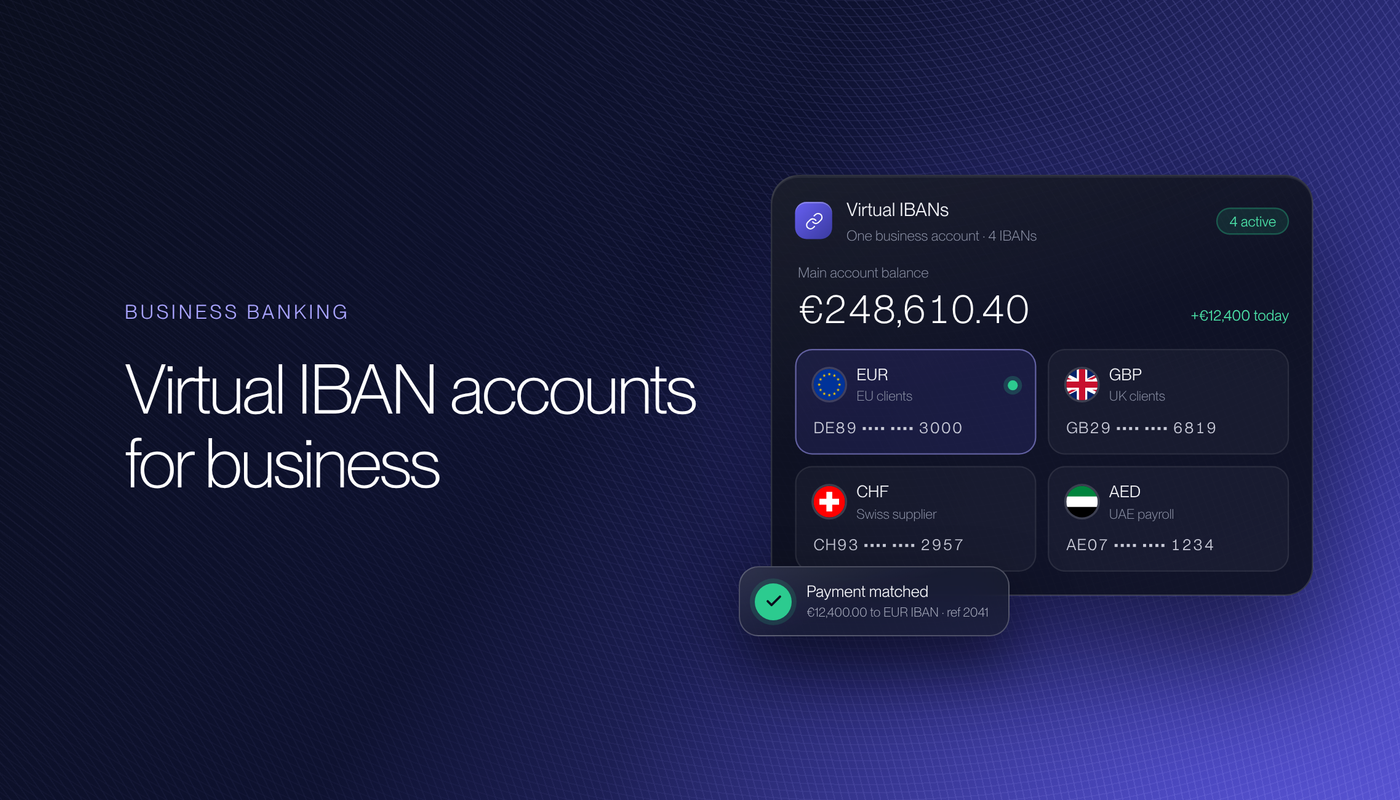
A virtual IBAN account gives your business a separate account number for every client, market or channel, without opening a new account each time. It works as a virtual bank account with IBAN numbers that all route money into one master account, so you see exactly who paid and what for. Reconciliation then mostly runs itself.
The hard part is getting one. Corporate banks offer virtual accounts mainly to large groups, on relationship pricing and after weeks of review. Multi-currency apps are fast but often turn away non-resident companies, holding structures and higher risk sectors. A refusal also stays on the record you show the next provider.
This is where we come in. We work with regulated partners who open a virtual bank account with IBAN numbers for companies the big banks overlook. We handle the parts that slow you down: the KYC file, the source of funds evidence, the compliance questions and the follow-up. One team, one contact, and a live account in days.
Our top-rated, regulated partners open these accounts for EU and international companies in days, fully remotely.

Equals Money
Business Bank Account
Time to onboard
2 Days
Account opening fee
Free
Monthly fee
€30

3S Money
Cross-border payments
Time to onboard
4 Days
Account opening fee
Free
Monthly fee
Starting from € 100
What Is a Virtual IBAN and How It Works
Put simply, it is an account number with the same format as a normal IBAN that does not hold money itself. Payments sent to it are credited to a master account, and payments out are debited from that master account. The European Banking Authority says in its May 2024 report that virtual IBANs "are typically indistinguishable from a regular IBAN" to the person paying.
So the payer sees a normal IBAN of up to 34 characters with a country code, check digits and a bank code. Behind it, the provider maps that number to your master account and tags every incoming payment with the number it arrived on. You can hold one number or several thousand under the same account, depending on the provider and your plan.
What a Virtual IBAN Account Is Not
It is not a second bank account. It has no balance of its own, no separate deposit protection and usually no separate statement. Everything sits in the master account, which is held either in your company's name or in the name of the bank or e-money institution that issues the numbers to its clients.
It is also not a virtual card. A virtual card with an IBAN is a marketing phrase some apps use for an e-money account that comes with a card number for online spending. The card spends money. The IBAN collects it. Many business accounts now offer both, but they solve different problems, so ask for the one you need.
Open a Virtual IBAN Account for Your Business
Your account opens in days when the file is complete, and we prepare that file with you.
- Regulated partners only: Accounts come from authorised e-money and payment institutions.
- KYC pack prepared: We tell you exactly what we need and build the file.
- Non-residents welcome: Directors and owners can sit anywhere outside sanctioned countries.
- Several IBANs, one balance: Collect per client or per country into one master account.
- No branch visit: The whole application runs online, with video ID where required.
Virtual IBAN Example for a Business
Here is a simple example. A software company in Cyprus sells to 400 customers across the EU. Instead of one IBAN on every invoice, it gives each customer a unique number. When customer 217 pays, the money lands in the master account tagged with that customer's number, even if the payment reference is blank or wrong. The finance team matches the payment automatically and chases nobody by email.
The same company can hold German and Lithuanian virtual IBANs for local collections, plus a sterling account number for UK clients. One login, one balance, several local-looking account numbers.
Virtual IBAN vs IBAN
The difference comes down to where the money sits. A standard IBAN belongs to an account that holds a balance. The virtual kind only points to an account. The table shows the practical differences.
Factor | Standard IBAN | Virtual IBAN |
|---|---|---|
Holds a balance | Yes | No, funds sit in the master account |
Format | ISO 13616, 15 to 34 characters | Same format, payer cannot tell |
Typical use | One account, all payments | One number per client, country or entity |
Reconciliation | Relies on payment reference | Number itself identifies the payer |
Country code | Country of the account | Can differ from the master account |
Statement | Its own statement | Usually part of the master statement |
In practice, most businesses do not choose one or the other. They hold a master account with its own IBAN and add virtual IBANs on top for collections. If you only receive a handful of payments a month, a normal account is enough. Once you invoice dozens of clients, the virtual layer pays for itself in hours saved. Read more: what an EMI account is and how it works.
Why Businesses Use a Virtual Bank Account With IBAN Numbers
Businesses use a virtual bank account with IBAN numbers for four reasons: faster reconciliation, local account numbers in several countries, ring-fenced collections for clients or group companies, and a way around IBAN discrimination. Each one saves time or money that a single account cannot.
Automatic Reconciliation of Incoming Payments
Finance teams spend hours matching bank lines to invoices when customers forget the reference or pay two invoices in one transfer. With one number per customer, the number does the matching. Most providers pass it through their API or export, so your accounting system can book the receipt without a human looking at it. For an online business with many small customers, this is often the main reason to switch.
Local Account Numbers in Several Countries
Some customers pay faster when they see an IBAN from their own country. A virtual IBAN account can give you, for example, a Belgian, German or Irish IBAN while the master account sits elsewhere in the EU. The EBA describes this use case directly, where a provider with a branch in one member state issues numbers with that state's country code.
Collecting for Clients, Group Companies and Marketplaces
Payment firms, marketplaces and group treasury teams use virtual IBANs to keep each client's or subsidiary's money identifiable inside one structure. A group can allocate one number per entity and run a single cash position, which is why the EBA lists group treasury companies as one of its six use cases. If you run a group, see how to open a bank account for holding companies.
A Fix for IBAN Discrimination
Article 9 of the SEPA Regulation says a payer or payee must not dictate the EU country in which a euro account is located, as long as the account is reachable through SEPA. Some utilities, tax offices and employers still reject foreign IBANs. A local IBAN gets you paid while the complaint process runs its course.
Virtual IBAN Providers and What They Charge
Providers fall into three groups: corporate banks with virtual account management, multi-currency apps, and specialist e-money and payment institutions. Banks suit large groups. Apps suit simple, low-risk companies. Specialist institutions suit everyone in between, including non-residents.
Provider type | Who it takes | Who it turns away | Typical cost |
|---|---|---|---|
Corporate banks (virtual account management) | Large groups with existing cash management | New, small and non-resident companies | Relationship based |
Multi-currency apps | Simple, low-risk companies | Many offshore, holding and high risk profiles | Wise: £50 one-time for account details; Revolut Business from €10 a month |
Specialist EMIs and payment institutions | SMEs, non-residents, groups, payment businesses | Sanctioned links, unclear source of funds | About €30 to €100 a month on our partners' plans |
The table shows why the route matters more than the brand. A corporate bank's virtual account management product is excellent, but it is sold on top of a full cash management relationship and priced privately. Apps publish low prices and open quickly, but their automated onboarding declines many perfectly legal structures without explanation. Specialist institutions sit in the middle and are the usual answer for founders who are not a fit for either.
Corporate Banks and Virtual Account Management
Global banks sell virtual account management as part of their treasury services. Pricing is not published and depends on balances and volumes. Expect a long onboarding, board resolutions, in-person or video meetings, and a minimum relationship size that rules out most small and new companies.
Multi-Currency Apps
Wise's business pricing page lists a one-time £50 fee for account details in 22 currencies, free local receipts in EUR and GBP, and 2.39 EUR per incoming EUR SWIFT payment. Revolut Business lists plans from €10, €35 and €125 a month in the EEA. Both are good products. The issue is acceptance, not price.
Why the Bank Route Costs More
Banks add cost in three places: a monthly account and package fee, a charge on every international payment, and a foreign exchange margin that is rarely shown as a separate line. A company receiving in several currencies pays all three.
Equals Money
Business Bank Account
Time to onboard
2 Days
Account opening fee
Free
Monthly fee
€30
A Faster and Cheaper Way to Open a Virtual IBAN Account
The faster way is a regulated e-money or payment institution that builds a virtual bank account with IBAN numbers into every plan. Our partners open an account in days, remotely, with no minimum balance, and give you named IBANs in your company's name plus additional virtual IBANs for collections.
They are authorised in the EU or the UK, they safeguard client money in segregated accounts at major banks, and they offer multi-currency balances, SEPA and SWIFT payments and an API. They also accept profiles the apps decline: non-resident directors, holding companies, trading companies with suppliers outside the EU and many regulated businesses. We prepare the application with you so the file answers the compliance questions before they are asked.
The route suits companies that need to be paid in euros and other currencies quickly, that invoice many clients, or that were refused elsewhere. It does not replace a lending relationship. If you need an overdraft or trade finance, keep a bank for that and use these accounts for day-to-day collections and payments.
Feature | Corporate banks | Our partners |
|---|---|---|
Time to open | Several weeks after a full relationship review | 2 to 4 business days on a complete file |
Who they accept | Established, mostly local groups | SMEs, non-residents, groups, many regulated sectors |
Minimum balance | Relationship based, often high | None |
Monthly cost | Relationship based | About €30 to €100 |
Multi-currency | Yes, on treasury packages | Yes, EUR, GBP, USD and more |
Virtual IBANs | Yes, on request, priced privately | Named and virtual IBANs as standard |
International payments | SWIFT fee on every payment | SEPA and SWIFT, priced on your plan |
The partner figures come from the cards below: about two business days for one partner and four for the other once the file is complete. Bank onboarding has no published timeline and depends on the relationship review.
Equals Money
Business Bank Account
Time to onboard
2 Days
Account opening fee
Free
Monthly fee
€30
3S Money
Cross-border payments
Time to onboard
4 Days
Account opening fee
Free
Monthly fee
Starting from € 100
Virtual IBAN Regulation in 2026
The rules in 2026 rest on four texts: the SEPA Regulation, the payment and e-money directives, the new EU AML Regulation and the Instant Payments Regulation. None bans virtual IBANs. Together they set who may issue them, how payers must treat them and how the issuer must know who uses each number.
SEPA Regulation Article 9 and IBAN Discrimination
Regulation (EU) No 260/2012, Article 9, stops a payer from specifying the member state of the payee's account, and stops a payee from specifying the member state of the payer's account, provided the account is reachable in SEPA. The European Commission asks businesses that meet IBAN discrimination to complain to the national authority in the country where it happened. The EBA notes that courts treat it as a breach, yet the practice still occurs.
The EBA Report on Virtual IBANs
The EBA published its report on virtual IBANs on 24 May 2024. It found that firms issue them in different ways, that national authorities apply the rules differently, and that nobody knows how many exist across the EU. Authorities that had assessed issuers' AML controls rated them poor or very poor. The report also warned that customers may not know which deposit guarantee scheme, if any, covers their money.
The EU AML Regulation From July 2027
Regulation (EU) 2024/1624, the new single AML rulebook, applies from 10 July 2027. It gives virtual IBANs a legal definition for the first time and requires the institution that issues them to be able to identify the person or company using each one. For honest businesses this means more questions at onboarding and fewer accounts closed later.
Verification of Payee
Since 9 October 2025, euro payment providers in the euro area must check the payee's name against the IBAN before a SEPA transfer is sent. The payer sees a match, a close match or no match. The obligation extends to EEA countries outside the euro area from 1 January 2027. Make sure each number carries your exact company name, or payers will see warnings.
Safeguarding vs Deposit Protection
Money in a bank is a deposit covered by a deposit guarantee scheme up to €100,000 per depositor per bank. Money held by an e-money institution is not a deposit. Instead, the institution must safeguard it, so that if the firm fails, client money is ring-fenced from its creditors and returned to clients first.
How E-Money Institutions Safeguard Client Funds
Under the second E-Money Directive, which applies the safeguarding rules of the payment services rules, an EMI must keep client funds separate from its own money. It either places them in a segregated account at a credit institution, invests them in secure, liquid, low-risk assets, or covers them with an insurance policy or comparable guarantee. EMIs also cannot pay interest on e-money balances.
What the €100,000 Deposit Guarantee Covers
Directive 2014/49/EU sets the EU deposit guarantee at €100,000 per depositor per bank. It covers deposits at banks, not e-money. For most operating companies, that limit is small against their cash anyway, which is why safeguarding is a sound model for payments. If you hold large surplus balances, consider moving idle cash into interest-bearing business accounts or other treasury products rather than leaving it in any single account.
Neither model is a reason to avoid a virtual bank account with IBAN details. Ask the provider who issues the IBANs, where client money is safeguarded, and which regulator supervises it. A good provider answers all three in one email. Read more: business bank account vs EMI account.
Documents Needed for a Virtual IBAN Account
The documents are the same as for any business account, plus a clear explanation of who will pay into each number. Expect a corporate pack, identity documents for directors and owners, and evidence of your business activity and money flows.
- Certificate of incorporation and a recent extract from the company registry
- Memorandum and articles of association, and the register of shareholders
- Passport and proof of address for every director and every owner of 25% or more
- An ownership chart down to the individuals, for groups and holding structures
- A short business description: products, customers, countries and expected monthly volumes
- Evidence of activity: contracts, invoices or a live website
- Source of funds for the opening deposit and source of wealth for main owners
- For payment businesses: your licence and how client money will flow through the virtual IBANs
Applications for a virtual bank account with IBAN details mostly stall on the business description and the money flows, not on the corporate documents. Write down which countries pay you, in which currencies, and roughly how much each month. Our checklist of documents needed to open a business bank account covers certification and translation rules.
Prepare Your Virtual IBAN Account File
A complete file is the fastest way to a live account, and most of the work is in the money flows.
- File review before submission: We check every document against the provider's list.
- Money flow summary drafted: Payers, countries, currencies and volumes, written the way compliance reads it.
- Ownership chart built: Clear down to every individual owner.
- Fewer question rounds: Gaps are closed before the file goes in.
- One point of contact: No email chains with three departments.
- Clear scope and pricing: You know the monthly cost before you apply.
Virtual IBAN Account Costs
A virtual IBAN bank account typically costs about €30 to €100 a month with our partners, with no minimum balance and no opening fee on the entry plans. Bank virtual account management is priced privately and only after a full relationship review. The table shows the main charges side by side.
Charge | Typical at a corporate bank | With our partners |
|---|---|---|
Account opening | Relationship based | Free on entry plans |
Monthly fee | Relationship based | About €30 to €100 |
Minimum balance | Often required | None |
Virtual IBANs | Priced per number or per block | Included or priced on your plan |
Extra currency accounts | Package based | Included on multi-currency plans |
Incoming SEPA payments | Per item on most tariffs | Priced on your plan |
Outgoing SEPA payments | Per item on most tariffs | Priced on your plan |
International payments | SWIFT fee per payment | Priced on your plan |
FX margin | Built into the rate | Shown before you convert |
Extra users and cards | Per user | Priced on your plan |
API access | Treasury package | Available on business plans |
Periodic compliance review | Part of relationship | Included |
The difference is not one big fee. It is the cost of every payment and every conversion added up over a year, plus the cash a minimum balance keeps idle. A company receiving hundreds of payments a month in several currencies usually pays more in per-item and FX charges than in the monthly fee. These figures are planning ranges. Your exact price depends on volumes and is confirmed before you apply.
Equals Money
Business Bank Account
Time to onboard
2 Days
Account opening fee
Free
Monthly fee
€30
3S Money
Cross-border payments
Time to onboard
4 Days
Account opening fee
Free
Monthly fee
Starting from € 100
How Long a Virtual IBAN Account Takes
With our partners, an account usually opens in 2 to 4 business days once the file is complete. Corporate banks take weeks because the virtual layer sits on top of a full cash management onboarding.
Stage | Corporate bank | Our partners |
|---|---|---|
Application and documents | Meetings, board resolutions and forms | Online form and uploads |
Compliance review | Full relationship review, often weeks | Focused review of the file |
Account and IBANs live | After the cash management setup | On approval |
Total | Several weeks, not published | 2 to 4 business days on a complete file |
Delays come from three places: missing ownership detail, a vague business description and slow answers to follow-up questions. Prepare the money flow summary first, have certified copies ready and answer questions the same day. Groups with several layers of ownership should allow extra time for the chart.
3S Money
Cross-border payments
Time to onboard
4 Days
Account opening fee
Free
Monthly fee
Starting from € 100
Virtual IBAN API and Payment Solutions
Once the account is live, most of the value comes from how you use the numbers. A virtual IBAN API lets your systems create numbers on demand and read every payment in real time, which turns the account into a full payment solution for collections.
Creating Numbers Through the API
Through the API, your platform can issue a new number when a customer signs up, attach it to the customer record and receive a notification when money arrives. Platforms, marketplaces and payment businesses rely on this. If you run a payment service provider, ask early how many numbers your plan includes and whether they can be named after your clients.
Managing Numbers Without Developers
Smaller companies do not need the API. The online dashboard lets you create a handful of numbers, label them and export statements per number. That alone removes most manual matching for a business with dozens of regular clients.
Paying Out and Converting
Payments out still leave from the master account. Most providers let you hold EUR, GBP and USD balances, convert at a rate shown before you confirm, and pay suppliers by SEPA or SWIFT. Read more: multi-currency business accounts.
Why the Company Comes Before the Account
A virtual bank account for business is opened for a company that already exists. The provider checks the registry before anything else. If you have not formed the company yet, form it first and apply for the account straight after, with the registry extract in hand. We can do both: see company formation with a bank account and our European company formation guide.
Common Virtual IBAN Account Mistakes
Most problems with virtual IBANs are avoidable. These are the four we see most often, what they cost, and what to do instead.
Treating Every Provider as Interchangeable
Founders often apply to the first app that advertises local IBANs, get declined by an automated check, and then apply to three more in a week. Each new application asks whether you were refused before. It costs two to four weeks and a weaker file. Apply once, to a provider that takes your profile, with a complete file.
Using the Wrong Name on the Account
Since Verification of Payee began, a mismatch between the account name and the name your customers type triggers a warning on their screen. Customers who see "no match" often stop the payment. Use your exact registered company name on every number and tell customers to pay that name, not your trading brand.
Ignoring Where the Money Is Safeguarded
Some businesses never ask which institution issues their IBANs or where client money sits. If the provider uses a partner model, the answer can involve two firms in two countries. Ask the three questions in the safeguarding section before you move large balances, and keep surplus cash in treasury products rather than a payment account.
Underestimating the Money Flow Questions
Any virtual bank account with IBAN numbers invites compliance questions about who pays into each number. Payment firms that collect for clients without explaining it get frozen accounts and weeks of review. Write a one-page money flow summary at the start and update the provider before you add a new type of payer. Read more: why banks reject business account applications.
Set Up Virtual IBANs for Your Company
Tell us how you get paid and where your company is registered, and we will tell you which route fits before you apply.
- Honest fit check: We say upfront whether your profile suits our partners.
- Non-resident friendly: Owners and directors can sit outside the EU.
- Groups and holdings: Ownership charts and multi-entity setups handled.
- Payment businesses: Money flow and client fund questions prepared in advance.
- Fast turnaround: Most complete files are live in 2 to 4 business days.
Bottom Line
A virtual IBAN account is one of the simplest ways to cut reconciliation work and get paid in local account numbers across Europe. The product is mature, and the regulation is tightening in a way that rewards honest, well-documented businesses. The real question is access: corporate banks sell virtual account management to large groups, apps decline many structures, and specialist regulated institutions fill the gap.
If you invoice many customers, collect in several countries or run a group or payment business, a virtual bank account with IBAN numbers from a regulated partner is usually the fastest route. Prepare the money flows, use your exact company name, and ask where your funds are safeguarded. Then let the numbers do the matching. Read more: how to open a business bank account and business bank accounts for non-residents.
What is a virtual IBAN?
What is the virtual IBAN meaning in banking?
Virtual IBAN vs IBAN: what is the difference?
Who are the main virtual IBAN providers?
How do I open a virtual IBAN account?
Is a virtual bank account for business safe?
Can a non-resident company get a virtual bank account with IBAN details?
How much does a virtual IBAN bank account cost?
What does virtual IBAN regulation say in the EU?
Can I get a business virtual IBAN account in several countries?
What is a virtual IBAN example for a marketplace?
Do enterprise virtual IBAN services differ from SME accounts?
Can I use an online virtual IBAN service without an API?
Sources
- European Banking Authority, Report on virtual IBANs, EBA/REP/2024/08, May 2024
- Regulation (EU) No 260/2012 (SEPA Regulation), EUR-Lex
- European Commission, IBAN discrimination
- Directive 2009/110/EC (second E-Money Directive), EUR-Lex
- Directive 2014/49/EU on deposit guarantee schemes, EUR-Lex
- Regulation (EU) 2024/1624 (AML Regulation), EUR-Lex
- Regulation (EU) 2024/886 (Instant Payments Regulation), EUR-Lex
- Wise Business, fees for getting paid
- Revolut Business, account plans (Ireland)