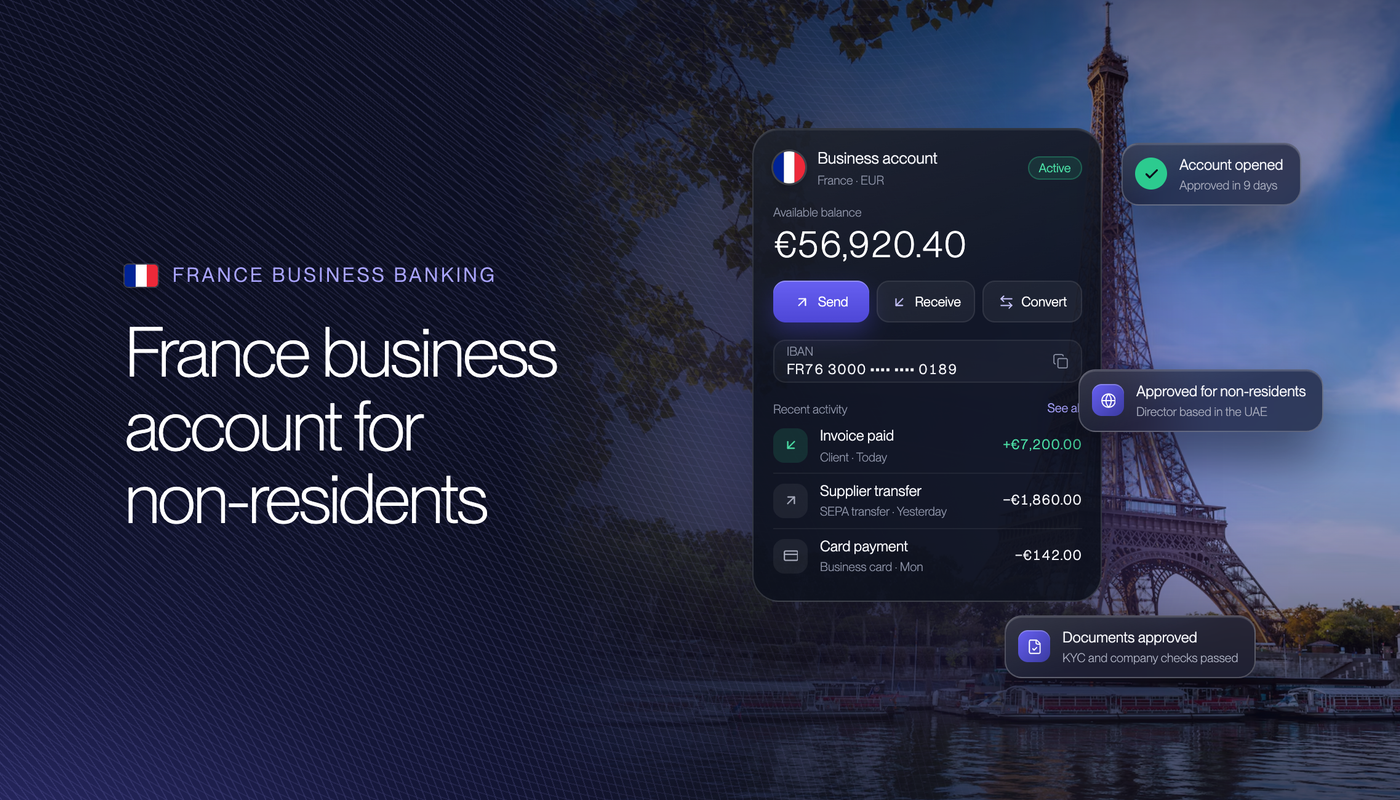
A France business bank account gives your SAS or SARL a euro IBAN, SEPA payments across Europe and an account that French clients, suppliers and the tax office pay into without question. Deposits are protected up to €100,000 per bank, and the account runs payroll, VAT and supplier payments from day one.
Getting one is the hard part when you live abroad. French banks want a Kbis and a French seat, identify every director in a branch or through a certified remote check, and charge a commission of up to 0.2% on the money you pay out. The legal right to an account only covers companies based in France.
This is where we come in. We work with EU-licensed partners who open euro and multi-currency accounts for French and foreign companies in about 4 days to a week, fully remotely. We handle the file: the Kbis and statutes, the beneficial owner records, your KYC pack and the source of funds. You send us your details, and we get it done.
Our top-rated, licensed banking providers open euro and multi-currency accounts for French SAS and SARL companies with owners abroad in days, with no branch visit.

3S Money
Cross-border payments
Time to onboard
4 Days
Account opening fee
Free
Monthly fee
Starting from € 100

Trumia
Business account
Monthly fees
€50
Onboarding fees
€500
Time to onboard
1 week
Accepts
Gambling, Betting, Casino, Crypto, and more
Why a Non Resident France Business Account Is Hard
A non resident France business account is possible, but French banks make it slow. They build their business accounts around companies with a French seat and directors they can meet, they must identify every director and beneficial owner, and they price the account for local customers. A foreign owner with a complete file gets an account. A file with gaps waits.
French Banks Want a Kbis and a French Seat
Every French bank starts from the Kbis, the extract from the Registre du commerce et des sociétés (RCS) that proves the company exists. The company gets its Kbis only after it registers through the guichet unique, the online one-stop shop that replaced the old business formality centres on 1 January 2023. Registration needs a French seat, so the company must have premises or use a licensed domiciliation address. A business bank account in France is opened for that registered company, usually by an adviser in a branch near the seat, not for a founder who is still deciding where to set up.
Every Director Must Be Identified
French anti-money laundering rules in the Monetary and Financial Code make the bank verify the identity of the company, its legal representative and its beneficial owners before the account opens. Showing an original passport or ID card means being there in person. A bank that onboards a director remotely must apply two extra measures under Article R561-5-2, and one of them can be a remote identity check certified by ANSSI, the national cyber security agency. Many branches simply ask the director to come in. For a founder in Dubai, London or Singapore, that is a flight before the first payment.
Open a Business Bank Account in France
You can open a business bank account in France for your SAS, SARL or foreign company without flying in. This is what we handle for you.
- No branch visit: Directors verify their identity online, from the country they live in.
- Owners abroad accepted: Foreign directors and shareholders are welcome at our partners.
- Open in days: About 4 days at one partner and about a week at the other.
- EU IBAN for SEPA: Pay French suppliers and get paid by French clients in euros.
- Harder sectors considered: One partner takes gambling, betting, casino and crypto.
- KYC pack prepared: We tell you what we need and build the file with you.
France Corporate Bank Account for Foreign Owners
A France corporate bank account for a company with foreign owners brings more questions. The bank checks the declaration of beneficial owners filed with the RCS at registration and asks who sits behind each shareholder. A holding company above the French SAS means documents for every layer. Money arriving from abroad needs a written source of funds with evidence. None of this is a reason to refuse, but every missing document adds a round of questions and another week.
Capital Must Be Deposited Before Registration
French company law puts the bank in the formation itself. Service Public, the official government portal, says the founders must deposit the share capital with a credit institution or a notary, and that a payment institution cannot hold it. An SARL pays in at least 20% of the cash contributions at the start and an SAS at least 50%, with the rest due within 5 years. The depositary issues the certificate of deposit that the registry needs, and it releases the money only once the company is registered. A non-resident founder therefore needs a bank or a notary at the very start, before any business account exists.
High Risk Sectors Get Extra Scrutiny
Businesses in gambling, betting, crypto, payments, cash-heavy trade or trade with high risk countries face enhanced due diligence at every French bank. Many of these files end in a refusal, often without a detailed reason. One of our partners accepts gambling, betting, casino and crypto businesses, so these sectors still have a route to a high risk business bank account.
The Droit au Compte Covers French Companies Only
France has a legal right to an account, the droit au compte. The French Banking Federation explains that a company domiciled in France that has been refused can ask the Banque de France to name a bank, and the Banque de France does so within one working day of a complete file. The company's representative must go to the Banque de France in person with the refusal letter and an original Kbis less than 3 months old. The designated bank provides basic services only: no chequebook and no overdraft. A foreign company with no French seat cannot use the procedure at all.
What to Do After a Refusal
Do not send the same file to the next branch. Find out which part failed: identification, ownership, source of funds or sector. Fix it with documents, then apply to a provider whose rules fit your company. We review refused files, close the gaps and place them with our partners, who open accounts for French companies with owners abroad in days. Banks can also close business accounts later when a review finds gaps, so keep the file current.
Read more: Business bank account for non-residents and why banks reject business account applications.
Best Bank for Business in France at Local Banks
The best bank for business in France for a resident owner is usually the network with a branch near the company. Entry packages run from about €5 to €42 a month, but French banks also charge a commission on every euro you pay out, a quarterly account fee and a yearly file review. The table shows what each bank publishes for professional customers.
Bank | Package for business | Monthly price | Charges on top |
|---|---|---|---|
BNP Paribas | Esprit Libre Pro, for turnover up to €750,000 | From €41 excl. VAT | Outside the package, €57.50 to €210 a quarter plus 0.06% to 0.1% of debits; €90 a year file update |
Société Générale | JAZZ Pro | €42 | Without JAZZ Pro, at least €28 a month, up to 0.2% of debits and €160 or €260 a year file review |
Crédit Agricole Ile-de-France | Pro by CA range, from 1 June 2026 | €10 to €114 | €0.10 to €0.50 per operation above the monthly allowance |
Caisse d'Epargne Ile-de-France (BPCE) | Libre Convergence and Labelis | From €28.90 | Outside a package, €73.80 a quarter plus 0.15% of debits |
LCL | LCL à la Carte PRO | From €5.33 | 0.18% of debits and €70 to €220.42 a quarter outside the offer |
CIC | Professionnel Essentiel to Global | €14.70 to €28.70 excl. VAT | 0.2% of debits outside a package; file update from €200 a year |
The package prices look low, but they are built for French residents with simple accounts. For a company that pays out large sums, the commission on debits matters more than the monthly price, and every bank adds a yearly charge for keeping your file up to date. Crédit Agricole and the Caisses d'Epargne are regional networks, so each regional bank sets its own prices and serves its own area.
The Commission de Mouvement on Every Payment Out
The commission de mouvement is a French charge that most other European banks do not have. It is a percentage of everything that leaves the account, taken each quarter. Société Générale and CIC charge up to 0.2%, LCL 0.18%, Caisse d'Epargne Ile-de-France 0.15% and BNP Paribas 0.06% to 0.1%. At 0.2%, a company that pays out €1 million a year in salaries, suppliers and tax pays €2,000 for the privilege. Some packages include it up to a limit: JAZZ Pro covers the first €12,500 of debits a month.
Account Fees and Yearly File Reviews
On top of the commission, French banks charge to keep the account and to review your file. BNP Paribas charges €57.50 to €210 per account per quarter outside its package and €90 a year to update your legal, tax and accounting file. Société Générale charges €160 a year for turnover up to €750,000 and €260 above. CIC starts at €200 a year. A business bank account fee of this kind is easy to miss on the first quote.
International Payments and Currency Margins
SEPA payments in euros are cheap at French banks: BNP Paribas and Société Générale charge nothing for a single SEPA transfer made online. Everything outside SEPA costs more. Société Générale charges 0.09% of each international payment made online, at least €13 and at most €70, and 0.11% with a €29 minimum in a branch. BNP Paribas charges €9.50 to €20 per payment and €11 to receive one. Both add a 0.05% exchange commission with an €18 minimum, and BNP Paribas states that its exchange rate includes its own commercial margin.
Branch Meetings and Slow Reviews
No French bank publishes a decision time for a company with owners abroad. The usual path is an appointment with a business adviser, a first list of documents, then follow-up questions on owners and funds. Each round takes days, and a director who must travel adds weeks. A French resident with a simple SAS often has an account quickly. A foreign-owned company waits longest.
Read more: Best banks for European companies and best EU countries for business banking.
3S Money
Cross-border payments
Time to onboard
4 Days
Account opening fee
Free
Monthly fee
Starting from € 100
A Faster Way to Open a Business Bank Account in France
A faster way to open a business bank account in France is to apply through us to our EU-licensed partners. They are regulated e-money and payment institutions, not banks, built for companies with owners abroad. They open a euro account with an EU IBAN in about 4 days to a week, fully online, and add other currencies in the same account.
One partner is authorised by the UK Financial Conduct Authority and has an e-money institution in Luxembourg authorised by the CSSF. The other is licensed by the Malta Financial Services Authority and accepts gambling, betting, casino and crypto businesses. We prepare the file before the partner sees it: the Kbis, the statutes, the beneficial owner declaration, each director's identity documents, a description of the business and a written source of funds. Client money is held in safeguarding accounts, separate from the partner's own funds.
Under Article 9 of the SEPA Regulation, a payer in the EU may not insist that your euro account sits in a particular member state. French clients, suppliers and public bodies can pay an EU IBAN from another member state like a French one.
Feature | French banks | Our partners |
|---|---|---|
Time to open | No published time, often weeks for owners abroad | About 4 days to a week |
Director identification | In a branch, or remotely with two extra measures | Online, from abroad |
Who they accept | Mostly French residents with a nearby seat | French and foreign companies with owners abroad |
Opening fee | Free | Free at one partner, €500 one-off at the other |
Monthly cost | €5.33 to €114, plus charges on debits | €50 to €100 on published plans |
Commission on debits | 0.06% to 0.2% outside packages | None published |
Currencies | Euro, separate foreign currency accounts at extra cost | Euro and other currencies in one account |
High risk sectors | Often refused | Gambling, betting, casino and crypto at one partner |
Capital deposit | Yes, with a certificate | Not possible, use a bank or notary |
Deposit protection | €100,000 per depositor per bank | Funds safeguarded, not deposit-guaranteed |
For a French company with owners abroad, or any company that pays across borders, our partners are faster and easier to open. A French bank can still be cheaper for a resident owner with a simple SAS that only pays in euros inside SEPA, and it is the place for loans, cash and the capital deposit.
International Business Bank Account in France
An international business bank account in France is one account that pays and receives in euros and other currencies, with the rates shown before you pay. Our partners give your French company that from the first day. Euro payments go through SEPA, and one partner publishes €1 to €2 per SEPA payment and free incoming payments from the EU, the UK, the US and the UAE on its plans. A multi-currency business account saves you a separate foreign currency account at €33 or more a month.
Keep a Bank or Notary for the Capital Deposit
Because a payment institution cannot hold share capital, a new French company still deposits its capital with a bank or a notary before registration. Many founders use a notary for this step, then open the operating account with our partners once the Kbis is issued. We tell you which route fits your company before you start, so you do not pay for two banking relationships you do not need.
Trumia
Business account
Monthly fees
€50
Onboarding fees
€500
Time to onboard
1 week
Accepts
Gambling, Betting, Casino, Crypto, and more
3S Money
Cross-border payments
Time to onboard
4 Days
Account opening fee
Free
Monthly fee
Starting from € 100
Documents Needed for a France Business Bank Account
The documents needed for a France business bank account follow the RCS file, plus the personal documents every bank and partner asks for. Have them ready in one set, in English or French, and check that the names and addresses match across every page. We gather them with you so the file arrives complete.
Company Documents From the RCS
Start with a Kbis extract less than 3 months old, the signed statutes and the declaration of beneficial owners. Add the company's SIREN number and VAT number, and proof of the registered seat, such as the lease or the domiciliation contract. If the seat is with a domiciliation company, it must hold a prefecture approval, and the provider will ask where the business is actually run.
Directors and Beneficial Owners
Each legal representative, signatory and beneficial owner holding more than 25% gives a valid passport or ID card and a recent proof of address. Infogreffe's registration list already asks for each director's ID, so use the same documents for the account. If a foreign holding company owns the French company, add its register extract and ownership chart.
The Business and the Money
Describe what the company sells, where its customers and suppliers are, and the payments you expect each month. Then write the source of funds with evidence: the capital, loans from shareholders or the first contracts. This is where most French and partner reviews slow down, so give it the most care.
Read more: Documents needed to open a business bank account and how to open a business bank account remotely.
Prepare Your France Business Bank Account File
A France business bank account opens fastest when the RCS records and your file tell the same story. We build it with you.
- RCS pack ready: Kbis under 3 months, statutes and beneficial owner declaration.
- Directors covered: ID and proof of address for every signatory and owner.
- Source of funds written: Clear, evidenced and in the format reviewers expect.
- Seat explained: Lease or domiciliation contract, with where the work happens.
- Group chart included: Every layer above the French company, with documents.
- Expected payments listed: Countries, currencies and monthly volumes.
France Business Bank Account Costs
France business bank account costs look low on the package price. The real cost for a company that pays out a lot sits in the commission on debits, the quarterly account fee, the yearly file review and payments outside SEPA. The table sets published ranges at French banks against our partners' published plans.
Charge | Typical range at a French bank | With our partners |
|---|---|---|
Account opening | Free | Free at one partner, €500 one-off at the other |
Monthly package | €5.33 to €42 for entry packages, up to €114 | €50 to €100 on published plans |
Account fee outside a package | €57.50 to €220.42 a quarter | None published |
Commission on debits | 0.06% to 0.2% of all debits | None published |
Yearly file review | €90 to €260 a year | None published |
SEPA transfer, online | Free at BNP Paribas and Société Générale | €1 to €2 at one partner |
SEPA transfer on paper | €6 to €16 each | Not needed, everything runs online |
Payment outside SEPA, out | €9.50 to €95 each | Shown on the plan |
Payment outside SEPA, in | €11 to €19 each | Free from the EU, UK, US and UAE at one partner |
Currency exchange | 0.05% commission, €18 minimum, plus the margin in the rate | Quoted with your setup |
Foreign currency account | From €33 a month at Société Générale | Other currencies in the same account |
Inactive account fee | Up to €30 a year | Shown on the plan |
Capital deposit for a new company | Handled with a certificate | Not possible, use a bank or notary |
Deposit protection | €100,000 per depositor per bank | Funds safeguarded, not deposit-guaranteed |
For a French resident with a simple SAS that pays only in euros, a French bank is often cheaper, and it is fair to say so. The picture changes with volume and borders. A company that pays out €80,000 a month at 0.2% pays €1,920 a year in commission alone, before the quarterly fee and the €160 to €260 file review. Add a few dozen payments outside SEPA at €13 to €95 each and the French account costs more than a year on a €100 partner plan. All figures are planning ranges from published tariffs, and we confirm your price in writing before you apply.
Read more: Business bank account in Europe and EU multi-currency business account.
Trumia
Business account
Monthly fees
€50
Onboarding fees
€500
Time to onboard
1 week
Accepts
Gambling, Betting, Casino, Crypto, and more
How Long a France Business Bank Account Takes
A France business bank account at a French bank has no published opening time. A resident with a simple SAS can open quickly, while a company with owners abroad meets branch appointments and rounds of questions that take weeks. With our partners, the account opens in about 4 days to a week once the file is complete.
Stage | French bank | Our partners |
|---|---|---|
Capital deposit and certificate | Before registration, at the bank | Before registration, at a bank or notary |
RCS registration and Kbis | Needed first | Needed first |
Director identification | Branch visit or remote check with extra measures | Online, from abroad |
Review and follow-up questions | Several rounds, no published time | One review of a prepared file |
Account open and ready | Often weeks for owners abroad | About 4 days to a week |
The capital deposit and the Kbis come first on either route, so the account timeline starts when the company exists. After that, the difference is the review: one prepared file against several rounds in a branch.
What Slows It Down
The usual delays are a Kbis older than 3 months, beneficial owners in the file that do not match the RCS declaration, a director who cannot travel, a foreign company in the ownership chain and a source of funds with no evidence. Each missing item restarts part of the review.
How to Speed It Up
Order a fresh Kbis, collect every document in one round, and answer questions the same day. Apply once, to a provider that accepts your owners' countries and your sector. That is how we run every file.
3S Money
Cross-border payments
Time to onboard
4 Days
Account opening fee
Free
Monthly fee
Starting from € 100
Trumia
Business account
Monthly fees
€50
Onboarding fees
€500
Time to onboard
1 week
Accepts
Gambling, Betting, Casino, Crypto, and more
What Happens After the Account Is Open
After the account opens, fund it, add your users and give the IBAN to clients, suppliers and the tax office. Then keep the company in good standing, because banks and partners check it at every review. French tax and invoicing rules also change in 2026, and both touch the account.
Corporation tax is 25%, with a reduced rate of 15% on the first €42,500 of profit for companies with turnover up to €10 million whose capital is fully paid up and at least 75% held by individuals. VAT is charged where it applies. From 1 September 2026 every French company must be able to receive electronic invoices, and large and mid-sized companies must also issue them. Small companies issue from 1 September 2027.
Payments are changing too. Euro area banks had to send instant payments and check the payee's name against the IBAN from 9 October 2025, and payment and e-money institutions must offer instant payments by 9 April 2027. The EU Anti-Money Laundering Regulation applies from 10 July 2027, with the same identity and ownership checks across the EU. Tell your provider about new owners, directors or activities before the payments change. Once cash builds up, cash management becomes the next question.
Read more: Germany business bank account and Spain business bank account for non-residents.
3S Money
Cross-border payments
Time to onboard
4 Days
Account opening fee
Free
Monthly fee
Starting from € 100
Why the Company Comes Before the Account
A French bank cannot open an operating account for a company that is not on the RCS, and neither can our partners. The founders deposit the capital, sign the statutes, declare the beneficial owners and register through the guichet unique, and only then does the Kbis exist. Plan the capital deposit with a bank or notary from the start, and ask for the Kbis as soon as registration is accepted. If you are still choosing where to form, our guide on how to set up a company as a non-resident and our breakdown of company formation costs by country help with that decision.
Common France Business Bank Account Mistakes
Most problems with a France business bank account come from the wrong order or the wrong expectations. These are the mistakes we see most.
Ignoring the Commission on Debits
Founders compare the monthly package price and stop there. A €20 package with a 0.2% commission costs €2,000 a year more on €1 million of payments out than the package price suggests. Ask each bank for its full tariff, check what the package includes and work out the cost on your real volumes before you sign.
Applying Before the Kbis Is Issued
A business account needs a registered company. Founders who ask a bank for an account before registration end up with only a capital deposit, blocked until the Kbis arrives. Plan the capital deposit first, then open the operating account with a Kbis less than 3 months old.
Counting on the Droit au Compte From Abroad
The droit au compte only covers companies domiciled in France, and the representative must go to the Banque de France in person. The account it gives has basic services only. A foreign company or a founder who cannot travel should not build a plan on it. A provider that opens remotely is the faster answer.
Leaving a Foreign Holding Company Unexplained
A holding company in another country above the French SAS is common and legal. Left unexplained, it triggers questions at every bank and partner. Show every layer, the owners at the top and why the structure exists, with the register extracts in the file.
Read more: European business bank account for non-residents and IBAN accounts for businesses.
Get Help With a French Business Bank Account
A French business bank account is very manageable when the file and the provider fit your company. Send us your details and we get back to you.
- Fit checked first: We confirm a partner can bank your company before you apply.
- Refused before: We review the old file and fix the gaps.
- Honest advice: We tell you when a French bank is the cheaper choice.
- Capital route planned: Bank or notary for the deposit, partner for daily payments.
- One point of contact: From the first document to the first payment.
Bottom Line
A business bank account in France is easy for a French resident with a simple SAS and slow for almost everyone else. French banks want a Kbis and a French seat, identify every director in person or with extra checks, and add a commission of up to 0.2% on debits, quarterly fees and yearly file reviews to the package price. The droit au compte helps only companies domiciled in France.
For a company with owners abroad, the faster route is our EU-licensed partners. Deposit the capital with a bank or notary, register the company, and we open the operating account with you in about 4 days to a week, fully remotely. For a company in another EU country, see our guides to the Netherlands business bank account, Malta business bank account and banks for Cyprus companies.
Can a non-resident open a business bank account in France?
How do I open a business bank account in France from abroad?
What is the best bank for business in France?
How much does a France business bank account cost?
What is the commission de mouvement at French banks?
Which documents do French banks ask for a corporate bank account?
How long does it take to open a business bank account in France?
Does the droit au compte apply to foreign companies?
Where do I deposit the share capital for a French SAS or SARL?
Can a French company use a non-French IBAN?
Is money in a France business account protected?
What is an international business bank account in France?
Can a high risk business get a France corporate bank account?
Sources
- BNP Paribas, Conditions et tarifs pour les professionnels, applicable 1 January 2026 (MoneyVox archive)
- Société Générale, Tarifs Professionnels et Associations, 1 October 2026
- Crédit Agricole Paris et Ile-de-France, Addendum professionnels, 1 June 2026 (MoneyVox archive)
- Caisse d'Epargne Ile-de-France, Conditions et tarifs professionnels, updated 1 September 2025 (MoneyVox archive)
- LCL, Conditions tarifaires Professionnels et Entrepreneurs, 1 January 2026 (MoneyVox archive)
- CIC, Recueil des prix aux Professionnels, 1 January 2026
- Service Public Entreprendre, Dépôt du capital social
- Service Public Entreprendre, Impôt sur les sociétés
- Les clés de la banque (French Banking Federation), Le droit au compte for businesses
- Infogreffe, Immatriculer une société au RCS, documents to provide
- Fonds de Garantie des Dépôts et de Résolution (FGDR)
- Regulation (EU) No 260/2012 (SEPA Regulation), EUR-Lex
- European Central Bank, Instant Payments Regulation
- Ministère de l'Économie, Facturation électronique calendar
- Actu-Juridique, Entrée en relation d'affaires à distance et PVID (Article R561-5-2 CMF)