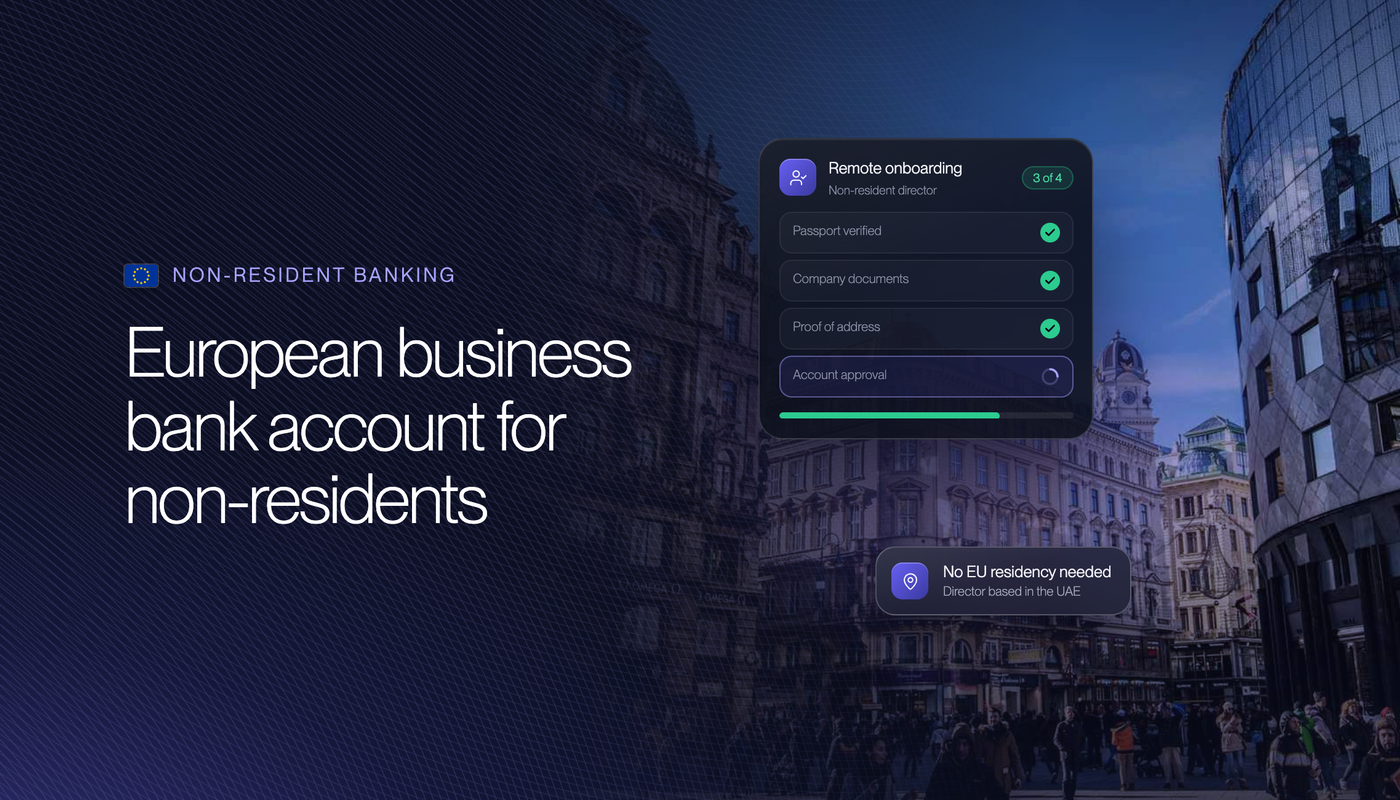
A European business bank account for non-residents gives your company an EU IBAN, euro payments across the SEPA area and an account EU clients and suppliers trust. EU law stops a payer from refusing your IBAN because it sits in another member state, and bank deposits are protected up to €100,000.
The hard part is the bank. EU banks see owners and directors who live outside the EU as a higher money laundering risk. Many want a local link, a branch visit and weeks of review. Foreign companies also pay more: HSBC Malta charges an international company €175 a month, against €30 for a local one.
This is where we come in. We work with regulated e-money partners built for owners abroad, and we handle the application with you: the KYC pack, the tax residence forms, the source of funds file and every question from compliance. One team, one point of contact. You tell us about the business, and we get the account open.
Our top-rated, licensed banking providers open EU business accounts for owners who live abroad in 4 days to about a week, with no branch visit.

Moneybase
Multi Currency Business Account
Time to onboard
4 Days
Account opening fee
Free
Monthly fee
Starting from € 9.99

3S Money
Cross-border payments
Time to onboard
4 Days
Account opening fee
Free
Monthly fee
Starting from € 100
Why a European Business Bank Account Is Hard for Non-Residents
A European business bank account for non-residents is hard to get because EU banks must treat distance as a risk. Owners abroad, a company run from another country or a company formed outside the EU all mean more checks, more questions and higher fees. A complete file and the right provider solve most of it.
What Non-Resident Means to an EU Bank
Banks use the word for three different readers. The first owns an EU company but lives outside the EU, for example a founder in Dubai with a Cyprus company. The second runs an EU company from abroad, so the directors and the decisions sit in another country. The third owns a company formed outside the EU, such as a UK, US or UAE company, that needs an EU account to collect euros.
Each case changes the anti-money laundering checks the bank runs. EU guidance lists non-face-to-face onboarding and links to higher-risk countries as risk factors. An owner with ties to a country on the EU list of high-risk third countries triggers enhanced due diligence by law. None of this blocks a European business bank account for a non-resident company. It means the bank wants more proof before it says yes.
Local Director and Substance Expectations
Some rules come from company law, not from the bank. In Ireland, section 137 of the Companies Act 2014 says at least one director must live in the European Economic Area. A company without one must hold a €25,000 bond for at least two years, or get a section 140 certificate showing a real and continuous link to an economic activity in Ireland. Our guide to Irish company formation requirements covers both routes.
Banks then add their own test of substance: an office, staff, local clients or a director in the country. Cyprus and Malta banks price foreign ownership into the account, as the tariffs below show. Check the Malta director residency rules before you plan who sits on the board.
Open an EU Business Bank Account as a Non-Resident
An EU business bank account for non-residents is very doable when the file answers the bank's questions before it asks them. This is what we do for you.
- Application handled for you: We build the KYC pack and send it to the partner that fits.
- No branch visit: Identity checks run online, wherever the owners live.
- EU IBANs: Collect and pay euros across SEPA from your first week.
- Owners anywhere: Directors and shareholders can live outside the EU.
- Tax forms done right: We complete the CRS self-certification with you.
- Clear costs: You see the opening fee and the monthly plan before we start.
Branch Visits and Video ID Limits
Remote onboarding is legal across the EU. The EBA guidelines on remote customer onboarding have applied since 2 October 2023 and set out how banks may verify a customer by video or with a digital identity check. They allow it. They do not force any bank to offer it.
Many local banks still want you in person. AIB checks the identity of every signing director in a branch, even when the company applies online. Bank of Ireland asks limited companies to arrange a meeting with a business adviser. For an owner in Singapore or Lagos, that is a flight before the first euro arrives.
Tax Residence Self-Certification Under CRS
Every EU bank must find out where the account holder is resident for tax. Under the Common Reporting Standard, a company signs a self-certification that lists each country where it is tax resident, its tax number, its CRS class and, for a passive company, the people who control it. The bank reports the account to those countries every year.
This is where an EU company run from abroad gets questions. A Cyprus company managed from Dubai may be tax resident in a different place than its registration says, and the form must match the facts. AIB asks for FATCA and CRS details as part of its business account opening. A wrong answer delays the file. A careful answer gets it through.
Refusals and Account Exits Follow You
Banks rarely explain a refusal, and the next bank will ask whether you were refused before. Exits cost money too. Bank of Cyprus charges a legal entity €320 a month once it has terminated the account, and €200 to close a company account. Read why banks close business accounts before you apply anywhere.
The rules are tightening, not loosening. From 10 July 2027 the EU Anti-Money Laundering Regulation (EU) 2024/1624 replaces national rules with one rulebook, and AMLA in Frankfurt will directly supervise selected cross-border firms. The EU right to a basic payment account does not help a company: it covers consumers legally resident in the EU.
Cyprus, Malta and Ireland Banks for Non-Residents
Cyprus, Malta and Ireland banks all accept a non-resident business bank account in Europe, but on different terms. Cyprus has units built for international companies and charges them more. Malta prices foreign ownership into the monthly fee. Ireland is cheap for Irish companies and asks for a real Irish footprint from everyone else.
Bank | Who it takes | Who it turns away or charges more | Monthly fee |
|---|---|---|---|
Bank of Cyprus (International Business Units) | International companies, including companies formed outside the EEA | Non-EEA companies pay a €300 application fee, €500 with enhanced checks | €50 (EEA company), €75 (non-EEA company) |
Eurobank, Cyprus (Hellenic Bank and Eurobank Cyprus combined) | International clients through its International Banking Centres | Decided case by case on risk | Relationship based |
Bank of Valletta, Malta | Maltese companies; international trading companies go to Specialised Business Banking | Gaming companies and payment firms pay €3,000 to open | €30 local, up to €60 Specialised |
HSBC Malta | Maltese companies and international companies | International companies pay a €100 opening fee | €30 local, €175 international |
AIB, Ireland | Companies registered and trading in Ireland | Companies not owned by their directors must apply in a branch | €4.50 a quarter plus €0.20 per automated item |
Bank of Ireland | Irish companies after a meeting with a business adviser | Limited companies must arrange a meeting with an adviser | €15 a quarter plus €0.10 per automated item |
PTSB, Ireland | Sole traders, partnerships and limited companies, online form | Applicants who cannot prove identity and address | Quarterly charge plus transaction fees |
The table shows the pattern. The same bank charges more once the company or its owners sit outside the country. At HSBC Malta, a company registered outside Malta, or 50% or more owned by a parent outside Malta, counts as an international company and pays almost six times the local fee. Irish banks are the cheapest on paper, but only for companies that are registered and trading in Ireland.
Cyprus Banks for Non-Resident Companies
Bank of Cyprus runs International Business Units for foreign clients. Its June 2026 tariff for those units charges no fee to open the account itself, but a company incorporated outside the EEA pays a €300 application fee, or €500 where it needs enhanced due diligence. Review fees for those companies start at €500. A low activity fee of €20 a month applies when a company account has four or fewer transactions in a month. Eurobank Cyprus merged into Hellenic Bank on 1 September 2025, and the combined bank, being renamed Eurobank Limited, serves international clients through its International Banking Centres. Our guide to opening a business bank account in Cyprus and our list of the best banks for Cyprus companies go deeper.
Malta Banks Charge Foreign Companies More
Bank of Valletta, the largest bank in Malta, charges local companies a €30 monthly administration fee from 1 September 2026. International trading companies go to its Specialised Business Banking unit, which charges €300 to open per entity and up to €60 a month. Gaming companies and payment firms pay €3,000 to open and up to €600 a month. HSBC Malta charges €175 a month to an international company. See opening a business bank account in Malta as a non-resident for the full process.
Irish Banks Want an Irish Footprint
AIB lets a limited company, DAC or company limited by guarantee apply online only if it is registered and trading in Ireland and wholly owned by up to five directors. Everyone else goes to a branch. Bank of Ireland asks limited companies to meet a business adviser. PTSB takes online applications but needs proof of identity and address. Our page on business bank accounts in Ireland for non-residents explains what an Irish bank looks for.
Why the Local Route Costs More for Non-Residents
The monthly fee is only part of it. Bank of Ireland charges €12.50 to €17.50 for each non-SEPA payment and €37.50 to €42.50 for an urgent one, plus a €7 foreign bank charge where one applies. Bank of Cyprus adds €30 to €40 of extra processing to each outward payment from a company incorporated outside the EEA. Every currency conversion carries a bank margin on top of the fee, and Bank of Ireland adds a handling fee as well.
Other EU Countries for a Non-Resident Account
Other EU banking markets work the same way, with their own local rules. We cover Germany, the Netherlands, Spain, Luxembourg, Greece and Portugal in separate guides.
Read more: Business bank account in Europe and the best banks for European companies.

Trumia
Business account
Monthly fees
€50
Onboarding fees
€500
Time to onboard
1 week
Accepts
Gambling, Betting, Casino, Crypto, and more
A Faster and Cheaper Way to Open a European Business Account
The faster route to an EU business account for non-residents is a regulated e-money institution that onboards owners abroad by design. Our partners open accounts in 4 days to about a week, fully online. They cost less where non-residents pay most: currency conversion, the foreign company surcharge and several currencies in one place.
Two of our partners are electronic money institutions licensed by the Malta Financial Services Authority. The third is authorised by the UK Financial Conduct Authority and runs an e-money company in Luxembourg authorised by the CSSF. One partner exchanges 24 currencies and publishes conversion margins from 0.95% on its entry plan down to 0.25% on its top plan. Another holds up to 65 currencies and issues local IBANs in Luxembourg, the Netherlands and France. One accepts gambling, betting, casino and crypto businesses.
We do the work in between. We prepare the file each partner asks for, answer compliance questions with you and stay on it until the account is live. You get a non-resident business account in Europe without a flight, a local director or a bank interview.
Feature | Cyprus, Malta and Ireland banks | Our partners |
|---|---|---|
Time to open | Weeks, longer with enhanced checks | 4 days to about a week |
Owners outside the EU | Accepted with surcharges or refused | Accepted |
Branch visit or meeting | Often required | None, identity checked online |
Opening fee | Free to €500, €3,000 for gaming at one bank | Free at two partners, €500 at one |
Monthly fee | €4.50 a quarter to €175 a month | From €9.99 to €100 on published plans |
Currencies | Euro first, extra currency accounts priced separately | 24 at one partner, up to 65 at another |
Currency conversion | Bank margin plus handling fee | From 0.25% on published plans |
International payments out | €4 to €22 or more a payment, more for urgent ones | From €5 at one partner |
High-risk sectors | Mostly refused or priced up | Gambling, casino and crypto accepted at one partner |
Deposit protection | Up to €100,000 per depositor | Safeguarding, no deposit guarantee |
For an owner abroad, speed and acceptance matter more than the headline fee. A bank that asks for a meeting in Dublin or Valletta costs more than its tariff shows. Our partners fix that, and they are cheaper on conversion and on holding several currencies.
How Client Money Is Safeguarded
E-money institutions are not banks. By law they must safeguard client money, usually in segregated accounts at banks, so it stays apart from the firm's own funds. They do not lend, offer overdrafts, pay interest or handle cash, and the €100,000 deposit guarantee does not cover them.
Read more: what an EMI account is and business bank account vs EMI account.
Your EU IBAN Works Across the EU
Article 9 of the SEPA Regulation (EU) 260/2012 says a payer or payee may not demand that an account sits in a particular member state, as long as it is reachable for SEPA payments. So an IBAN from Malta or Luxembourg works for a client in Ireland or Germany. That is why a European bank account for a non-resident company does not need to be in the country where you sell.
3S Money
Cross-border payments
Time to onboard
4 Days
Account opening fee
Free
Monthly fee
Starting from € 100
Trumia
Business account
Monthly fees
€50
Onboarding fees
€500
Time to onboard
1 week
Accepts
Gambling, Betting, Casino, Crypto, and more
Documents Needed for a European Business Bank Account
Documents for a European business bank account for non-residents are the same at most banks and partners. The company file proves the company exists and who owns it. The owner file proves who each person is. The business file proves where the money comes from and why the account belongs in the EU.
- Company documents: certificate of incorporation, constitution or articles, and a recent registry extract
- Ownership chart: every shareholder up to the ultimate beneficial owners, with percentages
- Directors and owners: passport and proof of home address for each director, signatory and owner of 25% or more
- Tax forms: a CRS self-certification for the company and, for a passive company, for each controlling person
- Source of funds: bank statements, contracts or invoices that show where the opening money comes from
- Business plan: what you sell, to whom, in which countries, and expected monthly volumes
- Foreign documents: certified copies, with an apostille or translation where the provider asks for one
The business plan carries the most weight for a non-resident. It must explain why a company owned from abroad needs an EU account: EU clients, EU suppliers or euro income. A clear answer to that one question removes most follow-up rounds. Our checklist of documents needed to open a business bank account covers each item in more detail.
Prepare Your EU Business Bank Account File
Most delays on a non-resident business bank account in Europe come from the file. We build it with you so it goes in complete.
- Ownership mapped: We draw the chain up to every beneficial owner.
- CRS forms checked: Tax residence and controlling persons filled in correctly.
- Source of funds proved: We pick the statements and contracts that answer it.
- Business plan written: Clients, countries and volumes stated in plain figures.
- Translations sorted: We tell you which papers need an apostille.
European Business Bank Account Costs for Non-Residents
European business bank account costs for non-residents run from €4.50 a quarter at an Irish bank for an Irish company to €175 a month at HSBC Malta for an international company. Add application fees of €100 to €500, review fees and payment charges. Our partners cost from €9.99 to €100 a month on published plans.
Charge | Typical range at a local bank | With our partners |
|---|---|---|
Account opening | Free at most banks; €100 to €300 for foreign companies; €500 with enhanced checks | Free at two partners, €500 at one |
Monthly fee | €4.50 to €15 a quarter in Ireland; €30 to €175 a month in Malta; €50 to €75 a month in Cyprus | From €9.99 to €100 on published plans |
Periodic review | From €500 at Bank of Cyprus for non-EEA companies | Quoted with your setup |
Overdue review | €50 a month at Bank of Cyprus | Quoted with your setup |
Low activity | €20 a month at Bank of Cyprus for four or fewer monthly transactions | Shown on the plan |
Online banking | €10 a month at Bank of Ireland | Shown on the plan |
SEPA payment out | €0.10 to €4 a payment | From €0.20, capped at €3.99, at one partner |
Urgent euro payment | €19 at Bank of Ireland | Shown on the plan |
International payment out | €4 to €22 or more, plus €30 to €40 for non-EEA companies at Bank of Cyprus | From €5 at one partner |
Urgent international payment | €30 to €42.50 | Quoted with your setup |
International payment in | Free to €10 in Malta, from €3 at Bank of Cyprus | €5 at one partner |
Currency conversion | Bank margin plus handling fee | From 0.25% on published plans |
Cash handling | 0.60% of notes at Bank of Ireland | Not offered |
Account closure | €200 at Bank of Cyprus | Shown on the plan |
Most of the cost for a non-resident hides outside the monthly fee. Every conversion carries the bank's margin, every non-SEPA payment carries a fixed fee, and foreign companies pay extra processing and review fees. A business that pays US suppliers from a euro account each week pays those fees every week.
To be fair, a resident director with a simple Irish company pays AIB €4.50 a quarter plus €0.20 per automated item, and nothing beats that. Bank opening is usually free, and so is opening at two of our partners. Our partners win on conversion from 0.25%, on holding many currencies in one account and on the foreign company surcharge. Treat these figures as planning ranges: the plan or quote you sign sets the final price.
Read more: business bank account fees and the multi-currency business account guide.
Moneybase
Multi Currency Business Account
Time to onboard
4 Days
Account opening fee
Free
Monthly fee
Starting from € 9.99
Trumia
Business account
Monthly fees
€50
Onboarding fees
€500
Time to onboard
1 week
Accepts
Gambling, Betting, Casino, Crypto, and more
How Long a European Business Bank Account Takes
A European business bank account for non-residents takes weeks at a local bank and 4 days to about a week with our partners. Even AIB, with its simplest online route for Irish companies, quotes up to five business days to review, a branch identity check, and up to 10 more business days for its final check.
Stage | Local bank | Our partners |
|---|---|---|
Application and first review | Up to 5 business days at AIB for an Irish company | Online form, same week |
Identity check | In a branch or at a meeting | Online, from abroad |
Compliance questions | Several rounds for owners abroad | One round when the file is complete |
Final check and account live | Up to 10 more business days at AIB | 4 days to about a week from a full file |
The local timeline grows with distance. AIB's figures cover a company registered and trading in Ireland and owned by its directors. A company owned from abroad goes to enhanced checks, and those add rounds of questions with no published end date.
What Slows a Non-Resident Application
Gaps in the ownership chain, a source of funds with no paper trail, a CRS form that does not match where the company is managed, and a plan with no EU link. Each one adds a round of questions. Foreign documents without certification add another.
How to Speed It Up
Send everything at once, answer the EU link question in the business plan and prepare the tax forms before you apply. Pick a provider that accepts your sector from the start, and keep one person on your side answering compliance questions the same day.
Read more: how to open a business bank account remotely.
3S Money
Cross-border payments
Time to onboard
4 Days
Account opening fee
Free
Monthly fee
Starting from € 100
What Happens After the Account Is Open
After a European business account for non-residents opens, the checks continue. Banks and e-money institutions review your file again on a schedule, ask about new payment patterns, and report the account under CRS every year. Keep the company file current and the account stays easy to run.
Expect periodic reviews. Bank of Cyprus charges non-EEA companies from €500 for each review and €50 a month when a review runs late. Tell your provider about changes in owners, directors or tax residence: PTSB's CRS self-certification asks for an updated form within 30 days of a change, and other providers set their own deadlines.
Name your payees correctly. Since 9 October 2025, euro area payment providers check the payee name against the IBAN under Verification of Payee, so use the exact registered company name on invoices. Payment rules will change again under PSD3 and the Payment Services Regulation, which are not yet in force.
UK Business Bank Accounts Are Outside the EU
A UK business bank account is not a European business bank account in the EU sense. The UK left the EU, so UK banks and e-money firms lost EU passporting rights at the end of 2020. The UK still takes part in the SEPA payment schemes, but as a non-EEA country.
Factor | UK | Cyprus, Malta and Ireland |
|---|---|---|
EU member | No | Yes |
SEPA payments | Yes, as a non-EEA SEPA country | Yes, full EU rules apply |
SEPA Regulation IBAN rule | Does not protect UK accounts | Applies |
Deposit protection | £120,000 under the FSCS | €100,000 per depositor |
VAT on sales to EU consumers | Non-Union OSS for services; an EU intermediary for IOSS | Union OSS available |
For a non-resident, this matters in practice. The EPC's list of SEPA scheme countries notes that EEA payment law applies fully only between institutions in the EU and the EEA, so the IBAN rule in Article 9 does not protect a GB IBAN. If your clients are in the EU, an EU IBAN is the safer choice. If your company is British, see opening a UK business bank account as a non-resident.
Why the Company Comes Before the Account
Every bank and partner opens the account for a company that already exists. You need the certificate, the registered address, the directors and the beneficial owners on record first. The choice of country also sets which tax forms you sign. Read our guide to EU company formation for non-residents, and see how to set up a company as a non-resident anywhere.
Moneybase
Multi Currency Business Account
Time to onboard
4 Days
Account opening fee
Free
Monthly fee
Starting from € 9.99
Common European Business Bank Account Mistakes
Most mistakes on a non-resident business bank account in Europe come from picking the wrong place or the wrong paperwork. Each one below costs weeks or real money, and each one is easy to avoid with a little planning before you apply.
Choosing the Bank on the Monthly Fee Alone
Founders see a low local fee and apply. Then the tariff for foreign companies applies: HSBC Malta charges €175 a month to an international company instead of €30, which is €1,740 more a year. Bank of Cyprus adds €300 to apply and €500 or more for each review. Compare the fee that applies to your company, with owners where they actually live, not the fee on the home page. A partner plan from €9.99 a month can cost less in the first year.
Applying Where You Have No Link
Applying to an Irish bank with no Irish address, staff or clients usually ends in a meeting request you cannot attend or a refusal. AIB's online route needs a company registered and trading in Ireland. Each refusal goes on record and the next bank asks about it. Apply where your company has a real link, or use a provider built for owners abroad. See banking for holding companies if the company only holds assets.
Getting the CRS Form Wrong
Many owners tick the country of incorporation as the tax residence without thinking. If the company is managed from Dubai or London, that answer may be wrong, and the bank will spot the mismatch in the file. The result is weeks of questions or a closed account later. Take tax advice on where the company is resident, then fill in the form to match.
Expecting a Bank From an E-Money Account
An e-money account is the fastest European business account for non-residents, but it is not a bank. It does not lend, take cash or pay interest, and the €100,000 deposit guarantee does not cover it. Founders who need a loan or a cash business find this out too late. Use the e-money account for payments and currencies, and plan credit separately. Gambling and crypto firms should read banking for a gambling company first.
Open a Non-Resident Business Bank Account in Europe
You can open a European business bank account as a non-resident without moving or appointing a local director. Send us your details and we get back to you.
- One request: Tell us the company, the owners and the countries you trade with.
- Right partner: We place the file with the partner that accepts your sector.
- Owners abroad welcome: No EU residence needed for directors or shareholders.
- Every question answered: We handle compliance follow-ups with you.
- Fast and remote: Accounts in 4 days to about a week, all online.
- Several currencies: Hold euros and other currencies in one place.
Bottom Line
A European business bank account for non-residents is very doable in 2026. Cyprus, Malta and Ireland banks accept foreign owners, but they charge more, take weeks and often want a visit or a local link. A non-EEA company pays €75 a month and a €300 application fee at Bank of Cyprus, and €175 a month at HSBC Malta.
Our regulated partners open EU accounts in 4 days to about a week, remotely, from €9.99 a month, with conversion from 0.25% at one partner. We prepare the file, handle the questions and stay with you until the account is live. For the worldwide picture, read our guide to the business bank account for non-residents.
Can a non-resident open a business bank account in Europe?
How much does a European business bank account for non-residents cost?
Do I need to visit the bank to open an EU business bank account?
Do I need a local director to open a business bank account in Europe?
Can a non-EU company open a European bank account?
How long does it take to open a business bank account in Europe as a non-resident?
What documents does a non-resident need for an EU business bank account?
Is my money protected in an EU business account?
Why do EU banks refuse non-resident business accounts?
What is CRS self-certification for a business account?
Is a UK business bank account the same as a European one?
Which EU country is easiest for a non-resident business bank account?
Can I use an IBAN from one EU country to trade in another?
Sources
- Bank of Cyprus, Table of Commissions and Charges, International Business Units Customers (June 2026)
- HSBC Bank Malta, General Tariff for Commercial Banking Customers (April 2026)
- Bank of Valletta, Tariff of Charges (effective 1 September 2026)
- Bank of Ireland, Schedule of Fees and Charges for Business Customers (effective 14 September 2026)
- Bank of Ireland, Business Current Account features and how to apply
- AIB, Centralised Account Opening Q&As
- AIB, Business Fees and Charges (effective 1 July 2026)
- PTSB, Entity Self-Certification for FATCA and CRS
- Companies Registration Office, European Economic Area Resident Director (Leaflet 17)
- Regulation (EU) No 260/2012 (SEPA Regulation), EUR-Lex
- Regulation (EU) 2024/1624 (Anti-Money Laundering Regulation), EUR-Lex
- Your Europe, Bank accounts in the EU (right to a basic payment account)
- European Commission, Deposit guarantee schemes
- European Payments Council, EPC List of SEPA Scheme Countries (v8.0)
- European Commission, VAT One Stop Shop registration