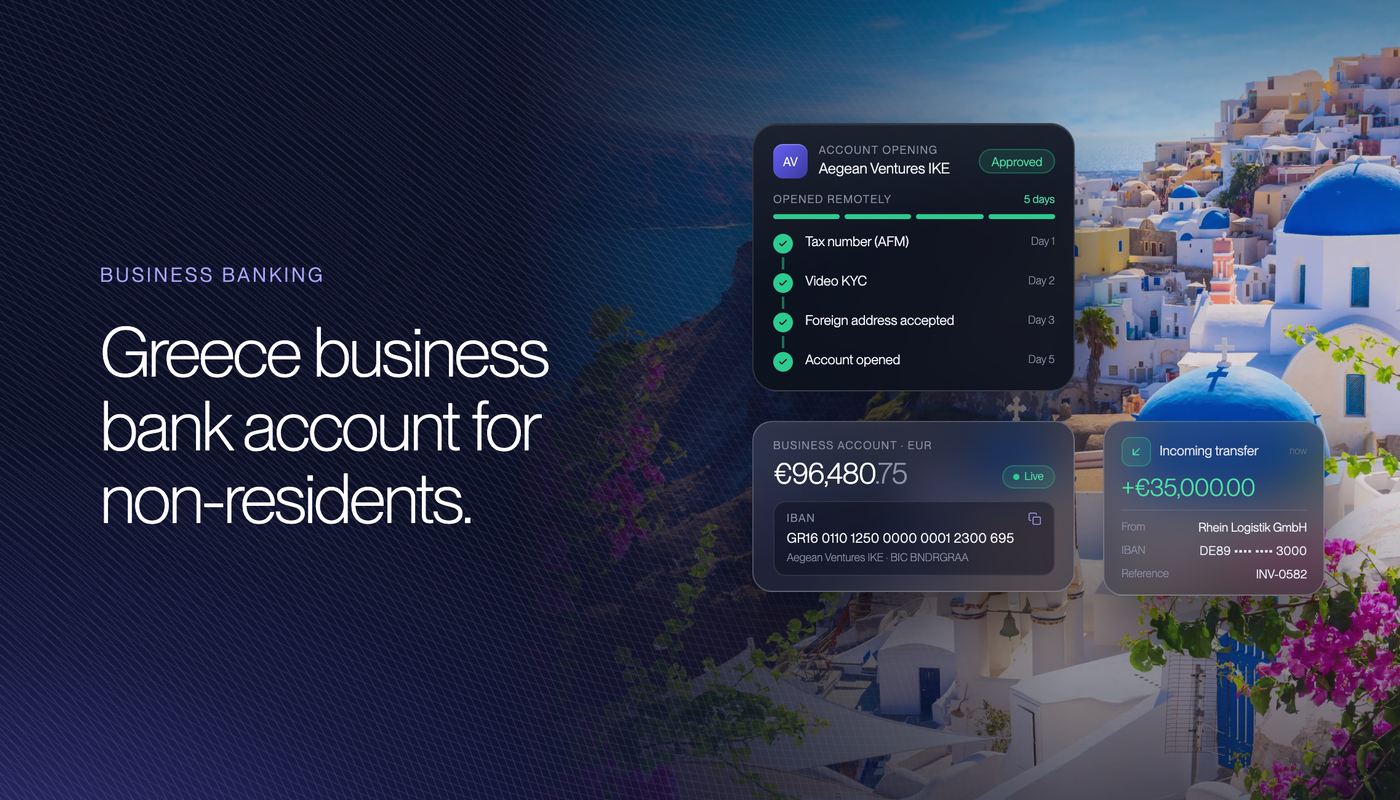
A business bank account in Greece gives your company an EU IBAN, euro payments across the SEPA area and instant transfers that settle within 10 seconds. Company deposits are covered up to €100,000 per bank by the Hellenic Deposit and Investment Guarantee Fund, and a Greek private company can be formed with no minimum capital.
The hard part is getting in from abroad. Five banks hold about 96% of Greek banking assets, and they meet foreign-based companies at a branch or through a separate remote unit. One charges non-resident companies it serves remotely €200 to assess the file and €150 a year to renew it, and expects €1,500 to stay in the account. Every founder also needs a Greek tax number first.
We make it simple. We prepare your full file with you, from the tax numbers and apostilles to the ownership chart and source of funds. Our licensed banking partners then open a multi-currency account online in days, with no branch visit. One team, one contact, done.
Our top-rated, licensed banking providers open multi-currency accounts with euro IBANs for companies in Greece in days, fully online.

MoneyGate
Business Banking
Monthly fee
€30
Onboarding fee
€500
Time to onboard
2-3 days
Features
Dedicated IBAN, SEPA, FX and more

3S Money
Cross-border payments
Time to onboard
4 Days
Account opening fee
Free
Monthly fee
Starting from € 100
Why Greek Bank Accounts Are Hard for Non-Residents
Greek bank accounts are hard for non-residents because a handful of banks hold almost the whole market, every founder needs a Greek tax number, and foreign-based companies are sent to branch appointments or separate remote units with their own fees. A business bank account in Greece for a company run from abroad draws more questions than any other file.
Five Banks Hold Almost the Whole Market
Greece had 35 domestic credit institutions in 2009. The Hellenic Bank Association counts 13 today, nine commercial banks and four cooperatives, plus 21 branches of foreign banks with an insignificant market share. In 2024 the five largest, Piraeus, National Bank of Greece, Alpha Bank, Eurobank and CrediaBank, held about 96% of banking assets, up from 69% in 2009. Branches fell from 1,702 in 2020 to 1,383 in 2024.
CrediaBank itself is new: Attica Bank and Pancreta Bank merged in 2024 and rebranded in July 2025. Consolidation made the banks stronger, with a non-performing loan ratio of 3.6% in the third quarter of 2025, but it also left a refused company with very few other doors to knock on.
Every Founder Needs a Greek Tax Number
Greek company formation runs through the One-Stop Shop, which issues the company's GEMI number, EUID and tax number (AFM) in one process under Joint Ministerial Decision 38164/2025. Every natural-person founder must already hold an active AFM and TAXISnet or eIDAS credentials, and a company that founds another company needs a Greek AFM too. Banks then check the tax details of the company and its people.
Non-residents can get an AFM through the myAADE app, a myAADElive video call, a tax office or a representative. Since 9 September 2024, AADE Decision A.1069/2024 has made a Greek tax representative optional for foreign residents who accept notices at their registered contact details. It is doable from abroad, but it is one more step before any bank will look at the file.
Open a Business Bank Account in Greece
Opening a business bank account in Greece from abroad is very doable with the right partner and a complete file. This is what we handle for you.
- No branch appointment: Identity checks by passport and selfie, from anywhere.
- Banks slow to onboard: Our partners open in days, fully online.
- Euro IBANs included: SEPA and SWIFT payments from one account.
- Multi-currency from day one: EUR, GBP, USD and more in one place.
- Tax numbers sorted: We tell you which founders need an AFM, and when.
- Avoid a rejection: We check the fit before anything is submitted.
- No back-and-forth emails: One point of contact from start to finish.
Foreign-Based Companies Need an Appointment
Greek banks built their online onboarding for Greek companies. Alpha Bank's digital business account is open only to companies registered and taxed in Greece whose single legal representative already banks with Alpha, and it takes about three working days. National Bank of Greece offers online opening to the legal representatives of Greek IKE, OE, EE, AE and EPE companies. Eurobank asks companies based abroad, or with more than one tax residence, to call and book a branch appointment.
The Bank of Greece does allow remote identification by video call or dynamic selfie, including for the beneficial owners and legal representatives of companies, under Executive Committee Act 172/1/29.05.2020. Its July 2025 amendment added automated video checks but capped accounts opened by dynamic selfie at €15,000 in credits a year, far below what a trading company moves. To open a bank account in Greece, non-resident owners usually still travel or wait for the bank to agree another route.
Non-Resident Companies Pay a Separate Tariff
Piraeus Bank serves non-resident legal entities remotely through its International Business Unit, under a separate section of its price list. It charges €200 to start and assess the relationship, €70 to legalise a foreign legal entity for up to three years, €150 for each annual remote renewal, €10 per remote order on top of the normal fee and €100 to close the account remotely. It also expects €1,500 to remain in the account.
Other banks charge foreign companies more to keep their file current. Optima bank charges €45 to review a foreign legal entity's legitimation, against €25 for a Greek one, and CrediaBank charges €40 plus VAT to renew a foreign legal entity's file. None of this is large on its own, but it all falls on the company that is least able to walk into a branch.
Fee Caps That Leave Companies Out
Greece capped some bank charges in December 2024. Article 48 of Law 5167/2024 limits domestic transfers to €0.50 each for up to €5,000 a day from 20 January 2025 and makes bill payments free, and most ATM withdrawal fees were dropped from 11 August 2025. Those protections apply to individuals, sole traders and freelancers only. Companies such as an IKE or an AE are excluded and pay the full business tariff.
Why Greek Banks Refuse Business Accounts
Refusals are common for companies run from abroad, and Greek banks rarely explain them. The files that stall share the same gaps: founders without an AFM, documents that are not apostilled or translated, certificates older than three months, an ownership chart that stops before the full chain of beneficial owners, and no clear reason for the company to be in Greece. A source of funds that rests on a single sentence ends many reviews, and so does activity in a sector the bank does not serve.
What to Do After a Refusal
Do not resubmit the same file to the next bank. Find the gap first, fix it with documents, then apply once to a provider whose rules fit your company. Each refusal in a five-bank market removes a large share of your options, and the next bank will ask where else you applied. Our guide to reapplying after a rejected business account walks through the rebuild.
Greek Banks for Business Accounts
Greek banks for business accounts publish clear tariffs, and their monthly fees are low. The problem for a non-resident is access, not the monthly fee, and there is no single best business bank account in Greece for a company run from abroad. The table shows who each bank takes, who it turns away and what it charges to keep a company account open.
Bank | Who it takes | Who it turns away | Monthly fee |
|---|---|---|---|
National Bank of Greece | Greek companies, online for IKE, OE, EE, AE and EPE | Files outside its risk appetite | €4 a month on Business BASIC, €130 a year on PRESTIGE |
Eurobank | Greek companies, and foreign-based companies by branch appointment | Companies that cannot attend or complete the file | €3.80 a month, free above a €100,000 average balance |
Alpha Bank | Greek-registered companies online, through an existing customer | Foreign companies from its online route | €5 a month |
Piraeus Bank | Greek companies, and non-resident companies through its remote unit | Files that fail its assessment | €30 a half-year, plus €150 a year for remote non-residents |
Optima bank | Greek and foreign companies after a legitimation review | Files that fail the legal review | In line with other Greek banks, plus a €45 foreign entity review |
CrediaBank | Greek companies and foreign legal entities | Files outside its risk appetite | €20 a half-year |
The pattern is clear. A Greek company with a Greek director pays a few euros a month and can often open online. A company run from abroad meets the same bank at a branch or through a remote unit, pays assessment and renewal fees, and waits. The best countries for business banking are the ones where that gap is small, and in Greece it is still wide. Our guide to a European business bank account for non-residents compares the wider picture.
International Payments Cost Far More Than Local Ones
Greek banks price euro payments inside the EEA cheaply and everything else steeply. Eurobank charges SMEs €1.20 for an online SEPA transfer up to €5,000, but €17 to send up to €12,500 to a bank outside the EEA and €30 up to €50,000. National Bank of Greece charges €20 up to €12,500 and 2 per mille above that, up to €300. Alpha charges €17 to €100, and Piraeus €9 to €150 plus a €2 or €4 message fee. Choosing to pay the foreign bank's charges adds €8 to €60.
Currency Conversion at the Bank's Rate
Conversion commissions look small: 0.10% at Eurobank, Alpha, Piraeus and Optima, and 1 per mille at National Bank of Greece, each capped at €30. But the commission sits on top of the exchange rate the bank sets for the day, and a company that receives dollars or pays suppliers in sterling pays both on every transfer. For a company whose customers pay in euros this matters little. For a company paying abroad, it is the cost that grows.
Slow, Paper-Heavy Onboarding
Piraeus asks for foreign documents with an apostille or other legal certification and an official translation into Greek or English, and it will not accept certificates issued more than three months before submission. Eurobank asks shareholders over 25%, legal representatives and account managers for identity, a tax clearance certificate or recent tax return and proof of residence, and asks the company for its E3 and Form N tax filings. One agent reports that opening can take two to four weeks, roughly one to two weeks in practice, and longer when founders live abroad.
Read more: a business bank account for non-residents and why banks reject business account applications.
3S Money
Cross-border payments
Time to onboard
4 Days
Account opening fee
Free
Monthly fee
Starting from € 100
A Faster Way to Open a Greek Business Account
There is a better way to open a Greek business account from abroad. Our banking partners are licensed e-money institutions that onboard international companies every day. They open accounts remotely, with identity checks by passport and selfie, no branch appointment, no non-resident surcharge and no balance kept idle in the account, usually within days.
One of our partners is licensed by the Central Bank of Cyprus and runs a branch in Athens registered with the Bank of Greece, so it knows Greek companies and paperwork well and can issue Greek IBANs. Another is licensed in the UK, Luxembourg and the DIFC, adding sterling, dirham and dozens of other currencies. Client money is safeguarded in segregated accounts at banks, apart from each partner's own funds.
Feature | Greek banks | Our partners |
|---|---|---|
Time to open | 1 to 4 weeks, longer for non-resident founders | About 2 to 10 business days |
Branch visit | Appointment for foreign-based companies at some banks | None, identity checked online |
Non-resident fees | €200 assessment and €150 a year at one bank | Same plan for every owner |
Balance kept in the account | €1,500 for non-residents at one bank | None |
Monthly cost | €3.80 to €10 a month, or €20 to €30 a half-year | Free to €100 a month |
Currencies | EUR, others through conversion | EUR, GBP, USD, AED and dozens more |
Payments outside the EEA | €9 to €300 plus message fees | Around €25 to €30 plus a small percentage |
Currency conversion | 0.10% commission plus the bank's rate | One margin, shown before you confirm |
The partner route removes the appointment, the non-resident tariff and most of the wait. A Greek bank still suits a company with a Greek director, Greek staff and customers paying in euros, where the domestic tariff is cheap and the online route works, and we say so when it applies.
How to Open a Business Bank Account in Greece
How to open a business bank account in Greece with us comes down to five steps. First, we check your structure, sector and countries against each partner's rules. Second, we build the file with you: GEMI certificate, articles, tax numbers, ownership chart, source of funds and proof of activity. Third, every director and owner completes an online identity check. Fourth, one partner reviews one complete file. Fifth, the account goes live and you receive your IBANs.
Who Our Partners Accept
Our partners take Greek companies owned and run from most countries, as long as the business is real and the money is explained. They also take companies registered elsewhere in the EU, such as Cyprus, and in the UK, the UAE and Switzerland that trade with Greece. That includes holding companies, shipping companies, trading and software companies and payment businesses that need a multi-currency account. Companies linked to sanctioned countries are declined by every partner. We check the fit before you open a Greek business account with any of them, so you never collect a refusal.
MoneyGate
Business Banking
Monthly fee
€30
Onboarding fee
€500
Time to onboard
2-3 days
Features
Dedicated IBAN, SEPA, FX and more
3S Money
Cross-border payments
Time to onboard
4 Days
Account opening fee
Free
Monthly fee
Starting from € 100
Documents Needed for a Greek Business Bank Account
The documents needed for a Greek business bank account cover the company, every person behind it and what the business really does. For a non-resident, the stamps and translations matter as much as the list itself, because one missing apostille or a certificate older than three months sends the file back. Anyone working out how to open a business bank account in Greece from abroad should start here.
For the Company
Banks ask for a recent GEMI certificate of registration and a certificate showing who can represent the company, the articles of association, the company's AFM, a beneficial owner declaration on the bank's own form and a resolution approving the account. Piraeus asks for the group structure as well. An established company adds its E3 and Form N tax filings, which Eurobank lists for existing businesses.
For Each Director, Owner and Signatory
Following Eurobank's list, every shareholder over 25%, legal representative and account manager provides a passport or ID, proof of residence and a tax clearance certificate or recent tax return, and each founder needs a Greek AFM. Non-EU founders who live in Greece, or plan to, need a residence permit to found the company. Tax documents from another country can take weeks to obtain, so request them first.
For the Business
Add a short business plan with expected turnover, customers, suppliers and countries, contracts or invoices with key counterparties, a live website, and documents proving the source of the first deposit. Licensed businesses add their licence. Greek banks do not list source of funds in their published document lists, but it is one of the first questions a reviewer asks about a company run from abroad, as our guide to KYC for business account opening explains.
Apostille and Translation
Documents issued outside Greece need legal certification, usually an apostille under the Hague Convention, and an official translation. Piraeus accepts translations into Greek or English. Certificates must be issued no more than three months before you submit them, so order company extracts last, after everything else is ready.
Read more: documents needed to open a business bank account and business bank account requirements.
Greece Business Account for Non-Residents
A Greece business account for non-residents opens quickly when the file is ready before the first review. We prepare it with you, including the documents needed for a Greek business bank account.
- No residency needed: Owners and directors can live abroad, outside sanctioned countries.
- No non-resident surcharge: The same plan whoever owns the company.
- Apostilles sorted: We tell you which documents need one.
- Fresh certificates: Company extracts ordered last, so none expire.
- Video identity checks: Passport and selfie from your own phone.
- Clear pricing: Every fee confirmed in writing before you apply.
Greek Business Bank Account Costs
Greek business bank account costs depend on where the company is run from. A Greek company with a Greek director pays low monthly fees, while a company run from abroad pays assessment, renewal and legitimation fees on top. The table sets typical ranges at Greek banks against our partners' plans.
Charge | Typical range at a Greek bank | With our partners |
|---|---|---|
Account opening or assessment | Free for local companies, €200 remote assessment for non-residents at one bank | Free to €500 |
Foreign legal entity review | €40 to €70 | No separate review fee |
Monthly fee | €3.80 to €10 a month, or €20 to €30 a half-year | Free to €100 a month |
Annual non-resident renewal | €150 a year at one bank | None |
Balance kept in the account | €1,500 for non-residents at one bank | None |
SEPA payment out | €0.50 to €25 online, by amount | From €2 per payment |
Payment in | Free for small amounts, then €3 to €10 | Free to €5 for SEPA, up to €20 for SWIFT |
Payment outside the EEA | €9 to €300, plus a €2 to €4 message fee at one bank | Around €25 to €30 plus a small percentage |
Paying the foreign bank's charges | €8 to €60 extra | Shown before you send |
Currency conversion | 0.10% commission plus the bank's rate | One margin, shown before you confirm |
Remote payment order | €10 per order at one bank | Online in the app, no order fee |
Account closure | Free at most banks, €100 remote closure at one | Up to €200 |
The monthly fee is the advertised number and the smallest one. For a company run from abroad, the cost is in the access: €200 to open a remote relationship at one bank, €150 every year to renew it, €70 to legalise the foreign company and €1,500 sitting idle in the account. Then comes every payment that leaves the EEA at €9 to €300, and the weeks of waiting before the first supplier can be paid.
Greek banks are cheap for domestic euro payments, and that is fair to say plainly. An online SEPA transfer under €5,000 costs €1 to €1.40 at the largest banks, less than our partners charge. So the case for our partners is speed, remote access, currencies and no idle balance, not a lower price on every line. For a company with modest volumes and a Greek director, a Greek bank can cost less overall. All figures are planning ranges from published tariffs, and we confirm your final price in writing before you apply.
MoneyGate
Business Banking
Monthly fee
€30
Onboarding fee
€500
Time to onboard
2-3 days
Features
Dedicated IBAN, SEPA, FX and more
3S Money
Cross-border payments
Time to onboard
4 Days
Account opening fee
Free
Monthly fee
Starting from € 100
How Long a Greek Business Bank Account Takes
A Greek business bank account takes roughly one to two weeks in practice and up to two to four weeks, according to one agent, and longer when the founders live abroad. Alpha's online route takes about three working days, but only for Greek companies whose representative is already a customer. With our partners, a complete file usually opens within 2 to 10 business days.
Stage | Greek bank | Our partners |
|---|---|---|
Tax numbers and founder documents | AFMs, apostilles and translations come first | Prepared with us in parallel |
Appointment or remote assessment | Branch slot or remote unit review | Not needed |
Review and follow-up questions | Questions by email or at the branch | One review of one complete file |
Account open and ready | 1 to 4 weeks, longer for non-resident founders | About 2 to 10 business days |
What Slows It Down
The usual delays are a founder without an AFM, apostilles and translations, a certificate that expired while the file waited, the branch appointment, a beneficial owner filing that does not match the ownership chart, and a source of funds without documents. New companies must register their beneficial owners within 60 days of formation, so a young company's filing is often still pending when the bank asks for it.
How to Speed It Up
Get every founder's AFM first, order apostilles and translations next, and request company certificates last so they are fresh. Write down your customers, suppliers, countries and expected volumes before you apply, and answer every question the same day. The fastest route is a partner that reviews one complete file online, and our guide on how long a business bank account takes compares the routes.
MoneyGate
Business Banking
Monthly fee
€30
Onboarding fee
€500
Time to onboard
2-3 days
Features
Dedicated IBAN, SEPA, FX and more
What Happens After the Account Is Open
Once the account is open, fund it, add users and share your IBAN with customers and suppliers. From then on, tax filings, registry updates and payee checks all run through the account.
Tax, Filings and the Beneficial Owner Register
Greek companies pay 22% corporate income tax, and dividends carry a 5% withholding tax, with an exemption for EU parent companies holding at least 10% for 24 months. Changes to beneficial owners must be filed within 60 days, and law firms report fines of €5,000 to €40,000 for failing to register. Banks ask for the latest filings at every review, so a missed deadline slows the account too.
Payee Checks on Every Transfer
Since 9 October 2025, Greek banks check the payee's name before a euro transfer leaves, and for companies the check can include the AFM or LEI. Press reports said 31% of 1.7 million transfers were rejected over name mismatches in the first days. Keep the company name identical on invoices, contracts and every account, and agree one spelling of it in Latin letters.
Instant Payments and IRIS
The Greek clearing house DIAS connected to the ECB's instant payment system in December 2021, and instant euro payments settle within 10 seconds, at no more than the price of a standard transfer. IRIS, the Greek instant payment service, serves individuals, freelancers and sole traders with a €1,000 daily limit, so a company's supplier and payroll payments run as standard or instant SEPA transfers.
Why the Company Comes Before the Account
A bank or partner can only verify a Greek company once it exists, with a GEMI number, an AFM and its beneficial owners on file. An IKE can be formed with capital set by the partners, which the law says may even be zero, through a chamber One-Stop Shop for €60 plus €10 for GEMI registration, or online through e-YMS for €18, usually within two to five business days.
The bank file can be built while the company is being formed. We collect the founders' documents, prepare the ownership chart and write the source of funds pack in parallel, so the application is ready the day the GEMI number arrives. Read more: company formation with a bank account and setting up a company as a non-resident.
3S Money
Cross-border payments
Time to onboard
4 Days
Account opening fee
Free
Monthly fee
Starting from € 100
Common Greek Business Bank Account Mistakes
Most files that stall in Greece stall for the same few reasons. These are the ones we see most, and what to do instead.
Applying Before Every Founder Has an AFM
A Greek company cannot be formed without an AFM for every natural-person founder, and a bank cannot finish its checks without the tax details of the people behind the company. Founders who leave the AFM until last lose weeks. Apply through the myAADE app or a myAADElive video call as soon as the structure is decided, and keep the confirmation for the bank file. Since September 2024 a tax representative is optional for foreign residents who accept notices at their registered contact details, so appoint one only if it helps you.
Sending Documents Without Apostille or Translation
A foreign passport copy, a parent company extract or a board resolution without legal certification is one of the most common reasons a Greek file goes back. Piraeus asks for an apostille or equivalent certification and an official translation into Greek or English. Check each foreign document against that rule before you send anything, order the apostilles and translations early, and keep the originals together so a second request does not start the process again.
Letting Certificates Go Stale
Greek banks want company certificates issued no more than three months before submission. A file that waits for an appointment, a missing AFM or a translation can see its GEMI certificates expire, and the bank then asks for new ones. Order the company extracts last, once everything else is ready, and track the dates. If the review drags on, ask early whether fresh copies are needed, rather than finding out at the end.
Assuming Greek Fee Caps Cover the Company
Many founders read that Greek transfers are capped at €0.50 and plan around it. That cap, and the free ATM withdrawals that followed in August 2025, apply only to individuals, sole traders and freelancers under Law 5167/2024. An IKE or an AE pays the full business tariff, including €9 to €300 for each payment outside the EEA. Build the real business tariff into your plan, or use a partner account where international payments and conversion are priced upfront.
Mismatched Names on Payments
Since payee checks became mandatory in October 2025, a transfer to a company whose name does not match the account can be flagged or stopped. A Greek company name can appear in Greek letters in the registry and in Latin letters on invoices, which is where mismatches start. Agree one Latin spelling with your bank or partner, use it on every invoice and contract, and tell your customers the exact account name to use.
Non-Resident Business Bank Account in Greece
A non-resident business bank account in Greece is very manageable with the right plan. Talk to us before you apply anywhere.
- Refused before: We review the old file and fix what failed.
- Founders abroad: AFMs and apostilles planned before any bank sees the file.
- Multi-currency needs: EUR, USD, GBP and more in one account.
- Shipping and trading companies: Partners used to international payment flows.
- Honest advice: We tell you when a Greek bank is the better fit.
Bottom Line
A business bank account in Greece gives your company an EU IBAN, deposit cover and fast euro payments. For a company run from abroad, the banks make it slow: five banks hold almost the whole market, every founder needs an AFM, foreign-based companies meet branch appointments or remote-unit fees, and payments outside the EEA cost €9 to €300 each.
Our licensed partners open the account online in days instead, including one with a branch registered with the Bank of Greece. If you are working out how to open a business bank account in Greece from abroad, start with a complete file and apply once to a provider that fits. You can add a Greek bank later, once the company has staff, customers and a trading history in Greece.
Can a non-resident open a business bank account in Greece?
Do I need to visit Greece to open a business bank account?
Which Greek banks accept foreign-owned companies?
How much does a business bank account in Greece cost?
How long does it take to open a business bank account in Greece?
Do I need a Greek tax number (AFM) to open a business account?
What documents are needed for a Greek business bank account?
Can I open a bank account in Greece online as a non-resident?
Do Greek bank fee caps apply to company accounts?
Are business deposits protected in Greece?
Can I get a Greek IBAN without a Greek bank?
Should I form the Greek company before opening the account?
Why do Greek banks refuse business accounts?
Sources
- Hellenic Bank Association, Greek banking system overview, November 2025
- National Bank of Greece, charges for other banking transactions
- Eurobank, banking transactions price list, September 2026
- Alpha Bank, transaction terms, commissions and other charges
- Piraeus Bank, price list, September 2026
- Alpha Bank, opening a business account online
- Law 5167/2024, article 48
- AADE, Decision A.1069/2024 on tax representatives
- Bank of Greece, Executive Committee Act 172 on remote identification
- Joint Ministerial Decision 38164/2025 on the One-Stop Shop
- DIAS, instant payments
- Piraeus Bank, deposit and investment guarantee
- PwC, Greece corporate taxes on income