Corporate tax filing in the UAE is the yearly return every taxable person sends to the Federal Tax Authority. It reports the accounting profit, adjusts it to taxable income and works out the tax due.
The hard part is that almost everyone has to file, and the form asks for more than a profit figure. A company with no tax to pay still files. So does one that uses Small Business Relief, and so does a free zone company at 0%. The return and the payment are due nine months after year end. A late return costs AED 500 a month, rising to AED 1,000 a month after a year, and unpaid tax is charged at 14% a year.
This is where we come in. Binderr connects you with our tax partners in the UAE, who prepare the computation from your accounts, complete the return on EmaraTax and file it before the deadline, with one quote priced on your scope.
Corporate Tax Filing in the UAE, Done for You
Our partners prepare and file your corporate tax return each year. Pricing is custom and set on your scope.
- Accounts checked: Financial statements reviewed against the standards the law requires.
- Taxable income computed: Every adjustment worked through and documented.
- Elections made: Small Business Relief and other choices tested before they are ticked.
- Filed on EmaraTax: Return submitted before the nine-month deadline.
- Payment planned: The amount due confirmed to you with time to pay.
Who Has to File and When
Every taxable person files a return for every tax period, whatever the result. Corporate tax filing in the UAE does not depend on making a profit or on owing tax.
Who | Files a return | Note |
|---|---|---|
Mainland company | Yes | Even with a loss or no activity |
Free zone company | Yes | The 0% rate is claimed in the return |
Company using Small Business Relief | Yes | A shorter version of the return |
Individual with business turnover above AED 1 million | Yes | For the calendar year |
Tax group | One return | Filed by the parent company |
Foreign company with a permanent establishment in the UAE | Yes | For the income of the establishment |
Exempt person that must register | Annual declaration | Within the same nine months |
The UAE Corporate Tax Filing Deadline
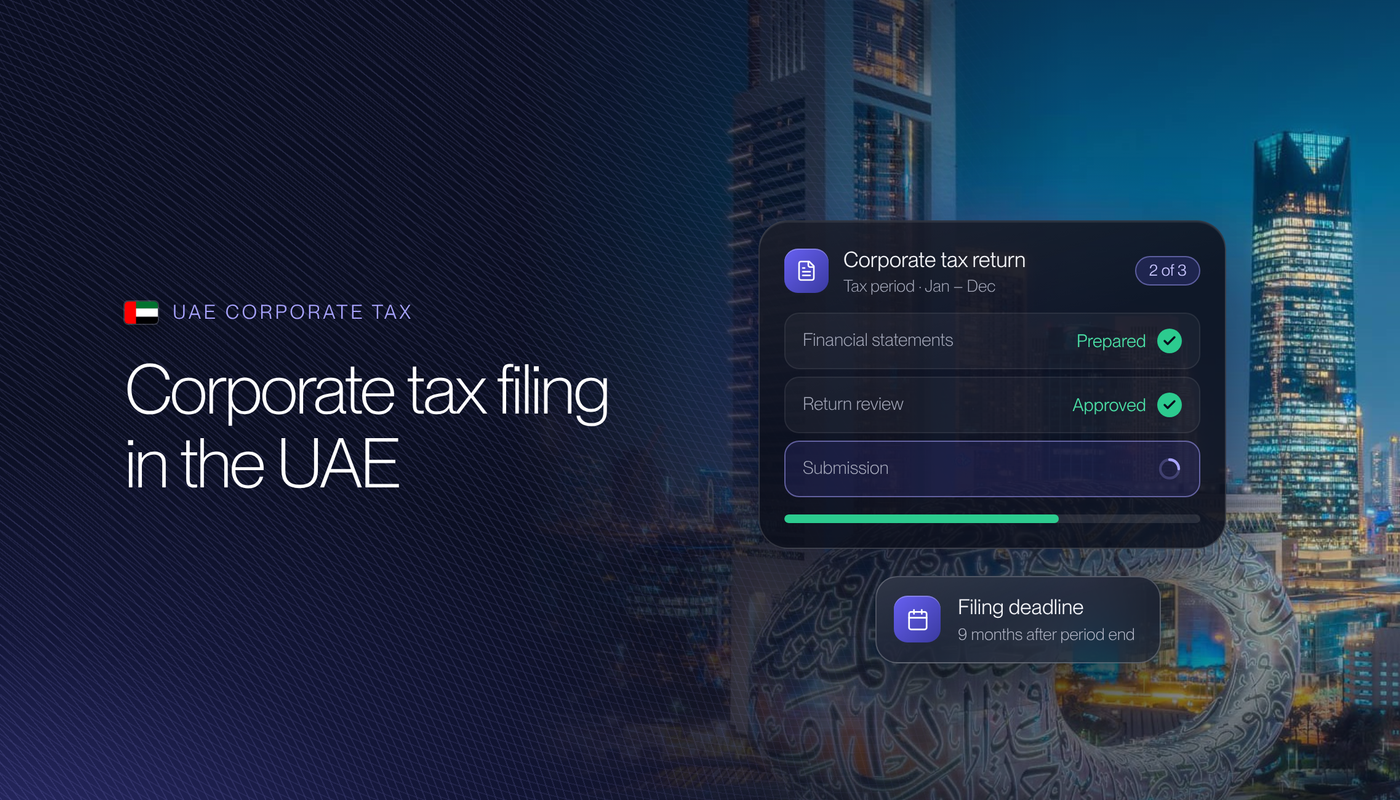
The UAE corporate tax filing deadline is nine months after the end of the tax period. The tax is due on the same date. The tax period is the company's financial year, so the date depends on the year end.
Financial year ends | Return and payment due |
|---|---|
31 December 2025 | 30 September 2026 |
31 March 2026 | 31 December 2026 |
30 June 2026 | 31 March 2027 |
31 December 2026 | 30 September 2027 |
The FTA advises filing early. The return can be submitted as soon as the accounts are ready, and nothing is gained by waiting for the ninth month.
Your First Tax Period
A new company's first tax period follows the first financial year in its constitutional documents. It can be shorter or longer than 12 months. Read the registration certificate when the TRN arrives, because it shows the first tax period and so the first deadline. Corporate tax return filing in the UAE starts with that date.
The Seven-Month Route for Late Registrants
A company that registered late for corporate tax owes a AED 10,000 penalty. The FTA waives it where the first return is filed within 7 months of the end of the first tax period, in place of the usual 9. The tax itself is still due by the nine-month date. Our guide to corporate tax registration in the UAE covers the waiver.
Read more: Corporate tax in the UAE

UAE Accounting and Tax Services
Exval
Services
Accounting, VAT, tax, audit
Company types
Mainland, free zone, offshore
Filing
FTA compliant
Pricing
Custom
What Goes Into Corporate Tax Return Filing in the UAE
Corporate tax return filing in the UAE starts from the financial statements and ends with one figure: the tax payable. The FTA lists what the return must show.
- The tax period and the date of filing.
- The name, address and TRN of the taxable person.
- The accounting basis used in the financial statements.
- The taxable income for the period.
- The tax loss relief claimed and the losses carried forward.
- The tax credits available.
- The corporate tax payable.
From Accounting Profit to Taxable Income
Taxable income is the accounting profit after the adjustments the law requires. These are the common ones.
Item | Effect on taxable income |
|---|---|
Dividends from UAE companies | Taken out, because they are exempt |
Qualifying foreign dividends and gains | Taken out under the participation exemption |
Client entertainment | 50% added back |
Fines and penalties | Added back |
Donations to bodies that are not approved | Added back |
Net interest above AED 12 million | Capped at 30% of EBITDA |
Payments to owners above market value | The excess is added back |
Tax losses from earlier years | Set against up to 75% of taxable income |
Take a trading company with an accounting profit of AED 1,200,000. It spent AED 40,000 on client entertainment, paid AED 5,000 in fines and received AED 100,000 of dividends from a UAE company. It has AED 200,000 of losses from last year.
- Add back: AED 20,000 of entertainment and AED 5,000 of fines.
- Take out: AED 100,000 of exempt dividends.
- Taxable income before losses: AED 1,125,000.
- Losses used: AED 200,000, which is inside the 75% limit.
- Taxable income: AED 925,000.
- Tax: 9% of the AED 550,000 above AED 375,000, which is AED 49,500.
Elections in the Return
The return asks the company to make choices, and some of them last. Small Business Relief is elected year by year. The choice to tax gains only when they are realised is made in the first return and is hard to reverse. A free zone company that elects to be taxed at the standard rate is bound for several years. Each election should be tested with figures before it is ticked.
Financial Statements Come First
The return cannot be better than the accounts behind it. Financial statements must follow IFRS, or IFRS for SMEs where revenue is AED 50 million or less. A business with revenue of AED 3 million or less may use the cash basis. Audited statements are required where revenue is above AED 50 million, for every Qualifying Free Zone Person and for every tax group. Our guides to accounting services in the UAE and audit services in the UAE cover that work.
Get Your Numbers Ready Before the Return
Most of the work in corporate tax return filing in the UAE happens before anyone opens EmaraTax. Our partners start with the accounts.
- Books closed: Year-end entries posted and balances reconciled.
- Standards checked: IFRS or IFRS for SMEs applied, or the cash basis where allowed.
- Audit arranged: Where your revenue, free zone status or group needs one.
- Adjustments listed: Each difference between profit and taxable income set out.
- Elections tested: Small Business Relief and other choices compared in figures.
- Losses tracked: Earlier losses confirmed and carried into this year.
How to File Corporate Tax in the UAE on EmaraTax
To file corporate tax in the UAE, you complete the return online on EmaraTax. The platform is open 24 hours a day. The form adapts to your answers, so a small company sees fewer sections than a group.
- Step 1: Log in to EmaraTax with UAE Pass or your email and password.
- Step 2: Open the taxable person profile and go to the corporate tax section.
- Step 3: Open the return for the tax period that is due.
- Step 4: Check the details that are filled in from your registration, and correct the registration first if they are wrong.
- Step 5: Answer the questions on elections, such as Small Business Relief.
- Step 6: Enter the accounting figures from your financial statements.
- Step 7: Enter the adjustments, exempt income, reliefs and losses.
- Step 8: Complete the schedules that apply to you, such as related party transactions.
- Step 9: Review the tax payable, confirm the declaration and submit.
- Step 10: Pay the tax before the deadline.
Is There a UAE Corporate Tax Return Format PDF
People often look for a UAE corporate tax return format PDF to fill in and upload. There is none. The return is an online form inside EmaraTax, and the figures are typed in or loaded section by section. The FTA's Corporate Tax Returns guide shows every section and field, and that guide is the closest thing to a printed format. After you submit, a copy of the return stays in your EmaraTax account.
The Sections of the Form
Section | What it asks |
|---|---|
Taxable person details | Name, TRN, tax period and activity, filled in from your registration |
Elections | Small Business Relief, realisation basis and other choices |
Accounting schedule | Revenue, costs and profit from the financial statements |
Adjustments and exempt income | The differences between accounting profit and taxable income |
Reliefs | Group transfers, restructuring relief and similar claims |
Losses and credits | Losses used and carried forward, and foreign tax credits |
Related parties | Transactions with related parties and connected persons |
Tax payable and declaration | The tax due and the signatory's confirmation |
Paying the Tax
The payment has the same deadline as the return, but it is a separate step. Filing does not pay the tax. The FTA advises paying well before the last day, because a bank transfer can take time, and a payment that arrives after the deadline is late. A dedicated company account helps, which our guide to opening a business bank account in the UAE covers.

UAE Company Incorporation
Binderr
Corporate tax
0% up to AED 375,000
Freezone Tax
0%
Time to Incorporate
1 Week
Cost
Starting from €1,899
Small Business Relief, Free Zones and Groups
The same form serves very different taxpayers. These are the cases where corporate tax filing in the UAE changes shape.
Small Business Relief
A resident company or individual with revenue of AED 3 million or less, in the tax period and in every earlier one, can elect to be treated as having no taxable income. The return is shorter, but it is still due. The relief runs to tax periods ending on or before 31 December 2029. A loss made in a year of relief cannot be carried forward, so the election is a poor choice in a loss year. Our guide to Small Business Relief in the UAE covers the test.
Free Zone Companies
A free zone company claims the 0% rate in its return by confirming that it is a Qualifying Free Zone Person. It reports qualifying income and other income separately and must hold audited financial statements. If a condition fails, the company is taxed at 9% for that period and the four after it. Our guides to free zone corporate tax in the UAE and free zone company formation in the UAE cover the conditions.
Tax Groups and Holding Companies
A tax group files one return through its parent, on consolidated figures, and needs audited statements. A holding company in the UAE with only exempt dividends still files and claims the exemption in the form.
Related Parties
Transactions with related parties and connected persons are disclosed in the return once they pass the thresholds in the FTA's guide. They must be priced at arm's length. Our guide to transfer pricing in the UAE covers the rules.
Individuals
An individual files only when the turnover of a business in the UAE passes AED 1 million in a calendar year. Wages, personal investment income and rent from property held as a personal investment are not counted. The return covers the calendar year and is due by 30 September of the next year. A holder of a freelance licence in the UAE is the usual case. Our guide to personal income tax in the UAE covers what is outside the tax.
Have the Return Prepared and Reviewed
Our partners know how to file corporate tax in the UAE so the return stands up to a later review. Corporate tax return filing in the UAE is checked by a second person before it goes in.
- Computation prepared: Profit to taxable income, line by line.
- Schedules completed: Related parties, losses and credits filled in.
- Free zone status confirmed: Conditions tested before the 0% rate is claimed.
- Draft shared: The return sent to you for approval before filing.
- Working papers kept: A file that explains every figure, held for 7 years.
Penalties for Late Corporate Tax Return Filing in the UAE
The penalties for late corporate tax return filing in the UAE are set by Cabinet decision and charged automatically.
Violation | Penalty |
|---|---|
Return filed late | AED 500 a month for the first 12 months, then AED 1,000 a month |
Tax paid late | 14% a year on the unpaid amount, charged monthly |
Registration filed late | AED 10,000 |
Records not kept for 7 years | AED 10,000, or AED 20,000 for a repeat within 24 months |
Error you disclose yourself | 1% a month on the tax difference |
Error the FTA finds in an audit | A fixed 15% plus 1% a month |
Take a company with a 31 December 2025 year end and AED 60,000 of tax. The return and the payment were due on 30 September 2026. It files and pays on 15 January 2027. The late return penalty covers four months or part months, so AED 2,000. The late payment penalty is 14% a year for the same four months, which is AED 2,800. The delay cost AED 4,800 on a AED 60,000 bill.
Correcting a Filed Return
An error that changes the tax due is corrected through a voluntary disclosure on EmaraTax. Disclosing first costs 1% a month on the difference. If the FTA finds the same error in an audit, the penalty is a fixed 15% plus 1% a month. Records must be kept for 7 years, and the FTA can ask for them at any point in that time.
What Filing Costs
The FTA charges nothing to file a return. The cost is the adviser's fee, and our partners quote it on scope.
Item | Cost |
|---|---|
FTA filing fee | None |
Our partners | Custom quote, priced on your scope |
Filing late | AED 500 a month, plus 14% a year on unpaid tax |
A dormant company or one that elects Small Business Relief needs the least work. A trading company needs a full computation. A free zone company adds the conditions test, and a group adds consolidation and transfer pricing. Clean books lower the fee in every case.
UAE Accounting and Tax Services
Exval
Services
Accounting, VAT, tax, audit
Company types
Mainland, free zone, offshore
Filing
FTA compliant
Pricing
Custom
Corporate Tax Filing in Dubai and the Other Emirates
Corporate tax filing in Dubai follows the same federal law, the same form and the same nine-month deadline as in every other emirate. There is no Dubai return and no Dubai tax office. A company with a corporate tax position in Dubai files on EmaraTax like one in Abu Dhabi or Sharjah.
What differs is the mix of taxpayers. Dubai has a large share of the country's free zone companies, in zones such as DMCC and DIFC, so more Dubai returns turn on the Qualifying Free Zone Person conditions and on an audit. Corporate tax filing services in Dubai are therefore often sold with the audit and the free zone review. Our guides to tax consultants in Dubai and accounting services in Dubai cover the local market.
Common Mistakes in UAE Corporate Tax Filing
Most problems in UAE corporate tax filing come from assumptions made before the form is opened.
Not Filing Because No Tax Is Due
Income under AED 375,000, a loss, Small Business Relief and the free zone 0% rate all still need a return. Each month of delay costs AED 500.
Filing Without a Corporate Tax TRN
A VAT TRN does not open a corporate tax return. The company must be registered for corporate tax first.
Using Accounts That Do Not Follow the Standards
Management accounts kept for the owner are not enough. The return rests on financial statements under IFRS or IFRS for SMEs, or on the cash basis where revenue is AED 3 million or less.
Missing the Audit
A free zone company that claims 0% without audited statements loses the status for five tax periods. Start the audit months before the return is due.
Ticking Small Business Relief Without Testing It
The relief removes the tax but also the loss. In a loss year, or just before a year of large profit, the normal rules can be better.
Paying on the Last Day
A transfer sent on the due date can arrive after it. The 14% a year penalty then applies from the first day.
Leaving a Closed Company Unfiled
A company that stops trading must deregister within 3 months and file a final return. Our guide to company liquidation in the UAE covers the steps.
UAE Company Incorporation
Binderr
Corporate tax
0% up to AED 375,000
Freezone Tax
0%
Time to Incorporate
1 Week
Cost
Starting from €1,899
How Our Partners Handle Your Return
Our partners start with your accounts. They close the year, check the standards, arrange the audit where one is needed and prepare the computation. They test the elections with you, complete the return, share the draft and file on EmaraTax once you approve. You pay the FTA from your own account.
Corporate tax filing in the UAE is usually part of a wider service. The same team keeps the books, files VAT and answers the FTA. If you are still setting up, we form the company, and our partners register it for corporate tax and set the filing calendar. Our guides to corporate tax services in the UAE, bookkeeping services in Dubai, VAT return filing in the UAE, company formation in the UAE, the tax residency certificate in the UAE and UAE double tax treaties cover the steps around the return.
Get Your Corporate Tax Return Filed on Time
Tell us your licence, your year end and your revenue. We connect you with our tax partners, and you get one quote for corporate tax filing in the UAE.
- Custom quote: Priced on your structure and the state of your books.
- Every taxpayer type: Mainland, free zone, groups and individuals.
- Accounts to return: Financial statements, computation and filing from one team.
- Deadline protected: Filed before the nine months are up.
- Late cases: Missed returns filed and the registration waiver checked.
- Remote by default: Documents shared online.
What is corporate tax filing in the UAE?
How to file corporate tax in the UAE?
When is the UAE corporate tax filing deadline?
Who has to file a corporate tax return in the UAE?
Is there a UAE corporate tax return format PDF?
What documents do I need for corporate tax return filing in the UAE?
What is the penalty for late corporate tax filing in the UAE?
Do I have to file if I owe no tax?
How does Small Business Relief change the return?
Do free zone companies file a corporate tax return?
How does corporate tax filing in Dubai work?
Can I correct a corporate tax return after filing?
How much do corporate tax filing services in Dubai cost?
Sources
- Federal Decree-Law No. 47 of 2022 on the Taxation of Corporations and Businesses, and its amendments
- Federal Tax Authority: corporate tax returns and payment within nine months
- Federal Tax Authority: late filing and late payment penalties for corporate tax
- Cabinet Decision No. 75 of 2023 on corporate tax administrative penalties, and its amendments
- Cabinet Decision No. 40 of 2017 on administrative penalties for tax violations, and its amendments
- Ministerial Decision No. 84 of 2025 on Audited Financial Statements
- Ministry of Finance: Ministerial Decision No. 114 of 2023 on accounting standards
- Ministry of Finance: Small Business Relief extended until 31 December 2029
- Federal Tax Authority: Waiver of Penalties
- Federal Tax Authority: Corporate Tax Registration service