VAT return filing in the UAE is how a registered business reports the VAT it charged and the VAT it paid for each tax period, and settles the difference with the Federal Tax Authority. The return is Form VAT 201, filed on EmaraTax, usually four times a year.
The hard part is the date and the detail. The return and the payment are both due by the 28th day after the tax period ends. A late return costs AED 1,000, a repeat within 24 months costs AED 2,000, and unpaid VAT is charged at 14% a year. A return is due even when there were no sales. Since 14 April 2026, an error the FTA finds in an audit costs a fixed 15% plus 1% a month.
This is where we come in. Binderr connects you with our accounting and tax partners in the UAE, who prepare each return from your books, check it and file it on EmaraTax before the 28th, with one quote priced on your scope.
VAT Return Filing in the UAE, Done for You
Our partners prepare and file your VAT return every tax period. Pricing is custom and set on your scope.
- Books reviewed: Sales, purchases and imports checked before the return is built.
- Boxes checked: Every figure placed in the right box of the VAT 201.
- Filed on EmaraTax: Return submitted before the 28th.
- Payment planned: The amount due confirmed to you with time to pay.
- Records kept: A file for each period, ready if the FTA asks.
What VAT Return Filing in the UAE Involves
VAT return filing in the UAE means completing Form VAT 201 on EmaraTax for every tax period and paying any VAT due by the same date. VAT filing in the UAE runs on a fixed cycle, and the cycle does not pause when business is quiet.
Item | Rule |
|---|---|
Form | VAT 201, completed online |
Where | EmaraTax, the FTA's platform |
How often | Every quarter, or every month for turnover of AED 150 million or more |
Due date | The 28th day after the tax period ends |
Payment | Due on the same date as the return |
Records | Kept for 5 years, or 15 years for real estate |
The UAE VAT Return in One Calculation
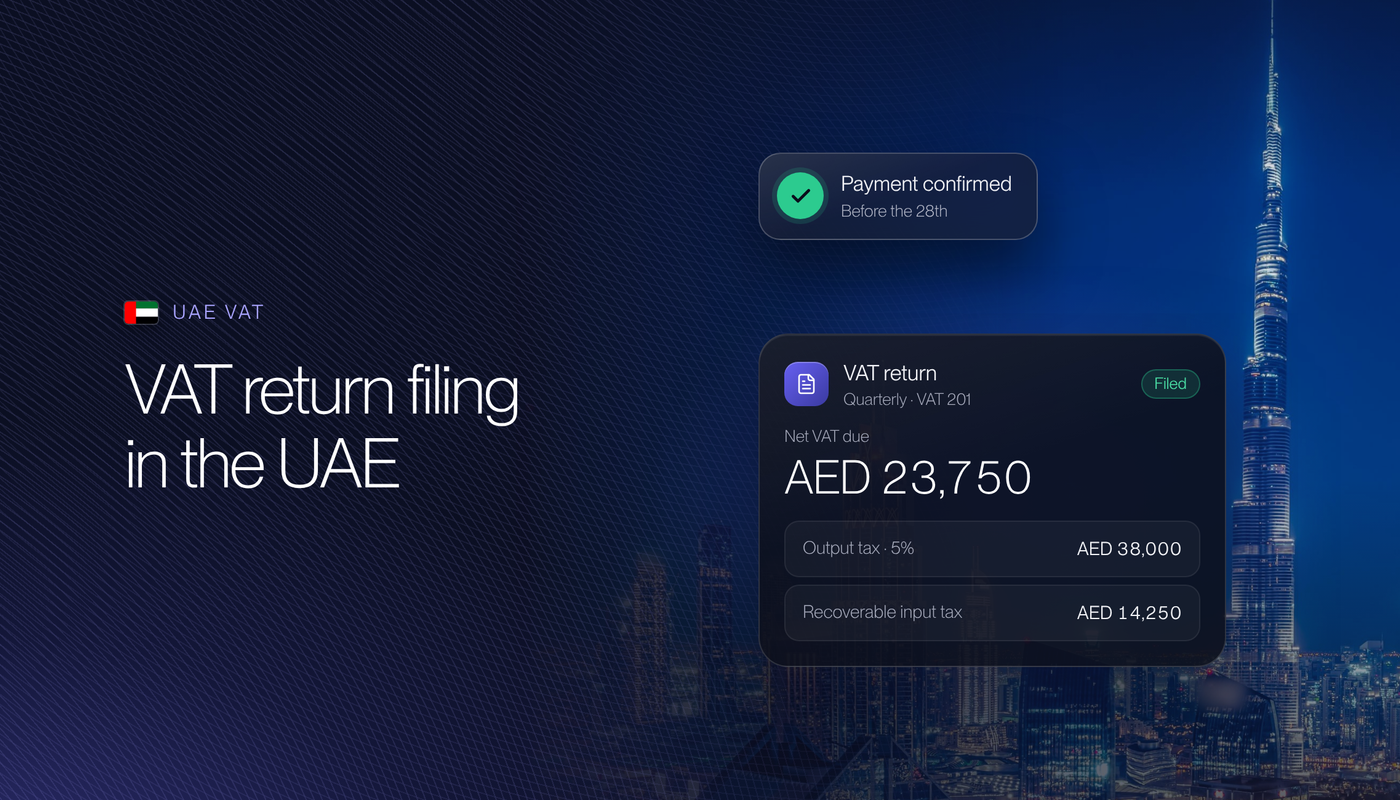
The return comes down to one sum: output tax minus recoverable input tax. Output tax is the VAT you charged on sales. Input tax is the VAT you paid on business costs and are allowed to recover.
Take a company that makes AED 400,000 of standard-rated sales in a quarter. Its output tax is AED 20,000. In the same quarter it buys AED 250,000 of goods and services with VAT, so its input tax is AED 12,500. It pays the FTA AED 7,500. If input tax is higher than output tax, the excess is carried forward to the next return or claimed as a refund.
Who Must File
Every business with a VAT registration files a return for every tax period, starting with the first period shown on its registration certificate. VAT filing in the UAE applies in the same way to a mainland company, a free zone company and a sole establishment. A tax group files one return through its representative member.
A return is due even when there were no sales and no purchases. It is filed with zeros and is known as a nil return. Our guide to VAT registration in the UAE covers who has to register, and our guide to the TRN number in the UAE covers the number that goes on every return.
VAT Filing in Dubai and the Other Emirates
VAT is a federal tax, so VAT filing in Dubai follows the same law, the same form and the same date as in Abu Dhabi or Sharjah. There is one difference inside the form. Standard-rated sales are split by emirate in boxes 1a to 1g, and Dubai is box 1b.
A VAT return in Dubai therefore shows the sales of a Dubai business in box 1b. A company with shops in Dubai and Sharjah reports each shop's sales under its own emirate. The split does not change the tax due. It decides how VAT revenue is shared between the emirates, and the FTA does check it.
Read more: VAT in the UAE

UAE Accounting and Tax Services
Exval
Services
Accounting, VAT, tax, audit
Company types
Mainland, free zone, offshore
Filing
FTA compliant
Pricing
Custom
UAE VAT Return Due Date and Tax Periods
The return is due on the 28th day after the end of each tax period. The FTA sets the tax period when it registers the business, and the registration certificate shows it. Most businesses file quarterly, and the FTA spreads them across three groups of quarters.
Quarter ends | Return and payment due |
|---|---|
31 March | 28 April |
30 June | 28 July |
30 September | 28 October |
31 December | 28 January |
Your own quarters may end in different months. Some businesses have quarters that end in January, April, July and October, and others in February, May, August and November. The rule is the same for all of them: the 28th of the following month. This is the calendar that UAE VAT filing runs on, and it is fixed for the life of the registration unless the FTA changes it.
Monthly Filers
A business with annual turnover of AED 150 million or more files every month. Its return for May is due on 28 June, and so on through the year. Monthly VAT filing in the UAE uses the same form and the same steps. The FTA can also assign a different tax period to certain types of business, so always go by the period shown in EmaraTax.
When the 28th Falls on a Weekend
Where the 28th falls on a weekend or a public holiday, the deadline moves to the next working day. Do not plan around this. The payment has to reach the FTA by the deadline as well, and bank transfers are not instant.
Your First Return
The first tax period is often shorter or longer than a normal quarter, because it starts on the effective date of registration. A company registered from 1 February in a March quarter group has a first period of two months, and its first return is due on 28 April. Read the certificate when it arrives.
VAT Return Filing Due Date in the UAE for a Final Return
The VAT return filing due date in the UAE is different for the last return. When a business deregisters, the final return and the final payment are due within 28 days of the effective date of deregistration. The FTA issues the deregistration certificate only after that return is filed and every amount is paid. Our guide to company liquidation in the UAE covers the closing steps around it.
Never Miss the 28th
The dates for VAT filing in the UAE do not move. Our partners build your calendar once and work to it.
- Tax period confirmed: Your quarters or months read from EmaraTax.
- Books closed early: Figures ready in the first two weeks after the period.
- Draft sent to you: The return shared for approval before it is filed.
- Payment reminder: The amount and the pay-by date sent ahead of the 28th.
- Nil returns filed: Quiet periods covered as well.
- First return checked: Short or long first periods handled correctly.
How to File a VAT Return in the UAE
To file a VAT return in the UAE, you log in to EmaraTax, open the return for the period that is due, enter the figures and submit. The platform is open 24 hours a day. The form itself is short. The work is in the figures behind it.
- Step 1: Log in to EmaraTax with UAE Pass or your email and password.
- Step 2: Open the taxable person profile and go to the VAT section.
- Step 3: Open the return for the tax period that is due. The period and the due date are filled in for you.
- Step 4: Enter your sales and the output tax in boxes 1 to 7.
- Step 5: Enter your purchases and the recoverable input tax in boxes 9 and 10.
- Step 6: Check the totals and the net VAT in boxes 12 to 14.
- Step 7: Confirm the declaration and submit the return.
- Step 8: Pay the VAT due before the deadline.
The VAT 201 Boxes
Box | What goes in it |
|---|---|
1a to 1g | Standard-rated sales, split by emirate |
2 | Tax refunds to tourists, for retailers in the refund scheme |
3 | Supplies under the reverse charge, such as services bought from abroad |
4 | Zero-rated supplies, such as exports |
5 | Exempt supplies |
6 | Goods imported into the UAE, filled in from customs records |
7 | Adjustments to goods imported |
9 | Standard-rated expenses |
10 | Reverse charge purchases where the VAT is recoverable |
12 to 14 | Total VAT due, total recoverable and the net amount to pay or reclaim |
Box 6 is filled in from the customs declarations linked to your TRN. If it does not match your own import records, find out why before you submit. Importers, such as a company with a general trading licence in Dubai or an import and export licence in Dubai, should check it every period.
Documents Required for VAT Return Filing in the UAE
The documents required for VAT return filing in the UAE are not uploaded with the return. You keep them, and the FTA can ask for them later.
- Sales records: Tax invoices and tax credit notes issued in the period.
- Purchase records: Valid tax invoices from suppliers, showing their TRN.
- Import records: Customs declarations and the related supplier invoices.
- Export evidence: Shipping and customs documents behind any zero-rated sale.
- Reverse charge records: Invoices for services bought from suppliers abroad.
- Bank statements: To agree receipts and payments to the ledger.
- VAT ledger: The account in your books that the return is built from.
- Previous return: To carry forward any credit correctly.
Paying the VAT
Payment is made through EmaraTax, by bank transfer or by card. Each taxpayer has a GIBAN, a bank account number unique to that taxpayer, and a transfer to it is matched to the tax account automatically. A payment that arrives after the deadline is late, even if you sent it on the 28th. Paying is the last step of VAT filing in the UAE, and it is the step most often missed.
If the return shows a credit, you can leave it in the account for the next period or apply for a refund. From 1 January 2026 a credit can be reclaimed for five years only. Balances that had already passed that age, or will pass it during 2026, can be claimed until 31 December 2026. A separate UAE account makes this easier to track, which our guide to opening a business bank account in the UAE covers.

UAE Company Incorporation
Binderr
Corporate tax
0% up to AED 375,000
Freezone Tax
0%
Time to Incorporate
1 Week
Cost
Starting from €1,899
VAT Return Review in the UAE Before You Submit
A VAT return review in the UAE is a check of the draft return against the books before it is filed. It takes an hour or two for a small company and prevents most penalties. These are the errors a review finds most often.
- Wrong emirate box: Dubai sales reported under another emirate, or all sales placed in one box.
- Zero rate without evidence: An export or a service to a foreign customer with no proof on file.
- Reverse charge missed: Software, advertising or consulting bought from abroad and left out of boxes 3 and 10.
- Blocked input tax claimed: VAT on entertainment or on a car available for personal use.
- Invalid invoices: Input tax claimed on a document that is not a tax invoice or shows no supplier TRN.
- Advance payments: VAT not accounted for when a deposit was received.
- Box 6 differences: Customs figures that do not agree with the import records.
Correcting a Filed Return
An error found after filing is corrected in one of two ways. If the underpaid tax is AED 10,000 or less, it is corrected in the next return. If it is more than AED 10,000, a voluntary disclosure must be filed within 20 business days of finding it.
The penalty depends on who finds the error. Take AED 60,000 of underpaid VAT that comes to light five months later.
- You disclose it: The penalty is 1% a month on the difference, so AED 3,000.
- The FTA finds it in an audit: The penalty is a fixed 15%, which is AED 9,000, plus 1% a month, another AED 3,000.
That is AED 3,000 against AED 12,000 for the same mistake. Our guide to VAT services in Dubai covers audits and disclosures in more detail.
Check Your Suppliers From 2026
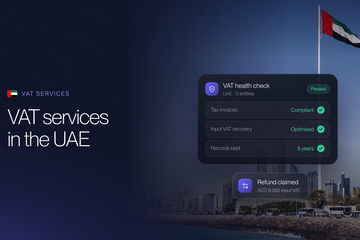
The VAT law changed on 1 January 2026. The FTA may now refuse an input tax claim where the purchase was part of a tax evasion arrangement, and a business is expected to check that its supplies are genuine before it claims. In practice that means confirming the supplier's TRN, holding a valid tax invoice and being able to show the goods or services were received. The same change removed the need to issue an invoice to yourself for reverse charge purchases, as long as the supporting documents are kept.
Have Your Return Reviewed Before It Goes In
Our partners know how to file a VAT return in the UAE without leaving an error for an audit to find. A VAT return review in the UAE is part of every filing.
- Sales tested: Rates and emirate boxes checked against invoices.
- Input tax tested: Supplier TRNs and tax invoices confirmed.
- Reverse charge added: Foreign services identified from the ledger.
- Imports agreed: Box 6 matched to your customs records.
- Past errors found: Earlier returns corrected the cheaper way.
Penalties for Late VAT Filing in the UAE
The penalties for late VAT filing in the UAE were reset on 14 April 2026, when Cabinet Decision No. 129 of 2025 took effect. The amounts are fixed by law, and the FTA applies them automatically.
Violation | Penalty |
|---|---|
Return filed late | AED 1,000, or AED 2,000 for a repeat within 24 months |
VAT paid late | 14% a year on the unpaid amount, charged monthly |
Incorrect return | AED 500, unless it is corrected before the due date |
Error you disclose yourself | 1% a month on the difference |
Error the FTA finds in an audit | A fixed 15% plus 1% a month |
Records not kept | AED 10,000, or AED 20,000 for a repeat within 24 months |
Tax invoice not issued | AED 2,500 for each case |
Take a company whose quarter ended on 30 September. The return and AED 40,000 of VAT were due on 28 October. It files and pays on 10 November. The late return costs AED 1,000. The late payment penalty is charged for each month or part of a month, so one month at 14% a year on AED 40,000 adds about AED 467. Two weeks of delay cost AED 1,467, and the next late return within 24 months starts at AED 2,000.
The old late payment rules could build up to 300% of the unpaid tax. The flat 14% a year is lighter, but it runs for as long as the VAT stays unpaid.
What VAT Return Filing Services in the UAE Cost
The FTA charges nothing to file a return. The cost of VAT return filing services in the UAE is the adviser's fee. Published 2026 price guides from UAE firms put a return at about AED 500 to AED 2,000 a quarter, depending on the number of transactions.
Item | Cost |
|---|---|
FTA filing fee | None |
VAT return, published market guides | About AED 500 to AED 2,000 a quarter |
Our partners | Custom quote, priced on your scope |
These are market guides, not quotes. The fee follows the volume of invoices, the number of imports, any zero-rated or exempt sales and the state of the books. A company that keeps its bookkeeping current pays less for each return. Our guides to accounting services in Dubai and bookkeeping services in Dubai cover the work behind the return.
UAE Accounting and Tax Services
Exval
Services
Accounting, VAT, tax, audit
Company types
Mainland, free zone, offshore
Filing
FTA compliant
Pricing
Custom
Records, Audits and E-Invoicing After the Return
Records
UAE VAT filing does not end when the return is submitted. VAT records must be kept for 5 years after the end of the tax period, or 15 years for records about real estate. That covers invoices, credit notes, import and export documents and the working papers behind each return. Failing to keep them costs AED 10,000.
FTA Audits
The FTA can audit any return inside the time limits in the law. It normally gives notice, names the tax periods and asks for the records. A business that has a file for each return answers in days. One that has to rebuild its figures usually finds the errors at the same time as the auditor. Our guide to tax consultants in Dubai covers representation in an audit.
E-Invoicing
Electronic invoicing arrives in stages. Companies with revenue of AED 50 million or more go live on 1 January 2027. Companies under AED 50 million must appoint an Accredited Service Provider by 31 March 2027 and go live on 1 July 2027. Once it starts, the FTA sees invoice data as it is issued, so the return has to agree with it.
The Same Books Feed Corporate Tax
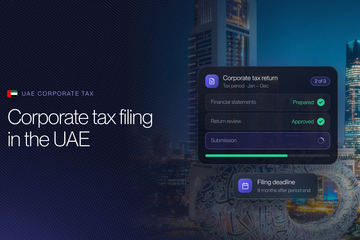
The sales in your four VAT returns should agree with the revenue in your yearly accounts and your corporate tax return. The FTA can compare them. Our guides to corporate tax in the UAE and corporate tax filing in the UAE cover that return, and our guide to audit services in the UAE covers the audit of the accounts.
Common Mistakes With UAE VAT Filing
Most penalties in UAE VAT filing come from a short list of habits.
Skipping a Nil Return
No sales does not mean no return. A missed nil return costs the same AED 1,000 as any other late return.
Filing on Time but Paying Late
The return and the payment are separate steps with the same deadline. Submitting the form does not pay the tax.
Treating Free Zone Sales as Outside VAT
A free zone is not outside VAT. Only certain movements of goods in a designated zone are treated differently, and services are taxed as normal. A Dubai free zone company charges 5% on the same rules as a mainland one. Our guide to designated zones in the UAE explains the exception.
Forgetting the Reverse Charge
Services bought from abroad go in the return twice: once as output tax in box 3 and once as input tax in box 10. For most businesses the two cancel out, but leaving them out is still an error.
Mixing Up VAT and Excise
Excise tax has its own registration and its own monthly return. A business that sells excise goods files both. Our guide to excise tax in the UAE covers it.
Leaving It to the 28th
A return prepared on the last day has no time for a review, a query or a slow bank transfer. Online sellers with many small sales, such as a company with an e-commerce licence in Dubai, need the longest lead time.
UAE Company Incorporation
Binderr
Corporate tax
0% up to AED 375,000
Freezone Tax
0%
Time to Incorporate
1 Week
Cost
Starting from €1,899
How Our Partners Handle Your VAT Returns
Our partners take your books after each tax period, reconcile them and build the return from the VAT ledger. They review it, send you the draft and the amount due, and file on EmaraTax once you approve. You pay the FTA directly from your own account. For VAT return filing in Dubai and in every other emirate the process is the same, and it is handled remotely.
VAT return filing in the UAE is usually part of a wider service. The same partners keep the books, file corporate tax and deal with FTA questions. If you are still setting up, we form the company, and the VAT calendar starts with the registration. Our guides to VAT services in the UAE, accounting services in the UAE, VAT registration in Dubai and company formation in the UAE cover the steps around the return. A free zone company and a mainland company file in the same way.
Get Your VAT Return Filed on Time
Tell us your tax period, your monthly invoice volume and whether you import. We connect you with our partners, and you get one quote.
- Custom quote: Priced on your transactions and the state of your books.
- Every period covered: Quarterly or monthly returns, nil returns included.
- Reviewed first: Each return checked before it is submitted.
- Past returns corrected: Voluntary disclosures prepared where needed.
- Remote by default: Documents shared online.
- One team: Bookkeeping, VAT and corporate tax handled together.
What is VAT return filing in the UAE?
How to file a VAT return in the UAE?
What is the UAE VAT return due date?
Is the UAE VAT return due date monthly or quarterly?
What are the documents required for VAT return filing in the UAE?
What is the penalty for late VAT filing in the UAE?
Do I have to file a VAT return if I had no sales?
How do I file a VAT return in Dubai?
Can I correct a VAT return after filing?
How do I pay the VAT due with the return?
What is a VAT return review in the UAE?
How much do VAT return filing services in the UAE cost?
Can a tax agent file my VAT return?
Sources
- UAE Government: Filing a tax return for VAT
- Federal Tax Authority: Registration for VAT
- Ministry of Finance: Value Added Tax
- Ministry of Finance: VAT law amendments in force from January 2026
- Cabinet Decision No. 40 of 2017 on administrative penalties for tax violations, and its amendments
- Federal Tax Authority: Cabinet Decision No. 129 of 2025 on administrative penalties in force
- Federal Tax Authority: VAT Deregistration service
- Federal Tax Authority: Tax Agent Registration
- Ministerial Decision No. 244 of 2025 on the Implementation of the Electronic Invoicing System