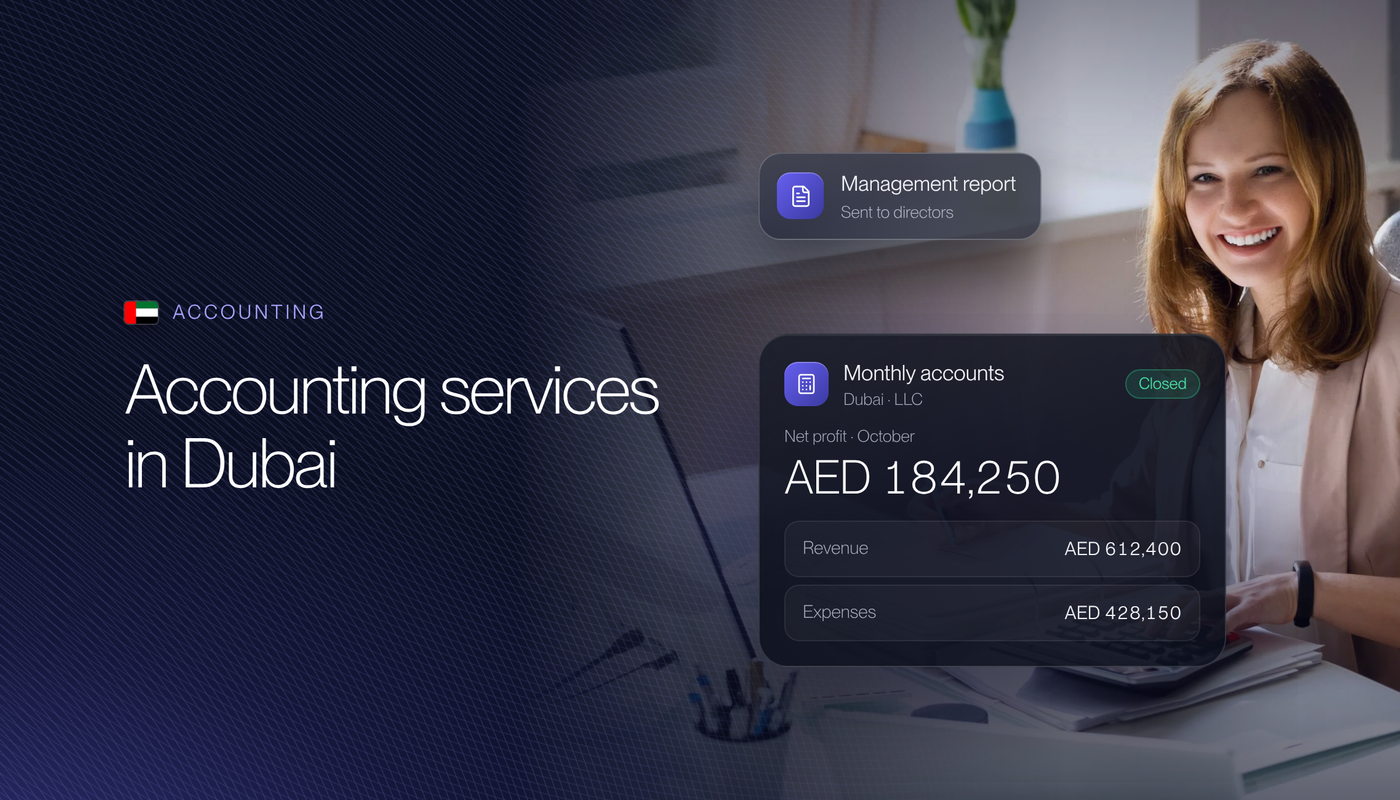
Good accounting services in Dubai give your company clean monthly books, VAT returns filed on time, year-end accounts under IFRS and a corporate tax return the FTA accepts. They also keep the 7 years of records the law now asks for, so a bank review, an audit or an FTA query is quick to answer.
The hard part is how fast the rules have changed. Corporate tax at 9% above AED 375,000 turned bookkeeping into a legal duty. Many free zones want audited accounts every year. Companies with revenue under AED 50 million must appoint an e-invoicing provider by 31 March 2027. A missing record costs AED 10,000 per violation.
This is where we come in. Binderr connects you with our accounting partners in Dubai, and they run the whole cycle for you: bookkeeping, VAT, corporate tax, year-end accounts and audit support. One team, one quote priced on your scope, and no chasing between an accountant, an auditor and the FTA.

UAE Accounting and Tax Services
Exval
Services
Accounting, VAT, tax, audit
Company types
Mainland, free zone, offshore
Filing
FTA compliant
Pricing
Custom
What Accounting Services in Dubai Cover
Accounting services in Dubai cover four jobs: monthly bookkeeping, VAT returns, the annual corporate tax return and year-end financial statements. Most companies also need payroll and audit support. One provider handling all four means one set of numbers, so the VAT returns, the accounts and the tax return always agree.
Accounting and Bookkeeping Services in Dubai, Month by Month
The monthly work is the base of everything else. Accounting and bookkeeping services in Dubai record every sale, purchase and bank movement, match them to invoices, and reconcile each bank account at month end. Sales and purchases are coded for VAT as they are recorded, so the quarterly return is a summary of work already done.
Payroll sits in the same cycle. Mainland salaries run through the Wages Protection System, and the end of service gratuity builds up every month, so it should be accrued in the books each month too. Our partners also handle payroll services in the UAE when you have staff.
Year-End Accounts, Audit Support and Tax Filings
At year end, your provider closes the books, prepares the financial statements and works with the auditor where an audit is required. The same numbers then feed the corporate tax return. Dubai accounting services that cover the full year mean the auditor and the FTA see the same figures, which is what keeps queries short.
What the Best Accounting Firms in Dubai Include
The best accounting firms in Dubai do more than enter data. They give you a monthly profit and loss report, flag VAT issues before the return is due, and track every filing deadline on your behalf. A good accounting firm in Dubai also has FTA-registered tax agents on the team. Only a registered tax agent can represent your company before the FTA.
Read more: Bookkeeping services in Dubai
Accounting and Bookkeeping Services in Dubai
Our partners take on your accounting and bookkeeping services in Dubai from the first month. Pricing is custom and set on your scope, so you pay for what your company needs.
- Priced on scope: One quote built on your transaction volume, VAT status and audit needs.
- Books closed monthly: Bank, sales and expenses reconciled every month, not at year end.
- VAT and corporate tax filed: Returns prepared and submitted on EmaraTax before the deadline.
- Year-end accounts ready: IFRS or IFRS for SMEs statements your auditor can sign.
- Fully remote: Work with our partners from anywhere, with no office visits.
Why Accounting in Dubai Is Now a Legal Requirement
Accounting in Dubai became a legal requirement for almost every company when corporate tax arrived in June 2023. The tax applies at 9% on profit above AED 375,000. Every company must register, keep records for 7 years and file a return based on financial statements, even when no tax is due.
Corporate Tax Made Books Compulsory
Federal Decree-Law No. 47 of 2022 applies to financial years starting on or after 1 June 2023. Our guide to corporate tax in Dubai covers the rates and reliefs. Every UAE company, on the mainland or in a free zone, must register for corporate tax. Late registration carries a fixed penalty of AED 10,000. The return is due within 9 months of the end of each tax period.
For a company with a 31 December 2026 year end, that means a return by 30 September 2027. The return is built from financial statements, so books that are kept properly through the year make the filing straightforward. Our guide to corporate tax registration in the UAE covers the first step.
The Records You Must Keep for 7 Years
Article 56 of the corporate tax law requires every taxable person to keep records for at least 7 years after the end of the tax period they relate to. VAT records must be kept for 5 years, or 15 years for real estate. The 7 years run even after a company closes.
Records mean more than the ledger. They include invoices, contracts, bank statements, payroll files and the working papers behind the tax return. Under Cabinet Decision No. 75 of 2023, failing to keep them costs AED 10,000 for each violation, and AED 20,000 for a repeat within 24 months.
Which Accounting Standard Your Company Uses
Ministerial Decision No. 114 of 2023 sets the standards. Full IFRS is the default. A company with revenue up to AED 50 million may use IFRS for SMEs, which is simpler. A company with revenue up to AED 3 million may prepare its statements on a cash basis.
Annual revenue | Accounting standard | Audited accounts for tax |
|---|---|---|
Up to AED 3 million | Cash basis allowed, or IFRS for SMEs | Only for a Qualifying Free Zone Person |
AED 3 million to AED 50 million | IFRS for SMEs or full IFRS | Only for a Qualifying Free Zone Person |
Over AED 50 million | Full IFRS | Required |
Any size, in a tax group | IFRS for SMEs or full IFRS by revenue | Required for every tax group |
Most small companies can use the simpler options, which keeps the cost of accounting in Dubai down. Free zone companies claiming the 0% rate need an audit at any size. That is the line our partners check first, because it changes the scope and the quote.
UAE Accounting and Tax Services
Exval
Services
Accounting, VAT, tax, audit
Company types
Mainland, free zone, offshore
Filing
FTA compliant
Pricing
Custom
Who Needs Accounting Services for Small Business in Dubai
Accounting services for small business in Dubai are needed by every company with a trade licence, because corporate tax registration and record keeping apply at any size. What changes by company type is the audit. Mainland, free zone and offshore companies each carry different extra rules on top of the federal tax law.
Mainland Companies
A mainland company licensed by the Department of Economy and Tourism follows the federal rules. It keeps books, registers for corporate tax, files VAT once taxable supplies pass AED 375,000 and files the annual tax return. An audit for tax purposes applies once revenue passes AED 50 million. Our guide to business setup in Dubai mainland covers the licence side.
For a small mainland business, the main value of accounting services for small business in Dubai is the monthly discipline. Clean books make the VAT return quick and the year-end close cheap.
Free Zone Companies and the Annual Audit
Free zones add their own rules. DMCC, JAFZA and DWC require every company to prepare audited accounts each year as a condition of the licence. DMCC takes them through its Member Portal, and a missed submission can hold up the licence renewal.
The tax side adds a second reason. A free zone company that wants the 0% rate as a Qualifying Free Zone Person must keep audited financial statements at any revenue. Our guide to free zone corporate tax in the UAE explains the conditions. A DMCC company needs an auditor from the DMCC approved list, and an IFZA company should check its own licence terms.

UAE Company Incorporation
Binderr
Corporate tax
0% up to AED 375,000
Freezone Tax
0%
Time to Incorporate
1 Week
Cost
Starting from €1,899
Audit Rules by Dubai Free Zone
Each Dubai free zone sets its own audit rule, and the rules have tightened since corporate tax arrived.
Free zone | Annual audit | What to know |
|---|---|---|
DMCC | Required for every company | Uploaded on the Member Portal within 6 months of year end, by a DMCC approved auditor |
JAFZA | Required for every company | Uploaded each year. Published deadlines differ, so confirm the date on the JAFZA portal |
DAFZA | Required for FZE and FZCO companies | The auditor must be approved by DAFZA |
DIFC | Required under the DIFC Companies Law | Some small companies can be exempt. Confirm with the DIFC Registrar of Companies |
IFZA and newer zones | Rules have changed recently | Check your licence terms and renewal checklist every year |
These rules come from each authority, and they change. A deadline that applied two years ago may not apply now. Our partners confirm the current rule with your free zone before year end, so the audit is booked in time. The tax rule then sits on top: a company that wants the 0% rate needs audited statements whatever its free zone says.
Offshore Companies and Foreign Owners
An offshore company in Dubai does not trade inside the UAE, but it is still a juridical person under the corporate tax law. It needs records, a corporate tax registration and annual statements. Many offshore registries also ask for accounts at renewal.
Foreign owners are the clearest case for accounting services for small business in Dubai. Our partners deliver accounting services in Dubai fully remotely, so the books, filings and FTA correspondence are handled without the owner in the country. Our guide to opening a business bank account in Dubai covers the account your accountant will reconcile.
Read more: Business setup in Dubai
Dubai Accounting Services That Keep You Compliant
The rules are clear once someone owns them. Our Dubai accounting services partners set up your books to the right standard from day one and keep every deadline in view.
- Right standard chosen: Cash basis, IFRS for SMEs or full IFRS, set by your revenue.
- Registration checked: Corporate tax and VAT registrations confirmed or filed.
- 7-year archive: Records stored so the FTA or your auditor can check them on request.
- No AED 10,000 surprises: Record and registration gaps fixed before they become penalties.
- Audit-ready books: Free zone and tax audits start from clean, reconciled accounts.
- One contact: One team for books, VAT and corporate tax, not three firms.
Deadlines and Penalties for Accounting in Dubai
Accounting in Dubai runs on three deadlines: VAT returns 28 days after each tax period, the corporate tax return 9 months after year end, and e-invoicing from 2027. Penalties are fixed amounts plus a monthly charge on unpaid tax, so a missed date costs money from day one.
Obligation | Deadline | Penalty if missed |
|---|---|---|
VAT registration | Once taxable supplies pass AED 375,000 | AED 10,000 |
VAT return | 28 days after each tax period | AED 1,000, then AED 2,000 for a repeat |
Corporate tax registration | Set by the FTA for each company | AED 10,000 |
Corporate tax return | 9 months after year end | AED 500 a month for 12 months, then AED 1,000 a month |
Records | Kept for 7 years | AED 10,000, or AED 20,000 for a repeat |
Late payment of VAT | Same date as the return | 14% a year, charged monthly |
The fixed amounts are small next to a company's revenue, but they repeat. Dubai accounting services exist largely to stop that from happening. A company that misses every quarterly VAT return pays every quarter. Our partners work to a filing calendar built on your year end, so these dates are set when they take you on.
VAT Returns Every Quarter
A company must register for VAT once its taxable supplies and imports pass AED 375,000 over 12 months, or are expected to within the next 30 days. Voluntary registration opens at AED 187,500. Our guide to VAT registration in Dubai covers the application.
Returns are usually quarterly and due by the 28th day after the period ends. Since 14 April 2026, Cabinet Decision No. 129 of 2025 charges late VAT payment at 14% a year, calculated monthly. That replaced the old system, which could climb to 300% of the unpaid tax. See VAT return filing in the UAE for the return itself.
UAE Accounting and Tax Services
Exval
Services
Accounting, VAT, tax, audit
Company types
Mainland, free zone, offshore
Filing
FTA compliant
Pricing
Custom
The Corporate Tax Return 9 Months After Year End
The corporate tax return is filed on EmaraTax within 9 months of the end of the tax period. A late return costs AED 500 a month for the first 12 months and AED 1,000 a month after that. Late payment of corporate tax runs at 14% a year.
Small Business Relief helps companies with revenue up to AED 3 million. Ministerial Decision No. 131 of 2026 extended it to tax periods ending on or before 31 December 2029. It does not remove the return. The company still registers, keeps books and files to claim it. Our guide to Small Business Relief in the UAE covers the test.
A Compliance Calendar for a December Year End
A company with a 31 December year end and calendar VAT quarters works to the dates below. Your own VAT quarters are set by the FTA and may differ.
When | What is due |
|---|---|
28 January, 28 April, 28 July, 28 October | Quarterly VAT return and payment |
Within 6 months of year end | Audited accounts to the free zone, where it requires them. For DMCC that is 30 June |
30 September | Corporate tax return and payment for the previous year |
31 March 2027 | E-invoicing provider appointed, for revenue under AED 50 million |
1 July 2027 | E-invoicing go-live for the same companies |
Licence renewal date | Renewal documents, plus accounts where the authority asks for them |
Six of these dates fall in the first nine months of the year. That is why the books cannot wait for year end. A company that closes each month by the 15th of the next one meets every date above without a rush.
E-Invoicing Starts in 2027
Ministerial Decisions No. 243 and 244 of 2025 bring structured e-invoicing through Accredited Service Providers on the Peppol network. Companies with revenue of AED 50 million or more had until 30 October 2026 to appoint a provider and go live on 1 January 2027.
Companies under AED 50 million must appoint a provider by 31 March 2027 and go live on 1 July 2027. Business to consumer sales are outside the system for now. Your accounting software and your provider need to be ready before that date, which is now only a few months away. Good accounting services in Dubai now include this setup as part of the monthly work.
UAE Accounting and Tax Services
Exval
Services
Accounting, VAT, tax, audit
Company types
Mainland, free zone, offshore
Filing
FTA compliant
Pricing
Custom
How Accounting Outsourcing in Dubai Works
Accounting outsourcing in Dubai replaces an in-house accountant with a team that runs your books remotely. You share bank access, invoices and payroll data each month, and the team returns reconciled accounts, filed returns and a monthly report. Most companies are fully set up within the first month.
A Records Review Before Anything Is Filed
The work starts with a review. Accounting and bookkeeping services in Dubai that skip this step usually file on top of old errors. Our partners check your licence, your corporate tax and VAT registrations, your year end and the state of your books. Where earlier months are missing or messy, they rebuild them first. Filing on top of wrong opening balances only moves the problem into next year.
Monthly Bookkeeping and Quarterly VAT
Each month you upload invoices and receipts, and the team codes and reconciles them. This is the core of accounting and bookkeeping services in Dubai. The quarterly VAT return is then drawn from closed months, checked with you and filed. Accounting outsourcing services in Dubai work best when the monthly upload becomes a routine, which takes most owners one or two cycles.
What to Send Each Month
The monthly handover is short once it is a habit.
- Bank statements: Every company account, for the full month.
- Sales invoices: Everything issued, including credit notes.
- Supplier bills: With the tax invoice, so input VAT can be recovered.
- Payroll changes: Joiners, leavers, salary changes and leave.
- New contracts: Leases, loans and large customer or supplier agreements.
- Import and export papers: Customs declarations and shipping documents, where you trade goods.
Most cloud accounting tools take these by upload or photo. What matters is that nothing is held back until year end.
UAE Company Incorporation
Binderr
Corporate tax
0% up to AED 375,000
Freezone Tax
0%
Time to Incorporate
1 Week
Cost
Starting from €1,899
Year End, Audit and the Tax Return
After year end, the team closes the books, prepares the financial statements under the right standard and supports the auditor where one is needed. The corporate tax return follows from the final figures. One team handling all three is the main reason companies choose accounting outsourcing in Dubai over separate firms.
In-House Accountant or Outsourced Team
Published 2026 salary data puts the median accountant in Dubai at about AED 60,000 to AED 99,000 a year, which is AED 5,000 to AED 8,250 a month. Visa costs, medical insurance, annual leave and end of service gratuity come on top. A standard outsourced SME package runs AED 1,500 to AED 5,000 a month in published price guides.
Cost is only part of it. One accountant rarely covers bookkeeping, IFRS, VAT and corporate tax equally well, and the work stops when that person is on leave or resigns. An outsourced team spreads the work across people with different skills. An in-house accountant still makes sense for a company with hundreds of transactions a day, or one that needs someone on site to manage stock, cash and suppliers. Many companies in that position keep a junior in-house and outsource the month-end close and the tax work.
Switching From Another Accounting Firm
Changing provider is simple when it is planned. The best time is the end of a VAT quarter or the financial year, so the new team starts from a closed period. Ask the outgoing firm for the trial balance, the general ledger, the fixed asset register, the VAT workings for each return and the last financial statements. Remove their access to your EmaraTax profile and link the new tax agent. Your records belong to the company, and a professional firm hands them over without delay.
Read more: Audit services in Dubai and corporate tax filing in the UAE
Never Miss an FTA Deadline
Our partners build a filing calendar around your year end and work to it, so returns go in on time without reminders from you.
- Filing calendar set: VAT, corporate tax and e-invoicing dates planned on day one.
- Returns filed on time: Prepared, checked with you and submitted on EmaraTax.
- E-invoicing ready: Software and provider set up before your 2027 go-live date.
- Relief claimed: Small Business Relief applied where your revenue qualifies.
- FTA queries answered: Registered tax agents reply on your behalf.
How Much Accounting Services in Dubai Cost
Accounting services in Dubai are priced on volume and scope, not on a fixed fee. Published 2026 price guides from Dubai firms start at about AED 500 a month for basic bookkeeping on a low-volume company. Standard SME packages with VAT and reporting commonly run AED 1,500 to AED 5,000 a month.
Service | Typical published Dubai price | What moves the price |
|---|---|---|
Basic bookkeeping | From about AED 500 a month | Number of transactions and bank accounts |
SME accounting package | AED 1,500 to AED 5,000 a month | VAT, reporting and corporate tax support included |
VAT return | AED 500 to AED 2,000 a quarter | Volume and any zero-rated or export sales |
Payroll | AED 50 to AED 150 per employee a month | Headcount, WPS and gratuity tracking |
Our partners | Custom quote | Priced on your scope after a short review |
These figures are market guides for accounting and bookkeeping services in Dubai, not quotes. A trading company with stock, several currencies and a free zone audit costs more than a consultancy with ten invoices a month. Our partners quote after they see your volume, so the price fits the work.
What Drives the Price
Transaction count is the biggest driver, which is why accounting services in Dubai are quoted after a review, not from a price list. After that come the number of bank accounts and currencies, VAT registration, payroll headcount, inventory and whether an audit is required. A company that sends clean records each month pays less than one that sends a year of receipts at once.
Three Worked Examples
These examples use the ranges in published 2026 Dubai price guides. They show where a company usually falls, not what our partners will quote you.
- A free zone consultancy: About 15 invoices a month, one bank account and no VAT registration. This sits at the low end, about AED 500 to AED 1,000 a month, plus the yearly corporate tax return.
- A mainland trading company: About 150 transactions a month, VAT registered, five staff on payroll. This usually falls between AED 2,500 and AED 4,500 a month, because VAT returns and payroll are part of the work.
- An online seller: Several sales channels, stock, refunds and two or three currencies. This sits at the top of the SME range, AED 5,000 a month or more, because every payout has to be split and reconciled.
In each case the audit, where one is required, is a separate fee. The first two companies would also pay less in a year where their records arrive complete each month.
Costs to Plan For Separately
The audit fee is separate from accounting and is paid to the auditor. E-invoicing needs software connected to an Accredited Service Provider. Catch-up work on past months is priced on its own. Our partners list each item in the quote, so nothing is added later.
UAE Accounting and Tax Services
Exval
Services
Accounting, VAT, tax, audit
Company types
Mainland, free zone, offshore
Filing
FTA compliant
Pricing
Custom
Common Mistakes With Accounting in Dubai
Most penalties come from a few repeated mistakes, not from complex tax positions. Each one below has a fixed cost and a simple fix.
Treating Small Business Relief as an Exemption
Many owners read Small Business Relief as "no tax, so no filing". It is the opposite. The relief is claimed in the return, so the company must register, keep books for 7 years and file every year. A company that skips registration pays AED 10,000, and one that skips the return pays AED 500 a month from the deadline. The fix is simple: register, keep monthly books, and claim the relief in each return. It now covers tax periods ending on or before 31 December 2029, and it must be elected in every return.
Leaving the Free Zone Audit to the Last Month
Free zone companies often start looking for an auditor a few weeks before the deadline. If the books are not reconciled, the audit stalls, the submission is late and the licence renewal can be held. For a Qualifying Free Zone Person, missing audited accounts can also cost the 0% rate, and profit above AED 375,000 is then taxed at 9%. The fix is to close the books monthly and book the auditor straight after year end.
Missing the Corporate Tax Registration
Some owners assume a free zone or offshore company is outside corporate tax. Every juridical person must register, including companies that will pay 0%. The penalty for late registration is a fixed AED 10,000, the same as for late VAT registration. Check your registration on EmaraTax now. If it is missing, file it before anything else, because the later returns depend on it.
Thinking the Accountant Carries the Liability
Outsourcing the work does not move the legal duty. The company stays responsible for its records and returns, even when a registered tax agent files them. That is why a monthly report you actually read matters. Work with a team that shows you each return before it is filed, and keep your own copy of the records. Our guide to tax consultants in Dubai explains what a registered tax agent can and cannot do for you.
Get Your Accounting Sorted in Dubai
Tell us what your company needs and we connect you with our accounting partners. You get one quote and one team for the whole year.
- Custom quote: Priced on your volume, VAT status, payroll and audit needs.
- Catch-up included: Missing months rebuilt before the first filing.
- Free zone audits supported: Books prepared to the standard your auditor needs.
- Remote by default: Work from anywhere, with every file shared online.
- Registered tax agents: FTA correspondence handled for you.
- Clear monthly reports: Profit, cash and tax position in one place.
How much do accounting services in Dubai cost?
Is accounting mandatory for companies in Dubai?
Do free zone companies in Dubai need audited accounts?
How long must a Dubai company keep accounting records?
What accounting standard do Dubai companies use?
Do I need accounting and bookkeeping services in Dubai if my company has no revenue yet?
When is the corporate tax return due in Dubai?
Do I need an accountant if my company qualifies for Small Business Relief?
How do I find the best accounting company in Dubai?
Can a foreign owner use accounting services in Dubai remotely?
What happens if I do not keep proper books in Dubai?
Does e-invoicing apply to my Dubai company?
What is accounting outsourcing in Dubai?
Sources
- Federal Decree-Law No. 47 of 2022 on the Taxation of Corporations and Businesses, and its amendments
- Cabinet Decision No. 75 of 2023 on corporate tax administrative penalties, and its amendments
- Ministry of Finance: AED 10,000 penalty for late corporate tax registration
- Ministerial Decision No. 84 of 2025 on Audited Financial Statements
- Ministry of Finance: Ministerial Decision No. 114 of 2023 on accounting standards
- Ministry of Finance: Small Business Relief extended until 31 December 2029
- Federal Tax Authority: Registration for VAT
- Federal Tax Authority: Cabinet Decision No. 129 of 2025 on administrative penalties in force
- Ministerial Decision No. 244 of 2025 on the Implementation of the Electronic Invoicing System
- Ministry of Finance: amendments to the e-invoicing decisions
- Federal Tax Authority: Tax Agent Registration