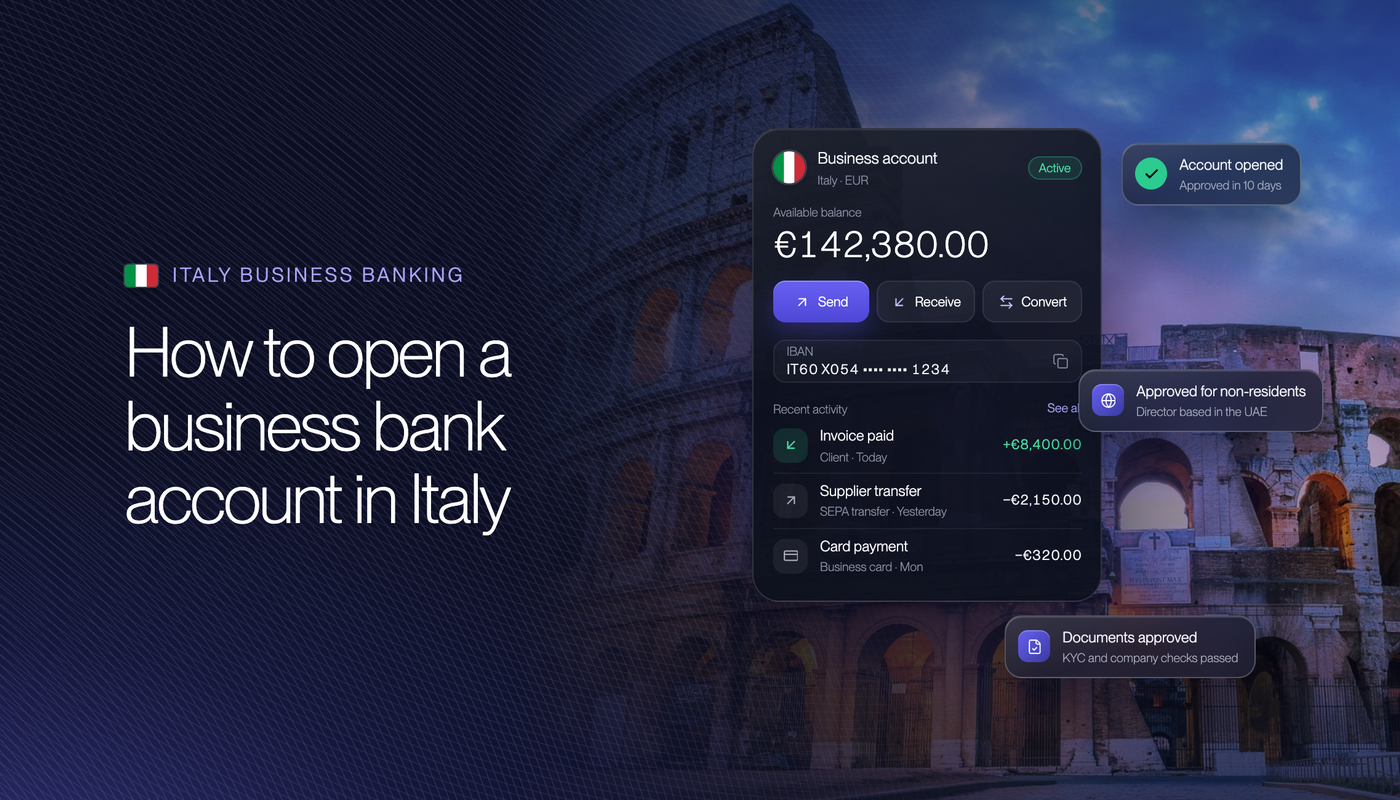
An Italy business bank account gives your SRL or SpA an Italian IBAN, euro payments across the SEPA area and deposits protected up to €100,000 per bank. Clients pay into it, payroll runs from it, and Italian taxes are paid from it with the F24 form.
The hard part is the bank. Italian banks want an Italian tax code for the company and for every director and owner. Online opening is mostly built for people who live in Italy, and foreign-owned files face a long anti-money laundering review. UniCredit also charges €6 for every online SEPA transfer on its standard business account.
This is where we come in. We work with regulated partners who open euro and multi-currency accounts for Italian and foreign companies in 4 days to about a week, fully online. We handle the file: the visura camerale, the tax codes, your KYC pack and the source of funds. You send us your details, and we open the account with you.
Our top-rated, licensed banking providers open euro and multi-currency accounts for Italian SRLs and foreign companies in 4 days to about a week, with no branch visit.

Moneybase
Multi Currency Business Account
Time to onboard
4 Days
Account opening fee
Free
Monthly fee
Starting from € 9.99

Trumia
Business account
Monthly fees
€50
Onboarding fees
€500
Time to onboard
1 week
Accepts
Gambling, Betting, Casino, Crypto, and more
Italy Business Bank Account for Non-Residents
An Italy business bank account for non-residents is possible, but Italian banks make it slow. Every director, signatory and owner needs an Italian tax code, online opening is mostly for residents, and foreign-owned files get a full anti-money laundering review. With a complete file, a foreign owner can open a business bank account in Italy without delays.
Italian Banks Want an Italian Tax Code
Every Italian bank asks for the codice fiscale, the Italian tax code. The company gets one when it registers, and each director, signatory and beneficial owner needs a personal one too. A foreign national who lives abroad usually cannot request it online. The Italian consulate in Hannover explains the rule: a non-resident foreigner delegates someone to file the request at an Agenzia delle Entrate office in Italy, and consulates issue codes only in limited cases. Plan this step first, because nothing else at the bank moves without it.
Online Opening Is Built for Residents
Italian banks sell online business accounts, but the rules usually assume you live in Italy. BPER Banca's online business account is open only to sole traders and freelancers. The owner must be resident in Italy, have an Italian mobile number and show an Italian health card, the tessera sanitaria. Companies with foreign directors normally sign the contract and complete identification in a branch. For a director who lives in Dubai or London, that means a trip to Italy before the account opens.
Open a Business Bank Account in Italy
You can open a business bank account in Italy for your SRL, SpA or foreign company without flying in. This is what we handle for you.
- No branch visit: Directors verify their identity online, from wherever they live.
- English from start to finish: No Italian-only forms or branch appointments.
- Foreign owners welcome: Directors and shareholders outside Italy are accepted.
- Account in days: 4 days to about a week once the file is complete.
- EU IBAN for SEPA: Pay and get paid in euros across the SEPA area.
- KYC pack prepared: We tell you what we need and build the file for you.
Corporate Bank Account in Italy for Foreign Companies
A corporate bank account in Italy for a foreign company needs more paper. If your company trades in Italy through a branch, the bank wants the branch's entry in the Registro delle Imprese and the parent's own register extract, articles and board resolution. Foreign documents usually need an apostille and a sworn Italian translation. Decide between an Italian branch and a subsidiary first, because the answer changes which documents the bank asks for.
Strict Checks on Owners and Money
Legislative Decree 231/2007, Italy's anti-money laundering law, makes the bank identify the company, its directors and every beneficial owner, and understand where the money comes from. Access to Italy's beneficial ownership register at the Chambers of Commerce has been suspended by court rulings, so check its current status. In the meantime, banks ask you directly: an ownership chart with percentages, a signed declaration and proof for each layer. A holding company above the SRL adds a set of documents for every level.
High Risk Sectors Get Extra Scrutiny
Crypto, gaming, payments, cash businesses and trade with high risk countries get enhanced checks at every Italian bank. Many are refused without a detailed reason. Italian law gives a company no right to an account: the conto di base, the basic account under Article 126-noviesdecies of the Consolidated Banking Act, applies only to consumers. One of our partners accepts gambling, betting, casino and crypto businesses, so a bank account for a gambling company is possible without an Italian bank.
A Refusal Follows You
A refusal costs more than time. The next bank asks whether another bank turned you down, and a yes brings more questions. Do not send the same file again. Find out which part failed, such as the tax codes, ownership, source of funds or sector, and fix it with documents. We review refused files, close the gaps and place them with our partners, who open accounts for foreign-owned Italian companies in 4 days to about a week.
Read more: Business bank account for non-residents and why banks reject business account applications.
Best Bank for Business in Italy at Local Banks
The best bank for business in Italy depends on how many payments you make and where your owners live. Small business packages at the big Italian banks cost €10 to €37 a month, and most charge for every entry above an allowance. Italian residents with a simple SRL do well here. Foreign owners meet the tax code, residency and branch rules first.
Bank | Who it takes | Who it turns away | Monthly fee |
|---|---|---|---|
Intesa Sanpaolo (BusinessInsieme) | Businesses and craftsmen with an Italian VAT number, 2 years free for new VAT numbers opening by 31 October 2026 | No published residency rule, but every file goes through checks under Legislative Decree 231/2007 | €10, €25 or €30 by the number of operations included |
UniCredit (Imprendo packages) | Microenterprises on Imprendo Start and Imprendo Easy; other companies on the standard account | No published residency rule, but every file goes through the same anti-money laundering checks | €17.50 or €37; standard account €90 a quarter plus €15 a month for online banking |
Banco BPM (YouBusiness Easy) | Small companies with low volumes, 30 entries a quarter included | No published residency rule, but every file goes through the same checks | €10 (€30 a quarter) |
BPER Banca (Welcome Business) | Companies in branch; online only for sole traders and freelancers | Online, anyone not resident in Italy or without an Italian mobile and health card | €8 in year one (€24 a quarter), then €58.50 (€175.50 a quarter) |
Monte dei Paschi di Siena (MPS MIO Business) | Companies, on three modules by branch volume | No published residency rule, but every file goes through the same checks | €13, €18 or €33 |
For an Italian-resident founder the cheapest choice may well be a local bank. For a foreign owner, the real price is the tax codes, the branch visit and the time in review. Each bank publishes its full tariff in a foglio informativo, an information sheet Italian law requires, so read that rather than the advert.
A Charge on Every Entry and Transfer
Italian business accounts charge per entry above the package allowance. Banco BPM includes 30 entries a quarter and charges €1.50 for each one after that. Intesa Sanpaolo charges €1.60 per operation above the 30 or 75 in its two cheaper plans, and UniCredit's Imprendo Start €3.70 after 50 centrally processed entries a quarter. Transfers add their own fee. UniCredit's information sheet, updated 13 October 2026, charges €6.00 for an online SEPA transfer and €12.75 at the branch on its standard account. Banco BPM charges €0.50 to €1.00 online.
International Payments Cost Extra
Payments outside the SEPA area, or in other currencies, carry fees on every transfer. UniCredit charges €10 for an online foreign transfer, plus 0.22% of the amount with a minimum of €4, plus €1.25 for the payment message. Incoming foreign transfers cost €11 in euros or €13.25 in another currency, plus 0.22%. Banco BPM charges €15.50 for an outgoing non-SEPA transfer in euros and €20 in another currency, plus 0.2% with a €3.50 minimum. The exchange rate margin comes on top.
Stamp Duty and Other Fixed Costs
Every Italian company account also pays an annual stamp duty on business current accounts, charged on the statements. UniCredit's standard account adds €90 a quarter for calculating interest and charges, and €15 a month plus VAT for online banking. Intesa Sanpaolo's InBiz platform costs €5 to €40 a month.
Read more: Best banks for European companies and the best EU countries for business banking.
Moneybase
Multi Currency Business Account
Time to onboard
4 Days
Account opening fee
Free
Monthly fee
Starting from € 9.99
A Faster and Cheaper Way to Open an Italy Business Bank Account
The faster way to open an Italy business bank account is through our regulated partners. Both are licensed e-money and payment institutions authorised by the Malta Financial Services Authority, so they are licensed in the EU. They open euro and multi-currency accounts in 4 days to about a week, fully online, in English, with owners accepted from most countries.
We prepare the file before the partner sees it: the visura camerale, the deed, the tax codes, the ownership chart, the passports and a written source of funds. Client money is safeguarded in segregated accounts, separate from the partner's own funds, rather than covered by the deposit guarantee.
Under Article 9 of the SEPA Regulation (EU) No 260/2012, a payer or payee may not require your euro account to be in a particular EU member state. An EU IBAN works for Italian clients and suppliers, and since 9 October 2025 every euro area payment provider checks the payee name before a transfer under the Instant Payments Regulation.
Feature | Italian banks | Our partners |
|---|---|---|
Time to open | Days for a simple local file, often weeks for foreign owners | 4 days to about a week |
Who they accept | Mostly companies with Italian directors and owners | Italian and foreign companies with owners in most countries |
Identity check | Branch visit, or Italian online ID for residents | Online, from most countries |
Opening fee | Free at most banks, €10 on UniCredit's Imprendo packages | Free at one partner, €500 at the high-risk partner |
Monthly cost | €10 to €37 plus a fee per entry and transfer | From €9.99 on published plans, €50 at the high-risk partner |
Currencies | Euro, other currency accounts on request | Euro plus 24 currencies to exchange at one partner |
Currency conversion | Bank's own rate, 2% on Banco BPM card spending abroad | From 0.25% on published plans |
International payments | €10 plus 0.22% at UniCredit, minimum €4 | Fee shown before you pay |
High risk sectors | Enhanced checks, often refused | Gambling, betting, casino and crypto accepted at one partner |
F24 tax payments | Yes, at banks with an Agenzia delle Entrate agreement | Plan F24 with your accountant |
Protection | €100,000 per depositor per bank | Client money safeguarded in segregated accounts |
For a foreign-owned SRL, or any company that pays across borders, our partners are faster and usually cheaper. An Italian bank can still be cheaper for a resident founder with a simple company that pays only in euros. Our partners do not lend, take cash or pay interest. F24 tax payments run through Italian banks and providers with an Agenzia delle Entrate agreement, so many companies keep a small Italian account for F24 and use our partners for the rest.
Italian Business Bank Account for Foreign Companies
Foreign companies gain the most from our partners. A UK, US or EU company that sells into Italy does not need an Italian bank to receive euros from Italian clients. Our partners open the account in the company's own name with an EU IBAN, and an Italian branch can use it from day one.
How to Open a Business Bank Account in Italy With Us
With us, it takes three steps. You send us your company details in the form. We build the file and submit it. Each director verifies their identity online with a passport and a live selfie, which takes minutes. We answer the partner's questions and tell you when the account is live.
Trumia
Business account
Monthly fees
€50
Onboarding fees
€500
Time to onboard
1 week
Accepts
Gambling, Betting, Casino, Crypto, and more
Moneybase
Multi Currency Business Account
Time to onboard
4 Days
Account opening fee
Free
Monthly fee
Starting from € 9.99
Documents to Open a Business Bank Account in Italy
The documents to open a business bank account in Italy follow Legislative Decree 231/2007. The bank verifies the company from the register and its deed, and every person from an official photo ID and a tax code. Expect the same core list at Intesa Sanpaolo, UniCredit and the other banks, with extra questions for foreign owners.
Company Documents
For an SRL or SpA, the bank wants a recent visura camerale, the register extract from the Registro delle Imprese, plus the deed of incorporation (atto costitutivo) and the articles (statuto). It also wants the company's codice fiscale and VAT number (partita IVA) and its certified email address, the PEC. Since the 2025 Budget Law, directors must also register a digital domicile with the register. A foreign company adds its home register extract and articles, with an apostille and a sworn translation.
Directors and Owners
Every director, signatory and beneficial owner holding more than 25% provides a valid passport or ID card, proof of address and an Italian codice fiscale. While access to the beneficial ownership register is suspended, a clear ownership chart with percentages for each layer saves a round of questions.
Business Plan and Source of Funds
Banks also want to know what the company does, who its customers and suppliers are, which countries the money comes from and goes to, and the monthly volumes you expect. The money paid in as share capital needs a source too, such as savings, a dividend or the sale of an asset, with bank statements or contracts as proof.
This is the checklist we work from:
- Visura camerale: recent, showing the directors and the share capital.
- Deed and articles: the atto costitutivo and statuto as filed.
- Tax numbers: the company's codice fiscale and partita IVA, plus each person's codice fiscale.
- Director and owner IDs: passport or ID card plus proof of address.
- Ownership chart: every layer up to the people, with percentages.
- Source of funds: a written note with bank statements, contracts or a sale agreement.
- Business description: activity, customers, countries and expected monthly volumes.
Read more: Documents needed to open a business bank account and how to set up a company as a non-resident.
Prepare Your Italy Business Bank Account File
Opening an Italian business bank account goes fastest when the register, the tax codes and your file tell the same story. We build it with you.
- Register extract ready: A recent visura camerale with directors and capital.
- Tax codes checked: A codice fiscale for every director, signatory and owner.
- Ownership mapped: A chart for every layer, matched to the deed.
- Source of funds written: Clear, evidenced and in the form reviewers expect.
- Translations sorted: Apostilles and sworn translations for foreign documents.
Italy Business Bank Account Costs
An Italy business bank account costs €10 to €37 a month on small business packages at the big local banks, plus a fee for entries above the allowance, transfers, foreign payments and an annual stamp duty. Our partners charge from €9.99 a month on published plans, with several currencies in one account. The table sets the two side by side.
Charge | Typical range at a local bank | With our partners |
|---|---|---|
Account opening | Free at most banks, €10 on UniCredit Imprendo | Free at one partner, €500 one-off at the high-risk partner |
Monthly fee | €10 to €37 on small business packages, €58.50 at BPER after year one | From €9.99 on published plans, €50 at the high-risk partner |
Promotional periods | 2 years free at Intesa Sanpaolo for new VAT numbers, €24 a quarter in BPER's first year | Standard plan price from the start |
Entries above the allowance | €1.50 at Banco BPM, €1.60 at Intesa Sanpaolo, €3.70 at UniCredit Imprendo Start | Set by your plan |
SEPA transfers out online | €0.50 to €1.00 at Banco BPM, €6.00 on UniCredit's standard account | Shown on the plan |
SEPA transfers at the branch | €3.50 to €12.75 | Not needed, everything runs online |
International payments out | €10 plus 0.22% plus €1.25 at UniCredit, €15.50 to €20 plus 0.2% at Banco BPM | Fee shown before you pay |
International payments in | €11 to €13.25 plus 0.22% at UniCredit, €10.50 to €15 plus 0.2% at Banco BPM | Set by your plan |
Currency conversion | Bank's own rate, 2% on Banco BPM card spending abroad | From 0.25% on published plans |
Online banking | €15 a month plus VAT on UniCredit's standard account, €5 to €40 for Intesa's InBiz | Included in the plan |
Debit cards | €3 a month at Intesa Sanpaolo, €21 a year at UniCredit | Quoted with your setup |
Payment recalls | €16.40 to revoke and €50 to return a received transfer at UniCredit | Quoted with your setup |
Stamp duty on statements | An annual stamp duty on every business current account | Ask your accountant how it applies |
Deposit protection | €100,000 per depositor per bank | Client money safeguarded in segregated accounts |
The markup sits in the fees around the account, not in the monthly price. Banco BPM's €10 account with 300 entries a quarter costs €435 a quarter, or €145 a month, once the €1.50 entry fees are added. A trading company that sends 20 foreign payments of €10,000 a month from UniCredit pays €33.25 on each, or €665 a month, before the exchange rate margin. At one partner, conversion starts from 0.25%, or €25 on €10,000.
For an Italian-resident founder with a small SRL that pays only in euros, a local bank is often cheaper, and Banco BPM's €1 online transfers are hard to beat. For a foreign-owned company that pays across borders, our partners usually cost less. All figures are planning ranges from the banks' own information sheets, and we confirm your price in writing before you apply.
Read more: EU multi-currency business account and import and export company banking.
Moneybase
Multi Currency Business Account
Time to onboard
4 Days
Account opening fee
Free
Monthly fee
Starting from € 9.99
Trumia
Business account
Monthly fees
€50
Onboarding fees
€500
Time to onboard
1 week
Accepts
Gambling, Betting, Casino, Crypto, and more
How Long Opening a Business Account in Italy Takes
Opening a business account in Italy takes a few days at a local bank when the company is Italian, the directors live in Italy and the file is complete. With foreign owners, it often takes weeks, because the tax codes and the branch visit come first. With our partners, the account opens in 4 days to about a week once the documents are ready.
Stage | Local bank | Our partners |
|---|---|---|
Tax codes for foreign directors | First, through a delegate at an Agenzia delle Entrate office | Part of the company file we prepare |
Notarial deed and capital | First, before any account | First, before any account |
Registro delle Imprese and partita IVA | Needed before the operating account | Needed before the account |
Identity check of directors | Branch visit, or Italian online ID for residents | Online in minutes |
Review and follow-up questions | Days for a simple local file, weeks for foreign owners | A few days |
Account open and ready | Days to weeks | 4 days to about a week after the file is complete |
The stages before the account are the same on both routes. The difference is the review: an Italian bank works through a foreign file slowly, often in Italian, while our partners review an English file built for them.
What Slows It Down
The usual delays are a director with no codice fiscale, a visura camerale that does not match the ownership chart, a foreign holding company with no documents, documents without an apostille or translation, and a source of funds with no evidence. A missing PEC address also holds up the register filing.
How to Speed It Up
Request every director's codice fiscale before the notary appointment. Collect every document in one round, apply once, and answer the provider's questions the same day. Apply to one provider that takes your owners' countries, rather than to three banks at once.
Read more: Business bank account in Europe.
Trumia
Business account
Monthly fees
€50
Onboarding fees
€500
Time to onboard
1 week
Accepts
Gambling, Betting, Casino, Crypto, and more
What Happens After the Account Is Open
After the account opens, fund it, add your users and share the IBAN with clients, suppliers and your accountant. Then keep the company in good order, because banks and partners review every client again over time. The first months set the pattern the provider checks your later payments against.
Set up how you will pay taxes. Italian companies pay corporate income tax (IRES), regional tax (IRAP), VAT and payroll contributions with the F24 form, so agree with your accountant which account runs F24. Italy also requires electronic invoices through the Agenzia delle Entrate's exchange system, the Sistema di Interscambio, so connect your invoicing early.
File changes of directors, address or capital with the Registro delle Imprese, and tell your provider about new owners, directors or activities before the payments change. Keep your cash management simple. If you plan to move to Italy yourself, read about Italy's flat tax for new residents.
Read more: Germany business bank account and France business account for non-residents.
Moneybase
Multi Currency Business Account
Time to onboard
4 Days
Account opening fee
Free
Monthly fee
Starting from € 9.99
Why the Company Comes Before the Account
A bank cannot open an operating account for a company that does not exist yet. An Italian SRL is formed by a notarial deed. Article 2463 of the Civil Code sets its capital at €10,000, or from €1 if the founders pay it in full. Article 2464 says at least 25% of the cash capital is paid to the directors at signing, or all of it when one founder sets the company up, so an SRL does not need a bank deposit first. An SpA is different: Article 2342 requires 25% of its cash capital to be deposited with a bank, and our partners are not banks. Plan the order with us: tax codes, deed, register, partita IVA, then the account. Our European company formation guide helps if you are still choosing a country.
Common Italy Business Bank Account Mistakes
Most problems with an Italy business bank account come from applying before the paperwork is ready, or from choosing on the headline fee. These are the mistakes we see most often, with what they cost. Each one is easy to avoid when you check the bank's rules and your documents before the first application.
Applying Before Every Director Has a Tax Code
Founders book the notary and the bank appointment, then learn that a foreign director has no codice fiscale. The bank cannot open the file without it. A non-resident foreigner must usually send a delegate to an Agenzia delle Entrate office in Italy, which needs a power of attorney and adds time. The notary date moves, the capital waits, and the account opens later than planned. Request every director's and owner's tax code first, before you book anything else, and keep the certificate with your company file.
Reading Only the Monthly Fee
A €10 account looks cheap until the entries start. Banco BPM's YouBusiness Easy includes 30 entries a quarter, and a company with 300 entries pays €405 a quarter on top of the fee. On UniCredit's standard account, the €6 online SEPA fee means 100 supplier payments cost €600 a month, plus €90 a quarter for the interest calculation and €15 a month for online banking. Count your monthly payments, receipts and direct debits, then price the whole year from the bank's information sheet, not the advert.
Paying Foreign Suppliers From a Euro Account
A trading company that pays suppliers in Asia or the US from an Italian euro account pays twice: a fee on every transfer and a margin on every conversion. At UniCredit, a €10,000 foreign payment costs €33.25 in fees, so 20 a month cost €665 before the rate. Receiving $10,000 from a US client costs another €13.25 plus 0.22%. A multi-currency business account lets you pay in the invoice currency and see the rate first. Plan the currencies before the first invoices arrive.
Forgetting How You Will Pay F24
Some founders open an account abroad and only later learn how Italian taxes are paid. F24 payments run through banks, Poste Italiane and providers with an agreement with the Agenzia delle Entrate, and banks outside Italy generally cannot make them. A missed F24 deadline brings penalties and interest, even when the money was ready. Decide the F24 route with your accountant before you open anything: a small Italian account for F24, or an accountant who pays on your behalf, plus our partners for everything else.
Get Help With an Italy Business Bank Account
Italian business banking is very manageable when the file and the provider fit your company. Send us your details and we get back to you.
- Fit checked first: We confirm a partner can take your company before you apply.
- Refused before: We review what went wrong and fix the file.
- Honest view on cost: We tell you when an Italian bank is the cheaper choice.
- Foreign groups welcome: Holding companies and branches of foreign companies.
- High risk sectors: Gambling, betting, casino and crypto accepted at one partner.
- One point of contact: From the first document to the first payment.
Bottom Line
An Italy business bank account is easy for an Italian-resident founder with a simple SRL, and slow for almost everyone else. Italian banks want a tax code for every director and owner, online opening is built for residents, and every entry, transfer and currency adds a fee. Monthly prices of €10 to €37 are only the start, and an annual stamp duty comes on top.
For a foreign-owned SRL or a foreign company selling into Italy, the faster route is a regulated partner with an EU IBAN that works across SEPA. With a complete file, you can open a business bank account in Italy in 4 days to about a week, without a branch visit, and keep a small Italian account only if you need it for F24 or loans.
Can a non-resident open a business bank account in Italy?
What is the best bank for business in Italy?
Is there a free business bank account in Italy?
How much does an Italy business bank account cost?
How long does it take to open a business bank account in Italy?
What documents do I need to open a business bank account in Italy?
Can a foreign company open an Italian business bank account?
Can I open an Italy corporate bank account online?
Do I need a codice fiscale to open a business bank account in Italy?
Does an Italian SRL need a bank account before registration?
Can I pay Italian taxes from a foreign business account?
Is money in an Italian business bank account protected?
Can I get a multi-currency business account in Italy?
Sources
- UniCredit, Foglio Informativo CC56, current account in euro and currencies for non-consumers, updated 13 October 2026
- UniCredit, Foglio Informativo CC131, Imprendo Start for microenterprises, updated 19 May 2026
- UniCredit, Foglio Informativo CC81, Imprendo Easy, updated 19 May 2026
- Intesa Sanpaolo, Conto BusinessInsieme
- Banco BPM, Foglio Informativo Conto Corrente YouBusiness Easy, updated 13 October 2026
- BPER Banca, Welcome Business
- BPER Banca, Conto Business Online (On Demand Business)
- Banca Monte dei Paschi di Siena, MPS MIO Business
- Italian Civil Code, Article 2463, SRL incorporation and share capital
- Italian Civil Code, Article 2464, SRL contributions
- Italian Civil Code, Article 2342, SpA contributions and bank deposit
- Consolidated Banking Act (TUB), Article 126-noviesdecies, the conto di base
- Agenzia delle Entrate, Versamenti modello F24
- Consolato Generale d'Italia in Hannover, Codice fiscale for non-resident foreign nationals
- Camera di Commercio di Napoli, digital domicile (PEC) for directors under Law 207/2024
- Fondo Interbancario di Tutela dei Depositi
- Regulation (EU) No 260/2012 (SEPA Regulation), EUR-Lex
- Regulation (EU) 2024/886 (Instant Payments Regulation), EUR-Lex