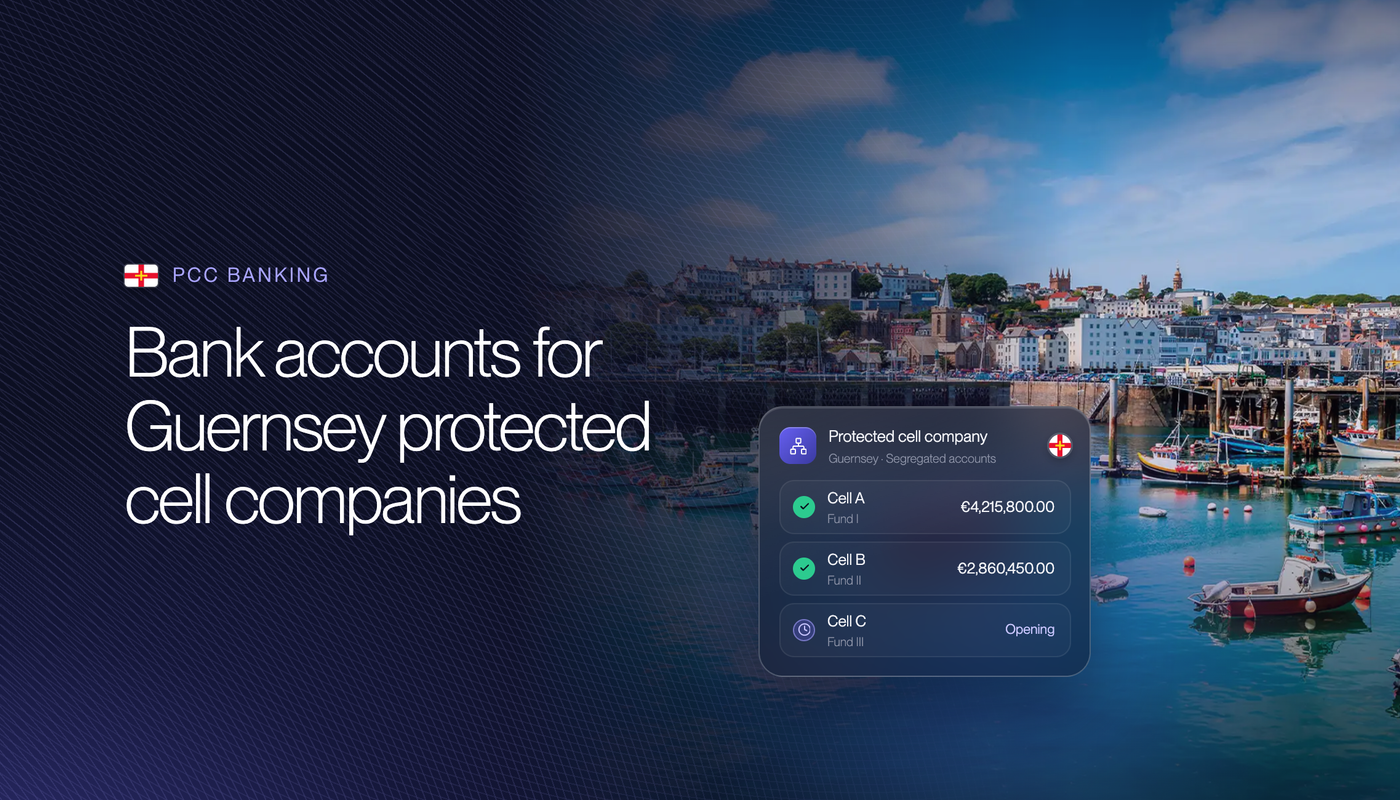
A bank account for a Guernsey protected cell company keeps each cell's money where the law wants it: separate and easy to identify. Premiums, fund subscriptions, claims and redemptions run through the right cell, the core stays apart, and the directors can show any creditor exactly which assets belong to which cell.
The hard part is the bank. Island banks take cell companies through licensed administrators, identify the owners of every cell and price the complexity. One bank charges £8,000 a year for a higher-risk file and £40 a month for each account, reviews run for weeks, and one missing cell owner can stop the whole file.
This is where we come in. We work with licensed Guernsey administrators and our regulated banking partner for complex structures, and we handle the banking file for you: the GFSC consent, the cell resolutions, the ownership chart, the source of funds and the KYC. One team, one point of contact. You tell us about the cells, and we get the account open.
Our top-rated, licensed banking provider for trusts, funds and other complex structures opens multi-currency accounts for Guernsey cell companies in about a week, fully online.

Interpolitan Money
Business account
Time to onboard
1 Week
Currency
EUR, USD, GBP, AED, and 50+
Monthly fee
Custom
Why a Guernsey Protected Cell Company Bank Account Is Hard to Open
A Guernsey protected cell company bank account is hard to open because the bank is not reviewing one simple company. It is reviewing a core and a set of cells, each with its own owners, its own money and its own creditors, run by a licensed administrator under GFSC consent. Every layer has to be evidenced before the bank says yes.
One Company With Many Separate Cells
Guernsey created the protected cell company in 1997 and was the first jurisdiction in the world to do so. The rules now sit in the Companies (Guernsey) Law, 2008. A PCC is one legal person with one board, one set of articles and one registration number, but its assets are split into a core and any number of cells. Each cell's assets and liabilities are kept apart from the other cells and from the core. Cells are created by a board resolution, with no filing at the Registry, so a bank cannot look them up anywhere. It relies on the documents you give it, and it reads them closely. At the end of 2025, the GFSC counted 44 protected cell companies with 222 cells on the island, so the banks have seen many of these files and know exactly what to ask for.
The Bank Must Know Which Cell It Is Dealing With
When a PCC enters into a transaction, the directors must tell the other party that it is a protected cell company and name the cell, or the core, it is acting for. A bank account is a contract like any other. If the directors fail to identify the cell, they can become personally liable for the transaction, and any liability not attributed to a cell falls on the core by default. In practice, PCCs keep a separate account for each cell, so the money of each cell can be identified at any time. That is why a bank asks for the cell's name in the account title, a resolution showing who can sign for that cell, and proof that the cell exists.
Open a Bank Account for a Guernsey Protected Cell Company
You can open a bank account for a Guernsey protected cell company without weeks of back and forth when the cells are explained upfront. This is what we do for you.
- Cell by cell file: Each cell's owners, purpose and money shown on one page.
- Built for complex structures: Our partner banks funds, trusts and layered ownership.
- Banks slow to onboard: An account in about a week, not months of questions.
- Many currencies: EUR, USD, GBP, AED and 50+ more in one account.
- Administrator involved: We work with your licensed Guernsey administrator.
- Price agreed first: Your structure is quoted before you apply.
Every Cell Owner Has to Be Identified
A bank has to know who stands behind the money in each account. For a PCC, that means the shareholders and beneficial owners of the core and of every cell that will use the account. The core is often owned by an insurance manager or a fund sponsor, while each cell belongs to a different client or investor group. The Beneficial Ownership of Legal Persons (Guernsey) Law, 2017 requires the company's beneficial owners to be filed with the Guernsey Registry, and any change to reach the Registry within 14 days. The bank checks that its own file matches. When cell owners are companies or trusts, the bank looks through them to the people at the top, so the ownership chart grows quickly.
Banks Take Cell Companies Through Licensed Administrators
A company cannot be incorporated as a Guernsey PCC, or converted into one, without written GFSC consent. The PCC must also be run by a licensed administrator, or be licensed itself under the Protection of Investors (Bailiwick of Guernsey) Law, 2020 or the Insurance Business (Bailiwick of Guernsey) Law, 2002. Island banks follow the same line. Lloyds International, for example, onboards clients through trust and corporate service providers and fund administrators. They submit their own due diligence on the end client through a digital platform, and the bank then reviews the purpose of the structure and the source of wealth. A cell sponsor who goes to a bank directly is usually sent back to the administrator.
How a PCC Differs From an ICC at the Bank
An incorporated cell company works differently. Each incorporated cell is a company in its own right, with its own registration number and its own board, so it opens an account in its own name. A protected cell cannot do that. Its account is opened by the PCC, acting for that cell. Some banks find an ICC easier to read for this reason, but a PCC is simpler and cheaper to run. Our guide to Guernsey protected cell and incorporated cell companies explains the choice between the two.
Why Guernsey Protected Cell Company Bank Accounts Get Rejected
Most refusals come from gaps in the file, not from the structure itself. A cell is not named in the application. A cell owner, or a beneficial owner further up the chain, is missing. The source of funds behind a cell's capital is thin. A politically exposed person sits in one cell and nobody said so. Or the GFSC consent letter and the administrator's details are left out. Banks rarely explain a refusal, and one refusal can make the next bank more cautious. Knowing why Guernsey protected cell company bank accounts get rejected lets you close every gap before you apply.
Read more: How to open a Guernsey business bank account and the requirements for a Guernsey bank account.
Best Banks for Guernsey Protected Cell Companies
The best banks for Guernsey protected cell companies are the ones built around administrators, fund businesses and insurance managers. Guernsey had 21 licensed banks holding £70,783 million of deposits in June 2026, but only a few publish what they charge a structure like a PCC. The table shows what each one publishes.
Bank | Who it takes | Who it turns away | Monthly fee |
|---|---|---|---|
Butterfield | Administered structures, client money accounts and custody clients | Higher-risk files, unless they pay £2,500 a year, or £4,500 with a PEP | Set at the bank's discretion |
RBS International | Fund managers, fund administrators and corporate service providers | Higher-risk files, unless they pay £8,000 to join and £8,000 a year | £40 per current account |
HSBC (Channel Islands) | Local businesses, and corporates generally above £40 million turnover | Customers outside the Channel Islands and the Isle of Man | £8 to £10, corporate fees agreed |
Lloyds International | Clients onboarded by trust and corporate service providers and fund administrators | Sanctioned sectors and countries, with extra scrutiny on PEP links | No fees for standard risk, extra fees for higher risk |
Investec Channel Islands | Financial intermediaries placing deposits for trust and corporate clients | Set case by case with the intermediary | Relationship based |
The low monthly fees in the table are per account, and a PCC usually needs one account for each cell. The real cost sits in the yearly risk charges, which a structure with owners in several countries often attracts. Lloyds' Business Extra account costs £20 a month and is open only to businesses with turnover above £25 million or financial institutions based in Jersey, Guernsey or the Isle of Man. Investec's island bank offers notice and fixed-term deposits through intermediaries, which suits cell capital that must sit still and earn interest.
One Account per Cell Multiplies the Fees
Because each cell keeps its own money, the fees on bank accounts for Guernsey protected cell companies grow with the number of cells. At RBS International, a business current account costs £40 a month and a cash management account £500 a year. A PCC with five cells, each with one current account, pays £2,400 a year in maintenance before a single payment moves. HSBC charges £96 to £180 a year for each international currency account, so a cell that needs euro and US dollar accounts pays that fee twice.
Yearly Risk Charges on Complex Files
Guernsey banks price risk as a yearly fee. Butterfield's fee schedule, effective 1 June 2026, charges £2,500 a year for an account it rates as high risk, rising to £4,500 where a politically exposed person is linked. RBS International charges £8,000 to onboard a higher-risk customer and £8,000 at each annual review, £12,000 each where a low-risk PEP is involved and £24,000 each for a high-risk PEP. A cell company with owners in several countries is exactly the kind of file that attracts these charges.
High Fees on International Payments
Cells pay claims, reinsurers, investors and service providers abroad, and every payment costs money. Butterfield charges £25 to £37 for an online SWIFT payment and £80 to £92 for a manual one. RBS International charges £20 electronic and £100 manual. HSBC charges £17 online and up to £40 by post. Butterfield also charges £500 to change administrators and £150 for each audit or balance confirmation, which auditors ask for at every year end.
No Deposit Cover for Company Accounts
The Guernsey Banking Deposit Compensation Scheme pays up to £50,000 per qualifying depositor per bank, with a cap of £100 million over any five years. Its 2026 leaflet is clear that a company is not a qualifying depositor. A PCC holding cell capital or claims reserves at one island bank has no scheme cover, so plan where large balances sit. Our guide to business savings accounts in Guernsey covers the deposit options.
Read more: The best banks for Guernsey companies and the Guernsey offshore banking guide.
Interpolitan Money
Business account
Time to onboard
1 Week
Currency
EUR, USD, GBP, AED, and 50+
Monthly fee
Custom
A Faster Way to Open a Guernsey PCC Account
The faster way to open a Guernsey PCC account is through our banking partner for trusts, foundations, funds and other complex structures. It is an e-money institution authorised by the UK Financial Conduct Authority and built to take layered files like a cell company. With a complete file, the account opens in about a week, fully online.
Each account holds EUR, USD, GBP, AED and more than 50 other currencies, so a cell can receive premiums or subscriptions in one currency and pay claims or redemptions in another without separate currency accounts. Pricing is set on your structure: the number of cells, the currencies and the payments you expect. We confirm it with you before anyone applies.
We prepare the file before the partner sees it: the GFSC consent, the certificate of incorporation, the cell resolutions, a chart of the core and every cell with their owners, identity documents and a written source of funds for each cell. Because the structure is explained upfront, the review happens once. Be clear about what the partner is. It is not a bank: it does not lend, pay interest or handle cash, and it safeguards client money in segregated accounts instead of offering a deposit guarantee.
Feature | Guernsey banks | Our partner |
|---|---|---|
Time to open | Several weeks, longer for new cells | About a week |
Who they accept | Structures introduced by licensed administrators | Trusts, foundations, funds and other complex structures |
Accounts for cells | A separate account per cell, each charged | Set up at onboarding, with a file for each cell |
Risk and PEP charges | £2,500 to £24,000 a year | Priced on your structure, quoted upfront |
Monthly cost | £8 to £40 per account | Custom, quoted with your setup |
Currencies | Sterling base, currency accounts at extra cost | EUR, USD, GBP, AED and 50+ more |
Interest, lending and custody | Available | Not offered |
Deposit protection | None for company accounts under the island scheme | Client money safeguarded, no deposit guarantee |
Regulator | GFSC-licensed banks | FCA-authorised e-money institution |
For a cell company that needs to collect and pay money across borders, our partner is faster and simpler to deal with. A Guernsey bank is still the right place for a cell that needs interest on its capital, custody of investments, a letter of credit or lending. Many PCCs keep both: the bank for capital and custody, and the partner for day to day payments.
Which Cell Companies Our Partner Accepts
Our partner looks at cell companies with a clear purpose and real money behind each cell: captive insurance programmes, umbrella and private investment funds, and investment or asset holding cells. The core and the cells can be owned from most countries. What it will not take is a cell with hidden owners, money with no clear source, or a cell used for a prohibited activity. We check the fit before you apply, so the PCC does not collect a refusal.
How to Open a Bank Account for a Guernsey Protected Cell Company Online
Knowing how to open a bank account for a Guernsey protected cell company online mostly comes down to the file. We build it with you and your administrator. The PCC's authorised signatories verify their identity remotely and sign electronically. We submit the file, answer the partner's questions and tell you when the account is live, usually about a week after the file is complete. Nobody travels to Guernsey or visits a branch.
Read more: Banking for Guernsey captive insurance companies.
Interpolitan Money
Business account
Time to onboard
1 Week
Currency
EUR, USD, GBP, AED, and 50+
Monthly fee
Custom
Documents to Open a Bank Account for a Guernsey Protected Cell Company
The documents to open a bank account for a Guernsey protected cell company cover three layers: the PCC itself, each cell that will use the account, and every person who owns or controls them. We gather them with your administrator and write the parts reviewers read most closely, so the file arrives complete.
Core Company Documents
Start with the certificate of incorporation, the memorandum and articles, the GFSC consent to form the company as a PCC, and the registers of directors and members. Add the administrator's details and licence, the company's own licence where it is an insurer or a fund, and a board resolution naming the signatories. A recent extract from the Guernsey Registry shows the bank that the company is in good standing.
Cell Documents
For each cell, give the board resolution that created it, the cell's name or designation, the register of cell shares and the documents that explain what the cell does: the insurance programme, the offering document or the investment mandate. Include any recourse agreement that lets a creditor reach another cell's assets, because the bank will want to know about it. Where the cell's business is regulated, add the licence or GFSC approval that covers it.
Owners and Controllers of Each Cell
Every director, cell shareholder and beneficial owner provides a certified passport and a recent proof of address, as for any business bank account. Where a cell is owned by a company, a fund or a trust, add that entity's documents and look through it to the people at the top. A cell owned by a trust brings the trust's own banking file with it. One chart showing the core, every cell and their owners saves more time than any other document.
Source of Funds for Each Cell
Explain where each cell's capital came from, with evidence: the sponsor's accounts, the parent group's audited financial statements or the investors' subscriptions. Then describe the payments the account will see, such as premiums in and claims out, or subscriptions in and redemptions out. An insurance PCC writing general business usually issues at least £100,000 of core shares to meet the minimum capital under the Insurance Business (Bailiwick of Guernsey) Law, 2002, and the bank will ask where that money came from too.
Read more: Banking for investment funds.
Prepare Your Guernsey PCC Bank Account File
A Guernsey PCC bank account opens fastest when the core, the cells and their owners tell one story. We prepare it with you.
- Structure chart drawn: Core, every cell and their owners on one page.
- Consent and licences: GFSC consent and the administrator's licence included.
- Cell resolutions: Signed resolutions and cell share registers in order.
- Source of funds written: Each cell's capital traced and evidenced.
- Signatories set: One mandate showing who signs for which cell.
Guernsey PCC Bank Account Costs
A Guernsey PCC bank account at an island bank looks cheap on the monthly fee, from £8 to £40 an account. The real cost is that the fee applies per account, and risk charges, payment fees and administration fees come on top. The table sets published island bank charges against how our partner prices.
Charge | Typical range at a Guernsey bank | With our partner |
|---|---|---|
Account opening or onboarding | Free for standard risk at Lloyds International, £8,000 for higher risk at RBS International | Priced on your structure |
Monthly account fee | £8 to £40 per account | Custom, quoted with your setup |
Accounts for five cells | £2,400 a year at £40 a month each | Quoted for the whole structure |
Currency accounts | £96 to £180 a year per account at HSBC | EUR, USD, GBP, AED and 50+ in one account |
Cash management account | £500 a year at RBS International | Not offered, no interest paid |
Yearly high-risk charge | £2,500 to £8,000 | Priced on your structure, quoted upfront |
Yearly charge where a PEP is involved | £4,500 to £24,000 | Priced on your structure, quoted upfront |
International payments out, online | £17 to £37 | Confirmed in your quote |
International payments out, manual | £80 to £100 | Not needed, everything runs online |
Change of administrator | £500 at Butterfield | We update the file with you |
Audit or balance confirmation | £150 at Butterfield | Confirmed in your quote |
Bank reference letter | £75 at Butterfield | Confirmed in your quote |
Dormant account | £1,000 a year at Butterfield | Confirmed in your quote |
Deposit protection | None for company accounts | Client money safeguarded, no deposit guarantee |
For a bank account for a Guernsey protected cell company, the monthly fee is the smallest cost. Five cells at £40 a month comes to £2,400 a year in account fees alone, and one higher-risk rating at RBS International adds £8,000 to join and another £8,000 at every annual review. Conversion costs come on top when cells collect in one currency and pay in another. A Guernsey bank can still be the better choice where a cell needs interest on its capital, custody or lending, and keeping one for that job makes sense. All figures are planning ranges drawn from published tariffs, and we confirm your price in writing before you apply.
Interpolitan Money
Business account
Time to onboard
1 Week
Currency
EUR, USD, GBP, AED, and 50+
Monthly fee
Custom
How Long a Guernsey PCC Bank Account Takes
A Guernsey PCC bank account takes several weeks at an island bank, because the administrator and then the bank each review the core, every cell and their owners. Higher-risk files and new cells take longer. With our partner, the account opens in about a week once the file is complete.
Stage | Guernsey bank | Our partner |
|---|---|---|
GFSC consent and incorporation | Needed first | Needed first |
Cell resolution and cell documents | Needed for each cell | Needed for each cell |
Preparing the bank file | Built by the administrator, often over weeks | A few days, built with us |
Review and questions | Several weeks, with rounds of questions | About a week |
Adding a new cell later | A new account and a new review | A new cell file, prepared by us |
What Slows It Down
The usual delays are a cell missing from the application, an owner further up the chain who is not identified, a cell's source of funds with no evidence, and a PEP disclosed late. Each missing item sends the file back to the administrator and restarts part of the review.
How to Speed It Up
Draw the structure chart first, collect every owner's documents in one round, and agree the signatories for each cell before you apply. Open the account as soon as the GFSC consent and the cell resolution are in place, not in the week the first premium or subscription is due.
Interpolitan Money
Business account
Time to onboard
1 Week
Currency
EUR, USD, GBP, AED, and 50+
Monthly fee
Custom
What Happens After the Account Is Open
After a bank account for a Guernsey PCC opens, fund each cell from its own source, set up the signatories and keep every payment inside the right cell. Money moving between cells without a proper agreement is the fastest way to weaken the segregation the structure exists for.
Keep the PCC in good standing, because banks and partners check it at every review. Under the Guernsey Registry fee schedule in force since 1 December 2025, the annual validation costs £785 for the company plus £100 for each protected cell, so a PCC with five cells pays £1,285 a year. Changes to beneficial ownership go to the Registry within 14 days. Banks also close accounts they no longer understand, so answer review questions quickly.
Guernsey's economic substance rules apply to tax resident companies that carry on relevant activities, including insurance and fund management. The PCC has to show the activity is directed and managed in Guernsey, with its core income generating activities and adequate people, premises and spending on the island, and a PCC meets the test as one company, cells included. CRS 2.0 has applied since 1 January 2026, so update the self-certifications when an owner changes, and tell your partner about each new cell before money moves through it.
Why the Structure Comes Before the Account
A bank or partner can only review a PCC that exists: GFSC consent given, the company incorporated, the administrator appointed and each cell created by board resolution. The Guernsey Registry charges £100 for a standard incorporation within 24 hours. We form Guernsey companies with our licensed partners, from €1,899 for a standard company in about a week. Cell companies need GFSC consent first and are quoted separately, and we prepare the bank file at the same time as the company file.

Guernsey Company Incorporation
Binderr
Corporate tax
0% standard / 10% regulated activities
Capital gains and inheritance tax
0%
Time to incorporate
1 Week
Cost
Starting from €1,899
Common Guernsey PCC Bank Account Mistakes
Most problems with a Guernsey PCC bank account come from how the cells are presented, not from the structure itself. These are the mistakes we see most.
Running Every Cell Through One Account
Some sponsors open a single account in the PCC's name and plan to track the cells in the books. It looks cheaper: £40 a month instead of £200 for five cells at RBS International. But money from several cells in one account makes it hard to show which assets belong to which cell, and the law requires cellular assets to be kept separate and separately identifiable. If a claim lands on one cell, a creditor and a liquidator will look at the account first. Open an account for each cell, keep the core's money apart, and record every transfer with the cell it belongs to.
Leaving the Cell Out of the Mandate
The account title and the signing mandate name the PCC but not the cell. The directors then sign contracts and payments without saying which cell they act for, and the law can make them personally liable for those transactions. Fixing it later means new account documents, new signatures and another review, often just as the first premiums or subscriptions are due. Name the cell in the account title and the mandate from the first day, and add a fresh mandate for every new cell before it starts trading.
Hiding a Cell Owner Behind a Company
A cell owned by a company, a fund or a trust is shown with the entity's name and nothing more. The bank looks through it, finds the people at the top missing and stops the review. If one of them is a politically exposed person, a late disclosure turns a standard file into one that costs £4,500 to £24,000 a year in risk charges, and it damages trust in the rest of the file. Show every layer and every person at the start, with the documents for each entity in the chain.
Letting Cell Money Cross Over
A cell pays an expense for another cell or for the core because the money happens to be there. The cells of a PCC cannot contract with each other or with the core, and every crossover blurs the segregation the structure is built on. It also creates questions at the next audit and the next bank review. Where cells need to deal with each other, use a proper recourse agreement or a separate company, such as a Guernsey SPV with its own account, and pay each cost from the right account.
Get Help With a Guernsey PCC Bank Account
Banking a cell company is very manageable when the cells are planned with the bank in mind. Send us your structure and we get back to you.
- Fit checked first: We confirm our partner can bank your cells.
- Administrator coordinated: We work directly with your licensed administrator.
- Refused before: We review the file and fix the gaps.
- Honest advice: We tell you when a local bank should sit alongside.
- Every new cell: Each later cell runs through the same team.
- One point of contact: From the first document to the first payment.
Bottom Line
A bank account for a Guernsey protected cell company is harder to open than a normal company account. The bank has to understand the core, every cell and every owner, and the law requires each cell's money to be kept apart and the cell to be named in every transaction. Island banks take these files through licensed administrators, charge per account and add yearly risk charges of £2,500 to £24,000 on complex files.
For cells that need to collect and pay money across borders, the faster route is our regulated partner built for complex structures. With a complete file, the account opens in about a week, in more than 50 currencies. Keep a Guernsey bank where a cell needs interest, custody or lending. Most of the reasons why Guernsey protected cell company bank accounts get rejected come down to a missing cell or a missing owner, and a complete file fixes both.
How to open a bank account for a Guernsey protected cell company?
What are the best banks for Guernsey protected cell companies?
What are the documents to open a bank account for a Guernsey protected cell company?
Why do Guernsey protected cell company bank accounts get rejected?
Does each cell of a Guernsey PCC need its own bank account?
Can a protected cell open a bank account in its own name?
How much does a Guernsey PCC bank account cost?
How long does it take to open a Guernsey PCC account?
Can I open a Guernsey PCC account without a licensed administrator?
Is a protected cell company bank account covered by the Guernsey deposit scheme?
Can a Guernsey PCC bank account hold several currencies?
Is a bank account for a Guernsey ICC different from a PCC?
Can a Guernsey PCC keep a local bank and a partner account together?
Sources
- Guernsey Registry: Fee Schedule for companies (from 1 December 2025)
- Guernsey Registry: Beneficial Ownership guidance
- GFSC: Companies (Protected Cell Companies) (Prescribed Classes) Regulations, 2024 (section 437, Companies (Guernsey) Law, 2008)
- Guernsey Financial Services Commission
- GFSC: Insurance statistics (31 December 2025)
- GFSC: Banking statistics (June 2026)
- Guernsey Banking Deposit Compensation Scheme: Scheme leaflet 2026
- States of Guernsey: Economic substance requirements
- Butterfield Bank (Channel Islands): Fee Schedule, effective 1 June 2026
- RBS International: Institutional Banking business account charges
- HSBC Channel Islands and Isle of Man: Business Price List, 30 September 2026
- Lloyds International: Onboarding for service providers
- Lloyds International: Business Extra charges guide
- Investec Channel Islands: Savings accounts for financial intermediaries