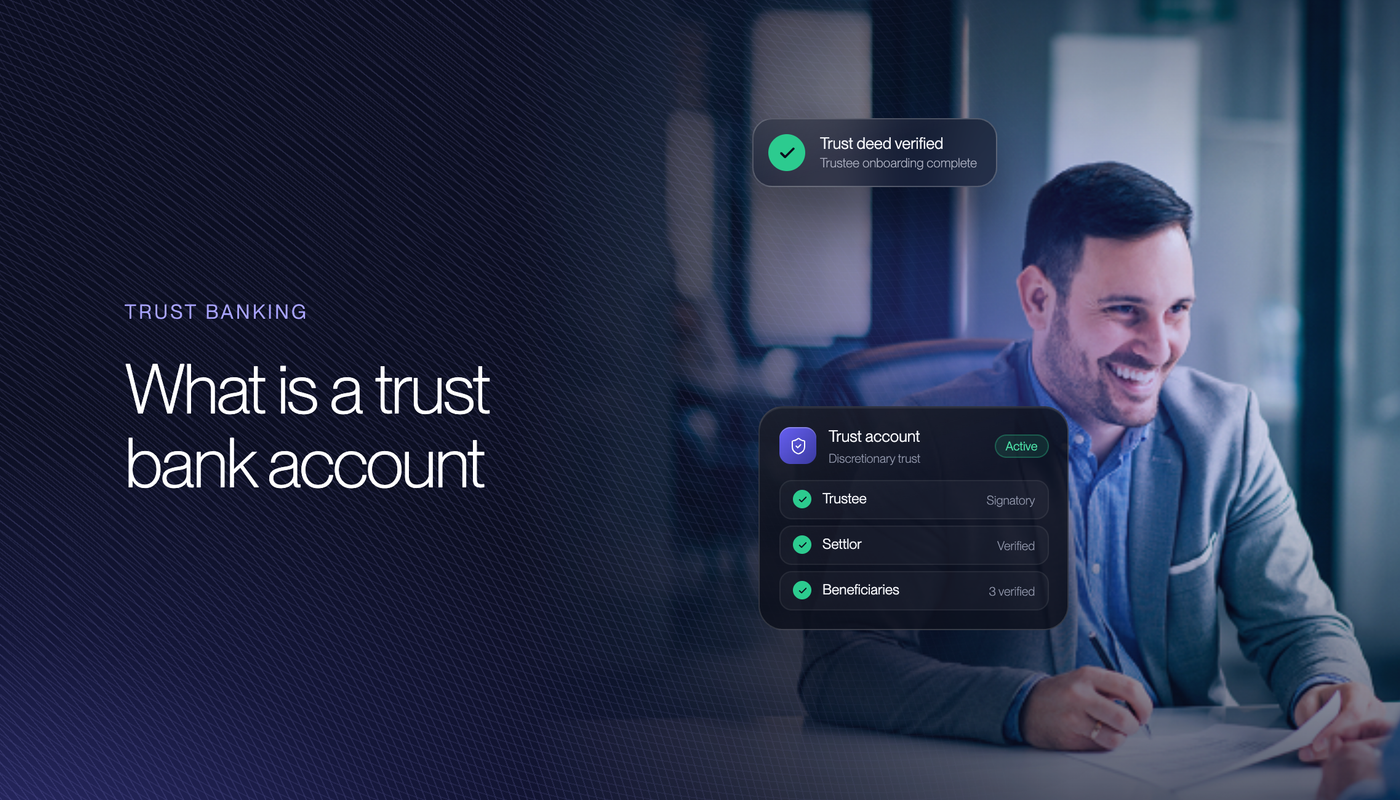
What is a trust bank account in practice? It is the working account of a trust, held by the trustees for the trust. Rent, dividends and sale proceeds come in, bills and investments are paid, and money goes out to beneficiaries. Everything stays apart from the trustees' own money, with a clean record for the trust's tax returns.
The hard part is getting one. Many banks have stepped back from trusts, and those that remain want local trusts and local people. Metro Bank needs at least half of the trustees, settlors and beneficiaries living in the UK, Coutts looks for £3 million from new clients, and every party must be identified first.
This is where we come in. We work with a regulated partner built for trusts and complex structures, and we handle the file: the deed review, the party chart, each trustee's KYC, the settlor's source of wealth and the application. One team, one point of contact. You tell us about the trust, we get it opened.
Our top-rated, licensed banking partner for trusts, foundations, funds and other complex structures opens multi-currency accounts for trustees in about a week, fully remotely.

Interpolitan Money
Business account
Time to onboard
1 Week
Currency
EUR, USD, GBP, AED, and 50+
Monthly fee
Custom
What Is a Trust Bank Account
A trust bank account is an account the trustees hold for the trust. In most common law systems a trust is not a legal person, so the account sits in the names of the trustees, or of a corporate trustee, as trustees of the named trust. The trustees control it and sign on it. Beneficiaries and the settlor generally do not.
GOV.UK states that the trustees are the legal owners of the assets held in a trust. The cash is one of those assets. It belongs to the trust fund, not to the trustees personally, and they may only use it as the deed or will allows.
Is a Trust a Bank Account
No. A trust is a legal relationship, not an account. A settlor moves assets to trustees, who hold them for beneficiaries under a deed or a will. The fund can hold shares, property, a family company and cash, and the bank account is only the part that holds cash and moves money.
Can a Trust Have a Bank Account
Yes, a trust can have a bank account, but not the way a company does. A company is a legal person and opens an account in its own name. Under English law and in most common law systems a trust has no legal personality, so the trustees open it. The title reads along the lines of "Jane Smith and Peter Lee as trustees of the Smith Family Trust". Either way, the bank account of a trust is legally the trustees' account, held in a special capacity.
Set Up the Bank Account of a Trust
A bank account of a trust opens quickly when the structure is clear before anyone asks. This is what we handle for you.
- Trust file built: Deed, party chart and trustee documents prepared with you.
- Built for complex structures: Our partner banks trusts, foundations and funds.
- Parties abroad accepted: Settlors, trustees and beneficiaries in most countries.
- About a week to open: Not weeks of back and forth with a local bank.
- 50+ currencies: EUR, USD, GBP, AED and more in one account.
- Price agreed first: Priced on your structure before you apply.
What Is a Trust Account in a Bank Called
A trust account in a bank is named after the trustees and the trust, never the beneficiaries. Statements and the mandate show the trustees acting "as trustees of" the named trust. In the US, the IRS says a revocable trust that becomes irrevocable needs a new EIN.
Bank Trust Departments Are Something Else
In the US and in private banking, many banks run a trust department that acts as trustee itself. Then the bank owns and controls the money, and you pay it for fiduciary services. So when someone asks what is a bank trust account, check which one they mean, because control sits in a different place.
A Trust Bank Account Is Not a Client Money Account
Solicitors and letting agents hold client money in client accounts, which some countries call trust accounts. Our guide on what a client money account is covers them. For the full application process for a private trust, read our guide on how to open a bank account for a trust.
How Does a Trust Bank Account Work
A trust bank account works like any other account, with one difference: every payment must fit the trust deed. The trustees decide, the bank follows the mandate they sign, and money moves only for the trust's purposes. Records must show what came in, what went out and why.
Who Opens the Account
The trustees open the account, not the settlor or the beneficiaries. The trust must already exist: United Trust Bank says the trust documents must be provided at opening. At Metro Bank the form is signed by all trustees, and each trustee completes a separate identity form. A corporate trustee applies with a board resolution naming who may sign.
Who Signs Payments and the Mandate
The mandate tells the bank who can approve a payment: all trustees, any two, or one up to a limit. Under English law, private trustees act together unless the deed allows majority decisions, so many banks ask for every signature. Metro Bank's standard online banking works only where one signature is enough, and two-signature accounts use Dual Sign Online Banking at £5 a month per trust account. The Trustee Act 2000 lets trustees use agents for admin, but decisions on who receives trust assets cannot be handed over.
Letters of Wishes and Protector Consent
A settlor's letter of wishes guides the trustees but does not bind them, and the bank never acts on it. Some deeds name a protector whose consent is needed for steps such as adding a beneficiary or a large distribution. HMRC treats protectors, advisers and enforcers with powers to veto or consent as people with control, so the bank will identify them and may ask to see the consent.
Money In and Money Out
Rent, dividends and sale proceeds come in. Tax, fees, investments and distributions go out, each after a trustee decision, minuted on a discretionary trust. That is how a trust bank account works in practice: the statement shows the money, and the minutes show why it moved.
Read more: Business bank account vs personal account.
Who Controls the Bank Account of a Trust
The trustees control the bank account of a trust. They hold legal title, sign the mandate and answer for every payment. The settlor, the beneficiaries and any protector generally do not control it, even though the bank must identify each of them before it opens the account.
The Trustees Hold Control
Individual trustees control the account jointly, under the mandate. Where a trust company is trustee, its board decides and its officers sign. Control carries duties: keep trust money separate and account for every payment. Paying personal costs from the trust is a breach of trust, whatever the bank allowed.
Why the Settlor Should Not Sign
Once the settlor gives assets to the trust, they are no longer the settlor's to spend. A settlor who keeps signing powers invites questions about whether the trust is real, and banks treat hidden settlor control as a warning sign. The common exception is a family trust or US revocable living trust where the settlor is also a trustee. Then they sign as a trustee, under the mandate.
Beneficiaries Have Rights, Not Signing Powers
Beneficiaries can hold the trustees to account, but they cannot instruct the bank. Even under a bare trust, where GOV.UK says the beneficiary can claim all capital and income once they reach 18 in England and Wales or 16 in Scotland, the beneficiary asks the trustees to transfer the money. Until then, the trustees sign.
Who Controls a Trust Bank Account When Trustees Change
Control passes to the trustees in office. The bank needs the deed of appointment or retirement, a new mandate and checks on any new trustee, and payments can stall until its records are updated.
Types of Trust and Their Bank Accounts
The type of trust changes who the bank must identify, how payments are approved and how tax is reported. Bare, discretionary, interest in possession and offshore trusts all use the same basic trust account in a bank, held by the trustees, but the file differs for each.
Bare Trusts
In a bare trust the beneficiary is entitled to everything, and the trustee simply holds it. They are common for gifts to children. Metro Bank asks for a certified birth certificate or passport for each minor beneficiary. United Trust Bank explains that under a bare trust each eligible beneficiary is covered by the FSCS up to £120,000.
Discretionary and Family Trusts
The trustees choose who receives income or capital, and when. Beneficiaries are often a class, which the bank must be able to identify at the point of payment. Some use a private trust company as trustee, and our guide on using a trust to plan for inheritance tax covers the tax side.
Interest in Possession Trusts
The trustees pass all income to the beneficiary as it arises, after expenses, while the capital stays in the trust. The account usually carries a regular payment to the income beneficiary.
Offshore Trusts
An offshore trust has trustees outside the settlor's home country, often a licensed trust company in Jersey, Guernsey, the Isle of Man or the BVI. Many hold assets through an underlying company, which needs its own account. Our planned guides on the offshore trust and the asset protection trust explain the structures.
US Revocable Living Trusts
Many Americans act as trustee of their own revocable living trust and retitle accounts in that capacity. Banks often accept a short certification of trust, signed in California by all acting trustees, instead of the full deed.
Read more: Private foundation vs trust.
Interpolitan Money
Business account
Time to onboard
1 Week
Currency
EUR, USD, GBP, AED, and 50+
Monthly fee
Custom
Can You Open a Trust Account at a Bank
Yes, you can open a trust account at a bank, but the choice is narrow and the entry rules are strict. UK lenders that still take trusts want UK parties and often a deposit, private banks want large balances, and offshore banks charge extra for files they rate high risk. The table shows what each bank publishes.
Bank | Who it takes | Who it turns away | Fee or minimum |
|---|---|---|---|
Metro Bank | UK trusts with most assets in the UK and at least 50% of key parties UK resident | Trusts with most parties living abroad | £150 to open, £5 a month below £25,000 |
United Trust Bank | UK-registered trusts where every settlor, trustee and beneficiary is UK resident | Any party living abroad, and registered charities | No fees, £15,000 minimum opening balance |
Hampden Bank | Trusts that want a nominated banker | Smaller trusts | Typically £250,000 or more in deposits |
Coutts | Private clients who meet its wealth threshold | New clients below £3 million | Relationship based |
Butterfield (Channel Islands) | Trust and company structures banked in Jersey and Guernsey | Decided case by case | £2,500 a year if rated high risk, £4,500 with a PEP |
The low fees are for UK trusts with UK people. Private and offshore banks take international trusts but price them through thresholds, risk charges and payment fees.
Residency Rules Keep International Trusts Out
A trust with a settlor in Dubai, a trustee in Jersey and beneficiaries in three countries fails the Metro Bank and United Trust Bank residency rules, yet it is the trust that most needs multi-currency banking. Our guide to the business bank account for non-residents explains why banks draw these lines.
Minimum Balances Tie Up Trust Money
United Trust Bank asks for £15,000, Hampden Bank's trust deposits are typically £250,000 or more, and Coutts looks for £3 million from new clients. Money held to meet a floor cannot be invested, which matters for trustees who must use the fund well.
Why Banks Refuse Trust Accounts
Refusals usually follow a gap: a protector left off the chart, a source of wealth with no evidence, an unregistered trust or parties in countries the bank avoids. Banks rarely explain a refusal, so the file must be right first time. Read why banks reject account applications and how de-risking closes accounts.
Read more: Bank accounts for Guernsey trusts and the Guernsey offshore banking guide.
Interpolitan Money
Business account
Time to onboard
1 Week
Currency
EUR, USD, GBP, AED, and 50+
Monthly fee
Custom
A Faster Way to Get a Trust Account Opened
Our banking partner for trusts, foundations, funds and other complex structures opens accounts for trustees in about a week, fully remotely. It accepts parties in most countries, holds EUR, USD, GBP, AED and 50+ currencies in one account, and prices each account on the structure. We prepare the file it needs.
Our partner is an electronic money institution authorised by the UK Financial Conduct Authority, built for layered ownership, parties abroad and corporate trustees. Each trust gets a multi-currency account to pay each beneficiary in their own currency. It is not a bank: no lending, cash or interest, and no deposit guarantee. Client money is safeguarded instead, kept apart from the partner's own funds. Our guide to the business bank account vs EMI account explains the difference.
Feature | Banks | Our partner |
|---|---|---|
Time to open | Up to 15 working days to review at Metro Bank, longer offshore | About a week |
Who they accept | Mostly UK trusts with UK parties | Trusts with parties in most countries |
How you apply | Paper pack or a store visit with all trustees at some banks | Fully remote |
Minimum deposit | £15,000 to £250,000 at specialist lenders | Confirmed in your quote |
Monthly cost | Free to £5 at UK lenders, risk charges offshore | Priced on your structure |
Currencies | Relationship based | EUR, USD, GBP, AED and 50+ |
Lending, custody and interest | Available at many banks | Not offered |
Protection | FSCS up to £120,000 per trust | Safeguarded, no deposit guarantee |
For a trust that receives income, pays beneficiaries abroad and holds several currencies, our partner is the faster and simpler route. A fee-free UK lender can still be cheaper for a small UK family trust whose people all live in the UK. A bank or private bank remains the place for lending, custody and a long relationship, and many trusts keep both.
Which Trusts Our Partner Takes
Family, discretionary and offshore trusts, the trust companies that run them, foundations and family offices. It will not take a structure that hides who is behind it. We check the fit, build the file, and each trustee verifies online, so no trustee visits a branch.
Interpolitan Money
Business account
Time to onboard
1 Week
Currency
EUR, USD, GBP, AED, and 50+
Monthly fee
Custom
What Banks Ask for Before Opening a Trust Account
Banks ask for the trust deed, identity checks on every person with a role in the trust, evidence of where the money came from, proof of registration where the law requires it and a tax classification for the trust. The file is larger than a company's because a trust has more people to check.
The Trust Deed and Trustee Documents
A certified copy of the deed or will and any later deeds, a certified passport and proof of address for each trustee, and for a corporate trustee its incorporation documents, licence and a board resolution naming signatories. See the documents needed to open a business bank account for the corporate items.
KYC on the Settlor, Beneficiaries and Protector
UK money laundering rules define the beneficial owners of a trust as the settlor, the trustees, the beneficiaries or the class of beneficiaries, and any individual with control over the trust. So the bank checks the settlor and any protector as well as the trustees, identifies named beneficiaries and needs a clear description of any class.
Source of Wealth and Source of Funds
The bank wants to know how the settlor made the money and how it reached the trust. A sale agreement, dividend statements or an estate grant help. "Family wealth" on its own does not.
Trust Registration Service and EU Registers
Most UK express trusts must register with HMRC's Trust Registration Service, generally within 90 days of being created or becoming liable for tax, and failing to register can cost a £5,000 penalty. Under regulation 30A of the Money Laundering Regulations, a UK bank must collect a register excerpt before the relationship starts. In the EU, the Anti-Money Laundering Regulation applies from 10 July 2027, and its Article 67 requires trustees of trusts run from outside the EU to file beneficial ownership details with the member state's register before the relationship begins, and to report changes within 28 days.
CRS Classification of the Trust
The bank asks for a Common Reporting Standard self-certification. HMRC says a trust is a Financial Institution when its income comes mainly from financial assets and it is managed by a Financial Institution, such as a professional trustee. Otherwise it is usually a passive Non-Financial Entity, and the bank reports its controlling persons. A trust holding only cash is not an Investment Entity. CRS 2.0 rules apply from 1 January 2026.
Read more: Business bank account requirements.
Prepare Your Trust Account File
Most delays come from a missing party or a thin source of wealth. We build the file the way reviewers want to read it.
- Party chart on one page: Settlor, trustees, protector and beneficiaries shown.
- Source of wealth written: Evidenced and in plain words.
- Trustee pack checked: Deed, appointments and signing mandate in order.
- Registration covered: TRS excerpt or your trust's local equivalent.
- Tax forms ready: CRS self-certification for the trust and its people.
How Much a Trust Bank Account Costs
A trust bank account at a UK lender can cost nothing for a local family trust. The cost rises with international parties: minimum balances, private bank thresholds, risk charges and payment fees. With our partner the price is set on your structure and confirmed in writing before you apply.
Charge | Typical range at a bank | With our partner |
|---|---|---|
Account opening | Free at United Trust Bank, £150 at Metro Bank | Quoted with your setup |
Monthly fee | None at United Trust Bank, £5 at Metro Bank below £25,000 | Priced on your structure |
Minimum deposit | £15,000 at United Trust Bank, typically £250,000 at Hampden Bank | Confirmed in your quote |
Private bank entry | £3 million for new Coutts clients | No private banking relationship needed |
High-risk account charge | £2,500 a year at Butterfield in the Channel Islands | Quoted with your setup |
Account linked to a PEP | £4,500 a year at Butterfield | Quoted with your setup |
SWIFT payment out, online | £37 at Butterfield | Set out in your fee schedule |
SWIFT payment out, manual | £92 at Butterfield | Set out in your fee schedule |
SWIFT repair | £25 at Butterfield | Set out in your fee schedule |
Bank reference letter | £75 at Butterfield | Confirmed in your quote |
Currencies held | Relationship based | EUR, USD, GBP, AED and 50+ in one account |
Lending and interest | Interest on deposits, lending at many banks | Not offered |
For an international trust, the biggest cost is money that sits still: a £250,000 deposit floor or a £3 million threshold ties up capital the trustees could invest. Then come payments: ten manual SWIFT payments a year at £92 cost £920, and a high-risk rating adds £2,500 a year.
To be fair, a UK family trust whose people all live in the UK can bank with a fee-free lender, and that is cheaper. These figures are planning ranges from published tariffs. Our planned guide to business bank account fees explains how bank tariffs are built.
Interpolitan Money
Business account
Time to onboard
1 Week
Currency
EUR, USD, GBP, AED, and 50+
Monthly fee
Custom
How Long It Takes to Open a Trust Account
A trust account at a UK lender takes about three to four weeks once the pack is complete, and offshore and international trusts usually take longer. Metro Bank reviews within 15 working days and aims to open within five more. Our partner opens in about a week.
Stage | Local bank | Our partner |
|---|---|---|
Building the file | Trustees collect documents themselves | We build it with you |
Review | Up to 15 working days at Metro Bank | Within the week |
Opening after approval | Within 5 working days at Metro Bank | Account goes live on approval |
Funding | Within 90 days of applying at United Trust Bank | As soon as the account is live |
Total | About 3 to 4 weeks, longer offshore | About a week |
At a bank the stages run one after another, and each missing document restarts the clock. With a complete file, the same work fits into about a week.
What Slows It Down
A party missing from the chart, an unregistered trust, a source of wealth with no evidence and a trustee who cannot sign in time. Offshore trusts add a review of the trust company.
How to Speed It Up
Build the party chart and source of wealth first, collect every trustee's documents in one round, agree the mandate before you apply and apply once, to a provider that accepts your kind of trust.
Interpolitan Money
Business account
Time to onboard
1 Week
Currency
EUR, USD, GBP, AED, and 50+
Monthly fee
Custom
What Happens After the Account Is Open
The trustees fund the account, set up regular payments and record every decision. The provider reviews the trust from time to time, and the account is reported under CRS each year.
Protection depends on where the money sits. At a UK bank, the FSCS covers up to £120,000 per trust for most trusts, and per eligible beneficiary for a bare trust. In the US, the FDIC has insured trust deposits since 1 April 2024 at $250,000 per beneficiary for up to five beneficiaries, so $1,250,000 per grantor at each bank. Money with our partner is safeguarded instead.
Keep the file current: update the Trust Registration Service and the bank when trustees or beneficial owners change.
Why the Trust Comes Before the Account
A provider can only review a trust that properly exists: a signed deed, trustees in place, assets settled or ready to settle, and registration done where required. If you are still choosing where to set the trust up, our planned guides on the best jurisdictions for trust formation and a holding company and trust structure cover the choice. Once the trust exists, we open the account with you.
Common Trust Bank Account Mistakes
Most trust account problems come from how the trust is presented and run, not from the trust itself. These are the mistakes we see most.
Opening the Account in a Personal Name
Some trustees keep trust money in their own account to save time. It mixes trust and personal money, makes the trust's records hard to prove and can be a breach of trust. It also changes deposit protection: at a UK bank, trust money in a personal account shares the owner's single £120,000 FSCS limit instead of having its own cover. Open an account in the trustees' names for the trust from the start, and move the trust money there before the first tax return.
Applying Before the Trust Is Registered
A UK bank must collect an excerpt of the Trust Registration Service before it opens the account, so an unregistered trust stops at the first step. Missing the registration deadline can also bring a £5,000 penalty from HMRC. Register within 90 days of the trust being created or becoming liable for tax, download the proof of registration and send it with the application.
Leaving a Protector or Beneficiary Off the Chart
A protector, an enforcer or a beneficiary who has already received money is easy to forget. The bank finds out later and the review starts again, which at Metro Bank can mean another 15 working days. List every person named in the deed, everyone with power to consent or veto, and everyone who has been paid. We build that chart with you before anything is sent.
Get Your Trust Account Opened With Less Work
Opening a trust account is simple when the file is planned around the bank's questions. Send us your details and we get back to you.
- Fit checked first: We confirm our partner can take your trust.
- Corporate trustees handled: Trust companies and private trust companies.
- Refused before: We review the file and close the gaps.
- Fair view of banks: We say when a local or private bank should sit alongside.
- One point of contact: From the first form to the first distribution.
Bottom Line
A trust bank account is an account held by the trustees for the trust. The trust has no legal personality, so the trustees own the account, sign the mandate and answer for every payment, while the settlor and beneficiaries stay off the signing list. The bank still checks every one of them.
For a small UK trust with UK people, a UK lender can be the cheapest home. For a trust with people or money in several countries, the faster route is our regulated partner built for complex structures, with the account open in about a week. We prepare the file, and you tell us about the trust.
What is a bank trust account?
Can a trust have a bank account?
Can you open a trust account at a bank?
What is a trust account in a bank?
Who controls the bank account of a trust?
What is a trust bank account and how does it work?
Is a trust a bank account?
How does a trust bank account work with a corporate trustee?
Can a beneficiary or settlor sign on a trust bank account?
How much does a trust bank account cost?
Is money in a trust bank account protected?
How is a trust bank account reported under CRS?
What happens to a trust bank account when a trustee dies or retires?
Sources
- GOV.UK: Trusts and taxes
- GOV.UK: Types of trust
- GOV.UK: Register a trust as a trustee
- The Money Laundering Regulations 2017, regulation 6: beneficial owners of trusts
- The Money Laundering Regulations 2017, regulation 30A: register excerpts
- Trustee Act 2000, section 11: delegation to agents
- HMRC Trust Registration Service Manual, TRSM32060
- HMRC International Exchange of Information Manual, IEIM400800: trusts as Investment Entities
- Regulation (EU) 2024/1624 on anti-money laundering (EUR-Lex)
- IRS: Do you need a new EIN?
- FDIC: Trust accounts deposit insurance guide
- Metro Bank: Trustee banking
- United Trust Bank: Trust account product guide (August 2026)
- Hampden Bank: Banking for trusts
- Butterfield: Channel Islands fee schedule (June 2026)