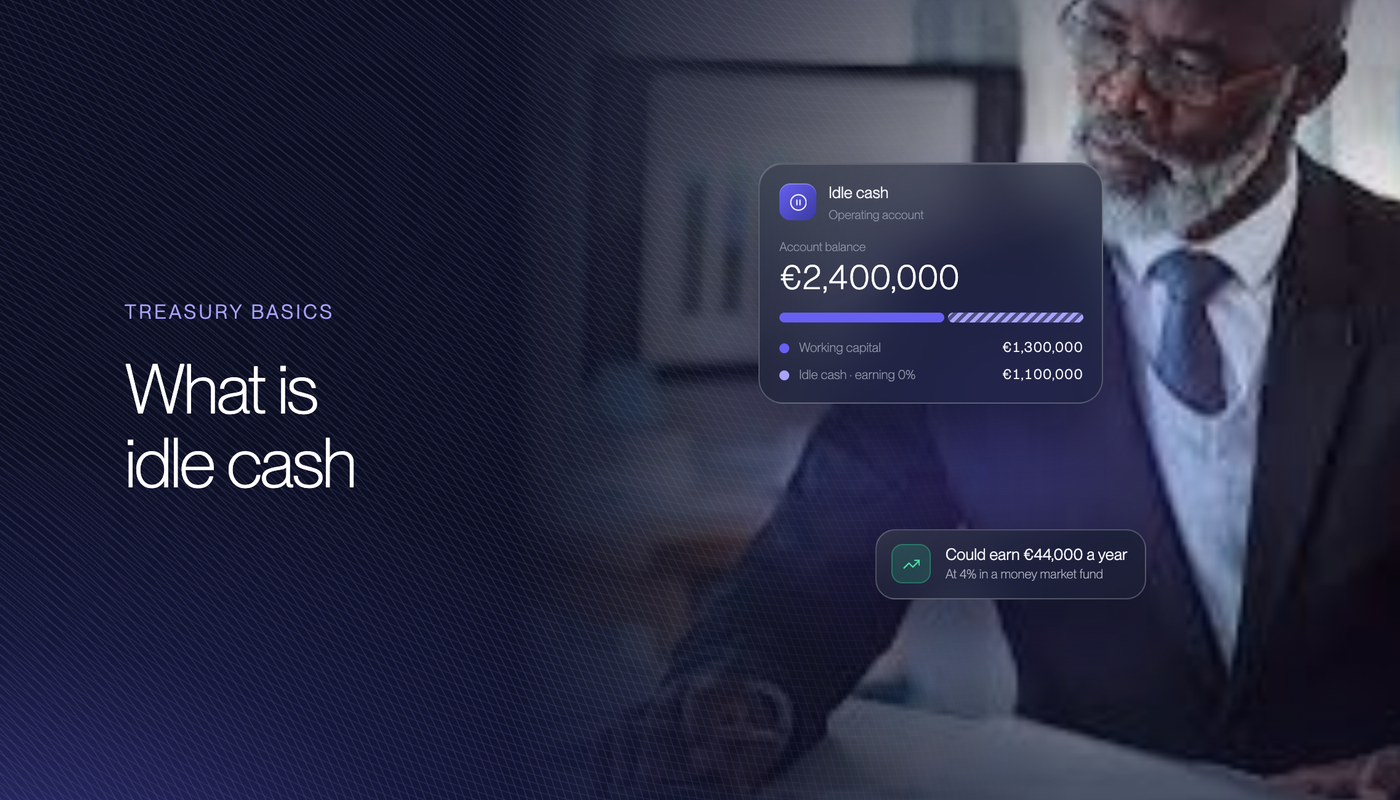
Idle cash is money your business holds but does not need for day-to-day running, usually sitting in a current account. Most companies have more of it than they think: tax set aside months early, customer prepayments, a buffer that grew with sales. Put to work, that excess cash can earn a market rate.
The hard part is that banks rarely pay for it. Euro area banks paid companies an average of 0.61% on overnight deposits in August 2026, while the ECB paid those banks 2.25% on money left with it overnight. The deposit guarantee also stops at €100,000 per bank, so a large cash surplus in one account is exposed.
This is where we come in. We introduce your company to Sophic, a service of Athlos Capital Investment Services Ltd, a CySEC-regulated investment firm. You choose the instruments and amounts. Sophic executes your orders and holds the investments. We check that you qualify first and prepare the onboarding with you.
Put Your Idle Cash to Work
Idle cash above what you need this month can earn a market rate. We introduce you to Sophic and handle the onboarding with you.
- Money market funds: Currently from 2% p.a. before fees, a variable return that can fall.
- Treasury bills: Currently from 2.5% p.a. before fees, repaid on a set date.
- Government bonds: Currently from 3% p.a. before fees, with regular interest.
- No lock-in: Sell when you need the money back, at the market price.
- Quick start: Digital onboarding in about a day, invested 2 to 3 business days later.
- Segregated client cash: Held in segregated accounts at J.P. Morgan.
- Safeguarded investments: Safeguarded by SIX Group.
When investing, your capital is at risk. Yields may vary.
Sophic
Treasury management
Yield
2% to 3%+ p.a
Fees
0.3% a year + €10 per order
Eligibility
EU/EEA businesses with an LEI
When investing, your capital is at risk. Yields may vary.
What Is Idle Cash
Idle cash is money a business holds beyond what it needs to pay its bills in the coming weeks, earning little or nothing. It is not a separate account. It is the part of your bank balance that has no job this month, so it can be put somewhere that pays more.
Idle Cash Meaning in Plain Terms
The idle cash meaning is simple: cash that is not working. It is not being spent on stock, salaries or growth, and it is not earning a fair return. In most companies it builds up quietly in the main current account, because moving it takes a decision nobody has made yet.
Idle cash goes by other names too: idle funds, idle money or idle balances. Accountants and analysts usually say excess cash or surplus cash. All of these describe the same thing, money above the level the business needs to run without strain.
Idle Cash Is Not the Same as Working Capital
Working capital is current assets minus current liabilities: cash, stock and money owed to you, less what you owe within a year. Working capital includes the cash you need. Idle cash is only the part of the cash line that sits above your operating needs and your reserve.
A company can have tight working capital and still hold idle cash, for example when a large tax payment is due in nine months and the money is already in the account. Good working capital management plans for that date and decides where the money waits until then.
Excess Cash in Company Accounts
Company accounts do not show idle cash as a line. They show cash and cash equivalents. IAS 7 defines cash equivalents as short-term, highly liquid investments that are readily convertible to known amounts of cash and subject to an insignificant risk of changes in value. An investment normally qualifies only with a maturity of three months or less from purchase (IAS 7, paragraphs 6 and 7).
Analysts who value a company separate operating cash from excess cash, the amount the business could pay out without hurting its operations. You can use the same idea for your own planning: decide your operating cash first, and the excess cash is the rest.
Excess Cash vs Cash Surplus vs Cash Reserves
Excess cash, a cash surplus and cash reserves overlap but are not the same. Excess cash is a balance above your needs at one moment. A cash surplus is more cash coming in than going out over a period. Reserves are cash you keep on purpose for shocks. Each one needs a different home.
Term | What it means | Where it shows | What to do with it |
|---|---|---|---|
Excess cash | Cash above operating needs and reserves at a point in time | The bank balance on the balance sheet | Move it to instruments that fit when you need it |
Cash surplus | More cash in than out over a month, quarter or year | The cash flow statement | Decide each period how much becomes excess cash |
Cash reserves | Cash kept on purpose for shocks you cannot date | A buffer set in your cash policy | Keep it within a day's reach |
Idle cash | Any cash earning little or nothing, wherever it sits | Current accounts and old deposit accounts | Find it, size it and give it a job |
The point of separating the terms is timing. A cash surplus in one quarter only becomes idle cash if it is still sitting in the account when the next quarter starts. Your reserve is not idle cash at all, even though it can sit in an instrument that pays more than the bank. Our guide to cash flow management for businesses shows how to track the surplus month by month.
A Cash Surplus Can Arrive Before Its Costs
A surplus often arrives before the costs it has to cover. A school collects a term's fees in September, a SaaS company bills annual plans upfront, a builder takes deposits before buying materials. The money is in the account, but much of it is already promised. Count it as excess cash only after those costs are planned.
Reserves Have a Job, So They Are Not Idle Cash
A reserve pays for the late customer, the lost contract or the urgent repair. It should stay within a day's reach. That does not mean it must earn nothing. Money market funds usually pay out the same day or the next. Our guide on how much cash reserves a business should have covers the sizing.
Sophic
Treasury management
Yield
2% to 3%+ p.a
Fees
0.3% a year + €10 per order
Eligibility
EU/EEA businesses with an LEI
When investing, your capital is at risk. Yields may vary.
What Idle Cash Costs a Business
Idle cash costs a business the return it gives up. Euro area companies earned an average of 0.61% on overnight deposits in August 2026, while the ECB paid banks 2.25% on overnight money, rising to 2.50% from 16 September. Cash above €100,000 at one bank also carries risk the deposit guarantee does not cover.
Banks Pay Companies 0.61% on Overnight Deposits
The ECB's bank interest rate statistics for August 2026, released on 1 October 2026, put the average rate on overnight deposits from companies at 0.61%, unchanged on the month. Deposits with an agreed maturity of up to one year paid 2.24%. Many current accounts pay nothing at all.
Published bank rates show the same pattern. permanent tsb in Ireland pays businesses 0.75% on its demand deposit account, 1.75% on 32-day notice and 2.25% fixed for 12 months, on rates effective 7 July 2026, with a €2,000,000 cap per account.
Banks Do Not Pass Rate Rises On in Full
The ECB's deposit facility rate is what a bank earns when it leaves money with the ECB overnight. It was 2.25% through the summer of 2026 and rose to 2.50% on 16 September. In August, while banks earned 2.25% on that money, they paid companies an average of 0.61% on overnight deposits.
The difference stays with the bank. That is a normal part of banking, but it means idle business cash in a current account earns a small share of what short-dated government debt pays. French 13-week Treasury bills were auctioned at an average rate of 2.750% on 19 October 2026, for example.
Deposits Above €100,000 Are Not Fully Protected
The Deposit Guarantee Schemes Directive 2014/49/EU covers deposits up to €100,000 per depositor per bank (Article 6(1)), adding all your accounts at that bank together (Article 7(1)). Ordinary companies qualify. Financial institutions, insurers and public authorities are excluded (Article 5(1)).
Every euro of idle cash above €100,000 at one bank depends on that bank staying sound. Silicon Valley Bank showed how fast that can change: it lost over $40 billion of deposits on 9 March 2023 and was closed the next day, when Roku reported about 26% of its cash there. Our guide to deposit guarantee schemes for business accounts explains the limits.
Idle Money Also Costs Time and Options
Cash with no plan is cash nobody watches. It sits at the wrong bank, in the wrong currency or on an old rate after a fixed term ends. When a big bill or an opportunity arrives, the business decides in a hurry. A written plan for excess cash takes that pressure away.
Find and Invest Your Excess Cash
We introduce you to Sophic, where you choose the instruments and amounts, and we prepare the onboarding with you.
- Eligibility checked first: We check your country, sector and LEI before any paperwork.
- One document list: Everything onboarding needs, asked for once.
- You stay in control: You choose the instruments and amounts, Sophic executes your orders.
- Three currencies: Money market funds in EUR, GBP or USD.
- Sell any time: No lock-in, sold at the market price.
When investing, your capital is at risk. Yields may vary.
How to Work Out How Much Idle Cash You Have
To find your idle cash, start from a 13-week cash forecast, set aside operating cash for the next one to two months, then set aside a reserve for shocks. What remains is your excess cash. Split it by the date you expect to need it, because that date decides where it can sit.
Start From a 13-Week Cash Forecast
List every receipt and payment you expect over the next 13 weeks: salaries, suppliers, rent, VAT, loan repayments and customer receipts. Weekly figures are enough. Then add the big dated items beyond that window, such as corporate tax, dividends or planned equipment. Our guide to liquidity management for businesses shows how to build it.
Set Your Operating Cash Line
Operating cash pays the next 30 to 60 days of outgoings and stays in current accounts with same-day access. Size it from the heaviest month in the forecast, not the average, and add a margin. Once it is well above €100,000, split it across two banks.
Keep a Reserve for Shocks You Cannot Date
The reserve covers what the forecast cannot see: a large customer paying late, a lost contract, an urgent repair. Two to three months of fixed costs is a common starting point, more for seasonal or project businesses. Intrum's European Payment Report 2026 found that about 12% of business revenues are paid late, so plan for slow payers.
The Rest Is Your Excess Cash
Cash above the operating line and the reserve is your excess cash. Give each part a date: needed in 3 months, in 6 months, in a year, or not planned at all. Cash with a date gives you more choice over where it waits. Cash with no date needs a decision from the owners or the board.
Sophic
Treasury management
Yield
2% to 3%+ p.a
Fees
0.3% a year + €10 per order
Eligibility
EU/EEA businesses with an LEI
When investing, your capital is at risk. Yields may vary.
Businesses That Hold the Most Idle Cash
Businesses paid in advance, paid in large lumps or paid by season hold the most idle cash. Schools, SaaS companies, insurers, funded startups, ecommerce sellers and project businesses all see cash arrive months before it is needed. Each one knows roughly when that money will be spent, which makes it easier to plan.
Business | Why cash builds up | When it is needed |
|---|---|---|
Fees paid a term or a year in advance | Salaries spread over the school year | |
Annual plans billed upfront | Payroll and hosting month by month | |
Insurance companies | Premiums collected before claims are paid | Claims and capital needs, often years out |
A funding round lands in one payment | Runway spent over 18 to 24 months | |
Peak season sales | Stock bought before the next peak | |
Construction and project firms | Client deposits and stage payments | Materials and subcontractors later |
Dividends from subsidiaries or proceeds from a sale | Reinvestment or a payout to owners | |
Charities | Donations and grants received in lumps | Projects spread over months or years |
In every row, the business knows roughly when the money goes out. That date is what lets idle cash earn more without putting the next payment at risk. Charities and holding companies may need additional checks before onboarding.
Prepaid Businesses Hold Cash That Is Already Promised
Schools, SaaS companies and insurers collect cash before they deliver. The cash is real, but most of it is owed back as service. It behaves like dated cash with a known spending pattern, so it can be planned month by month as costs fall due.
Funded Startups Hold Large Balances for Their Size
A startup that raises a round often holds 18 to 24 months of runway in one account. That is a large cash surplus for a small company, and usually far above €100,000. Founders tend to leave it in the current account because spending is spread out, which leaves most of the runway earning little.
Seasonal Sellers Swing Between Surplus and Shortfall
An online retailer may hold several times its usual cash after the December peak and very little in October, when stock for the next peak is bought. Its excess cash is real but temporary. Planning it quarter by quarter, rather than once a year, keeps the October bills covered.
What You Can Do With Excess Cash
A business can do five things with excess cash: leave it in the bank, pay down expensive debt, reinvest it, return it to shareholders or put it into short-term instruments. The right mix depends on when you need the money and what your owners want. Most companies use more than one.
Leave It in the Bank or a Deposit Account
A current account gives same-day access and little or no interest. Notice and fixed deposits pay more but lock the money for the notice period or the term, and they stay covered up to €100,000 per bank. Offshore banks price these the same way, as our guide to business savings accounts in Guernsey shows.
Pay Down Expensive Debt
If the company carries an overdraft or revolving loan, repaying it is often a good use of a cash surplus. Euro area banks charged companies an average of 3.92% on revolving loans and overdrafts in August 2026, far above what deposits pay. Keep the facility open in case you need it later.
Reinvest It in the Business
Excess cash can fund stock, equipment, hiring or an acquisition. That is a business decision rather than a treasury one. Until the money is spent, it still needs a home, and that home should be able to pay out on the day the invoice is due.
Return It to Shareholders
Cash the business will never need can be paid out as a dividend or used to buy back shares, subject to company law, distributable reserves and tax. Some groups move it up to a holding company first. The cost differs by country and by shareholder, so take tax advice. Our guide to tax planning for business owners covers the main routes.
Put It in Short-Term Instruments
Money market funds, Treasury bills and government bonds let excess cash earn a market rate with no lock-in. They are not bank deposits, so the deposit guarantee does not cover them, and their value can move. Our guide to short-term investments for business cash goes through them in depth.
Sophic
Treasury management
Yield
2% to 3%+ p.a
Fees
0.3% a year + €10 per order
Eligibility
EU/EEA businesses with an LEI
When investing, your capital is at risk. Yields may vary.
Where Idle Cash Can Sit
Idle cash can sit in a savings account, a money market fund, Treasury bills or government bonds. They differ on return, access, lock-in and risk. Bank deposits are covered up to €100,000 per bank. Funds, bills and bonds are not covered, and repayment depends on the issuing government or the fund's holdings instead.
Factor | Business savings account | Money market fund | Treasury bills | Government bonds |
|---|---|---|---|---|
Current rate | 0.75% on demand, 2.25% fixed for 12 months (permanent tsb, July 2026) | Currently from 2% p.a. before fees, variable and can fall | Currently from 2.5% p.a. before fees | Currently from 3% p.a. before fees |
Access to cash | Same day, or after the notice period or term | Usually the same day or the next | At maturity, or sold early at the market price | At maturity, or sold early at the market price |
Lock-in | None on demand accounts, yes on fixed terms | None | None, but the price moves if sold early | None, but the price moves if sold early |
Deposit guarantee cover | Up to €100,000 per bank | Not covered | Not covered | Not covered |
Main risk | The bank's balance sheet above €100,000 | Value can fall, rare limits on redemptions | Price change before maturity | Price change before maturity, larger for longer bonds |
The table compares access, lock-in and risk side by side. Bank deposits are covered up to €100,000 but pay less, while funds, bills and bonds pay a market rate and can move in value. Fund, bill and bond figures are Sophic's current starting yields, before fees. When investing, your capital is at risk. Yields may vary.
Money Market Funds Pay a Variable Return
A money market fund holds short-term, high-quality debt and pays a variable return. EU funds follow Regulation (EU) 2017/1131: public debt CNAV and LVNAV funds must hold at least 10% of assets maturing daily and 30% weekly. In heavy outflows a fund can charge a fee or limit redemptions (Article 34).
Treasury Bills Repay on a Set Date
Treasury bills are short-term government debt, usually 3, 6 or 12 months. You buy below face value and receive the full amount at maturity. Repayment depends on the issuing government rather than on a single bank's balance sheet. Our guide to what Treasury bills are covers how they pay.
Government Bonds Pay Regular Interest
Government bonds pay interest on a schedule and repay at maturity, often years out. Their price moves with interest rates, so selling early can mean a gain or a loss.
Give Your Idle Cash a Job
You decide how to split cash between funds, bills and bonds. Sophic executes your orders and holds the investments.
- Fund yields: Money market funds currently from 2% p.a. before fees, variable.
- Bill yields: Treasury bills currently from 2.5% p.a. before fees.
- Bond yields: Government bonds currently from 3% p.a. before fees.
- Issuers you know: Bills and bonds from the EU, Germany, France, Cyprus, the UK and the US.
- Onboarding prepared: We gather your company documents and LEI details with you.
- Clear costs: Fees are shown on the card, with no lock-in period.
When investing, your capital is at risk. Yields may vary.
How to Invest Idle Cash as a Company
To invest idle cash, a company needs a board decision or a written policy, an active LEI and an account with a regulated investment firm. Onboarding checks your company documents and owners. With Sophic, onboarding takes about a day and money is invested 2 to 3 business days later.
Write a Short Cash Policy
Set down how much stays in the bank, which instruments the company may hold, the longest maturity, any limit per issuer and who approves each order. One page is enough. In the 2026 AFP Liquidity Survey, three in four organisations had a written investment policy, and the habit suits smaller companies just as well.
Get an LEI Before You Invest
EU investment firms cannot buy Treasury bills or bonds for a company without a Legal Entity Identifier (Article 13(2) of Delegated Regulation (EU) 2017/590). Buying fund shares directly from a fund's administrator is not covered by that rule, but Sophic asks for an active LEI at onboarding. An LEI is renewed every year. See what an LEI number is.
How Investing With Sophic Works
You choose the instruments and amounts. Sophic executes your orders and holds the investments. With Sophic, client cash is held in segregated accounts at J.P. Morgan and investments are safeguarded by SIX Group. There is no lock-in, and you can sell when you need the cash back.
Sophic onboards businesses incorporated in Cyprus, Austria, Belgium, Bulgaria, Estonia, France, Germany, Greece, Ireland, Italy, Luxembourg, Portugal, Slovenia, Spain and Switzerland. Companies also need an active LEI, proof of legal existence and a sector Sophic accepts. If you are still setting up the company, see our guides to Cyprus company formation with a bank account and Ireland company formation.
Read more: How Sophic works for businesses.
Sophic
Treasury management
Yield
2% to 3%+ p.a
Fees
0.3% a year + €10 per order
Eligibility
EU/EEA businesses with an LEI
When investing, your capital is at risk. Yields may vary.
Common Idle Cash Mistakes
Most idle cash mistakes come from leaving money where it landed. Companies keep too much at one bank, invest money they need soon, forget old deposit rates or leave onboarding until the cash has piled up. Each one costs return or access, and each one is easy to fix with a short written plan.
Keeping All Excess Cash at One Bank
One account is convenient, so excess cash collects there. Above €100,000, the money depends on that bank's balance sheet, and most of it earns little. When Silicon Valley Bank failed in March 2023, companies with most of their cash there could not reach it until regulators stepped in. Keep operating cash at two banks and move the rest into instruments held in custody. A multi-currency business account can be the second operating account.
Investing Operating Cash for a Higher Yield
Putting next month's payroll into a 6-month bill for a slightly better rate forces a sale if cash runs short. If yields have risen since you bought, the sale price is lower, and dealing costs come off too. Treat the operating line as fixed. Only cash above it and above the reserve counts as idle cash.
Leaving Cash on an Expired Rate
Fixed deposits often roll into an instant access account at a lower rate when the term ends, unless you give new instructions. A balance can sit there for months before anyone notices. Put every maturity date in the finance calendar and review where the cash sits each quarter.
Waiting Until Cash Piles Up to Get Ready
Opening an investment account takes documents, owner checks and, for bills and bonds, an LEI. Companies that start only when the cash is already large lose weeks of return. Sort the LEI and onboarding while the surplus is building, so it can be invested within days. The paperwork is close to the documents needed to open a business bank account.
Bottom Line
Idle cash is the part of your balance with no job this month. Find it with a 13-week forecast, keep an operating line and a reserve, and give the rest a date. Bank rates on corporate deposits trail the ECB rate, and the deposit guarantee stops at €100,000, so excess cash is worth a written plan. Our overview of what treasury management is puts it in context.
What is idle cash?
What is the meaning of idle cash in business?
What is excess cash?
What is the difference between excess cash and a cash surplus?
How much cash should a business keep before it counts as idle?
Why is idle cash bad for a business?
Is idle cash the same as cash reserves?
What can a company do with excess cash?
Is money above €100,000 in a business account protected?
Where can a business invest idle cash?
Do I need an LEI to invest company cash?
Which businesses hold the most idle cash?
How quickly can idle cash be invested and taken back out?
Sources
- European Central Bank, Key ECB interest rates (checked 20 October 2026)
- European Central Bank, Euro area bank interest rate statistics, August 2026 (released 1 October 2026)
- European Central Bank Data Portal, Revolving loans and overdrafts to corporations, new business, August 2026
- permanent tsb, Non-personal deposit interest rates effective 7 July 2026
- Agence France Trésor, Latest auction results, BTF auction of 19 October 2026
- IFRS Foundation, IAS 7 Statement of Cash Flows
- Directive 2014/49/EU on deposit guarantee schemes, EUR-Lex
- Regulation (EU) 2017/1131 on money market funds, EUR-Lex
- Commission Delegated Regulation (EU) 2017/590 (RTS 22), EUR-Lex
- GLEIF, Introducing the Legal Entity Identifier (LEI)
- Board of Governors of the Federal Reserve System, Review of the Federal Reserve's Supervision and Regulation of Silicon Valley Bank (28 April 2023)
- Roku, Inc., Form 8-K filed 10 March 2023, SEC
- Intrum, European Payment Report 2026 (published 21 April 2026)
- Association for Financial Professionals, 2026 AFP Liquidity Survey press release
Binderr is not an investment provider or adviser. We connect businesses with regulated investment providers and help with the setup. Every investment is made under the provider's own terms, fees and risk disclosures, which you review and accept directly with them, and the decision to invest is yours. Binderr is not responsible for investment performance or for any loss. This article is general information, not investment, tax or legal advice, and figures can change after the time of writing. When investing, your capital is at risk. Yields may vary.