Treasury bills let a company lend spare cash to a government for a few weeks or months and earn a fixed return on it. You buy a bill for less than its face value, and the government repays the full face value on a set date. Germany, France, Italy, Spain, the Netherlands, the US and the UK all sell them.
The hard part is access. In Germany, Italy and the UK, only approved firms can bid at the auction, and bids often start at €1 million. Each country also quotes yields in its own way. T-bills are not bank deposits either, so the €100,000 deposit guarantee does not cover them.
Setting it up with us is simple. Our regulated treasury partner buys and holds the bills for your company, so you never need an auction seat. We confirm that you qualify, prepare the onboarding file with you and answer every question along the way. Your cash goes in 2 to 3 business days after onboarding, with no lock-in.
Earn on Company Cash With Treasury Bills
Cash you will not touch for months can earn a fixed rate to a set date. We set up the Treasury bills with you.
- Bills from 2.5% p.a.: Treasury bills through our partner, fixed if held to maturity.
- Regulated investing: A CySEC-regulated investment firm buys and holds the bills for you.
- No lock-in: Sell before maturity if plans change, at the market price on the day.
- Less bank exposure: Move balances above €100,000 off a single bank's books.
- Fast onboarding: Digital onboarding in about a day, invested 2 to 3 business days later.
- One contact: We handle the setup and paperwork with you.
When investing, your capital is at risk. Yields may vary.

Sophic
Treasury management
Yield
2% to 3%+ p.a
Fees
0.3% a year + €10 per order
Eligibility
EU/EEA businesses with an LEI
What Are Treasury Bills
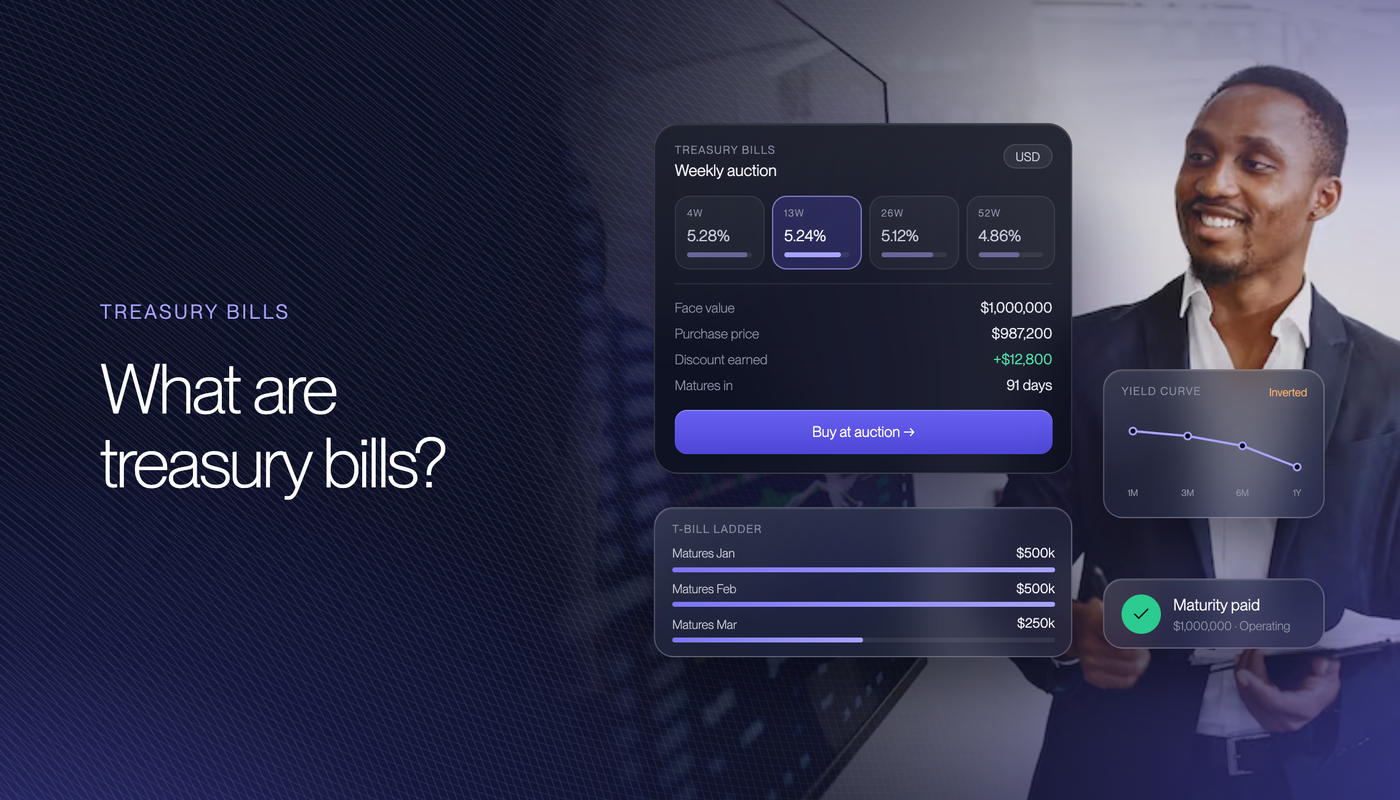
Treasury bills are short-term government debt. A government sells them for less than their face value and repays the full face value on a set date, usually within a year. The gap between the two is your return. T-bills pay no coupon, and the yield is fixed on the day you buy.
A T-Bill Is Sold Below Face Value and Repaid in Full
TreasuryDirect, the US Treasury's sales site, puts it simply: for bills, "interest" is the difference between what you paid and the face value you get when the bill matures. European debt offices work the same way. Agence France Trésor describes its BTFs as discounted bills: the discount is applied at issue, so no coupons are paid.
A real case shows the mechanics. On 5 October 2026, Germany sold Bubills maturing on 14 July 2027 at an average price of 97.81503 per 100 of face value. A company paying €978,150 for €1,000,000 of these Treasury bills gets €1,000,000 back on 14 July 2027. The €21,850 difference is its gain, about 2.87% a year. When investing, your capital is at risk. Yields may vary.
Treasury Bill Maturities Run From 4 Weeks to 1 Year
The US sells T-bills for 4, 6, 8, 13, 17, 26 and 52 weeks. The UK sells 1, 3 and 6 month bills, and its rules allow up to 364 days. France most often issues 13, 26 and 52 week BTFs. Italy sells 3, 6 and 12 month BOTs, and Spain sells 3, 6, 9 and 12 month Letras. Germany issues 12 month Bubills and reopens them at 11, 9, 6, 5 and 3 months, so six maturities are on offer each month.
Governments Use Bills to Cover Short Cash Gaps
Tax income and spending rarely line up week by week, and bills fill the gap. The US had $7.25 trillion of bills outstanding at the end of August 2026, 22.8% of its marketable debt. Germany planned 36 Bubill auctions for 2026 worth €176 billion, and Italy had €141.3 billion of BOTs outstanding on 30 September 2026. For longer funding, governments issue government bonds.
Sophic
Treasury management
Yield
2% to 3%+ p.a
Fees
0.3% a year + €10 per order
Eligibility
EU/EEA businesses with an LEI
How Treasury Bills Work From Auction to Maturity
Treasury bills work in five steps. The debt office announces an auction, banks bid in yield terms, the bills are allotted and paid for within days, holders can trade them, and the government pays face value at maturity. Your return is set by the price you pay.
The Debt Office Announces Each Auction
Germany auctions Bubills on Mondays and announces each one four bank business days ahead. France announces its BTF auctions at 11am on Friday for the following Monday. The UK DMO publishes a quarterly timetable and confirms each Friday's sizes a week ahead.
Banks Bid in Yield Terms
Bidders state the yield and the amount they want. Italy has taken BOT bids in yield terms since April 2009, and France prices BTFs as a money market yield on an actual/360 basis. The US accepts bids from the lowest yield up, and every winner gets the highest accepted rate. Germany uses a multi-price auction, so each bid is filled at its own price.
Buyers Pay Within Days of the Auction
Bubills and BTFs sold on Monday 5 October 2026 settled on Wednesday 7 October, and UK bills from the Friday tender on 2 October settled on Monday 5 October. You hold the bill from then, and nothing is paid until maturity.
€985,075 Today Becomes €1,000,000 in 26 Weeks
On 5 October 2026, France sold 26-week BTFs at an average rate of 2.997%. For a 182-day bill, the price is 100 divided by (1 + 2.997% x 182 / 360), which gives 98.5075. A company buying €1,000,000 of face value pays about €985,075 and gets €1,000,000 on maturity. The €14,925 gain on €985,075 over 182 days is exactly 2.997% a year on the actual/360 basis. When investing, your capital is at risk. Yields may vary.
US Bills Quote a Discount Rate Below the True Yield
US Treasury bills are priced from a discount rate taken off face value: price = face value x (1 minus discount rate x days / 360). The 13-week bill sold on 5 October 2026 had a 4.050% discount rate and a price of $98.97625 per $100. The Treasury also publishes the investment rate, 4.149% for that bill, which measures the gain against the money you actually pay, over a 365-day year. Compare that figure with other yields. When investing, your capital is at risk. Yields may vary.
Hold T-Bills Without an Auction Seat
Many auctions are open only to approved banks. Our regulated treasury partner gives your company access, and we handle the setup.
- No auction bidding: Our partner places the orders, so you never bid.
- Segregated client cash: Held in segregated accounts at J.P. Morgan.
- Independent safeguarding: Your investments are safeguarded by SIX Group.
- Your choice of date: Pick bills that mature before the payment they are meant for.
- Yield shown first: See the rate and the fees before you confirm an order.
When investing, your capital is at risk. Yields may vary.
Treasury Bills in the EU, US and UK
Each government issues its own Treasury bills through its debt office. Euro area bills are all in euros but carry different issuers, so their yields differ. US T-bills are in dollars and UK Treasury bills in sterling, which adds currency risk for a euro company.
Euro Area Countries Each Issue Their Own Bills
Germany's Finanzagentur issues Bubills, and only the 33 banks in its Bund Issues Auction Group can buy them at auction, in bids of at least €1 million. Agence France Trésor sells BTFs every Monday, with a par value of €1 and bids of at least €1 million.
Italy's Treasury Department issues BOTs, and the Bank of Italy runs the auctions. They are open to authorised intermediaries, but anyone can book from €1,000 through one. Spain's Tesoro Público sells Letras del Tesoro from €1,000. The Dutch State Treasury Agency (DSTA) auctions Dutch Treasury Certificates (DTCs) on the first and third Monday of each month, mostly for 3 or 6 months. Our guide to euro area government debt covers the longer bonds.
US T-Bills Are Auctioned Every Week
The US Treasury sells 4, 6, 8, 13, 17 and 26 week bills every week and 52 week bills every four weeks. Individuals and US entities can buy from $100 through TreasuryDirect, as non-competitive bids of up to $10 million. Competitive bids, capped at 35% of the offering, go through a bank, broker or dealer.
UK Treasury Bills Are Sold Every Friday
The UK Debt Management Office (DMO) holds a tender most Fridays for 1, 3 and 6 month bills. Bids come through its 22 Treasury Bill Primary Participants, for themselves or for clients, with a minimum of £500,000.
Country | Bill and issuer | Usual maturities | Auctions | Minimum |
|---|---|---|---|---|
Germany | Bubill, Finanzagentur | 12 months, reopened down to 3 months | Mondays, auction group banks only | €1 million per bid |
France | BTF, Agence France Trésor | 13, 26 and 52 weeks | Every Monday | €1 million per bid |
Italy | BOT, Treasury Department | 3, 6 and 12 months | Monthly for 6 and 12 months | €1,000 via an intermediary |
Spain | Letras del Tesoro, Tesoro Público | 3, 6, 9 and 12 months | Regular auctions | €1,000 |
Netherlands | DTC, DSTA | Mostly 3 or 6 months | First and third Monday | Through a bank or investment firm |
United States | T-bill, US Treasury | 4 to 52 weeks | Weekly, 52 weeks every 4 weeks | $100 in TreasuryDirect |
United Kingdom | Treasury bill, DMO | 1, 3 and 6 months | Most Fridays | £500,000 per bid |
The low minimums are for direct routes that most foreign companies cannot use. What matters for a company is the issuer, the currency and the maturity date of its T-bills.
Sophic
Treasury management
Yield
2% to 3%+ p.a
Fees
0.3% a year + €10 per order
Eligibility
EU/EEA businesses with an LEI
Treasury Bill Yields in October 2026
At the time of writing, in early October 2026, euro area Treasury bill yields ran from 2.59% for three months to 3.26% for a year. US bills paid 3.96% to 4.62%, measured as an investment rate. When investing, your capital is at risk. Yields may vary.
Bill | Auction date | Time to maturity | Yield |
|---|---|---|---|
Germany, Bubill | 5 October 2026 | About 3 months (13 January 2027) | 2.586% |
Germany, Bubill | 5 October 2026 | About 9 months (14 July 2027) | 2.872% |
France, BTF | 5 October 2026 | 13 weeks | 2.786% |
France, BTF | 5 October 2026 | 26 weeks | 2.997% |
France, BTF | 5 October 2026 | 52 weeks | 3.262% |
Italy, BOT | 25 September 2026 | 6 months | 2.873% |
Spain, Letras | 6 October 2026 | 6 and 12 months | 2.798% and 3.026% (marginal rate) |
Netherlands, DTC | 5 October 2026 | About 6 months (30 March 2027) | 2.74% |
US, T-bill | 1 to 5 October 2026 | 4, 13 and 26 weeks | 3.956%, 4.149% and 4.314% (investment rate) |
US, T-bill | 29 September 2026 | 52 weeks | 4.616% (investment rate) |
Longer bills paid more in every country, and US bills paid well above euro bills. Figures are as each debt office reports them: averages for Germany, France and Italy, the marginal rate for Spain, and for the US the highest accepted rate, which every winner gets. When investing, your capital is at risk. Yields may vary.
Euro Bills Pay More Than Company Deposits
Euro area companies earned an average of 0.61% on overnight deposits in August 2026, and 2.24% on deposits fixed for up to a year, according to the ECB. A six-month euro bill at about 2.7% to 3% paid several times the overnight rate. Our guide to interest on business accounts explains why banks pay so little. When investing, your capital is at risk. Yields may vary.
Bill Yields Follow Central Bank Rates
Treasury bill yields track what markets expect from central banks over the life of the bill. The ECB raised its deposit rate to 2.50% from 16 September 2026, and its next meeting ends on 29 October. The Federal Reserve moved its target range to 3.75% to 4.00% on 17 September 2026. The Bank of England held Bank Rate at 3.75% the same day, with its next decision due on 5 November 2026. When investing, your capital is at risk. Yields may vary.
Sophic
Treasury management
Yield
2% to 3%+ p.a
Fees
0.3% a year + €10 per order
Eligibility
EU/EEA businesses with an LEI
Treasury Bill Risks for a Business
A bill held to maturity pays its face value unless the government defaults. The other risks sit around that. You can lose part of your return by selling early, lose money on currency, take credit risk on the issuer, and earn less when you reinvest. Deposit guarantees do not apply.
Selling Before Maturity Can Cut Your Return
Bill prices fall when yields rise. Take a 364-day bill bought at a 2.80% yield, a price of 97.2468. If yields rise to 3.30% and you sell three months later, the price is 97.5586. On €1,000,000 you gain about €3,118 instead of the €6,740 you would have had if yields had not moved. A sharper rise soon after buying can push the price below what you paid. When investing, your capital is at risk. Yields may vary.
Currency Moves Can Wipe Out a Higher Yield
On 5 October 2026, a 26-week US bill paid 4.314% and a 26-week French BTF 2.997%, a gap of about 0.66% over the six months. The euro traded between $1.1204 and $1.1974 in the year to 5 October 2026, on ECB reference rates, a swing of almost 7%. A small currency move erases that gap. When investing, your capital is at risk. Yields may vary.
The Issuing Government Must Repay
A bill is only as good as the government behind it. Moody's cut the US from Aaa to Aa1 on 16 May 2025. Markets also price issuers differently: on 5 October 2026, France paid 2.786% on 13-week bills while Germany paid 2.586% on Bubills maturing a week later. Spreading cash across issuers limits this.
Yields Can Fall Before You Reinvest
T-bills mature fast, so you reinvest often at whatever rates apply then. The ECB's deposit rate was 4.00% from September 2023 to June 2024 and 2.00% by June 2025. Short bill yields fell with it, so each new 3-month bill bought that year tended to pay less. Rates can also rise: six-month Dutch DTCs paid 2.00% in January 2026 and 2.74% in October. When investing, your capital is at risk. Yields may vary.
T-Bills Are Not Covered by the €100,000 Deposit Guarantee
The EU Deposit Guarantee Schemes Directive 2014/49/EU covers deposits up to €100,000 per depositor, per bank. T-bills are securities, not deposits, so it never covers them. Our guide to deposit guarantees for business accounts explains the bank side.
Read more: how companies manage treasury risk.
Invest Company Cash in Treasury Bills
Matching each balance to its payment date keeps these risks small. We set it up with our partner.
- Dated cash in bills: Treasury bills from 2.5% p.a. for money with a known payment date.
- Reserve cash in funds: Money market funds from 2% p.a. for cash you may need any day.
- Longer money in bonds: Government bonds from 3% p.a. with regular interest payments.
- Currency matched: Hold each balance in the currency of the bill it will pay.
- Simple fee structure: A small yearly fee plus a flat charge per order.
- Proceeds paid back: Sale and maturity proceeds go straight to your company account.
When investing, your capital is at risk. Yields may vary.
Businesses That Keep Cash in Treasury Bills
T-bills suit any business holding cash that will go out on a known date, a few weeks to a year away. The bill matures just before the money is due. This is idle cash with a date on it, and it shows up in different sectors.
Business | Why cash builds up | When it is needed |
|---|---|---|
Premiums come in before claims are paid | As claims and reinsurance bills fall due | |
Fees are paid a term or a year ahead | Salaries every month of the school year | |
Grants arrive in large payments | Across the funded project, plus a reserve | |
A funding round lands in one payment | Month by month over the next year or two | |
Customers pay annual plans upfront | Month by month as the service runs | |
Event and festival organisers | Tickets sell months before the event | Venue, artists and suppliers in the final weeks |
Construction contractors | Clients pay advances at the start of a project | Materials and subcontractors at each stage |
Agricultural exporters | Harvest sales bring in most of the year's cash | Seed, fuel and wages before the next season |
Holding companies after a sale | Sale proceeds wait for the next deal | When the next purchase or dividend is agreed |
Any profitable company | Corporate tax and VAT build up between payments | On the tax and VAT payment dates |
In every row, the business knows roughly when the cash will leave. That date decides the bill. A tax payment due in five months fits a bill maturing in four, not one that runs for a year. Cash with no clear date suits a money market fund better.
Match Each Bill to a Payment Date
Start from a rolling cash forecast, the base of cash flow management. Keep the next one to two months of payments in your current account or EMI account, set a reserve with our guide on how much cash reserves a business should have, and ladder Treasury bills against the bigger dated payments. Staggered maturities give regular access without selling early, the core of good liquidity management.
T-bills are one tool in cash management, and our guide to what treasury management is covers the wider job.
Read more: where to put business cash for the short term.
Sophic
Treasury management
Yield
2% to 3%+ p.a
Fees
0.3% a year + €10 per order
Eligibility
EU/EEA businesses with an LEI
Treasury Bills Compared With Deposits, Funds and Bonds
Treasury bills sit between a bank deposit and a government bond. They pay a fixed yield to a set date like a term deposit, but lose the €100,000 deposit cover. They tie money up for less time than bonds, with smaller price moves, and suit dated cash better than a fund does.
Factor | Treasury bills | Bank deposit | Money market fund | Government bonds |
|---|---|---|---|---|
Typical return | From 2.5% p.a. with our partner, fixed if held to maturity | 0.61% on company overnight deposits, 2.24% fixed up to 1 year (ECB, August 2026) | From 2% p.a. with our partner, variable | From 3% p.a. with our partner, fixed coupon |
Access to cash | Repaid on the maturity date, or sold earlier at market price | Same day on overnight accounts, notice or term on others | Sell on any dealing day | Repaid at maturity, or sold earlier at market price |
Lock-in | None with our partner | None on overnight accounts, fixed on term deposits | None with our partner | None with our partner |
Deposit guarantee cover | None, not a deposit | Up to €100,000 per depositor per bank | None, not a deposit | None, not a deposit |
Main risk | Issuer credit, price moves if sold early | Bank failure above €100,000, low return | Holdings can lose value, return falls with rates | Price falls when rates rise, more on long bonds |
T-bills give up the deposit cover for a market rate fixed to a date, with a government rather than a bank on the other side. A fixed term deposit keeps the cover but usually pays less. When investing, your capital is at risk. Yields may vary.
Read more: Treasury bills vs bonds and money market funds for companies.
How Companies Get Access to T-Bills
Most companies hold T-bills through a bank or regulated investment firm. The firm buys at auction through a dealer or on the secondary market and keeps the bills in custody for your company. Direct routes exist, but they are narrow, and buying through an EU investment firm needs an active LEI.
Auctions Are Mostly Limited to Approved Banks
Only members of the Bund Issues Auction Group can buy Bubills directly at auction. BOT auctions are reserved to authorised intermediaries. In the UK, tender bids come through Treasury Bill Primary Participants.
TreasuryDirect Needs a US Tax Number and Address
An entity TreasuryDirect account needs a US Employer Identification Number, a US address of record for the entity and its account manager, and a US bank account. Most European companies have none of these, so they hold US Treasury bills through an investment firm.
You Need an LEI Before a Firm Can Buy Bills for You
EU rules ban an investment firm from carrying out a reportable trade, such as buying Treasury bills, for a company that has no LEI (Article 13(2) of Delegated Regulation (EU) 2017/590). GLEIF describes the LEI as a 20-character code under ISO 17442, renewed every year. A lapsed code stops new trades and rollovers. See what an LEI number is, how to get an LEI number and our guide to LEI renewal.
Read more: how to buy Treasury bills as a business.
Sophic
Treasury management
Yield
2% to 3%+ p.a
Fees
0.3% a year + €10 per order
Eligibility
EU/EEA businesses with an LEI
What Treasury Bills Cost
Treasury bills carry no fund charges, but holding them still costs something. Expect a dealer spread, a service or custody fee, an order fee, currency conversion on non-euro bills and the yearly LEI fee. Together they lower the yield you keep, more so on short bills.
Cost | How it is charged | What to check |
|---|---|---|
Dealer spread | The gap between the buying and selling price | Matters most if you sell before maturity |
Subscription fee | A percentage of the amount bought at auction | Italy caps bank fees on new BOTs at 0.03% to 0.15% |
Service or custody fee | A yearly percentage of your invested balance | What it covers, such as custody and reporting |
Order fee | A flat amount per purchase or sale | How often you plan to roll bills |
Currency conversion | A margin on the exchange rate | Only for bills in dollars or sterling |
LEI | Paid to an LEI issuer and renewed every year | The renewal date, so it never lapses |
Italy's cap scales with time: 0.03% for bills of up to 80 days, rising to 0.15% from 271 days. Short bills pay little interest in total, so a flat fee takes a bigger share of it.
What €500,000 in Six-Month Bills Earns After Costs
Assume a company puts €500,000 into 182-day bills yielding 2.8% a year. That earns about €7,078. With an assumed yearly service fee of 0.3%, about €758 for the half year, and a €10 order fee, about €6,310 is left. The same cash at the ECB's August 2026 average of 0.61% on company overnight deposits earns about €1,520 over six months. When investing, your capital is at risk. Yields may vary.
Check If Your Company Can Hold T-Bills
Most EU and EEA companies with spare cash qualify. We check the details with you before onboarding starts.
- EU or EEA business: Our partner onboards companies based in the EU and EEA.
- LEI sorted early: We tell you on the first call if you need an LEI or a renewal.
- One document list: Everything we need, asked for once.
- Sector check upfront: Excluded industries are flagged before any paperwork.
- Invested within days: Cash goes in 2 to 3 business days after onboarding.
When investing, your capital is at risk. Yields may vary.
Common Treasury Bill Mistakes
Most Treasury bill mistakes come from reading the numbers wrong or picking the wrong date. Each of the three below costs a business return or access to cash, and each one is easy to avoid once you know what to check.
Comparing a US Discount Rate With a Euro Yield
US Treasury bills are quoted first as a discount rate, while euro bills are quoted as a money market yield. The 13-week US bill sold on 5 October 2026 had a 4.050% discount rate but a 4.149% investment rate. That 0.099 point gap is about €1,980 a year on €2,000,000. Day counts add another gap: UK bills use a 365-day year and euro bills a 360-day year, which moves a 3% yield by about 0.04 points. Put every option on the same basis before you compare. When investing, your capital is at risk. Yields may vary.
Buying a Bill That Matures After the Payment Date
A company with a €400,000 VAT payment due in five months buys a 6-month bill for the slightly higher yield. When the payment date comes, the bill still has a month to run and has to be sold. If yields have risen, the sale price is lower, and the dealer spread comes off too. The extra yield on the longer bill rarely covers that. Pick the maturity that ends just before the payment, even if it pays a little less, and keep a small buffer in the current account for late receipts.
Chasing Dollar Yields Without Counting the Currency
A euro company sees US bills paying about 1.3 points more than French bills and moves €1,000,000 into dollars for six months. The extra yield is worth about €6,600. A 1% fall in the dollar over the same six months costs about €10,000, and the euro moved in a range of almost 7% in the year to 5 October 2026. Hedging removes most of that risk, but the hedge has its own cost, which can take much of the gap. Buy dollar T-bills to cover dollar costs, or compare the yield after the hedge before you switch. When investing, your capital is at risk. Yields may vary.
Sophic
Treasury management
Yield
2% to 3%+ p.a
Fees
0.3% a year + €10 per order
Eligibility
EU/EEA businesses with an LEI
Bottom Line
Treasury bills are short-term government debt bought below face value and repaid in full on a set date. They suit cash with a known payment date. They are not deposits and carry issuer, price and currency risk. Match each T-bill to a payment and compare yields on the same basis.
What are Treasury bills in simple terms?
How do Treasury bills work?
What are Treasury bill yields in October 2026?
What is the difference between a T-bill's discount rate and its yield?
Are Treasury bills covered by the €100,000 deposit guarantee?
Can you lose money on Treasury bills?
What maturities do Treasury bills come in?
Can a European company buy US T-bills?
What is the difference between Bubills, BTFs and BOTs?
Do I need an LEI to buy Treasury bills?
Can I sell a Treasury bill before it matures?
Are Treasury bills better than a bank deposit?
How much does it cost to hold Treasury bills?
Sources
- TreasuryDirect, Treasury Bills (US Department of the Treasury)
- TreasuryDirect, Understanding Pricing and Interest Rates
- TreasuryDirect, How Auctions Work
- TreasuryDirect, Open an Entity Account
- US Treasury Fiscal Data, Treasury Securities Auctions Data, bill auctions 29 September to 6 October 2026
- US Treasury Fiscal Data, Monthly Statement of the Public Debt, 31 August 2026
- Federal Reserve, Open Market Operations, target range history (checked 6 October 2026)
- Moody's Ratings, The US Sovereign Rating Action, 16 May 2025
- Deutsche Finanzagentur, Treasury Discount Paper (Bubills)
- Deutsche Finanzagentur, Auction Process
- Deutsche Finanzagentur, Bund Issues Auction Group
- Deutsche Bundesbank, Multi-ISIN tender allotment, Bubills, 5 October 2026
- Agence France Trésor, Latest auction results, BTF auction of 5 October 2026
- Agence France Trésor, BTF characteristics
- Agence France Trésor, Primary dealers
- Banca d'Italia, Results of the BOT auction of 25 September 2026
- Ministry of Economy and Finance, Department of the Treasury, Treasury Bills (BOT)
- CNMV, Public fixed-income products (Letras del Tesoro)
- Infobae, Tesoro Público Letras auction of 6 October 2026
- Dutch State Treasury Agency, Money markets
- Dutch State Treasury Agency, Issuance results DTC, 6 October 2026
- UK Debt Management Office, Sterling Treasury bill tenders October to December 2026, 25 September 2026
- UK Debt Management Office, Cash Management Operational Notice and UK Treasury Bills Information Memorandum, 28 March 2024
- HM Treasury and UK DMO, The UK Treasury bill market: a consultation document, January 2026
- Bank of England, Bank Rate (decision of 17 September 2026)
- European Central Bank, Key ECB interest rates (checked 6 October 2026)
- European Central Bank, Euro area bank interest rate statistics, August 2026 (released 1 October 2026)
- European Central Bank, Euro foreign exchange reference rates, US dollar
- Directive 2014/49/EU on deposit guarantee schemes, EUR-Lex
- Commission Delegated Regulation (EU) 2017/590 (RTS 22), EUR-Lex
- GLEIF, Introducing the Legal Entity Identifier
- GLEIF, The LEI in numbers Q2 2026, 23 July 2026
Binderr is not an investment provider or adviser. We connect businesses with regulated investment providers and help with the setup. Every investment is made under the provider's own terms, fees and risk disclosures, which you review and accept directly with them, and the decision to invest is yours. Binderr is not responsible for investment performance or for any loss. This article is general information, not investment, tax or legal advice, and figures can change after the time of writing. When investing, your capital is at risk. Yields may vary.