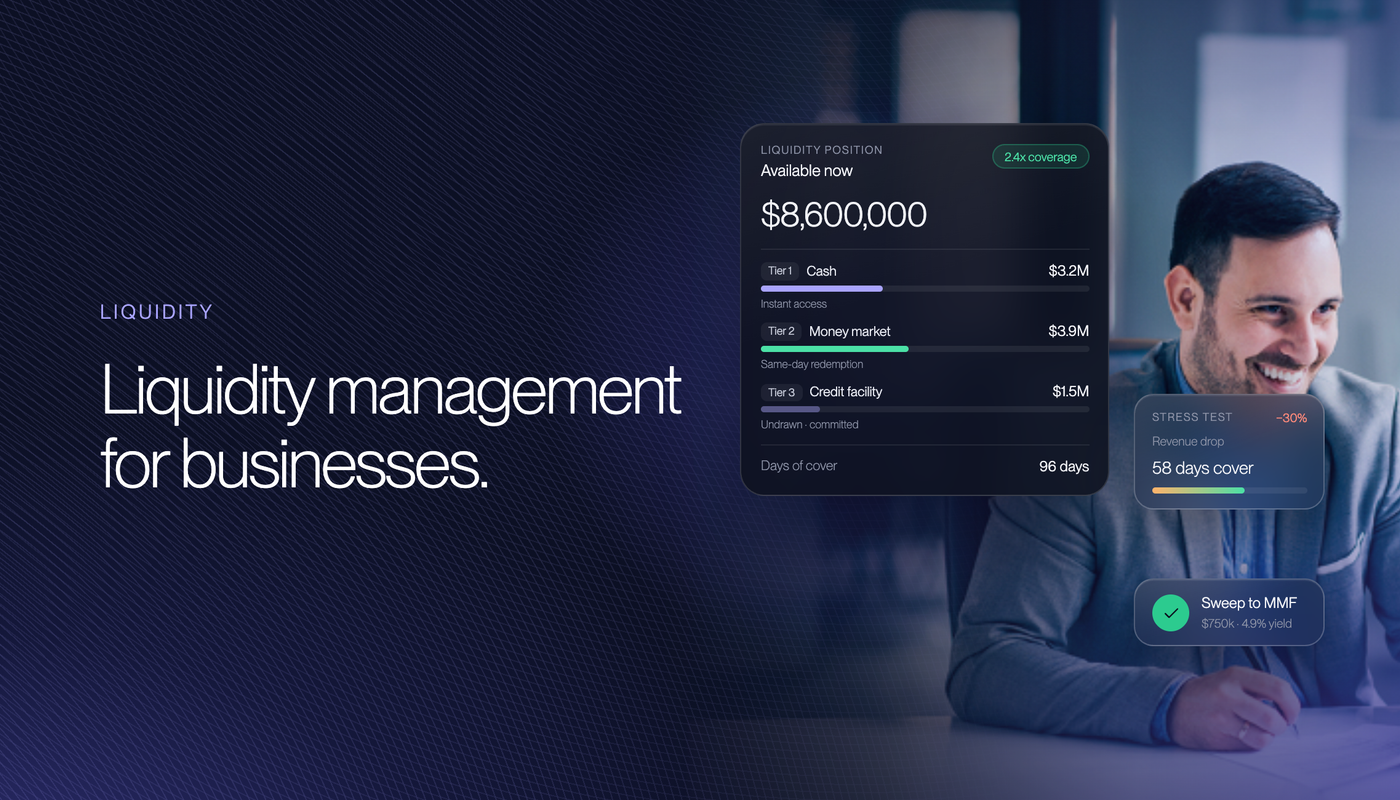
Good liquidity management means your business pays every bill on the day it falls due and still earns on the cash it will not need for a while. Payroll, suppliers and VAT need cash you can reach the same day. A reserve can wait a day or two, and money for next year's plans can wait months.
The hard part is the split. Euro area banks paid companies an average of 0.61% on overnight deposits in August 2026, according to the ECB, and the deposit guarantee stops at €100,000 per bank. Keep too much in the current account and it pays almost nothing. Keep too little and one late customer pushes you into an overdraft.
This is where we come in. We connect your company with our regulated treasury partner, so cash you do not need this month can go into money market funds, Treasury bills or government bonds, with no lock-in. We check that you qualify, prepare the onboarding with you and stay your single contact.
Put Your Liquidity Buffer to Work
Cash above what you need this month can earn a market rate and stay within reach. We set it up with you.
- Money market funds: From 2% p.a. in EUR, GBP or USD for your reserve cash.
- Treasury bills: From 2.5% p.a. for cash with a known payment date.
- Government bonds: From 3% p.a. for money you will not need for a year or more.
- Quick start: Digital onboarding in about a day, invested 2 to 3 business days later.
- Regulated investing: A CySEC-regulated investment firm holds the investments for you.
When investing, your capital is at risk. Yields may vary.

Sophic
Treasury management
Yield
2% to 3%+ p.a
Fees
0.3% a year + €10 per order
Eligibility
EU/EEA businesses with an LEI
What Is Liquidity Management
Liquidity management is how a business makes sure it can pay every obligation when it falls due, at a sensible cost, while putting cash it does not need to work. It answers three questions: how much cash you need, where it should sit and how fast you can reach it.
Liquidity Means Cash You Can Reach When a Bill Is Due
Liquidity is about speed and cost. Money in a current account is liquid, because you can pay with it today. Unpaid invoices, stock and equipment are worth money too, but turning them into cash takes weeks, a discount or a buyer. A business with €5 million of assets and €40,000 in the bank can still miss Friday's payroll.
For most companies, business liquidity management is about the normal calendar more than rare crises: salaries every month, VAT every quarter, a loan repayment once a year. Good liquidity planning lines up enough cash for each date and decides what to do with the rest.
Business Liquidity Management Has No Legal Ratio
Banks have a legal liquidity test. Under the Basel III Liquidity Coverage Ratio, a bank must hold high-quality liquid assets at least equal to its expected net cash outflows over a 30-day stress period, with a 100% minimum since 1 January 2019. Companies have no such rule, but the idea is useful for liquidity management at any size: know what leaves your account in the next 30 days and hold enough to cover it if receipts slow down.
Liquidity Management in Treasury Covers Four Jobs
Liquidity management in treasury has four parts: forecasting what comes in and goes out, positioning cash in the right account and currency, holding a liquidity buffer for surprises, and investing what is left. It sits inside treasury management, next to funding and risk, and overlaps with day-to-day cash management.
Larger companies already manage liquidity this way. In the 2026 AFP Liquidity Survey of 309 US treasury professionals, 46% had increased their US cash balances, and the average share of short-term investments held as bank deposits fell to 42%, the lowest since 2011.
Sophic
Treasury management
Yield
2% to 3%+ p.a
Fees
0.3% a year + €10 per order
Eligibility
EU/EEA businesses with an LEI
Liquidity vs Solvency vs Profitability
Liquidity, solvency and profitability are three different tests. Liquidity asks whether you can pay this month's bills. Solvency asks whether everything you own covers everything you owe. Profitability asks whether income beats costs over a period. A business can pass two of them and still fail the third.
Test | Question it answers | Typical measure | Time frame | Warning sign |
|---|---|---|---|---|
Liquidity | Can we pay what falls due soon? | Cash on hand, months of outgoings covered | Days to months | Overdraft used every month, suppliers paid late |
Solvency | Do our assets cover all our debts? | Net assets, debt to equity | Years | Debts above assets, loan covenants broken |
Profitability | Does income beat costs? | Net profit margin | A quarter or a year | Losses that keep growing |
A liquidity gap is solved with cash in the right place and a plan for slow months. A solvency or profit problem needs a change to the business itself, which no amount of liquidity management can make.
A Profitable Company Can Run Out of Cash
Take a distributor with €4 million of yearly sales whose customers pay after 60 days. If sales grow by 25%, money owed by customers rises by about €164,000 before the extra profit is collected. The accounts show a profit while the bank balance falls, a classic liquidity risk. Our guide to working capital shows how to measure that gap.
A Solvent Company Can Still Be Short of Cash
A company with a €3 million building, no debt and €60,000 in the bank is solvent on paper. A €250,000 tax bill due next week is still a liquidity problem, because selling the building takes months. The fix is lining up cash for each big date in advance, the core of working capital management.
Build a Liquidity Buffer in Three Tiers
A simple way to manage liquidity is to split cash into three tiers by when you will need it. Operating cash covers the next one to two months and sits in the bank. Reserve cash covers shocks you cannot date. Strategic cash has a known use months away, so it can earn more.
Operating Cash Covers the Next 30 to 60 Days
This liquidity tier pays salaries, suppliers, rent and taxes due in the next month or two, so it sits in current accounts with same-day access. Size it from the largest monthly outflow in the next quarter, plus a margin. Split it across two banks once it is well above €100,000.
Reserve Cash Covers Shocks You Cannot Date
This part of the liquidity buffer pays for the late customer, the lost contract or the urgent repair. You may need it at a day's notice. A starting point is two to three months of fixed costs, more for seasonal or project businesses. Our guide on how much cash reserves a business should have covers the sizing.
Strategic Cash Has a Date or a Purpose
This liquidity tier holds money for known uses: corporate tax, a dividend, equipment or a loan repayment. You know when it is needed, so you can pick instruments that mature just before that date. Most idle cash belongs here.
Liquidity Tiers for a Company With €2.4 Million
Take a services company with €2,400,000 in the bank and €300,000 of monthly outgoings. This is one way to set its liquidity tiers.
Tier | What it covers | Amount | Where it sits | Access |
|---|---|---|---|---|
Operating | 1.5 months of outgoings | €450,000 | Current accounts at two banks | Same day |
Reserve | 2 months of outgoings for shocks | €600,000 | Money market fund | Same day or next day |
Strategic | Tax due in 5 months, equipment in 9 months | €650,000 | Treasury bills maturing in 4 and 8 months | At maturity, or about 2 business days after a sale |
Strategic | No planned use for 2 years | €700,000 | Government bonds | At maturity, or about 2 business days after a sale |
Left in a current account at the ECB's August 2026 average of 0.61%, the full €2,400,000 would pay about €14,600 a year. At the starting yields our regulated treasury partner quotes, from 2% p.a. on the fund, 2.5% p.a. on the bills and 3% p.a. on the bonds, the €1,950,000 outside the bank would earn about €49,250 a year before costs. When investing, your capital is at risk. Yields may vary.
Treasury Liquidity Management Without a Treasury Team
You do not need a treasury department to run three liquidity tiers. We set up the investing side with our regulated treasury partner.
- Setup handled: We prepare the onboarding file and answer every question.
- Segregated client cash: Held in segregated accounts at J.P. Morgan.
- Independent safeguarding: Your investments are safeguarded by SIX Group.
- Maturities you choose: Bills that mature before the payment they are meant for.
- Costs shown upfront: See the yield and every fee before you confirm an order.
When investing, your capital is at risk. Yields may vary.
How Fast Each Liquidity Tier Turns Into Cash
Access time decides which liquidity tier an instrument suits. Current accounts pay out the same day, notice and fixed deposits after the notice period or term, and money market funds the same day or next. Treasury bills and government bonds pay at maturity, or about 2 business days after a sale.
Current Accounts Pay Out the Same Day
Since 9 October 2025, euro area payment providers must let customers send instant euro transfers, which arrive in under 10 seconds at any hour (Regulation (EU) 2024/886). The price is the rate: company overnight deposits averaged 0.61% in August 2026, and many current accounts pay nothing. See our guide to interest-bearing business accounts.
Notice and Fixed Deposits Pay More but Make You Wait
Notice accounts pay out after a warning period, fixed deposits on their end date. Business rates at permanent tsb in Ireland, effective 7 July 2026, show the pattern: 0.75% on demand, 1.75% on 32-day notice and 2.25% fixed for 12 months. Deposits stay covered up to €100,000 per bank, but a fixed deposit usually locks the money until the end date.
Money Market Funds Usually Pay Out the Same Day or Next Day
You sell before the daily cut-off and usually get cash that day or the next business day. An April 2026 article for the Association of Corporate Treasurers lists same-day (T+0) settlement for traditional money market fund share classes. EU rules make LVNAV and public debt CNAV funds hold at least 10% of assets maturing daily and 30% weekly.
Access has limits, which matters for liquidity risk. In heavy outflows, a fund's board may charge a liquidity fee, cap redemptions at 10% a day or suspend them for up to 15 working days (Article 34 of Regulation (EU) 2017/1131). ESMA reports that no EU fund had to do so in March 2020, after central banks stepped in. Money market funds are not deposits, so the €100,000 guarantee does not apply.
Treasury Bills and Bonds Settle in About 2 Business Days
Treasury bills and government bonds pay out on their maturity date, and you can sell them earlier at the market price. EU trades on trading venues settle two business days later (T+2), and Regulation (EU) 2025/2075 cuts that to one day from 11 October 2027. French bills auctioned on Monday 5 October 2026 settled on Wednesday 7 October, priced at 2.786% for 13 weeks and 3.262% for 52 weeks. When investing, your capital is at risk. Yields may vary.
Factor | Current account | Notice or fixed deposit | Money market fund | Treasury bills | Government bonds |
|---|---|---|---|---|---|
Typical return | 0.61% average (ECB, August 2026) | 2.24% average fixed up to 1 year (ECB) | From 2% p.a. with our partner | From 2.5% p.a. with our partner | From 3% p.a. with our partner |
Access to cash | Same day | After the notice period or term | Same day or next business day | At maturity, or 2 business days after a sale | At maturity, or 2 business days after a sale |
Lock-in | None | Notice period or fixed term | None with our partner | None with our partner | None with our partner |
Deposit guarantee cover | Up to €100,000 per bank | Up to €100,000 per bank | None, not a deposit | None, not a deposit | None, not a deposit |
Main risk | Bank failure above €100,000, low return | Cash tied up, bank failure above €100,000 | Value can fall, sales limited in stress | Issuer credit, price moves if sold early | Price falls when rates rise, if sold early |
This table is the core of treasury liquidity management. Same-day instruments hold the operating tier, same-day or next-day funds hold the reserve, and dated instruments hold strategic cash. With our regulated treasury partner, cash is invested 2 to 3 business days after onboarding. When investing, your capital is at risk. Yields may vary.
Read more: money market funds for companies.
Sophic
Treasury management
Yield
2% to 3%+ p.a
Fees
0.3% a year + €10 per order
Eligibility
EU/EEA businesses with an LEI
Bank Concentration Risk and the €100,000 Guarantee
Keeping all your cash in one bank is a liquidity risk many businesses take without noticing. The EU deposit guarantee covers €100,000 per depositor per bank. Anything above that depends on the bank staying open, and a bank run can now happen in a single day.
Deposits Above €100,000 Are Not Fully Protected
The Deposit Guarantee Schemes Directive 2014/49/EU covers deposits up to €100,000 per depositor (Article 6(1)), adding up all your accounts and currencies at one bank (Article 7(1)). Ordinary companies qualify, while financial firms, insurers and public authorities do not (Article 5(1)). Covered deposits must be repaid within 7 working days (Article 8(1)). If that bank fails, a company with €1,500,000 there has €1,400,000 that depends on how the bank is wound up.
Companies Lost Access to Cash When SVB Failed
Silicon Valley Bank lost over $40 billion of deposits on 9 March 2023 and expected to lose over $100 billion more the next day, according to the Federal Reserve's review. About 94% of its deposits were uninsured at the end of 2022. It was closed on 10 March.
That day, Roku told the SEC that about $487 million, roughly 26% of its cash, was at SVB, largely uninsured, and that it did not know how much it would recover. Rocket Lab reported about $38 million, about 7.9% of its cash and marketable securities. On 12 March, the US Treasury, the Federal Reserve and the FDIC used a systemic risk exception so depositors could reach all their money from 13 March. That was a one-off decision, not something your liquidity management can rely on.
Cap How Much Sits in One Bank
Set a limit per bank in your liquidity policy, for example €100,000 plus one month of operating cash. Keep operating cash at two banks, so a frozen account or an outage does not stop payroll. Move reserve and strategic cash into investments held in custody, away from any one bank's balance sheet. Roku had its other $1.4 billion spread across several large financial institutions. See how deposit guarantee schemes cover business accounts.
Read more: how companies manage treasury risk.
Sophic
Treasury management
Yield
2% to 3%+ p.a
Fees
0.3% a year + €10 per order
Eligibility
EU/EEA businesses with an LEI
Cash Pooling and Multi-Currency Liquidity
Cash pooling is a liquidity management tool for groups with several companies or accounts: one company's surplus covers another's shortfall without new borrowing. Businesses that pay in several currencies also need liquidity in each one. Both put cash where the payments are, at the lowest cost.
Physical Pooling Moves the Cash Every Day
In physical pooling, also called zero balancing, the bank sweeps each subsidiary's balance into a master account at the end of the day. A subsidiary holding €80,000 ends the day at zero, and the master account gains €80,000. One that is €30,000 overdrawn is topped up. The group sees one cash position and can invest one larger surplus.
Notional Pooling Offsets Balances Without Moving Them
In notional pooling, balances stay where they are. The bank works out interest as if they were one account, so credit balances offset overdrafts. Banks usually ask for cross-guarantees between the companies taking part.
Each Sweep Is a Loan Between Group Companies
Physical pooling creates loans between group companies. Each one needs a written agreement, an interest rate that tax authorities accept as arm's length and a check of local rules, so take tax and legal advice first. Groups running treasury liquidity management across many entities can read our guide to corporate treasury management.
Hold Each Currency for Its Own Payments
Currency moves can drain a liquidity buffer that looks large in euros. In PwC's 2025 Global Treasury Survey of 350 treasurers, 83% named foreign exchange as their most critical economic exposure. A company paying $200,000 a month to US suppliers should keep its dollar operating cash in dollars, rather than buying dollars every month at the bank's margin. A multi-currency EMI account can hold several currencies, and money market funds in EUR, GBP and USD can hold each currency's reserve.
Invest Your Reserve and Strategic Cash
The liquidity tiers you do not need this week can earn a market rate, in the right instrument and currency.
- Reserve in funds: Money market funds from 2% p.a. for cash you may need at short notice.
- Dated cash in bills: Treasury bills from 2.5% p.a., timed to tax or spending dates.
- Long money in bonds: Government bonds from 3% p.a. for cash you will not touch for a year.
- Three currencies: Hold money market funds in EUR, GBP or USD.
- Proceeds to your account: Sale and maturity proceeds go back to your company account.
When investing, your capital is at risk. Yields may vary.
How to Stress Test Your Liquidity Buffer
A stress test runs your cash forecast through bad but realistic events and checks whether the liquidity buffer lasts. Pick three or four shocks, apply them together over a quarter and see how low cash falls. If the low point is under one month of outgoings, add to it.
Start From a 13-Week Cash Forecast
Use a weekly forecast for the next 13 weeks with every known receipt and payment, the base of cash flow management and of liquidity management. Then change one line at a time. A good liquidity plan names the shocks that hurt most: slower customers, a lost contract, an unplanned cost and an account you cannot use for a few days.
Plan for Customers Paying 20 Days Late
Intrum's European Payment Report 2026 found that the gap between agreed terms and actual payment between businesses grew from 16 days in 2023 to 20 days. About 12% of revenues arrive late, and 62% of businesses pay their own suppliers late as a result.
A Stress Test With Assumed Numbers
Take the services company from earlier, with €450,000 of operating cash, €320,000 of monthly receipts and €300,000 of monthly outgoings. Over one quarter, customers pay 20 days later, so about €213,000 of receipts slip past the quarter. Its largest customer, 15% of sales, stops paying for three months (€144,000). A key supplier asks for €120,000 upfront.
Together that is €477,000 less cash. The normal €60,000 quarterly surplus softens it, so operating cash falls by about €417,000 to €33,000, less than a week of outgoings. The company sells €300,000 of its money market fund and is back to about €333,000 within a day or two. The bills and bonds are never touched, which is the point of liquidity tiers.
Set Triggers in Your Liquidity Policy
Write simple rules down. If operating cash falls below one month of outgoings, sell from the reserve tier. If the reserve falls below half its target, rebuild it before investing anything new. Three in four organisations in the AFP survey have a written investment policy, and the same habit suits business liquidity management at any size.
Sophic
Treasury management
Yield
2% to 3%+ p.a
Fees
0.3% a year + €10 per order
Eligibility
EU/EEA businesses with an LEI
Which Businesses Need Which Liquidity Tiers
Every business needs all three liquidity tiers, but the size of each depends on how cash comes in. Businesses paid upfront hold large strategic tiers. Businesses paid late or by project need bigger reserves. Seasonal businesses swing between the two through the year.
Business | Why cash is uneven | Operating tier | Reserve tier | Strategic tier |
|---|---|---|---|---|
Annual plans paid upfront | Payroll and hosting | A lost large client | Prepaid revenue not yet earned, plus tax | |
Fees paid a term or a year ahead | Monthly salaries | Lower enrolment next year | Building works and the summer months | |
Grants arrive in large payments | Staff and programme costs | A grant paid late or not renewed | Funds set aside for future projects | |
Premiums arrive before claims | Claims and commissions due now | A large claim or a storm | Claims expected in later years | |
A funding round lands at once | The next two months of spending | A delayed next round | Runway for the next 12 to 24 months | |
Peak sales, stock bought months before | Stock, ads and payment holds | Returns and chargebacks | Stock for the next peak, VAT | |
Fees billed after the work | Salaries and rent | Slow-paying clients | Partner drawings and tax | |
Construction contractors | Stage payments and retentions | Wages, materials, subcontractors | A disputed stage payment | Retentions released at the end |
Tour operators | Customers pay months before travel | Supplier deposits due soon | Cancellations and refunds | Final payments to hotels and airlines |
Holding companies after a sale | Sale proceeds arrive in one payment | Running costs | Warranty claims from the buyer | The next deal or a dividend |
In each row, the business knows roughly when its strategic cash is needed, and that date picks the instrument. Where the date is unclear, the cash belongs in the reserve tier.
Seasonal businesses need the most careful liquidity planning. An online retailer may hold three times its usual cash after the December peak and very little in October, when stock for the next peak is bought. Its tiers should be reset every quarter, not once a year.
Read more: where to put business cash for the short term.
Sophic
Treasury management
Yield
2% to 3%+ p.a
Fees
0.3% a year + €10 per order
Eligibility
EU/EEA businesses with an LEI
What Liquidity Management Costs
Liquidity management costs money either way. Too much cash in the bank costs the return you give up. Too little costs overdraft interest, late payment charges and missed supplier discounts. Investing adds fund charges, service and order fees, dealer spreads and currency margins.
Too Little Cash Costs More Than Too Much
In August 2026, euro area banks charged companies an average of 3.92% on revolving loans and overdrafts, against 0.61% paid on overnight deposits, according to the ECB. An overdraft used as your liquidity buffer charges the higher rate on the days you need it most. Paying suppliers late can cost statutory interest of at least 8 points above the reference rate, plus €40 per invoice.
An Illustration With Assumed Numbers
Assume a €600,000 reserve tier. In a current account at 0.61%, it earns about €3,660 a year. In a money market fund at 2% p.a., the starting yield our partner quotes, it earns about €12,000 before costs. With assumed total costs of 0.3% a year, about €10,200 is left. When investing, your capital is at risk. Yields may vary.
Before you invest, check the fund's ongoing charges, any yearly fee on your balance, fees per order, the dealer spread on bills and bonds, currency margins and the yearly LEI fee. Our treasury service for businesses covers the setup.
Check If Your Company Can Invest Its Cash
Most EU and EEA companies with spare cash qualify. We confirm the details on the first call.
- EU or EEA company: Our partner onboards businesses based in the EU and EEA.
- LEI checked early: We tell you upfront if you need an LEI or a renewal.
- Single document list: Everything we need, asked for once.
- Sector screened first: Excluded industries are flagged before any paperwork.
- Cash in within days: Invested 2 to 3 business days after onboarding.
When investing, your capital is at risk. Yields may vary.
Common Liquidity Management Mistakes
Most liquidity management mistakes come from timing or concentration: cash at the wrong bank, in the wrong currency or locked up when a payment is due. Each of the four below costs a business money or access to cash, and each one is easy to fix with a written liquidity plan.
Leaving Every Euro in One Current Account
A company with €2,000,000 at one bank has €1,900,000 above the deposit guarantee, and it is paid little or nothing on most of it. Roku had 26% of its cash at SVB when the bank failed. It turns a bank's problem into your liquidity problem. Keep operating cash at two banks and move the reserve and strategic tiers into investments held in custody.
Investing Money You Need This Month
Putting operating cash into a 6-month Treasury bill for the extra yield forces a sale if payroll runs short. If yields have risen, the sale price is lower, and the dealer spread comes off too. Liquidity management in treasury starts with matching dates, not chasing yield. Keep at least one month of outgoings in the bank and invest only from the reserve and strategic tiers. When investing, your capital is at risk. Yields may vary.
Counting the Overdraft as Your Liquidity Buffer
A credit line is not cash. Most overdrafts are repayable on demand, and a bank can cut a facility at its yearly review, often when trading is weak and you need it most. At 3.92% on average in August 2026, it also costs far more than deposits pay. Keep the overdraft as a last resort behind a funded reserve, and agree its limit before you need it.
Leaving Onboarding Until Cash Piles Up
Investing company cash takes preparation. EU investment firms cannot buy Treasury bills or bonds for a company without an LEI (Article 13(2) of Delegated Regulation (EU) 2017/590), and onboarding needs company documents. Sort both while cash is building, so the reserve can be invested within days. See what an LEI number is.
Read more: how to buy Treasury bills as a business.
Sophic
Treasury management
Yield
2% to 3%+ p.a
Fees
0.3% a year + €10 per order
Eligibility
EU/EEA businesses with an LEI
Bottom Line
Liquidity management keeps enough cash within reach for every payment and puts the rest to work. Split cash into operating, reserve and strategic tiers, match each tier to how fast you need it, cap what sits in one bank and stress test your liquidity buffer every quarter.
What is liquidity management?
What is liquidity management in treasury?
What does treasury and liquidity management mean for a small business?
What is the difference between liquidity and solvency?
What are the three liquidity tiers?
How big should a liquidity buffer be?
How quickly can a business get money out of a money market fund?
How long does it take to sell Treasury bills or bonds?
Is company money above €100,000 protected if a bank fails?
What is cash pooling?
What is a liquidity stress test?
What is liquidity risk for a business?
How much does it cost to invest a liquidity reserve?
Sources
- European Central Bank, Key ECB interest rates (checked 7 October 2026)
- European Central Bank, Euro area bank interest rate statistics, August 2026 (released 1 October 2026)
- European Central Bank Data Portal, Revolving loans and overdrafts to corporations, new business, August 2026
- Bank for International Settlements, FSI Connect summary, Liquidity Coverage Ratio (30 April 2018)
- Association for Financial Professionals, 2026 AFP Liquidity Survey press release
- Regulation (EU) 2024/886 on instant credit transfers in euro, EUR-Lex
- permanent tsb, Non-personal deposit interest rates effective 7 July 2026
- Association of Corporate Treasurers, An evolution of cash management: ETF share classes (20 April 2026)
- Regulation (EU) 2017/1131 on money market funds (Articles 24 and 34), EUR-Lex
- ESMA, Final Report on the EU Money Market Fund Regulation legislative review (14 February 2022)
- Autorité des marchés financiers, Settlement cycle T+1 (Regulation (EU) 2025/2075)
- Agence France Trésor, Latest auction results, BTF auction of 5 October 2026
- Directive 2014/49/EU on deposit guarantee schemes, EUR-Lex
- Board of Governors of the Federal Reserve System, Review of the Federal Reserve's Supervision and Regulation of Silicon Valley Bank (28 April 2023)
- Roku, Inc., Form 8-K filed 10 March 2023, SEC
- Rocket Lab USA, Inc., Form 8-K filed 10 March 2023, SEC
- Joint Statement by the US Treasury, Federal Reserve and FDIC (12 March 2023)
- PwC, 2025 Global Treasury Survey
- Intrum, European Payment Report 2026 (published 21 April 2026)
- Directive 2011/7/EU on combating late payment in commercial transactions, EUR-Lex
- Commission Delegated Regulation (EU) 2017/590 (RTS 22), EUR-Lex
Binderr is not an investment provider or adviser. We connect businesses with regulated investment providers and help with the setup. Every investment is made under the provider's own terms, fees and risk disclosures, which you review and accept directly with them, and the decision to invest is yours. Binderr is not responsible for investment performance or for any loss. This article is general information, not investment, tax or legal advice, and figures can change after the time of writing. When investing, your capital is at risk. Yields may vary.