Working capital tells you whether a business can pay what it owes over the next 12 months from what it already holds. It is one subtraction from the balance sheet, current assets minus current liabilities, and lenders, investors and buyers of a business check it early.
The hard part is reading it well. A healthy total can hide cash tied up in slow stock and unpaid invoices, and a negative one is normal for some businesses and a warning for others. Cash above what the business needs also tends to sit in a current account, where euro area companies were paid 0.61% on average in August 2026.
This is where we come in. Once you know how much cash the business needs day to day, we connect your company with our regulated treasury partner to invest the rest in money market funds, Treasury bills or government bonds. We check eligibility, prepare the onboarding with you and stay your single point of contact, with no lock-in.
Earn a Return on Working Capital You Do Not Need
Cash above what your working capital cycle needs can earn a market rate. We set up the investing side with you.
- Money market funds: From 2% p.a. in EUR, GBP or USD, with a variable return.
- Treasury bills: From 2.5% p.a. for cash with a known date of use.
- Government bonds: From 3% p.a. for money you will not touch for longer.
- No lock-in: Sell when the business needs the cash back.
- Regulated investing: A CySEC-regulated investment firm handles the investments.
- Quick start: Digital onboarding that usually takes about a day.
When investing, your capital is at risk. Yields may vary.

Sophic
Treasury management
Yield
2% to 3%+ p.a
Fees
0.3% a year + €10 per order
Eligibility
EU/EEA businesses with an LEI
What Is Working Capital
Working capital is the difference between a company's current assets and its current liabilities. Current assets turn into cash within about a year, and current liabilities fall due within about a year. A positive figure means the business holds more short-term resources than short-term debts, so it can meet its bills as they come.
It measures short-term financial health, not profit. A company can report a profit and still run short of cash for its bills. It is also the starting point for treasury management.
Working Capital Definition Under IFRS
Under IAS 1 Presentation of Financial Statements, an asset is current when the company expects to realise, sell or use it in its normal operating cycle, holds it mainly for trading, expects to realise it within 12 months after the reporting date, or when it is cash that is free to use (paragraph 66).
A liability is current when the company expects to settle it in its normal operating cycle, holds it mainly for trading, must settle it within 12 months, or has no right at the reporting date to defer settlement for at least 12 months (paragraph 69). The operating cycle is the time between buying inputs and turning them back into cash. When it is not clearly identifiable, IAS 1 assumes 12 months (paragraph 68).
Amendments in force since 1 January 2024 clarified that the liability test depends on the rights a company has at the reporting date. A loan covenant counts only if the company must meet it on or before that date (paragraph 72B). IFRS 18 replaces IAS 1 for annual periods beginning on or after 1 January 2027 and keeps the same tests.
Current Assets Turn Into Cash Within a Year
The usual current assets are cash at the bank, trade receivables (money customers owe), inventory, prepayments such as rent paid in advance, tax refunds due, and deposits or Treasury bills that mature within the year. Inventory and receivables count as current even when they take over 12 months to turn into cash, if that is the normal operating cycle.
Current Liabilities Fall Due Within a Year
The usual current liabilities are supplier bills (trade payables), accrued wages and expenses, VAT and corporate tax due, overdrafts and short-term loans, and the part of any long-term loan repayable within 12 months. Advance payments from customers, such as deposits or annual subscriptions, usually count too, because the business still owes the goods or the service.
Read more: what cash management covers.
Sophic
Treasury management
Yield
2% to 3%+ p.a
Fees
0.3% a year + €10 per order
Eligibility
EU/EEA businesses with an LEI
The Working Capital Formula
The working capital formula is current assets minus current liabilities. Both figures sit on the balance sheet, usually as subtotals. The result is an amount of money, such as €390,000. Divide the same two figures instead and you get the working capital ratio, covered below.
Working capital = current assets minus current liabilities
Net Working Capital Is the Same Sum
Net working capital means the same thing in most reports. The word net only signals that liabilities have been taken off.
Operating Working Capital Leaves Out Cash and Debt
Analysts and buyers of businesses often use a narrower version: trade receivables plus inventory minus trade payables. It leaves out cash, loans and tax, so it shows how much money the trading cycle itself ties up.
Changes in Working Capital Show in the Cash Flow Statement
When receivables or stock rise during the year, cash is tied up and operating cash flow falls below profit. When payables rise, the reverse happens. Under the indirect method in IAS 7, the cash flow statement shows each movement. Walmart's statement for the year to 31 January 2026 shows higher inventories using $1,443 million of cash and higher accounts payable adding $1,611 million. These movements link the balance sheet to cash flow forecasting.
How to Calculate Working Capital
To calculate working capital, take total current assets and total current liabilities from the latest balance sheet and subtract the second from the first. Then look at the lines behind each total, because the total alone can hide stock that sells slowly or a loan that falls due soon.
Take Both Totals From the Same Balance Sheet
Start with the month-end balance sheet from your management accounts. Last year's filed accounts can be many months old. Add up every current asset, then every current liability, including loan repayments due within the next 12 months. Subtract liabilities from assets, and check that nothing sits on the wrong side.
A Worked Example From a Balance Sheet
Take an example company: a distributor of kitchen equipment with yearly sales of €3,650,000. The figures below are assumed for illustration.
Balance sheet line | Type | Amount |
|---|---|---|
Cash at bank | Current asset | €180,000 |
Trade receivables | Current asset | €420,000 |
Inventory | Current asset | €308,000 |
Prepayments | Current asset | €42,000 |
Total current assets | Subtotal | €950,000 |
Trade payables | Current liability | €259,000 |
Accrued wages and expenses | Current liability | €71,000 |
VAT and corporate tax due | Current liability | €60,000 |
Overdraft | Current liability | €50,000 |
Loan repayments due within 12 months | Current liability | €80,000 |
Customer deposits | Current liability | €40,000 |
Total current liabilities | Subtotal | €560,000 |
Working capital | Result | €390,000 |
The distributor has a cushion of €390,000, so it can cover the next year's short-term bills with room to spare. But only €180,000 of its current assets is cash. Most of the rest is money customers owe and stock on the shelves, which turn into cash at their own pace.
Check the Lines Behind Each Total
Look at how old the receivables are, because an invoice 120 days overdue may never be paid. Check stock that has not moved for months, since IAS 2 requires inventory at the lower of cost and net realisable value. On the liability side, look for a loan that falls due soon or a covenant test coming up. Any of these can change the figure quickly.
Put Positive Working Capital to Work
Your balance sheet shows how much cash the business needs day to day. Tell us what sits above that line.
- Your split, your call: You decide what stays in the bank and what is invested.
- Segregated client cash: Held in segregated accounts at J.P. Morgan.
- Assets safeguarded: Your investments are safeguarded by SIX Group.
- Paperwork prepared: We prepare the onboarding documents with you.
- One point of contact: One team from the first call to the first investment.
When investing, your capital is at risk. Yields may vary.
Working Capital Ratio and Quick Ratio
The working capital ratio, also called the current ratio, divides current assets by current liabilities. A result of 1.0 means the two are equal. Above 1.0 there is a cushion. Below 1.0 the company owes more over the next year than its current assets cover. The quick ratio and the cash ratio apply stricter tests.
A Working Capital Ratio Above 1 Means a Cushion
This ratio uses the same two totals as the formula but divides instead of subtracting. For the distributor, €950,000 divided by €560,000 gives 1.70. It holds €1.70 of current assets for every €1 it owes in the next year.
The Quick Ratio Leaves Out Stock
Stock can take months to sell, and in a downturn it may sell for less. The quick ratio, also called the acid test, counts only cash, investments that can be sold quickly and receivables. For the distributor that is €600,000 divided by €560,000, or 1.07.
The Cash Ratio Counts Only Cash
The strictest test divides cash and near-cash investments by current liabilities. The distributor's €180,000 against €560,000 gives 0.32. Trading businesses rarely need to be near 1.0 here, because receivables keep turning into cash.
Ratio | Formula | Distributor example | What it tells you |
|---|---|---|---|
Current ratio | Current assets divided by current liabilities | 1.70 | Whether current assets cover the next year's bills |
Quick ratio | Cash, quick-sale investments and receivables divided by current liabilities | 1.07 | Whether bills are covered without selling stock |
Cash ratio | Cash and near-cash divided by current liabilities | 0.32 | How much could be paid today from cash alone |
Read the three together. A high current ratio with a low quick ratio means much of the cushion is stock. A quick ratio that falls month after month is an early sign that customers are paying more slowly. Day to day, these ratios are a snapshot of liquidity.
There Is No Single Right Ratio
What counts as healthy depends on the business model. Walmart reported current assets of $84.9 billion against current liabilities of $107.5 billion on 31 January 2026, a ratio of about 0.79. A manufacturer with months of stock and 60-day customer terms usually needs well above 1.0. A ratio of 3 or 4 can mean cash or stock sitting unused. Lenders often set a minimum ratio in loan covenants, so check yours.
Sophic
Treasury management
Yield
2% to 3%+ p.a
Fees
0.3% a year + €10 per order
Eligibility
EU/EEA businesses with an LEI
Positive vs Negative Working Capital
Positive working capital means current assets exceed current liabilities, so the next year's bills are covered by what the business already holds. Negative working capital means the opposite. A negative figure is normal and even efficient when customers pay before suppliers are due. It is a warning when bills fall due before the cash comes in.
Positive Working Capital Covers the Next Year's Bills
Most manufacturers, wholesalers and business service firms sit on the positive side. They buy materials or pay staff first, then invoice customers on 30 or 60 day terms. The cushion lets them absorb a late payer or a slow month without borrowing. More is not always better, though. A cushion far above what the cycle needs usually means cash or stock that is doing nothing.
Negative Working Capital Works When Customers Pay First
Shoppers at a supermarket pay at the till, and suppliers are paid weeks later. Walmart's annual report for the year to 31 January 2026 shows a working capital deficit of $22.6 billion, up from $17.1 billion a year earlier. The company says it generally runs a deficit because of its efficient use of cash in funding operations, its steady access to capital markets and the cash it returns to shareholders. Its accounts payable of $63.1 billion were larger than its inventories of $58.9 billion, so suppliers in effect funded the shelves.
Tesco's balance sheet at 28 February 2026 shows net current liabilities of £5,846 million, with trade and other payables of £10,746 million against inventories of £2,840 million.
Airlines and subscription businesses get there through advance payments. At 31 March 2026, Ryanair's current liabilities of €8,573 million exceeded current assets of €7,745 million. Of those liabilities, €3,420 million was unearned revenue, meaning tickets sold for flights not yet flown. The airline still held €2,733 million in cash and cash equivalents.
Negative Working Capital Is a Warning When Bills Come First
For a manufacturer, builder or wholesaler that sells on credit, negative working capital usually means the gap is funded by an overdraft or by paying suppliers late. The ECB's composite cost of borrowing for new loans to euro area companies was 3.77% in August 2026. Warning signs are an overdraft used every month, supplier payments slipping past their terms, and a loan moving into current liabilities after a covenant breach.
Sophic
Treasury management
Yield
2% to 3%+ p.a
Fees
0.3% a year + €10 per order
Eligibility
EU/EEA businesses with an LEI
How the Working Capital Cycle Works
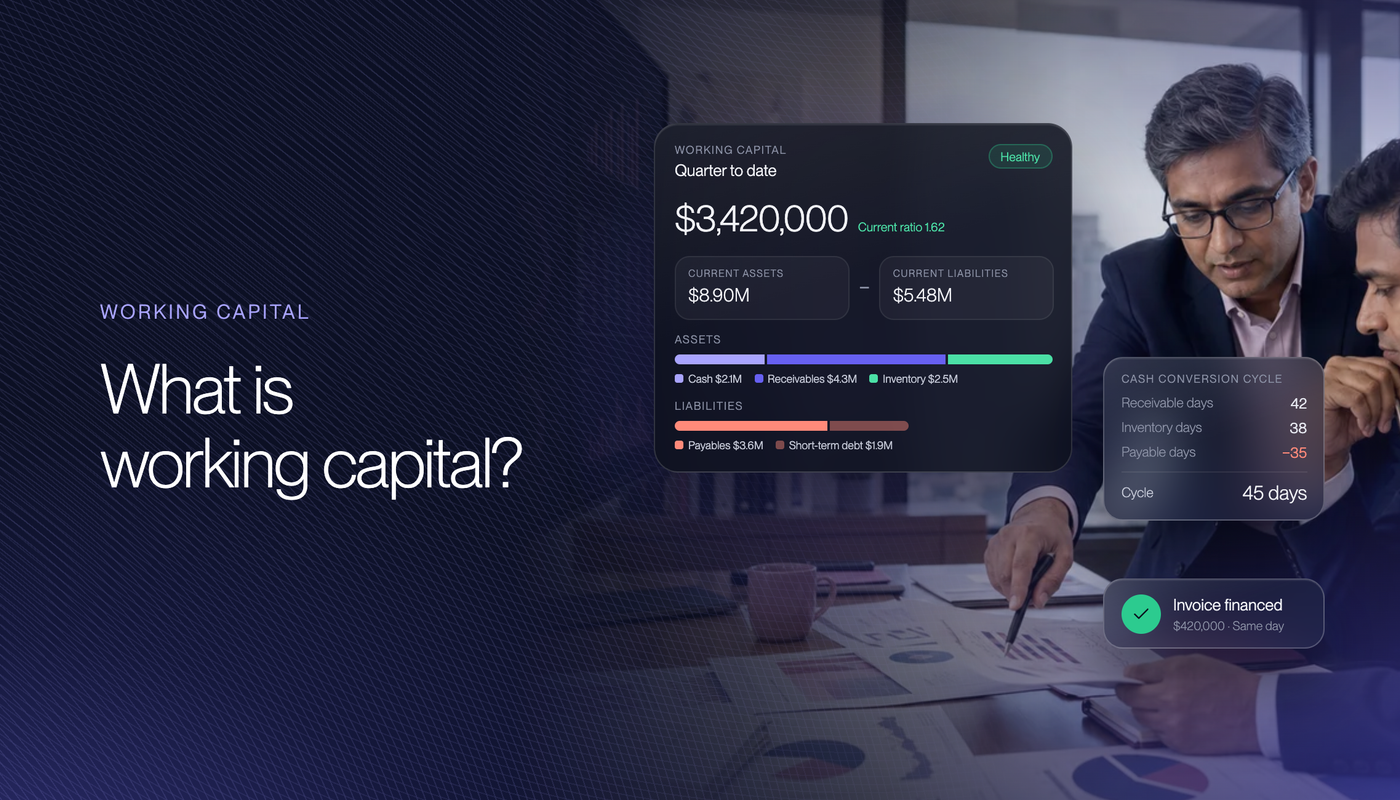
The working capital cycle is the number of days between paying for stock or inputs and collecting cash from customers. It equals days inventory plus days receivable minus days payable. The longer the cycle, the more cash the business needs to keep trading. It is also called the cash conversion cycle.
Three Measures Make Up the Cycle
Measure | Formula | Distributor example |
|---|---|---|
Days inventory | Inventory divided by cost of sales, times 365 | 44 days |
Days receivable | Trade receivables divided by sales, times 365 | 42 days |
Days payable | Trade payables divided by cost of sales, times 365 | 37 days |
Full cycle | Days inventory plus days receivable minus days payable | 49 days |
With cost of sales of €2,555,000, the distributor holds stock for 44 days, waits 42 days for customers and pays suppliers after 37. For 49 days it funds each sale itself. Each extra day customers take ties up about €10,000 more, its average daily sales.
Walmart Turns Its Cycle in About 3 Days
On our calculation from the year-end balances in its annual report for fiscal 2026, Walmart held inventory for about 40 days, collected receivables in about 6 and paid suppliers after about 43. That is a cycle of roughly 3 days.
The EU Sets a 60-Day Limit on Payment Terms
The Late Payment Directive 2011/7/EU says terms between businesses should not exceed 60 calendar days unless both sides expressly agree and the term is not grossly unfair to the supplier. Public authorities must generally pay within 30 days. Shortening the cycle is the job of working capital management.
Invest a Working Capital Surplus
When the cycle frees more cash than it uses, that money can earn instead of waiting in the bank.
- Matched to dates: Bills that mature before a tax bill, payroll peak or stock order.
- Currency kept: Hold each balance in the currency of the costs it will pay.
- Spread beyond one bank: Move balances above €100,000 off a single bank's books.
- Fees shown upfront: One yearly fee and a flat charge per order, before you invest.
- Invested in days: Cash goes in 2 to 3 business days after onboarding.
- Sell when you need: You choose how much to invest and when to sell.
When investing, your capital is at risk. Yields may vary.
How Working Capital Differs by Business Type
Working capital depends on how a business gets paid and what it must hold. Retailers and airlines collect cash before they pay, so they can run negative working capital. Manufacturers, builders and wholesalers pay for materials and then wait for customers, so they need more. Service firms sit in between, with little stock but unpaid invoices.
Working Capital by Industry
Business | Typical level | Why |
|---|---|---|
Supermarkets and discount retailers | Often negative | Shoppers pay at the till, suppliers are paid weeks later |
Airlines and tour operators | Often negative | Tickets and holidays are paid for months before travel |
Low or negative | Annual plans are paid upfront and held as deferred revenue | |
Restaurants and cafés | Low | Card payments arrive in days and fresh stock is small |
Swings with the season | Stock is bought months before the peak, cash piles up after it | |
Manufacturers | High | Raw materials, work in progress and finished goods, then 30 to 60 day terms |
Wholesalers and distributors | High | Large stock and trade credit on both sides |
Construction contractors | High and uneven | Work is billed in stages and clients often hold back retention money |
Wine, whisky and cheese makers | Very high | Stock ages for years before it can be sold |
Law firms and consultancies | Medium | Little stock, but unbilled time and invoices waiting to be paid |
Negative early in the term | Fees are paid a term or a year ahead and spent on salaries month by month | |
Large and positive after a round | Funding arrives at once and is spent month by month | |
Positive | Grants and large gifts often arrive before the project spending |
Compare Your Ratio With Businesses Like Yours
Two companies with the same sales can need very different amounts. A whisky distillery may hold years of sales in stock, while a software company may collect a year's fees before it delivers the service. A current ratio of 0.8 is normal for a supermarket and worrying for a machine maker. Compare your figures with businesses that sell the same way, and track your own trend month by month.
Sophic
Treasury management
Yield
2% to 3%+ p.a
Fees
0.3% a year + €10 per order
Eligibility
EU/EEA businesses with an LEI
What a Working Capital Surplus Means for Spare Cash
A working capital surplus is cash and other current assets above what the business needs to run its cycle and cover its short-term bills. Part of it should stay as a buffer. The rest is money the business does not need day to day, and in a current account it earns very little.
Keep the Cash Your Cycle Needs in the Bank
Start with the next one to two months of payments, such as payroll, suppliers and VAT. Keep that in your current account or EMI account. Add a buffer for late payers and a weak month, sized with our guide on how much a business should hold in reserve. What is left is the true surplus, the idle cash on your balance sheet.
Cash Above That Line Can Earn a Market Rate
At the time of writing, in October 2026, the ECB's deposit facility rate is 2.50%. Euro area companies were paid an average of 0.61% on overnight deposits and 2.24% on deposits fixed for up to one year in August 2026, according to the ECB. On 5 October 2026, Germany sold Treasury bills maturing in July 2027 at a yield of 2.872%.
With our regulated treasury partner, money market funds start from 2% p.a., Treasury bills from 2.5% p.a. and government bonds from 3% p.a., with no lock-in. When investing, your capital is at risk. Yields may vary.
Where Spare Working Capital Can Go
Factor | Business savings account | Money market fund | Treasury bills | Government bonds |
|---|---|---|---|---|
Typical return | 0.61% on corporate overnight deposits, 2.24% fixed up to 1 year (ECB, August 2026) | From 2% p.a. with our partner, variable | From 2.5% p.a. with our partner, fixed to maturity | From 3% p.a. with our partner, fixed coupon |
Access to cash | Same day on demand accounts; notice or term on others | Sell on any dealing day | Repaid at maturity or sold earlier at market price | Repaid at maturity or sold earlier at market price |
Lock-in | None on demand accounts; notice or term for higher rates | None with our partner | None with our partner | None with our partner |
Deposit guarantee cover | Up to €100,000 per bank | None, not a deposit | None, not a deposit | None, not a deposit |
Main risk | Bank failure above €100,000, low return | Holdings can lose value, returns fall with rates | Issuing government's credit, price moves if sold early | Price falls when rates rise, more on longer bonds |
Each option suits a different part of the money. A money market fund suits cash you may need within days. Treasury bills suit cash with a known date, such as a tax payment in six months. Government bonds suit money you will not touch for a year or more. A fixed deposit pays a set rate but locks the cash for the term. When investing, your capital is at risk. Yields may vary.
You Need an LEI Before You Can Invest
EU rules require an investment firm to have a company's LEI before it carries out reportable trades for it, such as buying Treasury bills or bonds (Article 13(2) of Delegated Regulation (EU) 2017/590). Our regulated treasury partner asks for an active LEI at onboarding, a 20-character code renewed every year. See what an LEI number is and who needs one.
Read more: short-term options for business cash and money market funds for companies.
Sophic
Treasury management
Yield
2% to 3%+ p.a
Fees
0.3% a year + €10 per order
Eligibility
EU/EEA businesses with an LEI
What Spare Working Capital Costs in Lost Return
Cash left in a current account costs the gap between the interest it gets there and what the money could make elsewhere, less any investing costs. With euro area companies paid 0.61% on overnight deposits in August 2026 and inflation estimated at 3.8% in September, money in a current account is losing buying power every month.
Cash in a Current Account Loses Buying Power
Eurostat's flash estimate puts euro area inflation at 3.8% in September 2026, up from 3.2% in August. If prices kept rising at that rate for a year, €1,000,000 would need to grow to €1,038,000 to buy the same as today. At 0.61% it would reach about €1,006,100.
An Illustration With Assumed Numbers
Assume a company has €1,000,000 it will not need for a year. In a current account at 0.61%, it earns about €6,100. In Treasury bills at 2.5%, the starting yield our partner quotes, it earns about €25,000 before costs. With assumed total costs of 0.3% a year, about €22,000 is left, roughly €15,900 more than the current account. When investing, your capital is at risk. Yields may vary.
Costs to Check Before You Invest
Ask about the fund's own ongoing charges, any yearly fee on your invested balance, fees per order, the margin on any currency conversion and the yearly LEI renewal. Compare returns after every charge.
Read more: why business current accounts pay so little.
Check Your Eligibility to Invest Company Cash
Most companies based in the EU or EEA with spare cash can start quickly. We confirm the details on the first call.
- EU or EEA business: Our partner onboards companies based in the EU and EEA.
- Active LEI needed: We tell you upfront if you still need one.
- One document list: A single list of what to send, with no repeat requests.
- Sector checked early: Excluded industries are flagged before you start.
- Proof of existence: A recent registry extract shows the company is active.
When investing, your capital is at risk. Yields may vary.
Common Working Capital Mistakes
Most of these mistakes come from trusting the total without reading the lines behind it, or from mixing it up with profit or cash. Each of the four below has a real cost in money or time, and each is easy to avoid.
Counting Slow Stock as Ready Cash
Stock sits on the balance sheet at cost, not at what it will sell for. Say the distributor's €308,000 of inventory includes €60,000 of last year's models that will now sell for only half of what they cost. Its real cushion is about €30,000 smaller than the balance sheet shows, and its quick ratio is the better guide. Review stock by age every quarter, write down what will not sell at cost, and clear old lines before they tie up more cash.
Missing a Loan That Falls Due Within 12 Months
A five-year loan repaid in one sum moves into current liabilities once that repayment is less than 12 months away. The same happens at the reporting date if the company has broken a covenant and the lender can demand repayment. A €500,000 loan can turn a positive figure negative overnight, just as a bank or buyer reads the accounts. Agree the refinancing before the year end, as part of managing treasury risk.
Treating Profit as Working Capital
Growth uses cash. If the distributor's sales rise by €1,095,000 a year and customers still take 42 days to pay, receivables rise by about €126,000, and stock usually grows too. The extra profit arrives later than the extra cash goes out. Before a big contract or a growth push, work out how much more working capital it will need and how you will fund it.
Leaving Every Spare Euro in the Current Account
The opposite mistake is common in cash-rich firms. The EU Deposit Guarantee Schemes Directive 2014/49/EU covers €100,000 per depositor per bank, so a €2,000,000 balance in one bank is mostly uncovered, and it gets the low overnight rate. Keep the operating cash and the buffer in the bank, and put a time limit on any amount above that. See how deposit guarantee schemes cover business accounts.
Sophic
Treasury management
Yield
2% to 3%+ p.a
Fees
0.3% a year + €10 per order
Eligibility
EU/EEA businesses with an LEI
Bottom Line
Working capital is current assets minus current liabilities, and it shows whether a business can meet the next year's bills from what it holds. Read the working capital ratio and the cycle with it, and judge the result against how your business gets paid. Keep the cash the cycle needs close, and put the rest to work.
What is working capital in simple terms?
What is the working capital formula?
How do you calculate working capital from a balance sheet?
What is a good working capital ratio?
Is negative working capital bad?
What is the difference between working capital and net working capital?
What counts as current assets and current liabilities?
Is working capital the same as cash flow?
What is the working capital cycle?
What does positive working capital mean?
Can a company have too much working capital?
How often should a business calculate working capital?
What can a business do with surplus working capital?
Sources
- IAS 1 Presentation of Financial Statements as adopted in the EU, Commission Regulation (EU) 2023/1803 (paragraphs 66, 68 and 69; also IAS 2 and IAS 7), EUR-Lex
- Commission Regulation (EU) 2023/2822 amending IAS 1 (classification of liabilities as current or non-current, non-current liabilities with covenants), EUR-Lex
- IFRS Foundation, IFRS 18 Presentation and Disclosure in Financial Statements
- BDO, IFRS 18: Classification of Loans as Current or Non-current (June 2026)
- Walmart Inc., Form 10-K for the fiscal year ended 31 January 2026, SEC
- Tesco PLC, Annual Report and Financial Statements 2026, Group balance sheet at 28 February 2026
- Ryanair Holdings plc, 2026 Annual Report, Consolidated balance sheet at 31 March 2026
- Directive 2011/7/EU on combating late payment in commercial transactions, EUR-Lex
- European Central Bank, Key ECB interest rates (checked 6 October 2026)
- European Central Bank, Euro area bank interest rate statistics, August 2026 (released 1 October 2026)
- Eurostat, Flash estimate, euro area annual inflation up to 3.8%, September 2026 (released 2 October 2026)
- Deutsche Bundesbank, Bubill auction results, 5 October 2026
- Directive 2014/49/EU on deposit guarantee schemes, EUR-Lex
- Commission Delegated Regulation (EU) 2017/590 (RTS 22), EUR-Lex
- GLEIF, Introducing the Legal Entity Identifier
Binderr is not an investment provider or adviser. We connect businesses with regulated investment providers and help with the setup. Every investment is made under the provider's own terms, fees and risk disclosures, which you review and accept directly with them, and the decision to invest is yours. Binderr is not responsible for investment performance or for any loss. This article is general information, not investment, tax or legal advice, and figures can change after the time of writing. When investing, your capital is at risk. Yields may vary.