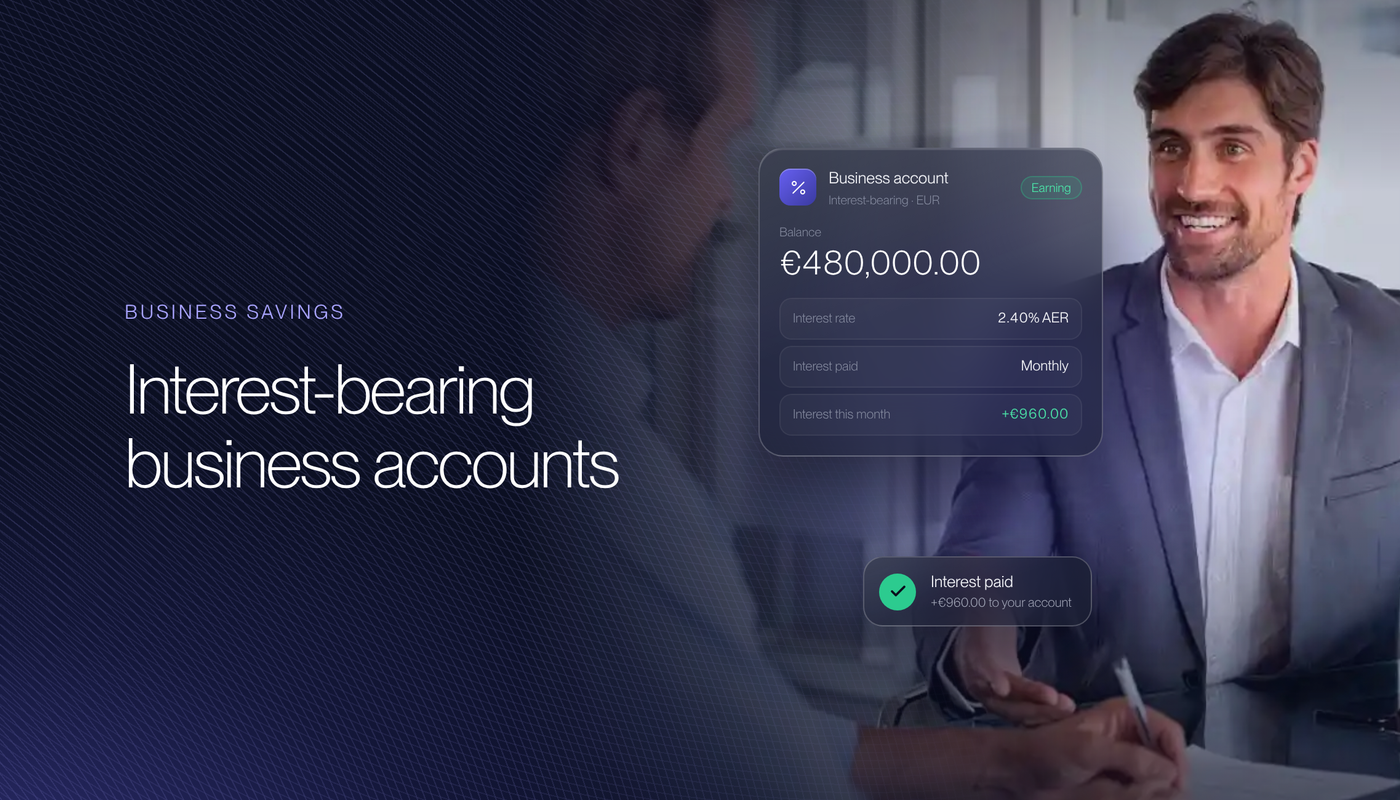
An interest bearing account lets your business earn on the cash it holds for payroll, tax and reserves, instead of leaving it at zero. Euro area companies earned an average of 0.68% on overnight deposits in September 2026, according to the ECB, while the ECB deposit facility rate stood at 2.50%. On €500,000, that gap is worth about €9,100 a year.
The hard part is that most business current accounts pay little or nothing, and the better rates come with conditions. Promotional savings rates drop after three or four months, many need a minimum balance or the bank's own current account, and the deposit guarantee stops at €100,000 per bank.
This is where we come in. We connect EU and EEA businesses with our regulated treasury partner and handle the setup with you: the eligibility check, the LEI and the onboarding file. Your cash goes into funds, bills or bonds held in your company's name, with no lock-in. We handle it, and your cash is invested within days.
Earn More Than a Business Account With Interest
A business account with interest rarely pays what your cash could earn. We set up an investment account for your company with our regulated treasury partner.
- Money market funds: From 2% p.a. before fees, a variable return.
- Treasury bills: From 2.5% p.a. before fees, repaid at maturity.
- Government bonds: From 3% p.a. before fees, with regular interest.
- No lock-in: Sell when you need the cash, at the market price.
- Setup done with you: Eligibility, LEI and onboarding file handled in one go.
- Invested fast: Your first orders go through 2 to 3 business days after onboarding.
When investing, your capital is at risk. Yields may vary.
Do Business Bank Accounts Earn Interest
Most business bank accounts earn little or no interest. ECB figures for September 2026 put the average rate on overnight company deposits in the euro area at 0.68%, against an ECB deposit facility rate of 2.50%. A business account with interest exists, but the rate is usually low, tiered or temporary, and the operating account itself often pays nothing.
Why Most Business Current Accounts Pay Nothing
A bank earns the ECB deposit rate on the reserves it holds, and it decides how much of that to pass on. Operating balances are cheap money for the bank. Companies leave them in place because salaries, suppliers and tax payments run through that account, so the bank does not need to compete for them with a high rate.
That is why a standard business current account with interest is rare. Where a bank does pay, it usually pays on a separate savings pot, on new money only, or above a balance threshold. The bank keeps the spread between what it earns at the central bank and what it pays you.
What the ECB Figures Show for Company Cash
The ECB bank interest rate statistics released on 2 November 2026 show the gap clearly. Companies earned 0.68% on overnight deposits in September 2026. The same companies earned 2.46% on new deposits fixed for up to one year. The difference is the price of keeping money instantly available in an interest bearing account at a bank.
On a balance of €500,000, 0.68% is €3,400 a year before tax. At the ECB deposit rate of 2.50% the same cash would earn €12,500. Most finance teams never see that difference, because the account statement shows only what was paid, not what was possible.
Business Checking Account With Interest in the US
In the US, a business checking account with interest has been allowed since 21 July 2011, when the Federal Reserve repealed Regulation Q under Section 627 of the Dodd-Frank Act. Before that date, US banks could not pay interest on business demand deposits at all. Today a business checking account with interest is common, but many still pay a low rate or set a minimum balance.
In Europe the same product is a business current account, and the same pattern applies. Whatever the name, the question is what the bank pays compared with what the cash could earn elsewhere. An interest bearing business checking account at a US bank and a current account at a German bank both tend to pay far less than the central bank rate.
Sophic
Treasury management
Yield
2% to 3%+ p.a
Fees
0.3% a year + €10 per order
Eligibility
EU/EEA businesses with an LEI
When investing, your capital is at risk. Yields may vary.
Types of Interest Bearing Business Account
A business has three kinds of interest bearing account at a bank: a current account that pays a small rate, an interest bearing business savings account with instant access, and a notice or fixed deposit. The longer you commit the money, the higher the rate. All three are deposits, so the €100,000 deposit guarantee applies to each bank.
Business Current Account With Interest
A business current account with interest pays on the balance you use for daily payments, the European version of a business checking account with interest. Few banks offer one, and those that do tend to pay a fraction of the savings rate. It suits a company that keeps most of its cash in one place and does not want to move money between accounts.
Interest Bearing Business Savings Account
An interest bearing business savings account sits next to the current account and pays more, with instant or next-day access. In a Biallo comparison of German business savings accounts dated 3 June 2026, DKB paid 1.20% to customers with a DKB business account, EthikBank paid 1.00%, and Commerzbank paid 1.70% on new money for 12 months before dropping to 0.75%.
Notice and Fixed Deposits
A fixed deposit locks the money for a set term in exchange for a higher rate. The ECB figures show euro area companies earned 2.46% on new deposits fixed for up to one year in September 2026. The trade-off is access: break the term early and most banks charge a penalty or refuse.
Promotional Rates on a Business Account With High Interest
A business account with high interest is usually a promotion. In the same Biallo comparison, ING paid 3.50% on its Business Extra-Konto for four months before the rate fell to 1.00%. Several other banks offered 3.50% for three months on new money, then 0.50%. Budget on the rate that follows the promotion, not on the headline.
Bank | Product | Rate on 3 June 2026 | Main condition |
|---|---|---|---|
ING | Business Extra-Konto | 3.50% for 4 months, then 1.00% | Promotion up to €1,000,000 |
GEFA Bank | TagesGeld | 2.11% | 0.00% below €10,000 |
Commerzbank | Topzinskonto Plus | 1.70% for 12 months, then 0.75% | New money, business account needed |
DKB | Tagesgeld Geschäftskunden | 1.20% | DKB business account needed |
EthikBank | ZinskontoBusiness | 1.00% | Up to €1,000,000 |
ProCredit Bank | Business savings | 0.50% | 0.00% above €1,000,000 |
Source: Biallo comparison of German business savings accounts, rates as at 3 June 2026. Rates change often, so check the bank's own page before you move money.
The pattern is the same across these banks: a business account with interest pays its best rate for a few months, then settles between 0.50% and 1.20%. Conditions do the rest of the work: minimum balances, caps, and the need to hold the bank's own current account. Most of these rates sat well below the ECB deposit rate even when they were fresh.
Put Idle Cash to Work Beyond the Bank
Interest bearing accounts at a bank stop at a low rate and a €100,000 cover limit. Investing company cash through our partner works around both.
- Your company's name: Funds, bills and bonds are held for the company, not a director.
- Segregated client cash: Uninvested cash sits in segregated accounts at a major global bank.
- Independent custody: Your investments are held with an independent custodian.
- Clear fees: 0.3% a year on the invested balance plus €10 per order.
- One file, asked once: We tell you what onboarding needs and check it before you apply.
When investing, your capital is at risk. Yields may vary.
The Limits of a Business Bank Account With Interest
A business bank account with interest has three limits: the deposit guarantee stops at €100,000 per company per bank, the rate follows the ECB with a delay and a margin, and most offers carry balance tiers or time limits. For a company holding more than a few months of costs, those limits decide where the cash should sit.
The €100,000 Deposit Guarantee Limit
Directive 2014/49/EU sets the deposit guarantee at €100,000 per depositor per bank across the EU. Companies are covered as depositors, but the limit is the same as for a private person. A business holding €800,000 at one bank has €700,000 with no scheme cover.
Spreading cash across eight banks to stay inside the limit means eight account openings, eight KYC files and eight sets of statements. That is the main reason finance teams look at money market funds and government paper instead. Read more: business cash management services.
Rates Follow the ECB, With a Lag
Banks raise deposit rates slowly when the ECB raises its rate and cut them quickly when it falls. The ECB kept its deposit facility rate at 2.50% at its meeting on 29 October 2026. A month earlier, in September, the average overnight rate paid to companies was still under 1%. An interest bearing account at a bank captures only part of the policy rate. Our guide to what cash management is covers how finance teams track that gap.
Balance Tiers, Caps and Conditions
Many business rates apply only within a band. In the Biallo comparison, GEFA Bank paid nothing below €10,000 and ProCredit paid nothing above €1,000,000. Promotional rates often apply to new money only, so cash already at the bank earns the old rate. Read the conditions before you count the interest.
Sophic
Treasury management
Yield
2% to 3%+ p.a
Fees
0.3% a year + €10 per order
Eligibility
EU/EEA businesses with an LEI
When investing, your capital is at risk. Yields may vary.
Alternatives to an Interest Bearing Account
The three main alternatives to an interest bearing account are money market funds, Treasury bills and government bonds. Our partner currently offers them from 2%, 2.5% and 3% p.a. before fees. They are investments, not deposits, so the deposit guarantee does not cover them and the value can move. In return, there is no €100,000 limit on what your company can hold.
When investing, your capital is at risk. Yields may vary.
Money Market Funds for Business Cash
A money market fund invests in very short-term debt from governments, banks and large companies. In the EU, Regulation (EU) 2017/1131 sets the rules on what these funds can hold and how much they must keep in cash-like assets. Through our partner, funds start from 2% p.a. before fees, the return is variable, and you can sell when you need the cash. See what a money market fund is for how these funds work.
Treasury Bills
A Treasury bill is short-term government debt, usually for three, six or twelve months. You buy it below face value and receive the full amount at maturity. Through our partner, bills start from 2.5% p.a. before fees. They suit cash you know you will not need until a set date, such as a tax payment. Read more: what Treasury bills are.
Government Bonds
Government bonds run for longer and pay regular interest. Through our partner, they start from 3% p.a. before fees. The price moves with interest rates, so selling before maturity can return more or less than you paid. They suit strategic reserves that will stay put for a year or more. Read more: what government bonds are.
Factor | Business savings account | Money market fund | Treasury bills | Government bonds |
|---|---|---|---|---|
Typical return | 0.50% to 1.20% after promotions (Biallo, June 2026) | From 2% p.a. before fees | From 2.5% p.a. before fees | From 3% p.a. before fees |
Access to cash | Instant or next day | Sell when needed | At maturity, or sell early | At maturity, or sell early |
Lock-in | None on easy access | None | None, sold at market price | None, sold at market price |
Deposit guarantee cover | Up to €100,000 per bank | None, it is an investment | None, it is an investment | None, it is an investment |
Main risk | Bank failure above €100,000 | Fund value can fall | Price moves if sold early | Price moves with rates |
When investing, your capital is at risk. Yields may vary.
The table shows the real choice. A savings account gives instant access and cover up to €100,000, but a low rate once the promotion ends. Funds, bills and bonds pay more today and have no cover limit, but they are investments, so the value can move. Most companies keep both: a working balance at the bank and the rest invested.
Invest Company Cash Instead of Parking It
Your interest bearing account keeps the working balance. The rest can go into funds, bills and bonds held for your company.
- Three instruments: Money market funds, Treasury bills and government bonds in one account.
- Familiar issuers: Bills and bonds from EU governments, the UK and the US.
- You decide the split: Choose how much goes into each instrument and when.
- No minimum lock-in: Sell any holding when the business needs the cash.
- One contact: We stay with you from the eligibility check to the first order.
- Digital onboarding: No branch visit and no paper forms.
When investing, your capital is at risk. Yields may vary.
How Investing Company Cash Works With Our Partner
We connect your company with our regulated treasury partner, check that you qualify, prepare the onboarding file with you and stay with you until the first order is placed. Onboarding is digital, and your cash is usually invested 2 to 3 business days after you are approved. You choose the instruments and the amounts.
Which Companies Are Eligible
Our partner works with EU and EEA businesses that hold an active LEI, can prove their legal existence and do not operate in a prohibited industry. A Legal Entity Identifier is a 20-character code issued under the GLEIF system, and investment firms need it before they can place an order for you. If you do not have one yet, an accredited issuer can usually set one up within days, and we tell you what it needs.
How Your Money Is Held
Our partner is an EU-regulated investment firm. Client cash waiting to be invested sits in segregated accounts at a major global bank, and the investments are held with an independent custodian, separate from the firm's own assets. That structure is what replaces the deposit guarantee for investment holdings.
What Happens After Onboarding
You place orders for funds, bills or bonds, and they are held in your company's name. You can sell at the market price when the business needs the cash, and there is no lock-in. Read more: how a business investment account works.
Sophic
Treasury management
Yield
2% to 3%+ p.a
Fees
0.3% a year + €10 per order
Eligibility
EU/EEA businesses with an LEI
When investing, your capital is at risk. Yields may vary.
What a Business Account With Interest Earns Compared With Investing
On €500,000, a business account with interest at the euro area average of 0.68% earns about €3,400 a year. The same amount in a money market fund at a return of 2% before fees would earn about €10,000, less our partner's fee of €1,500 a year plus €10 per order. These figures are illustrations, not forecasts.
When investing, your capital is at risk. Yields may vary.
Item | Bank account at 0.68% | Money market fund at 2% | What it means |
|---|---|---|---|
Balance | €500,000 | €500,000 | Same starting cash |
Gross return per year | €3,400 | €10,000 | Fund return is variable |
Fees per year | Account fees vary by bank | €1,500 plus €10 per order | 0.3% on the invested balance |
Return after fees | €3,400 | About €8,490 with one order | Before tax in both cases |
Cover | Up to €100,000 | No deposit guarantee | Investment held with a custodian |
The fee matters more on small amounts. On €50,000 the same 0.3% is €150 a year, which still leaves room above a bank rate below 1%, but the €10 order fee weighs more if you trade often. For most companies, a few larger orders a year keep costs low. Read more: short-term investments for business cash.
Where Each Part of Your Cash Should Sit
The simplest way to choose is to split company cash by when you need it. Operating cash for the next one to three months stays in the current account. Reserve cash goes into an interest bearing business savings account or a money market fund. Strategic cash that will not move for a year can go into bills and bonds.
Operating Cash Stays in the Current Account
Keep enough in the current account to cover salaries, suppliers and tax payments due soon. Whether that account pays interest matters less here, because the balance turns over quickly. Our guide to cash flow management for businesses shows how to size it. If you pay suppliers in several currencies, a multi-currency business account keeps that working balance in one place.
Reserve Cash Earns Its Keep
Reserves are cash the business keeps for emergencies and opportunities, often three to six months of costs. This is where an interest bearing business savings account or a money market fund pays its way. Read what idle cash is to see how much of your balance has no job, and working capital management to set the buffer.
Strategic Cash Goes Into Bills and Bonds
Cash set aside for a future purchase, a tax bill or a long-term buffer can be matched to Treasury bills or bonds with maturities that fit the date. This is the core of business treasury management: matching each pot of cash to the job it has to do.
Common Mistakes With an Interest Bearing Account
The most common mistakes are counting the promotional rate as the real rate, keeping everything at one bank above the €100,000 limit, and leaving reserves in an account that pays nothing. Each one costs money every month, and each one is easy to fix.
Budgeting on a Business Account With High Interest
A business account with high interest at 3.50% for four months, followed by 1.00%, averages about 1.83% over the first year. Companies that plan on 3.50% expect almost twice the interest they will earn. Use the rate after the promotion and treat the first months as a bonus.
Keeping Everything at One Bank
A company with €1,000,000 at one bank has €900,000 above the deposit guarantee. Many finance teams do not notice until a bank is in the news. Keep the working balance at the bank and invest or spread the rest.
Leaving Reserves in the Operating Account
Reserves that sit in the current account earn the current account rate, often close to zero. A business account with interest often pays little more. On €300,000 at 0.68% instead of a money market fund from 2% p.a. before fees, the difference is about €3,960 a year before fees and tax. Move the reserve once and review it each quarter.
When investing, your capital is at risk. Yields may vary.
Investing Cash You Will Need Soon
Bonds and longer bills can be worth less than you paid if you sell before maturity. Do not invest the money for next month's payroll. Keep that in the bank, and invest only what has no job for several months.
Talk to Us About Your Company Cash
Not sure how much to keep in an interest bearing account and how much to invest? Tell us your balances and timing, and we check what fits.
- Eligibility first: Country, sector and LEI checked before any paperwork.
- A clear split: Working balance, reserves and strategic cash sized with you.
- Fees in writing: 0.3% a year plus €10 per order, nothing hidden.
- No lock-in: Your company can sell holdings when it needs the cash.
- Fast start: Invested 2 to 3 business days after onboarding.
When investing, your capital is at risk. Yields may vary.
Bottom Line
A business account with interest is worth having for the working balance, but it is not where most company cash should earn its return. In September 2026 euro area companies earned 0.68% on overnight deposits while the ECB rate was 2.50%, and the best savings rates fell back to between 0.50% and 1.20% after their promotions.
Keep operating cash at the bank, keep reserves in an interest bearing business savings account or a money market fund, and match strategic cash to bills and bonds. Remember that the deposit guarantee stops at €100,000 per bank, and that funds, bills and bonds are investments without that cover. We set up the investment side with you through our regulated treasury partner. Read more: what treasury management is.
When investing, your capital is at risk. Yields may vary.
Do business bank accounts earn interest?
Can business checking accounts earn interest?
What is an interest bearing account?
What is the best business bank account with interest?
Is an interest bearing business savings account covered by the deposit guarantee?
How much interest does a business account with interest pay in 2026?
Is a business current account with interest worth it?
What are the alternatives to an interest bearing account for a business?
Are money market funds covered by the deposit guarantee?
Is there a lock-in when a business invests idle cash?
Who can invest company cash through Binderr's partner?
Does a company need an LEI to invest its cash?
How is interest on company cash taxed?
Sources
- European Central Bank, Monetary policy decisions, 29 October 2026
- European Central Bank, Euro area bank interest rate statistics: September 2026, released 2 November 2026
- EUR-Lex, Directive 2014/49/EU on deposit guarantee schemes
- EUR-Lex, Regulation (EU) 2017/1131 on money market funds
- Federal Reserve Board, Final rule repealing Regulation Q, 14 July 2011
- Biallo, Firmentagesgeld comparison, June 2026
- Global Legal Entity Identifier Foundation, GLEIF
Binderr is not an investment provider or adviser. We connect businesses with a regulated investment provider and help with the setup. Every investment is made under the provider's own terms. This article is general information, not investment or tax advice. When investing, your capital is at risk. Yields may vary.