The right online payment gateway UK customers trust lets you take Visa, Mastercard, Amex, Apple Pay, Google Pay and bank payments on your website, with funds paid out in pounds to your business account. Interchange on UK consumer cards is capped at 0.2% for debit and 0.3% for credit, so taking cards in Britain can be cheap.
The hard part is getting the price you see on the pricing page. Flat rates hide premium card, Amex and currency charges, EEA cards cost up to 1.5% in interchange alone, and a gateway can freeze payouts weeks after you go live if the onboarding file was thin. Companies registered outside the UK are often declined at the first step.
This is where we come in. We match you with a regulated payment partner that takes your business model and handle the application with you: the website check, the KYC pack, the processing history and every underwriting question. Apply once, get a fast approval and start taking payments in days.

What Is an Online Payment Gateway in the UK
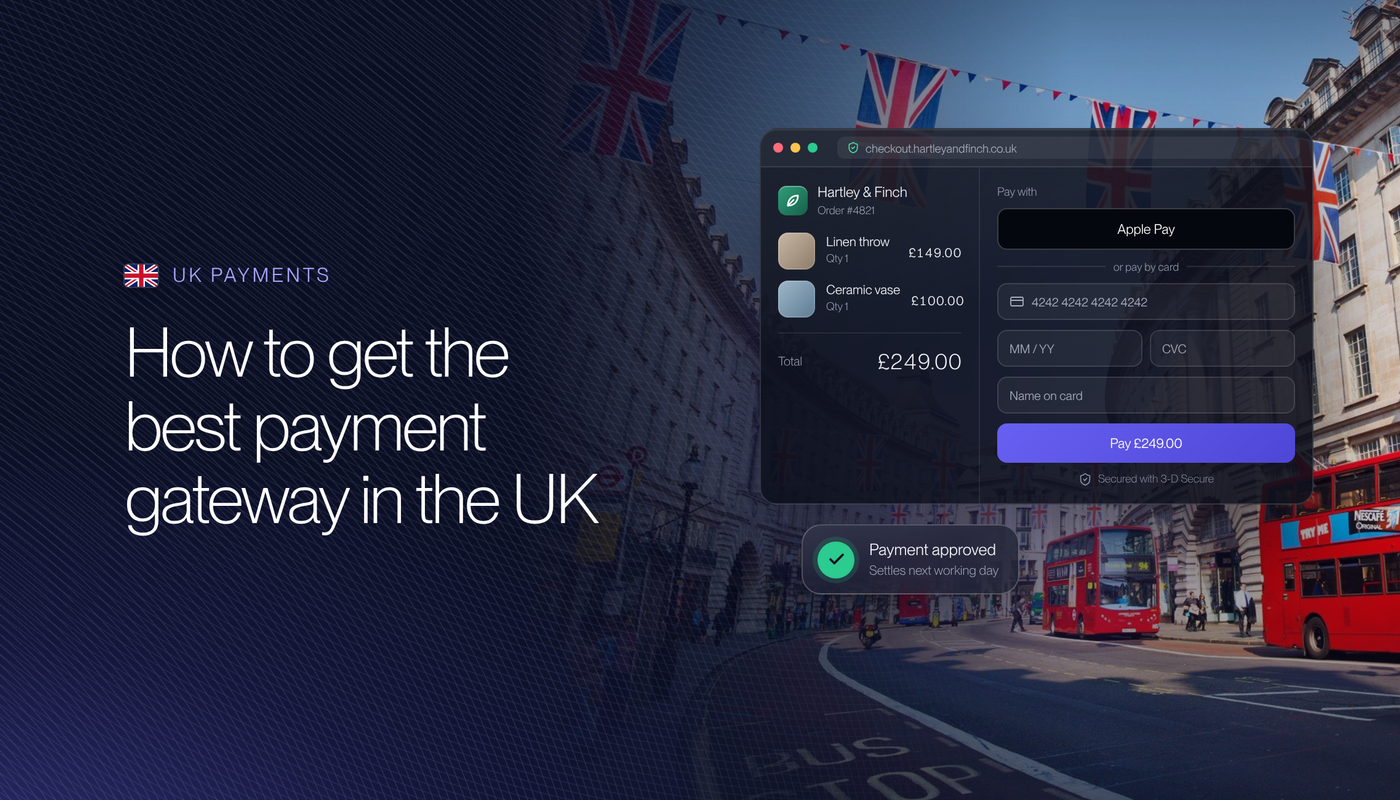
An online payment gateway in the UK is the service that captures your customer's card or bank details at checkout, encrypts them, sends them for authorisation and returns an approve or decline within seconds. It connects your website to the card schemes, the issuing bank and the acquirer that settles the money into your account.
How a UK Payment Gateway Works
When a customer pays, the gateway passes the card data to the acquirer, which asks the card scheme and the customer's bank to approve it. If the bank needs extra proof, the customer completes a 3D Secure check in their banking app. Approved payments are batched and paid out to your business account, usually on a fixed schedule. A UK payment gateway also handles refunds, recurring payments, saved cards and the fraud rules that decide which orders get through. Our guide to what a payment gateway is and how it works goes through each step in detail.
Gateway, Merchant Account and Processor
Most modern providers sell the gateway, the merchant account and the processing as one product, so you sign one contract and see one fee. Older setups split them: a bank acquirer gives you the merchant account and you connect a separate gateway on top. The bundled model is faster to open. The split model can be cheaper at high volume, because you negotiate the acquiring rate directly. For card-specific detail, see how credit card payment gateways work.
Who Regulates Payment Gateway Providers in the UK
Payment gateway providers UK merchants use are authorised by the Financial Conduct Authority as payment institutions, e-money institutions or banks. The FCA sets the rules on safeguarding customer money and on Strong Customer Authentication. The Payment Systems Regulator, which is being merged into the FCA, oversees card fees and the payment systems themselves. Always check that a provider appears on the FCA register before you sign.
Get a Payment Gateway in the UK
A UK payment gateway can be live within days when the application is right the first time. We match you with a regulated partner and build the file with you.
- Fast approval: We send your application to a partner that takes your business model
- KYC pack prepared: We tell you what is needed and build the file with you
- Non-UK companies welcome: Partners that onboard companies registered abroad
- Cards and wallets: Visa, Mastercard, Apple Pay and Google Pay at checkout
- Apply once: One application instead of five rejections
- Regulated partners: Licensed payment institutions with safeguarded funds
UK Payment Gateway Fees in 2026
UK payment gateway fees start at about 1.4% plus 25p for a standard UK card online and rise to 3% or more for international cards, Amex and payments that need a currency conversion. The headline rate is only the first line. The card mix of your customers decides what you really pay.
Provider and source | Standard UK card online | EEA or international card | Chargeback fee |
|---|---|---|---|
Stripe, UK pricing page, November 2026 | 1.5% + 20p | 2.5% + 20p (EEA), 3.15% + 20p (international), plus 2% if converted | £20 |
PayPal, UK merchant fees, updated 1 October 2026 | 2.9% + 30p standard, 1.2% + 20p on approved advanced card processing | Plus 1.29% (EEA) or 1.99% (other markets) | £14 |
Square, UK pricing page, November 2026 | 1.4% + 25p | 2.5% + 25p for non-UK cards | Per Square terms |
Shopify Payments, Basic plan, November 2026 | 2% + 25p, plus £19 a month | 3.1% + 25p | Per Shopify terms |
Adyen, UK pricing page, November 2026 | Interchange++ plus 0.60% + £0.11 | Interchange++ plus 0.60% + £0.11 | Quoted with your setup |
On paper the gap between providers is small. In practice, a business with mostly UK debit cards pays close to the headline rate, while a business selling to Europe or taking a lot of premium and Amex cards can pay double. Ask any provider for a breakdown by card type on your own sales before you compare quotes.
Flat Rate or Interchange++
A flat rate, such as Stripe's 1.5% plus 20p, charges the same on every standard UK card, whatever it costs the provider. Interchange++ passes through the real interchange and scheme fees and adds a fixed margin on top. Adyen's UK page lists 0.60% plus £0.11 on top of interchange for Visa and Mastercard. Because UK consumer interchange is capped at 0.2% on debit and 0.3% on credit, Interchange++ usually wins once you process a steady monthly volume, but providers that offer it often set a minimum monthly invoice.
Cross-Border Cards From the EEA
Since the UK left the EU, Visa and Mastercard raised interchange on online payments between the UK and the EEA from 0.2% to 1.15% on consumer debit and from 0.3% to 1.5% on consumer credit. The Payment Systems Regulator decided in October 2025 not to impose an interim cap and is consulting on a long-term method. In January 2026 the High Court confirmed its power to cap these fees, but no cap is in force yet. If a large share of your customers pay with EU cards, this one line can decide which gateway is cheapest.
The Fees Beyond the Headline Rate
Currency conversion is the biggest hidden cost: Stripe adds 2% when it converts an EEA or international payment, and PayPal adds 3% above its base rate. Chargebacks cost £20 each at Stripe and £14 at PayPal. Fraud screening is often extra, for example Stripe Radar from £0.04 per screened transaction. Amex is usually priced separately, at 3.5% on PayPal's advanced card rates. Add these to the headline before you compare.
How Much Does a Payment Gateway Cost in the UK
A UK business taking £20,000 a month online in 400 payments of £50 on standard UK cards pays roughly £320 to £520 a month in gateway fees, depending on the provider. The worked example below uses each provider's own published UK rates for standard UK cards only. If you are asking how much does a payment gateway cost, UK sellers can use it as a planning guide.
Provider | Published rate used | Monthly fee on £20,000 in 400 payments | What is not included |
|---|---|---|---|
Stripe | 1.5% + 20p | £380 | Premium cards, conversion, disputes |
Square online | 1.4% + 25p | £380 | Non-UK cards at 2.5% + 25p |
PayPal advanced cards (approved merchants) | 1.2% + 20p | £320 | Amex, international surcharge |
Shopify Payments, Basic plan | 2% + 25p, plus £19 plan | £519 | International cards at 3.1% + 25p |
Adyen | 0.60% + £0.11, plus interchange and scheme fees | £164 plus interchange and scheme fees | Minimum invoice by industry |
The spread is about £200 a month, or £2,400 a year, on the same sales. Change the mix and the order changes too: move a third of those payments to EEA cards and every flat rate provider adds a percentage point or more on that share. That is why the cheapest UK payment gateway for one business is the wrong choice for the next. The figures are planning numbers from published price lists, not quotes.
The Cheapest Payment Gateway UK Sellers Can Get
The cheapest online payment gateway UK merchants can get depends on three numbers: monthly volume, average order value and card mix. Under about £10,000 a month, a flat rate with no monthly fee is usually cheapest because nothing is wasted on minimums. Above that, an Interchange++ contract starts to pay off. With small baskets, the fixed fee per payment matters more than the percentage, so 20p against 25p or 30p is a real difference.
Is There a Free Payment Gateway in the UK
There is no free payment gateway UK businesses can use for card payments. What providers call free is a gateway with no setup fee and no monthly fee, where you only pay per transaction. That suits a new business. Bank transfers through open banking are the closest thing to free, because there is no card interchange, but the provider still charges for the service.
Lower Your UK Payment Gateway Costs
The cheapest online payment gateway UK businesses use is the one priced on their own card mix. We show you where the money goes and match you with the right partner.
- Fee check on your sales: We look at your card mix, not a generic rate card
- No monthly minimum: Partners that charge per payment, not per month
- Lower cross-border cost: Settlement options for customers who pay in euros
- Fewer failed payments: Checkout set up for 3D Secure without extra drop-off
- Transparent pricing: Every fee line shown before you sign
- Payouts in pounds: Settlement to your UK or multi-currency account
The Best Payment Gateway in the UK by Business Type
The right gateway is the one built for how you sell: a small shop, a Shopify store, a subscription product, a marketplace or a business with customers across Europe. Each needs different features, and each pays a different real rate on the same headline price.
Best Payment Gateway for Small Business UK
For the best payment gateway for small business, UK owners usually want three things: no monthly fee, quick setup and payouts within a few days. A flat rate provider covers this well at low volume. Watch the fixed fee if your orders are small, and check the payout schedule, because a new account can be held back for the first weeks. Our guide to payment gateways for small businesses covers the trade-offs in more depth.
Best Payment Gateway for Shopify UK
The best payment gateway for Shopify UK stores is usually Shopify Payments, because Shopify charges an extra fee on every order paid through a third-party provider: 2% on Basic, 1% on Grow, 0.6% on Advanced and 0.2% on Plus. A third-party gateway only makes sense if its rate saves more than that fee, or if Shopify Payments does not accept your business.
Subscriptions and SaaS
Recurring billing needs saved cards, automatic retries, account updater services and clean handling of 3D Secure on renewals. Missing any of these shows up as involuntary churn. See how subscription payment gateways work and our article on the SaaS payment gateway for the details that move retention.
Marketplaces and White Label Payment Gateway UK Options
A marketplace that pays sellers needs split payments, seller onboarding and payouts to third parties, which brings extra FCA rules on handling other people's money. A white label payment gateway UK platforms can rebrand is a different product: it suits software companies that want to offer payments under their own name. Both need a provider that has done it before, and both take longer to approve.
Selling Into Europe From the UK
If many customers pay with EU cards, look at the cross-border cost first. Some providers can settle EU payments through an EU entity, which changes the interchange that applies. A multi-currency setup also stops you losing 2% to 3% on every conversion. Read about international payment gateways and a multi-currency business account if this is your market.
UK Rules Every Online Payment Gateway Must Meet
Every online payment gateway UK merchants use must support Strong Customer Authentication, keep card data to PCI DSS standards and safeguard customer funds under FCA rules. You do not run these yourself, but they decide how your checkout works and how fast you get paid.
Strong Customer Authentication and 3D Secure
UK rules, set in the FCA's technical standards on Strong Customer Authentication, require two-factor checks on most online card payments, usually through 3D Secure in the customer's banking app. There are exemptions for low value payments, trusted merchants, low risk transactions and merchant-initiated payments such as subscriptions. A good gateway requests the right exemption automatically, which cuts friction at checkout without shifting fraud liability to you.
PCI DSS
Card data security in the UK follows PCI DSS version 4.0.1, set by the PCI Security Standards Council. If you use the gateway's hosted checkout or hosted fields, card data never touches your servers and your yearly check is a short self-assessment. If you build your own card form, the work and the cost rise sharply.
Open Banking and Pay by Bank
Pay by bank lets customers pay straight from their bank account over Faster Payments, with open banking used to start the payment. There is no card interchange and no chargeback, and the money usually arrives within seconds. It works well for higher value orders and invoices. Customers still expect cards, so it sits next to card payments, not in place of them.
Safeguarding Customer Money
Payment institutions must keep merchant funds separate from their own money. The FCA tightened these safeguarding rules in its policy statement PS25/12. In practice, it means your unsettled funds are protected if the provider fails, even though they are not covered by the FSCS deposit guarantee the way a bank deposit is.
Apply Once for a UK Payment Gateway
A UK payment gateway application goes faster when underwriting gets everything it asks for on day one. We prepare the file and stay with you until you are live.
- Application ready: Business model, website and refund policy checked first
- Avoid rejection: We fix the gaps that trigger a decline before you submit
- SCA handled: Checkout set up with 3D Secure and the right exemptions
- Hosted checkout: Lower PCI scope with hosted fields or payment pages
- An account that lasts: Clear processing history and limits from the start
- We handle everything: Underwriting questions answered with you
How to Get Approved for a Payment Gateway in the UK
Approval for a payment gateway in the UK depends on your company, your website and what you sell. Low risk UK companies with a complete website can be approved within days. Non-UK companies, new businesses with no history and higher risk sectors face more questions, so preparation makes the biggest difference.
What You Need Before You Apply
You need a registered company or a registered sole trader business, a business bank account in the company's name, and a live website with clear prices, delivery terms, a refund policy, terms and conditions and contact details. Underwriters check that the website matches the activity on your application. If you have not set up the company yet, read how to register a company in the UK or how to start a business in the UK first, and see the UK business bank account guide for the account.
Documents Needed for a UK Payment Gateway
- Company documents: Certificate of incorporation and the register of shareholders and directors
- Identity: Passport and proof of address for each director and owner above 25%
- Bank details: A business account in the company's name for payouts
- Website: Live URL with terms, refund policy, delivery terms and contact details
- Processing history: Three to six months of statements if you already take cards
- Business model: Expected monthly volume, average order and countries you sell to
Missing processing statements and a website that does not match the stated activity are the two most common reasons for a delay. Both are simple to fix before you apply.
UK Payment Gateway for Non-UK Companies
Many UK-focused providers only onboard companies registered in the UK, with UK directors. If your company is registered in the EU, the UAE or elsewhere, you either need a provider that accepts foreign companies or a UK entity. Our guide to UK company formation for non-residents explains the second route, and how to register a company online covers the first steps.
Higher Risk Sectors
Gambling, adult content, CBD, travel, subscriptions with free trials and similar models are underwritten as higher risk. They can still get processing, but at a provider that accepts the sector, often with a rolling reserve. If this is you, start with what a high risk merchant account is and our guide on payment gateways for travel agencies for an example of how the extra checks work.
Payment Gateway Comparison UK Merchants Should Make
A useful payment gateway comparison UK businesses can trust compares pricing model, who each provider accepts and what you give up, not a list of features every provider has. The table summarises the published facts for the best-known names.
Provider | Pricing model | Best suited to | What to check |
|---|---|---|---|
Stripe | Flat rate, no monthly fee | Developers, SaaS, online stores | 2% conversion fee, premium card rate 2.8% + 20p |
PayPal | Flat rate, cheaper advanced card rate on approval | Stores where customers want PayPal | 2.9% + 30p standard rate, 3% conversion |
Square | Flat rate | Shops selling online and in person | Non-UK cards at 2.5% + 25p |
Shopify Payments | Plan fee plus flat rate | Shopify stores | Extra fee if you use another gateway |
Adyen | Interchange++ plus fixed fee | Large and fast-growing businesses | Minimum invoice by industry |
None of these is right for every business. The big flat rate brands are fast to open for UK companies with a simple model. Interchange++ suits volume. Companies registered abroad, or with a model the big brands decline, need a regulated partner that underwrites them properly. Our list of the best payment gateways and the guide to choosing a payment gateway provider go further on each model.
Find the Best Payment Gateway in the UK for Your Business
The right gateway for you depends on your company, your customers and your sector. We match you with a partner that fits all three.
- Matched to your model: A partner whose risk appetite includes your business
- Fast-track opening: Live in days on a complete application
- Multi-currency payouts: Settle in GBP, EUR, USD and other majors
- Dedicated contact: One person from application to go-live
- No resident director needed: Options for companies registered abroad
Common Mistakes With a Payment Gateway in the UK
Most payment gateway problems in the UK come from choosing on the headline rate, applying unprepared or ignoring the terms on reserves and payouts. Each one costs real money, and each one is avoidable.
Comparing Only the Headline Rate
Merchants pick the lowest advertised rate and then pay more because most of their customers use premium, Amex or EU cards. On £20,000 a month, a mix that is one third EEA cards can add about £65 a month at a flat rate provider, and close to £200 if those payments are also converted. Ask each provider to price your last three months of real transactions instead.
Applying Before the Website Is Ready
Underwriters check the website. A missing refund policy, no contact address or prices that do not load leads to a decline or a long delay, and a decline has to be disclosed on the next application. Finish the website, then apply once.
Ignoring Reserves and Payout Terms
Some providers hold back a share of your sales as a rolling reserve, or delay payouts for new accounts. A 10% reserve held for 90 days on £20,000 a month ties up £6,000 of cash flow. Read the reserve and payout clauses before you sign, not after your first payout is late.
Using a Gateway That Does Not Accept Your Model
Signing up to a provider whose terms exclude your business works until the first review, then the account is closed and funds are held. The cost is weeks of lost sales and a closure on your record. Check acceptance in writing at application, and see our guide to opening a high risk merchant account if your model is outside standard terms.
Get Your UK Payment Gateway Right the First Time
Setting up an online payment gateway UK customers can use is quick when the provider fits your business. Tell us what you sell and we take it from there.
- Quick assessment: Five minutes to tell us your model and volumes
- Clear recommendation: The partner and pricing model that fit your sales
- Application handled: We prepare and submit the file with you
- Ongoing support: Help with limits, reserves and new markets after go-live
- Full audit trail: Every document and answer kept in one place
Bottom Line
The right online payment gateway UK businesses choose is the one priced on their own card mix, accepting their own business model and paying out on terms they can live with. For most new UK companies with simple sales, a flat rate with no monthly fee is the easy start. Volume, EU customers or a non-UK company change the answer.
Your situation | What to do | Why |
|---|---|---|
New UK business, under £10,000 a month | Flat rate, no monthly fee | Nothing wasted on minimums |
Steady volume above £10,000 a month | Ask for Interchange++ | UK interchange is capped at 0.2% and 0.3% |
Many customers pay with EU cards | Price the EEA share first | Cross-border interchange is up to 1.5% |
Shopify store | Start with Shopify Payments | Third-party gateways pay an extra 0.2% to 2% |
Company registered outside the UK | Use a partner that onboards foreign companies | Many UK providers decline them |
Higher risk sector | Apply to a provider that accepts the sector | A wrong fit ends in a closure |
Whatever your situation, a complete application is what gets you approved fast and keeps the account open. Our guide on how to set up an online payment gateway covers the integration once you are approved.
What is the best payment gateway UK businesses can use in 2026?
How much does a payment gateway cost in the UK?
What is the cheapest payment gateway UK merchants can use?
Is there a free payment gateway in the UK?
What is the best payment gateway for small business UK owners?
What is the best payment gateway for Shopify UK stores?
Which payment gateway providers UK businesses use are regulated?
What is a white label payment gateway UK companies can offer?
Do I need a company before I can get a payment gateway in the UK?
Can a non-UK company get a UK payment gateway?
How long does it take to get a payment gateway approved in the UK?
Do UK payment gateways need Strong Customer Authentication?
Why are EU card payments more expensive for UK businesses?
Sources
- Stripe UK pricing, card, dispute and Radar fees, accessed November 2026
- PayPal UK merchant fees, last updated 1 October 2026
- Square UK pricing, online, in person and invoice fees, accessed November 2026
- Shopify UK pricing, plan prices and Shopify Payments rates, accessed November 2026
- Adyen UK pricing, Interchange++ and processing fees, accessed November 2026
- Payment Systems Regulator, market review into cross-border interchange fees
- PSR decision not to proceed with an interim cap, October 2025
- Regulation (EU) 2015/751 on interchange fees, as it applies in the UK
- FCA Handbook, technical standards on Strong Customer Authentication
- FCA policy statement PS25/12 on safeguarding
- FSCS, what we cover
- PCI Security Standards Council, PCI DSS