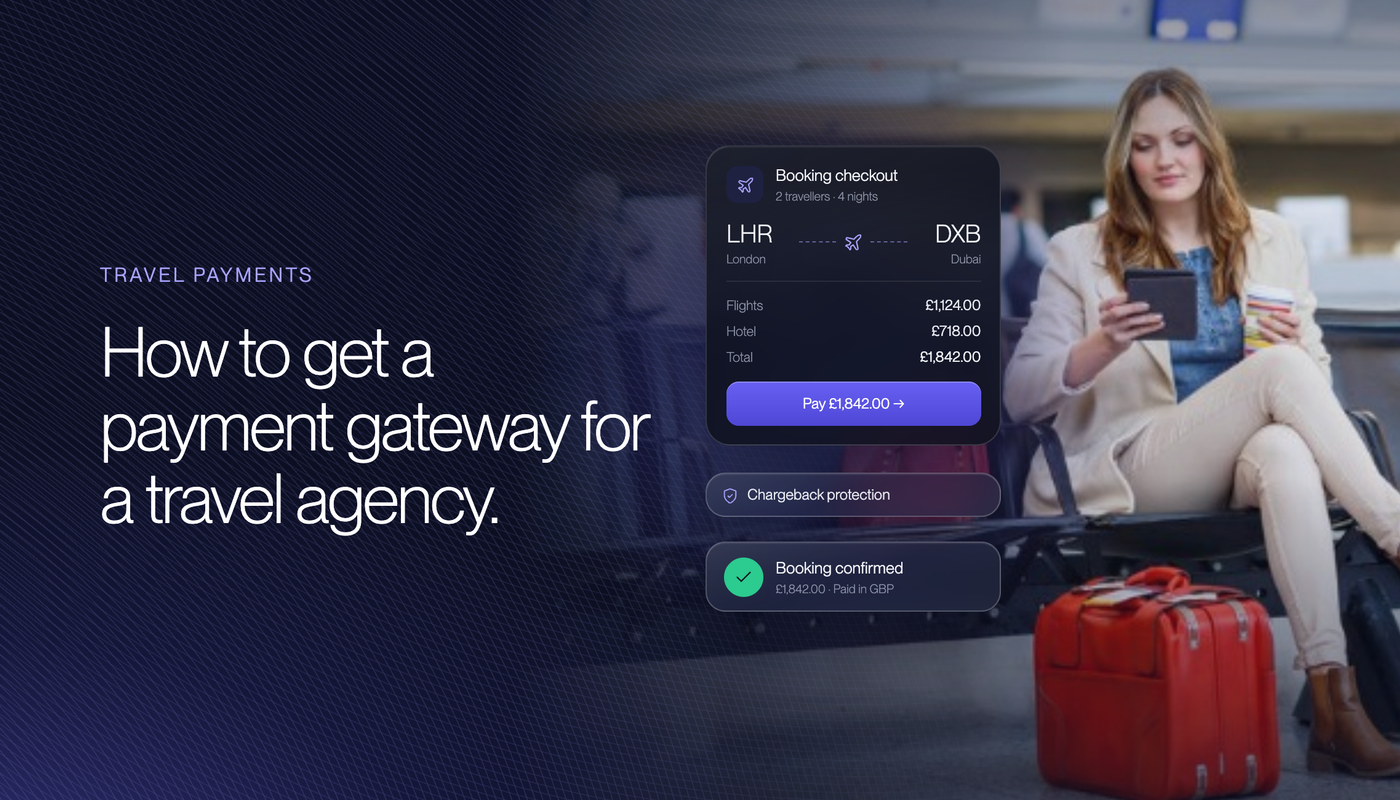
A payment gateway for a travel agency lets you take card payments online, by phone and through payment links. You can take a deposit at booking, collect the balance before departure and price each trip in your customer's currency. More enquiries turn into paid bookings on the day the customer decides.
Getting approved takes more preparation than in most sectors. Your customer pays today for a trip that is months away, so if your business fails, the acquirer can end up refunding every booking not yet travelled. That is why acquirers check your bonding, booking terms and how far ahead you sell, and many hold back part of the money until travel.
Setting it up with us is simple. You fill in one intake form, Binderr Chooses, and we pick a regulated partner that suits your bookings. We prepare the file, from your bond to your booking terms, and take the application through to approval. Most agencies are live within 5 to 7 business days.

What Is a Payment Gateway for a Travel Agency?
A payment gateway for a travel agency is the service that carries a card payment from your booking page, your phone team or a payment link to the bank that processes it, and brings the answer back in seconds. Approved money goes to your merchant account with the acquirer, then on to your business bank account. The basics are in what a payment gateway is, and how a gateway, a merchant account and a processor differ sets out who does what. In travel the technology is standard. What is different is how the acquirer reviews your business, because of when you deliver.
Why Acquirers Watch Travel Closely
Travel is a standard category for the card schemes. Travel agencies and tour operators process under merchant category code 4722, and Visa's list of high integrity risk merchants, which covers businesses such as gambling, adult content and crypto exchanges, does not include them. Acquirers still underwrite travel with care, for one reason: future delivery. A customer who books a summer holiday in January pays months before anything is delivered. If the business fails in between, the customer's card issuer can reclaim the money through a dispute. The acquirer has to pay the issuer, whether or not it can recover the money from you.
Add that up across every booking not yet travelled, and the acquirer's exposure is a large share of a year's sales, not a month's. That is why a travel application is judged on your finances, your insolvency protection and how far ahead you take money, rather than on what you sell. The question an underwriter is really asking is how much it would owe your customers if you stopped trading tomorrow.
Travel Payment Gateway vs Mainstream Processors
Stripe puts travel reservation services and clubs on its restricted list, which means approval first, and it does not accept commercial airlines, cruises or timeshare services at all. PayPal requires pre-approval before a business takes payments for airlines and charter flights. A common pattern is that a small agency opens an all-in-one account in minutes, takes bookings for a season, and is then reviewed once forward bookings build up. The result is often a hold on funds or a closed account just before the busy months. A travel payment gateway set up with an acquirer that has underwritten your business from day one agrees the settlement terms before your first booking, so nothing changes when volume arrives. Both are covered in more detail in what Stripe and PayPal allow.
Start Taking Bookings With a Travel Payment Gateway
We set up card payments for your bookings through a regulated partner that understands future delivery.
- Deposits and balances: take a deposit at booking and the rest before departure.
- Payment links: send a secure link for phone and email bookings.
- Priced in their currency: charge in EUR, GBP, USD and more.
- Travel understood: a partner that underwrites bookings made months ahead.
- Your file prepared: bond, booking terms and company documents in one pack.
- Live within a week: most agencies take payments in 5 to 7 business days.
How a Travel Payment Gateway Handles Future Delivery
Every acquirer that takes on a travel business has to decide how much of its exposure to cover, and how. There are three common tools, and many agreements combine two of them. Which one you get depends on your finances, your protection scheme and your booking pattern. It usually matters more to your cash flow than the processing rate does.
Delayed Settlement Until Travel
With delayed settlement, the acquirer pays out each booking only after the customer travels, or a set number of days after the departure date. It removes most of the acquirer's exposure, and it is a common starting term for a new travel business. The cost is cash flow. If you take EUR 300,000 a month in bookings and customers book four months ahead on average, about EUR 1.2 million of your sales sits with the acquirer at any time once the pattern is steady. Meanwhile hotels, ground handlers and airlines often want paying before the customer travels. That is the opposite of the instant settlement payment gateways retail sellers use, and you need to plan for it.
Rolling Reserves and Collateral
A rolling reserve holds a percentage of each day's sales for a fixed period, then releases it. If your acquirer holds back 10% of sales for 180 days, it has up to EUR 180,000 of yours at EUR 300,000 a month once the reserve is full. A collateral deposit is a lump sum you place with the acquirer at the start, sometimes as a bank guarantee instead of cash. Collateral suits established operators with strong balance sheets, because it leaves daily payouts untouched. The acquirer will ask where that money comes from, with the same source of funds checks any regulated firm runs.
How Your Protection Scheme Changes the Terms
Insolvency protection is what makes the numbers work. If your customers are covered by ATOL, a bond, insurance or a trust account, the scheme is there to pay travellers back if you fail, and the acquirer's real exposure falls. Visa's dispute rules build this in for Europe. When a travel provider is insolvent and the services are covered by a bonding authority or insurance scheme, the cardholder, or the issuer on their behalf, must first try to claim from that scheme unless it is insufficient. The issuer then waits 60 calendar days from the claim before it can raise a dispute. A bonded operator is therefore a very different proposition for an acquirer than one with no protection.
What the Thomas Cook Collapse Showed
Thomas Cook failed on 23 September 2019. The Civil Aviation Authority ran 746 flights to bring more than 140,000 customers home from 54 airports in 18 countries, and the National Audit Office estimated the call on the Air Travel Trust Fund at GBP 481 million. The NAO also noted that, without the government stepping in, credit and debit card providers and travel insurers would have been liable for costs owed to Thomas Cook customers. That is the risk acquirers price when they review a travel business, even a small one.

How to Get a Travel Agency Payment Gateway
Acquirers approve a travel agency payment gateway on six things: a registered company, a business bank account, insolvency protection where the law requires it, clear booking terms, a website that meets card scheme rules and an honest sales profile. The sales profile means your average booking value, how far ahead customers book and when you pay suppliers. Our list of payment gateway requirements gives the general checklist. These are the parts that change for travel.
Licences and Insolvency Protection
In the UK, a business selling flight-inclusive packages needs an ATOL from the Civil Aviation Authority, and pays an ATOL Protection Contribution of GBP 2.50 per passenger into the Air Travel Trust. Packages without flights fall under the Package Travel and Linked Travel Arrangements Regulations 2018, which require insolvency protection through a bond, insurance or a trust account. After a 2025 consultation, the UK made amending regulations in 2026. They remove linked travel arrangements and give organisers a right to refunds from suppliers within 14 days, and the government intends them to apply from 6 April 2027.
In the EU, the Package Travel Directive (EU) 2015/2302 requires package organisers to hold insolvency protection for the payments travellers make. A revised directive, proposed by the European Commission in November 2023, entered into force on 28 May 2026. It extends protection to refunds and vouchers owed before a failure, and member states have 28 months to put it into national law. Acquirers ask for your licence, your bond or trust account details and the policy documents behind them. If you issue airline tickets, your IATA accreditation is part of the file too.
Documents Needed for a Travel Agency Payment Gateway
Expect to provide your certificate of incorporation, articles, register of shareholders, proof of who owns and controls the company, passports and proof of address for each director and owner, and details of the business bank account that will receive payouts. Acquirers run the checks described in merchant onboarding and KYB for payment acquirers. For travel, add your ATOL certificate, bond or trust deed, a list of your main suppliers, your latest filed accounts and a forecast showing sales by month of booking and month of travel. That forecast tells the underwriter more than anything else in the file. If you are starting from scratch, our guides to how to set up a company and how to open a business bank account cover the first two steps.
Booking Terms, Refunds and Cancellations
Your booking terms decide how disputes end, so acquirers read them closely. They look for the deposit amount and whether it is refundable, the date the balance is due, cancellation charges by date, what happens if you cancel, and how fast refunds are paid. Visa lets travel and tourism merchants take the full price in advance, but the terms must state the date the service will be provided. Before you take an advance payment or a deposit, Visa's rules also require the customer's express consent to terms that include the total price, the cancellation and refund policy, and the date after which cancelling means losing the deposit. Vague terms lose disputes.
Website Rules Acquirers Check
Acquirers review your website before they approve you. They look for your company name and country, a full address and contact details, total prices with the currency shown before payment, booking terms and cancellation rules visible at checkout, your ATOL number or protection details where they apply, and card brand logos. Our guide to setting up an online payment gateway covers the card scheme website rules in full. Fix these before you apply, because an underwriter will not sign off a site that hides its terms.
Processing History and Financials
Existing card processing helps. Statements from the last three to six months with few disputes show the acquirer how your customers behave. Filed accounts with positive net assets and cash in the bank carry just as much weight. A new agency is not a barrier on its own. It usually means stricter settlement terms for the first months, reviewed once you have a record of trips delivered and few disputes.
Travel Agency Payment Gateway With the File Prepared
Acquirers approve travel businesses on the file, so we prepare every part of it before submission.
- Protection shown up front: ATOL, bond or trust account evidence ready to review.
- Booking terms checked: deposit, balance and cancellation rules written clearly.
- Checkout fixed: prices, currency, terms and company details before payment.
- Sales profile explained: how far ahead you sell and when suppliers are paid.
- KYB pack built: company, owners and bank details in one clean file.
- Quick first answer: a preliminary decision in about 1 business day.
- No email chains: one contact runs the application for you.
Taking Payments Through a Travel Payment Gateway
Travel payments do not look like retail payments. One booking can mean a deposit, a balance, an amendment fee and a partial refund, paid by different people on different cards, some online and some by phone. A payment gateway for a travel agency has to handle all of it, and how credit card payment gateways work explains what happens to each payment behind the scenes.
Deposits and Balance Payments
Most operators take a deposit at booking and the balance a set number of weeks before departure. There are two ways to collect the balance. You can send a payment link when it is due, or store the card at booking and charge it on the due date. Storing the card needs the customer's express consent to terms that state the amount, the date and how the card will be used, under Visa's stored credential rules. A balance charged that way is a merchant-initiated payment, so the customer does not have to pass 3D Secure a second time. The rules for stored cards are the same ones subscription sellers follow, covered in how subscription payment gateways work.
Payment Links and Phone Bookings
Many travel bookings are made by phone or email, especially tailor-made trips and group bookings. A payment link lets the customer pay on a hosted page, so card numbers never pass through your staff or your systems, and the payment can go through 3D Secure. Taking card numbers over the phone is still allowed as a mail or telephone order, and it falls outside the strong customer authentication rules. But you carry the fraud risk on those payments. A hosted page also keeps your security obligations light, as covered in hosted vs third-party payment gateways.
Multi-Currency Pricing and Settlement
Your costs are often in a different currency from your sales. A UK operator selling Italian villas pays the owners in euros and sells in pounds. A gateway that prices in the customer's currency and settles in more than one currency lets you match income to supplier payments and avoid converting twice. Visa's rules also treat the agency's country as the transaction country for travel it sells, so a UK cardholder booking a Spanish hotel through a UK agency makes a domestic payment. Our guides to how multi-currency payment gateways work and international payment gateways cover currencies and cross-border acquiring.
BSP Airline Tickets vs Your Own Sales
If you are IATA accredited and issue tickets through the Billing and Settlement Plan, or BSP, a card payment for the ticket is processed in the airline's name. The airline is the merchant of record, so a card dispute goes to the airline, which can pass the loss back to you with an agency debit memo. Your own gateway handles everything else: your service fees, hotels, transfers, tours and packages. IATA's guidance says any service fee you charge to the card should be shown to the customer before the ticket is bought. If you buy fares from a consolidator and charge the customer yourself, you are the merchant for the full fare, and the acquirer will count those flights in your exposure.
3D Secure and SCA for Travel Bookings
In the UK and the EEA, online card payments started by the customer need strong customer authentication, which cards handle through 3D Secure. When a payment is authenticated, liability for most fraud disputes moves to the card issuer. Payments sent through an exemption keep that liability with you. In several Asia Pacific markets, including Singapore, Hong Kong, Thailand and Vietnam, Visa requires acquirers to make sure online merchants under MCC 4722 use Visa Secure, its 3D Secure service. The tools are covered in payment gateway security features.
What a Travel Payment Gateway Costs
What a payment gateway for a travel agency costs depends more on your card mix than on the headline rate. Consumer cards issued in the EEA are cheap to accept, because the EU Interchange Fee Regulation (EU) 2015/751 caps interchange at 0.2% for debit and 0.3% for credit. Business, corporate and non-EEA cards are not covered by these caps, and travel sells a lot of them. These are typical market ranges.
Cost item | Typical market range |
|---|---|
EEA consumer cards, flat rate | 1.2% to 1.5% plus a small fixed fee |
Business, corporate and non-EEA cards | Around 2.5% to 3% |
Interchange++ markup | 0.5% to 1% plus a few cents, on top of interchange and scheme fees |
EEA consumer interchange (capped) | 0.2% for debit, 0.3% for credit |
Chargeback fee | 15 to 25 in EUR, GBP or USD per dispute |
Future delivery terms | Delayed settlement, a rolling reserve or a collateral deposit, set per business |
Take a tour operator with 200 bookings a month at EUR 1,500 each, EUR 300,000 in total, with a deposit and a balance on every booking, so 400 card payments. If EUR 210,000 comes in on EEA consumer cards at 1.3% plus EUR 0.20, that costs EUR 2,730 plus EUR 56 in fixed fees, so EUR 2,786. The other EUR 90,000 on business and non-EEA cards at 2.8% plus EUR 0.20 costs EUR 2,520 plus EUR 24, so EUR 2,544. The total is EUR 5,330, or about 1.78% of sales. Notice that the deposit and balance split doubles the fixed fees. The blended rate is the number to compare, and our guide to the best payment gateways shows where Interchange++ overtakes a flat rate as volume grows.
UK Cards and Cross-Border Card Costs
The UK kept the same caps for UK consumer cards used at UK merchants. Cross-border payments are different. Over 2021 and 2022, Visa and Mastercard raised interchange on online payments at UK merchants with cards issued in the EEA from 0.2% to 1.15% for debit and from 0.3% to 1.5% for credit, according to the Payment Systems Regulator, which has been reviewing these fees since. A UK agency selling to EU customers pays that difference. See how to accept international payments online for ways to reduce it.
The Real Cost Is Often Cash Flow
For many travel businesses the settlement terms cost more than the rate. In the example above, delayed settlement until travel on a four month booking window holds about EUR 1.2 million. At 6% a year, funding EUR 1.2 million costs EUR 72,000, more than the EUR 63,960 the same business pays in processing fees over twelve months. Negotiate the settlement terms first and the rate second.
How Long Setup Takes
Our partners work to a set timeline, and a complete file gets most agencies live within 5 to 7 business days. The stages and typical times are below.
Stage | Typical time |
|---|---|
Quick assessment | 5 minutes |
Preliminary approval | 1 day |
Complete onboarding requirements | 15 minutes |
Provision of services | 3 days |
Total | 5 to 7 business days |
A missing bond certificate, a sales forecast without travel dates or booking terms that need rewriting are what push the timeline out. With them ready at the start, the timeline holds.
Payment Gateway for a Travel Agency With Clear Terms
Settlement, reserve and pricing agreed in writing before your first booking, so your cash flow has no surprises.
- Terms in writing: settlement timing and any reserve agreed before launch.
- Card mix priced: consumer, business and non-EEA rates set out clearly.
- Payout dates known: you know when each booking pays out.
- Terms reviewed: settlement can loosen as your record builds.
- Honest numbers: what the delivery terms cost you, before you sign.
Chargebacks and Cancellations in Travel
Travel disputes differ from retail disputes in one way that matters: they can arrive long after the payment. Card scheme rules measure the dispute window from the date the service was due, not only from the payment date.
Not Received Disputes and the 540 Day Limit
Under Visa dispute condition 13.1, Merchandise/Services Not Received, the issuer can raise a dispute up to 120 days from the processing date or 120 days from the last date the customer expected the service, capped at 540 days from processing. A trip paid for on 1 February 2026 and due on 1 October 2026 can be disputed until 29 January 2027, almost a year after you were paid. The customer must first try to resolve it with you, or with your liquidator if the business has failed.
When a Supplier Cancels
For travel agencies and tour operators under MCC 4722, Visa makes the issuer wait 30 calendar days after the service is cancelled before it can raise a not received dispute. That gives you a window to rebook the customer or refund them yourself. The wait does not apply if your business is insolvent. Use those 30 days well. A refund you make yourself costs you the booking. A dispute costs you the booking, a fee and a mark on your dispute ratio.
Customer Cancellations and Your Terms
A customer who cancels and wants a refund your terms do not give has no valid not received dispute, because Visa treats a cancellation before the service date as invalid under condition 13.1. The issuer may try condition 13.7, Cancelled Merchandise/Services, instead. That dispute succeeds when you did not properly disclose a limited cancellation policy at the time of booking, or disclosed one but did not apply it. In Europe, the 14-day distance selling cancellation right does not apply to travel and entertainment transactions under Visa's rules. Clear terms, shown and accepted at booking, are your defence.
Scheme Monitoring Thresholds
Visa's monitoring programme for acquirers counts fraud and disputes together. An online merchant is flagged at 1.5% of transactions with at least 1,500 cases in a month in the US, Canada, Europe and Asia Pacific. Mastercard's excessive chargeback programme begins at 100 chargebacks and a 1.5% ratio in a month. Travel ratios usually look low in a normal month and jump when something goes wrong, such as a supplier failure, a strike or a closed destination. Acquirers plan for the jump, not the average. If an acquirer terminates you for cause, your business can be listed on Mastercard's MATCH list for 5 years, as set out in what the Mastercard MATCH list is.
How to Keep Travel Disputes Low
Set your billing descriptor to the trading name customers booked with, not a holding company name. Send a booking confirmation with the full terms and the balance date, and remind customers before the balance is charged. When a supplier cancels, contact the customer first and offer a new date or a refund before they call their bank. Keep proof of delivery, such as hotel confirmations and e-tickets, for at least 540 days. Fraud screening, covered in payment gateway fraud detection, handles stolen cards, which in travel often show up as last-minute bookings for someone other than the cardholder.
What the Best Payment Gateway for Travel Offers
There is no single best payment gateway for a travel agency, because a coach tour operator, an online hotel agency and a tailor-made specialist need different things. But the best payment gateway for travel businesses has the same six features, whoever provides it. Use them to judge the terms you are offered. For the general points, see what to look for in a payment gateway provider.
Multi-Currency Pricing and Payouts
You should be able to charge customers in their own currency and settle in the currencies you pay suppliers in. Every conversion you avoid saves a currency margin, and customers see exactly what they will pay. The same point runs through our guide to ecommerce payment gateways, where approval rates and checkout friction decide more than the fee.
Settlement Terms Built for Future Delivery
The right settlement terms match your booking pattern. A seller of city breaks booked two weeks ahead can live with settlement after travel. An operator selling next summer's tours in September needs a reserve or collateral instead, or it cannot pay its suppliers. The terms should be in writing, with the conditions for review.
Reserve Terms You Can Plan Around
If there is a reserve, the percentage, the hold period and the review date should all be in the agreement, and the money should release on a fixed schedule. A reserve that can change without notice is a cash flow risk you cannot plan for.
Payment Links and Pay-Later Deposits
Look for payment links for phone and email bookings, stored card balances with the customer's consent, and scheduled balance charges. These features decide how much admin your team does on every booking, and they cut the number of balances paid late.
3D Secure and Local Payment Methods
3D Secure should be built in, with the option to use exemptions where they help. Local methods matter too: iDEAL in the Netherlands, BLIK in Poland, open banking payments in the UK, and wallets such as Apple Pay and Google Pay. For large balances, a bank payment avoids card fees and does not carry card chargeback rights. How eCheck and open banking payment gateways work explains the mechanics. Put together, that is what the best payment gateway for a travel agency looks like, whichever partner runs it.
A Travel Payment Gateway Built for Growth
The best payment gateway for a travel agency still fits after you grow, with new markets and higher volumes on the same setup.
- New currencies: add markets as you grow, on the same account where possible.
- Pay-later deposits: split bookings into a deposit and a scheduled balance.
- Local methods: wallets and bank payments next to cards.
- 3D Secure built in: fewer fraud disputes on online bookings.
- Room to grow: we go back to the partner as your bookings grow.
- Peak season ready: settlement terms that still work in your busiest months.
Common Travel Agency Payment Gateway Mistakes
Each of these mistakes can freeze payouts or close an account, and all of them are avoidable.
Taking Deposits Without Written Terms
A deposit taken without terms that state when it becomes non-refundable is a refund waiting to happen. The customer's issuer will side with the customer if you cannot show what they agreed to.
Understating Your Booking Window
Telling the acquirer that customers book four weeks ahead when they book four months ahead gets you better terms for a few months. Then the acquirer sees the real pattern and changes the terms mid-season, which hurts far more than honest terms at the start.
Running Consolidator Fares Through Your Own Account
Flights charged on your own merchant account put the full fare into your exposure and your dispute ratio. Declare them if you sell them, or keep ticketing inside BSP.
Ignoring the Currency Mismatch
Selling in pounds and paying suppliers in euros through a gateway that settles in one currency means converting twice, and a pricing gap every time the exchange rate moves.
Letting Your Protection Lapse
An expired ATOL, bond or insurance policy changes your risk overnight. Acquirers check renewals, and a lapse can freeze payouts until new cover is in place.
One Application for Your Travel Payment Gateway
Tell us about your business once, and we handle the partner, the paperwork and the application.
- Tell us once: Binderr Chooses reads your business and places you.
- One honest application: travel declared plainly, with your real booking window.
- Right partner for your model: agency, tour operator or package organiser.
- Paperwork done: we collect, check and submit everything.
- Taking bookings soon: most agencies go live in 5 to 7 business days.
Bottom Line
A payment gateway for a travel agency is approved on how well you cover future delivery, not on what you sell. Show your protection, write clear booking terms, give an honest picture of how far ahead you sell, and plan your cash flow around the settlement terms rather than the rate. Do that, and the account stays stable through your busiest season.
Through Binderr Chooses, we handle the setup with a regulated partner that suits your bookings, and most agencies are live within 5 to 7 business days. If you also need a bank account for supplier payments in several currencies, banking for travel and tourism businesses covers that side.