Business cash management services help you get paid faster, pay suppliers on time, keep cash where it is needed and earn on the rest. Done well, corporate cash management cuts bank costs, avoids overdraft interest and turns spare cash into income instead of a balance that just sits still.
The hard part is that banks bundle these services and price them per relationship, and they pay little for what you leave behind. Euro area banks paid companies an average of 0.61% on overnight deposits in August 2026, and the deposit guarantee stops at €100,000 per bank.
This is where we come in. Your bank keeps the payments and collections. For the cash you do not need for months, we introduce you to Sophic, a service of Athlos Capital Investment Services Ltd, a CySEC-regulated investment firm. You choose the instruments and amounts. Sophic executes your orders and holds the investments. We prepare the onboarding with you.
Earn a Market Rate on Spare Business Cash
Keep your bank for daily cash management. Put the cash you do not need soon to work.
- Money market funds: Currently from 2% p.a. before fees, a variable return that can fall.
- Treasury bills: Currently from 2.5% p.a. before fees, repaid at maturity.
- Government bonds: Currently from 3% p.a. before fees, with regular interest.
- Your decision every time: You choose the instruments and amounts, Sophic executes them.
- Setup handled with you: We prepare the onboarding file and check your LEI first.
When investing, your capital is at risk. Yields may vary.

Sophic
Treasury management
Yield
2% to 3%+ p.a
Fees
0.3% a year + €10 per order
Eligibility
EU/EEA businesses with an LEI
When investing, your capital is at risk. Yields may vary.
What Business Cash Management Services Include
Business cash management services cover five jobs: collecting money from customers, paying suppliers and staff, moving cash between accounts so it sits where it is needed, reporting and forecasting balances, and investing surplus cash. Banks provide the first four. The fifth needs an authorised firm, because funds, bills and bonds are securities.
Collections and Receivables
Collections are how money reaches you: card payments, bank transfers, SEPA direct debits and virtual account numbers that match each payment to an invoice. The faster and cleaner the collection, the less cash is stuck in transit. Online sellers usually collect through a gateway first, as our guide to ecommerce payment gateways explains.
Payments and Payables
Payment services send money out: single transfers, bulk payment files for payroll and suppliers, standing orders and card programmes. Good cash management for business pays on the due date rather than early, keeping cash in your account for longer without paying anyone late.
Liquidity Through Sweeps and Pooling
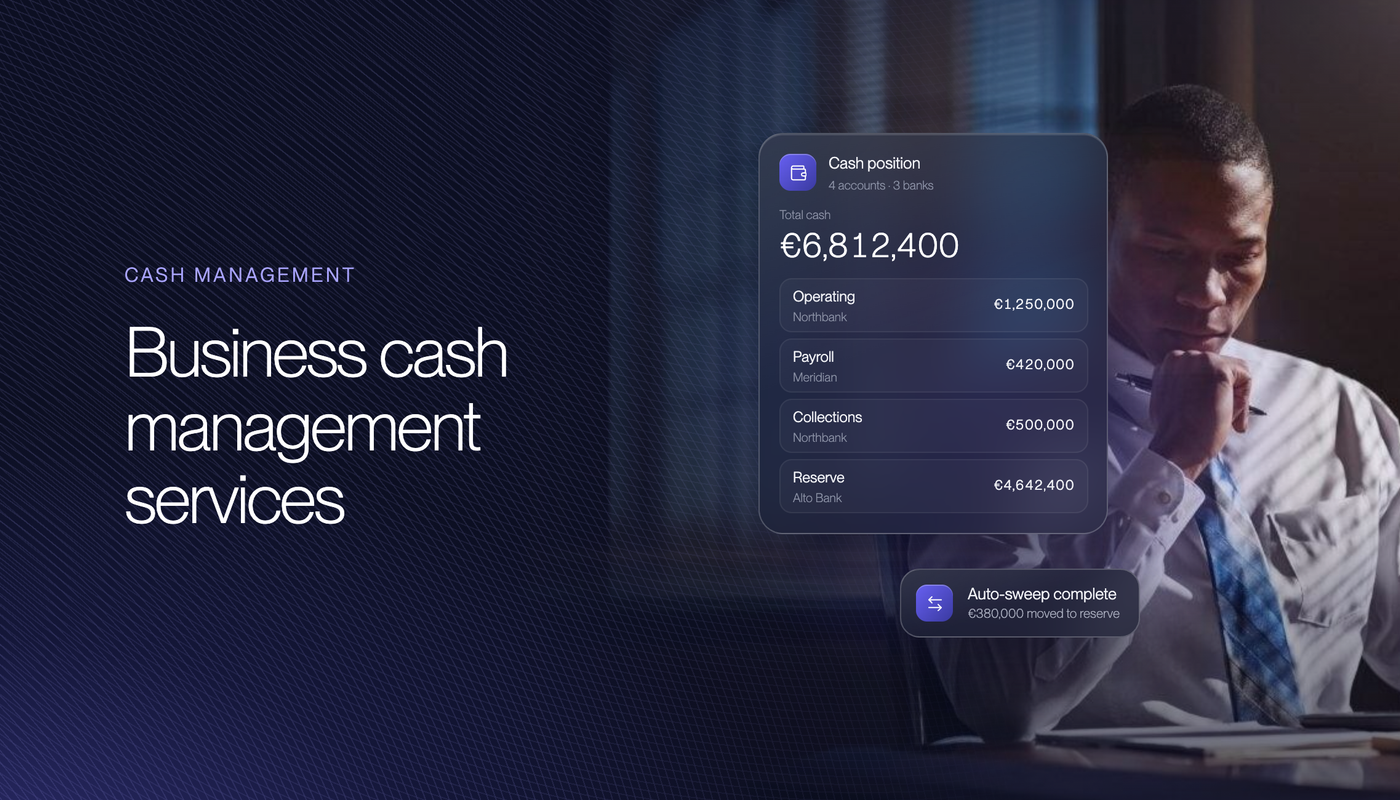
Sweeps and pooling move balances automatically so cash sits where it is needed. A sweep moves money above or below a set level between two accounts. Pooling links the accounts of several group companies. Both save manual transfers and reduce overdraft use.
Reporting and Forecasting
Bank portals show balances and transactions, and most corporate cash management services add daily statements and data feeds for accounting software. A 13-week forecast built on those feeds tells you how much cash has no job and when. Our guide to cash flow management for businesses shows how to build one.
Investing Surplus Cash
The last job is putting surplus cash to work in money market funds, Treasury bills or government bonds. Banks may offer deposits, but funds, bills and bonds are held in a securities account with an authorised firm. This is the part of corporate cash management that Sophic covers.
Cash Management in Corporate Banking
Cash management in corporate banking means the accounts, payment tools, sweeps and pooling a bank sets up around a company's operating cash. Most banks price these services per relationship, with monthly fees, charges per payment or file and FX margins. Interest on balances is usually low unless you ask for a better rate or move cash elsewhere.
Service | What it does | Typical user | How it is priced |
|---|---|---|---|
Corporate cash management account | Main operating account with payment and collection tools | Any company | Monthly fee plus per-transaction charges |
Sweep account | Moves balances above or below a set level between two accounts | Companies with an operating and a reserve account | Monthly or per-sweep fee |
Physical cash pooling | Sweeps each group company's balance into one master account daily | Groups with several companies | Setup and monthly fees, plus intercompany loan records |
Notional pooling | Offsets balances for interest without moving them | Groups banking with one bank | Interest margin and cross-guarantees |
Payment and collection files | Bulk payments, SEPA direct debits, virtual accounts | Companies with many payments | Per file or per item |
Most companies need the first row and nothing else for years. Sweeps and pooling start to pay once you run several accounts or entities. Check every line of the fee schedule before you add a service, because each one adds a monthly charge.
Corporate Cash Management Accounts
A corporate cash management account is the operating account where receipts land and payments leave. It should give same-day payments, direct debit collection, user permissions for staff and a clean data feed into your accounts. Our guide to what a business bank account is covers the basics, and business bank account requirements lists what banks ask for.
Sweeps, Zero Balancing and Notional Pooling
In physical pooling, also called zero balancing, the bank moves each subsidiary's balance into a master account at the end of the day and tops up any that are overdrawn. Each sweep is a loan between group companies, so it needs a written agreement and an interest rate tax authorities accept. In notional pooling the balances stay put, and the bank calculates interest as if they were one account. Groups built on a holding company structure use both.
What Banks Pay on Corporate Cash
The ECB's bank interest rate statistics for August 2026 put the average rate on overnight deposits from companies at 0.61%, and 2.24% on deposits fixed for up to a year. permanent tsb in Ireland pays businesses 0.75% on demand, 1.75% on 32-day notice and 2.25% fixed for 12 months, on rates effective 7 July 2026. Our guide to interest-bearing business accounts covers the options.
Sophic
Treasury management
Yield
2% to 3%+ p.a
Fees
0.3% a year + €10 per order
Eligibility
EU/EEA businesses with an LEI
When investing, your capital is at risk. Yields may vary.
Small Business Cash Management
Small business cash management comes down to four habits: one operating account and one reserve, faster collections, firm terms on late payers and a 13-week forecast. None of them needs special software. Together they keep the business paid on time and show how much cash has no job.
Keep One Operating Account and One Reserve
Run payments and receipts through one operating account and keep a reserve in a second account or instrument. Once operating cash grows well above €100,000, hold it at two banks. A multi-currency business account can be the second one if you trade in several currencies.
Get Paid Faster With Instant Payments and Direct Debits
Since 9 October 2025, euro area payment providers must let customers send instant euro transfers that arrive within 10 seconds, at any hour, and they cannot charge more for them than for a standard transfer (Regulation (EU) 2024/886). For regular customers, a SEPA direct debit collects on the due date. Under the B2B direct debit scheme, the payer has no right to a refund after an authorised collection.
Late Payments Stretch Your Cash
Intrum's European Payment Report 2026 found that about 12% of business revenues are paid late. The Late Payment Directive 2011/7/EU gives you statutory interest of at least 8 percentage points above the reference rate, plus €40 per late invoice. Say so on your invoices.
Forecast 13 Weeks Ahead
A weekly forecast of receipts and payments for the next quarter shows the low points in time to act. It also shows how much cash is spare. Our guide to working capital management covers the inputs, and liquidity management for businesses covers the buffer.
Cash Management Solutions for Small Business Cash
When your forecast shows cash with no job for months, we introduce you to Sophic, where you choose the instruments.
- Eligibility checked first: Country, sector and LEI checked before any paperwork.
- One document list: Everything onboarding needs, asked for once.
- Three currencies: Money market funds in EUR, GBP or USD.
- No lock-in: Sell when you need cash, at the market price.
- Invested in days: Onboarding in about a day, invested 2 to 3 business days later.
When investing, your capital is at risk. Yields may vary.
Corporate Cash Management Solutions for Surplus Cash
Corporate cash management solutions for surplus cash are deposits, money market funds, Treasury bills and government bonds. Deposits are covered up to €100,000 per bank. Funds, bills and bonds pay a market rate with no lock-in, but they are not covered by the deposit guarantee, and their value can move.
Factor | Business savings account | Money market fund | Treasury bills | Government bonds |
|---|---|---|---|---|
Current rate | 0.75% on demand, 2.25% fixed for 12 months (permanent tsb, July 2026) | Currently from 2% p.a. before fees, variable and can fall | Currently from 2.5% p.a. before fees | Currently from 3% p.a. before fees |
Access to cash | Same day, or after the notice period or term | Usually the same day or the next | At maturity, or sold early at the market price | At maturity, or sold early at the market price |
Lock-in | None on demand accounts, yes on fixed terms | None | None, but the price moves if sold early | None, but the price moves if sold early |
Deposit guarantee cover | Up to €100,000 per bank | Not covered | Not covered | Not covered |
Main risk | The bank's balance sheet above €100,000 | Value can fall, rare limits on redemptions | Price change before maturity | Price change before maturity, larger for longer bonds |
The table compares access, lock-in and risk side by side for surplus corporate cash. Fund, bill and bond figures are Sophic's current starting yields, before fees. When investing, your capital is at risk. Yields may vary.
Money Market Funds Usually Pay Out the Same Day or Next
A money market fund holds short-term, high-quality debt and pays a variable return. EU public debt CNAV and LVNAV funds must hold at least 10% of assets maturing daily and 30% weekly (Regulation (EU) 2017/1131). In heavy outflows a fund can charge a fee or limit redemptions. See our guide to money market funds for businesses.
Treasury Bills Repay on a Fixed Date
Treasury bills are short-term government debt, usually 3, 6 or 12 months. You buy below face value and receive the full amount at maturity. French 13-week bills were auctioned at an average rate of 2.750% on 19 October 2026. Our guide to what Treasury bills are explains how they pay.
Government Bonds Pay Regular Interest
Government bonds pay interest on a schedule and repay at maturity, often years out. Their price moves with interest rates, so selling early can mean a gain or a loss.
Sophic
Treasury management
Yield
2% to 3%+ p.a
Fees
0.3% a year + €10 per order
Eligibility
EU/EEA businesses with an LEI
When investing, your capital is at risk. Yields may vary.
Bank Concentration Risk for Corporate Cash
Keeping all corporate cash at one bank is a risk many companies take without noticing. The EU deposit guarantee covers €100,000 per depositor per bank. Anything above that depends on the bank's balance sheet, and modern bank runs can drain a bank in a day.
Deposits Above €100,000 Are Not Fully Protected
The Deposit Guarantee Schemes Directive 2014/49/EU covers deposits up to €100,000 per depositor (Article 6(1)), adding all your accounts and currencies at one bank (Article 7(1)). Ordinary companies qualify, while financial firms, insurers and public authorities do not (Article 5(1)). Covered deposits must be repaid within 7 working days (Article 8(1)).
Companies Lost Access to Cash When SVB Failed
Silicon Valley Bank lost over $40 billion of deposits on 9 March 2023, according to the Federal Reserve's review, and was closed on 10 March. About 94% of its deposits were uninsured at the end of 2022. Roku told the SEC that about 26% of its cash was there. Depositors reached their money only after a one-off decision by US authorities on 12 March.
Set a Limit Per Bank
Write a limit per bank into your cash policy, for example the guarantee amount plus one month of operating cash. Keep operating cash at two banks, so a frozen account does not stop payroll. Opening a second account is quicker than most expect, as our guide to business bank accounts in Ireland for new companies shows.
How Sophic Fits Into Your Cash Management
Sophic is the investing step in your cash management. Your bank keeps collections, payments and sweeps. When the forecast shows cash you will not need for months, we introduce you to Sophic, where you choose instruments that match those dates. Sophic executes your orders and holds the investments.
What You Can Hold With Sophic
Money market funds in EUR, GBP and USD are currently from 2% p.a. before fees, with a variable return that can fall. Treasury bills from the EU, Germany, France, Cyprus, the UK and the US are currently from 2.5% p.a. before fees. Government bonds are currently from 3% p.a. before fees. Yields may vary. There is no lock-in period.
How Your Investments Are Held
With Sophic, client cash is held in segregated accounts at J.P. Morgan and investments are safeguarded by SIX Group. Bills and bonds are claims on the issuing government, so repayment depends on that government rather than on a single bank's balance sheet. Sophic does not manage a portfolio for you: the choices are yours.
Who Can Use It
Sophic onboards businesses incorporated in Cyprus, Austria, Belgium, Bulgaria, Estonia, France, Germany, Greece, Ireland, Italy, Luxembourg, Portugal, Slovenia, Spain and Switzerland. Companies also need an active LEI, proof of legal existence and a sector Sophic accepts. Companies banking in Germany can see our guide to a business bank account in Germany for the operating side.
Read more: How Sophic works for businesses.
Corporate Cash Management Services for Surplus Cash
For eligible companies with cash that has no job for months. We introduce you to Sophic, where you decide how to split cash between funds, bills and bonds. Sophic executes your orders and holds the investments.
- Fund returns: Money market funds currently from 2% p.a. before fees, variable.
- Bill returns: Treasury bills currently from 2.5% p.a. before fees.
- Bond returns: Government bonds currently from 3% p.a. before fees.
- Segregated client cash: Held in segregated accounts at J.P. Morgan.
- Safeguarded investments: Safeguarded by SIX Group.
- One contact: We stay with you until onboarding is complete.
When investing, your capital is at risk. Yields may vary.
What Business Cash Management Services Cost
Business cash management services cost money in fees and in lost return. Bank services carry monthly account fees, charges per payment or file and FX margins. Investing carries a yearly fee on the invested balance, order fees, fund charges and dealer spreads. The rate gap on idle cash is often the largest cost of all.
Bank Charges
Expect a monthly account fee, a charge per payment or per file, fees for direct debit collection, card charges and FX margins on currency payments. Sweeps and pooling add their own fees. Ask for the full schedule in writing. Our guides to business bank account fees and free business bank accounts cover the usual lines.
The Rate Gap on Idle Cash
In August 2026, euro area banks charged companies an average of 3.92% on revolving loans and overdrafts while paying 0.61% on overnight deposits. The ECB paid banks 2.25% on overnight money that month, rising to 2.50% from 16 September. Cash left in a current account earns a small share of that.
Investing Costs
Investing usually carries a yearly percentage of the invested balance and a fixed fee per order. Money market funds have their own ongoing charges, and bills and bonds carry a dealer spread. The card on this page shows Sophic's fees. Bills and bonds also need an LEI, which has a yearly renewal fee.
Sophic
Treasury management
Yield
2% to 3%+ p.a
Fees
0.3% a year + €10 per order
Eligibility
EU/EEA businesses with an LEI
When investing, your capital is at risk. Yields may vary.
Common Cash Management Mistakes
Most cash management mistakes come from habits nobody revisits. Companies pay suppliers early, chase late payers too gently, keep everything at one bank and leave spare cash on the bank's rate. Each one costs money or access, and each one is easy to fix with a short policy and a quarterly review.
Paying Suppliers Early
Paying on the day an invoice arrives feels tidy, but it hands your cash to the supplier days or weeks before you need to. Pay on the agreed due date, using scheduled payments, unless the supplier offers a discount for paying early that is worth more than the return on that cash.
Chasing Late Payers Too Gently
With about 12% of business revenues paid late, a soft approach to late payers ties up working capital. Put your terms and the statutory interest under Directive 2011/7/EU on every invoice, send reminders on fixed days and move regular customers to direct debit.
Keeping Everything at One Bank
One account is simple, but every euro above €100,000 depends on that bank. Spread operating cash across two banks and hold spare cash in instruments kept in custody. Groups can add a Malta business bank account or another EU account to split risk.
Leaving Spare Cash on the Bank's Rate
Spare cash in a current account earns close to nothing while the same money in short-dated government debt earns a market rate. Review balances every quarter, move cash above your operating line and reserve, and start the LEI and onboarding before the cash piles up. Our guide to idle cash shows how to size it.
Bottom Line
Business cash management services keep money moving: collections in, payments out, cash in the right account. Banks do that part well but pay little on what you leave behind. Set a limit per bank, forecast 13 weeks ahead and move spare cash into instruments that repay before you need it. For the wider picture, see business treasury management, what cash management is and cash management vs treasury management.
What are business cash management services?
What is corporate cash management?
What is cash management in corporate banking?
What is a corporate cash management account?
What cash management solutions suit a small business?
What is a sweep account?
What is cash pooling?
How do instant payments help cash management?
How much do business cash management services cost?
What should a business do with surplus cash?
Is business cash above €100,000 protected?
What is the difference between cash management and treasury management?
Can a company invest cash without a treasury team?
Sources
- European Central Bank, Key ECB interest rates (checked 20 October 2026)
- European Central Bank, Euro area bank interest rate statistics, August 2026 (released 1 October 2026)
- European Central Bank Data Portal, Revolving loans and overdrafts to corporations, new business, August 2026
- permanent tsb, Non-personal deposit interest rates effective 7 July 2026
- Regulation (EU) 2024/886 on instant credit transfers in euro, EUR-Lex
- Directive 2011/7/EU on combating late payment in commercial transactions, EUR-Lex
- Intrum, European Payment Report 2026 (published 21 April 2026)
- Agence France Trésor, Latest auction results, BTF auction of 19 October 2026
- Regulation (EU) 2017/1131 on money market funds, EUR-Lex
- Directive 2014/49/EU on deposit guarantee schemes, EUR-Lex
- Board of Governors of the Federal Reserve System, Review of the Federal Reserve's Supervision and Regulation of Silicon Valley Bank (28 April 2023)
- Roku, Inc., Form 8-K filed 10 March 2023, SEC
- Joint Statement by the US Treasury, Federal Reserve and FDIC (12 March 2023)
Binderr is not an investment provider or adviser. We connect businesses with regulated investment providers and help with the setup. Every investment is made under the provider's own terms, fees and risk disclosures, which you review and accept directly with them, and the decision to invest is yours. Binderr is not responsible for investment performance or for any loss. This article is general information, not investment, tax or legal advice, and figures can change after the time of writing. When investing, your capital is at risk. Yields may vary.