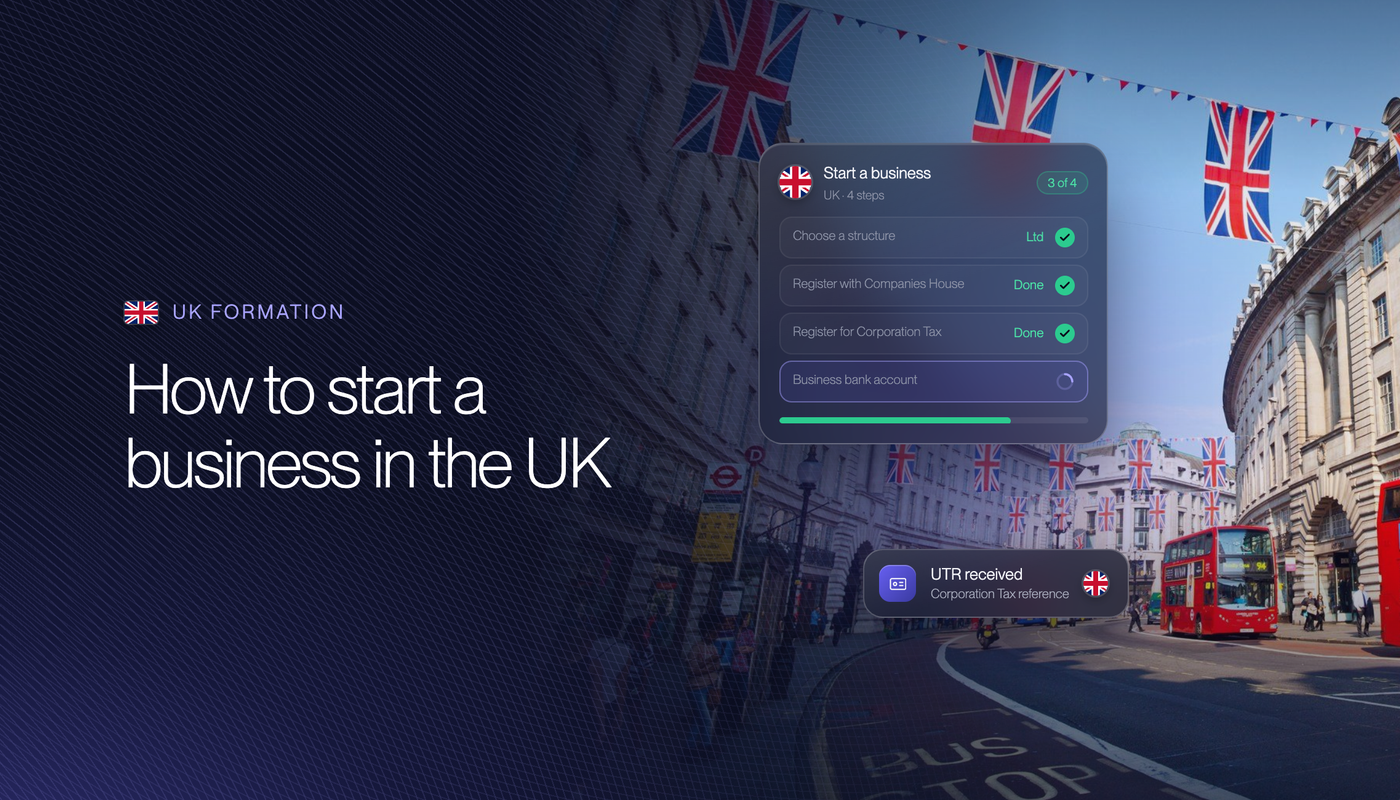
If you are working out how to start a business in the UK, a private limited company is the quickest and cheapest first step. Companies House normally registers an online application within a day, there is no capital to pay in, and profits up to £50,000 are taxed at 19%. One person from any country can own all of it.
The harder part is the admin around the filing. Every director must pass an identity check before the company is filed. After that, many UK banks want someone on the account who lives in the UK, and the HMRC registrations, insurance and filing dates all start in year one.
With us, the setup is simple. We form the company ourselves and handle the name check, each identity check, the articles, the filing and the HMRC registrations. The same documents become the bank file for our partners. Our price starts from €350 with the £100 Companies House fee included, and your company is ready in about a week.
UK Company Incorporation
Binderr
Corporate tax
19% (small profits) / 25% (main rate)
Time to Incorporate
1 Week
Cost
€350 (no pre-payment)
Why Start a Business in the UK
Founders start a business in the UK for low setup costs, a 19% tax rate on small profits and a company form that clients and banks trust.
Low Start-Up Costs and No Minimum Capital
An online application at Companies House has cost £100 since the fee change of 1 February 2026, and a paper one £124. A single £1 share is enough to start, and you do not need a company secretary.
19% Corporation Tax on Small Profits
Companies pay 19% Corporation Tax on profits up to £50,000 and 25% above £250,000, with marginal relief in between. A sole trader pays 40% Income Tax on profit above £50,270, plus National Insurance. Profit kept in the company to grow the business is taxed only at the company rate.
Start a UK Business in About a Week
A UK limited company is quick to form and cheap to keep.
- Small profits rate: 19% Corporation Tax on company profits up to £50,000.
- Owned from anywhere: One founder from any country can own and run it.
- Nothing to deposit: No minimum capital, so a single £1 share is enough.
- Checkable by clients: Every UK company sits on the public Companies House register.
- Online in a day: Most online applications are registered within 24 hours.
- Formed by our team: From €350, the £100 Companies House fee included, ready in about a week.
Personal Assets Protected by Limited Liability
A limited company is a separate legal person. GOV.UK explains that company owners are responsible for business debts only up to the value of their investment, while a sole trader is responsible for all of them. Your home and savings stay outside the company's debts, unless you sign a personal guarantee.
Open to Founders Who Live Anywhere
There is no UK residence rule for directors. A single founder can own all the shares and act as sole director, and the checks and signatures all run online, so you can set up a company as a non-resident from home.
Read more: the benefits of setting up a company in the UK.
Choosing a Limited Company to Start Your Own Business
To start your own business in the UK, you choose between trading as a sole trader and forming a private limited company. For founders who plan to grow, hire, sign larger contracts or run the business from abroad, the company is the right route, and it is the one we set up.
A sole trader carries every business debt personally, while a company keeps its debts separate. Our guide on how to register a business in the UK compares every structure, including partnerships and LLPs.
Trading as a sole trader can work for a UK resident trying out a small idea. Our sole trader vs limited company guide weighs the two, and the UK company registration guide sets out each Companies House rule.
UK Company Incorporation
Binderr
Corporate tax
19% (small profits) / 25% (main rate)
Time to Incorporate
1 Week
Cost
€350 (no pre-payment)
How to Start a Business in the UK Step by Step
Starting a UK business as a company follows a clear order: plan the setup, choose the name, verify each director, form the company, open the bank account, register with HMRC, then arrange insurance, licences and records. We handle the formation steps and prepare the rest with you.
Plan Your UK Business Before You File
Decide three things first. The activity sets the SIC code, a five-digit code for what the company does. The owners decide who is a person with significant control, meaning anyone with more than 25% of the shares or votes. Where the directors make decisions affects tax residence.
Choose and Check Your Business Name
The name must usually end in "Limited" or "Ltd" and cannot be the same as a name on the register, even if it differs only by punctuation. Sensitive words need permission. A name too like an older company's name or a trade mark may have to change after a complaint, so check the trade mark register first. See how to check company name availability in the UK.
We Guide Each Identity Check
Since 18 November 2025, identity verification has been a legal requirement for every director and person with significant control. Each director's personal code goes into the application itself, and a PSC gives theirs at filing or within 14 days. The check usually runs online through GOV.UK One Login, which accepts a biometric passport from any country.
We Form Your Limited Company
Our team drafts the application: the model articles, the statement of capital, the SIC code, the registered office and email, the lawful purpose statement and the details of every director, shareholder and PSC. We then register the company online and pay the £100 fee from our price. Registration usually takes under 24 hours, and HMRC normally sets up Corporation Tax from the same filing.
Read more: how to set up a limited company in the UK.
Full-Service Company Setup in the UK
We prepare, check and file every document, so your company is formed right first time.
- Name cleared first: Checked against the register and the sensitive word rules.
- Identity codes ready: Every director and PSC verified before we file.
- UK address arranged: A registered office in the right part of the UK.
- No travel needed: Checks and signatures happen online from your own country.
- Bank file included: Built from the same KYC pack on formation day.
Business Banking When You Start a UK Business
When you start a UK business as a company, it needs its own account from the first invoice. High street banks are cheap for UK residents but set residence rules. Our banking partners open multi-currency accounts remotely within days for owners anywhere, and we prepare the file.
UK Banks and Their Residence Rules
Starling charges no monthly fee, yet it asks for UK residence from each PSC and from each director who uses the account, and it turns away companies with corporate shareholders. Barclays waives its fee for the first 12 months on its start-up offer, then charges £8.50 a month, with transaction charges on top. Santander gives start-ups a year free on its Classic account, then charges £9.99 a month, and it asks whether the owners and directors are UK residents. NatWest asks for at least one UK resident on the application. Banks rarely say why they refuse, but most reasons can be fixed before you apply, as our guide on why banks reject business account applications shows.
Our Banking Partners for New UK Companies
Our banking partners are regulated payment institutions and electronic money institutions, not banks. They accept companies whose owners and directors live in any country, run every check online and open a multi-currency account within days. We turn your formation KYC pack into their application and make the introduction. Plans cost about €30 to €100 a month. See how a business bank account and an EMI account differ.
Factor | UK high street banks | Our banking partners |
|---|---|---|
Who can apply | At least one UK resident, sometimes everyone | Owners and directors in any country |
Monthly fee | £0 to £9.99 at Starling, Barclays and Santander | About €30 to €100 on a published plan |
Currencies | Mainly sterling | Several currencies in one account |
A UK resident trading only in sterling is often fine with a high street account. Founders abroad, or companies trading in several currencies, open faster with our partners.
Read more: how to open a UK business bank account.

Equals Money
Business Bank Account
Time to onboard
2 Days
Account opening fee
Free
Monthly fee
€30

3S Money
Cross-border payments
Time to onboard
4 Days
Account opening fee
Free
Monthly fee
Starting from € 100
Registering for Corporation Tax, VAT and PAYE
A new company registers with HMRC for up to three taxes. Corporation Tax applies to every company, VAT applies once taxable turnover passes £90,000 or earlier by choice, and PAYE starts with the first salary. Each has a clear trigger and deadline, so all three are easy to plan from the start.
Corporation Tax From Formation
HMRC expects a company to register for Corporation Tax within 3 months of starting to do business, and most companies do it in the same Companies House application. The £50,000 and £250,000 limits are divided by the number of associated companies. The tax falls due 9 months and 1 day after the end of the accounting period, and the return 12 months after it. Read about the tax benefits of setting up a limited company.
VAT Registration and the £90,000 Threshold
A company must register for VAT when taxable turnover passes £90,000 in any 12 months, or is expected to pass it in the next 30 days alone. A company selling to other businesses often registers early to reclaim VAT on its costs. One selling to consumers usually waits, because it must then add 20% to most sales. See how to register for VAT in the UK.
PAYE When You Pay Salaries
PAYE registration comes before the first payday, and no more than 2 months before it. It applies even when the only person on the payroll is you as director. For 2026 to 2027, employer National Insurance is 15% of each salary above £5,000 a year, and pension duties begin on the first employee's start date. Our partners run payroll services in the UK from the first payday.
Tax Registrations for a New UK Company
When you start a business in the UK with us, we set up the tax side with the company, so nothing is late.
- Corporation Tax from formation: Set up with the company, inside the 3-month window.
- VAT at the right time: At £90,000, or earlier when reclaiming VAT helps you.
- Payroll before payday: PAYE in place before the first salary, including yours.
- Filing dates on record: Accounts, tax return and confirmation statement dates set.
- One point of contact: One team from your first message to the open account.
Insurance, Licences and Data Protection Rules
Three more rules apply to many new companies: employer's liability insurance once you hire, a licence for some activities and the ICO data protection fee. Each is quick to sort before you trade, and none of them delays the formation.
Employer's Liability Insurance
You need employer's liability insurance as soon as you become an employer, with cover of at least £5 million from an authorised insurer. The fine is £2,500 for every day without it. A company whose only employee is an owner with 50% or more of the shares is exempt.
Licences for Regulated Activities
Most new companies trade without a licence. The regulated exceptions are payments, e-money, consumer credit and crypto, which need FCA permission, and gambling, which needs a Gambling Commission licence. Food businesses, including home and online ones, register with the local authority at least 28 days before they trade. The company comes first and the application follows, as our guide on how to get an FCA licence in the UK explains.
The ICO Data Protection Fee
A company that uses personal information, such as customer emails or staff records, pays a yearly data protection fee to the Information Commissioner's Office unless it is exempt. Most small companies pay £52 or £78 under the fees in force since 17 February 2025, within 21 days of first using personal data.
UK Company Incorporation
Binderr
Corporate tax
19% (small profits) / 25% (main rate)
Time to Incorporate
1 Week
Cost
€350 (no pre-payment)
First-Year Calendar After Starting a UK Business
A new UK company has a short list of fixed dates in its first two years. Companies House dates follow the incorporation date, HMRC dates follow the accounting period, and the rest start with an event such as the first salary.
When | What is due |
|---|---|
At filing | Identity check for each director, and for each PSC within 14 days at the latest |
Within 3 months of starting to do business | Corporation Tax registration, usually at formation |
Within 21 days of first using personal data | ICO data protection fee, £52 or £78 for most |
Before the first payday | PAYE registration with HMRC |
From the first employee's start date | Employer's liability insurance and pension duties |
Within 30 days of the end of the month you pass £90,000 | VAT registration |
Within 14 days after the first 12 months | Confirmation statement, £50 online |
9 months and 1 day after the period ends | Corporation Tax payment |
21 months after incorporation | First annual accounts at Companies House |
12 months after the period ends | Company Tax Return to HMRC |
Each of these dates has a fine attached. Late accounts cost £150 to £1,500, doubled if late two years running, and a missed confirmation statement can mean a fine of up to £5,000 and strike-off. We set these dates with you at formation. See how to file a confirmation statement in the UK.
Bookkeeping and Making Tax Digital for Companies
A company keeps accounting records from its first transaction and holds them for 6 years after the financial year they cover. The records show all money in and out, what the company owns and owes, and its sales and purchases. HMRC can fine a company £3,000 for not keeping them. On formation day we hand over the company documents and the filing dates, and our partners can keep the books from the first transaction through our bookkeeping services in the UK.
Making Tax Digital covers a company's VAT returns once it is VAT registered, with digital records and returns filed through compatible software. The Income Tax version is for sole traders and landlords. HMRC's Transformation Roadmap of July 2025 states that it does not intend to bring in Making Tax Digital for Corporation Tax. Good records also make cash flow management easier in year one.
UK Company Incorporation
Binderr
Corporate tax
19% (small profits) / 25% (main rate)
Time to Incorporate
1 Week
Cost
€350 (no pre-payment)
Costs of Starting a Business in the UK
With us, the costs of starting a business in the UK as a limited company begin from €350, and that already covers the £100 Companies House fee. For a simple company, plan about €2,000 to €5,000 for the first year once the registered office, accounting, yearly filings and a business account are added.
That price is for a standard private company limited by shares, used to trade or to hold assets. For it, we advise on the structure, check the name, guide each identity check and build your KYC pack. We also draft the model articles and the statement of capital, file the first PSC details, pay the £100 Companies House fee and prepare the bank file. Trusts, foundations, funds, regulated and high-risk structures get their own quote.
Cost item | When it is paid | Typical amount | What it covers |
|---|---|---|---|
Company incorporation with Binderr, all of the above included | Once, before filing | From €350 | Formation, the £100 filing, the KYC pack and the bank file |
Registered office service | Yearly, if you have no UK address | Quoted with your setup | A UK address for official post |
Confirmation statement | Every 12 months | £50 online | The yearly check of company details |
ICO data protection fee | Yearly, if you use personal data | £52 or £78 for most small companies | Registration with the ICO |
Accounts and Company Tax Return | Yearly | About £1,000 to £2,500, as a planning range | Accounts and the return for HMRC |
Business account with our banking partners | Monthly | About €30 to €100 on a published plan | A multi-currency account |
Realistic first-year total | Year one | About €2,000 to €5,000 for a simple company | Our price, filings, accounting and an account |
Accounting and the bank plan move this total most, and VAT, payroll and insurance add to it once you trade and hire. Set the figures against company formation costs by country.
Year-One Costs by Type of UK Company
Type of company | Year-one estimate | Main cost drivers |
|---|---|---|
Consultant or freelancer working alone in the UK | About €2,000 to €4,500 | Simple accounts, filings and a basic account |
Founder living outside the UK | About €2,200 to €5,000 | Registered office service and a multi-currency account |
Company that only holds investments | About €2,000 to €4,000 | Light accounts, no VAT or payroll |
Shop or agency with VAT and staff | About €3,000 to €5,500 | Bookkeeping, VAT returns, payroll and insurance |
Regulated or high-risk business | Quoted separately | Licence, capital rules and specialist banking |
Treat these ranges as a planning guide, with pounds converted to euros at recent rates. The written quote we send you is the number to rely on.
Read more: the full cost of setting up a UK company.
Start a Business in the UK From €350
Our price for a standard limited company starts from €350, Companies House fee inside.
- Fee inside the price: The £100 Companies House filing is never billed on top.
- Quote in writing: You see the full price before you pay anything.
- Ready in about a week: From a complete file to a registered company.
- Year-one estimate: About €2,000 to €5,000 for a simple company, with running costs.
- Special cases priced: Trusts, regulated and high-risk setups are quoted separately.
How to Open a Business in the UK From Abroad
You can open a business in the UK from any country. A non-resident can own 100% of a UK limited company and be its only director, and owning it needs no visa. Plan three things early: the identity check, a UK registered office and a bank account that accepts owners abroad.
The identity check runs online through GOV.UK One Login with a biometric passport from any country. The registered office must be a physical address in the same part of the UK as the company, never a PO box, and we arrange one with your setup. Our partners open the bank account for owners abroad.
A UK company does not come with a right to live or work in the UK. Tax residence can follow the place where the board makes its decisions, as our guide on whether you can run a UK business from Dubai shows. For a company managed from abroad, read up on UK VAT registration for non-resident companies before the first sale.
Read more: UK company formation for non-residents.
UK vs Ireland, Malta and Cyprus
The UK is the lowest-cost place to start a company with us, from €350, but it is outside the EU. Ireland suits EU trading companies, Malta suits holding structures that use its shareholder refunds, and Cyprus suits EU holding companies at a flat 15%. We form companies in all four.
Factor | UK | Ireland | Malta | Cyprus |
|---|---|---|---|---|
Company tax | 19% up to £50,000, 25% above £250,000 | 12.5% trading, 25% non-trading | 35% headline, about 5% effective after the 6/7ths refund | 15% from 1 January 2026 |
Standard VAT | 20% | 23% | 18% | 19% |
In the EU | No | Yes | Yes | Yes |
Known for | Low start-up cost | EU trading companies | Holding and trading structures | EU holding companies |
Our price | From €350 | From €1,899 | From €1,299 | From €1,200 |
Time with us | About 1 week | About 1 week | About 1 week | About 1 week |
Pick the UK for UK customers and the lowest cost, and an EU country when clients or a licence need an EU company.
UK vs Ireland
Ireland taxes trading profit at 12.5% inside the EU, but it needs a director resident in the European Economic Area or a €25,000 bond under section 137 of the Companies Act 2014. A UK company has no residence rule for directors. Read how to set up a company in Ireland.
Ireland Company Incorporation
Binderr
Corporate tax
12.5% trading / 25% non-trading income
Time to Incorporate
1 Week
Cost
€1,899
UK vs Malta
Malta charges 35% company tax, then refunds six sevenths of it to shareholders after a dividend, for an effective rate of about 5%. It needs share capital of at least €1,164.69 with 20% paid up, against one £1 share in the UK, and it suits holding and EU trading structures. See how to start a business in Malta.

Malta Company Incorporation
GCS Malta
Effective tax
~5% for non-resident
Time to Incorporate
1 Week
Cost
Starting from €1,299
UK vs Cyprus
Cyprus charges a flat 15% company tax from 1 January 2026, below both UK rates. Cyprus companies generally file audited accounts, so they cost more to run each year. Cyprus suits EU holding companies, as our guide on how to start a business in Cyprus explains.

Cyprus Company Incorporation
Binderr
Corporate tax
15% flat
Time to Incorporate
1 Week
Cost
€1,200 one-off
Who Should Not Start a UK Business
Starting a business in the UK as a company is wrong for founders who need an EU company, a licence before any trading, private records or only a small side income. For each of them, another structure or country saves time or money.
Some clients only contract with an EU company, so read our Ireland vs UK corporation tax comparison first. A payments, crypto or gambling business needs its licence before trading, and the licence takes far longer than the company. If privacy matters most, note that the public register shows directors' names, PSCs and accounts. With £1,000 or less a year from a side activity, the trading allowance means you generally need no registration, so a company only adds cost.
Common Mistakes When Starting a Business in the UK
Most problems when starting a business in the UK come after the company is formed, not at Companies House. Three of them come up again and again, and each one is easy to avoid with a plan.
Leaving the Bank Account Until Last
Many founders form the company, start invoicing and only then apply for an account. Starling, Santander and NatWest all set UK residence rules, so a founder abroad can lose weeks while client payments land in personal accounts. That mixes company and personal money, which makes the first accounts slower and more expensive to prepare. Plan the account together with the company instead. We build the bank file from the same KYC pack, and our partners can open the account days after the certificate arrives.
Hiring Before Insurance and Payroll Are Ready
A first hire often happens in a hurry, before the paperwork is ready. Without employer's liability insurance, the company can be fined £2,500 for each day without cover. PAYE must be registered before the first payday, and workplace pension duties start on the employee's first day. Sort all three in the weeks before the start date: buy the insurance, register as an employer and choose a pension scheme. Our partners can run payroll from the first month.
Missing the First Filing Dates
The first accounts are due 21 months after incorporation, a date that is easy to lose track of. Filing late costs £150 to £1,500, doubled if the accounts are late again the next year. HMRC adds £200 for a Company Tax Return one day late, and a missed confirmation statement can lead to strike-off. We put every date on your calendar on formation day, and our partners can prepare the accounts and the return well before each deadline. Our guide to company formation mistakes to avoid lists more.
Start Your Own Business in the UK With a Custom Setup
Some plans need more than a standard company. Send us your details for the right setup and a clear price.
- Sole trader to company: Contracts, invoices and VAT moved across properly.
- Several founders: Shares, PSC details and voting rights set out from the start.
- Holding structures: A UK holding company above your trading company, documented.
- Licence planning: The FCA or Gambling Commission steps set out before you trade.
- Founders moving abroad: Where the board meets and how that affects tax residence.
Bottom Line
Starting a business in the UK is quick when you follow the right order. Form a limited company, open its account, register with HMRC, then sort insurance, licences, the ICO fee and your records. Companies House usually registers an online application within 24 hours, and profits up to £50,000 pay 19% Corporation Tax.
Plan for the 2025 and 2026 rules: identity checks before filing, the £100 fee, the £50 confirmation statement and a £200 penalty for a late tax return.
We form the limited company ourselves, from €350 with the £100 Companies House fee inside the price. One team handles each identity check, the filing, the HMRC setup and the bank file for our partners, all remotely, in about a week. Begin with our UK Ltd formation service.
How do I start a business in the UK?
How much does it cost to start a business in the UK?
How to start a small business in the UK with little money?
Can I open a business in the UK from abroad?
How long does it take to start a business in the UK?
Do I need a separate business bank account for a limited company?
When does a new UK company have to register for VAT?
Do I need employer's liability insurance for my limited company?
Does my company need to pay the ICO data protection fee?
Does Making Tax Digital apply to limited companies?
What taxes does a new limited company pay in the UK?
Should I start my own business in the UK as a sole trader or a company?
Do I need an accountant to start a business in the UK?
Sources
- Companies House, Companies House fees (updated 25 September 2026)
- GOV.UK, Register your company (2026)
- GOV.UK, Choose a company name (2026)
- GOV.UK, Directors and company secretaries (2026)
- GOV.UK, Registered office and email address rules (2026)
- Companies House, Verify your identity (updated 30 April 2026)
- Companies House, When you need to verify your identity (2026)
- GOV.UK, Business legal structures (2026)
- HMRC, Tax-free allowances on trading income
- HMRC, Corporation Tax rates and reliefs (2026)
- NI Business Info, Register for Corporation Tax (2026)
- HMRC, Company Tax Return late filing penalties (2026)
- HMRC, Register for VAT (2026)
- HMRC, Making Tax Digital for VAT (updated 30 October 2024)
- HMRC, Overview of Making Tax Digital (updated 24 August 2026)
- HMRC, Transformation Roadmap, section 5.2 (21 July 2025)
- HMRC, Register as an employer (2026)
- HMRC, Rates and thresholds for employers 2026 to 2027
- HMRC, Tax on dividends 2026 to 2027
- HMRC, Income Tax rates 2026 to 2027
- The Pensions Regulator, Duties for new employers (2026)
- GOV.UK, Employers' liability insurance (2026)
- Health and Safety Executive, Employers' liability insurance, a brief guide for employers (HSE40)
- ICO, Data protection fee tiers (2025)
- The Data Protection (Charges and Information) (Amendment) Regulations 2025, SI 2025/63
- The Data Protection (Charges and Information) Regulations 2018, regulation 2
- GOV.UK, Company and accounting records (2026)
- GOV.UK, Food business registration (updated 25 June 2026)
- GOV.UK, Confirmation statement (2026)
- GOV.UK, Penalties for late filing of annual accounts (2026)
- Starling Bank, Business account eligibility (2026)
- Barclays, Start-up business account (2026)
- Santander UK, Opening a business current account (2026)
- NatWest, Business current account (2026)
- Companies Registration Office Ireland, Information Leaflet 17
- PwC, Cyprus corporate taxes on income (2026)