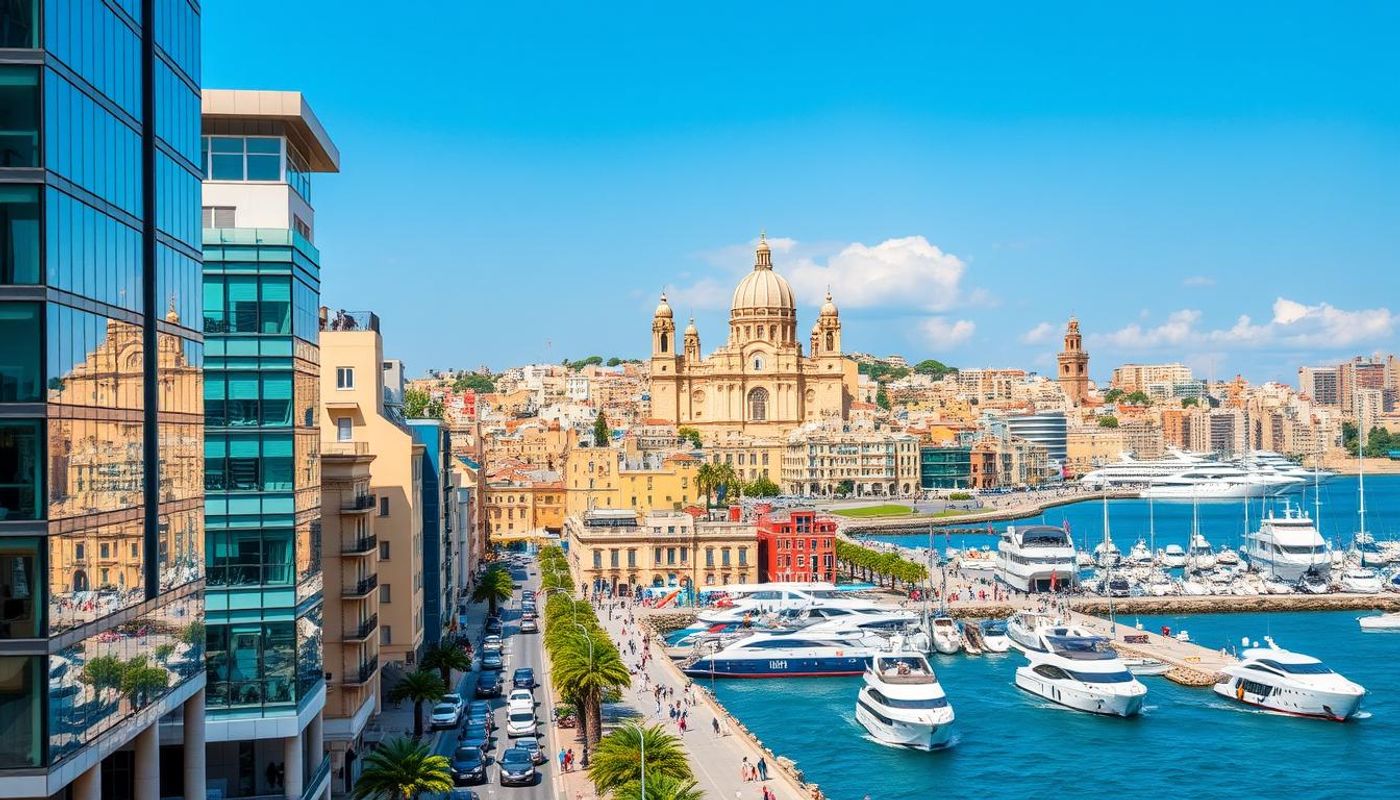
Starting a business in Malta gives you a base inside the EU and the eurozone, English as an official language and some of the lowest tax rates in Europe for a small business. In 2026 the first €12,000 of a sole trader's income is tax free, and a company's trading profits can be taxed at about 5% after shareholder refunds.
The hard part is the number of steps. You choose a business form, register with the right authority, sort out tax, VAT and social security, check whether your activity or your premises need a licence, and open a bank account that will take you. Each step has its own office and its own forms.
We make the company route simple. When you set up a business in Malta as a limited company, we form it for you, prepare the tax and VAT registrations and the bank file, and our partners provide the registered office and secretary. One team, one clear price, and you are ready to trade in about a week.
Malta Company Incorporation
GCS Malta
Effective tax (with 6/7ths refund)
~5% for non-resident shareholders
Time to Incorporate
1 Week
Cost
Starting from €1,299
Moving to Malta from outside the EU? Read our guide to starting a business in Malta as a foreigner.
Why Start a Business in Malta
People start a business in Malta for the EU market, low tax for small businesses and companies, English as an official language and a government that actively supports new businesses. Setting up a business in Malta is common: the country registered 10,208 new business units in 2025, and 146,420 were on the register at the end of the year.
EU Market and the Euro
Malta has been an EU member since 2004 and has used the euro since 2008. A Malta business sells across the single market on the same terms as any other EU business, gets an EU VAT number and pays its suppliers in euros without currency risk.
Low Tax for Small Businesses and Companies
For 2026, a single person pays no income tax on the first €12,000 of chargeable income, 15% up to €16,000, 25% up to €60,000 and 35% above. A company pays 35%, but its shareholders claim back six-sevenths of the tax on trading profits when it pays a dividend, which brings the effective rate to about 5%.
Set Up a Business in Malta With Us
Setting up a business in Malta as a company is quick when one team runs it. This is what we do for you.
- We form the company: Documents, ownership forms and the online filing in one process.
- About 5% effective tax: The refund route planned from the start.
- Office and secretary arranged: Our partners provide both from day one.
- VAT set up right: The VAT route chosen for how you will trade.
- Bank file ready: Prepared while the company is formed.
- No back-and-forth emails: One point of contact from start to finish.
- Clear pricing: From €1,299, yearly costs shown up front.
English Is an Official Language
English and Maltese are both official languages. Registrations, contracts, tax returns and bank documents can all be in English, so you do not pay for translations, and most government services and professional firms work in English every day.
Free Help From Business 1st
Business 1st is Malta's one-stop shop for businesses. It is free, it guides you through every step of setting up a business in Malta, and it submits applications to the right authority on your behalf. You can visit in Mrieħel, call 144 or use its online helpdesk.
A Busy and Growing Business Base
Most Malta businesses are small: 97.2% of registered business units were micro businesses in 2025, and 58.7% were sole owners or partnerships. On the company side, the Malta Business Registry registered 3,628 new private companies in 2025. Starting a business in Malta is common, and the system is used to it.
Business Structures in Malta
The main ways of starting a business in Malta are as a sole trader, a partnership or a private limited company. The choice decides who is liable for the debts, how you are taxed, which authority you register with and how much paperwork runs every year.
Sole Trader
A sole trader registers as self-employed and trades in their own name. It is the quickest and cheapest route, with no company to form, but the owner is fully liable for all business debts. Profits are taxed as personal income at the 2026 rates, and the owner pays self-employed social security.
Partnership En Nom Collectif
A general partnership has two or more partners who are all liable for its debts without limit, jointly and severally. The partners sign a deed of partnership and deliver it to the Malta Business Registry, which issues a certificate of partnership. The partnership has its own legal personality.
Partnership En Commandite
A limited partnership has at least one general partner with unlimited liability and at least one limited partner whose liability stops at the capital contributed. It suits investors who want to put money into a business without running it.
Private Limited Company
A private limited company is a separate legal person, so the owners' liability stops at the amount unpaid on their shares. It needs share capital of at least €1,164.69, with 20% paid up, at least one director and a company secretary. One person can own an exempt company alone. Our guide to setting up a limited company in Malta covers it in detail.
Structure | Liability | Registers with | Best for |
|---|---|---|---|
Sole trader | Unlimited | Jobsplus and the tax office | One person testing an idea or freelancing |
Partnership en nom collectif | Unlimited, joint and several | Malta Business Registry | Partners who trust each other and share the work |
Partnership en commandite | Limited for limited partners | Malta Business Registry | Investors backing an active partner |
Private limited company | Limited to unpaid share capital | Malta Business Registry | Growth, investors, foreign customers |
When setting up a business in Malta with customers abroad, investors or real financial risk, most founders choose a limited company. A sole trader registration makes sense when you are testing an idea alone with low risk.
Read more: Malta company formation agents and services and company formation vs incorporation.
Malta Company Incorporation
GCS Malta
Effective tax (with 6/7ths refund)
~5% for non-resident shareholders
Time to Incorporate
1 Week
Cost
Starting from €1,299
How to Start a Business in Malta
How to start a business in Malta comes down to six steps: choose the business form, register it, register for tax, VAT and social security, check licences and premises, open a bank account and register as an employer when you hire. The order matters, because each step needs the numbers from the one before.
Choose the Business Form
The first rule of how to start a business in Malta is to decide between a sole trader registration, a partnership and a company before anything else. The form decides which forms you file and with whom. If you are unsure, Business 1st can talk you through it for free, and we can tell you whether a company makes sense for your plans.
Register the Business
A sole trader registers as self-employed with Jobsplus. Maltese ID card holders can use the "Business Startup, Sole Traders" eForm on servizz.gov.mt, which registers VAT, a PE number and Jobsplus in one go, with the numbers sent within 48 hours. A partnership or a company is registered with the Malta Business Registry, online only since 1 March 2025, with a fee from €100. Our guide on how to register a business in Malta covers the sole trader route step by step.
Register for Tax, VAT and Social Security
A Maltese sole trader's tax number is their ID card number, and EU nationals get a tax number within two to three working days after their social security number. A company gets its tax number automatically when it is registered. Every business registers for VAT, and the self-employed start paying Class 2 social security once their income passes €910 a year.
Check Licences and Premises
Most activities do not need a trading licence, but some do, and restaurants, food businesses and regulated financial or gaming businesses need their own licences. Before setting up a business in Malta in rented premises, check that they have the right planning use class for your activity, and do it before you sign the lease.
Open a Business Bank Account
When you set up a business in Malta as a company, it needs a bank account in its own name before it can trade properly. Maltese banks are slow for new and foreign-owned companies, so most of our clients open with our partners first.
Register as an Employer
Before you hire, get a PE number from the tax office, then file a Jobsplus engagement form for each employee on their first day of work. The same applies to a director who is paid a salary.
Setting Up a Business in Malta Without the Paperwork
Setting up a business in Malta as a company is very manageable when the steps run in the right order. This is what we handle.
- Company formed for you: Online filing with the Registry, no Maltese e-ID needed.
- Tax and VAT set up: The right VAT article chosen for your trade.
- Ownership forms done: Beneficial owners declared the right way.
- Registered office included: The Malta address the law requires, from day one.
- Bank account ready: The file prepared while the company forms.
- Deadlines on our calendar: Annual return and ownership dates tracked.
Tax and Social Security for a New Business in Malta
Tax when setting up a business in Malta depends on the form. A sole trader pays personal income tax on profits and Class 2 social security. A company pays 35% corporate tax with shareholder refunds, or can elect a final 15%. Every business registers for VAT, but small businesses under €35,000 a year can use the Article 11 exemption.
Income Tax for Sole Traders
Chargeable income in 2026, single rates | Tax rate |
|---|---|
€0 to €12,000 | 0% |
€12,001 to €16,000 | 15% |
€16,001 to €60,000 | 25% |
€60,001 and above | 35% |
A person who is employed full time, a pensioner or a full-time student can opt to pay 10% on net profits from part-time self-employment, up to €12,000 of profit, so at most €1,200 a year.
Class 2 Social Security for the Self-Employed
Net income in 2026 | Weekly contribution |
|---|---|
€910 to €12,543.72 | €36.18 a week |
€12,543.73 to €29,083.35 | 15% of net income |
€29,083.36 and above | €83.89 a week, the maximum |
These rates apply to people born from 1962. Some part-time self-employed people with low income, including full-time students under 24 and pensioners, pay 15% of income instead of the fixed €36.18.
Company Tax and Refunds
A company pays 35% on its profits. When it pays a dividend, the shareholder claims a refund, six-sevenths on trading profits, so the net tax is about 5%. A company can instead elect a final 15% tax with no refunds, locked in for five years, which suits groups that want simplicity rather than a lower bill.
VAT
Malta VAT is 18%, with reduced rates of 0%, 5%, 7% and 12% for some goods and services. Every business registers. A business with domestic turnover of €35,000 or less can register under Article 11 as a small undertaking and does not charge VAT, but it cannot reclaim the VAT it pays either. Our guide on how to register for VAT in Malta covers the options.
Read more: Malta tax return deadlines and FS3, FS5 and FS7 forms in Malta.
Licences and Permits to Set Up a Business in Malta
Most people who set up a business in Malta need no trading licence at all. Since the trading licence rules were reformed, most activities are exempt, and licences are kept for a short list of activities, plus sector licences for food, catering, finance and gaming, and planning permission for premises.
Trading Licences
Trading licences are issued by the Trade Licensing Unit of the Commerce Department. They are still needed for door-to-door sellers, street and market hawkers, marketing agents, buskers, auctioneers, dealers in precious metals and jewellery, and credit reference agencies. Fees are small: €40 every three years for a street hawker, €90 a year for a busker and €200 for an auctioneer, then €40 a year.
Restaurants, Bars and Food Businesses
A restaurant or bar needs a catering establishment licence from the Malta Tourism Authority, with vetting, assessment and approval stages of about 25 working days in total. Food businesses are registered and inspected by the Food Safety and Security Authority. See our guide to the Malta Tourism Authority licence.
Premises and Planning
Premises must have the right planning use class: class 4A for offices, 4B for retail, 4C for food and drink without cooking and 4D for food and drink with cooking. Planning permits are applied for directly with the Planning Authority, not through Business 1st, so check the use class before you sign a lease.
Regulated Activities
Financial services, payments, e-money and crypto need MFSA authorisation, and online gaming needs a Malta Gaming Authority licence. These businesses form a company first and then apply. See our guides to fintech company formation in Malta, the Malta gaming licence and the Malta crypto licence.
Malta Company Incorporation
GCS Malta
Effective tax (with 6/7ths refund)
~5% for non-resident shareholders
Time to Incorporate
1 Week
Cost
Starting from €1,299
Support for a Business Start-Up in Malta
Support for a business start-up in Malta comes mainly from Malta Enterprise, the government's economic development agency, through grants, tax credits and repayable advances. Business 1st helps with the paperwork, but incentives are applied for with Malta Enterprise directly.
Scheme | What it gives | Who it is for |
|---|---|---|
Business Start | A grant of up to €10,000 | Small start-ups in their first three years, applications by 30 October 2026 |
Start-up Finance | A repayable advance, up to €500,000 or more in some cases | Innovative start-ups up to five years old |
Micro Invest | A tax credit of 45% of eligible costs in Malta, 65% in Gozo | Small businesses with up to 50 employees |
Accelerate | Support on up to €100,000 of eligible costs | Businesses in their first seven years |
Youth-Led Start-Up Support | Up to €1,000 towards Registry and service provider fees | Young founders forming a company |
Micro Invest From 2027
A new Micro Invest scheme for 2026 to 2030 was published in May 2026. It raises the tax credit to 65% in Malta and 85% in Gozo, with a cap of €65,000 over three years, and opens for applications on 1 January 2027.
Youth Enterprise Companies
Since March 2026, 16 and 17 year olds can form a Youth Enterprise company, with each member paying in €100 and authorised capital between €100 and €20,000. These companies cannot employ staff, and they are a way to try starting a business in Malta before turning 18.
The Malta Business Wallet
The Malta Business Wallet, launched by the Malta Business Registry on 14 May 2026, lets a business upload verified documents once and share them, with its consent, with authorities and with banks and other regulated firms. Binderr is the technology provider behind it, so the same once-only approach runs through our own onboarding.
Hiring Your First Employees
Hiring after setting up a business in Malta starts with a PE number from the tax office. After that, every new employee is registered with Jobsplus through an engagement form on their first day of work, and the employer pays social security on top of the salary.
Employer Social Security
In 2026 the employer and the employee each pay 10% of salary in Class 1 social security, capped at €55.93 a week each once the wage reaches €559.31 a week. The employer also pays 0.3% to the Maternity Leave Fund, up to €1.68 a week.
Payroll Forms
The employer deducts tax and social security every month and files the FS5 with the tax office, then gives each employee an FS3 at the end of the year and files the FS7. Our partners run payroll from €30 per payslip, with the forms included. See our page on payroll services in Malta.
Staff From Outside the EU
Workers from outside the EU need a Single Permit before they start, and that includes a director or shareholder who does executive work for the company. Our guide to the Malta employment licence for non-EU staff covers the process.
Business Banking When You Start a Business in Malta
Banking is often the slowest part of starting a business in Malta. Maltese banks meet new business clients by appointment, ask for a full ownership chart and a business plan, and charge foreign-owned companies separate fees, up to €175 a month at HSBC Malta. Reviews take from a couple of weeks to a few months.
Our banking partners are licensed e-money institutions, regulated in the EU and the UK. They open multi-currency business accounts online in days, from €30 to €100 a month, with no minimum balance. Read our guide on how to open a Malta business bank account.

MoneyGate
Business Banking
Monthly fee
€30
Onboarding fee
€500
Time to onboard
2-3 days
Features
Dedicated IBAN, SEPA, FX and more

3S Money
Cross-border payments
Time to onboard
4 Days
Account opening fee
Free
Monthly fee
Starting from € 100
Starting a Business in Malta as a Non-EU Founder
EU citizens can move to Malta and start a business freely, registering with Identità for a free eResidence document if they stay more than three months. Founders from outside the EU need a permit before setting up a business in Malta and running it there, because running your own company counts as work.
Start-up Residence Programme
The Start-up Residence Programme, run by Malta Enterprise and Residency Malta Agency, is for founders of innovative start-ups no more than seven years old. It needs at least €25,000 of investment or paid-up capital, with up to six founders, and gives a three-year permit that can be renewed for five years.
Self-Employed and Single Permits
A self-employment licence for a non-EU national is granted only in exceptional cases, for example with €500,000 of capital spending within six months. More commonly, founders who set up a business in Malta form a company and apply for a Single Permit as its employee. You can own a Malta company from abroad without any permit, as long as you do not work in Malta.
Read more: how to set up a company as a non-resident and business bank accounts for non-residents.
Malta Company Incorporation
GCS Malta
Effective tax (with 6/7ths refund)
~5% for non-resident shareholders
Time to Incorporate
1 Week
Cost
Starting from €1,299
How Much It Costs to Start a Business in Malta
The cost of starting a business in Malta depends on the form. A sole trader pays almost nothing to register but pays social security from the start. A company costs more to set up and run, but gives limited liability and the company tax rate.
Item | Sole trader | Private limited company |
|---|---|---|
Registration | No fee listed for the self-employed registration | From €1,299 with us, Registry fee included |
Share capital | None | €232.94 paid in, stays in the company |
Yearly services | Bookkeeping and tax return as needed | About €4,400 + VAT for office, secretary, compliance, accounts and tax return |
Social security | From €36.18 a week | Class 1 on any salaries paid |
Audit | None | Review report, audit or neither, by size |
If you set up a business in Malta as a company, a realistic first year is about €6,800 to €10,500 plus VAT, including a business account. Our partners' accounting services for Malta companies start from €1,500 + VAT a year, and our guide to the cost of setting up a company in Malta breaks down every line.
Time to Set Up a Business in Malta
How long it takes to set up a business in Malta depends on the form and the licences. A sole trader using the online form can have the registration numbers within 48 hours. A company takes about a week with us, and the Registry can register a complete file in as little as 24 hours.
Step | Typical time |
|---|---|
Sole trader registration through the eForm | Numbers within 48 hours |
Company formation with us | About 1 week |
Business account with our partners | About 2 to 4 business days |
Business account at a Maltese bank | A couple of weeks to a few months |
Catering licence from the Malta Tourism Authority | About 25 working days |
Planning permission for a change of use | Depends on the Planning Authority |
Common Mistakes When Starting a Business in Malta
Most mistakes when starting a business in Malta come from doing the steps in the wrong order or relying on old information. These are the ones we see most.
Trading as a Sole Trader When You Need Limited Liability
A sole trader is personally liable for every business debt. If you sign large contracts, hold stock, take deposits or work with customers abroad, one bad debt can reach your personal savings. If the risk is real, set up a company from the start, because moving later means new contracts, new registrations and a new bank account.
Signing a Lease Before Checking the Use Class
If you set up a business in Malta in a shop, office or restaurant, the premises need the right planning use class. Founders who sign a lease first sometimes find the premises cannot be used for their activity without a change of use, which takes time and can be refused. Check the use class with the Planning Authority before you sign anything.
Missing the Jobsplus Form on the First Day
Self-employed people and employers must file the Jobsplus engagement form when work starts, not weeks later. A late form means work done without registration and social security gaps. File it on the first day for yourself and for every employee.
Thinking €35,000 Means No VAT Registration
Some guides say you only register for VAT above €35,000. In Malta every business registers. The €35,000 figure is the Article 11 small undertaking threshold, below which you register but do not charge VAT. Getting this wrong means trading without a VAT number.
Missing Grant Deadlines
Malta Enterprise schemes have deadlines and conditions, such as applying within a set time from starting the business. Business Start applications close on 30 October 2026. Check the scheme rules before you spend the money, not after.
Start a Business in Malta With Expert Help
Setting up a business in Malta with partners, investors or a licence needs more than a standard setup. Talk to us before you commit.
- Sole trader or company: We tell you honestly which one fits your plans.
- Holding and trading groups: Two companies set up to work together.
- Licensed sectors: Gaming, payments and crypto companies prepared for the licence.
- Founders abroad: Ownership from abroad set up the right way.
- Refund structure planned: Who claims what, and when the cash comes back.
Bottom Line
Starting a business in Malta is straightforward once you know the order: choose the form, register it, sort out tax, VAT and social security, check licences and premises, open a bank account and register as an employer before you hire. Business 1st helps with setting up a business in Malta for free, and Malta Enterprise offers grants of up to €10,000 and tax credits for a business start-up in Malta.
A sole trader registration is quick and cheap but leaves you personally liable. A company gives limited liability and an effective tax rate of about 5% on trading profits. If you set up a business in Malta as a company, we form it from €1,299, prepare the VAT and the bank file, and have you ready to trade in about a week.
How do I start a business in Malta?
How much does it cost to start a business in Malta?
Is it better to be a sole trader or a company in Malta?
Do I need a licence to set up a business in Malta?
How long does it take to start a business in Malta?
Can a foreigner start a business in Malta?
What taxes does a small business pay in Malta?
Do I need to register for VAT when starting a business in Malta?
What grants are available for a business start-up in Malta?
What is Business 1st in Malta?
How much social security does a self-employed person pay in Malta?
Can I set up a business in Malta online?
What is the Malta Business Wallet?
Sources
- Business 1st, registration of a business
- servizz.gov.mt, business startup for sole traders
- Commissioner for Tax and Customs, tax rates for individuals 2026
- Commissioner for Tax and Customs, part-time self-employment
- Social Security, Class 2 contribution rates
- Social Security, Class 1 contributions 2026
- Trading Licences Regulations, S.L. 441.07
- Malta Enterprise, support schemes
- Malta Enterprise, Business Start
- NSO, registered business units 2025
- Malta Business Registry, Annual Report 2025
- Residency Malta, Start-up Residence Programme
- Companies Act, Cap. 386