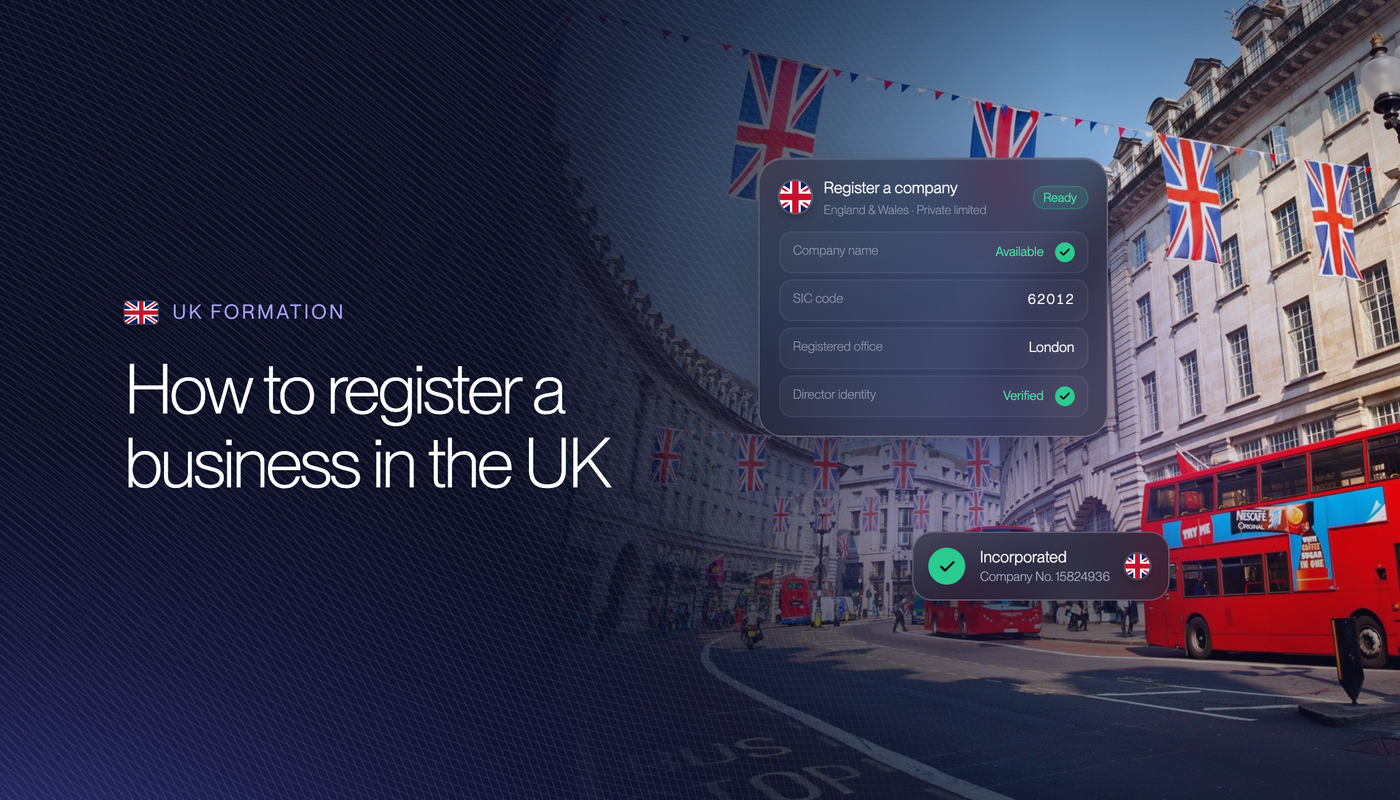
To register a business, UK law gives you two common routes. You can trade as a sole trader in your own name, or form a private limited company that exists in its own right. A company protects your personal assets, pays 19% tax on profits up to £50,000, needs no minimum capital and can be owned from any country.
The hard part is the paperwork around it. Since 18 November 2025, Companies House has required an identity check for every director and every person with significant control. The online fee is £100 from February 2026, and many UK banks expect at least one account holder to live in the UK.
This is where we come in. We register your business as a limited company ourselves. We advise on the structure, guide each identity check, check the name, prepare the articles, file the application and prepare your bank file. One team handles it from €350 with the Companies House fee included, and your company is ready in about a week.
UK Company Incorporation
Binderr
Corporate tax
19% (small profits) / 25% (main rate)
Time to Incorporate
1 Week
Cost
€350 (no pre-payment)
Already sure a limited company is right for you? See our step-by-step guide to setting up a UK limited company.
Why Register a Business in the UK
People register a business in the UK for low costs, a fast online registry and a company form that banks and clients everywhere recognise. A sole trader pays nothing to register with HMRC. A limited company costs £100 at Companies House, can be owned from any country and pays 19% tax on profits up to £50,000.
Low Cost to Start
HMRC charges nothing to register a sole trader. A limited company costs £100 to register online with Companies House, or £124 on paper, under the fees in force since 1 February 2026. There is no minimum share capital, and GOV.UK suggests a low share value such as £1. A company secretary is optional, so a one-person company stays cheap to run.
Limited Liability for Company Owners
A limited company is legally separate from the people who own it. GOV.UK puts it simply: company owners are responsible for the debts of the business only up to the value of their investment. A sole trader is personally responsible for all of the business debts. The company route keeps your savings and your home apart from the risks of the business.
Register a UK Business in About a Week
A UK limited company is quick to set up and cheap to run. These are the main reasons founders choose it.
- Low company tax: 19% on company profits up to £50,000, and 25% only above £250,000.
- Full foreign ownership: One person from any country can own and run the company.
- No minimum capital: A company can start with a single £1 share.
- Limited liability: Your personal assets stay separate from the company's debts.
- Registered in a day: Most online applications to Companies House are registered within 24 hours.
- Formed with us: From €350 with the £100 Companies House fee included, in about a week.
19% Tax on Profits up to £50,000
Companies pay Corporation Tax at 19% on profits up to £50,000. The main rate of 25% applies above £250,000, and marginal relief reduces the tax in between. A sole trader pays Income Tax at 20%, 40% or 45% in the 2026 to 2027 tax year, plus Class 4 National Insurance. Above £50,270, a sole trader pays 40% on each extra pound, while a company's Corporation Tax works out at 19% to 25% of its profit. Dividends you take out of the company are taxed separately.
Online Registration in About 24 Hours
One registry, Companies House, registers companies for the whole of the UK. GOV.UK says an online application is usually registered within 24 hours. If you need it sooner, a same-day service costs £156 through filing software. A paper application takes 8 to 10 days, so the online route is the better choice.
Open to Owners From Any Country
GOV.UK states that directors do not have to live in the UK. One person can be the only director and the only shareholder. The location rule applies to the company itself: it must have a UK registered office. That makes it simple to set up a company as a non-resident in the UK.
A Market of 5.7 Million Businesses
The Department for Business and Trade counted about 5.7 million private sector businesses in the UK at the start of 2025. About 57% were sole proprietorships and 37% were companies. UK clients, suppliers and payment providers deal with limited companies every day, so a UK Ltd is easy to sell with and easy to check.
Read more: why founders choose a UK company.
Business Structures You Can Register in the UK
For business registration, UK law offers five main structures: a sole trader, a general partnership, a private limited company, a limited liability partnership and, for a foreign company, a UK establishment. The structure decides who carries the debts, how profits are taxed and whether you register with HMRC, with Companies House or with both.
Structure | Liability | Where you register | How profits are taxed |
|---|---|---|---|
Sole trader | Unlimited, personal | HMRC, through Self Assessment | Income Tax and Class 4 National Insurance |
General partnership | Unlimited, shared by the partners | HMRC, through a nominated partner | Each partner pays tax on their share |
Private limited company (Ltd) | Limited to the value of your shares | Companies House, £100 online | Corporation Tax, 19% to 25% |
Limited liability partnership (LLP) | Limited for the members | Companies House, £100 by software | Each member pays tax on their share |
UK establishment of an overseas company | Carried by the overseas company | Companies House, £124 on paper | Corporation Tax on its UK profits |
For most people, business registration in the UK comes down to a sole trader or a Ltd. The sole trader route is free and quick, but you carry every debt yourself. The Ltd costs a little more to run, protects your assets and works for owners abroad. That is why it is the route we handle.
Sole Trader
A sole trader is a self-employed person who runs the business in their own name. There is no Companies House filing. You register with HMRC for Self Assessment and report the profits on your personal tax return, and you are personally responsible for all of the business debts. It suits a UK resident testing a small idea with low risk. It is a poor fit for large contracts, staff, investors, customers abroad or an owner who lives outside the UK. Our sole trader vs limited company guide sets out the full trade-off.
General Partnership
A general partnership is two or more people who run a business together without forming a company. The partners choose a nominated partner, who manages the partnership's tax returns and records, and each partner pays tax on their share of the profits. The partners share the losses and the bills with no limit. It suits small ventures between people who trust each other, not a founder working alone. Our guide to partnership vs limited company explains when a company is the better choice.
Private Limited Company
A private limited company (Ltd) is a separate legal person registered at Companies House. It needs at least one director aged 16 or over, at least one shareholder, who can be the same person, and a UK registered office. Its name ends in "Limited" or "Ltd". The company pays Corporation Tax on its profits, and the owners risk only what they put in. It suits almost every business that plans to grow, hire, sign contracts or bank abroad, and it is the structure we register for most readers. Our UK company registration guide covers every rule in detail.
Limited Liability Partnership
An LLP is a partnership whose members have limited liability, and it is taxed like a partnership: each member pays tax on their share of the profit. It needs at least two designated members at all times, and every individual member must verify their identity with Companies House. Registration costs £100 through filing software, or £124 on paper. It suits professional firms and joint ventures, not a founder on their own. Read how to register an LLP in the UK.
UK Establishment of an Overseas Company
A foreign company that opens a branch or place of business in the UK registers it as a UK establishment. It must file within one month of opening, and the paper registration costs £124. The branch is part of the foreign company, so the parent stays responsible for what it does. Many foreign groups form a UK subsidiary instead, a new Ltd owned by the parent, which keeps the UK risk inside the UK company. Our guide on how to register a UK branch or subsidiary covers both filings.
UK Company Incorporation
Binderr
Corporate tax
19% (small profits) / 25% (main rate)
Time to Incorporate
1 Week
Cost
€350 (no pre-payment)
Business Registration in the UK for Non-Residents
Business registration in the UK is open to every nationality. A non-resident can own 100% of a UK limited company and be its only director, with no visa and no local partner. What changes from abroad is the practical side: the identity checks, the UK address, the bank account and the place where the company is managed.
Directors and Owners Can Live Anywhere
Directors do not have to live in the UK, and one person can hold every share and be the only director. Owning the company does not give you a right to live or work in the UK, but you do not need that right to own it or to act as its director. Documents are signed electronically, so you never have to visit.
Why Sole Trader Registration Rarely Fits Abroad
A sole trader is not separate from you. The registration sits on your personal tax record with HMRC, so your own residence and your home country's tax rules decide most of the outcome. A person in the UK as a visitor cannot work as a self-employed person under the visitor rules. For a founder abroad, a Ltd keeps the business, its contracts and its bank account inside one UK company.
Verifying Your Identity From Abroad
Each director and person with significant control checks their identity through GOV.UK One Login. A biometric passport from any country works as photo ID. If the online check cannot confirm you, an authorised corporate service provider can do it instead. Each person verifies once and gets one personal code for every role they hold.
A UK Registered Office
The company needs a physical UK address in the same part of the UK where it is registered, so a Scottish company needs a Scottish address. Someone acting for the company must be told about post that arrives there, and PO boxes are not allowed. An address outside the UK cannot be used, so founders abroad use registered office address services in the UK.
Where the Company Is Managed
A company incorporated in the UK is UK tax resident. If every decision is made in another country, that country may also treat it as resident there, and the tax treaty between the two decides. Plan where the board meets before you register the business in the UK, not after. Our guide on whether you can run a UK business from Dubai shows how this works.
Read more: setting up a UK company as a non-resident.
Register a UK Business From Abroad
You can register a UK business as a limited company without travelling. This is what we handle for you.
- Fully remote setup: Identity checks, signatures and the filing are all done online.
- Identity codes sorted: We guide each director and PSC through the GOV.UK check.
- A UK address: A registered office in the right part of the UK, priced with your setup.
- Account in days: Our partners open business accounts within days for owners who live abroad.
- Tax residence checked: We show how the place of board decisions affects the company's tax.
- One team throughout: The same people handle your file from your first message to the certificate.
How to Register a Business in the UK
How to register a business in the UK depends on the structure. A sole trader registers with HMRC for Self Assessment. A limited company is registered at Companies House once every director has verified their identity, and is then set up with HMRC. We handle the company route for you, and Companies House usually registers a complete online application within 24 hours.
Before You Start
Decide the structure first, because it changes every step after it. Then check whether your activity needs permission before you trade. Payments, e-money, consumer credit and crypto businesses need approval from the FCA, and gambling businesses need a licence from the Gambling Commission. Our guide on how to get an FCA licence in the UK shows what that involves.
Registering as a Sole Trader With HMRC
A sole trader registers for Self Assessment on GOV.UK and gets a Unique Taxpayer Reference. You must tell HMRC by 5 October after the end of the tax year in which you started, so by 5 October 2027 for a business that starts in the 2026 to 2027 tax year. Gross trading income of £1,000 or less is covered by the trading allowance, and you generally only need to register above that. You keep records from the first sale and file a tax return every year. Since 6 April 2026, sole traders with qualifying income over £50,000 also use Making Tax Digital for Income Tax.
Why We Register Your Business as a Limited Company
We register your business as a limited company because it is the structure that holds up as the business grows. The company carries its own debts, pays 19% on profits up to £50,000, can be owned from any country and gives banks and clients a company number they can check. A sole trader registration is free, but personal liability and personal tax rates cost more as profits grow. If a sole trader registration is all you need, we tell you so.
We Check the Name and the Structure
We confirm the structure with you, usually a private company limited by shares, and check the name against the register. The name ends in "Limited" or "Ltd", it cannot match an existing company, and some words need approval first. We also choose the SIC code, the five-digit code that describes what the company does, and you can list up to four. See how to check company name availability in the UK.
We Guide Every Identity Check
Every director needs a personal code from Companies House identity verification before we file. Each person with significant control gives their code when added to the register or within 14 days. A PSC is anyone with more than 25% of the shares or voting rights, or the right to appoint or remove most of the directors. We guide each person through the online check from their own country.
We Prepare the Company Documents
We prepare the memorandum, the articles of association, usually the model articles, and the statement of capital, which shows each shareholder and their shares. We add the registered office, the registered email address, which stays off the public register, and the statement that the company is formed for a lawful purpose. All three became compulsory on 4 March 2024, and Companies House does not accept an application without them.
We File With Companies House
We file one online application and pay the £100 fee, which is included in our price. Companies House usually registers it within 24 hours and issues the certificate of incorporation with the company number. The company is usually set up for Corporation Tax at the same time, and HMRC posts the 10-digit Unique Taxpayer Reference to the company address.
We Set Up the HMRC Registrations
The company must be registered for Corporation Tax within three months of starting to do business, and we make sure that is done. If a director takes a salary, PAYE is set up before the first payday. VAT follows once taxable turnover passes £90,000, or earlier if registering helps you reclaim VAT on costs.
Read more: how to start a business in the UK.
Full-Service UK Business Registration
When you register your business with us, one team prepares, checks and files everything. Here is what that includes.
- Structure advice: We tell you when a Ltd fits your plans and when it does not.
- Name checked first: Against the register and the words that need approval.
- Articles and capital: Model articles, statement of capital and PSC details prepared.
- Clean first filing: One application that meets the 2024 and 2025 rules.
- HMRC set up: Corporation Tax, plus PAYE or VAT where your business needs them.
- Bank file ready: Built from the same KYC pack on the day you register.
- Filing dates set: Your first confirmation statement and accounts dates noted for you.
Documents Needed to Register a Business in the UK
To register a business in the UK as a limited company, you need few documents. Companies House does not ask for certified passport copies, because each person's identity is already confirmed through verification. It needs correct details of the people, the shares, the address and the activity. Banks ask for more, so we prepare both sets at the same time.
Director and Shareholder Details
The application lists each director and PSC with their full name, date of birth, nationality and country of residence. Each person adds their personal code from identity verification and two addresses: a service address that appears on the public register and a home address that Companies House does not publish. For each shareholder, it gives the name and the shares held.
Company Details for the Application
- Company name: Not already on the register, ending in Limited or Ltd.
- Registered office: A physical address in the right part of the UK.
- Registered email: For Companies House contact, not shown publicly.
- SIC code: At least one, and up to four.
- Statement of capital: The shares and who holds them.
- Articles of association: Usually the model articles.
- PSC details: Everyone with more than 25% or other control.
- Lawful purpose statement: Confirmed by the subscribers.
Documents for the Business Bank Account
A bank or payment provider wants more than Companies House does. Expect to give the certificate of incorporation and the articles, a passport and proof of address for each owner, a short description of the business, the monthly volumes you expect and the countries you trade with. Many also ask about the source of the starting funds. We build this file from the same KYC pack, so it is ready the day the company is registered. See the full list of documents needed to open a business bank account.
UK Business Registration Cost in 2026
UK business registration as a limited company costs from €350 with us, with the £100 Companies House fee included. A sole trader pays nothing to register with HMRC. For either route, the real cost is the yearly running cost: accounting, filings and the bank account.
The price applies to a standard private company limited by shares, whether it trades or holds investments. It includes the structure advice, the name check, identity verification guidance, your KYC pack, the model articles, the statement of capital, the first PSC filing, the £100 Companies House fee and a bank-ready file. Trusts, foundations, funds, regulated and high-risk structures are quoted separately.
Cost item | When it is paid | Typical amount | What it covers |
|---|---|---|---|
Company incorporation with Binderr, all of the above included | Once, before filing | From €350 | Advice, KYC pack, articles, capital, PSC details, the £100 filing and the bank file |
Registered office service | Each year, if you have no UK address you can use | Quoted with your setup | A UK address where official post is received |
Confirmation statement | Within 14 days after each review period | £50 online | Confirms the company's details once a year |
ICO data protection fee | Each year, if the company handles personal data | £52 or £78 for most small companies | The fee paid to the Information Commissioner's Office |
Accounts and Company Tax Return | First accounts within 21 months, then yearly | About £1,000 to £2,500 a year, as a planning range | Accounts for Companies House and the return for HMRC |
Business account with our banking partners | Monthly, once the account is open | About €30 to €100 a month on a published plan | A multi-currency business account |
Realistic first-year total | Year one | About €2,000 to €5,000 for a simple company | Our price, the filings, accounting and an account |
The accountant and the bank plan make the biggest difference to this total. VAT returns and payroll add to it, while the Companies House fees stay small.
First-Year Cost by Business Profile
Business profile | Realistic first year | What drives the cost |
|---|---|---|
Sole trader moving into a company | About €2,000 to €4,500 | Basic yearly accounts, the Companies House filings and an entry-level account plan |
Company owned and run from abroad | About €2,200 to €5,000 | The UK address service and an account that holds several currencies |
Holding company with no trading | About €2,000 to €4,000 | Light accounts and one tax return a year, no VAT or payroll |
Trading company with VAT and payroll | About €3,000 to €5,500 | Bookkeeping every month, VAT returns and payroll for the director |
Regulated or high-risk company | Quoted separately | The licence, any required capital and specialist banking |
These ranges are for planning only, with sterling converted at recent rates. Your written quote from us is the figure that counts. Compare them with company formation costs by country.
Read more: what a UK company costs to set up and run.
UK Company Incorporation
Binderr
Corporate tax
19% (small profits) / 25% (main rate)
Time to Incorporate
1 Week
Cost
€350 (no pre-payment)
How Long Business Registration in the UK Takes
Business registration in the UK takes about 24 hours at Companies House for an online application, or the same day for £156 through software. A paper application takes 8 to 10 days. With us, the whole setup takes about a week, because the identity checks come first and the bank file is built alongside.
Identity verification for each director and PSC happens online before the filing. We prepare the rest of the file within a few days, and our banking partners open the account in days from a complete file. The filing itself is fast. Most of the week goes on the identity codes, the address, the shares and the bank file. A sole trader has no filing to wait for, but must still tell HMRC by 5 October after the first tax year.
What Slows Registration Down
Most delays when you register a business in the UK come from four things: a name too close to an existing company, a registered office that is not appropriate, a director whose online identity check fails, and a PSC left off the application. Any one of them can get the application rejected, and it then has to be filed again.
How We Keep It to a Week
When we register a UK business, the identity checks go first, because the application needs every director's code. While they run, we agree the name, the registered office and the shares with you and start the bank file from the same documents. Our guide on how to register a company online covers the online process step by step.
Register a Business in the UK From €350
Our price for a standard limited company starts from €350 and already includes the Companies House fee.
- Fee included: The £100 Companies House fee is part of our price, not an extra.
- Written quote: You see the full price in writing before you pay anything.
- About a week: A complete file becomes a registered company in about one week.
- Complex setups quoted: Groups, regulated firms and high-risk activities are priced separately.
- First-year budget: About €2,000 to €5,000 for a simple company, running costs included.
Tax and Compliance After UK Business Registration
After UK business registration, a limited company pays Corporation Tax, files a confirmation statement and accounts with Companies House and files a tax return with HMRC every year. VAT and PAYE follow where they apply. A sole trader files a personal Self Assessment return instead. Every deadline is set in advance, so the year is easy to plan, and we note the first dates for you.
Corporation Tax and the Company Tax Return
The 19% and 25% rates and the marginal relief band apply to every limited company. The £50,000 and £250,000 limits are divided between associated companies, so a group reaches the 25% rate sooner. The company pays the tax 9 months and 1 day after its accounting period ends and files the return within 12 months. A late return costs £200, another £200 at 3 months, and each of these rises to £1,000 if the return is late three times in a row. Read about the tax benefits of setting up a limited company.
Paying Yourself From the Company
Directors often take a salary through PAYE and the rest as dividends. The company must register as an employer before the first payday, even if the only employee is you as the director. For 2026 to 2027, dividends above the £500 allowance are taxed at 10.75%, 35.75% or 39.35%, depending on your Income Tax band. Employer National Insurance is 15% on salaries above £5,000 a year. Our partners provide payroll services in the UK from the first payday.
VAT Registration
A business must register for VAT when taxable turnover passes £90,000 in any 12 months, or when it expects to pass £90,000 in the next 30 days alone. Registration is due within 30 days of the end of the month you went over. Businesses based outside the UK that supply goods or services in the UK must register whatever their turnover. The standard rate is 20%. Our guide to VAT registration for non-resident companies covers this case.
Companies House Filings
The company files a confirmation statement at least every 12 months, at £50 online, within 14 days after its review period. Missing it can bring a fine of up to £5,000 and strike-off. The first accounts are due 21 months after registration, then 9 months after each year end. Late accounts cost £150 to £1,500 depending on how late they are, and the penalty doubles if they are late two years in a row.
Tax for Sole Traders
A sole trader pays Income Tax on profits above the £12,570 personal allowance: 20% up to £50,270, 40% up to £125,140 and 45% above, with different bands in Scotland. Class 4 National Insurance adds 6% on profits between £12,570 and £50,270 and 2% above. The online return for 2025 to 2026 is due by 31 January 2027, and a late return costs £100. Making Tax Digital for Income Tax applies above £50,000 of qualifying income now, and above £30,000 from 6 April 2027.
UK Company Incorporation
Binderr
Corporate tax
19% (small profits) / 25% (main rate)
Time to Incorporate
1 Week
Cost
€350 (no pre-payment)
Business Banking After You Register a UK Business
After you register a UK business, the bank account is the step that needs the most planning. High street banks are cheap for UK residents, but many require someone on the account who lives in the UK. Our banking partners open multi-currency accounts remotely and within days, wherever the owners live.
What UK Banks Ask For
UK banks publish clear prices, but their rules leave out many founders abroad. Starling's business account has no monthly fee, but every director with access and every PSC must be a UK resident, and it takes no corporate shareholders or holding companies. NatWest's Standard Tariff has no minimum monthly charge and needs at least one UK resident on the application. Santander's Business Current Account Classic is free for 12 months for start-ups, then £9.99 a month, and everyone linked to the account must live in the UK. Barclays charges £8.50 a month after a 12-month free period for start-ups. Refusals are common for foreign-owned companies and rarely come with a reason, as our guide on why banks reject business account applications explains. Our UK business bank account guide covers each bank in detail.
Faster Accounts Through Our Banking Partners
We work with regulated payment partners built for companies owned from abroad. They are payment institutions and electronic money institutions, not banks, and they open multi-currency business accounts in days, fully remotely, with no UK-resident director. We prepare the file from the same KYC pack we use to register your business and make the introduction. Published plans run at about €30 to €100 a month. See how a business bank account and an EMI account differ.
Feature | UK high street banks | Our banking partners |
|---|---|---|
Who they accept | Often UK residents only, or at least one UK resident | Owners and directors anywhere |
Monthly cost | £0 to £9.99 at the banks above, after any free period | About €30 to €100 on a published plan |
How applications are reviewed | Case by case, with few reasons given | A file we prepare and submit with you |
Currencies | Sterling accounts | Several currencies in one account |
Time to open | Depends on the bank's review | Days, from a complete file |
A UK resident who trades only in sterling can usually open a free high street account. When the owners live abroad or the company trades in several currencies, our partners open the account faster and hold more currencies in it. Read more: company formation with a bank account.

Equals Money
Business Bank Account
Time to onboard
2 Days
Account opening fee
Free
Monthly fee
€30

3S Money
Cross-border payments
Time to onboard
4 Days
Account opening fee
Free
Monthly fee
Starting from € 100
UK vs Ireland, the Isle of Man and the UAE
The UK is the cheapest place to register a business with us, from €350, and its registry works in about 24 hours, but it is not in the EU. Ireland is the usual choice for an EU trading company, the Isle of Man for 0% tax on most activities, and the UAE for low company tax with free zone options. We form all four.
Factor | UK | Ireland | Isle of Man | UAE |
|---|---|---|---|---|
Company tax | 19% small profits rate, 25% main rate | 12.5% trading, 25% non-trading | 0% on most activities | 0% up to AED 375,000, then 9%, qualifying free zone income 0% |
VAT | 20% | 23% | 20% | 5% |
EU member | No | Yes | No | No |
Known for | Low-cost companies that banks and clients know | EU trading and technology companies | Holding and international trading | Free zones and a Gulf base |
Our price | From €350 | From €1,899 | From €1,499 | From €1,899 |
Time with us | About 1 week | About 1 week | About 1 week | About 1 week |
The UK wins on price and a fast registry, Ireland on EU access, the Isle of Man on tax for holding structures and the UAE on a low rate for Gulf businesses. Choose on where your customers and your management are.
UK vs Ireland
Ireland taxes trading profits at 12.5% and gives you a company inside the EU. It also needs at least one director who lives in the European Economic Area, or a €25,000 bond under section 137 of the Companies Act 2014. A UK company has no residency rule for its directors. Ireland suits a business whose clients or licence require an EU company, as our Ireland company formation guide explains.
Ireland Company Incorporation
Binderr
Corporate tax
12.5% trading / 25% non-trading income
Time to Incorporate
1 Week
Cost
€1,899
UK vs the Isle of Man
The Isle of Man taxes most company income at 0%, shares a common customs and excise area with the UK and charges VAT at 20%. Our Isle of Man setup starts from €1,499, against €350 for a UK company, so it suits holding and international trading more than a small trading business. See how to register a business in the Isle of Man.

Isle of Man Company Incorporation
Binderr
Corporate tax
0% for most activities
Time to incorporate
1 Week
Cost
Starting from €1,499
UK vs the UAE
UAE companies pay 0% on taxable income up to AED 375,000 and 9% above it, and qualifying free zone income can be taxed at 0%. VAT is 5%, and setup starts from €1,899 with us. Choose the UAE if you plan to live in or run the business from the Gulf, and read about company formation in the UAE.

UAE Company Incorporation
Binderr
Corporate tax
0% up to AED 375,000
Freezone Tax
0%
Time to Incorporate
1 Week
Cost
Starting from €1,899
Who UK Business Registration Is Wrong For
UK business registration is wrong for businesses that need an EU company, activities that need a licence before they trade, owners who want private records and very small side incomes. In each case, another structure or another country saves money or time.
Some clients, suppliers and regulators only deal with a company based in the EU, and a UK company cannot meet that need. Look at the Ireland vs UK corporation tax comparison before you decide.
A business in payments, e-money, crypto, investments or gambling needs FCA or Gambling Commission permission before it starts trading. The licence takes much longer than forming the company, as our guide to the FCA EMI licence in the UK shows.
The register is public. Anyone can see the directors' names and service addresses, the registered office, the PSCs and the filed accounts. A UK company is not the right fit if privacy is your main goal.
If you earn £1,000 or less a year from a small side activity, the trading allowance means you generally do not need to register a business in the UK at all. A company would only add cost.
Common Mistakes When Registering a Business in the UK
Most problems when registering a business in the UK come from the details around the filing, not from the filing itself. These are the mistakes we see most often, with what each one costs and what to do instead, so you can avoid them from day one.
Staying a Sole Trader Too Long
Many people start as sole traders and stay that way as profits grow. Above £50,270, every extra pound of profit pays 40% Income Tax plus 2% Class 4 National Insurance. A company's Corporation Tax works out at 19% to 25% of its profit, before tax on any dividends you take. A sole trader also carries every business debt personally, so one large unpaid invoice or a failed contract can reach your savings. Move the business into a company before you sign the large contract. The move is simple when it is planned: form the company, open its account, then move the contracts and invoices across. We register the company and prepare the bank file, so payments move without a gap.
Missing the 5 October Deadline
Sole traders often forget to tell HMRC in their first year. You must register by 5 October after the end of the tax year in which you started, and telling HMRC late can bring a penalty. A late tax return then costs £100, with daily penalties of £10 after 3 months, up to £900. Register as soon as your gross trading income passes £1,000. Below that, the trading allowance means you generally do not need to register, but you still keep records. Put 5 October and 31 January in your calendar from the first year.
Choosing the Wrong Registered Office
Some founders use a friend's flat or an old office as the registered office. When post stops reaching them, they miss letters from Companies House and HMRC, including penalty notices for late accounts of £150 to £1,500. If Companies House finds the address is not appropriate, it replaces it with a default address, and the company has 28 days to provide a proper one before strike-off proceedings can begin. The registered office is also public, so a home address puts where you live on the register. Use a registered office service from day one, in the same part of the UK as the company.
Choosing the Bank After the Company
Many UK banks set rules on who can own and run the company. Starling takes no corporate shareholders or holding companies and needs every PSC to live in the UK. NatWest needs at least one UK resident on the application, and Santander needs everyone on the account to live in the UK. Founders who form the company first and ask the bank later can lose weeks. We plan the company and the account together, and our partners can open the account days after the certificate arrives. Our guide to company formation mistakes to avoid covers more of them.
UK Business Registration for Complex Setups
Some businesses need planning before they register. Send us your details, and we come back with the right setup and a clear price.
- Moving from sole trader: The business, its contracts and its VAT moved into a company properly.
- Foreign parent companies: A UK subsidiary or a UK establishment, filed the right way.
- Groups and holdings: Each layer of ownership mapped and documented.
- Licensed activities: What needs FCA or Gambling Commission approval before you trade.
- Honest advice: We tell you when a sole trader registration is enough.
Bottom Line
To register a business, UK founders have two common routes. A sole trader registers with HMRC for free, by 5 October after the first tax year, and carries every debt personally. A limited company costs £100 at Companies House, is usually registered online within 24 hours and pays 19% Corporation Tax on profits up to £50,000.
The rules changed in 2025 and 2026. Plan for identity verification first, an appropriate registered office and email, the £50 confirmation statement and the Company Tax Return deadline, since a late return now costs £200.
For most readers, and for every founder abroad, the limited company is the right way to register a business in the UK. It limits your liability, it can be owned from any country and it gives banks and clients a company they can check. The bank account needs the most planning, because many UK banks want a UK resident on the account.
We register your business as a limited company ourselves, from €350 with the £100 Companies House fee included. We guide every director through verification, file the application, set up HMRC and prepare the bank file for our partners, all remotely and in about a week. Start with our UK limited company incorporation service.
How do I register a business in the UK?
How much does it cost to register a business in the UK?
How long does UK business registration take?
Can a non-resident register a business in the UK?
Should I register as a sole trader or a limited company in the UK?
When do I need to register as a sole trader in the UK?
Can I register a UK business online?
Do I need a UK address to register a business in the UK?
Do directors need to verify their identity to register a UK business?
What taxes does a business registered in the UK pay?
When does a UK business have to register for VAT?
Can a UK business open a bank account without a UK-resident director?
What changed for business registration in the UK in 2026?
Sources
- Companies House, Companies House fees (updated 25 September 2026)
- GOV.UK, Register your company (2026)
- GOV.UK, Registered office and email address rules (2026)
- Companies House, Verify your identity (updated 30 April 2026)
- Companies House, When you need to verify your identity (updated 30 July 2026)
- Companies House, Get ready for changes to UK company law (22 January 2024)
- Companies House, People with significant control (updated 30 July 2026)
- Companies House, Overseas companies registered in the UK (updated 25 September 2026)
- GOV.UK, Confirmation statement (2026)
- HMRC, Corporation Tax rates and reliefs (2026)
- HMRC, Register for VAT (2026)
- HMRC, Rates and thresholds for employers 2026 to 2027
- HMRC, Register for Self Assessment if you are self-employed (2026)
- HMRC, Tax-free allowances on trading income
- HMRC, Self-employed National Insurance rates 2026 to 2027
- HMRC, Income Tax rates 2026 to 2027
- HMRC, Tax on dividends 2026 to 2027
- HMRC, Making Tax Digital for Income Tax eligibility (2026)
- Department for Business and Trade, Business population estimates 2025
- Companies Registration Office Ireland, Information Leaflet 17
- Starling Bank, Business account eligibility (2026)
- NatWest, Business current account (2026)
- Santander UK, Opening a business current account (2026)
- Barclays, Start-up business account (2026)