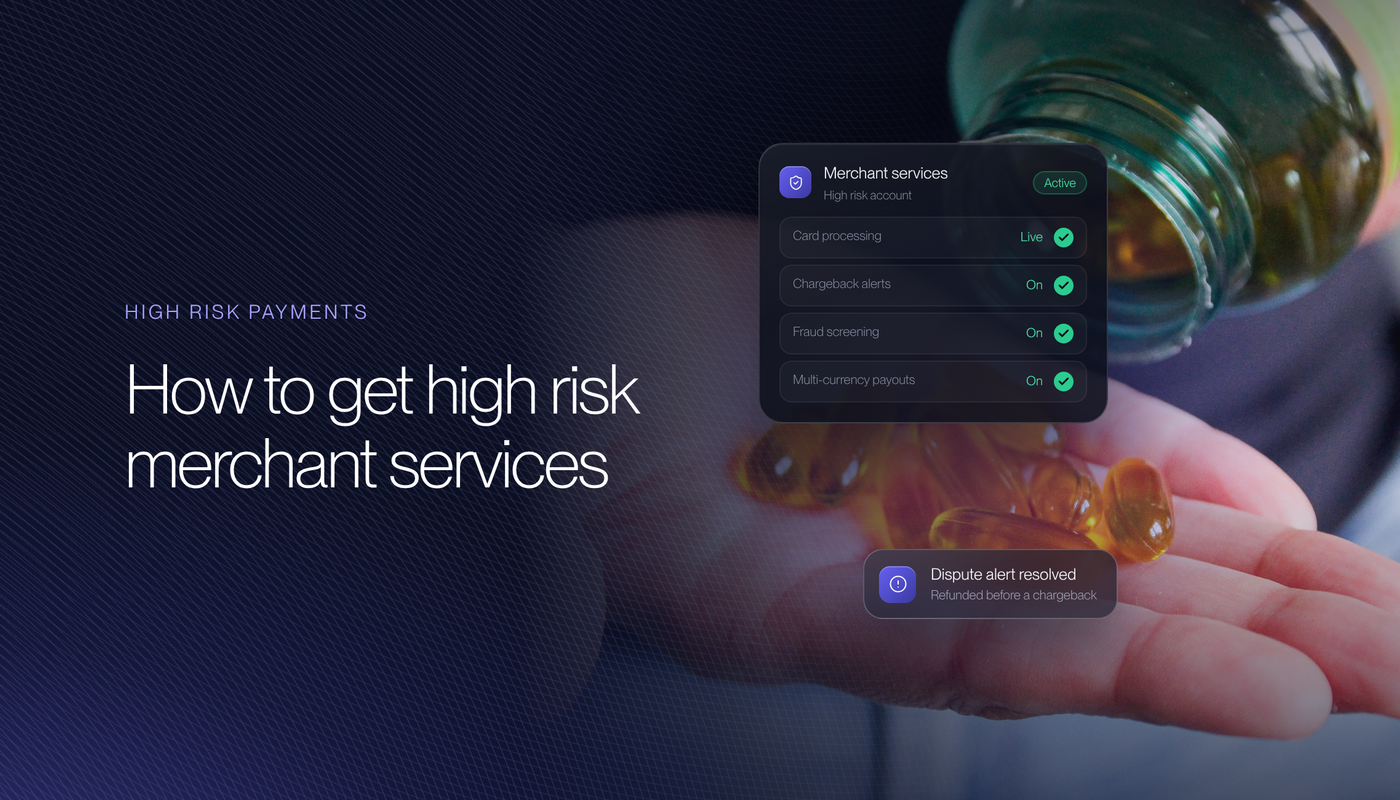
High risk merchant services give a business in a restricted industry everything it needs to take card payments and keep taking them: a merchant account in its own name, a gateway, fraud and chargeback tools, a reserve agreed upfront and, for shops, a POS terminal. Payouts arrive in USD, EUR, GBP, CAD and other major currencies.
The hard part is getting them set up. Stripe and PayPal prohibit or restrict gambling, adult content, CBD, many supplements and several travel and subscription models, and they can freeze an account and hold the balance after you sign up. Specialist acquirers do take these businesses, but each one wants a full underwriting file.
This is where we come in. You fill in one form and we match you with a regulated partner that already accepts your industry. We handle the rest: the KYC pack, the website check against card scheme rules, the gateway and the tools that keep the account open. Most businesses are processing within 5 to 7 business days.

High Risk Payment Gateway and Merchant Account
Binderr Chooses
Time to onboard
5 to 7 days
Currencies
USD, EUR, GBP and more
Industries
Gambling, Adult, CBD, Crypto, Travel, Forex and more
What Are High Risk Merchant Services
High risk merchant services are the accounts and tools a business needs to accept card payments when acquirers class its industry, billing model or history as high risk. The core is a dedicated merchant account. Around it sit the gateway, fraud screening, chargeback tools, a rolling reserve, settlement currencies and, for shops, card terminals.
What a High Risk Merchant Service Includes
A single high risk merchant service is rarely enough on its own. The account lets you take cards, but the tools around it decide whether the account survives its first busy month. The table shows the usual parts of the stack and who needs each one.
Service | What it does | Who needs it |
|---|---|---|
Merchant account (MID) | Holds the acquiring relationship and pays out your sales | Every business that takes cards |
Payment gateway | Connects your checkout to the acquirer and encrypts card data | Every online seller |
Fraud screening and 3D Secure | Blocks stolen cards and shifts fraud liability | Online sellers, above all digital goods |
Chargeback alerts | Lets you refund a dispute before it counts against you | Subscriptions, travel, adult, gaming |
Rolling reserve | Holds part of sales to cover later disputes | Most high risk accounts at the start |
Multi-currency settlement | Pays out in the currencies you sell and spend in | Cross-border sellers |
POS terminal or virtual terminal | Takes cards in person or by phone | Vape, CBD and firearms shops, phone sales |
Alternative rails | ACH, SEPA and open banking payments with fewer disputes | High ticket and recurring billing |
Most businesses need the first five rows from day one. The rest depend on how and where you sell. A merchant that sells one product online in one currency needs a lean setup. A gaming operator that bills players in four currencies needs the full stack.
Why Merchant Services for High Risk Businesses Are Different
Mainstream processors sign you up in minutes because they review you later. Stripe's list of prohibited and restricted businesses, last updated in September 2026, bars gambling, adult content and CBD above local THC limits, and restricts crypto, tobacco, firearms, online pharmacies and dating. PayPal's user agreement allows it to hold funds for up to 180 days when it sees a risk of liability. Our guide on whether Stripe and PayPal allow high risk merchants explains how those closures happen.
Merchant services for high risk businesses work the other way round. The acquirer checks the business first, agrees the rate, reserve and limits in writing, and then opens the account. That takes a few days longer, but your industry is approved before the first sale.
Who Needs High Risk Merchant Solutions
Visa's Integrity Risk Program sets the baseline. It names merchant category codes that need registration before an acquirer can process them online, including 5967 adult content, 7273 dating, 7995 gambling, 5122 and 5912 pharmacies, 6051 crypto and 5968 subscriptions that keep billing until the customer cancels. Our list of high risk merchant industries and MCC codes has the full set.
High risk payment solutions also suit businesses outside those codes: a new company with no processing history, a merchant with a high refund rate, a seller with high average tickets or one that sells mostly cross-border. Read more: what a high risk merchant account is.
Get High Risk Merchant Services With Fast Approval
They are easy to set up when the file goes to a partner that already accepts your industry. That is the part we handle.
- Fast approval: a preliminary answer in about 1 business day.
- Your industry accepted: gaming, adult, nutra, travel, forex, subscriptions and more.
- One intake form: we match you with the right regulated partner.
- Own merchant account: a dedicated MID in your company name.
- Major currencies: settle in USD, EUR, GBP, CAD and more.
High Risk Merchant Account Services
High risk merchant account services start with the account itself: a merchant ID issued by a regulated acquirer that has approved your industry. The account sets your rate, your monthly limit, your reserve and how fast you are paid. Get these terms right and every other tool in the stack works on top of them.
A Dedicated Merchant ID in Your Company Name
A payment facilitator puts you on a shared master account. A dedicated merchant account gives your company its own MID, its own statement descriptor and its own processing history. That history becomes your strongest asset when you ask for a lower reserve or a higher limit. Our guide on how to open a high risk merchant account walks through the application.
Underwriting, Limits and the Rolling Reserve
The underwriter reviews your business model, owners, website and statements, then sets a monthly processing limit. Most high risk accounts also carry a rolling reserve, typically 5% to 10% of daily sales held for 90 to 180 days. The reserve is still your money. It covers refunds and chargebacks if the business stops trading, and a clean record is the best argument for lowering it.
Settlement Currencies and Payout Timing
Pricing in the customer's currency lifts approval rates and settling in the currency you spend in cuts conversion costs. Our partners settle in USD, EUR, GBP, CAD and other major currencies. Payouts are usually slower at the start, often 5 to 7 days, and shorten after a few months of clean processing. Read more: how international payment gateways settle.
High Risk Business Account Merchant Services
Your payouts need a business account that accepts your industry, and many banks will not hold the proceeds of gaming, adult or CBD sales. High risk business account merchant services work best when the account and the merchant setup are planned together, so the account is ready before the first payout. Our guide on how to open a high risk bank account covers that side, and a multi-currency business account keeps each currency in its own balance.
High Risk Payment Processing Solutions at Checkout
High risk payment processing solutions at checkout cover the gateway, the payment methods you show the customer and, for shops, the terminal. The aim is simple: approve as many good payments as possible, keep card data off your servers and give the acquirer the data it needs to fight a dispute.
Gateway and Checkout Integration
The payment gateway encrypts card details and passes them to the acquirer. On a high risk setup it has to be a gateway the acquirer supports, so the two are agreed together. Most merchants use a plugin for their platform, a hosted payment page or an API. A hosted page keeps card data off your servers, which makes PCI compliance much simpler. Our guide on how to set up a high risk payment gateway covers the setup step by step.
Cards, Wallets and Local Payment Methods
Visa and Mastercard are the base. Apple Pay and Google Pay ride on the same card account and often lift conversion on mobile. Local methods matter in some markets, and an acquirer that offers them saves you a second contract. Show prices in the customer's currency and you remove one common reason for a decline.
ACH, SEPA and Open Banking Rails
Bank payments carry fewer disputes than cards and suit high ticket sales and recurring billing. ACH and eCheck cover the US, SEPA transfers and direct debits cover the euro area, and open banking payments cover the UK and much of Europe. Our guide to high risk ACH payment processing covers the US rail.
POS and In-Person High Risk Payment Solutions
Vape shops, CBD stores, firearms dealers and some clinics take most of their sales in person. In-person setups use a card terminal on the same merchant account, with chip and contactless payments that carry far less fraud than online sales. A virtual terminal adds phone and mail orders. For reference, Stripe's UK Terminal pricing is 1.4% + 10p for EEA cards, but its list prohibits or restricts most of these sectors.
High Risk Payment Gateway and Merchant Account
Binderr Chooses
Time to onboard
5 to 7 days
Currencies
USD, EUR, GBP and more
Industries
Gambling, Adult, CBD, Crypto, Travel, Forex and more
Payment Tools for High Risk Merchants
Payment tools for high risk merchants are what keep the account open. Visa and Mastercard measure every merchant's disputes and fraud each month. A merchant that crosses their limits pays fines, faces a higher reserve and risks closure. The right tools keep you well under the limits from the first month.
Chargeback Alerts and Pre-Dispute Tools
Verifi, a Visa solution, offers Order Insight and Rapid Dispute Resolution. Ethoca, a Mastercard solution, offers Consumer Clarity and Ethoca Alerts. They let you show order details to the issuer or refund a disputed payment before it becomes a chargeback, and disputes resolved this way do not count towards your ratio. A customer can usually dispute a Visa payment for 120 days, and up to 540 days for goods or services due later. Read more: chargeback management for high risk merchants.
Fraud Screening and 3D Secure
The Nilson Report put worldwide card fraud losses at USD 33.41 billion in 2024, or 6.43 cents per USD 100 spent. 3D Secure asks the customer to confirm the payment with their bank, and an authenticated payment disputed as fraud usually shifts liability to the issuer. In the EEA and the UK it is required for most online card payments. Add velocity limits, address and CVV checks, and device data. Read more: fraud prevention for high risk merchants.
Ratio Monitoring Against Visa and Mastercard Limits
Visa's Acquirer Monitoring Program counts fraud reports and disputes against settled card-not-present sales. Since 1 April 2026, a merchant in Asia Pacific, Canada, the EU or the US is flagged as excessive at a ratio of 1.5% with at least 1,500 fraud reports and disputes in a month. Mastercard's Excessive Chargeback Merchant level starts at 100 chargebacks and a 1.5% ratio, with fines from USD 1,000 in month two up to USD 100,000 a month from month 19.
A good setup includes a ratio dashboard that warns you before the month closes, not after. Our guide to how high risk payment processing works explains the full monitoring cycle.
PCI DSS and High Risk Payment Features
PCI DSS v4.0.1 is the card data security standard, and its future-dated requirements became mandatory on 31 March 2025. Two of them cover the scripts on your payment page, which is where card skimming attacks happen. Features such as tokenization, a hosted payment page and stored-card vaults keep most of that burden with the gateway instead of with you.
Apply for High Risk Payment Solutions Without Rejection
The right high risk payment solutions start with a file that gets approved the first time. We check it before anything is submitted.
- Avoid rejection: we only submit where your business model is accepted.
- Website checked: refund, contact and billing pages fixed before review.
- Chargeback alerts included: disputes refunded before they hit your ratio.
- 3D Secure ready: liability shift on authenticated card payments.
- Scheme registration handled: Visa and Mastercard filings arranged for you.
- One point of contact: no back and forth with five acquirers.
Payment Solutions for High Risk Industries
Payment solutions for high risk industries use the same core stack, but each sector adds its own rules. Gaming needs a licence, adult needs age checks, subscriptions need clear billing and supplements need clean claims. The table shows where each sector should put its effort.
Sector | Core service | Tools that matter most |
|---|---|---|
Gaming and betting | Merchant account with Visa and Mastercard registration | Licence on file, geolocation, multi-currency payouts |
Adult content and dating | Merchant account with registration | Age checks, clear descriptor, chargeback alerts |
Subscriptions and free trials | Merchant account with recurring billing | Trial reminders, easy cancellation, account updater |
Supplements, CBD and vapes | Merchant account, POS for shops | Product and label review, clean health claims |
Travel and tickets | Merchant account with higher reserve | Delivery dates on file, pre-dispute tools |
Forex and crypto | Merchant account plus bank rails | Licence on file, own KYC, open banking payments |
The pattern is clear. The core service barely changes from sector to sector. The tools change, and so does the file the underwriter expects to see. That is why high risk industry payment solutions are set up around the sector, not around the rate.
Gaming, Betting and Adult Content
Online gambling sits under MCC 7995 and needs a licence from a regulator such as the Malta Gaming Authority or the UK Gambling Commission before any acquirer will sign. See how to get a Malta gaming licence and getting a gambling licence in the UK. Adult content needs age verification and content moderation. Our guide to payment gateways for adult businesses covers that sector.
Subscriptions, Dating and Free Trials
Since 18 April 2020, Visa has required merchants that offer free trials to get express consent, send a reminder at least seven days before the first full charge and offer easy online cancellation. Dating services add Visa registration on top. Our guide on how subscription payment gateways work explains the billing side.
Supplements, CBD, Vapes and Peptides
Acquirers that accept these products check lab reports, labels and every health claim on the website. CBD must sit within local THC limits, and online tobacco sales across borders fall under Visa MCC 5993. See getting approved for a CBD payment gateway and our guide to high risk payment processors for peptides.
Travel, Tickets and Pre-Orders
The risk here is time. A customer who pays today for a trip in eight months can still dispute up to 540 days after the sale if the service never happens. Acquirers answer with a higher reserve and closer monitoring of forward bookings. Our guide to payment gateways for travel agencies covers forward bookings.
Forex, Crypto and Trading Platforms
Codes such as 6051 for crypto and 6211 for securities brokers sit on Visa's high integrity risk list. Acquirers want the financial services licence, the markets you serve and your own KYC process before they sign. See forex payment gateway requirements and the best jurisdictions for forex company formation.
High Risk Payment Gateway and Merchant Account
Binderr Chooses
Time to onboard
5 to 7 days
Currencies
USD, EUR, GBP and more
Industries
Gambling, Adult, CBD, Crypto, Travel, Forex and more
High Risk Business Payment Solutions by Stage
High risk business payment solutions should match where the business is today. A new company needs an approved account and the basics. A growing merchant needs tools that keep ratios low. A high volume seller needs several currencies, backup routing and bank rails. Building the full stack too early costs money you do not need to spend.
New Businesses With No Processing History
A new company can get approved without processing history, but the terms start tighter: a lower monthly limit, a higher reserve or both. A strong file makes up for it. Show a clear business plan, realistic volumes, a compliant website, supplier invoices and any licence your sector needs. Ask for a review after 3 to 6 months of clean processing.
Growing Online Merchants
Once volume builds, the cost of a dispute grows faster than the cost of the tools. Add chargeback alerts, 3D Secure on risky orders and a clear statement descriptor. Use your clean months to negotiate the reserve down. Our guide to high risk ecommerce merchant accounts covers the ecommerce side.
High Volume and Cross-Border Sellers
At high volume, settlement currencies, local acquiring and a backup account matter most. A second merchant account for the same declared business protects you during an outage. Using extra accounts to split chargebacks and stay under the limits breaks Visa and Mastercard rules, so the backup must be declared to both acquirers.
High Risk Merchant Account Solutions That Last
High risk merchant account solutions only pay off if the account stays open. We set yours up with the terms and tools that keep it open.
- Terms agreed upfront: rate, reserve and limits in writing before you sign.
- Ratio monitoring: early warning before Visa or Mastercard limits.
- Reserve reviews: clean months used to lower your holdback.
- Backup routing: a second account for the same business when you need it.
- Support after launch: we stay with you to your first payouts and beyond.
What High Risk Merchant Services Cost
High risk merchant services cost more than a standard account because the acquirer carries more fraud and refund risk. Standard merchants usually pay 1.5% to 2.9% per sale. The ranges below are typical market figures on the lower side for 2026. Your own price depends on your industry, volume and history.
Cost item | Typical market range |
|---|---|
Setup or application fee | $0 to $500, one-off |
Monthly account fee | $10 to $50 |
Processing rate | 2.5% to 5% of each sale |
Fee per transaction | $0.10 to $0.35 |
Gateway | $10 to $30 a month |
Chargeback fee | From about $25 per dispute |
Rolling reserve | 5% to 10% of sales, held 90 to 180 days |
PCI compliance | $99 to $200 a year |
Visa registration, where required | About $950 a year |
Early termination, if in the contract | $250 to $500 |
When buying merchant services, high risk businesses should look past the rate, because it is rarely the biggest cost. On $50,000 a month, a 10% reserve holds $5,000 of each month's sales until it rolls off. Chargebacks add their own fees, so a merchant with a low rate and no alerts can pay more overall. Our guide to high risk merchant account fees and rates breaks down each line.
Why the Rate Starts Higher
Part of the gap is built into the card system. In the EU, Regulation (EU) 2015/751 caps interchange at 0.2% for consumer debit cards and 0.3% for consumer credit cards, but those caps do not cover cards issued outside the EEA. For comparison, Stripe charges 1.5% + 20p for standard UK cards, 2.5% + 20p for EEA cards and 3.15% + 20p for international cards, with a £20 fee per dispute. The rest of a high risk rate is the acquirer's price for the risk.
Scheme Registration and Compliance Fees
Merchants in Visa's high integrity risk codes pay a registration fee, reported at $950 when they register and $950 each year after. Mastercard runs its own annual registration for similar sectors. The acquirer files both and usually passes the fees on. Read more: Visa and Mastercard high risk merchant registration.
High Risk Payment Gateway and Merchant Account
Binderr Chooses
Time to onboard
5 to 7 days
Currencies
USD, EUR, GBP and more
Industries
Gambling, Adult, CBD, Crypto, Travel, Forex and more
How Long High Risk Merchant Services Take
With a complete file, setup with our partners takes 5 to 7 business days from the first form to live processing, and a week is the usual maximum. Scheme registration or website changes can add a little time. Connecting a plugin or hosted page is quick once the credentials arrive.
Stage | Typical time |
|---|---|
Quick assessment | 5 minutes |
Preliminary approval | 1 day |
Complete onboarding requirements | 15 minutes |
Provision of services | 3 days |
Total | 5 to 7 business days, a week at most |
The slow part is almost never the acquirer. It is the gap in the file: a missing policy page, an old proof of address or statements that do not match the volumes on the form. Close those gaps first and the timeline holds.
Documents Your Underwriter Will Ask For
Expect incorporation documents, proof of the business address, a passport and proof of address for each owner with 25% or more, 3 to 6 months of bank statements and, if you already take cards, 3 to 6 months of processing statements. Add your licence where the sector needs one. Your website needs your trading name, contact details and a secure payment page, and underwriters expect a full refund policy, your country and clear prices before checkout.
Get Your Application Ready for High Risk Merchant Services
We prepare your KYC pack and check your website, so your file is complete on the first pass.
- KYC pack prepared: we tell you what we need and build the file.
- Statements checked: volumes and history matched to your form.
- Licence on file: gaming, forex and pharmacy licences attached upfront.
- Live in days: most businesses process within 5 to 7 business days.
- Gateway included: plugin, hosted page or API for your checkout.
Common Mistakes With High Risk Merchant Services
Most closed accounts come from a short list of mistakes, and each one can be avoided before you apply. These are the ones that cost merchants the most money and time.
Buying the Rate Instead of the Stack
Many merchants pick the lowest headline rate and skip the tools. A 0.5% saving on $40,000 a month is $200. Ten extra chargebacks at $25 each cost $250 in fees alone, before the lost sales, and they push the ratio towards Visa's 1.5% limit. Choose a setup with alerts and 3D Secure included, then negotiate the rate.
Miscoding Your Merchant Category
Some merchants describe the business as something safer to get a cheaper code. Visa and Mastercard treat misdescribed sales as a serious breach. An account closed for it can land on Mastercard's MATCH list, and both MATCH and Visa's VMSS listings stay for 5 years. Declare the real business and let the acquirer price it.
Running Sales Through Another Merchant's Account
Processing your sales through someone else's merchant account is transaction laundering. Visa's VMSS has a reason code for it, and MATCH lists laundering when the sales were not real sales between that merchant and a cardholder. It is the fastest way to lose card acceptance for years. Every sale goes through an account in your own name.
Leaving Chargeback Tools Switched Off
Alerts and pre-dispute tools only help if they are turned on and connected. Merchants often switch them on after the acquirer sends a warning, when that month's ratio is already counted. Set them up before your first sale and check the ratio every week.
Apply Once for High Risk Industry Payment Solutions
One form gets your business in front of the regulated partner that takes your sector, with no provider shopping.
- Apply once: one intake form instead of five applications.
- Honest answer upfront: told what is realistic for your industry first.
- Regulated partners only: licensed acquirers, no grey-market processors.
- Clear pricing: every fee in writing before you sign.
- Full stack in one setup: account, gateway, alerts and settlement.
Bottom Line
High risk merchant services are a stack, not a single account. The merchant account gets you paid, the gateway connects your checkout and the fraud and chargeback tools keep the account open. Most of the cost is in the reserve and the disputes, not in the headline rate.
Your situation | What to do | Why |
|---|---|---|
New business in a restricted sector | Apply with a full file and realistic volumes | Tighter terms at the start, reviewed after 3 to 6 months |
Closed by Stripe or PayPal | Move to a dedicated merchant account | Your industry is approved before the first sale |
Subscriptions or free trials | Add trial reminders and chargeback alerts | Visa rules and dispute ratios |
Shop selling vapes, CBD or firearms | Add a POS terminal on the same account | Card-present sales carry less fraud |
Selling in several currencies | Settle in USD, EUR, GBP or CAD as needed | Fewer declines and lower conversion costs |
Ratio close to 1% | Turn on alerts and 3D Secure now | Visa flags 1.5% and Mastercard 1.5% with 100 chargebacks |
Declare your business accurately, keep disputes well under 1% and plan the reserve into your cash flow. We match you with the partner, prepare the file and set up the tools, so you can start processing within 5 to 7 business days.
High Risk Payment Gateway and Merchant Account
Binderr Chooses
Time to onboard
5 to 7 days
Currencies
USD, EUR, GBP and more
Industries
Gambling, Adult, CBD, Crypto, Travel, Forex and more
What are high risk merchant services?
Which high risk payment solution does a new business need first?
What do high risk merchant account services include?
Do Stripe and PayPal offer merchant services for high risk businesses?
What high risk payment features matter most?
How much do high risk merchant services cost?
How long does it take to get high risk merchant services?
What do payment solutions for high risk industries like gaming and adult include?
Do high risk payment processing solutions include POS terminals?
What is a rolling reserve in high risk merchant solutions?
Do I need a company before I can get high risk merchant services?
What happens if my chargeback ratio gets too high?
How does Binderr help with high risk business payment solutions?
Sources
- Visa, Visa Acquirer Monitoring Program fact sheet (2025)
- Visa, Visa Integrity Risk Program (April 2023)
- Visa, Trial subscription rules for merchants
- Stripe Docs, Dispute and fraud card monitoring programs
- Stripe Docs, Terminated merchant files (MATCH and VMSS)
- Stripe Docs, How dispute prevention works (Verifi and Ethoca)
- Stripe, Prohibited and restricted businesses list
- Stripe, UK pricing
- PayPal, User Agreement
- The Nilson Report, Global card fraud losses at $33 billion (January 2026)
- PCI Security Standards Council, E-commerce requirements effective after 31 March 2025
- Regulation (EU) 2015/751 on interchange fees for card-based payment transactions
- Chargebacks911, High risk merchant account fees
- Chargebacks911, Visa chargeback time limits
- The Green Sheet, Visa Integrity Risk Program and registration fees (August 2023)