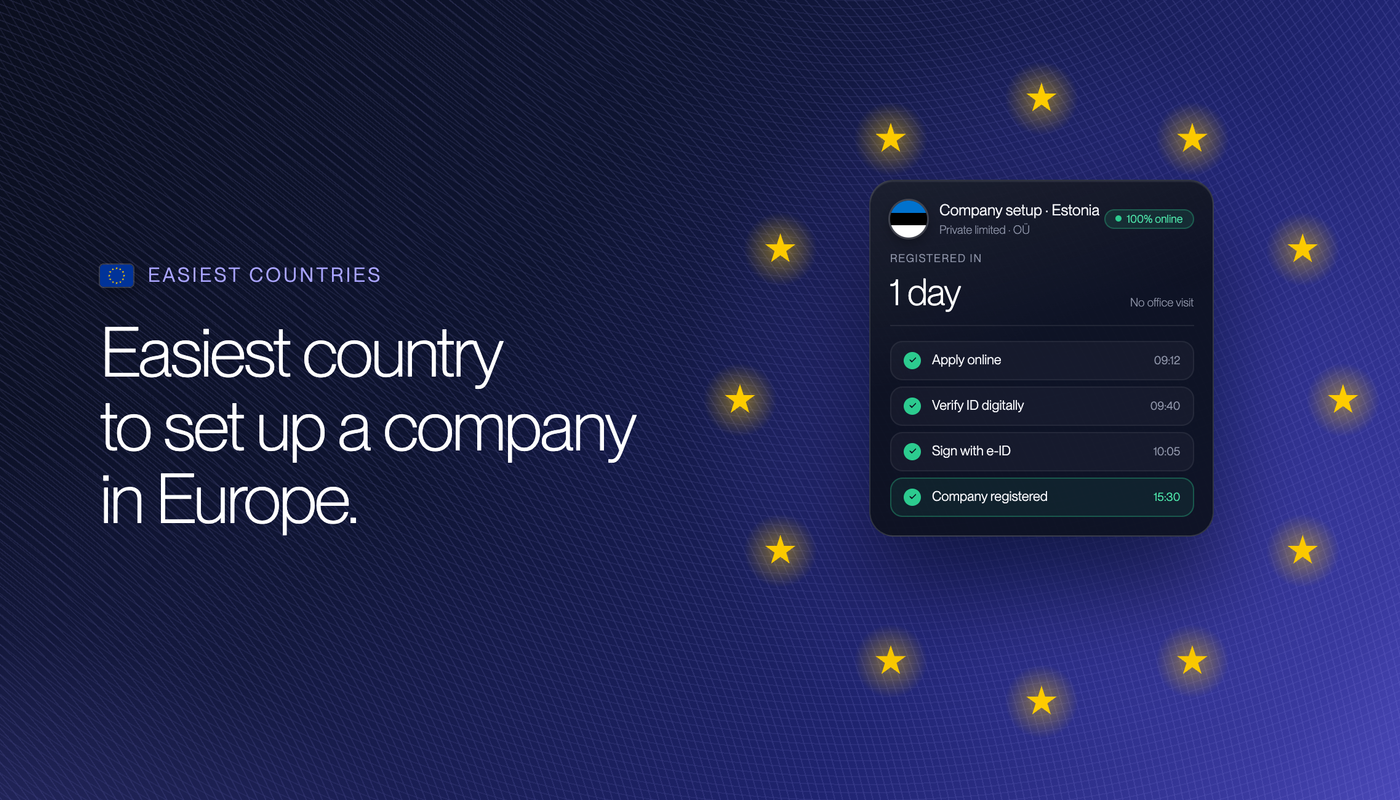
The easiest country to set up a company in Europe gives you a full EU company without moving there. It sells across a single market of 27 countries, invoices in euro and registers for EU VAT like any local business. In Cyprus, Malta and Ireland a founder from anywhere can own 100% of it.
What slows founders down is rarely the registry fee. Cyprus needs a licensed lawyer to sign the papers, and Malta's online filing needs a qualified e-signature. Ireland wants a director living in the EEA or a €25,000 bond. Then come documents in Greek, a capital deposit, identity checks and a bank that can take weeks.
This is where we come in. We make each of these countries easy because we do the filing ourselves: the lawyer and the e-signature, your KYC pack, the director rules, the registry and the bank account with our partners. You deal with a single team, pay from €1,200, and have your EU company in about a week.
We form companies in all three EU countries ourselves: from €1,200 in Cyprus, €1,299 in Malta and €1,899 in Ireland.
Cyprus Company Incorporation
Binderr
Corporate tax
15% flat
Time to Incorporate
1 Week
Cost
€1,200 one-off
Malta Company Incorporation
GCS Malta
Effective tax
~5% for non-resident
Time to Incorporate
1 Week
Cost
Starting from €1,299
Ireland Company Incorporation
Binderr
Corporate tax
12.5% trading / 25% non-trading income
Time to Incorporate
1 Week
Cost
€1,899
Easiest Country to Set Up a Company in Europe
For most founders outside the EU, Cyprus is the easiest country to set up a company in Europe. It has no director residency rule, no capital to pay in before filing and a registry that usually finishes in a few days. If you or a co-director live in the EEA, Ireland is just as easy, and you can file it yourself.
Malta comes a close third, with English documents but a capital deposit and a qualified e-signature. With us doing the filing, all three are straightforward. What still separates them is the director rule, the paperwork, the bank account and the yearly running costs.
Cyprus for Founders Outside the EU
Cyprus company law asks for no resident director and no share capital paid in before filing. The registration fee at the Registrar of Companies is €165 after a €10 name approval, and Invest Cyprus says registration is generally completed within a few days. Corporate tax is 15% from 1 January 2026.
The two steps that look hard are the ones we take off your desk. A lawyer licensed by the Cyprus Bar Association must prepare and sign the memorandum, the articles and the HE1 declaration, and the memorandum and articles are filed in Greek. We form a Cyprus company from €1,200, the lowest price of the three.
Ireland for Founders Living in the EEA
Ireland is the simplest of the three to file on your own. The Companies Registration Office (CRO) takes the A1 form online through CORE for €50, the constitution is one document in English, and there is no minimum share capital. Trading profits are taxed at 12.5%.
The catch is section 137 of the Companies Act 2014. At least one director must live in the European Economic Area, or the company must hold a €25,000 bond for at least two years. If that director is you or a partner, Ireland is as easy as company formation gets in the EU. We form an Irish company from €1,899.
Easy Company Formation in Europe
Easy company formation in Europe comes down to who does the work. We do the filing in Cyprus, Malta and Ireland, and this is what you get.
- Country chosen for you: Cyprus, Malta or Ireland, picked around where you live.
- Licensed filing covered: The Cyprus lawyer and the Malta e-signature arranged by us.
- Director rule solved: The Irish bond arranged where no director lives in the EEA.
- No flights to Europe: Every step runs from where you live.
- One price from €1,200: Registry fees included, confirmed before you pay.
Malta for English Paperwork and EU Licences
Malta suits founders who want English documents and an EU base for gaming or fintech. Malta Enterprise says registration generally takes 2 to 14 days, and shareholders can live anywhere. The headline tax rate is 35%, but the refund to shareholders brings most trading profits down to about 5%.
Two steps need planning. At least 20% of the share capital must be paid up when the memorandum is signed, and filings go through the Malta Business Registry's BAROS portal with a qualified e-signature. We handle both, and our Malta incorporation starts from €1,299. Licensed sectors start with our guide to EU iGaming licences and company formation.
Read more: our European company formation guide and the best country to register a company in Europe.
Cyprus Company Incorporation
Binderr
Corporate tax
15% flat
Time to Incorporate
1 Week
Cost
€1,200 one-off
Director Residency Rules in Cyprus, Malta and Ireland
None of the three countries asks shareholders to live there, and only Ireland puts a residency rule on directors in its company law. Cyprus and Malta require a company secretary instead. Each rule is a role someone fills for you, so the real question is cost.
Ireland's EEA Director or €25,000 Bond
Under section 137 of the Companies Act 2014, at least one director must be resident in an EEA member state. Without one, the company holds a bond worth €25,000 for at least two years. The bond covers company law fines and tax penalties, and what you pay for it is not refunded. Published broker prices put the two-year cost at about €1,500 to €1,970 including VAT.
Under section 140 a company can instead show a real and continuous link with economic activity in Ireland, but a new company rarely has that history. Our guide to the non-resident director rules for Irish companies covers each option. A sole director also needs a separate secretary, because section 129(6) stops one person holding both roles.
Company Secretary Rules in Cyprus and Malta
Every Cyprus and Malta company must have a company secretary. Article 138 of Malta's Companies Act adds that the secretary cannot be the sole director, and a company acting as secretary must be a registered company service provider. Our partners provide one in both countries, and we set it up with the company. The Malta director residency requirements explain the options.
Local Directors and Tax Residence
Tax is a separate question. Your home country can still claim a company that is run entirely from there, through its own residence or permanent establishment rules. That is why many founders appoint a local director in Cyprus or Malta, as our guide on how to set up a company as a non-resident explains.
Easiest Country in Europe to Register a Company
Ireland is the easiest country in Europe to register a company yourself, because CORE accepts a founder's own filing. In Cyprus a licensed lawyer must prepare and sign the documents, and in Malta the filer needs a BAROS login and a qualified e-signature. Those two are only hard if you do them alone, and we do them for you.
Ireland's CORE Accepts Your Own Filing
The A1 form is filed only online, through CORE, for €50. A name reservation costs €25, holds the name for 28 days and comes off the incorporation fee if you file in time. The constitution of a private company limited by shares (LTD) is one document with no objects clause, and no share capital is paid in first.
Since 11 June 2023 each director gives a Personal Public Service (PPS) number on the A1. A director without one files a Verification of Identity Form (VIF) instead. See how to register a company in Ireland online.
A Cyprus Lawyer Signs the Incorporation Documents
Invest Cyprus states that only lawyers licensed by the Cyprus Bar Association may prepare and sign the memorandum, the articles and the HE1 declaration. The Registrar adds that the lawyer swears the HE1 before a court. Name approval costs €10 per name, or €30 with the fast track, and an approved name is held for six months. Registration costs €165, plus €100 to speed it up.
Since 1 January 2026, documents filed with the Registrar no longer carry stamp duty. Our Cyprus filings are prepared and sworn by licensed Cyprus lawyers we work with. The Cyprus company formation requirements list every form.
Malta Filings Need a Qualified E-Signature
The Malta Business Registry takes filings online through BAROS. The filer must be an authorised user, log in with a Maltese e-ID or an e-ID from another EU member state, and sign every document with a qualified electronic signature. The fee starts at €100 for authorised capital up to €1,500, as our page on Malta company registration fees shows. A founder from outside the EU usually cannot log in at all, so a licensed Malta firm files, and we arrange it.
Read more: how to register a company online.
Set Up a Company in Europe Easily
You can set up a company in Europe easily when someone else holds the lawyer, the signature and the login. That is our job.
- Lawyer on our side: Cyprus documents prepared and sworn for you.
- E-signature handled: Malta filings made through BAROS by an authorised user.
- CORE filing done: The Irish A1 and constitution filed for you.
- Greek paperwork covered: Translations arranged where Cyprus needs them.
- Registry questions answered: We deal with the registrar until the certificate.
Quickest EU Company Formation at the Registry
If speed decides the easiest country to register a company in Europe, the three are close. Ireland publishes its queue every working day, Malta Enterprise puts registration at 2 to 14 days, and Invest Cyprus says a few days. With us, each is formed in about a week.
Registry | Fee to register | Published time | Faster option |
|---|---|---|---|
Ireland, CRO | €50, online only | Target of 10 working days | Fé Phráinn, target of 5 working days with a CRO-approved constitution |
Cyprus, Registrar of Companies | €10 per name, €165 to register | A few days (Invest Cyprus) | €20 per name and €100 to speed up registration |
Malta, Malta Business Registry | From €100, by authorised capital | 2 to 14 days (Malta Enterprise) | None published |
The gap between the three is a matter of days, not weeks. A missing signature, an unverified director or a rejected name costs more time than any queue, so the speed you get depends on the file you send.
CRO Processing Times in October 2026
The CRO posts its processing dates each working day. On 7 October 2026 it was working on ordinary online A1 filings received on 24 September, 9 working days earlier, and on Fé Phráinn filings from 30 September, 5 working days earlier. Fé Phráinn is faster because the CRO approves the constitution text in advance, and that text cannot then be changed without its approval. Our Ireland company registration process guide walks through each stage.
The EU Five and Ten Working Day Rule
Directive (EU) 2019/1151 requires every member state to let founders form a limited company online. Article 13g(7) sets the limit at 5 working days where only individuals found the company and use the state's template, and 10 working days in other cases, counted from when the file is complete and the fees are paid. Ireland's ordinary queue sat inside that limit in October. The rule covers the registry only, not the bank or the tax numbers, so the full answer to how long it takes to set up a company includes more than the filing.
Malta Company Incorporation
GCS Malta
Effective tax
~5% for non-resident
Time to Incorporate
1 Week
Cost
Starting from €1,299
Paperwork and Language in Each EU Country
Ireland and Malta both have English as an official language, so their forms and constitutions are in English. Cyprus files the memorandum and articles in Greek. Malta also asks for share capital to be paid up before registration, which Ireland and Cyprus do not.
Greek Memorandum and Articles in Cyprus
The Registrar asks for the memorandum and articles signed in Greek. Where yours are drafted in English, a certified translation by affidavit or by a sworn translator goes with the filing, and keeping an English translation file at the Registry costs €160 more. Once that file exists, later resolutions need a certified English translation too. The lawyer prepares both versions, so you never handle the Greek text yourself.
Malta's Paid-Up Share Capital
Article 72 of Malta's Companies Act sets the minimum authorised share capital of a private company at €1,164.69, and at least 20% of each share taken up must be paid when the memorandum is signed. At the minimum that is about €233. Malta Enterprise says the registry wants a deposit slip showing the paid-up capital credited to the company's bank account, which does not have to be in Malta.
So money moves before the company exists, a step Ireland and Cyprus do not have. It stays the company's money, and we plan the deposit route with you.
Remote Identity Checks for Foreign Founders
You can set up a company in Cyprus, Malta or Ireland without flying in. What changes is how each one proves who you are. Malta uses a video check for its own e-signature, Ireland may need a form signed in front of a witness, and in Cyprus the lawyer checks certified copies.
Ireland's VIF Must Be Witnessed in Person
A director with no PPS number proves identity on the VIF. Since midnight on 30 April 2026 the CRO only accepts a VIF where the witness and the director are in the same room, after serious concerns about online witnessing. A director outside Ireland swears it before a notary public where they live, so book the notary early.
Malta's Video Check for the E-Signature
The Malta Business Registry issues its own qualified signature after an identity check under the EU eIDAS rules, which includes a video interview with registry staff. Without that signature and an EU e-ID, the filing goes through a licensed Malta firm, which is how we file for most founders abroad.
Certified Copies for a Cyprus Lawyer
In Cyprus the lawyer checks certified copies of your passport and proof of address, with an apostille where needed. Under EU law a registry can demand a personal visit only in individual cases of suspected identity fraud.
Read more: how to set up a company remotely and EU company formation for non-residents.
Form Your EU Company Without Flying In
We plan every identity step with you, so nothing has to be done twice and nobody has to fly in.
- Notary step planned: The Irish VIF signed before a notary near you.
- Certified copies checked: Errors caught before the lawyer sees them.
- Apostilles sorted early: Foreign papers legalised once, in the right order.
- One file, used twice: The same KYC pack goes to the registry and the bank.
- Updates in one place: One contact for every country and every step.
Business Banking for a New EU Company
The bank account is where ease is really decided. A registry finishes in days, but a traditional bank in any of the three countries can need several weeks to accept a new company owned from abroad. With the file ready and our partners, an account in 2 to 4 days is the normal result.
Why Local Banks Take Several Weeks
A bank sees a company with no trading history, no filed accounts and an owner abroad, and every one of those points needs explaining. Local banks in all three countries are expensive, slow and quick to refuse this profile. Irish high street banks usually want an Irish-resident director and local activity, and branch banks often want to meet the directors. A refusal rarely comes with a reason. Read why banks reject business account applications to see what they look for.
Open a Business Account for Your EU Company
With a complete file, opening the account is quick. We build that file and open the account with you through our partners.
- Live within a week: Our partners open accounts in 2 to 4 days.
- Remote onboarding: No branch visit and no local director needed.
- Multi-currency accounts: Euro and other major currencies in one place.
- Application file built: Owners, source of funds and activity explained once.
- Clear monthly plans: From about €30 to €100 a month.
Accounts in Days Through Our Partners
This is the route most new EU companies should take first. Our partners are regulated payment providers, not banks, and they are built for companies with owners abroad. They open accounts remotely in 2 to 4 days, on monthly plans from about €30 to €100. We build the file they ask for and make the introduction.
It works the same way for a Cyprus, Malta or Ireland company, which is why the account rarely decides the country. See the easiest country to open a business bank account and how a business bank account compares with an EMI account.

3S Money
Cross-border payments
Time to onboard
4 Days
Account opening fee
Free
Monthly fee
Starting from € 100

Equals Money
Business Bank Account
Time to onboard
2 Days
Account opening fee
Free
Monthly fee
€30
Local Banks vs Our Partners
Factor | Traditional bank | Our partners |
|---|---|---|
Account ready in | Often several weeks | 2 to 4 days |
Application | Branch meetings and repeat questions | Online, with a file we prepare |
Local director | Often expected | Not needed |
New company owned from abroad | Reviewed case by case | Standard business |
Monthly cost | Account fees plus FX margins | From about €30 to €100 a month |
The partner account gets the company invoicing and paying straight after formation. Add a local bank later, when a client or lender wants one and the company has accounts to show.
Read more: business bank accounts in Europe and Cyprus company formation with a bank account.
Easiest EU Country to Set Up a Company
Cyprus, Malta and Ireland are the three EU countries where we form companies, each in about a week. The table sets them side by side on the factors that slow founders down. The director, filing and capital rows decide how much work lands on you.
Factor | Cyprus | Malta | Ireland |
|---|---|---|---|
Corporate tax | 15% from 1 January 2026 | 35%, about 5% effective after the shareholder refund | 12.5% trading, 25% non-trading |
Our price | From €1,200 | From €1,299 | From €1,899 |
Time with us | About 1 week | About 1 week | About 1 week |
Registry time | A few days | 2 to 14 days | 5 to 10 working days |
Who files | A Cyprus Bar lawyer | An authorised BAROS user with a qualified e-signature | You or an agent on CORE |
Director rule | No residency rule, secretary required | No residency rule, secretary required | One EEA-resident director or a €25,000 bond |
Capital paid before filing | None | At least 20%, about €233 at the minimum | None |
Document language | Greek | English | English |
Yearly audit | Audit, or a review for small companies | Audit, or a review for small companies | Exempt for small companies |
Account with our partners | 2 to 4 days | 2 to 4 days | 2 to 4 days |
Cyprus asks the least of a founder abroad: no director rule, no capital and the lowest price, with the lawyer and the Greek paperwork handled by us. That makes it the easiest EU country for company formation from outside Europe. Ireland asks the least of a founder in the EEA, who can file alone for €50. Malta sits between them, and banking with our partners takes the same 2 to 4 days in all three.
Cyprus Company Formation
Cyprus suits non-resident founders, holding companies and service businesses selling into the EU. We form a Cyprus company from €1,200 in about a week, with the Registrar fees and the lawyer's work inside that price. The catch is the Greek paperwork and a yearly audit or review, both of which we plan for. Start with our guide to Cyprus company formation.
Cyprus Company Incorporation
Binderr
Corporate tax
15% flat
Time to Incorporate
1 Week
Cost
€1,200 one-off
Malta Company Formation
Malta is the pick for gaming, fintech and trading businesses that need an EU licence or English documents. We form it from €1,299 in about a week. Tax is paid at 35% first. After a dividend, shareholders claim back six sevenths on most trading profits, which leaves about 5%. The catch is the capital deposit and the e-signature, which we arrange. Read our Malta company formation guide.
Malta Company Incorporation
GCS Malta
Effective tax
~5% for non-resident
Time to Incorporate
1 Week
Cost
Starting from €1,299
Ireland Company Formation
Ireland suits EU trading companies, especially where a founder or director lives in the EEA. We form an Irish company from €1,899 in about a week, with the CRO fee included. Trading profits pay 12.5%, and small companies can skip the audit. The catch is the director rule, because no EEA director means the €25,000 bond. See the Ireland company formation guide.
Ireland Company Incorporation
Binderr
Corporate tax
12.5% trading / 25% non-trading income
Time to Incorporate
1 Week
Cost
€1,899
Easiest Place to Start a Company in Europe
The answer depends on where you live and how fast you need to trade. If you live in the EU or the EEA, Ireland is the easiest country in Europe to start a company. You meet the director rule yourself, file online for €50 and pay 12.5% on trading profits.
If you live outside Europe, Cyprus is the easiest EU country to set up a company. There is no director rule and no capital to deposit, and we handle the lawyer and the Greek documents.
If you need a bank account fast, choose Cyprus as well. With no capital deposit and a registry that takes a few days, the company is formed in about a week and banked with our partners within days.
Choose Malta when you need an EU gaming or fintech licence or English documents, and plan one extra step for the capital. Our country comparison for setting up a company in Europe adds tax and cost.
Choose the Easiest EU Country for You
Tell us where you live, where you sell and when you need the account. We pick the easiest place to set up a company in Europe for your case and form it.
- Matched to where you live: EU resident, non-resident or in a hurry.
- Account planned in: Banking timed to start with the certificate.
- Local roles covered: The Irish bond and the company secretary arranged.
- Licensed sectors handled: Gaming and fintech set up with the licence in mind.
- Ready in one week: Once your file is complete.
UK Company Formation Outside the EU
The UK is the easiest option in Europe on paperwork alone, but it is not in the EU. Companies House registers a company online for £100, usually within 24 hours, and we form one from €350 with that fee included.
A private company needs no resident director, no minimum capital and no company secretary. Since 18 November 2025 each director verifies identity, usually through GOV.UK One Login.
Leaving the EU in 2020 took a lot away. A UK company has no access to the single market, no EU VAT One Stop Shop as an EU seller, no withholding tax relief under the EU Parent-Subsidiary and Interest and Royalties directives, and no licence that works across the EU. For clients inside the EU, an EU company is simply easier to run.
Factor | UK | Cyprus | Malta | Ireland |
|---|---|---|---|---|
EU member | No | Yes | Yes | Yes |
Registry fee | £100 | €165 plus €10 for the name | From €100 | €50 |
Registry time | Usually 24 hours | A few days | 2 to 14 days | 5 to 10 working days |
Our price | From €350 | From €1,200 | From €1,299 | From €1,899 |
The UK wins on speed and price, and the EU countries win on market access. Read about UK company formation for non-residents.
UK Company Incorporation
Binderr
Corporate tax
19% (small profits) / 25% (main rate)
Time to Incorporate
1 Week
Cost
€350 (no pre-payment)
Common Mistakes When Choosing the Easiest Country
Easy company formation in the EU depends on the order of the steps. These mistakes cost real time or money, and each is simple to avoid.
Judging Ease by the Registry Alone
A founder picks the country with the fastest registry, then waits weeks for a traditional bank. The registry was never the slow part. Meanwhile the yearly fees start. In Ireland the registered office and company secretary alone run about €400 to €975 plus VAT a year on published market prices, paid whether or not the company can invoice. A bank refusal restarts the clock, and the next application asks for the same file again. Plan the bank account with the company, and open it with our partners as soon as the certificate arrives.
Picking Ireland With No EEA Director
Ireland's €50 filing looks like the easiest route, so a founder outside Europe files there. Then the €25,000 bond becomes a condition of the company, at about €1,500 to €1,970 including VAT for two years, renewed when it ends. The section 140 certificate is no way out for a new company, because it needs an economic link to Ireland the company does not have yet. If nobody in your team lives in the EEA, compare that cost with Cyprus first, or let us arrange the bond as part of the setup.
Planning a Malta Company Without the Capital
A founder chooses Malta for its English documents and plans to open a bank account after registration. But the registry wants a deposit slip for at least 20% of the share capital, about €233 at the minimum, paid when the memorandum is signed. Without an account to hold it, the filing waits. Ireland and Cyprus have no such step, so a founder who copies an Irish plan gets caught here. The amount is small, but the order matters. Decide where the capital will sit before anything is filed, and we arrange the route with you.
Forgetting the Yearly Filings
Easy to form is not the same as easy to keep. Ireland charges a €100 late fee plus €3 a day for a late annual return, up to €1,200, and a company that files late more than once in 5 years loses its audit exemption for 2 years. Malta's annual return is due within 42 days of each anniversary of registration, and Cyprus companies file audited or reviewed accounts every year. Put every date in a calendar on day one. More traps sit in our list of company formation mistakes to avoid.
Get Advice on Setting Up in the EU
A short call costs far less than the wrong country. We look at where you live, where you sell and how you will bank.
- €30 advisory call: Fully credited if you set up within 30 days.
- Advice in writing: Which country, which company type and what year one costs.
- Year two priced upfront: Renewals and filings set out before you commit.
- Complex structures: Holding companies and multi-country groups planned in house.
- No obligation: Decide once you have read the plan.
Bottom Line on the Easiest Country in Europe
Cyprus is the easiest country to set up a company in Europe for most founders who live outside the EU: no director rule, no capital to deposit and a registry that takes a few days. Ireland is the easiest for founders in the EEA, who can file online for €50. Malta fits gaming, fintech and founders who want English documents.
In all three, the steps that make a country hard are steps we do: the lawyer, the e-signature, the bond or the secretary, the filing and the account through our partners. You choose the country, and we form the company in about a week. Our guide to company formation costs shows what the first year adds.
Which is the easiest country to set up a company in Europe?
What is the easiest country to set up a company in the EU as a non-resident?
Which is the easiest country in Europe to register a company online?
How long does it take to register a company in Cyprus, Malta or Ireland?
Do I need a resident director to set up a company in the EU?
Can I set up a company in Europe without travelling?
Do I need a lawyer to set up a company in Cyprus?
How much share capital do I need for an EU company?
Which EU country is easiest for opening a business bank account?
Is the UK easier than the EU for company formation?
What is the easiest place to start a company in Europe for EU residents?
How much does easy company formation in Europe cost?
What documents do I need to set up a company in Europe easily?
Sources
- Companies Registration Office (CRO), Daily processing times, 7 October 2026
- CRO, Registration methods for a company
- CRO, Company fees
- CRO, Information Leaflet 17, EEA resident director
- CRO, VIF form amendment and update, 30 April 2026
- CRO, Audit exemption
- CPA Ireland, Technical Alert 02/2023 on PPS numbers and the VIF
- Irish Statute Book, Companies Act 2014, section 137
- Revenue, Corporation tax basis of charge
- Cyprus Registrar of Companies, Applying to incorporate a company
- Cyprus Registrar of Companies, Company incorporation forms and fees
- Cyprus Registrar of Companies, Choosing a company name
- Cyprus Registrar of Companies, Creating a file of translations
- Cyprus Registrar of Companies, Repeal of the Stamp Duties Laws, 19 January 2026
- Invest Cyprus, Starting a business in Cyprus
- PwC Worldwide Tax Summaries, Cyprus corporate taxes on income
- Malta Business Registry, Registration and fee structure
- Malta Business Registry, BAROS FAQs, November 2025
- Malta Enterprise, Incorporation
- Laws of Malta, Companies Act (Cap. 386), articles 72 and 138
- Malta Tax and Customs Administration, Audit exemption rules guidelines, Legal Notice 139 of 2025
- PwC Worldwide Tax Summaries, Malta corporate taxes on income
- EUR-Lex, Directive (EU) 2019/1151 on digital tools in company law
- EUR-Lex, Council Directive 2011/96/EU, the Parent-Subsidiary Directive
- GOV.UK, Register your company
- GOV.UK, Companies House identity verification from 18 November 2025