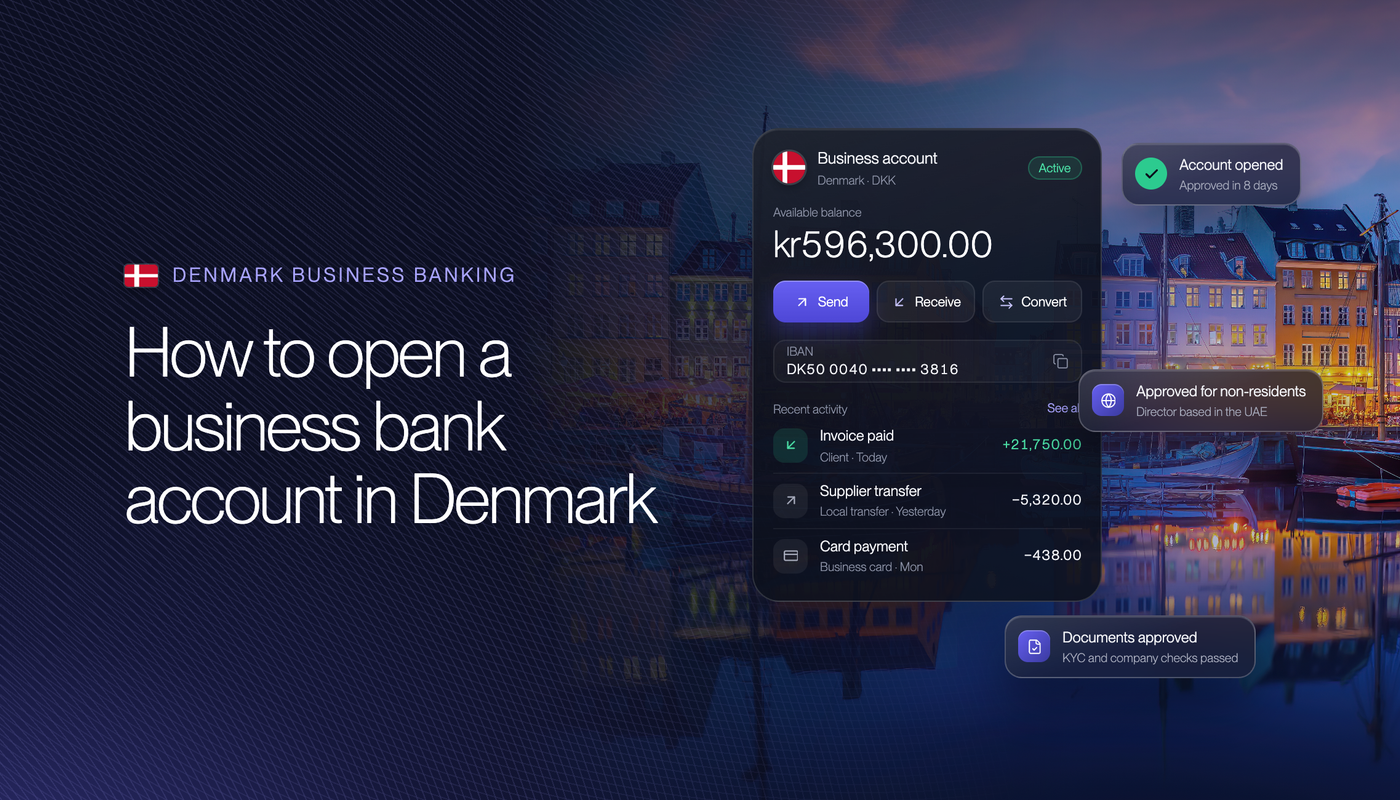
When you open a business bank account in Denmark, your company gets an account for customer payments, salaries in kroner, tax and VAT with Skattestyrelsen, and the NemKonto every Danish company must have for public payouts. Danmarks Nationalbank keeps the krone fixed against the euro, so euro income converts at a stable rate.
The hard part is getting through the bank. Danish banks build their online onboarding around MitID, the national digital ID, and charge onboarding fees of up to DKK 4,800. The legal right to a basic business account only applies when a director lives in Denmark. Foreign owners also face extra checks.
This is where we come in. We work with licensed payment partners regulated in the EU who open accounts for Danish companies remotely, in 4 days to about a week. We handle the work with you: the KYC pack, the ownership chart, the business profile and every follow-up question. Tell us about the company, and we get the account open.
Our licensed banking providers open accounts for Danish companies with foreign owners in days, with no branch visit and no MitID.

Moneybase
Multi Currency Business Account
Time to onboard
4 Days
Account opening fee
Free
Monthly fee
Starting from € 9.99

Trumia
Business account
Monthly fees
€50
Onboarding fees
€500
Time to onboard
1 week
Accepts
Gambling, Betting, Casino, Crypto, and more
Denmark Business Bank Account for Non-Residents
A non-resident can get a business bank account. Denmark's banks are built for local owners, so it takes planning. Online applications run on MitID, onboarding fees reach DKK 4,800, and the legal right to a basic account needs a director who lives in Denmark. Foreign-owned companies get more questions and a manual review.
Danish Banks Build Onboarding Around MitID
Nordea says its online business application takes about 10 minutes, and Danske Bank promises an answer within 24 hours on weekdays. Both flows expect the people behind the company to sign in and sign documents digitally, which in Denmark means MitID. Most people get MitID through a Danish CPR number. A director abroad without one has to go through a separate MitID process first, and until then the bank identifies people from passports and other documents. That moves the file from the fast online track to a manual review.
Our partners identify owners remotely, so nobody in the company needs MitID or a CPR number to open the account.
The Basic Business Account Needs a Danish Director
Since 1 January 2025, the Danish Act on Payment Accounts and Basic Business Accounts gives businesses a right to a basic business account, a basal erhvervskonto, at the systemically important banks and other large banks. The bank must open the account or refuse it within 10 working days of a complete application. The account is in Danish kroner and covers transfers, a payment card, online banking and cash deposits of up to DKK 20,000 a month.
The right has a condition that matters for foreign owners. Section 13 c applies it only to businesses with their registered office in Denmark where at least one member of the executive board lives in Denmark, or a 25% owner lives there when there is no executive board. A Danish ApS run entirely from abroad falls outside it. A bank can still open an account for you, but that is a commercial decision, not a legal right.
Open a Business Bank Account in Denmark
You can open a business bank account in Denmark for your ApS without a Danish director or MitID. We prepare the file and open the account with you.
- No MitID needed: Owners abroad are identified remotely, with no branch visit.
- KYC pack built for you: We tell you what is needed and assemble the file once.
- EU-licensed partners: Both are licensed by the Malta Financial Services Authority.
- Open in days: 4 days to about a week once the file is complete.
- High risk accepted: One partner takes gambling, betting, casino and crypto companies.
- Fewer follow-ups: We close gaps before the application goes in.
Denmark Corporate Bank Account for Foreign Companies
A Danish ApS owned by a foreign parent, or a foreign company with a Danish branch, needs a Denmark corporate bank account that can see through every layer of ownership. Danske Bank lists the CVR number and the identification of the beneficial owners as basic requirements for a business account. For a group, that means the register extract of each company above the Danish one, an ownership chart and the people at the top.
Each extra layer adds documents and time. A clean chart with percentages, matched to the CVR and to the parent's register, is the quickest way through. If you are still deciding how to enter Denmark, our guide to an EU branch or a subsidiary explains how each one banks.
Strict Checks Under the Danish Money Laundering Act
Danish banks apply the Money Laundering Act, last consolidated in April 2026 as Act no. 433. Section 11 requires them to identify the company, verify that identity from reliable sources, identify the beneficial owners and understand the ownership and control structure. In practice the bank asks where the money comes from, who the customers are, which countries payments go to and what turnover you expect. Finanstilsynet, the Danish Financial Supervisory Authority, supervises how banks carry out these checks.
From 10 July 2027, the EU Anti-Money Laundering Regulation sets one rulebook for these checks across the EU. Clear answers with documents attached keep the review short.
High Risk Sectors and a Danish Business Account
Gambling, betting, crypto, payment and money transfer companies need a high risk bank account and get extra scrutiny at any bank. The basic business account law lets a bank refuse when the business does not have the licence it needs, and when the bank suspects activity it would have to report. A licensed Danish operator can still bank locally, but the review is longer and the bank can end the relationship later.
One of our partners accepts gambling, betting, casino and crypto businesses, with a one-off €500 onboarding fee and about a week to open. Our guides on banking for a gambling company and crypto and Web3 banking cover the sector files.
What to Do After a Refusal
A refusal from one Danish bank is not the end. Ask the bank which point stopped the file. For a basic business account, the bank must give its reasons in writing and free of charge, unless an anti-money laundering rule prevents it. Fix the gap, such as a missing source of funds document or an unclear ownership layer, before you apply anywhere else.
Read why banks reject business account applications for the common causes. When you need the account quickly, we prepare a complete file for our partners and apply once.
Read more: business bank accounts for non-residents and European business bank accounts for non-residents.
Best Bank for Business in Denmark
The best bank for business in Denmark depends on where the owners live. For a Danish resident, Nordea has no onboarding fee and charges from DKK 245 a month, and Danske Bank's basic account costs DKK 139 a month. For a foreign owner, access matters more than price: MitID, the review and the basic account rule decide the route.
These are the main Danish banks for business customers, with fees taken from each bank's own published pages in 2026.
Bank | Who it suits | Opening fee | Monthly fee |
|---|---|---|---|
Danske Bank | Sole traders, new and mid-size companies; holding companies | DKK 1,500, DKK 0 for holding companies | DKK 139 to 299 for account, card and online banking |
Nordea Danmark | New and switching business customers | DKK 0 since January 2026 | From DKK 245 for Nordea Business Base |
Jyske Bank | Businesses with simple finances (Basal Erhvervskonto) | DKK 4,800, more for complex cases | DKK 230 |
Nykredit (with Spar Nord) | Small companies to groups, with a holding plan | At least DKK 3,000 | DKK 135 (Enkel) to DKK 385 (Total) |
The monthly fees look close, between DKK 135 and DKK 299 (about €18 to €40). The opening fee is where the banks differ: from nothing at Nordea to DKK 4,800 (about €640) at Jyske Bank.
Onboarding Fees Come Before the First Payment
Most Danish banks charge a one-off fee to take on a new business customer. Jyske Bank lists DKK 4,800 for its basic business account, Nykredit charges at least DKK 3,000 and Danske Bank DKK 1,500. Nordea removed its own DKK 4,800 fee in January 2026 and said this puts it among the cheapest banks for new business customers.
International Payments Cost Extra
Monthly packages cover domestic payments. Payments abroad sit outside them. Nykredit's business price list from 22 July 2026 charges DKK 50 plus a transaction fee for a standard SWIFT transfer, DKK 500 for an express transfer and an extra DKK 250 when you pay all foreign charges. Payments in from abroad cost DKK 50. Euro transfers within the EU and EEA are free.
Currency Accounts and Card Spending Abroad
A Danish business account holds kroner by default. Each extra currency account costs money: Nykredit charges DKK 450 a year per account on its Enkel plan. Card payments in other currencies carry a surcharge on the exchange rate, 1.00% for European currencies and 1.50% for others at Nykredit.
One of our partners includes euro, US dollar and sterling accounts and opens other major currencies on request at no extra charge, with conversions from 0.25%.
Where a Danish Bank Still Helps
If Danish consumers pay you by FI payment slip, you need a Danish creditor agreement, which Nykredit sets up for DKK 1,100. Cash handling, overdrafts and loans also stay with banks, because e-money institutions do not lend or handle cash. You can keep a small Danish account for these and run your international payments through our partners.
Read more: best banks for European companies and the best EU countries for business banking.
Moneybase
Multi Currency Business Account
Time to onboard
4 Days
Account opening fee
Free
Monthly fee
Starting from € 9.99
A Faster and Simpler Way to Open a Denmark Business Account
Our partners open a Denmark business account for your company remotely in 4 days to about a week. Both are e-money and payment institutions licensed by the Malta Financial Services Authority. They need no Danish director, no MitID and no branch visit, and they work in euro and other major currencies.
Plans start at €9.99 a month at one partner. The other charges €50 a month with a one-off €500 onboarding fee and accepts gambling, betting, casino and crypto companies.
Your money is safeguarded rather than covered by a deposit guarantee. E-money institutions keep client funds in segregated accounts or cover them by insurance or a guarantee, apart from the firm's own money. They do not lend or pay interest on e-money. Read what an EMI account is and how it differs from a bank account.
Feature | Danish banks | Our partners |
|---|---|---|
Time to open | Typically within 10 days at Nordea for a complete file, longer on a manual review | 4 days to about a week |
Who they take | Built for owners and managers with MitID | Danish companies with owners and directors abroad |
Identity check | MitID online, documents for owners without it | Remote, no MitID or CPR number |
Opening fee | DKK 0 to DKK 4,800 | Free at one partner, €500 at the other |
Monthly cost | DKK 135 to 299 (about €18 to €40) | €9.99 to €50 on published plans |
Currencies | Kroner, extra currency accounts from DKK 450 a year | Euro, dollar and sterling included at one partner |
Currency conversion | Bank rate plus a margin, 1.00% to 1.50% on card spending at Nykredit | 0.95%, 0.70% or 0.25% by plan at one partner |
High risk sectors | Case by case, refusal allowed without a licence | Accepted at one partner |
Protection | Deposits covered up to €100,000 | Client money safeguarded |
A Danish bank fits a resident company that trades in kroner and wants credit. For foreign owners, clients in several currencies or a high risk activity, our partners open faster, convert for less and need no MitID or Danish director.
International Business Bank Account in Denmark
An international business bank account in Denmark is the setup most foreign-owned companies need: an EU IBAN for euro clients, accounts in dollars and sterling, and a way to pay costs in Danish kroner. One of our partners converts 24 currencies and sends cross-border payments in 22, Danish krone included, so you can pay Danish suppliers and staff from the same account. For more on holding several currencies, see our multi-currency business account guide and our guide to international business bank accounts.
Under Article 9 of the SEPA Regulation, a payer sending euro cannot refuse your IBAN because it belongs to another EU country.
How to Open a Business Bank Account in Denmark With Us
Opening a business bank account in Denmark with us takes four steps. You tell us about the company and its activity in the pop-up form. We send a document list for your structure and check each file before it goes in. We submit to the partner that fits your sector and answer its questions with you. The account opens in 4 days to about a week, and we help you register it as the company's NemKonto if you want to.
Trumia
Business account
Monthly fees
€50
Onboarding fees
€500
Time to onboard
1 week
Accepts
Gambling, Betting, Casino, Crypto, and more
Moneybase
Multi Currency Business Account
Time to onboard
4 Days
Account opening fee
Free
Monthly fee
Starting from € 9.99
Documents to Open a Business Bank Account in Denmark
To open a business bank account in Denmark you need the CVR registration, the memorandum and articles of association, the beneficial owner details, a passport and proof of address for each director and owner, and a short business profile. Danish banks and our partners ask for the same core file, so build it once.
Company Documents
Start with the CVR extract from the Danish Business Authority, the memorandum of association (stiftelsesdokument) and the articles of association (vedtægter). Add the ownership chart and, for a holding structure, the register extract of every company above the ApS. A newly formed company also shows how the share capital was paid in. Our guide to banking for a newly formed company covers the first weeks.
Directors and Beneficial Owners
Every director and every person who owns or controls more than 25% provides a valid passport and a recent proof of address. Danish companies register their beneficial owners in the CVR, and the bank or partner checks that your chart matches the register. A mismatch between the two leads to follow-up questions and delays. The business bank account requirements guide lists what each type of owner needs.
Business Profile and Money Flows
The business profile explains what the company does, who its customers are, which countries money comes from and goes to, and the expected monthly turnover. A one-page profile with numbers answers most of the questions a bank asks under Section 11 of the Money Laundering Act. Our full list of documents needed to open a business bank account goes through each item.
Prepare Your Denmark Business Bank Account File
A complete file is what gets a Danish business bank account open in days. We build it with you.
- Register details checked: CVR, articles and ownership match before anything is sent.
- Ownership chart drawn: Every layer up to the people, with percentages.
- Source of funds explained: A short note with proof for the capital and first payments.
- Business profile written: Activity, customers, countries and turnover on one page.
- Translations flagged: We tell you which Danish documents need an English version.
Denmark Business Bank Account Costs
A Denmark business bank account at a local bank costs DKK 0 to DKK 4,800 to open and DKK 135 to 299 a month, before payments abroad, extra currency accounts and confirmations. With our partners, opening is free at one partner and €500 at the other, and plans run from €9.99 to €50 a month.
Charge | Typical range at a Danish bank | With our partners |
|---|---|---|
Account opening | DKK 0 at Nordea, DKK 1,500 at Danske Bank, DKK 4,800 at Jyske Bank | Free at one partner, €500 at the other |
Monthly package | DKK 135 to 299 (about €18 to €40) | From €9.99 to €50 on published plans |
Basic business account | DKK 139 a month at Danske Bank, DKK 230 at Jyske Bank | Not needed, the plan covers the account |
Extra currency account | DKK 450 a year at Nykredit (Enkel) | Euro, dollar and sterling included at one partner |
Extra online banking user | DKK 450 a year at Nykredit (Enkel) | Shown on the plan |
Extra debit card | DKK 300 a year at Nykredit (Enkel) | Shown on the plan |
Euro payment within the EU and EEA | DKK 0 at Nykredit | Shown on the plan |
International payment out (SWIFT) | DKK 50 plus a transaction fee, express DKK 500 | Shown on the plan |
Paying all foreign charges | DKK 250 extra at Nykredit | Quoted with your setup |
International payment in | DKK 50 at Nykredit, euro from the EU and EEA free | Shown on the plan |
Currency conversion | Bank rate plus a margin, 1.00% to 1.50% on card spending | 0.95%, 0.70% or 0.25% by plan at one partner |
Recall or change of a payment | DKK 400 at Nykredit | Quoted with your setup |
Auditor confirmation | DKK 1,200 per request at Nykredit | Quoted with your setup |
Cash deposit at the counter | DKK 50 per deposit at Danske Bank, plus 1.85 per mille | Not offered, e-money institutions do not handle cash |
Read the first year, not the monthly price. At Jyske Bank, the basic business account costs DKK 4,800 to open plus DKK 230 a month, which is DKK 7,560 (about €1,010) in year one. Danske Bank's basic account comes to DKK 3,168 (about €425) and Nordea's Business Base to DKK 2,940 (about €395). On its €9.99 plan, one of our partners comes to about €120 for the year.
The bigger costs sit in payments and currency. If your bank's margin on conversions is 1.00%, the same as Nykredit's card surcharge for European currencies, €200,000 of conversions a year costs €2,000. At 0.25% on one partner's top plan, the same volume costs €500.
To be fair to the local banks, a Danish resident with a simple ApS that only trades in kroner may pay less at Nordea or Danske Bank, and only a Danish bank offers FI payment slips and cash services. The figures above are planning ranges from 2026 price lists, and your bank or partner confirms the final price for your setup. Our guide to business bank account fees explains each charge.
Moneybase
Multi Currency Business Account
Time to onboard
4 Days
Account opening fee
Free
Monthly fee
Starting from € 9.99
Trumia
Business account
Monthly fees
€50
Onboarding fees
€500
Time to onboard
1 week
Accepts
Gambling, Betting, Casino, Crypto, and more
How Long Opening a Business Bank Account in Denmark Takes
Opening a business bank account in Denmark takes up to about 10 days at Nordea for a complete file, and a bank has 10 working days to decide on a basic account. Owners without MitID and foreign-owned groups can take longer. Our partners open in 4 days to about a week once the file is complete.
Stage | Danish bank | Our partners |
|---|---|---|
Company in the CVR | Required before the operating account | Required before the operating account |
Application | Online in about 10 minutes at Nordea, answer within 24 hours on weekdays at Danske Bank | Pop-up form, then the file we build with you |
Identity check | MitID, or documents for owners without it | Remote, no MitID |
Review | Typically within 10 days at Nordea, 10 working days for a basic account decision | Part of the 4 days to about a week |
Account ready | After review, then cards and online banking | 4 days to about a week after a complete file |
What Slows It Down
The usual causes are owners without MitID, a beneficial owner entry in the CVR that does not match the chart, missing register extracts for a foreign parent, a business profile without numbers, and an activity that needs a licence.
How to Speed It Up
Register the company and its beneficial owners first. Prepare the passports, proofs of address, ownership chart and a one-page profile before you apply. Answer every question in one reply with documents attached. If you are still at the formation stage, our guide on how long it takes to set up a company helps you plan both steps.
Read more: the best countries for business banking and business bank accounts in Europe.
Trumia
Business account
Monthly fees
€50
Onboarding fees
€500
Time to onboard
1 week
Accepts
Gambling, Betting, Casino, Crypto, and more
What Happens After the Account Is Open
After the account opens, register it where Danish authorities and customers need it: as the company's NemKonto, on your invoices, with your accountant and with Skattestyrelsen.
Every Danish company needs a NemKonto, the account public bodies pay into, for example when Skattestyrelsen refunds VAT. A Danish account becomes the NemKonto through its bank. A foreign account can also be the NemKonto: the company applies on a form through MitID Erhverv, or on a paper form, as described on virk.dk.
Danish tax, VAT and payroll are paid in kroner. Keep a kroner budget and convert in planned amounts. Because the krone is fixed against the euro, the rate between the two moves very little. Our guide to cash management covers how to plan balances across currencies.
When clients in the euro area pay you, their bank checks your company name against your IBAN under the Instant Payments Regulation, so the account name must match the CVR. Banks and our partners also review files over time, so keep your CVR entries and business profile current. Our guide on de-risking and account closures explains what triggers a review.
Why the Company Comes Before the Account
Before any business bank account, Denmark's company register comes first: a bank or partner opens an operating account only for a company that already exists in the CVR. A Danish ApS needs share capital of at least DKK 20,000, half the old DKK 40,000 minimum, after a 2025 change to the Companies Act. When the capital is paid in cash, the Danish Business Authority accepts a declaration from a bank, from an approved auditor that the money is in a bank account, or from a lawyer that it is in the lawyer's client account. A netbank printout is not enough.
Our partners are e-money institutions, not banks. A non-resident founder can pay the capital through a Danish lawyer's client account, register the company, and then open the operating account with us. Our guides on setting up a company as a non-resident and European company formation explain the order.
Moneybase
Multi Currency Business Account
Time to onboard
4 Days
Account opening fee
Free
Monthly fee
Starting from € 9.99
Common Denmark Business Bank Account Mistakes
Paying the Share Capital Into an E-Money Account
Founders who already hold an e-money account sometimes send the share capital there. The Danish Business Authority accepts cash capital only with a declaration from a bank, an approved auditor or a lawyer holding it on a client account, and a netbank printout does not count. If the money sits in the wrong place, the registration waits until the capital is paid again through an accepted route. Pay the capital through a Danish bank or a lawyer's client account, register the company, then open the operating account with our partners.
Applying for the Basic Account Without a Danish Director
Some founders treat the basic business account as a guaranteed route. Most foreign-owned companies do not qualify for it. Section 13 c covers only businesses where at least one executive board member lives in Denmark, or a 25% owner lives there when there is no executive board. A company that applies without meeting the condition can wait up to 10 working days for a refusal. If no director lives in Denmark, apply to our partners or to a bank on commercial terms.
Counting Only the Monthly Fee
A DKK 135 package looks cheap. Add a DKK 3,000 onboarding fee, DKK 450 a year for each currency account and DKK 50 for every SWIFT payment, and the year costs far more. A company with two currency accounts and four foreign payments a month pays DKK 7,920 (about €1,060) in year one at Nykredit, before transaction fees. Price the full year with your real payment pattern before you choose where to bank.
Get Help With a Denmark Business Bank Account
Tell us about your Danish company and its owners. We send back what we need and open the account with you.
- One form, one team: Send your details once and we handle every follow-up.
- Structure checked first: We spot ownership and capital gaps before a provider does.
- Kroner payments planned: Pay Danish suppliers and staff without a local bank.
- Sector fit: Gambling, betting and crypto companies go to the partner that takes them.
- Remote from start to finish: No branch visit and no MitID at any step.
Bottom Line
A Denmark business bank account is easy to open for a resident with MitID and a simple ApS. Run from abroad, it takes more: online flows depend on MitID, onboarding fees reach DKK 4,800 at Jyske Bank, and the right to a basic account needs a director who lives in Denmark.
Our partners open an account for your Danish company remotely in 4 days to about a week, from €9.99 a month, with euro, dollar and sterling accounts and payments in kroner. Pay the share capital through a bank or a lawyer, register the company in the CVR, then send us your file. We prepare it, submit it to the right partner and stay with you until the account is open.
Can a non-resident open a business bank account in Denmark?
What is the best bank for business in Denmark?
How much does a Denmark business bank account cost?
How long does it take to open a business bank account in Denmark?
What documents do I need to open a business bank account in Denmark?
Can a foreign company open a Denmark corporate bank account?
Can I open a Denmark business bank account online from abroad?
What is a basic business account in Denmark?
Do I need a Danish IBAN for my ApS?
Where do I pay in the share capital for a Danish ApS?
Is money in a Danish business bank account protected?
Can I pay in Danish kroner without a Danish bank?
Does a Danish company need a NemKonto?
Sources
- Danske Bank, Erhvervskonto (business account packages and opening fee)
- Danske Bank, Basal Erhvervskonto prices and terms from 17 June 2026
- Nordea Danmark, Bliv erhvervskunde (fees and onboarding time)
- Nordea press release, 12 January 2026, onboarding fee removed
- Jyske Bank, Basal Erhvervskonto
- Nykredit Bank, general business prices from 22 July 2026
- Act on Payment Accounts and Basic Business Accounts, LBK no. 1462 of 18 November 2025
- Money Laundering Act (hvidvaskloven), LBK no. 433 of 17 April 2026
- Act no. 1667 of 30 December 2024 amending the Companies Act (ApS minimum capital)
- Danish Business Authority, decision on documenting paid-in share capital
- Virk, NemKonto for companies (foreign account as NemKonto)
- Danmarks Nationalbank, the fixed exchange rate policy
- Financial Stability, Deposit Guarantee Fund (Garantiformuen)
- Regulation (EU) No 260/2012 (SEPA Regulation), EUR-Lex