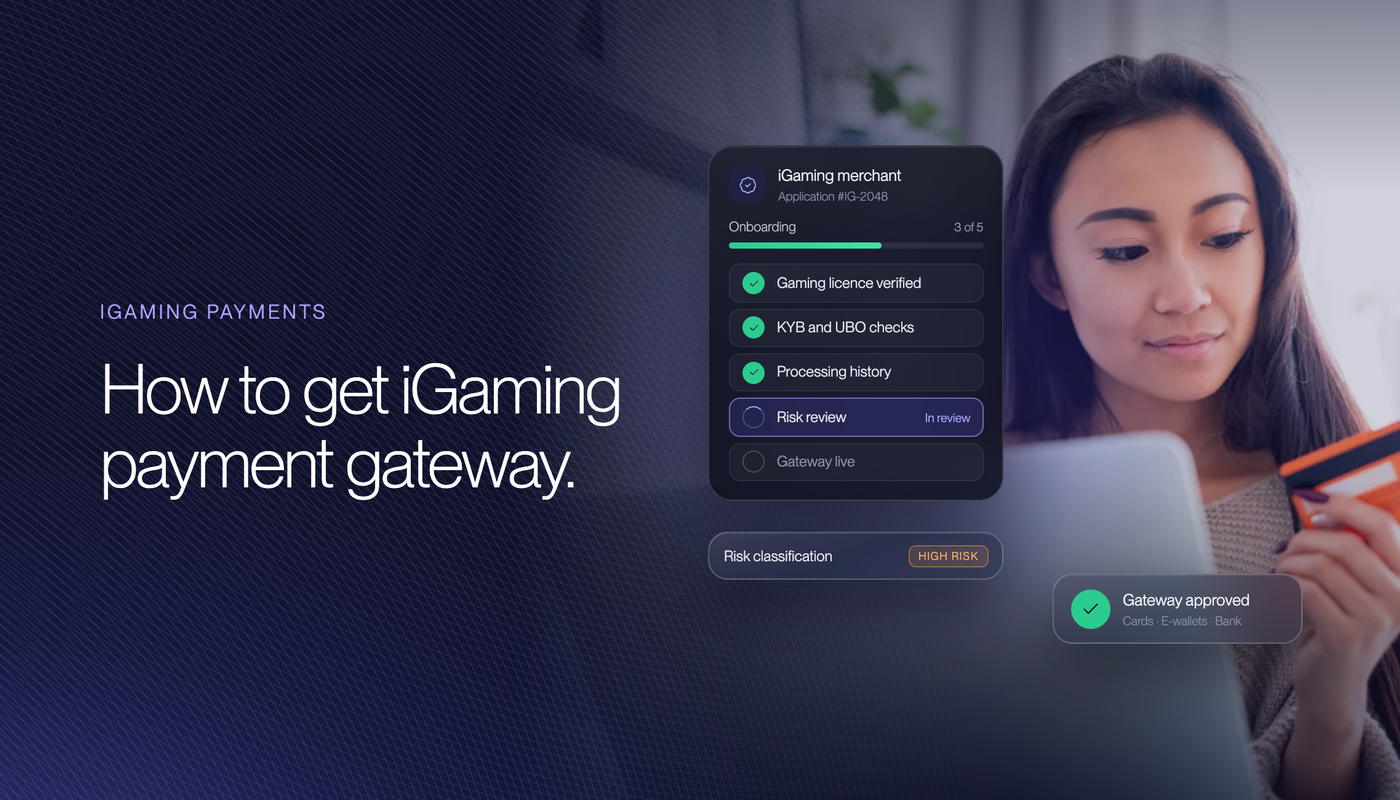
An iGaming payment gateway lets a licensed operator take deposits across every market it is licensed in, pay players out, and settle to the company in USD, EUR, GBP, CAD or another major currency. One connection carries cards, wallets, open banking and local bank rails, with reporting your finance and compliance teams can both use.
Operators rarely run one account for long. Approval rates differ by country, acquirers cap volume, reviews happen, and a single provider becomes a single point of failure on your biggest weekend. Add the scheme registration gambling needs and it is clear why this takes planning rather than a signup form.
This is where we come in. Through one intake form, Binderr Chooses, we place your file with a regulated partner that already accepts licensed gaming operators, prepare the KYC pack and run the whole application for you. Most merchants are taking payments within 5 to 7 business days.
Get an iGaming Payment Gateway Approved Fast
Licensed operators approved through partners that process betting and gaming volume every day.
- Licensed iGaming accepted: partners registered to write MCC 7995 business.
- Binderr Chooses: one intake form, and we place your file with the right partner.
- Fast approval: a preliminary answer in about 1 business day.
- Multi-market ready: the licensed countries you actually take traffic from.
- Major currencies: settle in USD, EUR, GBP, CAD and more.
- KYC pack prepared: licence, documents and policies checked before submission.
What Is an iGaming Payment Gateway?
An iGaming payment gateway is the payment layer behind an online gaming operator: the cashier, the acquiring behind it and the rails that move money in and out. It takes deposits, confirms them to your platform in real time, processes withdrawals and settles the balance to your company, with the scheme coding gambling requires on every transaction. An iGaming payment gateway is judged on all of that together, not on the checkout alone.
What a Payment Gateway for iGaming Includes
A payment gateway for iGaming is a package. It includes a merchant account with an acquirer registered to process gambling, card acceptance coded as MCC 7995, local payment methods per market, withdrawal rails, fraud and dispute tooling, player-level limits and reporting that satisfies a regulator's request without a data project.
The pieces are not interchangeable. Software with no registered acquirer behind it cannot process a single deposit, and an acquirer with no local methods leaves half your markets underperforming. Our guide to what a payment gateway is covers the parts that every sector shares, and payment gateways for video games and online gaming covers games sold without a cash prize, which are underwritten as standard risk.
What an eGaming Payment Gateway Is
An eGaming payment gateway is the same product under an older name. Regulators in Curacao and parts of Europe still use eGaming in licence documents, so procurement teams inherit the term. Whatever the label, the underwriting of an eGaming payment gateway is identical: a licensed operator, gambling coding, a registered acquirer and payouts on scheme-approved rails.
What a Payment Gateway in iGaming Must Do
A payment gateway in iGaming has to do three things a mainstream gateway never has to. It has to identify every transaction as gambling, including the quasi-cash indicator in the US, Canada, Asia Pacific, CEMEA and Latin America. It has to send winnings back out as Original Credit Transactions, returning to the same card in Europe. And it has to switch methods and limits market by market, because what is legal in one licensed country is capped or banned in the next.

High Risk Payment Gateway and Merchant Account
Binderr Chooses
Time to onboard
5 to 7 days
Currencies
USD, EUR, GBP and more
Industries
Gambling, Adult, CBD, Crypto, Travel, Forex and more
Gaming Operators High Risk Payment Processing Challenges
Most gaming operators' high risk payment processing challenges come down to four things: declines, disputes, concentration and complexity. None of these gaming operators high risk payment processing challenges is solved by a better looking checkout.
Declines and Approval Rates
Gambling deposits are declined more often than any mainstream category. Issuers block MCC 7995 by policy, credit cards are banned for gambling in several markets, cross-border cards perform worse than domestic ones, and the quasi-cash flag makes some issuers treat a deposit as a cash advance.
Approval rate is the number that moves revenue. Two points on real deposit volume outweighs any rate negotiation, and the fix is usually a local method or local acquiring rather than new software. Ask for approval rates by country and card type, and ask how the figure is calculated. Read more: how to improve payment gateway success rates.
Chargebacks and Scheme Monitoring
Visa flags a card-absent merchant at a 1.5% fraud and dispute ratio with at least 1,500 cases a month, and charges about USD 8 per case above the line. Mastercard's excessive chargeback programme starts at 100 chargebacks and a 1.5% ratio, with fines from USD 1,000 a month rising to USD 50,000 a month by the twelfth month.
Most disputes are players who lost rather than stolen cards, so the defences are operational: verify early, keep stake and session logs, use alerts to refund before a case is filed, and make bonus terms match what the cashier does. Read more: chargeback management for high risk merchants.
Concentration and Market Complexity
One acquirer covering every market is the risk operators notice last. A review, an outage or a market suspension stops deposits everywhere at once, and a volume cap agreed on an average month becomes declined deposits during a tournament weekend.
Complexity is the other half. Each licensed market has its own rules, from the UK ban on gambling with credit cards to Germany's EUR 1,000 monthly deposit cap and Brazil's bank-only payment regime. Our guide to gambling payment gateways covers those market rules in detail.
Fast Approval for a Payment Gateway for iGaming
Approved, coded and live in days, through partners that already run licensed gaming volume.
- MCC 7995 handled properly: scheme coding and registration from day one.
- Caps set on your peak: volume agreed for your busiest weekend, not your average.
- Approval rates by market: real figures per country and card type.
- Local methods included: open banking, wallets and bank transfer where players expect them.
- Regulated partners only: licensed acquirers and payment institutions.
High Risk Payment Solutions for Online Gaming
The high risk payment solutions for online gaming that actually work are structural. They spread risk, route around failure and give you numbers you can act on, and they sit on top of a high risk gaming merchant account rather than replacing one.
More Than One Acquiring Route
Operators of any size split volume across more than one acquirer. It keeps deposits flowing through a review or an outage, it gives you a live comparison of approval rates, and it removes the leverage a single provider has at renewal. Start the second route before you need it, because applying under pressure gets worse terms.
Routing, Cascading and Retries
Routing sends each deposit down the account most likely to approve it, usually by country, card type and amount. Cascading retries a declined payment on a second route, and sensible retry logic reads the decline code instead of hammering the same card. Together they recover deposits that a single connection loses silently. Read more: how smart routing and payment orchestration work.
Local Methods and Payout Rails
Cards are not the default in much of the world. Open banking and instant bank transfers lead in the Nordics and the Netherlands, Pix carries Brazil, Interac carries Canada, and wallets take a large share nearly everywhere. Payouts matter as much: a player paid in minutes tells nobody, and a player waiting three days tells everyone. Where crypto is allowed, it reaches players whose cards fail, and our guide to how crypto payment gateways work covers that setup.
Reporting Your Finance and Compliance Teams Can Use
Reconciliation across several acquirers, currencies and methods is where operators quietly lose hours. Ask for settlement files that match your platform's transaction IDs, per-market breakdowns and dispute data in a format you can query. Regulators ask for player-level payment histories, and a setup that cannot produce them turns every request into a project.
Choosing a Gaming Payment Gateway Provider
Choosing a gaming payment gateway provider is an underwriting question more than a feature question. Any of the gaming payment gateway providers in this market can show you a checkout. Far fewer can process your markets, take your product mix and still be there after a busy quarter.
What Gaming Payment Gateway Providers Must Support
Gaming payment gateway providers should cover your licensed markets, the methods players use in each, withdrawals on scheme-approved rails, player-level limits, fraud tooling built for gambling and reporting per market. Ask what happens during a volume spike and what the process is for raising a cap temporarily. The acquiring banks that write high risk business are a short list, so the acquirer behind the offer matters more than the brand in front of it.
Questions for Payment Gateway Providers for iGaming
Five questions separate payment gateway providers for iGaming quickly. Which acquirer sits behind the account and is it registered for gambling? What are the approval rates in my top three markets? What reserve and cap apply, and when are they reviewed? How are withdrawals processed and how fast? And what does the settlement file look like?
What the Best Payment Gateway for iGaming Looks Like
There is no single best payment gateway for iGaming, because the answer changes with your licence, markets, product mix and volume. The best setup is the one whose acquirer accepts your licence, prices your real markets, pays out on time and gives you the numbers to improve. Anything marketed as the best payment processing for high risk gaming transactions should be judged on those four points.
High Risk Payment Gateway and Merchant Account
Binderr Chooses
Time to onboard
5 to 7 days
Currencies
USD, EUR, GBP and more
Industries
Gambling, Adult, CBD, Crypto, Travel, Forex and more
iGaming Payment Gateway Integration
Integration is the quick part of an iGaming payment gateway project, as long as it is planned around the cashier rather than bolted onto it. Most iGaming payment gateway partners offer an API, a hosted cashier page or a plugin for the common platforms, and a developer can connect any of them in about a day once credentials arrive.
Cashier, Platform and Webhooks
The cashier has to talk to your platform in both directions. Deposits confirm through a webhook so the balance updates while the player is still on the page, withdrawals are requested from the same place, and every transaction carries an order reference your finance team can match to a settlement file. Read more: how to add a payment gateway to your website.
Card Data, Tokens and PCI Scope
Use a hosted or fully embedded cashier and card data never touches your servers, which keeps your PCI DSS obligation to a short self-assessment. Tokenise stored cards so returning players deposit in one tap and payouts can be sent back to the credential that placed the wager. Our guide to payment gateway security features covers the controls.
Adding Methods and Markets Later
A good setup makes a new market a configuration change rather than a project. Ask how a new payment method is enabled, whether limits are set per market, and what testing the partner provides before you switch a country on. Operators that get this right launch a market in days rather than a quarter.
What a High Risk Gaming Merchant Account Costs
A high risk gaming merchant account is priced on risk and history rather than volume alone. These are typical market ranges on the lower side, and your own numbers depend on licence, markets, products and chargeback record.
Cost item | Typical range |
|---|---|
Setup fee | USD 0 to USD 500 |
Monthly account fee | USD 10 to USD 50 |
Processing rate | 2.5% to 5% of each deposit |
Fee per transaction | USD 0.10 to USD 0.35 |
Gateway fee | USD 10 to USD 30 a month, plus USD 0.05 to USD 0.15 per transaction |
Chargeback fee | USD 15 to USD 35 per dispute |
Rolling reserve | 5% to 10%, held 90 to 180 days |
Scheme registration | USD 950 a year for Visa high integrity risk registration |
An online gaming merchant account, high risk by classification rather than by reputation, also carries scheme registration. Visa charges the acquirer USD 950 per registered merchant, up from USD 500 on 1 April 2024, and requires an annual attestation that you still operate lawfully. Our list of high risk merchant industries and MCC codes shows where gaming sits, and high risk merchant account fees and rates breaks the pricing down further.
Reserves and Volume Caps
The reserve costs more than the rate. At 8% held for 180 days, an operator processing USD 500,000 a month has around USD 240,000 of its own money with the acquirer at any time. Caps matter just as much in gaming, because volume is seasonal and a cap set on an average month stops deposits during your biggest event. A high risk gaming merchant account is reviewed on behaviour, so the first clean quarter is worth more than any negotiation.
Both are reviewed. After two or three clean quarters, ask for the rate, the reserve percentage, the hold period and the cap to be looked at together rather than one at a time.
How Long Approval Takes
With a complete file, most operators are live within 5 to 7 business days with our partners. This is the timeline they work to.
Stage | Typical time |
|---|---|
Quick assessment | 5 minutes |
Preliminary approval | 1 day |
Complete onboarding requirements | 15 minutes |
Provision of services | 3 days |
Total | 5 to 7 business days |
New licences, complex ownership and sites missing player protection tools add days. Read more: how to set up a high risk payment gateway and how to open a high risk merchant account.
High Risk Payment Solutions for Online Gaming Operators
Routing, reserves and reporting set up for an operator rather than a single merchant account.
- More than one route: volume split so a review never stops your deposits.
- Cascading built in: declined deposits retried the right way.
- Reserve agreed upfront: percentage and hold period in writing.
- Reporting per market: settlement files your finance team can reconcile.
- One point of contact: no back-and-forth with several providers.
Payment Gateways for High Risk iGaming in the US
The United States is licensed state by state, so payment gateway options for high risk iGaming businesses in the US depend on where you hold a licence rather than on what your provider can technically support. Online sports betting is live in 30 states plus Washington DC and Puerto Rico, while online casino games are legal in only eight states. Payment gateways for high risk iGaming in the US are approved against that map rather than against your global volume.
State Licensing and Geolocation
Each state licenses operators separately, and geolocation decides whether a deposit may be taken at all. A player who crosses a state line mid-session has to be blocked, and your payment setup has to record that decision. Acquirers ask about geolocation controls early, because they carry the consequence of an illegal transaction alongside you. Payment gateway options for high risk iGaming businesses in the US narrow quickly when those controls cannot be demonstrated.
Card Rules That Hit US Gaming Traffic
Two Visa rules bite hardest here. US gambling deposits carry the quasi-cash and online gambling indicator, so some issuers price them as a cash advance and others decline them. And a gambling merchant in the US gets no protection from card-absent fraud disputes when a payment is authenticated with 3D Secure, which ordinary online merchants do get.
That combination is why payment gateways for high risk iGaming in the US lean on debit cards, wallets and bank rails rather than credit cards, and why fraud screening has to be stronger than the scheme minimum.
Working Out Your US Payment Stack
Payment gateway options for high risk iGaming businesses in the US usually mean a domestic acquirer for card volume, an ACH or instant bank option for larger deposits, and a payout rail that matches state rules. Our guide to high risk merchant accounts in the USA covers the domestic side, and high risk ACH payment processing covers bank rails.
What Underwriters Check on an iGaming Application
Underwriting is deeper here than in any mainstream sector, and the file either answers the questions or it does not.
Licence, Ownership and History
Expect to provide incorporation documents, your gaming licence and the markets it covers, details of anyone owning 25% or more with passports and proof of address, 3 to 6 months of bank statements and processing history where you have it. Explain a holding structure before anyone has to ask about it.
Site and Player Protection
Underwriters open the site and check for the licence number and regulator, terms and conditions, bonus terms that match the cashier, responsible gambling tools and self-exclusion, age verification, contact details, a clear withdrawal policy and geo-blocking for markets you are not licensed for. Our guides to AML requirements for iGaming and online gambling operators and AML platforms for gambling operators cover the compliance side.
Your Licence Decides Your Options
The regulator you hold decides which acquirers can write your business. A Malta gaming licence or an Isle of Man gambling licence opens doors an unlisted authorisation does not. Curacao now licenses operators directly, sublicences ended on 1 January 2025 and physical presence on the island has been required since 1 January 2026. Our guide to setting up an iGaming business in Malta covers the company and the licence together.
High Risk Payment Gateway and Merchant Account
Binderr Chooses
Time to onboard
5 to 7 days
Currencies
USD, EUR, GBP and more
Industries
Gambling, Adult, CBD, Crypto, Travel, Forex and more
Banking and Settlement for iGaming Operators
Settlement has to land somewhere, player funds often have to be segregated, and affiliates and suppliers have to be paid. Most banks decline gaming as a category before reading the file, so run the account application alongside the gateway rather than after it.
Declare the activity upfront and expect questions about player fund segregation, your licence and your payment flows. Our guides to the best banks for online casino and iGaming companies, opening a bank account for a gambling company and how to open a high risk bank account cover that side. If the company is not set up yet, start with how to set up a company.
Common iGaming Payment Mistakes
These are the mistakes that cost operators money when they set up an iGaming payment gateway, in the order they usually happen.
Running One Account Until It Breaks
A single route is fine until the first review. Add the second before you need it, when your numbers are good and you have time to negotiate.
Setting Caps on an Average Month
Gaming volume is seasonal. A cap agreed on a quiet month turns your biggest weekend into declined deposits and support tickets.
Optimising Rate Instead of Approvals
A 0.2% rate cut is worth far less than two points of approval rate. Ask for the approval numbers first and negotiate the rate second.
Treating Payouts as a Back Office Problem
Withdrawal speed drives retention and disputes. Payout rails, the same card rule in Europe and verification timing belong in the design, not in a support script. Our guide to how casino payment gateways work walks through that flow.
Describing the Operation Loosely
Underwriters compare the application against the site. Products left off the form, markets you are not licensed for, or crypto deposits nobody mentioned turn a workable file into a closed account a quarter later, and a closure can put the company on the Mastercard MATCH list for five years.
One Application to Payment Gateway Providers for iGaming
Apply once, and we choose the partner, prepare the file and run the application for you.
- One intake form: Binderr Chooses reads your operation and picks the partner.
- High risk accepted: licensed gaming is what these partners write.
- Documents handled: KYC pack, licence and policies prepared for you.
- No provider shopping: no sending the same file to a dozen sites.
- Live in days: most operators take deposits within 5 to 7 business days.
Bottom Line
An iGaming payment gateway is an infrastructure decision, not a checkout choice. The acquirer has to be registered for gambling, the setup has to cover the markets your licence allows, and the numbers that matter are approval rates, reserve terms and payout speed rather than the headline rate. That is what makes the best payment gateway for iGaming a different answer for each operator.
We set it up through one intake form with a regulated partner that already accepts licensed operators, and most merchants are live within 5 to 7 business days. If you run a casino product, our guide to what a high risk merchant account is explains the account underneath it, and how high risk payment processing works covers the wider picture.