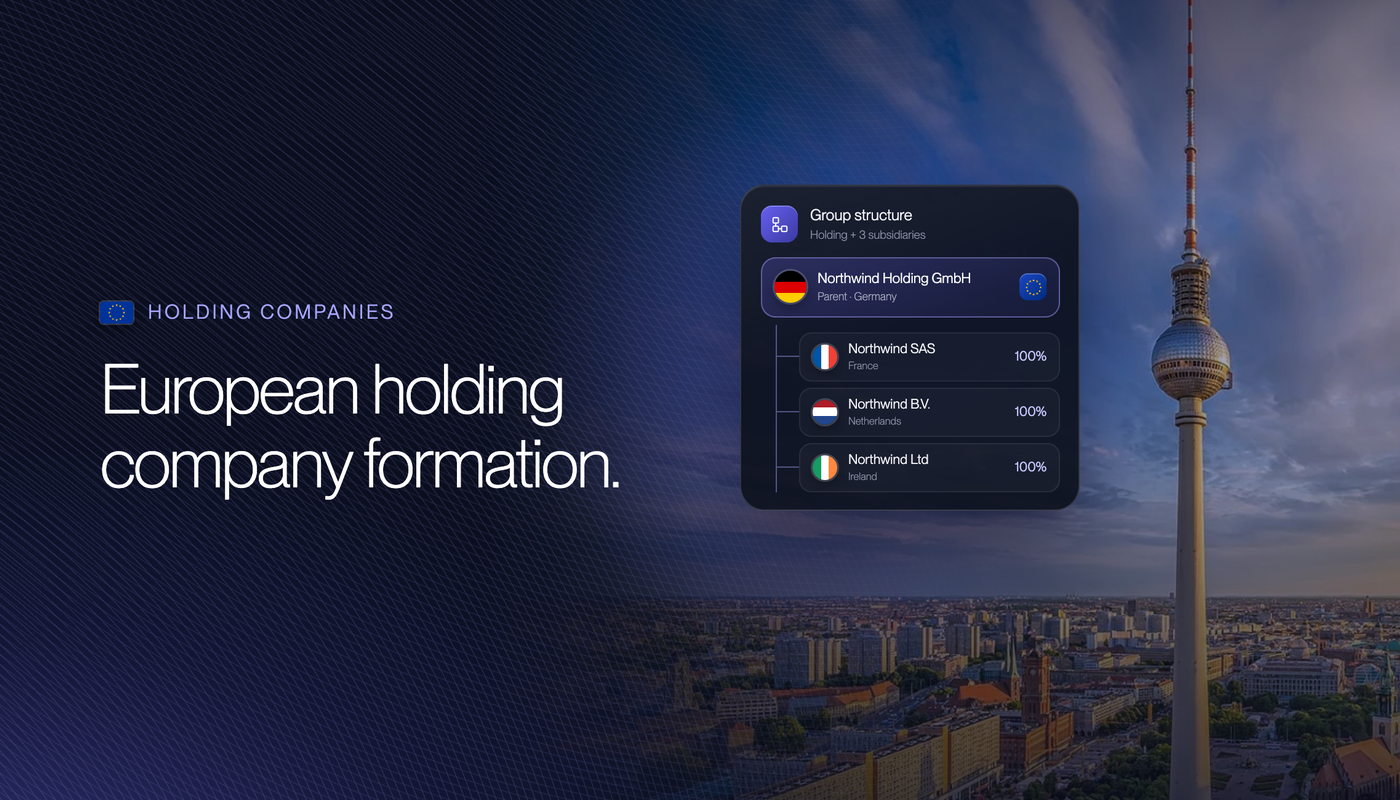
European holding company formation gives your group one EU parent that owns the operating companies. Under the Parent-Subsidiary Directive, dividends from EU subsidiaries reach it with no withholding tax. Cyprus, Malta and Ireland then exempt those dividends, and the gain on selling a subsidiary, once the holding tests are met.
The detail sits in those tests. Ireland wants a 5% stake held for 12 months, Malta wants a participating holding, and Cyprus has a check for passive, low-taxed subsidiaries. The company must also be run from the country where it is formed, and banks ask for the full group chart before they open an account.
This is where we come in. We form the holding company ourselves and take care of the parts that need it: the country choice for your group, the KYC pack, the board and substance plan, the registry filing and the bank introduction. One team runs it, with no email chains, and your EU holding company is ready in about a week.
We form your EU holding company from €1,200 in Cyprus, €1,299 in Malta or €1,899 in Ireland, usually in about a week.

Cyprus Company Incorporation
Binderr
Corporate tax
15% flat
Time to Incorporate
1 Week
Cost
€1,200 one-off
Malta Company Incorporation
GCS Malta
Effective tax
~5% for non-resident
Time to Incorporate
1 Week
Cost
Starting from €1,299
Ireland Company Incorporation
Binderr
Corporate tax
12.5% trading / 25% non-trading income
Time to Incorporate
1 Week
Cost
€1,899
Why Founders Use a European Holding Company
A holding company in Europe lets profits and sale proceeds move up a group with little or no tax on the way. Dividends from EU subsidiaries arrive free of withholding, Cyprus, Malta and Ireland exempt them, and a subsidiary can usually be sold with no tax on the gain.
Tax-Free Dividends From EU Subsidiaries
The Parent-Subsidiary Directive, 2011/96/EU, stops a member state from withholding tax on dividends that a subsidiary pays to its parent in another member state. The parent needs at least 10% of the capital, and a country may ask for the stake to be held for up to 2 years. Cyprus, Malta and Ireland then exempt qualifying dividends, so profit taxed once in the subsidiary is not taxed again. Our guide on how a holding company works covers the basics.
Tax-Free Gains on Selling a Subsidiary
Most groups build the holding layer for the day they sell. When the holding company sells a subsidiary, all three countries exempt the gain if their conditions are met. Cyprus exempts gains on shares outright, unless the company sold owns property in Cyprus. Malta exempts gains on a participating holding. Ireland exempts them when the stake is at least 5%, held for 12 months, and the group mainly trades.
Form Your European Holding Company With Us
European holding company formation is simple when one team runs all of it.
- Country chosen for your group: Cyprus, Malta or Ireland, based on your subsidiaries.
- One group file: One KYC pack for the registry and the bank.
- Local signing handled: The Cyprus lawyer, the Malta e-signature or the Irish director rule.
- Board planned for substance: Directors and meetings set so the company stays resident.
- Owners filed for you: The first beneficial ownership filing made at formation.
- Formed in about a week: Every step run by us once the file is complete.
No Withholding on Dividends to Owners Abroad
Profits still have to reach you. Cyprus charges no withholding tax on dividends to non-resident owners, apart from payments to companies in EU-blacklisted jurisdictions and, since 2026, to related companies in low-tax jurisdictions. Malta withholds nothing on dividends. Ireland charges 25% dividend withholding tax, but exempts most owners resident in the EU or a treaty country.
One Parent for Several Operating Companies
An EU holding structure puts every operating company under one owner. You can move cash up as dividends, fund a new venture from past profits, bring in an investor at the top, or sell one business without touching the rest. Our guide to how a holding company differs from an operating company explains the split, and SPVs and holding companies covers when a single-purpose vehicle fits better.
Treaty Access for an EU Holding Company
Tax treaties cut withholding on income from outside the EU. Ireland has signed treaties with 78 countries, 75 of them in effect. KPMG Malta puts Malta's network at close to 80 countries, and PwC lists 67 treaty partners for Cyprus. A subsidiary outside the EU then pays dividends to a holding company in the EU at the treaty rate. See our page on Cyprus double tax treaties.
Malta Company Incorporation
GCS Malta
Effective tax
~5% for non-resident
Time to Incorporate
1 Week
Cost
Starting from €1,299
Rules Every EU Holding Company Must Meet
An EU holding company must be a real company, run from its own country. Anti-abuse rules deny relief to arrangements with no business purpose, CFC rules can tax low-taxed income in some groups, and every company records its owners.
Tax Residence and Board Meetings
From 2026, Cyprus treats a company incorporated there as resident unless a treaty says otherwise, and Malta and Ireland treat their own companies as resident too. But if every decision is made in your home country, that country can claim the company as well, and the treaty tie-breaker decides. Hold board meetings in the holding country and keep the minutes. Our page on Cyprus tax residency rules covers the tests.
Anti-Abuse Test in the Parent-Subsidiary Directive
Since Directive (EU) 2015/121, relief is denied to arrangements set up mainly for a tax advantage that lack valid business reasons reflecting economic reality. On 26 February 2019, in Joined Cases C-116/16 and C-117/16, the EU Court of Justice held that tax authorities must refuse relief to abusive structures even without a national rule. A holding company that makes real decisions and has its own bank account is on safe ground.
ATAD Anti-Abuse and CFC Rules
The Anti-Tax Avoidance Directive, (EU) 2016/1164, has applied in every member state since 1 January 2019. It adds a general anti-abuse rule and controlled foreign company (CFC) rules: an EU parent that controls more than 50% of a company taxed at less than half its own rate can be taxed on that company's undistributed income. It also caps net interest costs at 30% of EBITDA. Our guide to using a holding company for tax efficiency shows where these rules apply.
Pillar Two and the €750 Million Threshold
The EU's 15% minimum tax, Directive (EU) 2022/2523, applies only to groups with revenue of €750 million or more in two of the last four years. Ireland's Department of Finance says over 99% of companies in Ireland are outside it, so for founder groups the exemptions here apply in full.
Beneficial Owner Filings for the Holding
Every EU company files the people who own or control it, usually anyone with more than 25%, and a holding company looks through the chain to the individuals at the top. A new Cyprus company files within 90 days of incorporation, and an Irish company within 5 months. Since an EU Court of Justice ruling of 22 November 2022, the public can no longer search these registers freely, but banks and authorities can.
Status of the EU Shell Entity Proposal
The Unshell Directive, often called ATAD 3, would have set substance tests for companies with mostly passive income. It never became law. ECOFIN's report of 18 June 2025 told the Council to stop work on it, and the Commission listed it for withdrawal on 21 October 2025. A tax package published on 24 June 2026 would drop the minimum stake under the Parent-Subsidiary and Interest and Royalties Directives from 2037, but it needs every member state to agree.
Read more: EU company formation for non-residents.
Build Substance Into Your EU Holding Structure
Your EU holding structure keeps its tax position when it is run where it is formed.
- Residence planned upfront: Where the board meets and decides, settled before filing.
- Resident director option: A local director through our partners where your group needs one.
- Anti-abuse tests checked: Your group reviewed against the directive and ATAD rules.
- Pillar Two scope confirmed: Whether the €750 million threshold touches your group.
- Minutes and records kept: Company secretary support through our partners.
How EU Holding Companies Are Taxed by Country
Holding companies in Europe pay little or no tax on dividends and gains in Cyprus, Malta and Ireland. The differences are in the conditions, the tax on interest and withholding on the way out to you. Cyprus is the simplest, Malta the broadest and Ireland the strictest on passive income.
Factor | Cyprus | Malta | Ireland |
|---|---|---|---|
Corporate tax | 15% from 1 January 2026 | 35%, with refunds to shareholders | 12.5% trading, 25% non-trading |
Dividends received | Exempt, with a test for passive, low-taxed payers | Exempt from a participating holding | Exempt by election, with 5% held 12 months |
Gains on selling a subsidiary | Exempt on shares, except Cyprus property companies | Exempt from a participating holding | Exempt with 5% held 12 months in a trading group |
Interest earned | 15% | About 10% after the 5/7ths refund | 25% |
Dividends paid to owners abroad | No withholding, except blacklisted or low-tax related companies | No withholding | 25%, with exemptions for EU and treaty residents |
On dividends and gains, all three reach the same result: no tax in the holding company. The gap opens on interest, where Malta and then Cyprus keep the most, and on the way out, where Cyprus and Malta are simplest for owners outside the EU.
Cyprus Holding Rules From 2026
Cyprus raised its corporate tax rate from 12.5% to 15% on 1 January 2026, after Parliament approved the reform on 22 December 2025. Dividends from abroad are exempt from corporate tax, and from the 5% special defence contribution unless the paying company earns mainly investment income and pays tax below an effective 7.5%. Gains on shares are exempt, except where the company sold owns Cyprus property. The IP box deducts 80% of qualifying IP profit, which leaves about 3% tax at the new rate, and setting up an IP holding in Europe has its own guide.
Malta Participating Holding Rules
Malta charges 35%, but exempts dividends and gains from a participating holding. A stake qualifies if it meets any one test, including at least 5% of the equity, €1,164,000 invested for 183 days, or the right to appoint a director. Dividends from a company outside the EU need one more condition, such as tax of at least 15% abroad or no more than 50% passive income. Gains need no extra condition. Where no exemption applies, shareholders claim refunds of 6/7ths, 5/7ths or 2/3 of the tax. Our page on setting up a Malta holding covers the steps.
Ireland Dividend and Gains Exemptions
Ireland taxes trading profit at 12.5% and passive income, such as interest, at 25%. Since 1 January 2025, an Irish holding company can elect to exempt dividends from subsidiaries in the EU, the EEA or a treaty country, where it has held at least 5% for 12 months. The election covers every subsidiary for the accounting period. Gains on selling a 5% stake held for 12 months are exempt under section 626B, if the group mainly trades. Our page on Ireland holding company formation has the detail.
Ireland Company Incorporation
Binderr
Corporate tax
12.5% trading / 25% non-trading income
Time to Incorporate
1 Week
Cost
€1,899
Setting Up a Holding Company in Europe
To set up a holding company in Europe, we run six steps with you: map the group, choose the country, build one KYC file, form the company, move your existing shares under it, then register for tax and file the owners. With a complete file, the company is formed in about a week.
Map the Group Before You Choose
Start with a chart of every company you own, where each one is resident, what it earns and who owns the top. That chart decides where your holding company in Europe should sit. Subsidiaries outside the EU point to the treaty network, plans to sell point to the gains exemption, and owners outside the EU point to Cyprus or Malta.
Reserve the Name and Build the KYC File
We check and reserve the name with the registry. We then collect one KYC file for the registry and the bank: certified passports and proof of address for every director and owner, the group chart, and evidence of where the money and the shares came from. The bank checks every link in the chain, so this file is heavier than a trading company's. Our list of documents you need to set up a company shows the core items.
Form the Company and Appoint the Board
We draft the articles with holding powers, set the share capital and file with the Cyprus Registrar of Companies, the Malta Business Registry or Ireland's CRO. In Cyprus, a lawyer licensed by the Cyprus Bar signs the documents. Malta needs a qualified electronic signature and €1,164.69 of share capital, 20% paid up. Ireland needs a director resident in the EEA or a €25,000 bond, covered in our page on Irish non-resident director rules.
Set Up a Holding Company in Europe
EU holding company formation needs no trip. We run every step with you from where you live.
- Signed where you live: Documents certified and witnessed in your own country.
- Share exchange mapped: Your companies moved under the holding in the right order.
- Irish director rule solved: An EEA director or the €25,000 bond arranged.
- Tax numbers registered: Corporate tax set up as soon as the company exists.
- No visa or residence needed: Full ownership for founders anywhere.
Move Your Companies Under the Holding
Existing companies usually join the holding through a share exchange: you transfer your shares and receive holding company shares in return. When both companies are in the EU, the Merger Directive, 2009/133/EC, stops the exchange itself from being taxed as a gain, provided the holding ends up with a majority of the votes. Shares in a company outside the EU follow your home country's rules, so we plan the order of transfers with your tax adviser first.
Register for Tax and File the Owners
Once the company number is issued, the holding company registers for corporate tax. A pure holding company that only receives dividends usually has nothing to register for VAT, while one that charges its subsidiaries management fees may need to. We then make the first beneficial ownership filing and prepare the bank file from the same KYC pack. For the worldwide process, see our global guide to setting up a holding company.
Read more: European company formation guide.
Bank Account for a European Holding Company
A European holding company needs an account to receive dividends and pay its owners. Local banks review holding companies slowly because they check the whole group, while our partners open accounts in about 2 days to a week with a file we prepare with you.
Local Banks and Holding Companies
Local banks take holding companies, but they check every company and owner in the chain, and a group owned from abroad can wait several weeks. The Bank of Cyprus tariff of June 2026 charges an active company incorporated in the EEA €50 a month, plus €20 in any month with four or fewer transactions. A quiet holding company often pays both, so €70 a month, and the bank charges €500 to apply where enhanced due diligence is needed. Our guide to the best banks for Cyprus companies compares the local options.
Partner Accounts for Holding Companies
Our partners are regulated payment and e-money firms used to holding companies. They open accounts in about 2 days to a week, hold euros, dollars, sterling and other currencies, and price from about €30 a month, with custom pricing for complex structures. We build the account file from the same KYC pack used for formation and introduce the company as soon as it is registered. The full guide is on banking for EU holding companies.
Our top-rated, regulated banking partners take holding structures and groups that work in several currencies.

Interpolitan Money
Business account
Time to onboard
1 Week
Currency
EUR, USD, GBP, AED, and 50+
Monthly fee
Custom

Equals Money
Business Bank Account
Time to onboard
2 Days
Account opening fee
Free
Monthly fee
€30
Bank vs Partner Account for a Holding
Factor | Local bank | Our partners |
|---|---|---|
Opening time | Several weeks for a group owned from abroad | About 2 days to a week |
Monthly cost | €50 to €70 at Bank of Cyprus for a quiet company | From about €30, custom for complex groups |
Application fee | €500 at Bank of Cyprus with enhanced due diligence | Quoted with your setup |
Currency conversion | 0.40% at Bank of Cyprus, €5 minimum | Quoted with your setup |
For a new holding company, the partner route opens faster and usually costs less each month. A local bank can be added later, when the group needs a lender or local payroll.
Read more: Business bank account in Europe.
Open an Account for Your EU Holding Company
The account opens fast when the group file is complete, and we build it during formation.
- Account in days to a week: Opened through our partners with a complete file.
- Group chart ready: Every subsidiary and owner documented for the review.
- Multi-currency from the start: Euros, dollars, sterling and more for dividends.
- Introduction made for you: The holding presented to the partner that suits it.
- Fewer refusals: Gaps in the group file closed before submission.
- Clear pricing: From about €30 a month, custom for complex groups.
Cost of European Holding Company Formation
European holding company formation with us starts from €1,200 in Cyprus, €1,299 in Malta and €1,899 in Ireland, with the registry fee included. A realistic first year runs about €4,000 to €7,000 in Cyprus, €6,800 to €10,500 plus VAT in Malta and €3,500 to €6,500 for an Irish holding company.
Our price for holding company formation in Europe covers the structure advice, the KYC pack, the constitution, the registry filing and the first beneficial ownership filing. In Ireland it also covers the registered office and company secretary for year one. Trusts, foundations, funds and regulated structures are quoted separately.
Cost item | Cyprus | Malta | Ireland |
|---|---|---|---|
Formation with us, registry fee included | From €1,200 | From €1,299 | From €1,899 |
Registered office and secretary | Custom (book a call) | From €900 + VAT a year each | Included in year one, then from about €400 + VAT |
Accounting and tax return | About €1,000 to €2,000 | From €1,500 + VAT, tax return from €500 + VAT | About €1,200 to €3,000 |
Audit or review | Custom (book a call) | Custom (book a call) | €0 when the group is small |
Annual return fee | €20 | From €85 online | €20 |
EEA director bond | €0, no residence rule | €0, no residence rule | About €1,500 to €1,970 for 2 years, only without an EEA director |
Realistic first-year total | About €4,000 to €7,000 | About €6,800 to €10,500 + VAT | About €3,500 to €6,500 |
A quiet holding company with few transactions sits at the low end of each range. The audit decides the rest. An Irish holding company is exempt only when the whole group counts as small, while a Cyprus holding company with assets over €500,000 is audited every year. For a full breakdown, see our guide to holding company setup costs.
Read more: Company formation costs by country and Malta company costs in 2026.
EU Holding Company in Cyprus, Malta or Ireland
For most founders living outside the EU, Cyprus is the best fit for an EU holding company: the lowest starting price, no director residence rule and no withholding on dividends to you. Malta suits groups planning an exit or holding many stakes. Ireland suits trading groups with a director in the EEA.
Factor | Cyprus | Malta | Ireland |
|---|---|---|---|
Corporate tax | 15% | 35%, refunds on distribution | 12.5% trading, 25% non-trading |
Our price | From €1,200 | From €1,299 | From €1,899 |
Time with us | About 1 week | About 1 week | About 1 week |
Director rule | 1 director, any residence | 1 director, any residence | 1 director in the EEA or a €25,000 bond |
Audit | Audit, review only for small companies | Audit, relief for very small companies | Exempt if the group is small |
First-year total | About €4,000 to €7,000 | About €6,800 to €10,500 + VAT | About €3,500 to €6,500 |
Account with our partners | About 2 days to a week | About 2 days to a week | About 2 days to a week |
Read the director row first. Ireland is the cheapest to run, but only with a director living in the EEA. Without one, Cyprus costs less to start and asks nothing about where directors live. Malta costs the most, which pays off when an exit or its broad holding tests matter more than the yearly bill.
Cyprus for a European Holding Company
Cyprus suits founders outside the EU who want dividends in and out with no tax, gains on shares exempt with no holding period, and an IP box at about 3%. We form it from €1,200 in about a week. The catch is the audit: a holding company with assets over €500,000 cannot use the small company review. See our guide to holding company formation in Cyprus.
Cyprus Company Incorporation
Binderr
Corporate tax
15% flat
Time to Incorporate
1 Week
Cost
€1,200 one-off
Malta for a European Holding Company
Malta suits groups that plan to sell or that hold many stakes, because any one participating holding test is enough and gains carry no extra conditions. We form it from €1,299 in about a week. The catch is the running cost: a company secretary is required and most holding companies need an audit, so plan €6,800 to €10,500 plus VAT for year one. Our Malta company formation guide covers the setup.
Malta Company Incorporation
GCS Malta
Effective tax
~5% for non-resident
Time to Incorporate
1 Week
Cost
Starting from €1,299
Ireland for a European Holding Company
Ireland suits groups with trading subsidiaries in treaty countries and a director resident in the EEA, backed by 75 treaties in effect. We form it from €1,899 in about a week. The catch is the 25% rate on interest and other passive income, and the EEA director rule, which otherwise needs a €25,000 bond. Our Ireland company formation guide explains the process.
Ireland Company Incorporation
Binderr
Corporate tax
12.5% trading / 25% non-trading income
Time to Incorporate
1 Week
Cost
€1,899
Our Recommendation for Your EU Holding Structure
Choose Cyprus if you live outside the EU, want the lowest cost and need dividends to reach you without withholding. Choose Malta if an exit is the point, or if you hold stakes under 5% worth more than €1,164,000. Choose Ireland if a director lives in the EEA and your subsidiaries trade. For the full ranking, read our guide to the best EU jurisdiction for holding companies, and for options outside the EU, our best countries for holding company formation. For a trading company, see the best country in Europe to set up a company.
Choose a Country for Your EU Holding Company
The right country depends on your subsidiaries, exit plans and residence. We work it out with you.
- Numbers for each country: Dividends, gains and interest modelled for Cyprus, Malta and Ireland.
- Exit timing planned: Holding periods started now, not when a buyer calls.
- Dividends to you mapped: Withholding and home-country tax checked before you choose.
- Written recommendation: The country, the setup and the first-year cost in one note.
- Formed from €1,200: Cyprus from €1,200, Malta from €1,299 and Ireland from €1,899.
UK as a Holding Location Outside the EU
A UK holding company is quick and cheap: we form one from €350, the £100 Companies House fee included, in about a week. The UK exempts most dividends a company receives, exempts gains on a trading subsidiary held at 10% or more for 12 months, and withholds no tax on the dividends it pays.
But the UK is not in the EU. It left on 31 January 2020, so a UK parent gets no Parent-Subsidiary Directive relief, and an EU subsidiary may withhold tax on its dividends unless a treaty removes it. It has no access to the EU VAT One Stop Shop as an EU business, and no EU passport for a financial licence. Our guide to setting up a UK holding company covers the UK route.
Factor | UK | Cyprus | Malta | Ireland |
|---|---|---|---|---|
Our price | From €350 | From €1,200 | From €1,299 | From €1,899 |
In the EU | No | Yes | Yes | Yes |
Corporate tax | 19% to 25% | 15% | 35% before refunds | 12.5% trading, 25% non-trading |
Directive relief on EU dividends | No | Yes | Yes | Yes |
Withholding on dividends paid | None | None to non-residents | None | 25%, with exemptions |
If your subsidiaries are in the EU, the EU three protect their dividends by law rather than by treaty. The UK wins only when the EU is not where the group earns its money.
.svg.webp?w=96&q=75)
UK Company Incorporation
Binderr
Corporate tax
19% (small profits) / 25% (main rate)
Time to Incorporate
1 Week
Cost
€350 (no pre-payment)
Common Mistakes With a European Holding Company
Mistakes in European holding company formation rarely show in year one. These four come up often, and each is cheap to avoid at the start.
Running the Holding From Your Home Country
Founders form the holding company in Cyprus or Malta, then make every decision from home by email. The home country can then argue the company is managed there and tax it. On a €1 million gain from selling a subsidiary, a 20% home rate would cost €200,000 that the exemption was meant to save. Hold board meetings in the holding country, add a local director where it helps and keep signed minutes. Our guide on setting up a company as a non-resident covers management from abroad.
Setting It Up When a Buyer Appears
Many owners add the holding company only when a sale is close, so the clocks start too late. Ireland needs 12 months of ownership before a gain is exempt, Malta's €1,164,000 test needs 183 days, and anti-abuse rules look hard at a structure created just before a deal. Outside Cyprus, a sale six months away may get no exemption at all. Put the holding company in place as soon as a sale is plausible, ideally a year or more ahead.
Forgetting the Interest the Holding Earns
Founders plan for dividends and gains, then lend spare cash to the subsidiaries. That interest is taxed. On €60,000 of interest, an Irish holding company pays €15,000 at 25% and a Cyprus company €9,000 at 15%. A Malta company pays €21,000 at 35% first, and the 5/7ths refund brings the net cost to about €6,000 once a dividend is paid. Decide how cash will move inside the group before you pick the country.
Counting on the Cyprus Audit Review
Cyprus lets small companies file a review instead of an audit when turnover stays under €300,000 and gross assets under €500,000 for two years in a row, for financial years starting on or after 6 February 2026. A holding company's assets are its shareholdings and loans, so most pass €500,000 quickly and need a full audit every year. Budget for it from the start, or compare Ireland, where a holding company in a small group can skip the audit. Our guide to audit services in Cyprus explains the costs.
Talk to Us About Your European Holding Structure
Holding company mistakes are cheap to avoid before formation and costly to fix after.
- €30 advisory call: Credited in full against a setup within 30 days.
- Group chart reviewed: Your companies checked against the EU and treaty tests.
- Home-country risk flagged: Management and residence questions answered early.
- Cash flows planned: How money and interest move inside the group, decided upfront.
- Clear next steps: What to send, who signs and when the company is formed.
Bottom Line on European Holding Company Formation
European holding company formation gives your group tax-free dividends from EU subsidiaries, exempt gains on a sale and, from Cyprus or Malta, dividends to you with no withholding. Each result depends on meeting the holding tests and running the company where it is formed.
We form EU holding companies from €1,200 in Cyprus, €1,299 in Malta and €1,899 in Ireland, in about a week. For most founders living outside the EU, Cyprus is our pick. Malta wins when an exit is the point, and Ireland when a director lives in the EEA.
What is a European holding company?
How much does European holding company formation cost?
Is Cyprus, Malta or Ireland better for an EU holding company?
Do EU holding companies pay tax on dividends from subsidiaries?
Is there withholding tax when a European holding company pays me dividends?
Can a non-resident set up a holding company in Europe?
How long does it take to set up a holding company in Europe?
What substance does an EU holding company need?
Does Pillar Two apply to a holding company in the EU?
What happened to the EU shell company directive?
Can I move my existing companies under a European holding company?
How do I open a bank account for a European holding company?
Is a UK holding company a good alternative to an EU holding company?
Sources
- EUR-Lex, Directive 2011/96/EU, Directive (EU) 2015/121, Directive 2003/49/EC and Directive 2009/133/EC
- EUR-Lex, ATAD (EU) 2016/1164 and Pillar Two (EU) 2022/2523
- CJEU, Joined Cases C-116/16 and C-117/16, 26 February 2019, and C-37/20 and C-601/20, 22 November 2022
- Council of the EU, ECOFIN report 9960/25, 18 June 2025; European Commission, 2026 work programme; DLA Piper, EU tax simplification package, 30 June 2026
- PwC Tax Summaries, Cyprus income, withholding, residence, incentives and 2026 reform, 4 August 2026
- Cyprus Registrar of Companies, beneficial owners, annual return fee and stamp duty repeal; Mondaq, Cyprus audit requirements, 25 March 2026
- Bank of Cyprus, international business charges, June 2026
- Malta Income Tax Act, Cap. 123; PwC Tax Summaries, Malta corporate tax, income, withholding and residence, 30 September 2026
- KPMG Malta, Malta your EU hub and base, January 2026; Malta Business Registry, annual filings
- Revenue, foreign distributions exemption, section 626B manual, corporation tax and Pillar Two; PwC Tax Summaries, Ireland withholding, 11 August 2026
- CRO, audit exemption, fees, EEA director and VIF update; RBO FAQs; Companies Act 2014, section 137
- GOV.UK, Corporation Tax rates, substantial shareholdings exemption and Companies House fees; PwC Tax Summaries, UK withholding, 23 July 2026