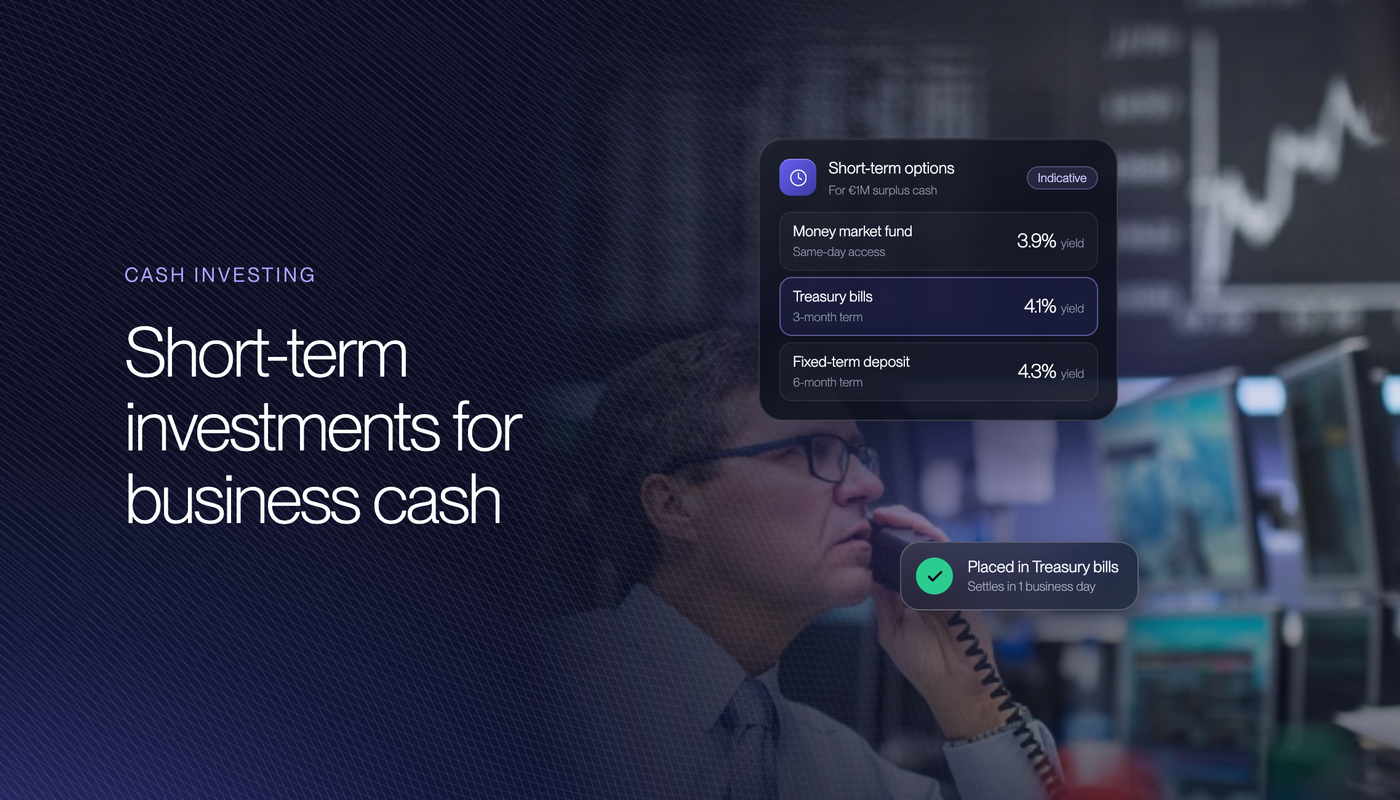
Short-term investments let a business earn a market rate on cash it does not need this month, without locking it away for years. Money market funds, Treasury bills and government bonds can pay out within days or on a date you pick, so your business cash keeps working until the day it is needed.
The hard part is knowing where to invest excess cash without putting the next payment at risk. Banks paid euro area companies an average of 0.61% on overnight deposits in August 2026. Funds, bills and bonds pay more, but they are not deposits, and their value can move.
This is where we come in. We introduce your company to Sophic, a service of Athlos Capital Investment Services Ltd, a CySEC-regulated investment firm. You choose the instruments and amounts. Sophic executes your orders and holds the investments. We check that you qualify and prepare the onboarding with you.
Short-Term Investments for Your Business Cash
Invest excess cash in government bills, bonds and money market funds through Sophic, with no lock-in. You choose the instruments and amounts.
- Money market funds: Currently from 2% p.a. before fees, a variable return that can fall.
- Treasury bills: Currently from 2.5% p.a. before fees, repaid at maturity.
- Government bonds: Currently from 3% p.a. before fees, with regular interest.
- No lock-in: Sell when you need cash, at the market price.
- Quick start: Digital onboarding in about a day, invested 2 to 3 business days later.
- Onboarding prepared: We check your LEI and gather the documents with you.
When investing, your capital is at risk. Yields may vary.
Sophic
Treasury management
Yield
2% to 3%+ p.a
Fees
0.3% a year + €10 per order
Eligibility
EU/EEA businesses with an LEI
When investing, your capital is at risk. Yields may vary.
What Short-Term Investments Are
Short-term investments are assets a business expects to turn back into cash within about a year: notice and fixed deposits, money market funds, Treasury bills and short-dated government bonds. They earn more than a current account, and most can be sold before maturity. Their value can move, and only deposits are covered by the deposit guarantee.
Short-Term Investments in Company Accounts
In company accounts, short-term investments sit in current assets, because the business expects to realise them within twelve months. The very shortest and most stable ones count as cash equivalents. Everything else, such as a 9-month bill or a bond due within the year, is shown separately as an investment.
Cash Equivalents vs Other Short-Term Investments
IAS 7 defines cash equivalents as short-term, highly liquid investments that are readily convertible to known amounts of cash and subject to an insignificant risk of changes in value. An investment normally qualifies only with a maturity of three months or less from the date it was bought. A 13-week bill can qualify. A 12-month bill does not, even though it is still short term.
Business Cash Investment Puts Access First
A business cash investment has a different aim from personal investing. The money belongs to the company and usually has a job later: tax, payroll, a loan repayment, an acquisition. So the order of priorities is getting the money back in full, being able to reach it when needed and only then the return. Our guide to idle cash explains how to find the cash that has no job yet.
Can a Business Invest Money
Yes. A company can invest money in its own name, as long as its articles of association allow it and the directors act in the company's interest. Most standard articles do not restrict investing surplus cash. The practical limits are the company's need for the money, its written policy and the rules of the firm it invests through.
Check the Articles of Association
Most modern articles give the company full capacity to hold investments, but older or bespoke articles sometimes restrict what directors can do with company funds. Read the objects clause and any limits on directors' powers. If the articles restrict it, only the shareholders can change them. A board resolution approving the investment policy records the decision. Groups forming a new parent company can set this out from the start, as our guide to holding company articles of incorporation explains.
Directors Must Act in the Company's Interest
Directors decide how to invest company money, and they must act in the company's interest, with reasonable care and skill. In practice that means investing only cash the company does not need, choosing instruments that suit the timing and recording the decision. A one-page policy approved by the board covers all three.
Can I Invest My Business Money in Stocks
A company can usually buy shares, and many holding companies exist for exactly that. Shares are a different job from short-term investments, though. Their prices can fall sharply over months, so they do not suit money with a date. Groups that hold shares long term often do it through a holding company or a personal investment company. Sophic does not offer shares. It offers money market funds, Treasury bills and government bonds. A company whose business is investing other people's money needs a licence of its own, such as a Cyprus Investment Firm licence.
Sophic
Treasury management
Yield
2% to 3%+ p.a
Fees
0.3% a year + €10 per order
Eligibility
EU/EEA businesses with an LEI
When investing, your capital is at risk. Yields may vary.
Where to Invest Excess Business Cash
The main places to invest excess business cash are notice and fixed deposits, money market funds, Treasury bills and government bonds. They differ on return, how fast you can reach the money, lock-in and risk. Bank deposits are covered up to €100,000 per bank. Funds, bills and bonds are not covered, and repayment depends on the issuer or the fund's holdings.
Factor | Business savings account | Money market fund | Treasury bills | Government bonds |
|---|---|---|---|---|
Current rate | 0.75% on demand, 2.25% fixed for 12 months (permanent tsb, July 2026) | Currently from 2% p.a. before fees, variable and can fall | Currently from 2.5% p.a. before fees | Currently from 3% p.a. before fees |
Access to cash | Same day, or after the notice period or term | Usually the same day or the next | At maturity, or sold early at the market price | At maturity, or sold early at the market price |
Lock-in | None on demand accounts, yes on fixed terms | None | None, but the price moves if sold early | None, but the price moves if sold early |
Deposit guarantee cover | Up to €100,000 per bank | Not covered | Not covered | Not covered |
Main risk | The bank's balance sheet above €100,000 | Value can fall, rare limits on redemptions | Price change before maturity | Price change before maturity, larger for longer bonds |
The table compares access, lock-in and risk side by side. Each instrument has a different access time and a different risk. Fund, bill and bond figures are Sophic's current starting yields, before fees. When investing, your capital is at risk. Yields may vary.
Notice and Fixed Deposits
Notice accounts pay out after a warning period and fixed deposits on their end date. permanent tsb in Ireland pays businesses 1.75% on 32-day notice and 2.25% fixed for 12 months, on rates effective 7 July 2026. Deposits stay covered up to €100,000 per bank. Offshore banks price them the same way, as our guide to business savings accounts in the Isle of Man shows. See also business fixed deposit accounts.
Money Market Funds
A money market fund holds short-term, high-quality debt and pays a variable return. You usually get cash the same day or the next business day. EU public debt CNAV and LVNAV funds must hold at least 10% of assets maturing daily and 30% weekly under Regulation (EU) 2017/1131.
Treasury Bills
Treasury bills are government debt of up to a year. You buy below face value and receive the full amount at maturity. French 13-week bills were auctioned at an average rate of 2.750% on 19 October 2026, and 50-week bills at 3.292%. Our guide to how to buy Treasury bills as a business covers the process.
Government Bonds
Government bonds pay interest on a schedule and repay at maturity, often years out. A bond close to maturity behaves much like a bill. Longer bonds move more in price when rates change. Our comparison of Treasury bills vs bonds sets out the trade-off.
Commercial Paper and Corporate Bonds
Large companies sometimes buy short-term debt issued by other companies. It can pay more than government debt, but repayment depends on the issuing company, and the market for it is mostly open to large professional investors. Sophic offers government bills and bonds and money market funds rather than corporate debt.
Invest Excess Cash With Sophic
We help you get ready. You decide how to split cash between funds, bills and bonds.
- Eligibility checked first: Country, sector and LEI checked before any paperwork.
- One document list: Everything onboarding needs, asked for once.
- Three currencies: Money market funds in EUR, GBP or USD.
- Familiar issuers: Bills and bonds from the EU, Germany, France, Cyprus, the UK and the US.
- Sell any time: No lock-in, sold at the market price.
When investing, your capital is at risk. Yields may vary.
How to Invest Excess Cash in Four Steps
To invest excess cash, size the surplus from a cash forecast, give each part a date, set simple rules for what the company may hold and open an account with an authorised investment firm. The first three take an afternoon. The fourth takes a day or two once your LEI and documents are ready.
Size the Surplus First
Start from a 13-week cash forecast. Set aside operating cash for the next 30 to 60 days and a reserve for shocks you cannot date, often two to three months of fixed costs. Only cash above both counts as surplus. Our guide on how much cash reserves a business should have covers the reserve.
Give Each Part a Date
Split the surplus by when you expect to need it: within 3 months, within 6 months, within a year, or no planned use. The date matters because an instrument that matures after the money is needed may have to be sold at whatever price the market offers that day.
Set Simple Investment Rules
Write down which instruments the company may hold, the longest maturity, any limit per issuer or fund, the currencies allowed and who approves each order. Keep it to one page. In the 2026 AFP Liquidity Survey, three in four organisations had a written investment policy.
Open an Account With an Investment Firm
Funds, bills and bonds are bought through an authorised firm. Onboarding checks your company documents, directors and beneficial owners. For bills and bonds you need an LEI. The documents are much the same as the documents needed to open a business bank account. Our guide on who needs an LEI number explains the rule.
Sophic
Treasury management
Yield
2% to 3%+ p.a
Fees
0.3% a year + €10 per order
Eligibility
EU/EEA businesses with an LEI
When investing, your capital is at risk. Yields may vary.
Investing Surplus Business Cash With Sophic
Investing surplus business cash with Sophic works like this: you choose the instruments and amounts, and Sophic executes your orders and holds the investments. Onboarding is digital and takes about a day. Money is invested 2 to 3 business days later, with no lock-in period.
What You Can Invest In
Sophic offers money market funds in EUR, GBP and USD, currently from 2% p.a. before fees, with a variable return that can fall. Treasury bills from the EU, Germany, France, Cyprus, the UK and the US are currently from 2.5% p.a. before fees. Government bonds, including Greek and Spanish issues, are currently from 3% p.a. before fees. Yields may vary.
How Your Investments Are Held
With Sophic, client cash is held in segregated accounts at J.P. Morgan and investments are safeguarded by SIX Group. Bills and bonds are claims on the issuing government, so repayment depends on that government rather than on a single bank's balance sheet. Sophic does not manage a portfolio for you: the choices are yours.
Which Companies Can Invest
Sophic onboards businesses incorporated in Cyprus, Austria, Belgium, Bulgaria, Estonia, France, Germany, Greece, Ireland, Italy, Luxembourg, Portugal, Slovenia, Spain and Switzerland. Companies also need an active LEI, proof of legal existence and a sector Sophic accepts. Holding companies may need additional checks before onboarding. If you are setting up a group, see holding company formation in Cyprus or our Ireland company formation guide.
Read more: How Sophic works for businesses.
Risks of Short-Term Investments
Short-term investments are not the same as cash in the bank. Prices can move before maturity, funds can limit redemptions in stressed markets, issuers can fail to pay and currencies can move. Funds, bills and bonds are not covered by the deposit guarantee. Knowing each risk helps you match the instrument to the date.
Price Risk Before Maturity
A bill or bond repays its full face value at maturity. Before then, its price moves with interest rates. If rates rise after you buy and you sell early, you get less than you would at maturity. The longer the instrument, the bigger the move. Holding to maturity avoids this price risk, though repayment still depends on the issuer.
Fund Liquidity Fees and Redemption Limits
In heavy outflows, the board of a public debt CNAV or LVNAV money market fund may charge a liquidity fee, limit redemptions to 10% of the fund a day or suspend them for up to 15 working days (Article 34 of Regulation (EU) 2017/1131). ESMA reported that no EU fund had to do so in March 2020, after central banks stepped in.
Issuer and Currency Risk
Government bills and bonds depend on the issuing government paying. Repayment depends on that government rather than on a single bank's balance sheet. Holding a currency other than the one you spend in adds exchange risk. Keep each currency for the payments due in it, which a multi-currency business account makes easier.
No Deposit Guarantee
The €100,000 deposit guarantee covers bank deposits only. Funds, bills and bonds are securities, held for you by an investment firm and a custodian. Segregation keeps client assets apart from the firm's own if the firm fails, but it does not protect against a fall in value. Check where your assets are held before you invest.
Invest Idle Cash in Government Bills and Funds
For eligible companies with cash that has no job for months. Sophic executes your orders and holds the investments.
- Fund returns: Money market funds currently from 2% p.a. before fees, variable.
- Bill returns: Treasury bills currently from 2.5% p.a. before fees.
- Bond returns: Government bonds currently from 3% p.a. before fees.
- Segregated client cash: Held in segregated accounts at J.P. Morgan.
- Safeguarded investments: Safeguarded by SIX Group.
- One point of contact: We stay with you until onboarding is complete.
When investing, your capital is at risk. Yields may vary.
Costs and Tax on Business Cash Investment
A business cash investment carries four kinds of cost: a yearly fee on the invested balance, a fee per order, the fund's own ongoing charges and the dealer spread on bills and bonds. The income is then taxed in the company. Check both before you invest, because they decide what the company actually keeps.
Fees to Check Before You Invest
Ask any investment firm for its yearly fee, its order fee, the ongoing charges of each fund and how it prices bills and bonds. Add the yearly LEI renewal fee and any currency conversion margin. The card on this page shows Sophic's fees. There is no lock-in with Sophic, and a sale is charged like any other order.
Tax Stays With the Company
Interest, fund income and gains on bills and bonds are normally taxed as part of the company's profits, under the rules of the country where it is resident. Rates for passive income can differ from the trading rate: in Ireland, for example, non-trading income is taxed at 25% rather than 12.5%. Take local tax advice, and see our guide to the lowest corporate tax in Europe for headline rates. Our guide to tax planning for business owners covers the wider picture.
Sophic
Treasury management
Yield
2% to 3%+ p.a
Fees
0.3% a year + €10 per order
Eligibility
EU/EEA businesses with an LEI
When investing, your capital is at risk. Yields may vary.
What's the Best Solution for Managing Idle Cash
There is no single best solution for managing idle cash. A common solution is a split by date: operating cash in the bank, a reserve where it can be reached within a day, and the rest in instruments that repay before the money is needed. The right split depends on your forecast, not on the highest yield.
Give Each Part of Your Cash a Date
A company that knows when it will need each part of its cash can choose instruments that pay out in time. Cash for next month stays in the bank or an EMI account. Cash needed in six months can wait in something that pays out by then. Cash with no planned use is a question for the board or the owners.
Review the Split Every Quarter
Forecasts change, and so do rates. Review the split each quarter: what has matured, what is coming due and how much new surplus has built up. A short review keeps the plan in line with the business. Our guide to liquidity management for businesses covers the routine.
Common Mistakes When You Invest Company Money
Most mistakes when companies invest money come from timing. They invest cash they need soon, chase the highest yield, ignore costs or leave the LEI until the last minute. Each one costs return or access, and each one is avoided by a forecast and a written policy.
Investing Money That Has a Job This Month
Putting next month's payroll into a 6-month bill for a slightly better rate forces a sale if cash runs short. If rates have risen since you bought, the sale price is lower, and dealing costs come off too. Invest only what sits above your operating line and your reserve.
Chasing the Highest Yield
The highest yield usually comes with a longer maturity or a riskier issuer. For business cash, a longer bond can mean selling at a loss if the money is needed early. Many finance teams look at the date first and the yield second.
Ignoring Costs on Small Amounts
Fixed order fees matter more on small amounts and short holdings. Buying and selling a small bill several times a year can eat a large part of its return. Grouping small amounts into fewer, larger orders spreads the fixed fee further.
Leaving the LEI Until Last
EU investment firms cannot buy Treasury bills or bonds for a company without a Legal Entity Identifier (Article 13(2) of Delegated Regulation (EU) 2017/590). Getting one takes time, and it must be renewed every year. Sort it while the surplus is still building. Business banking works the same way, as our guide to the best business bank account shows for account onboarding.
Bottom Line
Short-term investments let business cash earn a market rate until the day it is needed. Size the surplus from a forecast, give each part a date and hold it in deposits, money market funds, Treasury bills or government bonds that pay out in time. Check costs and tax, and get your LEI ready early.
What are short-term investments?
Where should a business invest excess cash?
Can a business invest money?
Can I invest my business money in stocks?
How do I invest excess cash as a company?
Are short-term investments covered by the deposit guarantee?
How long is a short-term investment?
What is the difference between cash equivalents and short-term investments?
How quickly can a business get money out of short-term investments?
How much does it cost to invest company money?
Is income from business cash investment taxed?
Do I need an LEI to invest business money?
What's the best solution for managing idle cash?
Sources
- European Central Bank, Euro area bank interest rate statistics, August 2026 (released 1 October 2026)
- permanent tsb, Non-personal deposit interest rates effective 7 July 2026
- Agence France Trésor, Latest auction results, BTF auction of 19 October 2026
- IFRS Foundation, IAS 7 Statement of Cash Flows
- Regulation (EU) 2017/1131 on money market funds, EUR-Lex
- ESMA, Final Report on the EU Money Market Fund Regulation legislative review (14 February 2022)
- Directive 2014/49/EU on deposit guarantee schemes, EUR-Lex
- Autorité des marchés financiers, Settlement cycle T+1 (Regulation (EU) 2025/2075)
- Commission Delegated Regulation (EU) 2017/590 (RTS 22), EUR-Lex
- GLEIF, Introducing the Legal Entity Identifier (LEI)
- Association for Financial Professionals, 2026 AFP Liquidity Survey press release
- Local Enterprise Office Fingal, Understanding Taxes (Irish corporation tax rates)
Binderr is not an investment provider or adviser. We connect businesses with regulated investment providers and help with the setup. Every investment is made under the provider's own terms, fees and risk disclosures, which you review and accept directly with them, and the decision to invest is yours. Binderr is not responsible for investment performance or for any loss. This article is general information, not investment, tax or legal advice, and figures can change after the time of writing. When investing, your capital is at risk. Yields may vary.