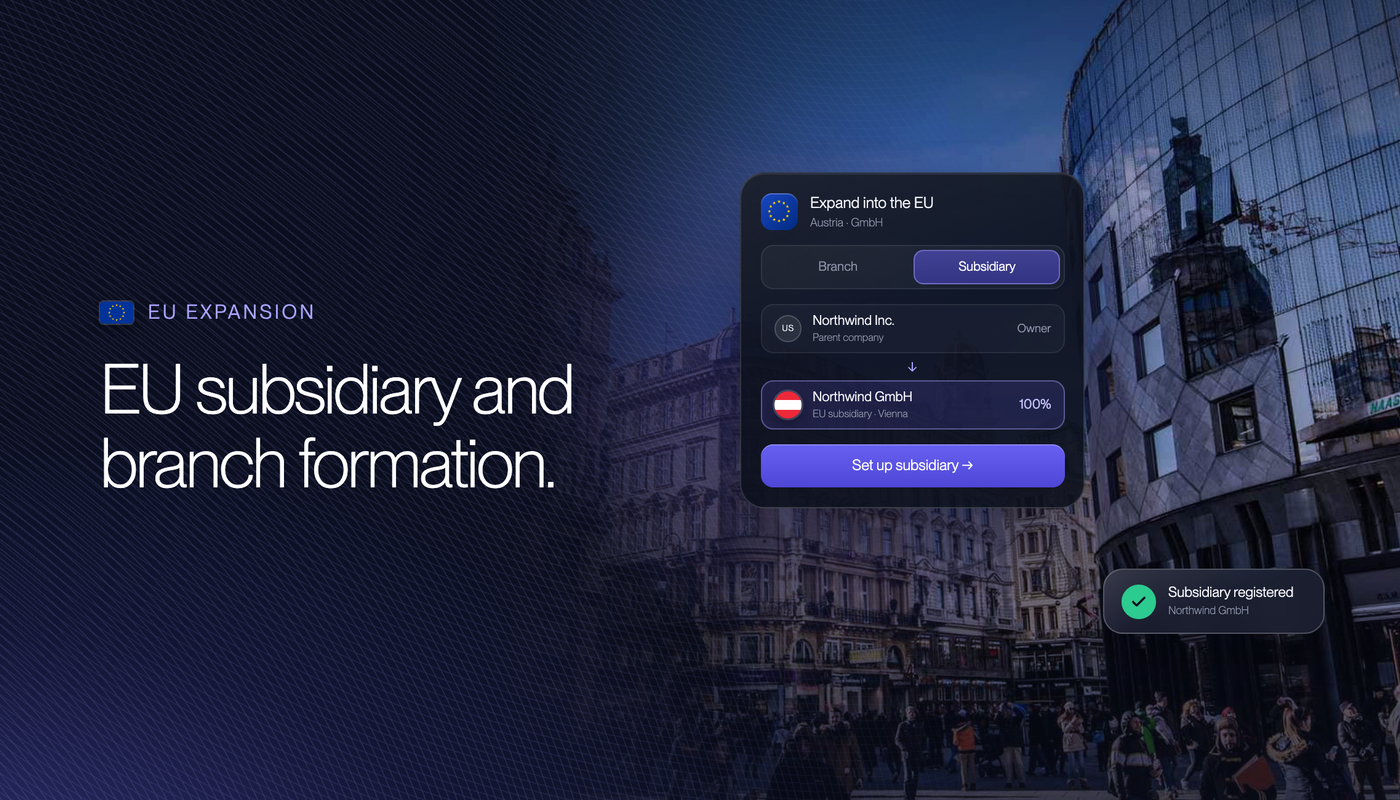
In the EU subsidiary vs branch choice, the subsidiary gives your group its own company inside the single market. It is a separate legal person with limited liability, its own tax residence and its own bank account. Dividends it pays to an EU parent leave free of withholding tax under the Parent-Subsidiary Directive.
A branch looks simpler, but it is your parent company registered abroad. The parent answers for every debt, its accounts go on a foreign register and the branch is taxed locally anyway. A subsidiary has local rules too: a Cyprus lawyer signs the papers, Malta needs a company secretary and Ireland an EEA-resident director or a €25,000 bond.
This is where we come in. We form your EU subsidiary ourselves in Cyprus, Malta or Ireland and handle the parts that slow groups down: the country choice, the parent documents, the local signatures, the filing and the bank introduction. One team, one price from €1,200, and the company is ready in about a week.
For most groups, a Cyprus subsidiary is the lowest-cost way into the EU, and we form it from €1,200 with the Registrar fees included.
Cyprus Company Incorporation
Binderr
Corporate tax
15% flat
Time to Incorporate
1 Week
Cost
€1,200 one-off
EU Subsidiary vs Branch at a Glance
An EU subsidiary is a new company your group owns in a member state. A branch in the EU is your existing company registered in that state. For most groups the subsidiary is the better choice, because it limits liability, has its own tax residence and gets a bank account more easily.
What an EU Subsidiary Is
An EU subsidiary is a company formed under the law of one member state, usually a private limited company, owned by your parent. It has its own directors, accounts and tax number, and in Cyprus, Malta and Ireland the parent can own 100% of it from anywhere. Our guide on how to set up a subsidiary company covers the general steps.
What a Branch in the EU Is
A branch is not a new company. It is the parent registered as an overseas company in the host state, with a local address and people who act for it. Malta Enterprise states that a branch has no legal personality apart from its head office, which is bound by the contracts the branch signs. Outside the EU, see our guide to a branch office vs subsidiary.
Set Up an EU Subsidiary
An EU subsidiary is very doable from abroad when one team runs it. Here is what we handle.
- Country picked for you: Cyprus, Malta or Ireland, chosen around your group and customers.
- Parent documents sorted: Certified, apostilled and translated where the registry asks.
- Local signatures arranged: The Cyprus lawyer, the Malta secretary or the Irish director rule.
- One KYC file: The same pack serves the registry and the bank.
- Filing handled: We submit it and answer every registry query.
- Formed in about a week: From €1,200, once the file is complete.
Why Most Groups Choose an EU Subsidiary
Four points decide it for most groups. A claim against an EU subsidiary stops at its own assets. Dividends to an EU parent leave without withholding tax. The subsidiary files only its own accounts. And a local company is a simpler file for a bank than a foreign parent. Its shares can also be sold, which gives you a clean exit.
EU Branch vs Subsidiary Side by Side
Factor | EU branch | EU subsidiary |
|---|---|---|
Legal status | Part of the parent company | A separate company |
Liability for debts | The parent, with no limit | Limited to the subsidiary's own assets |
Corporate tax | Host country taxes the branch profits | Taxed on its own profits where it is resident |
Dividends to an EU parent | No dividend, profits are remitted | 0% withholding under Directive 2011/96/EU |
Accounts on the host register | The parent's, and sometimes branch accounts too | Its own accounts only |
Bank account | Opened for the foreign parent | Opened for a local company |
Closing it | A closure notice to the register | Liquidation or strike-off |
In the EU branch vs subsidiary choice, the liability and accounts rows are the ones founders regret later. The branch puts the whole parent behind the EU business and its numbers on a foreign register. The subsidiary keeps both at home.
Read more: European company formation guide and EU company formation for non-residents.
A Malta subsidiary suits a profitable group that pays dividends up, because the refund system brings the tax on distributed trading profits to about 5%.
Malta Company Incorporation
GCS Malta
Effective tax
~5% for non-resident
Time to Incorporate
1 Week
Cost
Starting from €1,299
Liability and Control in an EU Branch Office
An EU branch office gives the parent no shield. Every contract the branch signs binds the parent, and a creditor of the branch can pursue the parent's assets. A subsidiary in the EU limits that exposure to the capital and assets you put into it, unless the parent signs a guarantee.
Who Pays the Debts of an EU Branch
A branch has no separate legal personality, so there is only one debtor: the parent. A lease, a staff contract or a supplier claim signed in Limassol or Dublin binds the whole company. That can help a strong parent borrow, but it exposes a young one. With a subsidiary, a creditor reaches only what the subsidiary owns.
Who Acts for a Branch in the EU
Directive (EU) 2017/1132 makes the people authorised to represent the company, and their powers, part of every branch filing. Cyprus also asks for Cyprus residents who can accept legal documents for the company, and Malta for a representative living in Malta. Their authority is public, and a local manager with wide powers can commit the whole parent, so set the limits before you file.
Control Through a Subsidiary Board
A subsidiary is run by its own board, and the parent controls it as shareholder through the articles, resolutions and the choice of directors. It starts with a parent decision, covered in our planned guide to a board resolution for setting up a subsidiary. Larger groups plan it as part of a parent company with subsidiaries.
How an EU Branch and Subsidiary Are Taxed
A branch and a subsidiary pay corporate tax in the host country at the same rate: 15% in Cyprus, 35% in Malta before refunds and 12.5% on trading profits in Ireland. The difference comes after. Branch profits go home with no further tax, while subsidiary dividends depend on directives, local law and treaties.
Branch Profits and the Permanent Establishment
Article 5 of the OECD Model Tax Convention lists a branch as a permanent establishment, and Article 7 lets the host country tax its profits as if it were a separate business, based on its functions, assets and risks. That means transfer pricing records for dealings with head office. PwC's 2026 summaries confirm that Cyprus, Malta and Ireland tax branch profits at normal company rates and withhold nothing when they go home.
Corporate Tax on an EU Subsidiary
A company incorporated in Cyprus, Malta or Ireland is tax resident there by default, and Cyprus and Ireland also treat a company managed and controlled locally as resident. Cyprus raised its rate from 12.5% to 15% on 1 January 2026, as our page on the Cyprus corporate tax rate explains. Malta charges 35%, then refunds 6/7ths to shareholders when trading profits are paid out. Ireland charges 12.5% on trading income and 25% on the rest.
Dividends Under the Parent-Subsidiary Directive
Directive 2011/96/EU removes withholding tax on dividends that an EU subsidiary pays to an EU parent holding at least 10%, and Ireland applies it from 5%. A branch never uses it, because sending branch profit home is not a dividend. Since Directive (EU) 2015/121, the relief is refused for arrangements that are not genuine. For several layers, see our guide to the holding company and subsidiary structure.
Withholding Tax for a Non-EU Parent
A parent outside the EU cannot use the directive, so local law decides. Cyprus and Malta withhold nothing on dividends paid abroad, apart from Cyprus charges on related companies in low-tax or EU-blacklisted places. Ireland applies 25%, but exempts parents resident in the EU or a treaty country on a declaration. Our page on Cyprus withholding tax covers the exceptions.
Tax point | Cyprus | Malta | Ireland |
|---|---|---|---|
Tax on branch or subsidiary profits | 15% | 35%, about 5% after the 6/7ths refund | 12.5% trading, 25% non-trading |
Branch profits sent to head office | No withholding tax | No withholding tax | No withholding tax |
Subsidiary dividends to an EU parent | 0% | 0% | 0% under the directive, from a 5% holding |
Subsidiary dividends to a non-EU parent | 0%, except low-tax or blacklisted places | 0% | 25%, or 0% for treaty-country parents |
Refund on branch profits | No refund system | Yes, for the company's shareholders | No refund system |
On the way out, a branch is clean in all three countries. A European subsidiary is clean in Cyprus and Malta for almost any parent, while Ireland needs an EU or treaty-country parent. Malta alone lets a branch reach the refund: KPMG Malta confirms that shareholders of a non-resident company with a Malta branch can claim it.
Early Losses in a Branch in the EU
Losses are the one tax point that can favour a branch in the EU. Where the parent's home country taxes worldwide profits with a credit for foreign tax, early branch losses can cut the parent's taxable profit at once. Countries that exempt foreign branch profits usually ignore the losses too.
Plan the Tax on Your EU Subsidiary
The tax side of an EU subsidiary is simple when it is planned before you file. We set it up with you.
- Residence planned: Where the board meets and decides, set from the first meeting.
- Dividend route checked: Directive, local law or treaty, confirmed for your parent.
- Malta refund structured: Shareholder claims set up so the 5% route works.
- Group charges planned: Parent billing set before the first invoice.
- Tax and VAT numbers: Registrations made as part of the formation.
EU Branch Registration Rules in 2026
Every branch in the EU is registered in the host country within a short deadline, under rules set by Directive (EU) 2017/1132. The parent's home decides the workload: a branch of an EU company files a short list and can register online, while a branch of a non-EU company files more.
Branches of EU Companies
Article 30 limits what the host state can ask of an EU company's branch: its address and activities, the parent's register entry, name and legal form, representatives, any winding up, accounts and closure. Since Directive (EU) 2019/1151, this can be done fully online, and Article 28a gives the register 10 working days once the file is complete. The details appear on BRIS, the Business Registers Interconnection System.
Branches of Non-EU Companies
A parent from outside the EU files more under Article 37, including the law that governs it, its constitution and its capital. Article 38 lets the host state ask for separate branch accounts where the parent's accounts are not equivalent to EU standards. Cyprus goes further: its Registrar asks for audited statements for the Cyprus place of business, plus the parent's own when it sits outside the EU.
What Directive (EU) 2025/25 Changes
Directive (EU) 2025/25 entered into force on 30 January 2025. Member states must adopt it by 31 July 2027 and apply it from 31 July 2028. It creates an EU Company Certificate, free in electronic form at least once a year, and a digital EU power of attorney. Under its once-only principle, the branch register of an EU parent pulls its documents from the home register instead of asking for them again.
Branch Deadlines in Cyprus, Malta and Ireland
Cyprus wants the branch registered within one month of opening, on three Registrar forms costing €380, or €100 more for express handling. Malta also allows one month, on Form M with a representative resident in Malta, for a fee based on the parent's authorised capital. Ireland gives 30 days, on Form F12 for an EEA parent or F13 for others, at €50 online plus €15 a year for the accounts on Form F7. Our guide to overseas company formation in Ireland has the detail.
Ireland Company Incorporation
Binderr
Corporate tax
12.5% trading / 25% non-trading income
Time to Incorporate
1 Week
Cost
€1,899
Steps for Setting Up a Subsidiary in Europe
Setting up a subsidiary in Europe takes about a week with us once the parent's documents are ready. The parent decides, its papers are certified, we file with the registry, and the tax numbers and bank account follow.
Parent Decision and Documents
The parent's board approves the new company, its share capital and its first directors. The registry then wants proof of the parent and its owners: usually a certificate of good standing, its constitution and ownership details, certified, apostilled and translated where needed. We ask for these first.
Name, Constitution and Officers
Cyprus approves the name first, for €10 or €30 with express handling, and a Cyprus Bar advocate must prepare and sign the documents. Malta needs a company secretary, and the paid-up capital is shown on a deposit slip. Ireland needs one EEA-resident director or a €25,000 bond, plus a secretary where there is only one director.
EU Subsidiary Formation in About a Week
EU subsidiary formation is quick when the parent papers are right first time. We make sure they are.
- Documents checklist sent: The exact parent papers each registry asks for.
- Apostille and translation: Arranged so the registry accepts them first time.
- Officers in place: Secretary, registered office and the Irish director route covered.
- Registry fees included: The filing fee sits inside our from price.
- Beneficial owners filed: The first ownership filing made with the formation.
- Clear from price: €1,200 in Cyprus, €1,299 in Malta, €1,899 in Ireland.
Filing, Tax Numbers and Beneficial Owners
We file with the Cyprus Registrar, the Malta Business Registry or the CRO in Ireland. Directive (EU) 2019/1151 caps online formation at 5 working days when only individuals form the company on a template, and 10 in other cases, which covers a subsidiary owned by a parent company. The company then registers for tax and VAT and files its beneficial owners, which Ireland wants within 5 months. Our guide on how long it takes to set up a company compares the timelines.
Business Banking for an EU Subsidiary or Branch
A subsidiary in the EU applies for a business account as a local company with its own directors and records. A branch applies as the foreign parent, so the bank reviews the whole group. A traditional bank often takes several weeks for a new entity owned from abroad. Our partners open accounts in about 4 days to a week.
Local Banks in Cyprus, Malta and Ireland
Local banks are a good long-term home, but slow and costly for a new entity owned from abroad. The Bank of Cyprus June 2026 tariff for international business customers charges €50 a month for an active company account. AIB in Ireland charges €4.50 a quarter but usually wants an Irish-resident director and local activity. Refusals are common and rarely explained. Our guides to the best banks for Cyprus companies and business bank accounts in Ireland for new companies cover each market.
A Faster Route Through Our Partners
Our partners are the faster route, and for most new EU entities the better one. They are regulated payment and e-money firms, and they open accounts in about 4 days to a week. Plans start from €100 a month, with custom pricing for complex groups. We build the bank file from your formation KYC pack and make the introduction once the certificate is issued.
Our top-rated, regulated banking partners onboard EU subsidiaries of foreign groups in about 4 days to a week.

3S Money
Cross-border payments
Time to onboard
4 Days
Account opening fee
Free
Monthly fee
Starting from € 100

Interpolitan Money
Business account
Time to onboard
1 Week
Currency
EUR, USD, GBP, AED, and 50+
Monthly fee
Custom
Why an EU Subsidiary Banks More Easily
An account for a branch is an account for the foreign parent, so the bank checks the parent's owners, accounts and source of funds under another country's law. A European subsidiary arrives with a local certificate and register entry, a shorter file that clears faster.
Read more: business bank account in Europe.
Open a Business Account for Your EU Subsidiary
Your EU subsidiary's account opens quickly when the file is complete, and we build that file with you.
- Fast account opening: About 4 days to a week through our partners.
- File built once: Your formation pack becomes the bank file.
- Group structure explained: Ownership chart and source of funds set out clearly.
- Introduction made: We present the company to the partner that fits it.
- Monthly cost upfront: From €100 a month, custom for complex groups.
VAT, Substance and Exit for an EU Subsidiary
After day one, VAT, substance and exit separate the two. A branch shares the parent's VAT identity, while an EU subsidiary has its own. A subsidiary must be run where it is resident to keep that residence. And a subsidiary can be sold or liquidated, while a branch simply closes.
VAT for a Branch in the EU
A branch registers for VAT in the host country but stays the same taxable person as its head office. In FCE Bank (C-210/04), the Court of Justice held in 2006 that services between the two are outside VAT. VAT groups change that, as Skandia America (C-7/13) and Danske Bank (C-812/19) showed. A subsidiary is always a separate taxable person, so charges from the parent need proper invoices.
Substance and Tax Residence
A subsidiary in the EU keeps its tax residence when its board really meets and decides in that country. Otherwise the parent's country may claim the company, or tax its profits under controlled foreign company rules. Plan directors, meetings and records early, as our page on Cyprus tax residency rules explains. A branch has the opposite risk: once staff sign contracts locally, a permanent establishment exists whether or not you registered it.
Closing or Converting an EU Branch
A branch closes with a notice to the host register, which, for an EU parent, informs the home register through BRIS under Directive (EU) 2019/1151. A subsidiary closes by liquidation or, where allowed, a strike-off. A growing branch can become a subsidiary, and between EU companies the Merger Directive (2009/133/EC) can make that transfer tax neutral. Our guide on how to transfer a company to another country covers moving a whole company.
Choose Between an EU Branch and Subsidiary
Not every group needs a subsidiary. Tell us what you plan, and we confirm the right entity before anything is filed.
- Entity confirmed early: Branch or subsidiary, decided on liability and tax.
- Licence questions covered: Passporting and regulated activity checked first.
- Subsidiary formed for you: We form the Cyprus, Malta or Ireland company in about a week.
- Parent country checked: How your home rules treat EU profits and losses.
- One team throughout: The same people advise, file and open the account.
Cyprus, Malta or Ireland for an EU Subsidiary
For an EU subsidiary, Cyprus suits most groups entering the EU, Ireland suits trading companies with staff and a parent in a treaty country, and Malta suits profitable companies that pay dividends. We form all three in about a week, from €1,200.
Factor | Cyprus | Malta | Ireland |
|---|---|---|---|
Corporate tax | 15% from 1 January 2026 | 35%, about 5% effective after the refund | 12.5% trading, 25% non-trading |
EU subsidiary with us | From €1,200 | From €1,299 | From €1,899 |
Time to incorporate | About 1 week | About 1 week | About 1 week |
Director rule | 1 director, any residence, plus a secretary | 1 director, any residence, plus a secretary | 1 EEA-resident director or a €25,000 bond |
Dividends to a non-EU parent | 0% in most cases | 0% | 0% for treaty-country parents, otherwise 25% |
Branch registry fee | €380, or €480 express | Custom (book a call) | €50 online |
Audit | Audit, or review below €300,000 turnover | Audit, with relief for very small companies | Exempt for small companies |
Realistic first-year total | About €4,000 to €7,000 | About €6,800 to €10,500 plus VAT | About €3,500 to €7,500 |
Read the dividend row with the tax row. Ireland has the lowest headline rate, but a parent outside the EU and its treaty network loses 25% of every dividend. Cyprus and Malta let profits leave at 0% to almost any parent, and Cyprus is the cheapest to form and run.
Cyprus Subsidiary
A Cyprus subsidiary suits most groups entering the EU, including parents outside it, service businesses and holding structures. We form it from €1,200 in about a week, and dividends usually leave tax free. The catch is the 15% rate since 2026, a yearly audit or review and an advocate's signature, which we arrange. Our guide to Cyprus company formation has the full process.
Cyprus Company Incorporation
Binderr
Corporate tax
15% flat
Time to Incorporate
1 Week
Cost
€1,200 one-off
Malta Subsidiary
A Malta subsidiary suits profitable groups that pay dividends up, and licensed sectors such as gaming and payments. We form it from €1,299 in about a week. The trade-off is timing: the company pays 35% first, and the 6/7ths refund reaches the shareholder only after a dividend and a claim. Our Malta company formation guide covers the rest.
Malta Company Incorporation
GCS Malta
Effective tax
~5% for non-resident
Time to Incorporate
1 Week
Cost
Starting from €1,299
Ireland Subsidiary
An Irish subsidiary suits a trading or software business that will hire staff, owned by a parent in the EU or a treaty country. We form it from €1,899 in about a week. The trade-off is the director rule: with no EEA-resident director, it needs a €25,000 bond, which we arrange at extra cost. Our guide to Irish company formation requirements explains the director rules.
Ireland Company Incorporation
Binderr
Corporate tax
12.5% trading / 25% non-trading income
Time to Incorporate
1 Week
Cost
€1,899
Which EU Subsidiary Should You Choose?
Choose a subsidiary, not a branch, unless one of three cases applies. You hold an EU licence and want to passport it through a branch, as our guide to the EMI licence in Europe explains. Early losses are worth more against the parent's profits at home. Or the presence is a short project.
Then pick the country. Start with Cyprus if you are unsure: it is the lowest-cost EU subsidiary, has no director residence rule and pays dividends to most parents at 0%. Choose Ireland for a trading subsidiary with staff and a treaty-country parent, and Malta for profits paid up as dividends. Our ranking of the best country to register a company in Europe goes further, and our planned guide to the best jurisdictions for subsidiary company formation looks beyond the EU.
Read more: company formation costs by country and how much a Malta company costs.
UK Branch or Subsidiary Outside the EU
A UK subsidiary is the cheapest company we form, from €350 with the £100 Companies House fee included, in about a week. A UK branch, called a UK establishment, is registered on Form OS IN01 within one month of opening, for £124 by post. Corporation tax is 19% on profits up to £50,000 and 25% above £250,000.
The UK is not in the EU. It left on 31 January 2020, so a UK company has no place in the single market, no EU VAT One Stop Shop as an EU business, no EU directive relief on withholding tax and no licence passport. Choose it when your customers are in the UK or outside Europe. Our guide to registering a UK branch as a foreign company covers the filing.
Factor | UK | Cyprus | Malta | Ireland |
|---|---|---|---|---|
EU member | No | Yes | Yes | Yes |
Subsidiary with us | From €350 | From €1,200 | From €1,299 | From €1,899 |
Branch registry fee | £124 | €380 | Custom (book a call) | €50 |
The UK wins on price and the EU three win on market access, including directive relief on dividends. If the business must sell into the single market, Cyprus, Malta or Ireland repays the extra cost.
.svg.webp?w=96&q=75)
UK Company Incorporation
Binderr
Corporate tax
19% (small profits) / 25% (main rate)
Time to Incorporate
1 Week
Cost
€350 (no pre-payment)
Common EU Subsidiary vs Branch Mistakes
The costly mistakes in the EU subsidiary vs branch choice happen before anything is filed. These four cost groups the most.
Registering a Branch to Save on Setup
Groups pick a branch because it sounds cheaper. In Cyprus it is not. The Registrar charges €380 to register a branch against €165 to register a company. The branch then files audited accounts for its Cyprus business every year, unless an EU parent qualifies for the exemption, plus the parent's statements when the parent sits outside the EU. That is an extra audit bill every year for as long as the branch exists, on top of certified translations of the parent's documents. Before you choose, cost both routes over five years, including the accounts, translations and the local representative.
Running the Subsidiary From the Parent's Office
A group forms an Irish subsidiary for the 12.5% rate, then makes every decision at head office abroad. The directors sign what they are sent and never meet in Ireland. The parent's country can then claim the company is managed there and tax it at home. On €200,000 of profit, a 25% home rate means €50,000 of tax instead of €25,000. A tax treaty may settle the clash, but only after a slow and costly process. Appoint directors who really decide, hold board meetings in the subsidiary's country and keep the minutes and records there.
Assuming Every Parent Gets Irish Dividends Tax Free
Ireland's 0% on dividends depends on where the parent sits. Groups see the 12.5% rate and assume the profit comes home freely. A parent outside the EU and Ireland's treaty network faces 25% dividend withholding tax, so a €100,000 dividend arrives as €75,000. Even a qualifying parent must give the subsidiary its declaration before the first payment, or tax is withheld. For a group that plans to pay out most of its EU profit, that one rule can outweigh the lower rate. Check the parent's country before you pick Ireland, or choose Cyprus or Malta, where dividends leave at 0% to most parents.
Opening the Bank Account Last
Many groups register the entity first and think about banking later. The company or branch then exists but cannot invoice, while a traditional bank works through the parent's documents for several weeks. For a group expecting €50,000 a month in EU sales, every month without an account holds back €50,000 of invoices. The bank also asks for the same parent papers the registry wanted, so a second request costs more time. Build the bank file from the formation documents and apply the day the certificate arrives. With our partners, the account follows in about 4 days to a week.
Get Advice on Your EU Subsidiary
Not sure whether a branch or an EU subsidiary fits your group? A short call settles it before you file.
- Written recommendation: Branch or subsidiary, the country and the year-one cost.
- Fitted to your group: Parent country, customers, staff and licences.
- €30 advisory call: Credited in full against a setup within 30 days.
- Complex groups covered: Holding chains, IP and regulated activity.
- Straight to formation: The same team forms the company after the call.
Bottom Line
In the EU subsidiary vs branch choice, the subsidiary wins for most groups. It limits liability, has its own tax residence, pays 0% on dividends to an EU parent and banks more easily. Choose a branch in the EU only to passport an EU licence, to use early losses at home or for a short project.
For the subsidiary, start with Cyprus from €1,200, choose Ireland for a trading business with staff and a treaty-country parent, and Malta for profits paid out as dividends. We form your EU subsidiary in about a week and open the account through our partners in days.
What is the difference between an EU subsidiary and a branch?
Is an EU subsidiary or a branch better for a non-EU company?
How much does EU subsidiary formation cost?
How long does it take to set up a subsidiary in the EU?
How long do I have to register a branch in the EU?
Does an EU branch office pay corporate tax locally?
Does the Parent-Subsidiary Directive apply to an EU branch?
Can a non-EU parent receive dividends from an EU subsidiary without withholding tax?
Do I need a local director for an EU subsidiary or branch?
Does an EU branch have to file the parent company's accounts?
Is VAT charged between a head office and its EU branch?
Can an EU branch be converted into a subsidiary later?
What changes for EU branches under Directive (EU) 2025/25?
Sources
- EUR-Lex, Directive (EU) 2017/1132, Directive (EU) 2019/1151 and Directive (EU) 2025/25, 19 December 2024
- EUR-Lex, Directive 2011/96/EU, Directive (EU) 2015/121 and Directive 2009/133/EC
- OECD, Model Tax Convention on Income and on Capital, 2017
- Court of Justice of the EU, C-210/04 FCE Bank, C-7/13 Skandia America and C-812/19 Danske Bank
- Cyprus Registrar of Companies, Overseas company forms and fees, Overseas company financial statements, Exemptions, Applying to incorporate and Choosing a name
- PwC Worldwide Tax Summaries, Cyprus branch income, withholding taxes and residence, reviewed 4 August 2026
- PwC Worldwide Tax Summaries, Malta branch income, withholding taxes and residence, reviewed 30 September 2026
- KPMG Malta, Malta, your EU hub and base, January 2026
- Malta Enterprise, Incorporation; Companies Act, Cap. 386, Part XI
- PwC Worldwide Tax Summaries, Ireland branch income and withholding taxes, reviewed 11 August 2026
- Companies Registration Office, Registration of external companies, Fees, Registration methods and EEA resident director; Revenue, Corporation tax
- Bank of Cyprus, International business charges, June 2026; AIB, Business fees, 1 July 2026
- GOV.UK, Register as an overseas company, Companies House fees and Corporation Tax rates