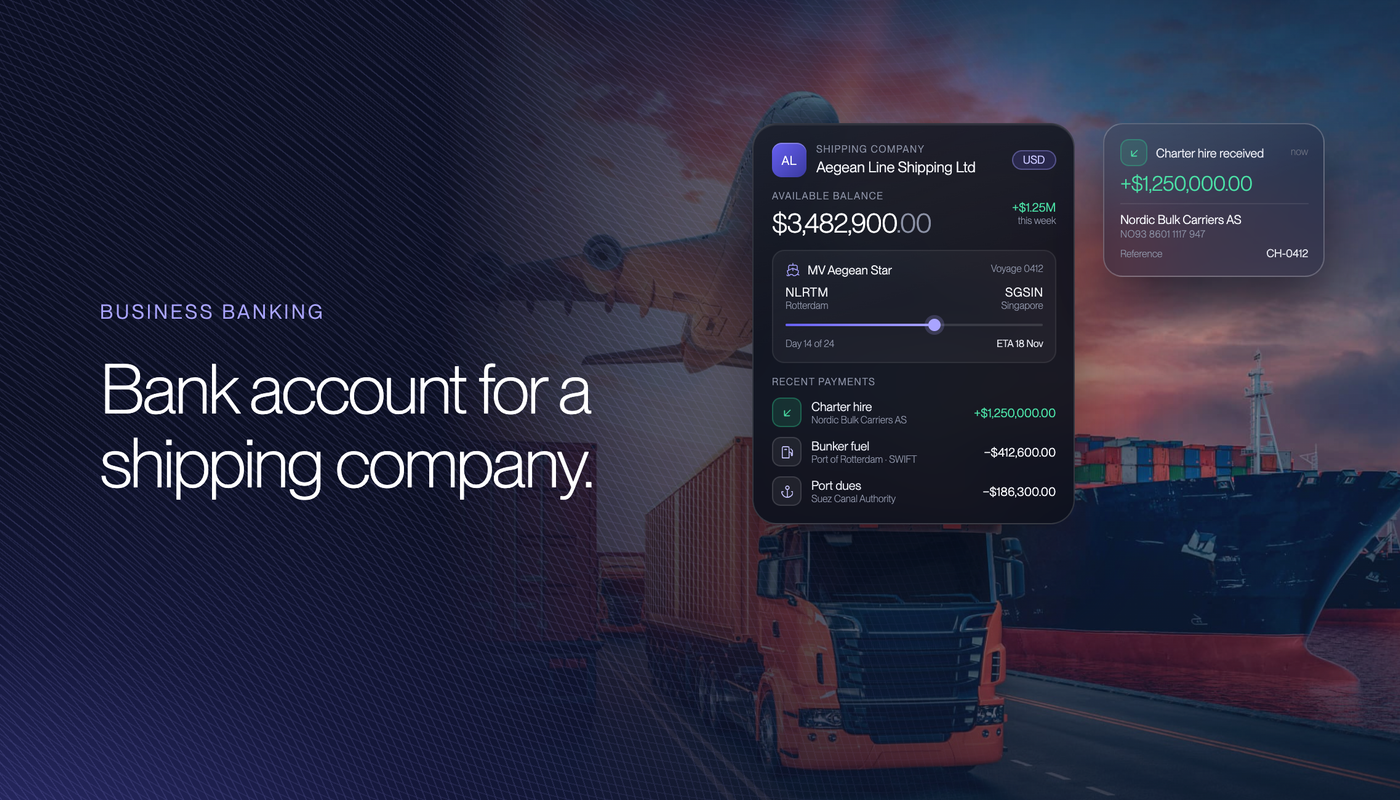
A bank account for a shipping company collects freight and hire in dollars, pays crews, bunkers, port agents and suppliers in dozens of countries, and services the loans behind each vessel. Shipping runs on the US dollar: dry bulk rates are quoted in dollars per day or per tonne, and a Greek containership owner such as Danaos earns all its revenue in dollars while paying part of its costs in euros.
The hard part is the banks. Bank ship finance is still well below its 2008 level, sanctions lists now name hundreds of vessels, and banks screen every ship, port call and counterparty by IMO number. Layers of one-ship companies, often registered in Liberia, the Marshall Islands or Panama, mean every owner has to be traced.
We make it simple. We prepare your full file with you, from the fleet list and ownership chart to the sanctions policy and source of funds. Our licensed banking partners then open a multi-currency account online in days. One team, one contact, done.
Our top-rated, licensed banking providers open multi-currency accounts for shipowners, managers and maritime businesses in days, with dollar and euro accounts in one place.

MoneyGate
Business Banking
Monthly fee
€30
Onboarding fee
€500
Time to onboard
2-3 days
Features
Dedicated IBAN, SEPA, FX and more

3S Money
Cross-border payments
Time to onboard
4 Days
Account opening fee
Free
Monthly fee
Starting from € 100
Why Shipping Company Bank Accounts Are Hard to Open
Shipping company bank accounts are hard to open because bank ship finance is still below its 2008 level, sanctions screening now reaches every vessel and voyage, and most fleets sit in layers of one-ship companies registered far from their owners. A bank account for a shipping company is one of the most closely reviewed files a bank sees.
Bank Ship Finance Is Below Its 2008 Level
Petrofin's research on the 40 largest ship finance banks puts their shipping lending at $300.6 billion at the end of 2025, up 6% on the year, with European banks holding 50.4%. Yet its index, set at 100 in 2008, stood at just 63, and its end-2024 report said fleet growth is funded mainly from non-bank sources such as leasing. Petrofin recorded no bank departures from ship finance in 2025, and BNP Paribas remains the largest shipping bank.
The shipping banks are also concentrated. National Bank of Greece, Eurobank and Piraeus each lend about $6 billion to Greek shipping, and the top 10 lenders hold 70% of Greek ship finance. Their shipping units lead with loans, with transaction services alongside, so a company without a loan, or a new owner with a single vessel, carries less weight with them.
Sanctions Screening Reaches Every Voyage
The EU had listed 673 vessels by its 21st sanctions package on 23 July 2026, up from 444 a year earlier, and the EU and UK price cap on Russian crude stands at $44.10, with the EU mechanism frozen until 15 July 2027. The UK has sanctioned more than 600 shadow fleet and LNG vessels, the US blocked 183 in a single day in January 2025, and OFAC said it had sanctioned over 100 Iran-linked vessels in the first seven months of 2026.
Banks respond by screening every vessel by IMO number, as the Wolfsberg Group recommends, because a ship's name can change but its IMO number cannot. The 2020 US advisory from OFAC, the State Department and the Coast Guard lists seven deceptive practices, from switching off AIS and ship-to-ship transfers to false flags and complex ownership. A single voyage that matches one of them can freeze a payment.
Open a Business Bank Account for a Shipping Company
Opening a business bank account for a shipping company is very doable with the right partner and a complete fleet file. This is what we handle for you.
- Partners that know shipping: One partner lists shipping among its core sectors.
- Banks slow to onboard: An account in days, fully online.
- Dollar and euro accounts: USD, EUR, GBP and more in one place.
- Crew payments covered: Bulk payments to many countries from one account.
- Fleet file prepared: Vessels, IMO numbers and owners laid out clearly.
- Avoid a rejection: We check the fit before anything is submitted.
- No back-and-forth emails: One point of contact from start to finish.
Flags of Convenience and One-Ship Companies
Three flags carry almost half the world fleet. Liberia carried 17.4% of world tonnage at the start of 2025, Panama 15.2% and the Marshall Islands 12.5%, 45.1% together, according to UNCTAD, while Greece, the largest ship-owning country, controls 16.4%. Each vessel usually sits in its own company, owned by a holding company and run by a manager. Our guide to the best flags for ship registration covers the registries.
Regulators treat that structure as a risk marker. OFAC's April 2025 guidance names multiple shell companies and vessel-owning special purpose vehicles in high-risk jurisdictions as a red flag, so layered structures get a closer look wherever they are registered. Cyprus goes further: its 2025 AML directive tells banks to refuse shell companies registered in countries that do not require audited accounts, or that have no tax residence. A bank must trace every layer to the people at the top before it opens anything, as it does for any SPV or project company.
Dollar Payments Pass Through US Banks
Freight is priced in dollars, and dollar payments usually clear through US correspondent banks, which bring US sanctions with them. OFAC has warned that non-US companies can be liable for causing a US bank to breach sanctions, and US banks must report a rejected payment to OFAC within 10 business days. In 2022 the Australian logistics group Toll paid $6.13 million to settle 2,958 payments made through US banks and linked to shipments involving North Korea, Iran and Syria.
So a shipowner's bank answers for its correspondents as well as its client. When the US designated Rosneft and Lukoil in October 2025, it warned that foreign banks facilitating significant transactions could lose their US correspondent accounts. Every bank in the chain now asks the same questions about the same voyage, and our guide to correspondent banking explains how that chain works.
Crew Payments in Many Countries
Crew is the largest cost for ship managers. In the Central Bank of Cyprus survey of ship managers for the second half of 2025, 58% of costs were crew costs and 37% of payments went to seafarers outside the EU. A manager paying hundreds of seafarers in many countries every month creates the pattern of many small cross-border payments that monitoring systems flag, so the bank needs the crew agreements and payroll structure upfront.
Why Shipping Company Bank Accounts Get Refused
Refusals usually come down to a few gaps: an ownership chain that stops at a one-ship company, vessels with gaps in their tracking history or past calls at sanctioned ports, trading in high-risk areas without a written sanctions policy, charter parties and counterparties the bank cannot check, or a young company moving large sums with little history, the kind of file behind much de-risking. The UK's July 2025 shadow fleet red alert lists companies with limited history trading large volumes fast as a warning sign.
What to Do After a Refusal
Do not resubmit the same file. Find the gap first: the ownership chart, the fleet data, the trading pattern or the source of funds. Fix it with documents, then apply once to a provider that works with shipping. Our guide to reapplying after a rejected business account covers the rebuild step by step.
Banks for Shipping Companies
Banks for shipping companies do exist, mostly in Greece and Cyprus, and they know the industry well. But their shipping units are built around ship finance, and their tariffs for international companies are high. The table shows who the main shipping banks take, who they turn away and what an international company pays.
Bank | Who it takes | Who it turns away | Monthly fee |
|---|---|---|---|
Eurobank Limited (Cyprus) | Shipowners, ship and crew managers, brokers and charterers, through its Limassol Shipping Centre | Files outside its risk appetite | €150 a quarter per customer on its international and shipping tariff |
Bank of Cyprus | Shipping clients through its Shipping Centre, set up in 2017 | Files that fail enhanced due diligence | €50 to €75 a month on its international tariff |
National Bank of Greece | Greek shipowners through its Shipping Branch | Files outside its risk appetite | Relationship based |
Alpha Bank | Tanker, gas, bulk and container owners through its Piraeus Shipping Division | Files outside its risk appetite | Relationship based |
Piraeus Bank | Greek shipping groups | Files that fail due diligence | Relationship based |
The pattern is clear. The banks that know shipping best are strongest for owners who borrow from them. An international company without a loan pays at least €200 for assessment under Eurobank's Cyprus tariff for international and shipping companies, €150 a quarter to keep its accounts, at least €500 for each periodic review and €100 to €500 to close. Bank of Cyprus charges €300 to apply for clients outside the EEA and equivalent countries, and €500 where enhanced due diligence applies.
Relationships Built Around the Loan
National Bank of Greece's Shipping Branch lists loans, interest rate swaps, FX and guarantees ahead of supplier and payroll payments, and Bank of Cyprus's Shipping Centre leads with shipping loans. That is where the banks earn their return. A ship manager, a broker or a young owner without a loan gets the same full review, without the lending relationship that makes a bank eager to finish it.
Payments Held for Sanctions Review
A payment that touches a vessel, port or counterparty the bank cannot clear is held while compliance checks it, and sometimes returned. US price cap guidance makes banks Tier 2 actors, which must request price information or obtain attestations from their customers. Each held payment delays hire, bunkers or crew wages, and a pattern of them can end the relationship.
International Tariffs and Review Fees
Eurobank's tariff for international and shipping companies in Cyprus shows the shape: a minimum €200 assessment, €150 a quarter per customer, at least €500 for each periodic review, €4 to €10 for a SEPA payment and 0.20% for a foreign currency SWIFT payment, with a €25 minimum and a €350 maximum. Bank of Cyprus charges non-EEA international clients €75 a month and adds surcharges of €30 to €40 to higher-risk SWIFT payments.
Currency Conversion on Every Dollar Receipt
A shipowner earning dollars and paying euro costs converts all the time. Eurobank charges 0.30% and Bank of Cyprus 0.40% on conversions, each with a minimum and a cap, and both on top of the bank's own rate. Incoming foreign currency payments add €8 to €40 each at Bank of Cyprus. Holding dollars in a multi-currency account and converting only what you need cuts the bill.
Slow, Paper-Heavy Onboarding
Cyprus agents report two to four weeks for a standard business account once the file is complete, and a shipping group with several vessel-owning companies has several files to clear. Eurobank's process for international clients starts with a questionnaire, then a virtual or physical meeting. Every company in the chain needs its own documents, certified and often apostilled.
Read more: where to bank a non-resident company and why banks reject business account applications.
3S Money
Cross-border payments
Time to onboard
4 Days
Account opening fee
Free
Monthly fee
Starting from € 100
A Faster Way to Open a Shipping Business Account
There is a better way to open a shipping business account for day-to-day operations. Our banking partners are licensed e-money institutions that onboard international companies every day, and one lists shipping among its core sectors, alongside payment companies and fintechs. They open accounts online, with identity checks by passport and selfie, usually within days, which turns a bank account for a shipping company into a matter of days rather than weeks.
Accounts come with dedicated IBANs and SEPA and SWIFT payments, and one partner adds bulk payments for crew and suppliers and API access. The partners are licensed in Cyprus, with a branch in Greece, and in the UK, Luxembourg and the DIFC, so a shipping company can hold dollars, euros, sterling and dirhams and pay in dozens more. Client money is safeguarded in segregated accounts at banks, apart from each partner's own funds.
Feature | Shipping banks | Our partners |
|---|---|---|
Time to open | 2 to 4 weeks or more per company | About 2 to 10 business days |
Assessment fee | From €200, and €500 or more with enhanced due diligence | Free to €500 |
Monthly cost | €50 to €75 a month, or €150 a quarter | Free to €100 a month |
Periodic review | At least €500 at one bank | No separate review fee |
Currencies | EUR, USD and other major currencies | USD, EUR, GBP, AED and dozens more |
Bulk crew payments | Offered by some shipping banks | Built in at one partner |
Ship finance | Available, the core of the relationship | Not offered |
Currency conversion | 0.30% to 0.40% commission plus the bank's rate | One margin, shown before you confirm |
The partner route removes the assessment queue, the quarterly fees and most of the wait. It does not lend, so owners who need ship finance keep a lending bank and use a partner for operations, and we say so when a shipping bank is the better fit.
Opening a Bank Account for a Shipping Company
Opening a bank account for a shipping company with us comes down to five steps. First, we check your structure, vessels, trading areas and countries against each partner's rules. Second, we build the file with you: ownership chart, fleet list with IMO numbers, management agreements, main charterers, sanctions policy and source of funds. Third, every director and owner completes an online identity check. Fourth, one partner reviews one complete file. Fifth, the account goes live and you receive your IBANs.
If you are asking how to open a bank account for a shipping company without a loan relationship, this is the route. It suits managers, brokers and owners who borrow elsewhere or not at all.
Which Shipping Companies Our Partners Accept
Our partners work with ship managers, shipowning holding companies, chartering and broking companies, maritime service providers and logistics businesses incorporated in the EU, the UK, the UAE, Switzerland, Gibraltar or the Crown Dependencies. A vessel-owning company registered in Liberia, the Marshall Islands or Panama falls outside those lists, so we look at whether the manager or the holding company is the right account holder. Any link to sanctioned vessels, ports, cargo or owners is declined. We check the fit before you open a shipping business account with any of them, so you never collect a refusal.
MoneyGate
Business Banking
Monthly fee
€30
Onboarding fee
€500
Time to onboard
2-3 days
Features
Dedicated IBAN, SEPA, FX and more
3S Money
Cross-border payments
Time to onboard
4 Days
Account opening fee
Free
Monthly fee
Starting from € 100
Documents Needed for a Shipping Company Bank Account
The documents needed for a shipping company bank account cover the group, every vessel and the way the business trades. Banks do not publish one standard shipping checklist, but the files that pass the first review all answer the same questions: who owns each ship, where it goes, what it carries and who pays. Getting those answers right is most of the work of opening a bank account for a shipping company.
The Group and Its Owners
Provide certificates of incorporation, articles and registers for each company in the chain, from the vessel-owning companies to the holding company, with an ownership chart that shows every layer and percentage up to the ultimate beneficial owners. US and UK sanctions guidance expects banks to hold the owners' names, passport details, addresses and photo identification, so include certified passports and proof of address for every owner, director and signatory, as our guide to KYC for business account opening explains.
Vessels and Fleet Data
Add a fleet list with each vessel's name, IMO number, flag, type, age and registered owner, plus the certificate of registry from wherever you register the vessel, the class certificate and the P&I certificate of entry. The Price Cap Coalition recommends checking for legitimate insurance and class from an IACS member, whose societies set rules for more than 90% of world cargo tonnage, while International Group P&I clubs cover about 87% of ocean-going tonnage. Include the ship management agreement and the manager's ISM Document of Compliance.
Trading, Charters and Counterparties
Include recent charter parties, the main charterers and brokers, the trading areas and ports, the cargo types and the bunker suppliers. For tankers, add the price cap attestations you give or receive, since US guidance makes banks Tier 2 actors that must request price information or obtain attestations. A reviewer wants to see that the vessels trade where the business plan says they do.
Sanctions Policy and Voyage Monitoring
Show a written sanctions policy, the screening tools you use, how you monitor AIS and ship-to-ship transfers, and the sanctions clauses in your charter parties. OFAC's April 2025 guidance tells financial institutions to check each vessel's IMO number, travel patterns, ship-to-ship history, ownership, insurance and flag history, so show that you already do the same.
Source of Funds and Vessel Purchases
Finish with the sale agreements for vessels bought, any loan agreements, recent accounts and the source of the first deposit. US guidance tells banks to check vessel purchases and sales so that blocked property does not enter a client's fleet, and since April 2026 EU rules require due diligence and a no-Russia clause on tanker sales.
Read more: documents needed to open a business bank account and UBO verification for business bank accounts.
Documents for a Shipping Company Bank Account
A shipping company bank account opens fastest when the fleet file answers the reviewer's questions before they are asked. We build it with you, vessel by vessel.
- Ownership chart drawn: Every layer, from each ship to the owners.
- Fleet list ready: IMO numbers, flags, class and P&I in one table.
- Sanctions policy in place: Screening and AIS monitoring written down.
- Charter parties checked: Counterparties and trading areas explained.
- Video identity checks: Passport and selfie from your own phone.
- Clear pricing: Every fee confirmed in writing before you apply.
Shipping Company Bank Account Costs
Shipping company bank account costs at the specialist banks depend on the relationship. A borrower with a fleet loan negotiates its terms, while an international company without one pays the published tariff for international business. The table sets typical ranges at Cyprus banks that publish them against our partners' plans.
Charge | Typical range at a shipping bank | With our partners |
|---|---|---|
Account assessment | From €200, and €500 or more with enhanced due diligence | Free to €500 |
Maintenance fee | €50 to €75 a month, or €150 a quarter per customer | Free to €100 a month |
Periodic compliance review | €500 to €2,000 | No separate review fee |
SEPA payment out | €4 to €12 | From €2 per payment |
SWIFT payment out in euros | €10 to €30 up to €50,000 | Around €25 to €30 plus a small percentage |
SWIFT payment out in other currencies | 0.15% to 0.20% plus fixed charges, up to €350 | Around €25 to €30 plus a small percentage |
Incoming payments | €3 to €40 | Free to €20 |
Currency conversion | 0.30% to 0.40% commission plus the bank's rate | One margin, shown before you confirm |
Closing the accounts | €100 to €500 | Up to €200 |
Ship finance | Available to borrowers | Not offered |
The tariff lines are small next to the money a ship moves, and that is where the real cost sits. A company converting dollar hire into euros every month pays the conversion commission and the bank's rate on every receipt. A held payment can delay hire, bunkers or crew wages by days. And an international company pays assessment, quarterly and review fees whether it moves €10,000 or €10 million.
Shipping banks can be cheaper on some lines, and that is fair to say plainly. A euro SWIFT payment under Eurobank's shipping tariff costs €10 to €30, less than our partners charge, and only a bank can lend against a vessel. So the case for our partners is speed, one review instead of several, dollar and euro accounts in one place and no separate review fees, not a lower price on every line. All figures are planning ranges from published tariffs, and we confirm your final price in writing before you apply.
MoneyGate
Business Banking
Monthly fee
€30
Onboarding fee
€500
Time to onboard
2-3 days
Features
Dedicated IBAN, SEPA, FX and more
3S Money
Cross-border payments
Time to onboard
4 Days
Account opening fee
Free
Monthly fee
Starting from € 100
How Long a Shipping Company Bank Account Takes
A shipping company bank account takes two to four weeks at a Cyprus bank for a standard file, according to local agents, and longer for a group with several vessel-owning companies, since each has its own file to clear. With our partners, a complete file usually opens within 2 to 10 business days.
Stage | Shipping bank | Our partners |
|---|---|---|
Preparing the file | Documents for every company in the chain | Built with us in parallel |
Questionnaire and meeting | Questionnaire, then a virtual or physical meeting | Online identity check only |
Sanctions and due diligence review | Fleet, trading and ownership checked in depth | One review of one complete file |
Account open and ready | 2 to 4 weeks or more per company | About 2 to 10 business days |
What Slows It Down
The usual delays are an ownership chart that stops at a one-ship company, fleet data without IMO numbers, vessels with tracking gaps or past calls at sensitive ports, missing P&I or class certificates, a sanctions policy that exists only in emails, and a source of funds for vessel purchases without documents.
Accounts for Several Ship-Owning Companies
Groups with several vessels face a choice: an account for every one-ship company, or accounts at the manager or holding level. Separate accounts keep each vessel's earnings and costs clean, which lenders often ask for, but multiply the paperwork. We map which companies need their own accounts before the first application, so the work is done once.
How to Speed It Up
Prepare the fleet list, certificates and ownership chart before you apply, write down your trading areas, charterers and volumes, and answer every question the same day. The fastest route is a partner that reviews one complete file online, and our guide on how long a business bank account takes compares the routes.
MoneyGate
Business Banking
Monthly fee
€30
Onboarding fee
€500
Time to onboard
2-3 days
Features
Dedicated IBAN, SEPA, FX and more
What Happens After the Account Is Open
Once the account is open, fund it, add users and share the IBANs with charterers, agents and suppliers. From then on, sanctions checks, tax filings and fleet changes all run through it.
Sanctions Checks on Every Voyage
Screening does not stop at onboarding. Keep AIS records, ship-to-ship documentation and price cap attestations for each voyage, and expect questions when a vessel changes route, flag or charterer. The EU's 21st package extended listings to vessels that provide bunkering and other support to the shadow fleet, so check support vessels and suppliers as well as your own ships.
Tonnage Tax and Group Filings
Many shipping groups can pay tonnage tax instead of corporate tax on shipping income. Cyprus's scheme, open to owners, charterers and ship managers, runs until 31 December 2029 and exempts shipping profits, dividends paid from them and bank interest on working capital. Malta's scheme was approved by the EU in 2017 for 10 years, Greece extended tonnage tax to charterers from 2023, and the UAE treats owning, managing and operating ships as a qualifying free zone activity.
Emissions and Fleet Changes
Under the EU emissions trading system, shipping companies surrender allowances for 70% of their 2025 emissions in 2026 and 100% from 2027, for ships of 5,000 gross tonnage and above, and allowance purchases run through the account. Tell your provider before you buy, sell or reflag a vessel. Since April 2026, EU rules require due diligence and a no-Russia clause on tanker sales, and a provider will ask to see both.
Why the Company Comes Before the Account
A bank or partner can only verify a shipping company once it exists, with its registration, directors and beneficial owners on file, and once it is clear which company owns, charters or manages each vessel. The structure comes first: where the holding company sits, where management happens and which companies need accounts. Our guide to the best jurisdictions for shipping company formation compares the options.
Cyprus is one of the strongest bases for that structure. Its ship managers handle about 2,900 ships and over 20% of the world's third-party ship management, according to the Cyprus Shipping Chamber, and ship management revenue passed €1.9 billion in 2025. If you do not have the company yet, we form it for you in Cyprus from €1,200 and prepare the bank file at the same time, including ship management companies and shipping holding companies.

Cyprus Company Incorporation
Binderr
Corporate tax
15% flat
Time to Incorporate
1 Week
Cost
€1,200 one-off
Common Shipping Company Bank Account Mistakes
Most shipping files stall for the same few reasons. These are the ones we see most, and what to do instead.
Leaving Vessel Details Out of the File
A shipping file without IMO numbers, flags, class and P&I details forces the bank to find them itself, and it will find the gaps too. Banks screen by IMO number because names change. Put every vessel in one table with its IMO number, flag, owner, manager, class society and P&I club, and attach the certificates. It is the single page that speeds up a shipping review most, and it shows you track your own fleet the way the bank has to.
Treating Sanctions Screening as the Bank's Job
Owners sometimes assume screening is the bank's problem. Under US price cap guidance, banks are Tier 2 actors that rely on price information or attestations from their customers, so the owner carries the first line. OFAC has fined non-US companies for causing US banks to process prohibited payments, including a $6.13 million settlement with a logistics group in 2022. Screen your own counterparties, keep voyage records and write your sanctions policy down before a bank asks for it.
Opening Each Ship Company at a Different Bank
Groups that open each one-ship company at a different bank, whenever a vessel is bought, end up with a patchwork of files, reviews and fees. Each bank sees only part of the group and asks for the whole chart anyway. Decide early which companies need their own accounts, apply once for the group with a single ownership chart, and keep the same provider across the fleet where you can.
Paying Crew Through Personal Accounts
Routing crew wages through a manager's personal account, or through agents with no written agreement, looks like the transfers between obscure parties that UK red alerts warn about. Pay seafarers from the company account under the crew agreements, keep payroll records for each vessel, and use bulk payments so every transfer has a clear reference. Crew costs are 58% of ship management costs in the Central Bank of Cyprus survey, so this is the flow a reviewer watches most.
Ignoring the Dollar Correspondent Chain
A dollar payment usually passes through a US bank, which applies US sanctions whatever your own bank's country. A payment that is fine under EU rules can still be blocked in New York and reported to OFAC within 10 business days. Know which of your trades carry US exposure, keep them clean, and consider holding and paying in euros where your counterparties allow it. Our guide to international payments for businesses covers the options.
Banking for Shipping Companies
A bank account for a shipping company is very manageable with the right plan. Talk to us before you apply anywhere.
- Refused before: We review the old file and fix what failed.
- One-ship companies: We work out the right account holder for each.
- Sanctions questions: Policies and voyage records the way reviewers need.
- Lending bank already: A partner account for operations alongside it.
- Honest advice: We tell you when a shipping bank is the better fit.
Bottom Line
A bank account for a shipping company has to handle dollars, crews in many countries and sanctions checks on every voyage. The banks that know shipping best are built around ship finance, charge international companies assessment, quarterly and review fees, and take weeks per company to open.
Our licensed partners open the operating account online in days instead, including one that lists shipping among its core sectors. Keep a lending bank if you need ship finance, run operations through a partner, and apply once with a complete fleet file. If you are working out how to open a bank account for a shipping company, start with the ownership chart and the fleet list.
How do I open a bank account for a shipping company?
Which banks accept shipping companies?
Why do banks refuse shipping company bank accounts?
What documents does a shipping company need to open a bank account?
How long does it take to open a shipping company bank account?
How much does a bank account for a shipping company cost?
Can a one-ship company open a bank account?
Can a shipping company hold US dollar accounts?
How do sanctions affect a shipping company bank account?
Should each ship-owning company have its own bank account?
Is Cyprus a good base for a shipping company?
Can a shipping company get a bank account without a ship finance loan?
Can a shipping company keep a bank account and a partner account together?
Sources
- Petrofin, global bank research and index of ship finance, end 2025
- UNCTAD, Review of Maritime Transport 2025, chapter 2
- OFAC, State Department and US Coast Guard, global maritime advisory, May 2020
- OFSI, financial sanctions guidance for maritime shipping
- Council of the EU, 21st sanctions package, July 2026
- OFAC, price cap guidance for the maritime industry
- OFAC, Toll Holdings settlement, 2022
- Eurobank Limited, shipping business
- Bank of Cyprus, Shipping Centre
- National Bank of Greece, shipping financing
- Central Bank of Cyprus, ship management survey, second half of 2025
- Cyprus Tax Department, tax system booklet
- European Commission, reducing emissions from the shipping sector
- International Group of P&I Clubs, about