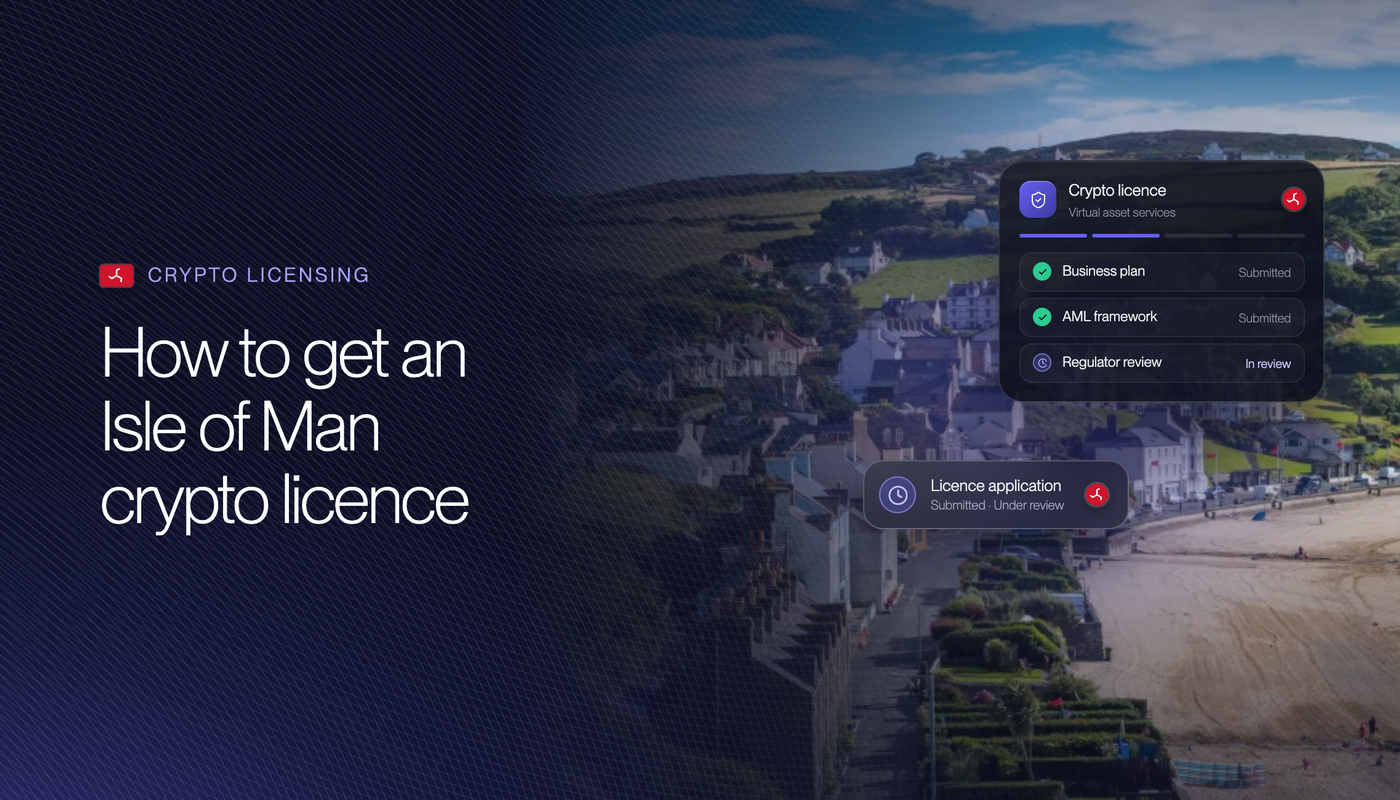
An Isle of Man crypto licence lets you run an exchange, a wallet or a transfer service from a Crown Dependency that has supervised crypto businesses since 2015. Most island companies pay 0% tax on their profits, and a 2006 Act company can be owned and run by one director who lives abroad.
The name is misleading, because there is no single crypto licence on the island. Most crypto businesses register with the Isle of Man Financial Services Authority for a £3,747 application fee, while security tokens and e-money tokens need a full licence. Many high street banks still turn crypto firms away.
This is where we come in. We work with a licensed registered agent to form your company, and we prepare the registration or licence file with licensed advisers: the business plan, the AML framework, the MLRO appointment and KYC on our own platform. Our crypto-friendly banking partners then open your account. One team, start to finish.
Isle of Man Company Incorporation
Binderr
Corporate tax
0% for most activities
Time to incorporate
1 Week
Cost
Starting from €1,499
Isle of Man Crypto Licence at a Glance
An Isle of Man crypto licence is usually a registration, not a licence. Most virtual asset service providers register with the Isle of Man Financial Services Authority (IOMFSA) under the Designated Businesses (Registration and Oversight) Act 2015. Tokens with investment or e-money features need a Financial Services Act 2008 licence from the same regulator.
Factor | Designated business registration | Financial Services Act 2008 licence |
|---|---|---|
Who needs it | Exchanges, transfers, wallets and custody of virtual assets, token sale services | Security tokens (Class 2), e-money tokens (Class 8(4)), payment services (Class 8(2)(a)) |
Application fee | £3,747 | £4,283, or £6,424 for e-money |
Annual fee | £3,747 to £8,565, set by headcount | £7,495 to £64,235, set by turnover |
Supervision | Anti-money laundering, with limited conduct rules | Licence conditions for the class, plus anti-money laundering |
Key appointments | MLRO and a manager who oversees compliance | MLRO, compliance oversight and what the class requires |
Decision time | Set case by case by the IOMFSA | Set case by case by the IOMFSA |
Company tax | 0% on most profits | 0% on most profits |
Fees checked against the Isle of Man Financial Services Authority (Fees) Order 2026, in operation from 1 April 2026, on 13 October 2026. They rise in line with inflation from 1 April 2027.
For most crypto businesses the left column is the one that applies. It is the cheaper and lighter route, but it is still real supervision, so the work sits in your anti-money laundering framework rather than in the fee.
Why Get a Crypto Licence in the Isle of Man
The island offers a low-cost route for most crypto models, 0% tax on most company profits and a regulator with more than ten years of crypto oversight. The registration fee is a fraction of what Malta and Gibraltar charge, and the company can be run by one director abroad.
Crypto Businesses Supervised Since 2015
The Isle of Man brought crypto businesses into anti-money laundering supervision in 2015, one of the first jurisdictions to do so. The main provisions of the Designated Businesses (Registration and Oversight) Act 2015 came into force on 26 October 2015. The Designated Businesses (Amendment) Order 2024 then replaced the old "convertible virtual currency" label with "virtual asset service provider", in line with international standards, from 25 October 2024.
A Settled Regime After the 2024 Review
In February 2024 the IOMFSA's discussion paper DP24-01 asked whether crypto should move into full licensing, including new licence classes for exchanges, issuers and stablecoins. Its Feedback Statement FS24-03 of 10 December 2024 kept the current approach under the 2015 Act and keeps it under review, partly to stay in line with the UK. Any change would go to a further consultation first, so you can plan your crypto licence in the Isle of Man around today's rules.
Get Your Isle of Man Crypto Licence Ready
Most crypto businesses on the island need a registration, and a complete file is what moves it along. This is what we handle for you.
- Route mapped first: We match your model to registration or the right licence class.
- Company formed for you: An Isle of Man company with a licensed registered agent.
- AML framework built: Policies, risk assessment and travel rule procedures in one pack.
- KYC on our platform: Customer checks run on Binderr from your first client.
- Licensed advisers involved: Your application is prepared with advisers licensed on the island.
- Crypto banking prepared: Your account file built for partners that accept crypto businesses.
0% Tax on Most Crypto Profits
An Isle of Man company pays 0% income tax on most profits. Crypto income usually falls under that standard rate, because the 10% rate covers banking business and retail profits above £500,000, and 20% covers income from Isle of Man land and property. There is no capital gains tax and no withholding tax on dividends. Our guide to Isle of Man company tax and zero rate rules covers the detail.
A Company You Can Run From Abroad
A 2006 Act company needs one director and one shareholder, and neither has to live on the island. It must keep a licensed registered agent, which gives it an island address and files on its behalf. For an Isle of Man crypto business, the people questions come from the regulator, not from company law. Our guide to Isle of Man company formation for non-residents covers the company side.
Where an Isle of Man Crypto Licence Lets You Operate
An Isle of Man registration lets you run a supervised crypto business from the island and serve customers abroad, subject to the rules of each country you serve. It gives no passport into the EU, because the island is not an EU member and MiCA does not apply there.
No EU Passport Under MiCA
MiCA, Regulation (EU) 2023/1114 of 31 May 2023, gives an authorised crypto-asset service provider one licence for the whole EU. The Isle of Man is a Crown Dependency and has never been an EU member. As its government told the UK Parliament in 2016, the EU Treaties allow only sovereign states to join. So MiCA does not apply on the island, and an Isle of Man registration gives no right to serve EU clients under it.
Serving Customers in Other Countries
Each country decides who may offer crypto services to its residents. Some accept a provider registered abroad, some require a local licence and some restrict marketing. The UK is one of these markets too: the island is outside the UK, although the two share a VAT area. Before you file, we map your target markets with licensed advisers, so your business plan matches where you really sell.
Read more: how to get a VASP licence and the best jurisdictions for VASP registration.
Isle of Man Crypto Licence Types
The island regulates a crypto business in one of four ways, and your activity decides which applies. Plain virtual asset services register as a designated business. Investment tokens, e-money tokens and payment services need a Financial Services Act 2008 licence. Gambling operators that take crypto go to the Gambling Supervision Commission (GSC).
Activity | Route | Application fee |
|---|---|---|
Exchange, transfer or safekeeping of virtual assets | Designated business registration | £3,747 |
Services for an issuer's token offer or sale | Designated business registration | £3,747 |
Security tokens with investment features | Class 2 investment business licence | £4,283 |
E-money tokens | Class 8(4) electronic money licence | £6,424 |
Payment services | Class 8(2)(a) payment services licence | £4,283 |
Online gambling that accepts crypto | Gambling licence from the GSC | Set by the GSC |
If any part of your business needs a Financial Services Act 2008 licence, plan the whole application around that licence. The registration is only for virtual asset businesses that the IOMFSA or the GSC does not already license.
The Five Registered Activities
The schedule in force since 25 October 2024 lists five activities: exchange between virtual assets and fiat, exchange between virtual assets, transfer of virtual assets, safekeeping or administration of virtual assets or the instruments that control them, and services for an issuer's offer or sale of a virtual asset. Brokers, exchanges, custodial wallets and token sale platforms all fit here.
What Does Not Count as a Virtual Asset
The definition leaves out digital fiat currency, securities and other financial assets. A token that works like a share, a bond or a fund unit is an investment, not a virtual asset, so the registration does not cover it. This one line decides whether your project files for £3,747 or needs a licence class.
Isle of Man Company Incorporation
Binderr
Corporate tax
0% for most activities
Time to incorporate
1 Week
Cost
Starting from €1,499
Registration, Full Licence or the Gambling Route
Choosing the route is the first decision, and it sets your cost, timeline and team. Most exchanges, brokers and wallet services register. Token issuers and e-money projects need a licence, and crypto casinos go through gambling licensing.
Crypto Exchange Licence in the Isle of Man
An exchange that swaps crypto for fiat or one crypto asset for another, or moves coins for clients, is a virtual asset service provider. In the Isle of Man that means registration under the 2015 Act, not a separate exchange licence, at £3,747 to apply and £3,747 to £8,565 a year. If the exchange also lists security tokens, that part needs a Class 2 licence. Our guide on how to register a crypto exchange covers the wider picture.
Security Tokens and E-Money Tokens
A token with investment features, such as a share of profits or a claim to repayment, is treated as an investment, and dealing in it can be Class 2 investment business. An e-money token falls under the Class 8(4) electronic money licence. Both carry higher fees and fuller supervision than registration. See the Isle of Man EMI or e-money licence and how to issue a token legally.
Crypto Casinos and the Gambling Route
Online gambling operators that accept crypto are licensed by the GSC, not registered with the IOMFSA. The GSC sets which crypto models a licensed operator can use, and the licence must cover the model it runs. See our guide on how to get an Isle of Man gambling licence.
Mining, Staking and Software Firms
Mining and staking are not among the five activities, and their treatment is not settled. Software firms that never hold client assets should also check where they stand. The IOMFSA published Virtual Assets Perimeter Guidance on 19 March 2025. We check your model against it with licensed advisers, and confirm with the regulator where needed, before anything is filed.
Isle of Man Crypto Licence Requirements
To register, you need an Isle of Man company, a money laundering reporting officer (MLRO), a manager who oversees compliance, an AML framework that meets the AML/CFT Code 2019, a travel rule process and the fee. Each licence class adds its own conditions.
An Isle of Man Company With a Registered Agent
Crypto company formation in the Isle of Man usually means a 2006 Act company with one director, one shareholder and a licensed registered agent at all times. Only that agent can file the incorporation, and the Companies Registry forms the company within 48 hours for £100, or 2 hours for £250. Our Isle of Man registered agent requirements guide explains the agent's role.
A Money Laundering Reporting Officer
Paragraph 23 of the AML/CFT Code 2019 requires an MLRO who is senior enough or has enough experience and authority, has direct access to the officers of the business, and has the time and resources for the job. The MLRO owns reports to the authorities, and a deputy may be appointed. The Code's rule that the MLRO lives on the island applies only to insurance businesses.
Compliance Oversight and Records
Paragraph 30 requires a suitable person at management level to oversee compliance monitoring and testing. Records are kept for 5 years from the end of the transaction or relationship, or longer if the authority asks. Customer due diligence and monitoring must work from your first customer, which is why we run KYC on our own platform before launch.
The Travel Rule
The Travel Rule (Transfer of Virtual Assets) Code 2024 has applied since 28 October 2024. Sender and recipient information must travel with each transfer. Below EUR 1,000, the sender's address, ID number and date and place of birth are not required, but the transfer is still covered. Regulations dated 1 January 2026 updated the civil penalty criteria for breaches.
Directors and Local Presence
Company law lets one director live anywhere. What the regulator expects on resident directors and an island office depends on your model, so we confirm it with licensed advisers before you file, not halfway through the review.
Read more: Isle of Man company annual filing and compliance and how to set up a company in the Isle of Man.
Before You Apply for an Isle of Man Crypto Licence
Check these points before you file. Each is easier to fix before submission than after.
- Your activity matched to one of the five registered activities, or to a licence class
- Your tokens checked for security or e-money features if you plan to register only
- Your target countries listed, with the rules in each one checked
- An Isle of Man company with a licensed registered agent, or one ready to form
- An MLRO with enough seniority, time and authority
- A manager who oversees compliance monitoring and testing
- A business risk assessment and AML/CFT policies written for crypto
- A travel rule process and the tool that runs it
- Source of funds and source of wealth evidence for every owner
- A business plan with projections and headcount, since the annual fee depends on staff numbers
- A bank account route that accepts crypto
Book Your Crypto Licence Readiness Check
Most of the work in a crypto application happens before it reaches the regulator. We check your file against this list and close the gaps.
- Gap review: We test your model, people and policies against each point above.
- Token check: Security or e-money features flagged before you choose a route.
- MLRO support: We help you define the role and the evidence the file needs.
- Market map: Your target countries listed with the rules that apply.
- One clear plan: A written list of what to fix, who does it and in what order.
How to Get a Crypto Licence in the Isle of Man
Getting a crypto licence in the Isle of Man takes six steps: map the activity, form the company, build the AML framework, file the application, answer the regulator's questions and open the bank account. We run them in parallel where we can.
Map Your Activity to a Route
Start with what the business does, not with the licence name. We list every service you plan to offer, match it to the five registered activities or a licence class, and check your tokens and target markets. The result is one route, one fee and one list of people to appoint.
Crypto Company Formation in the Isle of Man
We form the 2006 Act company with a licensed registered agent. You send the KYC documents for each owner and director, we prepare the memorandum and articles, and the agent files with the Companies Registry. The company is formed in about a week from a complete file.
Build the AML Framework and Appoint the MLRO
This is the largest part of the work: a business risk assessment, due diligence and monitoring procedures, suspicious activity reporting, record keeping and travel rule procedures, all written for your model. You appoint the MLRO and the compliance manager, and your onboarding runs live on our platform before the file goes in.
Prepare and File the Application
We prepare the application with licensed advisers on the island and send it to the IOMFSA with the £3,747 registration fee, or the class fee for a licence. Every name, figure and date must match across the company documents, the people, the business plan and the compliance framework.
Answer the Regulator's Questions
The IOMFSA reviews the file and usually comes back with questions. We draft the replies with you and the advisers, and fix any gap the questions reveal across the whole file, not just in the answer.
Open the Bank Account and Go Live
Our crypto-friendly banking partners open accounts in about a week, and we prepare that file while the review runs. Once the registration is confirmed and the account is open, you can take customers. Our guide to setting up an Isle of Man company with a bank account covers the joint process.
Documents Needed for an Isle of Man Crypto Licence
You need three groups of documents: the company file, the people file and the business file. The business file is the largest, because it shows the IOMFSA how your crypto business will prevent money laundering.
Company Documents
Expect the certificate of incorporation, the memorandum and articles, the registers of directors and members, the registered agent's details and an ownership chart that reaches every beneficial owner. Owners of 25% or more have 21 days to report a change to the nominated officer, who then has 21 days to file it.
Documents for Owners, Directors and the MLRO
Each owner, director and key officer sends a certified passport, a recent proof of address, a CV and evidence of source of funds and source of wealth. The MLRO and compliance manager add proof of their experience. Documents not in English need a certified translation.
Business and Compliance Documents
The business file holds the business plan, with services, target markets, projections and headcount, plus the risk assessment, the AML/CFT policies, the travel rule procedures and a description of how client assets and wallets are held. A licence class adds its own documents.
Isle of Man Crypto Licence Cost
The Isle of Man crypto licence cost for a registered business starts with a £3,747 application fee and an annual fee of £3,747 to £8,565, set by headcount. Add the company, its running costs, your compliance people and banking. As a planning estimate built from these fees, a registered business with 1 to 5 staff should budget about £10,200 to £12,500 in year one, on top of formation, staff and banking.
IOMFSA Fees for Crypto Registration
Employees | Annual fee |
|---|---|
1 | £3,747 |
2 to 5 | £4,283 |
6 to 10 | £5,354 |
11 to 15 | £6,424 |
16 to 25 | £7,494 |
More than 25 | £8,565 |
The application fee is £3,747 whatever your size, and the annual fee grows with your team, so a plan that adds staff in year two should budget for the next band.
Fees for a Full Licence
A Class 2 or Class 8(2)(a) licence costs £4,283 to apply for, and a Class 8(4) electronic money licence £6,424. The annual fee for all three is a £4,283 base plus a turnover fee, for a total of £7,495 below £500,000 of turnover, rising to £64,235 at £10 million or more.
First-Year Cost for a Registered Crypto Business
Cost item | When it is paid | Typical amount |
|---|---|---|
Company formation with Binderr | Once, before filing | From €1,499 |
IOMFSA application fee | With the application | £3,747 |
IOMFSA annual fee | Every year, by headcount | £3,747 to £8,565 |
Annual return to the Companies Registry | Every year | £380 on time |
Registered agent and office renewal | Every year | About £1,500 to £1,800 on published island scales |
Accounts and the CT1 tax return | Every year | About £800 to £2,300 for a simple company |
MLRO, compliance and legal advice | Ongoing | Priced on scope |
Business account with our partners | Every month | From €50 a month |
Planning estimate, 1 to 5 staff | Year one | About £10,200 to £12,500, plus formation, people and banking |
The planning total adds the regulator fees, the annual return, the agent and the accounts, and assumes the first annual fee falls in year one. People are the cost that varies most, so price your MLRO and compliance manager before you commit to a timeline. Our guide to how much an Isle of Man company costs covers the company side.
Banking Costs for a Crypto Business
The monthly fee is the smallest banking number. Traditional banks that take high risk files charge market rates of €500 to €2,500 to open, €50 to €300 a month and €25 to €60 per cross-border payment, and many want a €25,000 to €100,000 minimum balance that earns nothing. The real money is in the currency margin: at 2.5% over interbank, converting €500,000 a year costs €12,500. Our partners start from €50 a month, with no minimum balance and free additional users and IBANs.
Isle of Man Company Incorporation
Binderr
Corporate tax
0% for most activities
Time to incorporate
1 Week
Cost
Starting from €1,499
How Long an Isle of Man Crypto Licence Takes
Forming the company takes about a week from a complete file. The IOMFSA has no published service time for crypto registration or licences, so the review depends on your file and the questions it raises. A complete, consistent file is the one thing that shortens it.
Stage | Who does it | Time |
|---|---|---|
Company formation | Licensed registered agent, with us | About a week from a complete file |
AML framework and application file | You and us, with licensed advisers | Depends on your model and people |
IOMFSA review | IOMFSA | Set case by case |
Business account | Our crypto banking partners | About a week |
Only the company and the bank account run on a clock you can rely on. The middle rows are where time is won or lost, and most of it is in your hands: a team with its MLRO, policies and source of wealth evidence ready before filing moves faster than one that builds them during the review.
Start Your Crypto Company Formation in the Isle of Man
Your registration starts with the company. We form it with a licensed registered agent, ready for the IOMFSA file.
- Licensed agent and office: Registered agent and island address included at formation.
- Formed in about a week: From a complete file to your certificate of incorporation.
- One owner is enough: One director and one shareholder, who can live abroad.
- Beneficial owners filed: Your first beneficial ownership report handled for you.
- Clear starting price: From €1,499, with the Registry filing fee included.
- Ready for the regulator: Company papers prepared to match your crypto application.
After Your Isle of Man Crypto Registration Is Granted
Registration starts ongoing supervision. You pay the annual fee, run your AML programme every day, apply the travel rule to every transfer and keep company filings up to date.
Annual Fees and Filings
The IOMFSA annual fee follows your headcount band. The annual return is due within one month of its made-up date, at £380 on time, £480 up to 3 months late and £630 after that. The CT1 tax return is due 12 months and 1 day after the year end, and the beneficial ownership compliance statement by the annual return date.
Changes of Owner or Activity
Plan any change of owner, controller or activity with the IOMFSA before it happens rather than after. A new activity can also change your route: adding a security token or an e-money token moves that part of the business into a licence class, with its own application and fees.
Daily Anti-Money Laundering Duties
The MLRO reviews internal reports and makes external ones, the compliance manager runs monitoring and testing, and records stay on file for 5 years. Test your travel rule data regularly, because breaches can lead to civil penalties.
Opening a Crypto Bank Account in the Isle of Man
A crypto bank account in the Isle of Man is hard to get from a high street bank, even with an IOMFSA registration, because standard business accounts are built for island-resident owners and low-risk trade. Our licensed, crypto-friendly banking partners open accounts for registered crypto businesses in about a week.
Why Island Banks Refuse Crypto Businesses
High risk means high rejection. NatWest International asks that every owner, director and shareholder of a business account lives in the Channel Islands, the Isle of Man or Gibraltar, with one layer of ownership and no nominees. Lloyds' guide to bank charges allows an enhanced due diligence fee of up to £10,000 a year per legal entity. A crypto company owned from abroad fails the residency test before anyone looks at the activity, and a refusal can follow the file, as our guide on why banks reject business account applications explains.
Open a Crypto Bank Account for Your Isle of Man Company
Most banks will not take a crypto business. Our partners work with them, subject to their own checks, and we prepare the file with you.
- Licensed providers: Regulated institutions that accept crypto businesses.
- Multi-currency accounts: Major currencies held natively, with no forced conversion.
- Real IBANs: SEPA and SWIFT payments from day one.
- Fast-track opening: About a week, fully remote, with no branch visit.
- No minimum balance: Your working capital stays in the business.
- We handle everything: KYC pack, source of wealth file and the introduction.
How Your Registration Changes Your Banking Access
A registration shows that the business sits under anti-money laundering supervision, names your MLRO and fixes your activities on paper. Our partners ask for the registration, the AML policies, the flow of funds and the ownership chart, and a file built for the IOMFSA already holds most of it. That is why we build the regulator file and the bank file together.
Fiat Rails, Settlement and Growth
Check four things in any crypto account: a real IBAN for SEPA and SWIFT, settlement fast enough for customer withdrawals, the fiat rails your liquidity providers use, and whether the account will stay open as volumes grow. Our licensed, crypto-friendly banking providers open accounts for Isle of Man crypto businesses in about a week. For the wider picture, read our guide to banking for crypto and Web3 companies.
Trumia
Business account
Monthly fees
€50
Onboarding fees
€500
Time to onboard
1 week
Accepts
Gambling, Betting, Casino, Crypto, and more
Why Isle of Man Crypto Applications Get Delayed or Refused
A well-prepared application rarely meets surprises. Most delays come from three gaps in the file, and every one can be fixed before you submit.
An MLRO Without Authority
The Code wants an MLRO who is senior enough, reaches the officers directly and has time for the job. A part-time name with no budget and no reporting line does not meet that test. Give the role a clear mandate in the board minutes and the policies.
Policies Copied From Another Business
Generic policies do not describe your customers, products or transfer flows, and the risk assessment has to match your model. Write the policies for your own business, then test them on your own onboarding.
Gaps in Source of Funds
Owners must show where the money behind the business came from. A missing contract, an unexplained transfer or a name spelled two ways stops the review. We build the source of wealth story with evidence before submission.
Read more: Isle of Man bank accounts for non-resident companies and banking for Isle of Man gaming and e-money companies.
Isle of Man vs Malta, Cyprus and Gibraltar for Crypto
The Isle of Man is the low-cost registration route outside the EU. Malta and Cyprus license crypto firms under MiCA, which brings an EU passport and higher costs. Gibraltar runs its own DLT licence, with the highest published application fee of the four.
Factor | Isle of Man | Malta | Cyprus | Gibraltar |
|---|---|---|---|---|
Crypto regime | Registration | MiCA licence | MiCA licence | DLT provider licence |
EU passport | No | Yes | Yes | No |
Application fee | £3,747 | €10,000 to €25,000 | Set by CySEC by class | £45,000 |
Annual fee | £3,747 to £8,565 | Base plus volume fee, capped at €250,000 | Set by CySEC by class | £27,362 plus activity fee up to £90,000 |
Company tax | 0% on most profits | 35% headline, about 5% effective | 15% | 15% |
Our company formation | From €1,499 | From €1,299 | From €1,200 | From €1,899 |
The four split into two groups. If you need EU customers under one licence, Malta or Cyprus is the route, and the higher fees buy that passport. If you serve customers outside the EU and want a supervised base at a low fixed cost, the Isle of Man costs far less than Gibraltar to enter and keep.
Isle of Man vs Malta for Crypto
Malta licenses crypto-asset service providers under MiCA through the MFSA. Its fees regulations set €10,000, €20,000 or €25,000 to apply for Class 1, 2 or 3, and a yearly fee of the same base plus €2,000 per service and 0.05% of volume. You get the EU passport and an EU company, from €1,299 with us. Read about the Malta crypto licence and how to start a crypto exchange in Malta.

Malta Company Incorporation
GCS Malta
Effective tax
~5% for non-resident
Time to Incorporate
1 Week
Cost
Starting from €1,299
Isle of Man vs Cyprus for Crypto
Cyprus also licenses crypto firms under MiCA, through CySEC. MiCA sets minimum own funds of €50,000 to €150,000 depending on the services, and its transitional period for firms already operating ended on 1 July 2026 at the latest. Company tax is 15% from 1 January 2026, and we form Cyprus companies from €1,200. Read about crypto company formation in Cyprus and the crypto licence in Cyprus.

Cyprus Company Incorporation
Binderr
Corporate tax
15% flat
Time to Incorporate
1 Week
Cost
€1,200 one-off
Isle of Man vs Gibraltar for Crypto
Gibraltar regulates crypto through its own DLT provider licence, issued by the GFSC. Its 2025/26 fees set £45,000 to apply, a £27,362 additional annual fee and a trade activity fee capped at £90,000. Like the Isle of Man, it gives no MiCA passport, and company tax is 15%. See our guide to the Gibraltar DLT licence.
Gibraltar Company Incorporation
Binderr
Corporate tax
15% standard rate
Time to incorporate
1 Week
Cost
Starting from €1,899
Who an Isle of Man Crypto Licence Is Wrong For
The island suits supervised crypto businesses that serve customers outside the EU at a low fixed cost. It is the wrong choice for three groups.
Businesses built around EU customers should look elsewhere. An Isle of Man registration gives no MiCA passport, so a business that wants EU clients from day one is better served by a MiCA licence in Malta or Cyprus.
Token issuers who want only the cheap registration will be disappointed. If your token works like a share, a bond or e-money, it needs a licence class, from £4,283 to file and up to £64,235 a year. Plan for that cost or redesign the token.
Founders who want no compliance team should not apply. Registration means an MLRO, a compliance manager, written policies, a travel rule process and records kept for 5 years. Other crypto regimes ask for the same basics, as our guide to the BVI VASP licence shows, so build the team first.
Common Mistakes With an Isle of Man Crypto Licence
These mistakes cost crypto founders the most time and money, and each has a simple fix.
Assuming Registration Opens the EU
Some founders register in the Isle of Man and then plan an EU launch on the same footing. It does not work, because MiCA does not apply on the island and the registration carries no passport. The business then needs a second, separate MiCA licence, and in Malta that means another application fee of €10,000 to €25,000 on top of the £3,747 already paid. Decide where your customers are before you file, and pick the jurisdiction that matches them.
Choosing the Route After the Token Is Built
A team builds its token, launches a community and only then asks which licence it needs. If the token has investment features, the answer is a Class 2 licence, with a £4,283 application fee and an annual total of £7,495 to £64,235, instead of a £3,747 registration. Check the token against the definition of a virtual asset first, then design it for the route you want.
Treating Small Transfers as Outside the Travel Rule
The travel rule asks for less information on transfers below EUR 1,000, but those transfers are still covered. A team that switches its process off for small amounts breaks the rule on every one of them, and the 2026 amendment regulations updated the civil penalty criteria for breaches. Run the same process on every transfer, and collect the lighter data set below the threshold rather than nothing.
Leaving the Bank Account Until Last
Many founders finish the registration and only then look for a bank, and lose weeks to refusals. A traditional bank that does accept the file may want a €25,000 to €100,000 minimum balance and charge a currency margin of up to 2.5%, which is €12,500 a year on €500,000 converted. Start the bank file while the IOMFSA reviews your application, with a partner that accepts crypto from the start.
Book an Advisory Call on Your Crypto Licence
Not sure which route fits your model? Talk it through with us before you spend money on a file.
- Advisory call: €30, credited against a setup booked within 30 days.
- Route decision: Registration, licence class or gambling route, set on your facts.
- Cost plan: Regulator fees, company costs and banking in one estimate.
- Next steps in writing: A clear list of what to prepare and in what order.
- Dedicated contact: One person from the first call to go-live.
Bottom Line
For most businesses, an Isle of Man crypto licence is a registration with the IOMFSA: £3,747 to apply, £3,747 to £8,565 a year, 0% tax on most profits and more than ten years of crypto supervision behind it. Tokens with investment or e-money features need a licence class, crypto casinos need the GSC, and EU customers need MiCA.
Whichever route fits, the steps are the same: map the route, form the company, build the AML framework, file and open the account. The work is in the people, the policies and the bank, and that is the part we run with you.
Does the Isle of Man have a crypto licence?
How much does an Isle of Man crypto licence cost?
How long does it take to get a crypto licence in the Isle of Man?
Do I need an Isle of Man cryptocurrency exchange licence to run an exchange?
Who regulates crypto businesses in the Isle of Man?
Does MiCA apply to an Isle of Man crypto business?
Can a non-resident get a crypto licence in the Isle of Man?
Do I need a resident MLRO for an Isle of Man crypto business?
How are crypto companies taxed in the Isle of Man?
Can I open a crypto bank account in the Isle of Man?
Do I need a company before I apply for an Isle of Man crypto licence?
Does the travel rule apply in the Isle of Man?
Can an online casino accept crypto under an Isle of Man licence?
Sources
The facts and fees in this article come from these official sources and published instruments, read in October 2026. Where an official site could not be reached, the official instrument is linked through a public mirror of its text.
- IOMFSA, Feedback Statement FS24-03, Regulation of crypto asset activities (10 December 2024)
- Isle of Man Financial Services Authority (Fees) Order 2026, SD 2026/0060 (official text, mirror)
- Designated Businesses (Amendment) Order 2024, SD 2024/0135 (official text, mirror)
- Anti-Money Laundering and Countering the Financing of Terrorism Code 2019, SD 2019/0202 (official text, mirror)
- RegAlert, Isle of Man crypto regulation guide covering the Travel Rule Code 2024 and the 2026 penalty regulations (updated 1 October 2026)
- IOMFSA, Virtual Assets Perimeter Guidance (19 March 2025)
- Isle of Man Government, written evidence to the UK Parliament (18 November 2016)
- Regulation (EU) 2023/1114 on markets in crypto-assets (MiCA)
- Malta, Markets in Crypto-Assets Act (Fees) Regulations, SL 647.1
- Gibraltar Financial Services Commission, Fees Newsletter 2025/2026
- Isle of Man Government, Companies Registry fees
- Isle of Man Government, 2006 Act companies
- Isle of Man Government, Beneficial ownership
- Isle of Man Government, Corporate tax rates
- Isle of Man Government, Pay and file corporate income tax
- NatWest International, Business bank account eligibility
- Lloyds Bank, Your guide to bank charges (OB535_LBCM, from 19 June 2026)